

- Industry Size (2026)
- USD 7.6 Bn
- Forecast (2036)
- USD 12.3 Bn
- CAGR (2026 to 2036)
- 5.0%
Unbleached Kraft Paperboard Market Forecast and Outlook 2026 to 2036
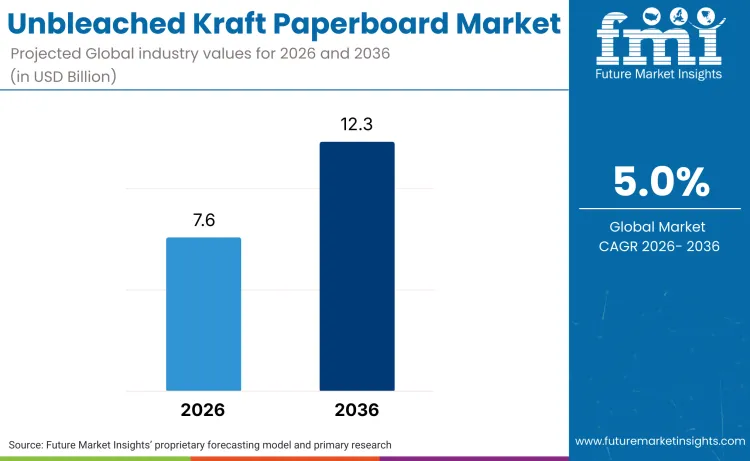
The global unbleached kraft paperboard industry is positioned to record a valuation of USD 7.6 billion in 2026, advancing toward USD 12.3 billion by 2036, representing a steady 5.0% CAGR. Business expansion is supported by a shift in production priorities across major European hubs; according to Cepi (Confederation of European Paper Industries), packaging grades drove sector growth in 2024, increasing 6.5% and now accounting for 63% of total paper and board production. Such statistic highlights a pivotal industrial pivot: as graphic paper demand continues its structural decline, the industrial base is reorienting aggressively around high-strength packaging substrates.
As per FMI's projection, the market is entering a cycle of "Quality over Quantity," where the sheer volume of output is less important than the technical capability of the kraft papers to replace plastic in complex food and beverage supply chains.
The consolidation of market power is further reshaping the competitive landscape, creating entities with unprecedented scale and resource capability to drive this transition. Tony Smurfit, CEO of Smurfit Westrock, articulated this new reality in July 2024, stating: “Smurfit Westrock is going to conquer the world of sustainable, paper-based packaging. It is an incredible moment to see the fusion of two really great companies.” Merger is not merely a financial transaction but a strategic alignment of North American and European assets, designed to optimize supply chains and accelerate the deployment of sustainable technologies globally. Consequently, the market will likely see a bifurcation where mega-players dominate standard grades, while specialized mills focus on high-margin, bespoke barrier solutions for paper and paperboard packaging.
Summary of Unbleached Kraft Paperboard Market
What Is the Growth Outlook for the Unbleached Kraft Paperboard Market as per Future Market Insights Projection?
According to FMI's estimates, the global unbleached kraft paperboard industry is projected to expand from USD 7.6 billion in 2026 to USD 12.3 billion by 2036, registering a CAGR of 5.0%.
FMI Research Approach: This valuation is constructed using FMI’s proprietary "Capital Efficiency" modeling, which factors in the supply-side discipline following the Smurfit Westrock merger, the deflationary impact of Chinese pulp integration, and the demand elasticity of the global sustainable food service sector.
How Do FMI Analysts Perceive the Unbleached Kraft Paperboard Market to Evolve?
FMI analysts perceive the market shifting from a "substrate-first" orientation to a "barrier-first" value proposition, where the competitive advantage lies not merely in the tensile strength of the kraft fiber but in the functionality of bio-based coatings that replace fossil plastics.
FMI Research Approach: Insights are derived from the analysis of patent filings by Stora Enso regarding "FiberLight Tec," examination of startup funding for seaweed-coating innovators like Kelpi, and evaluation of capital expenditure trends for virgin fiber mills in Scandinavia.
Which Country Holds the Largest Share in the Global Unbleached Kraft Paperboard Market?
The United States is anticipated to hold the largest value share, driven by a robust 15.50% CAGR, underpinned by a resurgence in domestic manufacturing and the strategic "reshoring" of sustainable packaging supply chains.
FMI Research Approach: The forecast leverages U.S. Census Bureau data on paperboard converting output, analysis of Graphic Packaging International’s USD 1 billion facility investment, and supply chain mapping of major North American integrated mills.
How Large Will the Unbleached Kraft Paperboard Market Be by 2036?
The global sector is expected to reach USD 12.3 billion by 2036, supported by the critical role of paperboard packaging in replacing single-use plastics and the increasing adoption of carrier board for beverage multipacks.
FMI Research Approach: Long-term forecasts are built on demographic modeling of urbanization in Asia-Pacific, capacity expansion data from Nine Dragons Paper, and material substitution rates for folding cartons in the consumer goods vertical.
What Is the Definition of the Unbleached Kraft Paperboard Market?
The unbleached kraft paperboard market comprises the aggregate revenue generated from the manufacturing and sale of paperboard grades produced primarily from virgin unbleached kraft pulp, known for superior strength and a natural brown appearance. This includes Coated Unbleached Kraft (CUK) and Uncoated Unbleached Kraft (UUK) substrates. The market explicitly covers boards used for heavy-duty applications such as beverage carriers, frozen food packaging, and industrial hardware boxes, where tear resistance and wet strength are paramount.
What Are Globally Unique Trends Shaping the Unbleached Kraft Paperboard Market?
Globally, the sector is defined by "Bio-Mimicry Integration," where manufacturers are partnering with biotech firms to apply natural coatings to kraft board, and "Capital Discipline," where Western majors are cancelling low-ROI conversions to focus on high-margin modernization.
FMI Research Approach: Trends are identified through the tracking of Billerud’s strategic pivot in North America, analysis of Notpla’s EU grant for seaweed-coated cups, and monitoring of "plastic-free" claims in the folding cartons sector.
Unbleached Kraft Paperboard Market Key Takeaways
| Metric | Details |
|---|---|
| Industry Size (2026) | USD 7.6 billion |
| Industry Value (2036) | USD 12.3 billion |
| CAGR (2026-2036) | 5.0% |
Why Is the "Green Premium" Driving Material Science?
The market is currently being reshaped by a "Green Premium" where brand owners are willing to pay for materials that offer verifiable circularity. This shift is legally enforced by the EU Packaging and Packaging Waste Regulation (PPWR), which mandates the reduction of single-use plastics and incentivizes fiber-based alternatives. FMI analysts opine that this regulatory environment is catalyzing a shift from standard PE-coated boards to advanced coated recycled paperboard compatible solutions. Manufacturers are no longer just selling "board"; they are selling "compliance" in the form of substrates that can pass strict recyclability tests while maintaining the wet strength required for beverage carriers and frozen food.
Demand for unbleached softwood kraft pulp is tightening as it becomes the preferred feedstock for high-strength packaging. Unlike recycled fibers which degrade over cycles, virgin unbleached kraft provides the structural "skeleton" needed for the global fiber loop. This creates a strategic imperative for integrated players to secure their fiber supply, as seen in the Scandinavian region where mills are optimizing wood yield. The intersection of regulatory pressure and raw material scarcity is driving innovation in "light-weighting", producing stronger boards with less fiber, effectively decoupling growth from resource intensity.
How Is the Unbleached Kraft Paperboard Market Segmented?
The market is segmented by product type, coating type, and end use to address the distinct performance requirements of retail presentation versus industrial durability. By product type, the industry divides into Folding Carton Boxes, Rigid Boxes, Rigid Tubes, and Others. By coating type, it splits into Coated (CUK) and Uncoated (UUK). End-use sectors cover Food & Beverage, Pharmaceuticals, Consumer Goods, Electrical & Electronics, and Automotive & Chemical. Folding Carton Boxes currently dominate with a 39% share, while Coated substrates lead with 63%, driven by the need for high-quality printing on retail shelves.
Why Do Folding Carton Boxes Command the Largest Share?
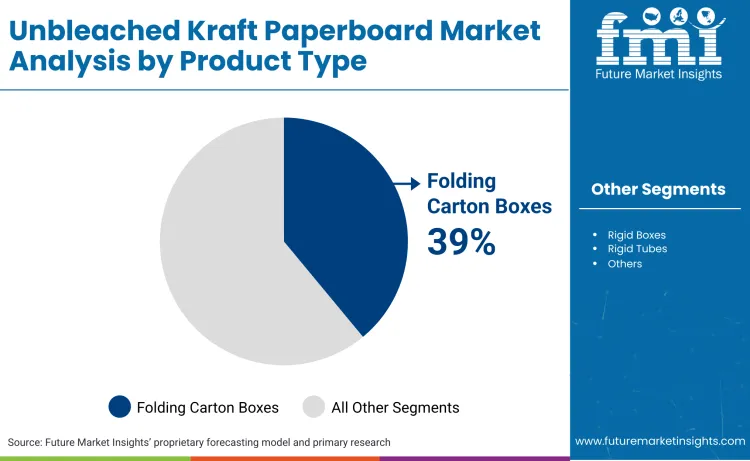
Folding Carton Boxes segment captures a commanding 39% market share, driven by their versatility in the retail and e-commerce environments. This format is the primary beneficiary of the "plastic-to-paper" transition, particularly in the beverage sector where plastic rings are being replaced by kraft-based folding cartons. The structural integrity of unbleached kraft allows these cartons to hold significant weight, such as six-packs of glass bottles, without tearing, a performance characteristic that lower-grade recycled boards cannot match. As brands seek "shelf-ready" packaging that communicates natural sustainability through its brown aesthetics, the folding carton remains the format of choice.
Why Is Coated Paperboard Outpacing Uncoated Variants?
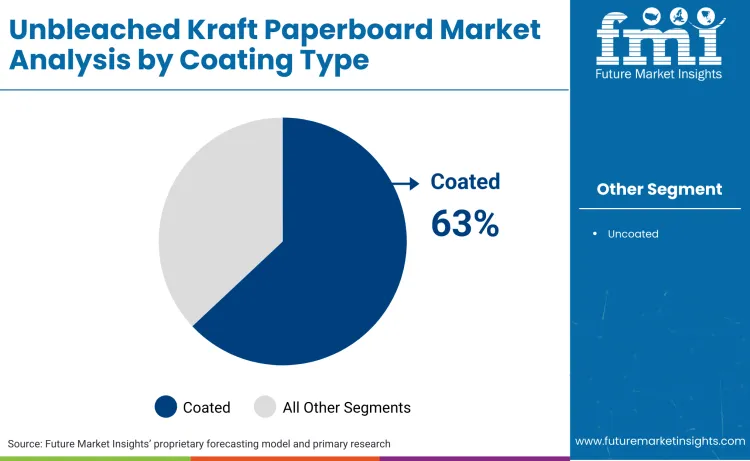
Coated segment holds a dominant 63% share, reflecting the market's requirement for a printable surface that does not compromise the "natural" look of the unbleached base. FMI analysts opine that while the unbleached aesthetic signals sustainability, brands still require high-resolution graphics for marketing. Coated Unbleached Kraft (CUK) offers the best of both worlds: a white clay-coated surface for vibrant printing and a strong, brown tear-resistant back. This duality is essential for the unbleached hardwood kraft pulp derived boards used in frozen food and cosmetic packaging, where visual appeal is as critical as structural performance.
Why Is the Food & Beverage Sector the Primary Growth Engine?
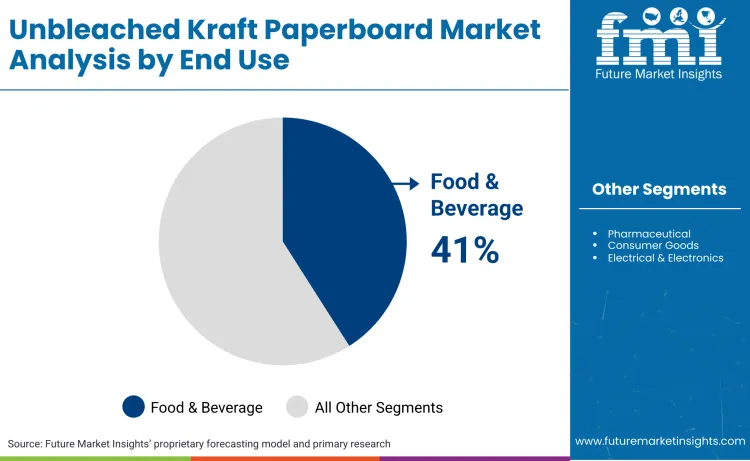
Food & Beverage end-use segment captures a leading 41% market share, fueled by the imperative to replace polystyrene foam and plastic trays. Startups like Notpla are replacing millions of single-use plastic units with seaweed-coated kraft products, creating a new paradigm for grease-resistant compostable food trays. The food sector demands materials that are safe for direct contact and capable of withstanding moisture, making unbleached kraft the substrate of choice for everything from coffee cups to take-out containers. The growth here is structural, driven by a permanent shift in consumer expectations toward plastic-free food service experiences.
Why Is the Shift to "Bio-Barriers" Accelerating?
The elimination of fossil-based plastic liners is accelerating as manufacturers seek to create fully repulpable packaging solutions. According to FMI's estimates, the integration of bio-based barriers is the next frontier for cellulose film packaging. Innovators like Kelpi have secured funding to scale seaweed-based coatings that provide water and grease resistance without rendering the paperboard difficult to recycle. This technology directly addresses the "recycling gap" where traditional poly-coated kraft boards are often sent to landfill or incineration because separating the plastic layer is too costly for municipal facilities.
Operational efficiency in recycling is becoming a key competitive metric. Graphic Packaging International reported that in 2023, 74% of its paperboard packaging contained recycled content, while its new Waco facility is designed to recycle all internally generated waste. This focus on "Internal Circularity" reduces dependency on volatile external kraft paper machine feedstock markets. By closing the loop within their own operations and adopting bio-barriers that simplify end-of-life processing, manufacturers are insulating themselves from regulatory penalties and raw material price shocks.
How is Unbleached Kraft Paperboard Market Regional Outlook?
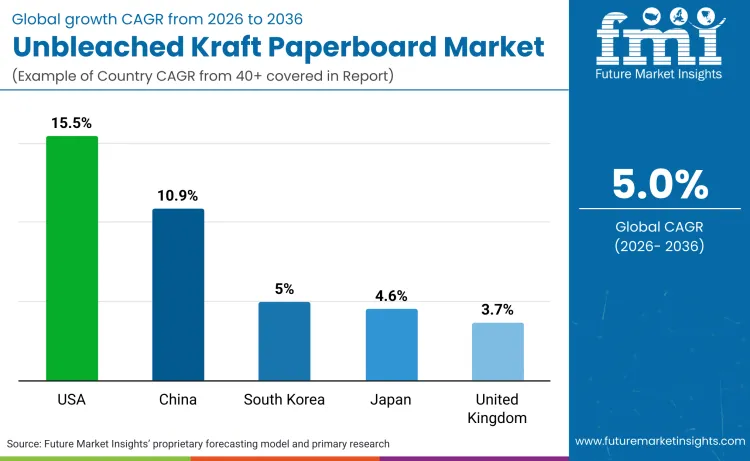
The regional outlook for the unbleached kraft paperboard industry reveals a sharp contrast between the rapid re-industrialization of North America, the biotech innovation of the UK, and the capacity-driven volume expansion in Asia. The United States leads with a 15.50% CAGR, driven by massive capital investments in modern mills. China follows with a 10.90% CAGR, anchored by its dominance in global manufacturing packaging. South Korea projects a 5.0% CAGR, influenced by high-tech consumer goods packaging. Japan maintains a 4.60% CAGR, focusing on efficiency and lightweight paperboard partition solutions.
| Country | CAGR (2026 to 2036) |
|---|---|
| United States | 15.50% |
| China | 10.90% |
| South Korea | 5.0% |
| Japan | 4.60% |
Why Is the United States Leading with Selective Investment?
The market in the United States is projected to expand at an unprecedented CAGR of 15.50%, but this growth is characterized by extreme capital discipline rather than reckless expansion. Manufacturers are scrutinizing every dollar of capital expenditure to ensure it aligns with long-term profitability.
Ivar Vatne, President and CEO of Billerud, exemplified this cautious strategic approach in June 2024, stating: “After in-depth feasibility studies, evaluations, and supplier discussions, we have concluded that the projected return on investment is not sufficiently attractive to proceed with the conversion of Escanaba to cartonboard production. During the process, conditions have changed and the cost of equipment and services necessary to transform the operations have greatly increased. Instead, we will pursue a higher returning and more moderate investment strategy for our North American mills going forward.” Such decisive pivot underscores a mature market dynamic where incumbents are prioritizing margin preservation and efficiency over simple capacity addition, ensuring that the growth in the U.S. corrugated boxes sector is financially sustainable.
Why Is China Expanding Virgin Fiber Capacity?
Expansion in China is expected to accelerate at a CAGR of 10.90% through 2036, sustained by a strategic shift toward virgin fiber security. Nine Dragons Paper reported that as of 30 June 2023, the Group’s total design production capacity for fibre raw materials amounted to 4.62 million tpa, with ongoing projects to add millions more tons of virgin kraftliner. This massive investment in domestic fiber capacity is designed to decouple the Chinese packaging sector from volatile import markets. By securing their own supply of unbleached pulp, Chinese manufacturers are aggressively positioning themselves to control the cost structure of global packaging, supporting the country's vast export engine with high-strength, cost-effective shipping materials.
Why Is the United Kingdom Becoming the Innovation Lab?
The unbleached kraft paperboard sector in the United Kingdom is estimated to develop at a CAGR of 3.70% through 2036, but it is punching above its weight in terms of technological disruption. The region is rapidly becoming a global testbed for plastic-free barrier technologies. Neil Morris, CEO of Kelpi, highlighted this transformative potential in June 2024, noting: "Kelpi can now play a key role in ending our dependence on fossil fuels to create single-use packaging and so eliminating a major source of plastic pollution." This innovation-first mindset is driving the adoption of paperboard mailer solutions treated with seaweed and plant-based coatings. While the volume growth is modest compared to the U.S. or China, the value created per ton is significantly higher, positioning the UK as the intellectual property hub for the next generation of bio-based paperboard.
Why Is Japan Maintaining Efficiency in a Mature Market?
Sales in Japan are anticipated to rise at a CAGR of 4.60% through 2036, driven by a relentless focus on material efficiency and "light-weighting" amid demographic shifts. Data from the Japan Paper Association indicates that while overall paper shipments have plateaued, the containerboard segment remains vital for the logistics network. Japanese mills are pioneering the production of ultra-lightweight unbleached grades that maintain high compression strength, reducing shipping costs for metallized paper laminates and industrial cartons. This efficiency-first mindset ensures profitability even in a mature market environment where population growth does not drive volume, proving that innovation in fiber alignment can extract value from a shrinking demographic base.
How Is Competition Evolving in the Unbleached Kraft Paperboard Market?
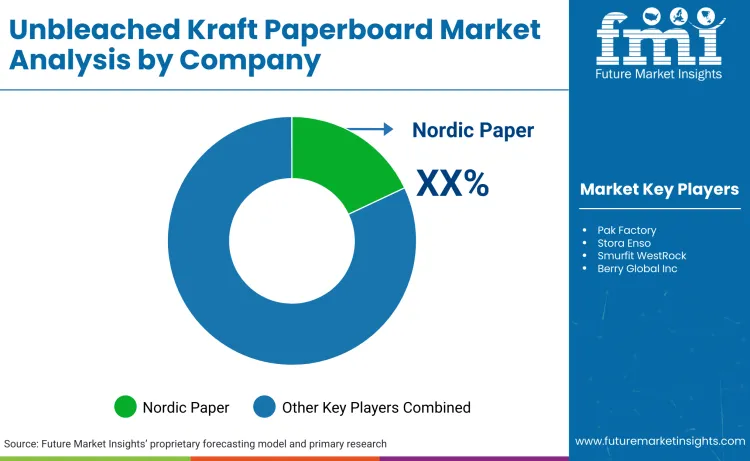
The competitive outlook in the unbleached kraft paperboard industry is defined by a "Great Consolidation," where distinct regional giants are merging to form global superpowers. The completion of the Smurfit Kappa and WestRock merger in July 2024 created a transatlantic behemoth, Smurfit Westrock, capable of leveraging balance sheet strength to dominate global tenders. This scale allows for optimized logistics and the ability to absorb volatility in unbleached softwood kraft pulp that smaller players cannot withstand. FMI analysts opine that the era of the mid-sized independent mill is fading, replaced by integrated networks that can guarantee supply continuity to the world's largest FMCG brands.
A trend of "Capital Discipline" is reshaping investment strategies among the remaining players. Billerud’s decision in June 2024 to cancel the conversion of its Escanaba mill to cartonboard production highlights a new rigor in capital allocation. Instead of chasing volume at any cost, companies are opting for moderate, high-return investments that improve the efficiency of existing assets. This disciplined approach prevents overcapacity and protects margins, ensuring that the corrugated box remains healthy. It signals a mature market where profitability is prioritized over reckless expansion, leading to a more stable pricing environment for unbleached kraft products.
Recent Developments:
- In January 2025, International Paper completed its acquisition of DS Smith, creating a global packaging leader with expanded capabilities in sustainable paperboard solutions, including unbleached kraft paperboard for corrugated packaging and industrial applications.
- In April 2025, Mondi Group finalized the acquisition of Schumacher Packaging's Western Europe operations, enhancing its corrugated and solid board portfolio with increased capacity for kraft-based packaging, including brown (unbleached) kraft liners for sustainable applications.
- In November 2025, Mondi officially opened a new kraft paper machine at its Štětí mill in the Czech Republic, boosting production of high-quality speciality kraft paper, including unbleached grades, to meet growing demand for eco-friendly packaging solutions.
Key Players in Unbleached Kraft Paperboard Market
- Nordic Paper
- Pak Factory
- Stora Enso
- Smurfit WestRock
- Berry Global Inc.
- Graphic Packaging International
- Nine Dragons Paper (Holdings) Limited
- Billerud
- Metsä Board
- Lee & Man Paper Manufacturing
- DS Smith
- Mondi Group
Market Definition
The unbleached kraft paperboard market comprises the aggregate revenue generated from the manufacturing and sale of paperboard grades produced primarily from virgin unbleached kraft pulp, known for superior strength and a natural brown appearance. This includes Coated Unbleached Kraft (CUK) and Uncoated Unbleached Kraft (UUK) substrates. The market explicitly covers boards used for heavy-duty applications such as beverage carriers, frozen food packaging, and industrial hardware boxes, where tear resistance and wet strength are paramount.
The market scope includes value-added converted products that utilize unbleached substrates, such as folding cartons, rigid boxes, and composite tubes, provided the base material is unbleached kraft. It captures revenue from both "virgin" boards and those with a controlled percentage of recycled fiber, as long as the primary structural integrity is derived from the kraft process. Furthermore, the definition extends to the emerging class of bio-coated boards where proprietary barrier technologies (e.g., seaweed, water-based coatings) are applied to the unbleached surface to enhance functionality.
The market excludes revenue derived from bleached paperboard grades (SBS), fully recycled paperboard (CRB/URB) that lacks significant virgin kraft content, and liquid packaging board (LPB) unless explicitly categorized as a subset of CUK usage. It strictly excludes the revenue generated from the raw pulp sold externally, focusing solely on the finished paperboard roll or converted sheet. Additionally, corrugated medium and linerboard used strictly for shipping boxes are excluded unless converted into primary consumer packaging formats.
Scope of the Report
| Items | Values |
|---|---|
| Quantitative Units (2026) | USD 7.6 billion |
| Product Type | Folding Carton Boxes, Rigid Boxes, Rigid Tubes, Consumer-Facing Corrugated Converters, Trays & Displays |
| Coating Type | Coated Unbleached Kraft (CUK), Uncoated Unbleached Kraft (UUK), Bio-Coated / Barrier-Coated Unbleached Kraft |
| Fiber Composition Focus | Virgin unbleached kraft pulp–based paperboard with controlled recycled fiber integration where structural integrity is retained |
| Barrier & Functional Technologies | Bio-based and water-based barrier coatings, grease- and moisture-resistant functional layers, plastic-free food-contact solutions |
| End-Use Industries | Food & Beverage, Pharmaceuticals, Consumer Goods, Electrical & Electronics, Automotive & Chemical, Personal Care & Cosmetics |
| Regulatory & Compliance Orientation | EU Packaging and Packaging Waste Regulation (PPWR) compliance, plastic substitution mandates, fiber recyclability and repulpability standards |
| Regions Covered | North America, Europe, Asia Pacific |
| Countries Covered | United States, China, South Korea, Japan |
| Key Companies Profiled | Nordic Paper, Stora Enso, Smurfit WestRock, Graphic Packaging International, Nine Dragons Paper, Billerud, Metsä Board, Lee & Man Paper Manufacturing, DS Smith, Mondi Group |
| Additional Attributes | Revenue analysis by product type and coating type, folding carton dominance assessment (39% share), coated substrate leadership evaluation (63% share), food & beverage end-use share analysis (41%), bio-barrier substitution feasibility, virgin fiber security and light-weighting benchmarking, capital discipline and mill modernization impact assessment, and competitive positioning under consolidation-driven supply chain restructuring |
Segmentation
By Product Type:
- Folding Carton Boxes
- Rigid Boxes
- Rigid Tubes
- Corrugated Converters (Consumer Facing)
- Others (Trays, Displays)
By Coating Type:
- Coated Unbleached Kraft (CUK)
- Uncoated Unbleached Kraft (UUK)
- Bio-Coated / Barrier Coated
By End Use:
- Food & Beverage
- Pharmaceuticals
- Consumer Goods
- Electrical & Electronics
- Automotive & Chemical
- Personal Care & Cosmetics
By Region:
- North America
- Europe
- Asia Pacific
- Latin America
- Middle East & Africa
Bibliography
- U.S. Department of Agriculture Forest Service. (2024). Forest Products Laboratory report on molded fiber and coated paperboard packaging performance. USDA.
- Fraunhofer Institute for Process Engineering and Packaging (IVV). (2024). Bio-based and mineral barrier coatings for recyclable paper packaging. Fraunhofer IVV.
- VTT Technical Research Centre of Finland. (2024). Fiber-based packaging as substitutes for plastic-coated paperboard. VTT.
- European Committee for Standardization. (2023). EN 13430: Packaging recoverable by material recycling. CEN.
- World Customs Organization. (2024). HS explanatory notes for paperboard cartons, coated paper, and packaging materials. WCO.
- Joint Research Centre (European Commission). (2024). Recyclability assessment of coated paperboard and food packaging formats. JRC.
Frequently Asked Questions
What is the current global market size for Unbleached Kraft Paperboard?
According to FMI's estimates, the global Unbleached Kraft Paperboard market is valued at USD 7.6 billion in 2026, reflecting a market driven by the substitution of plastic with high-strength, natural fiber packaging.
What is the projected CAGR for the Unbleached Kraft Paperboard market?
Market revenues are projected to grow at a robust 5.0% CAGR from 2026 to 2036, expanding from USD 7.6 billion to USD 12.3 billion, driven by the global expansion of sustainable food service and e-commerce packaging.
Which coating type currently dominates the industry?
Coated Unbleached Kraft (CUK) holds the dominant 63% market share, as it provides the necessary print surface for retail branding while maintaining the structural strength of the unbleached base.
What are the primary barriers to market growth?
The volatility of virgin pulp prices, the high capital expenditure required for mill conversions, and the technical challenge of developing plastic-free moisture barriers remain significant hurdles.
Who are the leading players in the Unbleached Kraft Paperboard market?
Nordic Paper, Stora Enso, Smurfit Westrock, and Graphic Packaging International lead the market, characterized by a trend of mega-consolidation and strategic focus on integrated fiber supply chains.
Preview the report firsthand - request a free sample
Get SampleGet the brochure for pricing and purchase details.
Get PDFTable of Content
- Executive Summary
- Global Market Outlook
- Demand Side Trends
- Supply Side Trends
- Technology Roadmap Analysis
- Analysis and Recommendations
- Market Overview
- Market Coverage / Taxonomy
- Market Definition / Scope / Limitations
- Research Methodology
- Chapter Orientation
- Analytical Lens and Working Hypotheses
- Market Structure, Signals, and Trend Drivers
- Benchmarking and Cross-market Comparability
- Market Sizing, Forecasting, and Opportunity Mapping
- Research Design and Evidence Framework
- Desk Research Programme (Secondary Evidence)
- Expert Input and Fieldwork (Primary Evidence)
- Data Engineering and Model Build
- Quality Assurance and Audit Trail
- Market Background
- Market Dynamics
- Drivers
- Restraints
- Opportunity
- Trends
- Scenario Forecast
- Demand in Optimistic Scenario
- Demand in Likely Scenario
- Demand in Conservative Scenario
- Opportunity Map Analysis
- Product Life Cycle Analysis
- Supply Chain Analysis
- Investment Feasibility Matrix
- Value Chain Analysis
- PESTLE and Porter's Analysis
- Regulatory Landscape
- Production and Consumption Statistics
- Import and Export Statistics
- Market Dynamics
- Global Market Analysis 2021 to 2025 and Forecast, 2026 to 2036
- Historical Market Size Value (USD Billion) Analysis, 2021 to 2025
- Current and Future Market Size Value (USD Billion) Projections, 2026 to 2036
- Y-o-Y Growth Trend Analysis
- Absolute $ Opportunity Analysis
- Global Market Pricing Analysis 2021 to 2025 and Forecast 2026 to 2036
- Y-o-Y Growth Trend Analysis 2021 to 2025
- Absolute $ Opportunity Analysis 2026 to 2036
- Global Market Analysis 2021 to 2025 and Forecast 2026 to 2036, By Product Type
- Introduction / Key Findings
- Historical Market Size Value (USD Billion) Analysis By Product Type, 2021 to 2025
- Current and Future Market Size Value (USD Billion) Analysis and Forecast By Product Type, 2026 to 2036
- Folding Carton Boxes
- Rigid Boxes
- Rigid Tubes
- Corrugated Converters (Consumer Facing)
- Others (Trays, Displays)
- Y-o-Y Growth Trend Analysis By Product Type, 2021 to 2025
- Absolute $ Opportunity Analysis By Product Type, 2026 to 2036
- Global Market Analysis 2021 to 2025 and Forecast 2026 to 2036, By Coating Type
- Introduction / Key Findings
- Historical Market Size Value (USD Billion) Analysis By Coating Type, 2021 to 2025
- Current and Future Market Size Value (USD Billion) Analysis and Forecast By Coating Type, 2026 to 2036
- Coated Unbleached Kraft (CUK)
- Uncoated Unbleached Kraft (UUK)
- Bio-Coated / Barrier Coated
- Y-o-Y Growth Trend Analysis By Coating Type, 2021 to 2025
- Absolute $ Opportunity Analysis By Coating Type, 2026 to 2036
- Global Market Analysis 2021 to 2025 and Forecast 2026 to 2036, By End Use
- Introduction / Key Findings
- Historical Market Size Value (USD Billion) Analysis By End Use, 2021 to 2025
- Current and Future Market Size Value (USD Billion) Analysis and Forecast By End Use, 2026 to 2036
- Food & Beverage
- Pharmaceuticals
- Consumer Goods
- Electrical & Electronics
- Automotive & Chemical
- Personal Care & Cosmetics
- Y-o-Y Growth Trend Analysis By End Use, 2021 to 2025
- Absolute $ Opportunity Analysis By End Use, 2026 to 2036
- Global Market Analysis 2021 to 2025 and Forecast 2026 to 2036, By Region
- Introduction
- Historical Market Size Value (USD Billion) Analysis By Region, 2021 to 2025
- Current Market Size Value (USD Billion) Analysis and Forecast By Region, 2026 to 2036
- North America
- Latin America
- Western Europe
- Eastern Europe
- East Asia
- South Asia and Pacific
- Middle East & Africa
- Market Attractiveness Analysis By Region
- North America Market Analysis 2021 to 2025 and Forecast 2026 to 2036, By Country
- Historical Market Size Value (USD Billion) Trend Analysis By Market Taxonomy, 2021 to 2025
- Market Size Value (USD Billion) Forecast By Market Taxonomy, 2026 to 2036
- By Country
- USA
- Canada
- Mexico
- By Product Type
- By Coating Type
- By End Use
- By Country
- Market Attractiveness Analysis
- By Country
- By Product Type
- By Coating Type
- By End Use
- Key Takeaways
- Latin America Market Analysis 2021 to 2025 and Forecast 2026 to 2036, By Country
- Historical Market Size Value (USD Billion) Trend Analysis By Market Taxonomy, 2021 to 2025
- Market Size Value (USD Billion) Forecast By Market Taxonomy, 2026 to 2036
- By Country
- Brazil
- Chile
- Rest of Latin America
- By Product Type
- By Coating Type
- By End Use
- By Country
- Market Attractiveness Analysis
- By Country
- By Product Type
- By Coating Type
- By End Use
- Key Takeaways
- Western Europe Market Analysis 2021 to 2025 and Forecast 2026 to 2036, By Country
- Historical Market Size Value (USD Billion) Trend Analysis By Market Taxonomy, 2021 to 2025
- Market Size Value (USD Billion) Forecast By Market Taxonomy, 2026 to 2036
- By Country
- Germany
- UK
- Italy
- Spain
- France
- Nordic
- BENELUX
- Rest of Western Europe
- By Product Type
- By Coating Type
- By End Use
- By Country
- Market Attractiveness Analysis
- By Country
- By Product Type
- By Coating Type
- By End Use
- Key Takeaways
- Eastern Europe Market Analysis 2021 to 2025 and Forecast 2026 to 2036, By Country
- Historical Market Size Value (USD Billion) Trend Analysis By Market Taxonomy, 2021 to 2025
- Market Size Value (USD Billion) Forecast By Market Taxonomy, 2026 to 2036
- By Country
- Russia
- Poland
- Hungary
- Balkan & Baltic
- Rest of Eastern Europe
- By Product Type
- By Coating Type
- By End Use
- By Country
- Market Attractiveness Analysis
- By Country
- By Product Type
- By Coating Type
- By End Use
- Key Takeaways
- East Asia Market Analysis 2021 to 2025 and Forecast 2026 to 2036, By Country
- Historical Market Size Value (USD Billion) Trend Analysis By Market Taxonomy, 2021 to 2025
- Market Size Value (USD Billion) Forecast By Market Taxonomy, 2026 to 2036
- By Country
- China
- Japan
- South Korea
- By Product Type
- By Coating Type
- By End Use
- By Country
- Market Attractiveness Analysis
- By Country
- By Product Type
- By Coating Type
- By End Use
- Key Takeaways
- South Asia and Pacific Market Analysis 2021 to 2025 and Forecast 2026 to 2036, By Country
- Historical Market Size Value (USD Billion) Trend Analysis By Market Taxonomy, 2021 to 2025
- Market Size Value (USD Billion) Forecast By Market Taxonomy, 2026 to 2036
- By Country
- India
- ASEAN
- Australia & New Zealand
- Rest of South Asia and Pacific
- By Product Type
- By Coating Type
- By End Use
- By Country
- Market Attractiveness Analysis
- By Country
- By Product Type
- By Coating Type
- By End Use
- Key Takeaways
- Middle East & Africa Market Analysis 2021 to 2025 and Forecast 2026 to 2036, By Country
- Historical Market Size Value (USD Billion) Trend Analysis By Market Taxonomy, 2021 to 2025
- Market Size Value (USD Billion) Forecast By Market Taxonomy, 2026 to 2036
- By Country
- Kingdom of Saudi Arabia
- Other GCC Countries
- Turkiye
- South Africa
- Other African Union
- Rest of Middle East & Africa
- By Product Type
- By Coating Type
- By End Use
- By Country
- Market Attractiveness Analysis
- By Country
- By Product Type
- By Coating Type
- By End Use
- Key Takeaways
- Key Countries Market Analysis
- USA
- Pricing Analysis
- Market Share Analysis, 2025
- By Product Type
- By Coating Type
- By End Use
- China
- Pricing Analysis
- Market Share Analysis, 2025
- By Product Type
- By Coating Type
- By End Use
- UK
- Pricing Analysis
- Market Share Analysis, 2025
- By Product Type
- By Coating Type
- By End Use
- Japan
- Pricing Analysis
- Market Share Analysis, 2025
- By Product Type
- By Coating Type
- By End Use
- South Korea
- Pricing Analysis
- Market Share Analysis, 2025
- By Product Type
- By Coating Type
- By End Use
- Germany
- Pricing Analysis
- Market Share Analysis, 2025
- By Product Type
- By Coating Type
- By End Use
- France
- Pricing Analysis
- Market Share Analysis, 2025
- By Product Type
- By Coating Type
- By End Use
- India
- Pricing Analysis
- Market Share Analysis, 2025
- By Product Type
- By Coating Type
- By End Use
- Brazil
- Pricing Analysis
- Market Share Analysis, 2025
- By Product Type
- By Coating Type
- By End Use
- Turkiye
- Pricing Analysis
- Market Share Analysis, 2025
- By Product Type
- By Coating Type
- By End Use
- USA
- Market Structure Analysis
- Competition Dashboard
- Competition Benchmarking
- Market Share Analysis of Top Players
- By Regional
- By Product Type
- By Coating Type
- By End Use
- Competition Analysis
- Competition Deep Dive
- Nordic Paper
- Pak Factory
- Stora Enso
- Smurfit Westrock
- Berry Global Inc.
- Graphic Packaging International
- Nine Dragons Paper (Holdings) Limited
- Billerud
- Metsä Board
- Lee & Man Paper Manufacturing
- DS Smith
- Mondi Group
- Competition Deep Dive
- Assumptions & Acronyms Used


