

- Industry Size (2026)
- USD 255.9 Mn
- Forecast (2036)
- USD 689.7 Mn
- CAGR (2026 to 2036)
- 10.4%
Demand for Regenerative Artificial Skin in United Kingdom Forecast and Outlook 2026 to 2036
The regenerative artificial skin market in the United Kingdom is projected to grow from USD 255.9 million in 2026 to USD 689.7 million by 2036, at a CAGR of 10.4%. This market holds a critical position within the broader healthcare and medical devices industry, particularly in the fields of wound care and burn treatment. As a highly specialized product, regenerative artificial skin plays an influential role in accelerating healing processes and improving patient outcomes. The competitive weight in this space is defined by technological innovation, regulatory approval timelines, and manufacturing capabilities, with a few key players holding significant market share due to their established expertise. Smaller competitors must focus on niche markets or new therapeutic applications to differentiate themselves. The market's dynamics are influenced by growing healthcare investments and an increasing emphasis on advanced treatments, making it a pivotal segment within the evolving field of regenerative medicine and tissue engineering.
Quick Stats for the Demand for Regenerative Artificial Skin in United Kingdom:
- Regenerative Artificial Skin in United Kingdom Value (2026): USD 255.9 million
- Regenerative Artificial Skin in United Kingdom Forecast Value (2036): USD 689.7 million
- Regenerative Artificial Skin in United Kingdom Forecast CAGR (2026 to 2036): 10.4%
- Regenerative Artificial Skin in United Kingdom Leading Segment: Burn Care Centers (48.5% share)
- Key Growth Regions of Regenerative Artificial Skin in United Kingdom: England
- Top Players of Regenerative Artificial Skin in United Kingdom: Integra Life Sciences Corporation, Mylan N.V., Johnson & Johnson Services, Inc., Smith & Nephew, Mallinckrodt Plc.
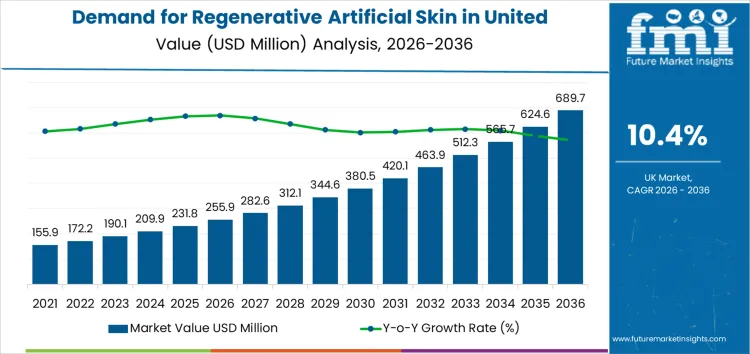
What is the Growth Forecast for Regenerative Artificial Skin in United Kingdom through 2036?
The demand for regenerative artificial skin in the United Kingdom is expected to rise from USD 255.9 million in 2026 to USD 689.7 million by 2036, reflecting a compound annual growth rate (CAGR) of 10.4%. Between 2026 and 2031, the market will experience steady growth, with values increasing from USD 255.9 million to USD 380.5 million. From 2031 to 2036, growth will continue, reaching USD 689.7 million by the end of the forecast period.
The market share erosion or gain analysis indicates that the demand for regenerative artificial skin will likely see a significant gain in market share over the forecast period. This is due to the growing acceptance of regenerative medicine in the medical field and the increasing adoption of advanced treatments over traditional wound healing methods. As new technologies improve the functionality and cost-effectiveness of regenerative artificial skin, the market will experience strong growth, contributing to market share gain. However, competition from alternative wound care technologies and pricing pressures could present challenges to the market, potentially limiting the rate of market share growth in certain segments. Overall, the market is expected to expand, with regenerative artificial skin increasingly becoming a preferred solution in wound care.
Key Takeaways for Demand for Regenerative Artificial Skin in United Kingdom
| Metric | Value |
|---|---|
| Industry Sales Value (2026) | USD 255.9 million |
| Industry Forecast Value (2036) | USD 689.7 million |
| Industry Forecast CAGR (2026 to 2036) | 10.4% |
Why is Demand for Regenerative Artificial Skin in United Kingdom Growing?
Demand for regenerative artificial skin in the United Kingdom has strengthened as clinical practices and healthcare investments adapt to rising needs for effective wound care and tissue repair solutions. Historically, treatments for chronic wounds, burns, and surgical defects relied on conventional dressings, autografts, or simple synthetic coverings with limited biological activity. Over time, clinicians and wound care specialists in the UK began adopting regenerative artificial skin products that combine structural scaffolds with biologically active components to promote tissue regeneration, reduce healing time, and lower complication rates. Use cases such as diabetic foot ulcers, venous leg ulcers, and severe burns illustrated shortcomings of traditional methods, prompting hospital procurement teams to evaluate advanced skin substitutes that deliver consistent performance. Demand was supported by national health priorities that focus on improving patient outcomes while managing long treatment cycles and high costs associated with non healing wounds. Suppliers able to demonstrate clinical efficacy and alignment with NHS formularies gained consideration among wound care buyers seeking value through improved healing trajectories and reduced readmissions.
Looking ahead, demand for regenerative artificial skin in the United Kingdom is expected to continue expanding as healthcare service providers, specialist clinics, and private care networks prioritize solutions that integrate with multidisciplinary care pathways. Growth drivers include an ageing population with elevated incidence of chronic wounds and comorbidities that complicate healing, such as diabetes and vascular disease. Clinical procurement and budget holders will assess products based on documented outcomes, ease of application, and total cost of care, including potential reductions in long term treatment burden. Innovation that enhances usability, storage stability, and compatibility with standard wound management protocols will support wider adoption across acute care and community settings. Manufacturers and distributors targeting the UK market should prioritize robust evidence generation, engagement with clinical opinion leaders, and clear value propositions for cost effectiveness and quality of life improvements. Continued focus on integrated care strategies and evidence based intervention standards positions regenerative artificial skin as a growing segment within therapeutic supplies and advanced wound management solutions in the UK healthcare landscape.
What Are the Key Segments in the Demand for Regenerative Artificial Skin in the United Kingdom?
Demand for regenerative artificial skin in the United Kingdom is primarily driven by material type and end-user sector. Engineered skin material leads the material segment with 30%, while burn care centers dominate the end-user segment with 48.5%. Other materials, such as temporary skin material, single layer material, bi-layered material, and permanent skin material, contribute to the market. These trends reflect the critical need for advanced skin substitutes in wound healing, especially for burn care and other severe skin injuries.
What Is the Material Segment of Demand for Regenerative Artificial Skin in the United Kingdom?
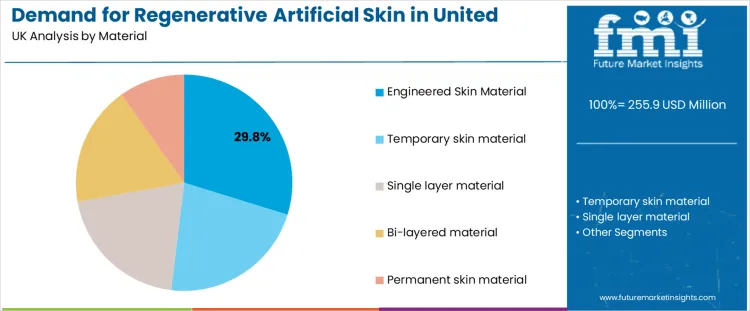
The material segment for regenerative artificial skin in the United Kingdom is primarily led by engineered skin material, which accounts for 30% of the market share. Engineered skin materials are developed to replicate the natural structure of skin, providing a sophisticated solution for covering severe burns or extensive skin injuries. These materials are typically used in cases where the skin's function must be restored in terms of both appearance and durability. Engineered skin is designed to integrate seamlessly with the patient's skin, promoting healing while minimizing scarring. The growing demand for engineered skin is driven by advancements in biomaterials and tissue engineering, which have significantly improved the quality and effectiveness of these products.
Temporary skin materials follow as another important segment, used primarily in the early stages of wound healing. These materials provide a protective barrier over the wound site, preventing infection and moisture loss while the body begins its healing process. Temporary skin substitutes are crucial for managing burn wounds and chronic wounds in their early stages. Single-layer materials, though a smaller segment, are also important in wound healing, offering a simplified solution for covering wounds in non-critical situations. Bi-layered materials, which combine both an epidermal and dermal layer, are more complex and are used for deeper, more severe injuries where greater functional restoration is needed. Permanent skin material is the smallest segment but plays a role in cases where a long-term or lasting skin replacement is required, such as for extensive burns or for those with chronic skin conditions. As demand for advanced regenerative skin products increases, engineered and bi-layered skin materials are expected to continue to grow due to their higher functionality and integration capabilities.
What Is the End-User Segment of Demand for Regenerative Artificial Skin in the United Kingdom?
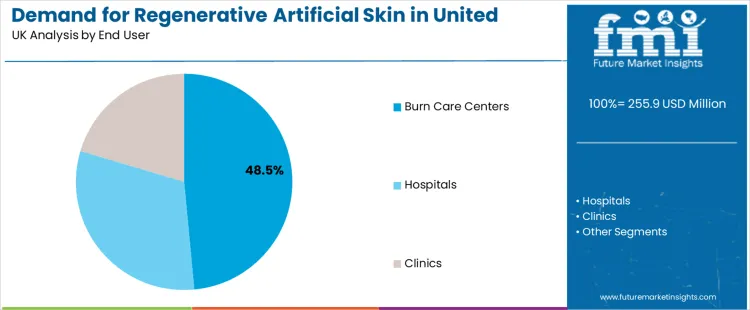
The end-user segment for regenerative artificial skin in the United Kingdom is led by burn care centers, which account for 48.5% of the market share. Burn care centers are specialized facilities that treat patients with severe burn injuries, where the need for advanced skin substitutes is critical for both functional and aesthetic recovery. Regenerative artificial skin is essential for covering burn wounds, promoting faster healing, and reducing scarring. The demand for regenerative skin in burn care centers is growing as advancements in skin substitutes offer better outcomes in terms of tissue integration and healing speed. Hospitals follow as another key end-user, where regenerative artificial skin is used in both emergency and ongoing care situations.
Hospitals often treat a wider range of injuries, including severe burns, trauma, and chronic wounds, and require versatile skin substitutes that can address various types of skin damage. Clinics also play a role in the demand for artificial skin, particularly in outpatient settings or for less severe injuries that do not require hospitalization. Clinics often treat patients with minor burns or wounds and use simpler forms of artificial skin for healing. As the demand for more sophisticated wound care solutions grows, regenerative artificial skin is becoming increasingly integral in clinical settings for faster and more efficient healing. The overall demand for regenerative artificial skin is expected to continue to grow as awareness of its benefits spreads and as more advanced materials become available for use in burn care centers, hospitals, and clinics.
What are the Key Dynamics in the Demand for Regenerative Artificial Skin in the United Kingdom?
Demand for regenerative artificial skin in the United Kingdom is expanding as clinical need intersects with innovation in biomaterials and tissue engineering. Hospitals, specialised wound care centres, and burn units procure these products to treat chronic wounds, burns, ulcers, and surgical defects where traditional dressings are insufficient. Demand patterns reflect the prevalence of diabetes and vascular conditions, ageing populations, trauma incidence, and capacity of NHS trusts and private providers to adopt advanced therapies. Procurement also depends on health economic assessments, hospital formularies, and integration into complex care pathways.
What are the Key Drivers for Regenerative Artificial Skin Demand in the United Kingdom?
Several factors support demand for regenerative artificial skin in the United Kingdom. Rising incidence of chronic wounds associated with diabetes, pressure injuries, and vascular disease increases clinical need for advanced wound management solutions. Surgical specialities, including reconstructive and trauma surgery, adopt regenerative skin products to enhance healing outcomes and reduce infection risk. Evidence demonstrating shorter healing times and reduced hospital stays influences formularies and clinician preference. NHS and private healthcare frameworks that prioritise outcomes and cost effectiveness reinforce uptake. Growing awareness among clinicians of biomaterial advancements and regenerative medicine supports broader prescription of artificial skin substitutes.
What are the Restraints on Regenerative Artificial Skin Demand in the United Kingdom?
Despite demonstrated clinical value, demand for regenerative artificial skin in the United Kingdom faces several constraints. High acquisition cost relative to standard wound dressings can deter uptake, particularly under constrained NHS budgets and capital planning cycles. Reimbursement and commissioning frameworks that vary between trusts may delay consistent adoption and complicate budget forecasting for providers. Limited specialised training in application techniques and product handling can slow change in clinical practice. Variable clinical evidence across different product classes, including comparative effectiveness data, can temper clinician confidence. Supply chain logistics for temperature sensitive biomaterials require robust cold chain management, adding operational complexity.
What are the Key Trends in Regenerative Artificial Skin Demand in the United Kingdom?
Key trends shaping demand for regenerative artificial skin in the United Kingdom include development and adoption of next generation bioengineered constructs that combine cellular matrices with growth factors to improve healing kinetics. There is increasing use of data and real world evidence to support health economic evaluations that justify procurement in budget constrained environments. Integration of advanced products into multidisciplinary wound care protocols and centres of excellence expands access beyond specialist units. Suppliers are also offering training programmes and clinical support services to improve clinician confidence and outcomes. Sustainability and lifecycle considerations in procurement decisions are emerging, with buyers assessing product waste reduction and overall care cost impacts when selecting regenerative skin solutions.
What is the Country-Wise Demand for Regenerative Artificial Skin in the United Kingdom?
The demand for regenerative artificial skin in the United Kingdom shows significant regional differences, with England leading the market. This demand is driven by the growing need for advanced wound care solutions, burn treatments, and skin regeneration therapies. England’s larger healthcare infrastructure, coupled with its extensive healthcare and medical research sectors, contributes to its dominance in the market. Scotland, Wales, and Northern Ireland follow with steady demand growth, supported by an increasing focus on healthcare innovation, aging populations, and the rising number of patients requiring advanced skin treatments. As regenerative medicine continues to evolve, the demand for artificial skin solutions is expected to grow across all regions, with England maintaining the highest share of the market.
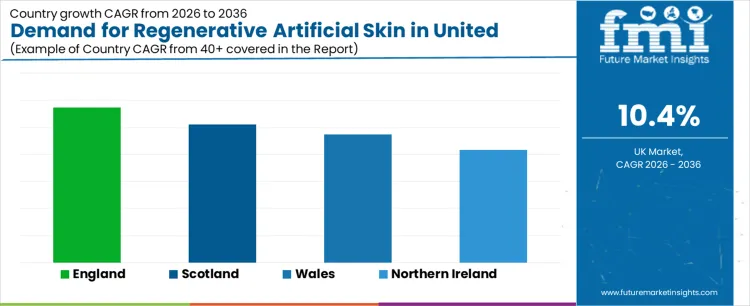
| Country | CAGR (2026 to 2036) |
|---|---|
| England | 11.5% |
| Scotland | 10.2% |
| Wales | 9.5% |
| Northern Ireland | 8.3% |
What is Driving the Demand for Regenerative Artificial Skin in England?
The demand for regenerative artificial skin in England is projected to grow at a CAGR of 11.5% from 2026 to 2036. England’s large healthcare infrastructure, which includes advanced hospitals, clinics, and medical research institutions, is a major driver of this demand. With an increasing number of patients suffering from severe burns, chronic wounds, and skin disorders, regenerative artificial skin offers an effective solution for faster healing and improved quality of life. Additionally, advancements in biotechnology, the growing trend toward personalized medicine, and the increasing need for skin grafts in surgical procedures are contributing to the demand. The expanding adoption of artificial skin in both burn centers and wound care facilities further drives the market in England. As medical treatments evolve, regenerative artificial skin is becoming an integral part of patient care, particularly in addressing skin loss and chronic skin conditions.
How is the Demand for Regenerative Artificial Skin Performing in Scotland?
In Scotland, the demand for regenerative artificial skin is expected to grow at a CAGR of 10.2% from 2026 to 2036. Scotland’s healthcare sector, which has been investing in innovative treatments and regenerative medicine, is seeing a rise in the use of artificial skin for burn treatment and chronic wound care. The growing elderly population in Scotland, combined with the increase in skin-related health issues, is a key driver of this demand. Furthermore, Scotland’s strong emphasis on healthcare research and development, coupled with the adoption of new medical technologies, is contributing to the expanding use of regenerative artificial skin in clinical settings. As healthcare providers continue to explore advanced wound care solutions, the market for artificial skin in Scotland is expected to grow, particularly as it becomes more integrated into burn and trauma care protocols.
What Are the Growth Drivers for Regenerative Artificial Skin in Wales?
The demand for regenerative artificial skin in Wales is projected to grow at a CAGR of 9.5% through 2036. The rising prevalence of skin injuries, burns, and chronic wounds is driving the adoption of regenerative artificial skin in Wales. As the healthcare system increasingly focuses on providing cutting-edge treatments, the need for advanced wound healing technologies, such as artificial skin, is growing. The introduction of cost-effective and more accessible artificial skin products is also playing a role in boosting demand. Additionally, the growing emphasis on wound care in the healthcare sector, combined with the rise of chronic conditions that affect skin integrity (such as diabetes), is expected to fuel the growth of the market. As medical professionals in Wales seek better solutions for skin regeneration, the market for regenerative artificial skin will continue to expand, with applications across burn units, wound care facilities, and general surgical procedures.
What is the Outlook for Regenerative Artificial Skin Demand in Northern Ireland?
Northern Ireland’s demand for regenerative artificial skin is expected to grow at a CAGR of 8.3% from 2026 to 2036. Although Northern Ireland represents the smallest market for regenerative artificial skin in the United Kingdom, the demand is steadily increasing, driven by an expanding focus on advanced wound care treatments and regenerative medicine. The aging population in Northern Ireland, along with the rising rates of burns, skin diseases, and diabetes, is contributing to this growing demand. The local healthcare system’s commitment to adopting new technologies and improving patient outcomes is also fueling the adoption of regenerative artificial skin. As the region’s healthcare infrastructure continues to evolve, the use of advanced skin regeneration treatments is expected to expand, ensuring steady growth in the market for regenerative artificial skin over the next decade.
What is the Competitive Landscape for Demand for Regenerative Artificial Skin in United Kingdom?
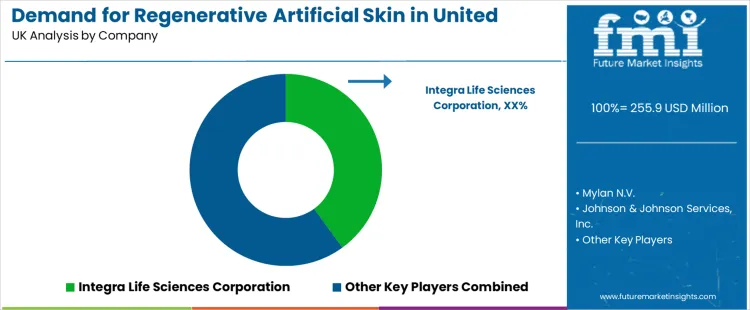
Demand for regenerative artificial skin in the United Kingdom is driven by trauma care, burn units, chronic wound management, and reconstructive surgery requirements. Healthcare procurement teams and clinical committees evaluate supplier offerings on documented healing rates, documented biocompatibility data, and documented integration with host tissues. Integra Life Sciences Corporation is positioned as a leading supplier with technical brochures that detail product compositions, documented clinical evidence, and recommended application protocols. These materials are referenced by surgeons and procurement professionals when aligning solutions with treatment pathways and institutional quality criteria. Buyers consider documented performance metrics alongside service support frameworks and documented sterilization standards. Documentation from Integra informs product selection by aligning technical attributes with therapeutic objectives in burns and complex wound procedures.
Mylan N.V. supplies regenerative skin substitutes supported by specification sheets that list documented scaffold architecture, documented cell interaction profiles, and documented storage conditions. Hospital buyers review these details to assess fit with surgical workflows and inventory management. Johnson & Johnson Services, Inc. offers documented artificial skin solutions with literature covering documented healing outcomes, documented patient tolerance values, and recommended handling guidelines. These data are used by clinical leads when comparing suppliers during procurement cycles.
Smith & Nephew competes with documented product lines that include performance benchmarks and documented support service terms. Procurement teams examine documented warranty and training resources when evaluating long term supply arrangements. Mallinckrodt Plc. provides artificial skin products accompanied by technical documentation that lists documented clinical trial outcomes and documented application techniques. Lead times and documented distribution capabilities are factored into selection decisions. Clinical users and hospital administrators jointly review documented product specifications and documented support services to align supplier selection with regulatory compliance and treatment quality benchmarks. Competitive activity in the United Kingdom regenerative artificial skin market is grounded in measurable technical data and documented support commitments that assist healthcare providers during specification and procurement processes.
Key Players of the Demand for Hydrocarbon Accounting Solution in United Kingdom
- Integra Life Sciences Corporation
- Mylan N.V.
- Johnson & Johnson Services, Inc.
- Smith & Nephew
- Mallinckrodt Plc.
Scope of the Report
| Items | Values |
|---|---|
| Quantitative Units (2026) | USD Million |
| Material | Engineered Skin Material, Temporary Skin Material, Single Layer Material, Bi-layered Material, Permanent Skin Material |
| End User | Burn Care Centers, Hospitals, Clinics |
| Companies | Integra Life Sciences Corporation, Mylan N.V., Johnson & Johnson Services, Inc., Smith & Nephew, Mallinckrodt Plc. |
| Regions Covered | United Kingdom |
| Countries Covered | England, Scotland, Wales, Northern Ireland |
| Additional Attributes | Dollar by sales by material, end user, and region. Includes market trends towards wound healing, advanced skin technology, and the role of regenerative artificial skin in healthcare. |
Key Segments of Demand for Regenerative Artificial Skin in United Kingdom
Material:
- Engineered Skin Material
- Temporary skin material
- Single layer material
- Bi-layered material
- Permanent skin material
End User:
- Burn Care Centers
- Hospitals
- Clinics
Countries:
- England
- Scotland
- Wales
- Northern Ireland
Bibliography
- Department of Health and Social Care. (2024). Advanced therapies and regenerative medicine: UK policy and regulatory framework. UK Government.
- Medicines and Healthcare products Regulatory Agency. (2024). Guidance on advanced therapy medicinal products (ATMPs) and tissue‑engineered products in the United Kingdom. MHRA.
- National Institute for Health and Care Excellence. (2024). Burns and complex wound management: Clinical guidelines and use of skin substitutes. NICE.
Frequently Asked Questions
How big is the demand for regenerative artificial skin in United Kingdom in 2026?
The demand for regenerative artificial skin in United Kingdom is estimated to be valued at USD 255.9 million in 2026.
What will be the size of regenerative artificial skin in United Kingdom in 2036?
The market size for the regenerative artificial skin in the United Kingdom is projected to reach USD 689.7 million by 2036.
How much will be the demand for regenerative artificial skin in United Kingdom growth between 2026 and 2036?
The demand for regenerative artificial skin in United Kingdom is expected to grow at a 10.4% CAGR between 2026 and 2036.
What are the key product types in the regenerative artificial skin in United Kingdom?
The key product types in regenerative artificial skin in United Kingdom are engineered skin material, temporary skin material, single layer material, bi-layered material and permanent skin material.
Which end user segment is expected to contribute significant share in the regenerative artificial skin in United Kingdom in 2026?
In terms of end user, burn care centers segment is expected to command 48.5% share in the regenerative artificial skin in United Kingdom in 2026.
Preview the report firsthand - request a free sample
Get SampleGet the brochure for pricing and purchase details.
Get PDFTable of Content
- Executive Summary
- UK Market Outlook
- Demand-side Trends
- Supply-side Trends
- Technology Roadmap Analysis
- Analysis and Recommendations
- Market Overview
- Market Coverage / Taxonomy
- Market Definition / Scope / Limitations
- Market Background
- Market Dynamics
- Drivers
- Restraints
- Opportunity
- Trends
- Scenario Forecast
- Demand in Optimistic Scenario
- Demand in Likely Scenario
- Demand in Conservative Scenario
- Opportunity Map Analysis
- Product Life Cycle Analysis
- Supply Chain Analysis
- Investment Feasibility Matrix
- Value Chain Analysis
- PESTLE and Porter’s Analysis
- Regulatory Landscape
- Regional Parent Market Outlook
- Production and Consumption Statistics
- Import and Export Statistics
- Market Dynamics
- UK Market Analysis 2021 to 2025 and Forecast, 2026 to 2036
- Historical Market Size Value (USD Million) Analysis, 2021 to 2025
- Current and Future Market Size Value (USD Million) Projections, 2026 to 2036
- Y-o-Y Growth Trend Analysis
- Absolute $ Opportunity Analysis
- UK Market Pricing Analysis 2021 to 2025 and Forecast 2026 to 2036
- UK Market Analysis 2021 to 2025 and Forecast 2026 to 2036, By Material
- Introduction / Key Findings
- Historical Market Size Value (USD Million) Analysis By Material , 2021 to 2025
- Current and Future Market Size Value (USD Million) Analysis and Forecast By Material , 2026 to 2036
- Engineered Skin Material
- Temporary skin material
- Single layer material
- Bi-layered material
- Permanent skin material
- Engineered Skin Material
- Y-o-Y Growth Trend Analysis By Material , 2021 to 2025
- Absolute $ Opportunity Analysis By Material , 2026 to 2036
- UK Market Analysis 2021 to 2025 and Forecast 2026 to 2036, By End User
- Introduction / Key Findings
- Historical Market Size Value (USD Million) Analysis By End User, 2021 to 2025
- Current and Future Market Size Value (USD Million) Analysis and Forecast By End User, 2026 to 2036
- Burn Care Centers
- Hospitals
- Clinics
- Burn Care Centers
- Y-o-Y Growth Trend Analysis By End User, 2021 to 2025
- Absolute $ Opportunity Analysis By End User, 2026 to 2036
- Market Structure Analysis
- Competition Dashboard
- Competition Benchmarking
- Market Share Analysis of Top Players
- By Regional
- By Material
- By End User
- Competition Analysis
- Competition Deep Dive
- Integra Life Sciences Corporation
- Overview
- Product Portfolio
- Profitability by Market Segments (Product/Age /Sales Channel/Region)
- Sales Footprint
- Strategy Overview
- Marketing Strategy
- Product Strategy
- Channel Strategy
- Mylan N.V.
- Johnson & Johnson Services, Inc.
- Smith & Nephew
- Mallinckrodt Plc.
- Integra Life Sciences Corporation
- Competition Deep Dive
- Assumptions & Acronyms Used
- Research Methodology


