

- Industry Size (2026)
- USD 604.7 Mn
- Forecast (2036)
- USD 2120.5 Mn
- CAGR (2026 to 2036)
- 13.4%
Demand for Small Satellite in United Kingdom Forecast and Outlook 2026 to 2036
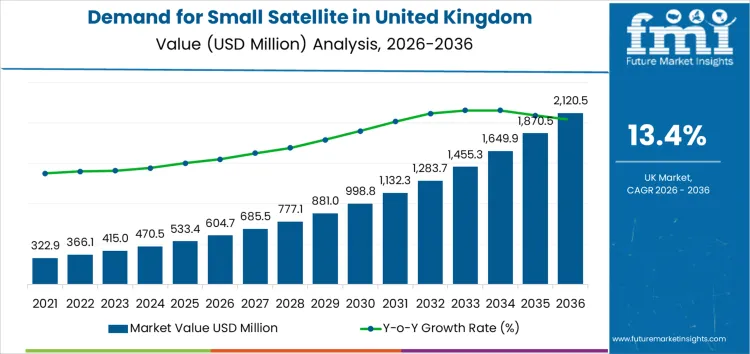
The small satellite market in the United Kingdom is projected to grow from USD 604.7 million in 2026 to USD 2,120.5 million by 2036, at a CAGR of 13.4%. Positioned at the intersection of aerospace, telecommunications, and data analytics, small satellites play a key role in expanding satellite-based services, from Earth observation to communication and navigation. This market’s influence is growing as demand for low-cost, high-efficiency satellite solutions rises across both commercial and governmental sectors.
Competitive landscape is determined by technological advancements in miniaturization, as well as the ability to offer scalable, versatile satellite systems. While major players dominate in terms of capacity and resources, smaller entrants are increasingly capturing market share by innovating in niche applications or providing specialized services. This dynamic fosters a competitive environment where both established companies and new entrants vie for a portion of a rapidly expanding market with diverse applications across industries.
Quick Stats for the Demand for Small Satellite in United Kingdom:
- Small Satellite in United Kingdom Value (2026): USD 604.7 million
- Small Satellite in United Kingdom Forecast Value (2036): USD 2,120.5 million
- Small Satellite in United Kingdom Forecast CAGR (2026 to 2036): 13.4%
- Small Satellite in United Kingdom Leading Segment: Low Earth Orbit (LEO) (79.6% share)
- Key Growth Regions of Small Satellite in United Kingdom: England
- Top Players of Small Satellite in United Kingdom: Airbus S.A.S., CASIC, OHB SE, Lockheed Martin Corporation, Boeing
What is the Growth Forecast for Small Satellite in United Kingdom through 2036?
The demand for small satellites in the United Kingdom is expected to rise from USD 604.7 million in 2026 to USD 2,120.5 million by 2036, reflecting a compound annual growth rate (CAGR) of 13.4%. Between 2026 and 2031, the market will experience steady growth, with values increasing from USD 604.7 million to USD 998.8 million. From 2031 to 2036, growth will continue, reaching USD 2,120.5 million by the end of the forecast period.
The market growth curve shape analysis indicates that the demand for small satellites will follow a sharply accelerating growth trajectory in the early part of the forecast period (2026-2031). This acceleration will be driven by advances in satellite miniaturization, increased investment in the commercial space industry, and new applications for small satellites. After 2031, the growth rate is expected to stabilize, with steady increases in demand as the market matures and the adoption of small satellite technology becomes more widespread. The curve suggests that the highest growth rates will occur in the first half of the forecast period, followed by continued but more gradual growth in the latter half as the market reaches a higher level of maturity and integration into existing industries.
Key Takeaways for Demand for Small Satellite in United Kingdom
| Metric | Value |
|---|---|
| Industry Sales Value (2026) | USD 604.7 million |
| Industry Forecast Value (2036) | USD 2,120.5 million |
| Industry Forecast CAGR (2026 to 2036) | 13.4% |
Why is Demand for Small Satellite in United Kingdom Growing?
Demand for small satellite in the United Kingdom has strengthened as national space capabilities and industry ambitions expanded beyond traditional large satellite programs. UK firms and research institutions historically participated in large space missions and satellite services, with established organizations like Surrey Satellite Technology and newer companies such as AAC Clyde Space and Alba Orbital driving small satellite production and innovation. These entities manufacture CubeSats, nanosatellites, and mission components that serve commercial and government clients, offering lower cost and faster development cycles compared to larger platforms. Small satellite demand is also underpinned by the UK’s space ecosystem, which supports satellite design, systems integration, and mission services that span Earth observation, telecommunications, and scientific applications. This has attracted supply chain participation from electronics, propulsion, and sensor manufacturers looking to service a growing array of space technology requirements. The emergence of dedicated test infrastructure, such as the National Satellite Test Facility in Oxfordshire, further enhances capability for satellite qualification and accelerates market responsiveness to new project needs.
Looking ahead, demand for small satellite in the United Kingdom is expected to remain robust as both commercial and institutional customers prioritize agile space solutions that deliver data and services at lower cost and shorter timelines. Commercial uptake in smallsat deployments for Earth observation, broadband connectivity, and maritime and environmental monitoring will sustain orders for satellite platforms and related subsystems, aligning with broader global growth trends projected at double digit annual rates. Government investments and national strategies aimed at expanding sovereign launch capabilities and supporting space sector innovation reinforce market confidence and create opportunities for domestic manufacturers and subsystem suppliers. Operators and procurement teams will increasingly evaluate small satellite options that balance performance, modularity, and scalability, with emphasis on integration ease and total lifecycle support. Continued development of UK launch infrastructure and partnerships across industry and academia will contribute to a competitive landscape where small satellites play a central role in meeting evolving needs for space based data and connectivity.
What Are the Key Segments in the Demand for Small Satellites in the United Kingdom?
Demand for small satellites in the United Kingdom is primarily driven by satellite type and orbit type. Minisatellites lead the satellite type segment with 25%, while low Earth orbit (LEO) dominates the orbit type segment with 79.6%. Other satellite types such as picosatellites, microsatellites, CubeSats, and femtosatellites, along with medium Earth orbit (MEO) and geosynchronous orbit (GEO), also contribute to the market. These segments reflect the growing interest in smaller, more cost-effective satellites for a variety of applications, including communication, Earth observation, and scientific research.
What Is the Satellite Type Segment of Demand for Small Satellites in the United Kingdom?
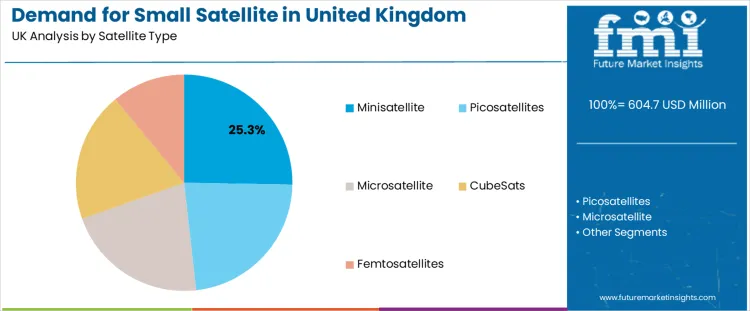
The satellite type segment for small satellites in the United Kingdom is led by minisatellites, which capture 25% of the market share. Minisatellites are often used for more complex tasks compared to smaller satellite types, offering a balance between size, power, and functionality. These satellites are commonly deployed for communications, Earth observation, and scientific missions. They offer more capability than picosatellites and CubeSats but are still small enough to be launched at a lower cost than larger satellites. The demand for minisatellites is driven by the need for affordable and scalable satellite solutions in various sectors, including government, commercial enterprises, and research institutions.
Picosatellites, while representing a smaller share of the market, are increasingly popular due to their ultra-small size and low cost, making them suitable for educational, research, and niche applications. Their limited payload capacity makes them ideal for small-scale experiments or specific monitoring functions, such as weather or atmospheric data collection. Microsatellites are slightly larger than picosatellites and are used in applications where greater power and payload capacity are required. Microsatellites are commonly deployed for communication, Earth observation, and scientific purposes. CubeSats, one of the most well-known small satellite forms, are increasingly being used for various commercial and academic purposes due to their modularity and affordability. Femtosatellites, though still emerging, represent the smallest form of satellites, ideal for specialized applications such as wireless communication or short-term monitoring. As small satellite technology continues to evolve, the demand for these smaller, more cost-effective solutions is expected to grow, with each satellite type serving different roles across industries.
What Is the Orbit Type Segment of Demand for Small Satellites in the United Kingdom?
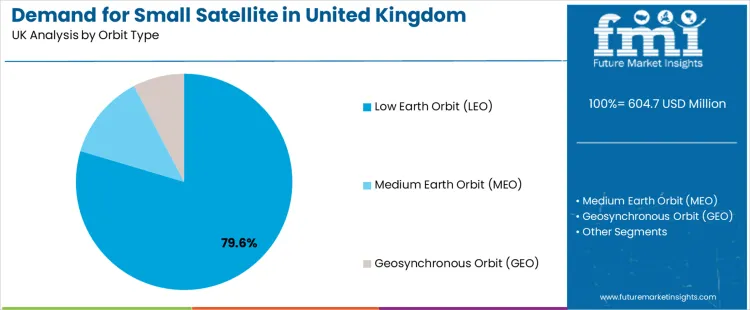
The orbit type segment for small satellites in the United Kingdom is predominantly led by low Earth orbit (LEO), which accounts for 79.6% of the market share. LEO is the most commonly used orbit for small satellites, as it offers lower launch costs and reduced latency for data transmission. LEO satellites are typically used for applications such as Earth observation, communications, and remote sensing, with a particular focus on providing global connectivity and data collection services. The demand for LEO satellites is expected to continue growing as advancements in technology and launch services reduce the cost of access to space.
Medium Earth orbit (MEO) follows as a smaller segment, where satellites are used for applications that require a balance between coverage area and data transfer speed. MEO satellites are often used for navigation systems, such as GPS, as well as for communication services. MEO offers a longer orbital period than LEO, allowing for wider coverage, and is ideal for applications that require a broader footprint than what LEO can provide. Geosynchronous orbit (GEO), although a niche segment for small satellites, is still relevant for certain communication applications. GEO satellites remain fixed over one point on Earth, making them ideal for weather monitoring, broadcasting, and long-range communication systems. However, due to the high launch costs associated with GEO, small satellites in this orbit remain limited. The growing demand for small satellite solutions is expected to continue driving advancements in all orbit types, with LEO remaining the dominant choice for cost-effective, high-frequency satellite missions.
What are the Key Dynamics in the Demand for Small Satellites in the United Kingdom?
Demand for small satellites in the United Kingdom is expanding as government space strategy, commercial space ventures, and research institutions prioritize low cost, rapid deployment orbital assets. Small satellites-typically under 500 kg including CubeSats and microsatellites-are used for Earth observation, communications, scientific research, and technology demonstration. Procurement patterns are influenced by constellation programs, sovereign capability goals, and partnerships with international launch providers. Demand correlates with investment cycles in space startups, satellite manufacturing capacity, and ecosystem development that includes systems integrators, payload specialists, and data analytics firms.
What are the Key Drivers for Small Satellite Demand in the United Kingdom?
Several factors are driving demand for small satellites in the United Kingdom. Strategic national programs aiming to grow sovereign space capability provide funding and policy support that de risk investment in small satellite projects. Commercial opportunities in broadband connectivity, Internet of Things (IoT) networks, and Earth observation data services attract venture capital and corporate participation. Advances in modular satellite platforms, standardized buses, and miniaturized payload technologies reduce unit cost and accelerate development timelines. Universities and research institutions adopt small satellites for experimental missions and training, reinforcing demand across public and private sectors. Supply chain maturation-including local fabrication, subsystem suppliers, and test facilities-supports broader adoption.
What are the Restraints on Small Satellite Demand in the United Kingdom?
Despite favorable momentum, the small satellite market in the United Kingdom faces several constraints. High upfront investment for end to end mission development-including payload integration, launch procurement, and ground infrastructure-can limit participation by smaller enterprises absent external financing. Competition for launch slots and integration manifest space remains tight, as small satellites often ride as secondary payloads, complicating scheduling and orbit selection. Technical complexity in achieving mission specific performance, especially for advanced sensors or communication payloads, can extend development timelines and raise risk. Regulatory processes for frequency coordination, orbital slot allocation, and space debris mitigation require specialist expertise and can delay project execution.
What are the Key Trends in Small Satellite Demand in the United Kingdom?
Key trends shaping demand for small satellites in the United Kingdom include an increase in constellation programs for broadband, remote sensing, and maritime monitoring, where aggregated low Earth orbit assets deliver high cadence data. Suppliers are offering modular, standardized platforms that reduce custom engineering and improve scalability for repeat missions. There is strong interest in co design partnerships between payload developers and platform manufacturers to tailor systems for emerging applications such as precision agriculture, climate monitoring, and autonomous systems support. Growth in on orbit servicing, in space demonstration, and hosted payload opportunities expands business models for small satellite use. Data analytics, machine learning, and cloud based downstream services enhance the value proposition of satellite data for commercial customers and government agencies alike.
What is the Country-Wise Demand for Small Satellites in the United Kingdom?
The demand for small satellites in the United Kingdom shows significant regional variation, with England leading the market. The demand is primarily driven by the UK’s growing aerospace, telecommunications, and defense industries, where small satellites play an important role in communication, Earth observation, and space research. England, with its advanced space infrastructure and significant investment in satellite technology, represents the largest market. Scotland, Wales, and Northern Ireland also show considerable demand, supported by the UK’s continued expansion of its space exploration capabilities and increasing interest in satellite technology for commercial and governmental purposes. As the demand for advanced space technologies grows, small satellites are expected to play an increasingly critical role in providing flexible, cost-effective solutions for communication, data collection, and monitoring.
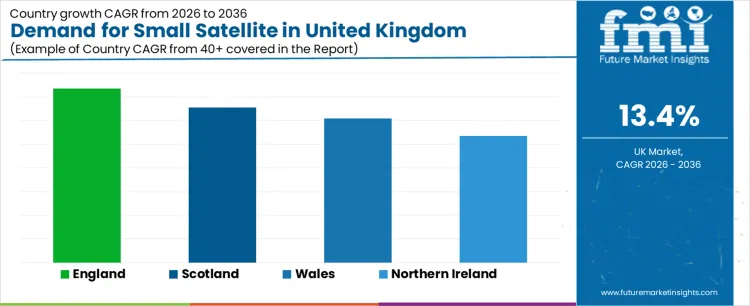
| Country | CAGR (2026 to 2036) |
|---|---|
| England | 14.7% |
| Scotland | 13.1% |
| Wales | 12.2% |
| Northern Ireland | 10.7% |
What is Driving the Demand for Small Satellites in England?
The demand for small satellites in England is projected to grow at a CAGR of 14.7% from 2026 to 2036. England’s dominant position in the aerospace and defense sectors, combined with its rapidly expanding space industry, is a primary driver of this growth. Small satellites are increasingly being used for Earth observation, telecommunications, and scientific research. With a rising interest in low-cost and flexible satellite technology, England’s companies and government agencies are investing in small satellites to meet growing demand for space-based services. The UK government’s commitment to expanding the nation’s space capabilities and attracting international collaborations also contributes to this market growth. Furthermore, England’s position as a hub for innovation and technological advancement in space research makes it a leader in the development and deployment of small satellites. As the cost of satellite launches decreases and technology improves, small satellites are expected to play an even larger role in both commercial and governmental operations.
How is the Demand for Small Satellites Performing in Scotland?
In Scotland, the demand for small satellites is expected to grow at a CAGR of 13.1% from 2026 to 2036. Scotland’s growing space industry, along with its focus on innovation and research in space exploration, is contributing to this increase in demand. The Scottish government has been actively investing in spaceports and satellite technologies, positioning the region as a key player in the emerging commercial space industry. Small satellites are increasingly being used in Scotland for applications such as remote sensing, communications, and scientific experiments. The country’s strengths in aerospace engineering and satellite technology, along with growing partnerships between universities, research institutions, and private companies, will continue to fuel demand for small satellites. As Scotland continues to invest in space infrastructure and satellite services, its demand for small satellites will grow, particularly in the commercial and governmental sectors.
What Are the Growth Drivers for Small Satellites in Wales?
The demand for small satellites in Wales is projected to grow at a CAGR of 12.2% through 2036. The growth is primarily driven by the increasing need for satellite communication, Earth observation, and scientific research. Wales is becoming more involved in space-related activities, with a growing interest in small satellite technology to meet commercial, scientific, and military needs. The Welsh government’s initiatives to promote the development of aerospace technologies and space infrastructure are further contributing to this demand. As industries such as telecommunications, agriculture, and environmental monitoring adopt satellite solutions for real-time data collection and analysis, the use of small satellites in Wales will continue to expand. Additionally, the growing collaboration between Welsh academic institutions and the space industry is expected to further stimulate demand for small satellites, as new research and development efforts lead to more applications for this technology.
What is the Outlook for Small Satellite Demand in Northern Ireland?
Northern Ireland’s demand for small satellites is expected to grow at a CAGR of 10.7% from 2026 to 2036. While Northern Ireland represents the smallest market for small satellites in the United Kingdom, the demand is steadily increasing, driven by both commercial and governmental sectors. Northern Ireland’s emerging space industry, including collaboration with international space agencies and private companies, is fueling this demand. Small satellites are being utilized for various applications, such as Earth observation, communication, and environmental monitoring. The growing need for cost-effective, scalable satellite solutions is making small satellites an attractive option for both established and emerging industries in Northern Ireland. As the region strengthens its space sector and attracts more investment, the demand for small satellites is expected to continue its upward trajectory.
What is the Competitive Landscape for Demand for Small Satellites in the United Kingdom?
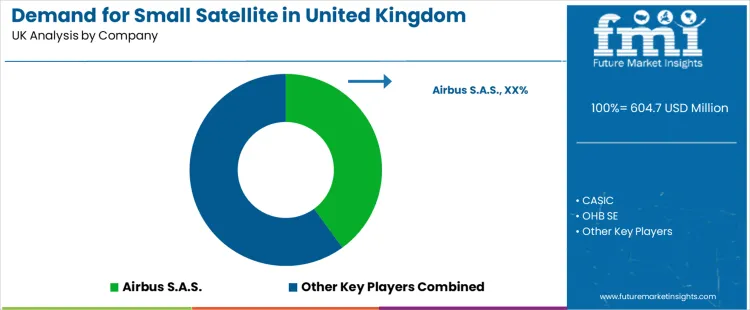
Demand for small satellites in the United Kingdom is driven by increasing government and commercial investment in Earth observation, communication constellations, and space research missions. Procurement teams and mission planners specify platforms based on documented payload capacity, documented bus performance, and documented integration support services. Airbus S.A.S. is positioned as a leading supplier with documented small satellite product lines that include modular bus architectures, documented subsystem interfaces, and documented qualification data. These technical brochures and specification sheets are reviewed by UK prime contractors and satellite integrators when aligning platform selection with mission objectives and schedule constraints. Buyers also assess documented launch compatibility and documented ground segment support to ensure that selected systems meet end to end program needs.
CASIC competes with documented small satellite solutions that highlight scalable designs, documented environmental tolerance figures, and documented supply support frameworks. UK space program stakeholders and systems engineers consult these documents to compare performance metrics and risk profiles. OHB SE supplies satellite platforms accompanied by technical literature listing documented power budgets, documented attitude control specifications, and documented test protocols that assist procurement teams in aligning supplier offerings with defined system requirements. Lockheed Martin Corporation offers documented small satellite architectures with emphasis on modular payload interfaces and documented reliability data, which are referenced by organizations planning constellation deployments or defense oriented missions. Boeing’s documented product materials cover scalable spacecraft buses and documented integration support for complex subsystem combinations. Competitive evaluation in the UK market incorporates documented quality assurance processes, documented supply lead times, and documented service support agreements. Technical reviewers and procurement professionals use these documented attributes to benchmark supplier proposals, ensuring that selected small satellite solutions align with performance targets, regulatory requirements, and operational risk frameworks. Competitive behavior in this segment reflects emphasis on measurable specifications and documented support commitments that guide formal procurement and partnership decisions.
Key Players of the Demand for Small Satellite in United Kingdom
- Airbus S.A.S.
- CASIC
- OHB SE
- Lockheed Martin Corporation
- Boeing
Scope of the Report
| Items | Values |
|---|---|
| Quantitative Units (2026) | USD Million |
| Satellite Type | Picosatellites, Minisatellite, Microsatellite, CubeSats, Femtosatellites |
| Orbit Type | Low Earth Orbit (LEO), Medium Earth Orbit (MEO), Geosynchronous Orbit (GEO) |
| Application | Military Intelligence, Communication and Navigation, Earth Observation, Remote Sensing, Scientific Research & Exploration |
| Companies | Airbus S.A.S., CASIC, OHB SE, Lockheed Martin Corporation, Boeing |
| Regions Covered | United Kingdom |
| Countries Covered | England, Scotland, Wales, Northern Ireland |
| Additional Attributes | Dollar by sales by satellite type, orbit type, and application. Includes market trends towards advancements in satellite technology, cost-effectiveness, and the role of small satellites in various applications including military, communication, and scientific exploration. |
Key Segments of Demand for Small Satellite in United Kingdom
Satellite Type:
- Picosatellites
- Minisatellite
- Microsatellite
- CubeSats
- Femtosatellites
Orbit Type:
- Low Earth Orbit (LEO)
- Medium Earth Orbit (MEO)
- Geosynchronous Orbit (GEO)
Application:
- Military Intelligence
- Communication and Navigation
- Earth Observation
- Remote Sensing
- Scientific Research & Exploration
Countries:
- England
- Scotland
- Wales
- Northern Ireland
Bibliography
- UK Space Agency. (2024). National space strategy in action: Delivering growth across the UK space sector. UK Government.
- Department for Science, Innovation and Technology. (2024). Advanced manufacturing and space technologies: Strategic priorities. UK Government.
- Organisation for Economic Co-operation and Development. (2024). The space economy in figures: Small satellites and downstream services. OECD Publishing.
- United Nations Office for Outer Space Affairs. (2024). Global trends in small satellite missions and space governance. United Nations.
- European Space Agency. (2023). Small satellite systems and space infrastructure development. ESA.
Frequently Asked Questions
How big is the demand for small satellite in united kingdom in 2026?
The demand for small satellite in united kingdom is estimated to be valued at USD 604.7 million in 2026.
What will be the size of small satellite in united kingdom in 2036?
The market size for the small satellite in united kingdom is projected to reach USD 2,120.5 million by 2036.
How much will be the demand for small satellite in united kingdom growth between 2026 and 2036?
The demand for small satellite in united kingdom is expected to grow at a 13.4% CAGR between 2026 and 2036.
What are the key product types in the small satellite in united kingdom?
The key product types in small satellite in united kingdom are minisatellite, picosatellites, microsatellite, cubesats and femtosatellites.
Which orbit type segment is expected to contribute significant share in the small satellite in united kingdom in 2026?
In terms of orbit type, low earth orbit (leo) segment is expected to command 79.6% share in the small satellite in united kingdom in 2026.
Preview the report firsthand - request a free sample
Get SampleGet the brochure for pricing and purchase details.
Get PDFTable of Content
- Executive Summary
- UK Market Outlook
- Demand-side Trends
- Supply-side Trends
- Technology Roadmap Analysis
- Analysis and Recommendations
- Market Overview
- Market Coverage / Taxonomy
- Market Definition / Scope / Limitations
- Market Background
- Market Dynamics
- Drivers
- Restraints
- Opportunity
- Trends
- Scenario Forecast
- Demand in Optimistic Scenario
- Demand in Likely Scenario
- Demand in Conservative Scenario
- Opportunity Map Analysis
- Product Life Cycle Analysis
- Supply Chain Analysis
- Investment Feasibility Matrix
- Value Chain Analysis
- PESTLE and Porter’s Analysis
- Regulatory Landscape
- Regional Parent Market Outlook
- Production and Consumption Statistics
- Import and Export Statistics
- Market Dynamics
- UK Market Analysis 2021 to 2025 and Forecast, 2026 to 2036
- Historical Market Size Value (USD Million) Analysis, 2021 to 2025
- Current and Future Market Size Value (USD Million) Projections, 2026 to 2036
- Y-o-Y Growth Trend Analysis
- Absolute $ Opportunity Analysis
- UK Market Pricing Analysis 2021 to 2025 and Forecast 2026 to 2036
- UK Market Analysis 2021 to 2025 and Forecast 2026 to 2036, By Satellite Type
- Introduction / Key Findings
- Historical Market Size Value (USD Million) Analysis By Satellite Type , 2021 to 2025
- Current and Future Market Size Value (USD Million) Analysis and Forecast By Satellite Type , 2026 to 2036
- Minisatellite
- Picosatellites
- Microsatellite
- CubeSats
- Femtosatellites
- Minisatellite
- Y-o-Y Growth Trend Analysis By Satellite Type , 2021 to 2025
- Absolute $ Opportunity Analysis By Satellite Type , 2026 to 2036
- UK Market Analysis 2021 to 2025 and Forecast 2026 to 2036, By Orbit Type
- Introduction / Key Findings
- Historical Market Size Value (USD Million) Analysis By Orbit Type, 2021 to 2025
- Current and Future Market Size Value (USD Million) Analysis and Forecast By Orbit Type, 2026 to 2036
- Low Earth Orbit (LEO)
- Medium Earth Orbit (MEO)
- Geosynchronous Orbit (GEO)
- Low Earth Orbit (LEO)
- Y-o-Y Growth Trend Analysis By Orbit Type, 2021 to 2025
- Absolute $ Opportunity Analysis By Orbit Type, 2026 to 2036
- UK Market Analysis 2021 to 2025 and Forecast 2026 to 2036, By Application
- Introduction / Key Findings
- Historical Market Size Value (USD Million) Analysis By Application, 2021 to 2025
- Current and Future Market Size Value (USD Million) Analysis and Forecast By Application, 2026 to 2036
- Military Intelligence
- Communication and Navigation
- Earth Observation
- Remote Sensing
- Scientific Research & Exploration
- Military Intelligence
- Y-o-Y Growth Trend Analysis By Application, 2021 to 2025
- Absolute $ Opportunity Analysis By Application, 2026 to 2036
- Market Structure Analysis
- Competition Dashboard
- Competition Benchmarking
- Market Share Analysis of Top Players
- By Regional
- By Satellite Type
- By Orbit Type
- By Application
- Competition Analysis
- Competition Deep Dive
- Airbus S.A.S.
- Overview
- Product Portfolio
- Profitability by Market Segments (Product/Age /Sales Channel/Region)
- Sales Footprint
- Strategy Overview
- Marketing Strategy
- Product Strategy
- Channel Strategy
- CASIC
- OHB SE
- Lockheed Martin Corporation
- Boeing
- Airbus S.A.S.
- Competition Deep Dive
- Assumptions & Acronyms Used
- Research Methodology


