

- Market Size (2026)
- USD 653.1 Mn
- Forecast (2036)
- USD 1249.2 Mn
- CAGR (2026 to 2036)
- 6.7%
How big is Wax Melts Market in 2026?
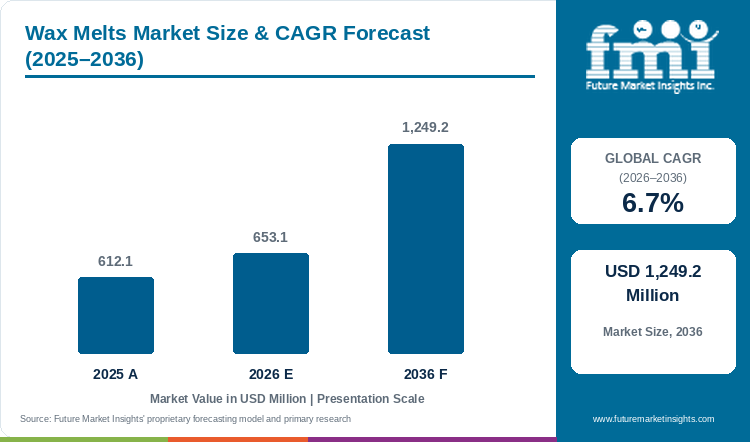
FMI values the market at USD 612.1 Million in 2025. Sales are forecast to reach USD 653.1 Million in 2026 and USD 1,249.2 Million by 2036 at a 6.7% CAGR.
The category works like a refill business because the warmer can stay in the home while fragrance is replaced many times. That makes scent variety and easy reordering more important than repeated hardware purchase. The same behavior links wax melts to the broader scented candle market without giving the product the same burn profile or vessel cost.
Digital retail adds another layer because small wax-melt packs can support dozens of scents without requiring the same shelf space in every store. The model works best when fragrance descriptions are clear and repeat purchase is simple. Indoor-air questions still matter because flame-free use does not remove fragrance emissions.
Key Takeaways
- The market rises from USD 653.1 Million in 2026 to USD 1,249.2 Million by 2036 at a 6.7% CAGR.
- FMI estimates clamshell cubes and break-apart bars at 46.0% of Product Form revenue in 2026 because the format is easy to portion and widely used across mass and direct brands.
- FMI estimates paraffin and paraffin-blend wax at 43.0% of Wax Base revenue in 2026. Scentsy uses paraffin while WoodWick lists soy-paraffin blends in wax melts.
- FMI estimates E-commerce & DTC at 32.0% of Sales Channel revenue in 2026. Broad online assortments and recurring-order tools fit a replenishment category.
- Indoor-air performance and fragrance compliance remain the main product-development constraint. ACS research in 2025 found nanoparticle formation from scented wax melts under indoor conditions. [1]
- Saudi Arabia carries the fastest profiled CAGR at 8.2% from 2026 to 2036. South Korea follows at 7.8% and the UAE at 7.5%.
Analyst Perspective
“Wax melts are bought for fragrance rather than hardware. Brands need a scent that performs well in the warmer and a pack that is easy to reorder. Clear formulation choices matter because consumers are paying closer attention to what heated fragrance products release indoors.”
- Rahul Pandita, Principal Consultant, Future Market Insights
How is the wax melts market segmented?
Product Form; Wax Base; Fragrance Family; Price Positioning; Sales Channel
Product Form includes Clamshell cubes & break-apart bars, Snap bars, Molded shapes & tarts, Cups & pods, and Mixed-scent sets. Wax Base includes Paraffin & paraffin blends, Soy & soy blends, Other plant-wax blends, Beeswax blends, and Specialty wax systems. Fragrance Family includes Fresh & clean, Gourmand & bakery, Floral, Fruity & citrus, Woody & amber, and Seasonal & licensed. Price Positioning covers Mass, Masstige, Premium, and Artisanal / luxury. Sales Channel covers E-commerce & DTC, Mass merchandisers, Specialty home-fragrance retail, Supermarkets & hypermarkets, and Independent gift & lifestyle stores.
Why do Clamshell cubes & break-apart bars lead demand within the Product Form category?
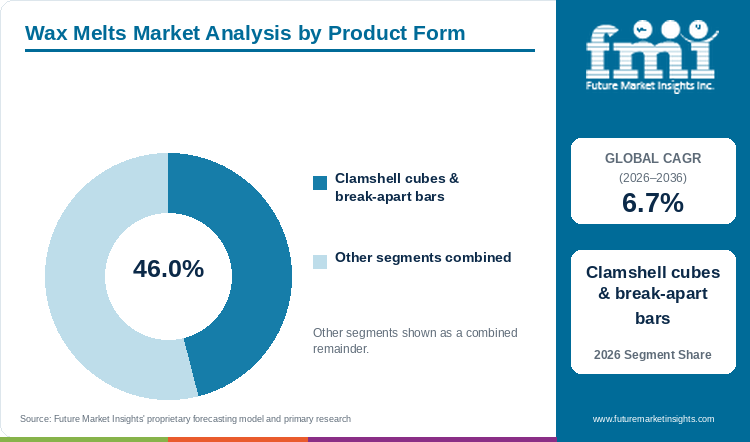
FMI estimates 46.0% share of Product Form revenue in 2026
The format solves a simple use problem because consumers can break off one or two cubes and leave the rest sealed for later. Scentsy Bars use eight break-apart cubes while ScentSationals and Kringle sell multi-piece packs. Portioning therefore feels familiar across several price points.
Clamshells also travel well through stores and parcel networks because flat packs stack efficiently and still give retailers useful front-panel space for scent names. That fit matters in both mass merchandising and direct replenishment.
- FMI estimates clamshell cubes and break-apart bars at 46.0% of Product Form revenue in 2026.
- Rimports describes a portfolio built around scented wax cubes and wax warmers for major retail partners.
Why do Paraffin & paraffin blends lead demand within the Wax Base category?
FMI estimates 43.0% share of Wax Base revenue in 2026
Wax choice affects scent load and the temperature at which a melt softens. Scentsy states that its Bars use high-quality paraffin wax while WoodWick lists a soy and paraffin blend for its wax melts. These systems remain common because manufacturers can tune melt behavior and fragrance release for warmers.
Plant-based alternatives are expanding the choice set as Happy Wax uses soy wax and Devon Wick markets 100% soy melts. The material distinction is easy to communicate but does not remove the performance requirements around scent throw and clean release from the warmer dish.
- FMI estimates paraffin and paraffin-blend wax at 43.0% of Wax Base revenue in 2026.
- Material choice is increasingly visible on pack as soy and plant-wax brands use wax base as part of product positioning.
Why does Fresh & clean lead demand within the Fragrance Family category?
FMI estimates 28.0% share of Fragrance Family revenue in 2026
Fresh scents work across more rooms and seasons than many event-led fragrances. Clean linen notes and soft citrus can sit in kitchens or bedrooms without being tied to a holiday which gives retailers a dependable year-round core beside stronger bakery or autumn ranges.
Seasonality still shapes the shelf because Goose Creek groups wax melts across fruity and bakery profiles as well as fresh and woodsy families. Kringle also carries year-round scents beside seasonal collections. Retailers can keep a stable fresh base while rotating the rest of the assortment.
- FMI estimates Fresh & clean at 28.0% of Fragrance Family revenue in 2026.
- Seasonal and licensed fragrances remain important for traffic even when everyday scents carry steadier replenishment.
Why does Mass lead demand within the Price Positioning category?
FMI estimates 45.0% share of Price Positioning revenue in 2026
Wax melts lower the cost of trying a new fragrance because ScentSationals lists many 2.5 oz packs at USD 2.99 while Candle Warmers Etc. also lists Classic Wax Melts at USD 2.99. That low ticket supports add-on purchases and multi-scent baskets.
Premium products have a different job and can use more complex scent stories or specialty wax claims. The wider market still depends on easy trial because consumers often rotate fragrances before a pack is fully replaced.
- FMI estimates Mass at 45.0% of Price Positioning revenue in 2026.
- Low unit prices let retailers sell fragrance variety without asking consumers to replace the warmer.
Why does E-commerce & DTC lead demand within the Sales Channel category?
FMI estimates 32.0% share of Sales Channel revenue in 2026
Online retail is well suited to a category with many scent variants because a brand can carry a large catalog without putting every fragrance on a physical shelf. Product pages can also keep scent notes and warmer instructions beside the purchase button.
Subscriptions make the fit stronger because Scentsy Club allows recurring shipments of consumables and can keep selected wax bars available for subscribers. That reduces the work required to repeat a known scent.
Digital replenishment is also shaping adjacent home fragrance categories where persistent customer data can guide the next purchase. The same direct relationship appears in the home fragrance customization market where product selection depends on more persistent consumer data.
- FMI estimates E-commerce & DTC at 32.0% of Sales Channel revenue in 2026.
- The channel is strongest when scent descriptions and reorder tools reduce the uncertainty of buying fragrance without smelling it first.
What are the drivers, restraints and opportunities in the Wax Melts Market?
Driver: repeat fragrance replenishment | Restraint: indoor-air and formulation questions | Opportunity: subscription and lower-emission product design
- Driver: Reusable warmers turn fragrance into a repeat consumable and make scent rotation easy.
- Restraint: Heated fragrance can release volatile compounds even without a flame. Formulation and product claims therefore need evidence.
- Opportunity: Better scent matching and recurring-order tools can reduce choice friction while product development focuses on controlled fragrance release.
Driver: Replenishment keeps the category active after the warmer is sold
A warmer can remain in use through many fragrance changes which shifts spending toward the consumable rather than the device. Scentsy has built recurring wax shipments into its Club program while major direct brands maintain broad year-round catalogs.
Seasonal releases add another reason to return as Scentsy scheduled a four-scent Hogwarts Houses collection for July 2026 and Newell uses recurring seasonal fragrance stories across Yankee Candle formats. The pattern is similar to the luxury candle market where scent stories can justify repeat discovery even when the basic household function has not changed.
Restraint: Flame-free does not mean emission-free
The main technical issue comes from fragrance chemistry rather than combustion. An ACS study published in 2025 tested 15 commercial wax melts and found that scented products released terpenes that reacted with ozone to form nanoparticles indoors. The measured particle levels were comparable with previously reported candle conditions. [1]
That does not make every formulation equivalent but it does weaken broad claims that a product is safe simply because it has no wick. IFRA Standards can restrict fragrance ingredients in finished products and do not replace the manufacturer’s safety assessment or local regulation.
Opportunity: Better product information can improve repeat purchase
Wax melts are difficult to evaluate through a screen because scent cannot be sampled digitally. Retailers can reduce that gap with clear fragrance families and strength cues while reorder history helps a consumer return to a known scent or move to a nearby profile.
Product design can address the same issue from another direction because better control of fragrance load and warmer temperature can make performance more predictable. The technical side links the market to the wider flavors and fragrances market where fragrance houses develop materials for specific end-use conditions.
Which country CAGRs are profiled in the Wax Melts Market?
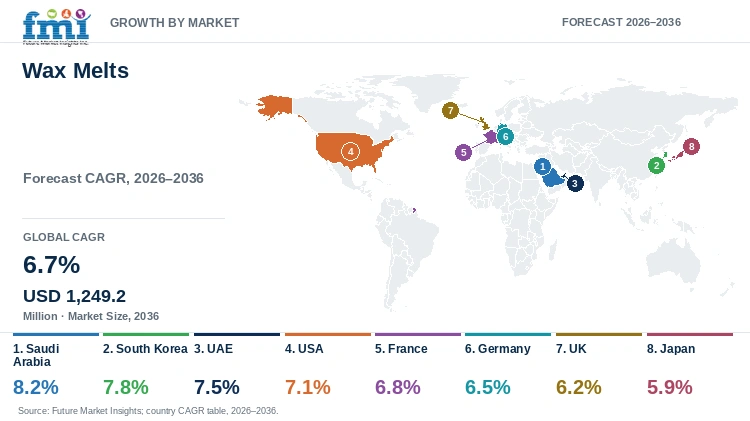
| Country | CAGR |
|---|---|
| Saudi Arabia | 8.2% |
| South Korea | 7.8% |
| UAE | 7.5% |
| USA | 7.1% |
| France | 6.8% |
| Germany | 6.5% |
| UK | 6.2% |
| Japan | 5.9% |
Country-wise Analysis
- Saudi Arabia is projected to grow at an 8.2% CAGR from 2026 to 2036. GASTAT reported that the retail e-commerce sales index rose 13.4% year over year in the second quarter of 2026. [3] SAMA reported that electronic payments represented 85% of retail payments in 2025. [4] Those conditions make checkout and repeat ordering easier for small home-fragrance purchases. Wax melts still need scents that fit local preferences because incense and concentrated fragrance formats are already familiar.
- South Korea is projected to grow at a 7.8% CAGR from 2026 to 2036. Statistics Korea reported that mobile shopping represented 79.4% of online shopping value in August 2025. DSM-Firmenich described scent as an increasingly important part of identity and emotion when it launched SENSORIUM Seoul in June 2026. Wax-melt brands can use mobile-first launches and limited collections to test scent ideas quickly. The product still has to earn attention inside a mature beauty and lifestyle market.
- UAE is projected to grow at a 7.5% CAGR from 2026 to 2036. TDRA reported that active internet users represented 99% of the population in its Digital UAE factsheet. Shopping was listed among common internet uses. Strong digital access gives direct fragrance brands a workable route to market but does not remove competition from bakhoor and oud. Wax melts need a distinct use case such as easier scent switching or lower-smoke home fragrance.
- USA is projected to grow at a 7.1% CAGR from 2026 to 2036. The U.S. Census Bureau reported USD 340.2 billion in retail e-commerce sales for the second quarter of 2026. That was 12.2% above the same quarter of 2025. [2] The country also has direct category depth through Scentsy and Yankee Candle as well as ScentSationals and Glade. Safety messaging needs care because the 2025 ACS study puts more attention on indoor emissions from heated fragrance products. [1]
- France is projected to grow at a 6.8% CAGR from 2026 to 2036. Insee reported that 63.6% of people aged 15 or older made an online purchase during the previous three months in 2025. That gives home-fragrance brands a mature digital route for replenishment. France also has a deep fragrance-development base that can support more sophisticated scent profiles. Growth depends on giving consumers a reason to choose melts beside candles and other established home-scent formats.
- Germany is projected to grow at a 6.5% CAGR from 2026 to 2036. Destatis reported that 86% of people aged 16 to 74 had purchased online by 2025 and 70% had done so in the previous three months. Digital access is therefore not the main constraint. Product information and formulation discipline matter more as brands compete for repeat orders. European fragrance rules also keep ingredient management and finished-product responsibility in focus.
- UK is projected to grow at a 6.2% CAGR from 2026 to 2036. ONS reported that online sales represented 28.8% of retail spending in August 2026. The country also has specialist wax-melt brands such as Devon Wick selling large direct assortments. That combination makes discovery easy but also raises the bar for differentiation. Scent quality and pack value need to stand out in a crowded direct-to-consumer environment.
- Japan is projected to grow at a 5.9% CAGR from 2026 to 2036. METI reported that household goods and interiors had a 32.58% e-commerce ratio in 2024. Digital access is therefore well established for home-related purchases. Slower profiled growth points to the need for sharper assortment rather than more channel buildout. Compact packs and controlled scent strength can fit smaller homes while seasonal themes give consumers a reason to rotate fragrances.
Who are the notable companies in the Wax Melts Market?
Scentsy; Newell Brands; Rimports; SC Johnson; Happy Wax; Goose Creek Candle; Candle Warmers Etc.; PartyLite; Kringle Candle Company; The Candleberry Candle Company
The competitive set is built around companies with direct wax-melt products rather than adjacent fragrance capability alone. Scentsy and Rimports combine scented wax with dedicated warmers while Newell Brands and SC Johnson bring larger home-fragrance portfolios. Happy Wax and Goose Creek compete through direct fragrance catalogs while Candle Warmers Etc. links melt sales closely to hardware.
Other direct participants include PartyLite and Kringle Candle Company as well as The Candleberry Candle Company. The market spans direct selling and mass retail beside specialist e-commerce which gives consumers several ways to switch brands without changing the basic warmer routine.
- Direct-selling and warmer ecosystem: Scentsy.
- Mass and omnichannel home fragrance: Newell Brands; Rimports; SC Johnson.
- Specialist DTC fragrance: Happy Wax; Goose Creek Candle; Kringle Candle Company; The Candleberry Candle Company.
- Warmer-led home fragrance: Candle Warmers Etc.; PartyLite.
Competitive Benchmarking: Wax Melts Market
| Company | Direct Wax-Melt Portfolio | Warmer Integration | Channel Breadth | Positioning |
|---|---|---|---|---|
| Scentsy | High | High | High | Direct selling and subscription replenishment |
| Newell Brands (Yankee Candle / WoodWick) | High | Medium | High | Specialty retail, mass retail and online |
| Rimports (ScentSationals) | High | High | High | Major mass-retail programs and DTC outlet |
| SC Johnson (Glade) | Medium | Low | High | Broad household retail distribution |
| Happy Wax | High | High | Medium | DTC-led specialist home fragrance |
| Goose Creek Candle | High | Medium | High | DTC plus Walmart distribution |
| Candle Warmers Etc. | High | High | High | DTC and wholesale warmer ecosystem |
| PartyLite | High | High | Medium | Direct and online home fragrance |
| Kringle Candle Company | High | Medium | Medium | DTC and specialty fragrance retail |
| The Candleberry Candle Company | High | High | Medium | DTC and specialty home fragrance |
High indicates a broad direct offer against the criterion while Medium indicates a narrower but established capability. Low indicates limited direct coverage of that criterion. Scores describe observable capability and route to market rather than company market share.
Key Developments in the Wax Melts Market
- In July 2026 Scentsy scheduled the Hogwarts Houses Wax Collection with four house-specific fragrances in one themed box. The launch uses licensing and multi-scent packaging to make wax melts a collectible seasonal purchase.
- In January 2026 Candle Warmers Etc. introduced five new spring wax-melt scents in its 2.5 oz Classic line. The launch shows how quickly a warmer-led brand can refresh a low-ticket fragrance assortment.
- In September 2025 Newell Brands described Yankee Candle’s Fantastical Fall collection across formats including wax melts. Six fragrances turned a seasonal story into a coordinated home-fragrance assortment.
Key Players in the Wax Melts Market
Integrated wax and warmer ecosystems
- Scentsy
- Rimports
- Candle Warmers Etc.
- PartyLite
Large home-fragrance portfolios
- Newell Brands
- SC Johnson
Specialist wax-melt and candle brands
- Happy Wax
- Goose Creek Candle
- Kringle Candle Company
- The Candleberry Candle Company
Wax Melts Market - Report Scope
| Coverage field | Report scope |
|---|---|
| Market breakdown | Product Form; Wax Base; Fragrance Family; Price Positioning; Sales Channel |
| Quantitative Units | USD Million |
| Market Definition | Revenue includes finished scented wax melts sold for use in electric or tea-light warmers. It excludes warmers and other hardware, candles, reed diffusers, room sprays, incense, bakhoor, standalone fragrance oils, and upstream fragrance ingredients. |
| Regions Covered | North America; Latin America; Western Europe; Eastern Europe; East Asia; South Asia and Pacific; Middle East and Africa |
| Countries Covered | USA; Germany; France; UK; Saudi Arabia; UAE; Japan; South Korea |
| Key Companies Profiled | Scentsy; Newell Brands; Rimports; SC Johnson; Happy Wax; Goose Creek Candle; Candle Warmers Etc.; PartyLite; Kringle Candle Company; The Candleberry Candle Company |
| Forecast Period | 2026 to 2036 |
| Approach | Primary and secondary research with market triangulation. Segment shares are FMI analyst estimates based on current assortment, retail pricing, channel presence, and product evidence. |
Wax Melts Market - Research Methodology
| Method | Approach |
|---|---|
| Primary Research | FMI gathers input from manufacturers and retailers as well as distributors and home-fragrance specialists. Interviews focus on assortment planning, replenishment, pricing, scent selection, and product-use requirements. |
| Desk Research | Desk research uses official retail statistics and fragrance-safety guidance alongside company product information. Current product assortments help define the category and its commercial formats. |
| Market Sizing and Forecasting | The model combines the market baseline with historical demand, channel development, product mix, and country conditions. Forecasting considers repeat purchase and digital access as well as formulation constraints. |
| Segment Estimation | Segment shares are FMI analyst estimates. They use observed product formats, wax-base disclosures, price points, and route-to-market evidence across the profiled company set. |
| Data Validation | Market totals and segment estimates are cross-checked against category totals and observable market conditions. Company statements use direct product or business evidence and adjacent fragrance activity is not treated as finished wax-melt participation. |
Wax Melts Market by Segments
Wax Melts Market segmented by Product Form:
- Clamshell cubes & break-apart bars
- Snap bars
- Molded shapes & tarts
- Cups & pods
- Mixed-scent sets
Wax Melts Market segmented by Wax Base:
- Paraffin & paraffin blends
- Soy & soy blends
- Other plant-wax blends
- Beeswax blends
- Specialty wax systems
Wax Melts Market segmented by Fragrance Family:
- Fresh & clean
- Gourmand & bakery
- Floral
- Fruity & citrus
- Woody & amber
- Seasonal & licensed
Wax Melts Market segmented by Price Positioning:
- Mass
- Masstige
- Premium
- Artisanal / luxury
Wax Melts Market segmented by Sales Channel:
- E-commerce & DTC
- Mass merchandisers
- Specialty home-fragrance retail
- Supermarkets & hypermarkets
- Independent gift & lifestyle stores
Wax Melts Market by Region:
- North America
- United States
- Canada
- Latin America
- Brazil
- Mexico
- Argentina
- Chile
- Western Europe
- Germany
- France
- United Kingdom
- Italy
- Spain
- Benelux
- Nordics
- Eastern Europe
- Poland
- Czech Republic
- Romania
- Hungary
- East Asia
- China
- Japan
- South Korea
- South Asia and Pacific
- India
- ASEAN
- Australia and New Zealand
- Middle East and Africa
- GCC Countries
- South Africa
- Türkiye
- Israel
Research Sources and Bibliography
- [1] American Chemical Society (2025, February 21). Scented wax melts may not be as safe for indoor air as initially thought, study finds. Source
- [2] U.S. Census Bureau (2026, August 18). Quarterly Retail E-Commerce Sales, Second Quarter 2026. Source
- [3] General Authority for Statistics, Saudi Arabia (2026, August 30). GASTAT: Operating Revenues Index for Wholesale and Retail Trade Increases by 3.2% in Q2 of 2026. Source
- [4] Saudi Central Bank (2026, April 12). SAMA: E-Payments Account for 85% of Total Retail Payments in 2025. Source
- International Fragrance Association. IFRA Standards and guidance for safe use of fragrance ingredients.
- Telecommunications and Digital Government Regulatory Authority, UAE (2023, August 10). Digital UAE Factsheet.
- Statistics Korea (2025, October 1). Online Shopping in August 2025.
- Insee (2025, December 2). Achat sur Internet selon l’âge, 2025.
- German Federal Statistical Office (2025). Internet users and online shoppers.
- Office for National Statistics (2026, September 18). Retail sales, Great Britain: August 2026.
- Ministry of Economy Trade and Industry Japan (2025, August 26). Results of FY2024 E-Commerce Market Survey Compiled.
- dsm-firmenich (2026, June 18). SENSORIUM Seoul: Exploring the Rise of K-Scent and the Future of Fragrance Creation.
- Scentsy. Wax Bars and company product information.
- Scentsy (2026). Hogwarts Houses - Scentsy Wax Collection.
- Newell Brands. Yankee Candle and WoodWick home-fragrance information.
- Newell Brands (2025, September 29). Experience the Season with Yankee Candle’s Fall Collections.
- Rimports. Company and ScentSationals product information.
- SC Johnson / Glade. Wax Melts product information.
- Happy Wax. Soy Wax Melts and Wax Warmers.
- Goose Creek Candle. Wax Melts collection and company information.
- Candle Warmers Etc. (2026, January). New Spring Wax Melt Scents.
- PartyLite. Wax Melts collection.
- Kringle Candle Company. 6-Piece Wax Melts collection.
- The Candleberry Candle Company. Warmers & Tart Wax Melts.
This bibliography is provided for reader reference and is not exhaustive. The full report contains the complete reference list and supporting data.
This Report Answers
- How large is the Wax Melts Market in 2026 and what value is forecast for 2036?
- How does the reusable-warmer model support repeat purchase of wax melts?
- Why do clamshell cubes and break-apart bars lead Product Form?
- Why do paraffin and paraffin blends retain a leading position in Wax Base?
- Which countries have the fastest profiled growth from 2026 to 2036?
- Which companies have direct wax-melt products and warmer ecosystems?
- What indoor-air and fragrance compliance issues affect product development?
- How do digital retail and subscription models change wax-melt replenishment?
Frequently Asked Questions
How big is the Wax Melts Market in 2026, and what is forecast for 2036?
The market is valued at USD 653.1 Million in 2026 and is forecast to reach USD 1,249.2 Million by 2036. FMI values the market at USD 612.1 Million in 2025.
What is the CAGR of the Wax Melts Market from 2026 to 2036?
The market is projected to grow at a 6.7% CAGR from 2026 to 2036. Repeat fragrance purchase supports the category while formulation and scent-choice friction can slow conversion.
Which Product Form segment leads the Wax Melts Market?
FMI estimates clamshell cubes and break-apart bars at 46.0% of Product Form revenue in 2026. The format is easy to portion and widely used across direct and mass-market brands.
Which Wax Base segment leads the Wax Melts Market?
FMI estimates paraffin and paraffin blends at 43.0% of Wax Base revenue in 2026. The material family remains common because manufacturers can tune melt point and fragrance load for warmer use.
Which profiled countries have the highest growth rates in the Wax Melts Market?
Saudi Arabia has the highest profiled CAGR at 8.2% from 2026 to 2036. South Korea follows at 7.8% and the UAE at 7.5%.
Which companies are active in the Wax Melts Market?
Notable participants include Scentsy and Newell Brands alongside Rimports and SC Johnson. Happy Wax and Goose Creek Candle also have direct wax-melt ranges. Candle Warmers Etc. and PartyLite compete through integrated home-fragrance ecosystems.
Preview the report firsthand - request a free sample
Get SampleGet the brochure for pricing and purchase details.
Get PDFTable of Content
- Key Takeaways
- Market Size and CAGR
- Top Growth Driver
- Fastest Growing Segment
- Leading Region
- Key Companies
- Emerging Opportunities
- Executive Summary
- Global Market Outlook
- Demand-side Trends
- Supply-side Trends
- Technology Roadmap Analysis
- Analysis and Recommendations
- Analyst Perspective (What is happening? Why now? What should investors know?)
- Key Questions Answered
- How large is the market?
- What is the CAGR?
- What are key trends?
- Which region dominates?
- Who are the leaders?
- Market Overview
- Market Coverage / Taxonomy
- Market Definition / Scope / Limitations
- Research Methodology
- Chapter Orientation
- Analytical Lens and Working Hypotheses
- Market Structure, Signals, and Trend Drivers
- Benchmarking and Cross-market Comparability
- Market Sizing, Forecasting, and Opportunity Mapping
- Research Design and Evidence Framework
- Desk Research Programme (Secondary Evidence)
- Expert Input and Fieldwork (Primary Evidence)
- Tooling, Models, and Reference Databases
- Data Engineering and Model Build
- Quality Assurance and Audit Trail
- Market Background
- Market Dynamics (Drivers, Restraints, Opportunity, Trends)
- Scenario Forecast (Optimistic, Likely, Conservative)
- Impact Analysis
- AI Impact
- Sustainability Impact
- Regulatory Impact
- Technology Impact
- Consumer / Buyer Analysis
- Purchase Drivers
- Adoption Barriers
- Buyer Journey
- Opportunity Map Analysis
- Product Life Cycle Analysis
- Supply Chain Analysis
- Investment Feasibility Matrix
- Value Chain Analysis
- PESTLE and Porter's Analysis
- Regulatory Landscape
- Regional Parent Market Outlook
- Production and Consumption Statistics
- Import and Export Statistics
- Global Market Analysis and Forecast, 2021 to 2036
- Historical Market Size Value (USD Million) Analysis, 2021 to 2025
- Current and Future Market Size Value (USD Million) Projections, 2026 to 2036
- Y-o-Y Growth Trend Analysis
- Absolute $ Opportunity Analysis
- Global Market Pricing Analysis, 2021 to 2036
- Global Market Analysis and Forecast, By Product Form, 2021 to 2036
- Introduction / Key Findings
- Historical Market Size Value (USD Million) Analysis By Product Form, 2021 to 2025
- Current and Future Market Size Value (USD Million) Analysis and Forecast By Product Form, 2026 to 2036
- Clamshell cubes & break-apart bars
- Snap bars
- Molded shapes & tarts
- Cups & pods
- Mixed-scent sets
- Y-o-Y Growth Trend Analysis By Product Form, 2021 to 2025
- Absolute $ Opportunity Analysis By Product Form, 2026 to 2036
- Global Market Analysis and Forecast, By Wax Base, 2021 to 2036
- Introduction / Key Findings
- Historical Market Size Value (USD Million) Analysis By Wax Base, 2021 to 2025
- Current and Future Market Size Value (USD Million) Analysis and Forecast By Wax Base, 2026 to 2036
- Paraffin & paraffin blends
- Soy & soy blends
- Other plant-wax blends
- Beeswax blends
- Specialty wax systems
- Y-o-Y Growth Trend Analysis By Wax Base, 2021 to 2025
- Absolute $ Opportunity Analysis By Wax Base, 2026 to 2036
- Global Market Analysis and Forecast, By Fragrance Family, 2021 to 2036
- Introduction / Key Findings
- Historical Market Size Value (USD Million) Analysis By Fragrance Family, 2021 to 2025
- Current and Future Market Size Value (USD Million) Analysis and Forecast By Fragrance Family, 2026 to 2036
- Fresh & clean
- Gourmand & bakery
- Floral
- Fruity & citrus
- Woody & amber
- Seasonal & licensed
- Y-o-Y Growth Trend Analysis By Fragrance Family, 2021 to 2025
- Absolute $ Opportunity Analysis By Fragrance Family, 2026 to 2036
- Global Market Analysis and Forecast, By Price Positioning, 2021 to 2036
- Introduction / Key Findings
- Historical Market Size Value (USD Million) Analysis By Price Positioning, 2021 to 2025
- Current and Future Market Size Value (USD Million) Analysis and Forecast By Price Positioning, 2026 to 2036
- Mass
- Masstige
- Premium
- Artisanal / luxury
- Y-o-Y Growth Trend Analysis By Price Positioning, 2021 to 2025
- Absolute $ Opportunity Analysis By Price Positioning, 2026 to 2036
- Global Market Analysis and Forecast, By Sales Channel, 2021 to 2036
- Introduction / Key Findings
- Historical Market Size Value (USD Million) Analysis By Sales Channel, 2021 to 2025
- Current and Future Market Size Value (USD Million) Analysis and Forecast By Sales Channel, 2026 to 2036
- E-commerce & DTC
- Mass merchandisers
- Specialty home-fragrance retail
- Supermarkets & hypermarkets
- Independent gift & lifestyle stores
- Y-o-Y Growth Trend Analysis By Sales Channel, 2021 to 2025
- Absolute $ Opportunity Analysis By Sales Channel, 2026 to 2036
- Global Market Analysis and Forecast, By Region, 2021 to 2036
- Introduction
- Historical Market Size Value (USD Million) Analysis By Region, 2021 to 2025
- Current Market Size Value (USD Million) Analysis and Forecast By Region, 2026 to 2036
- North America
- Latin America
- Western Europe
- Eastern Europe
- East Asia
- South Asia and Pacific
- Middle East and Africa
- Market Attractiveness Analysis By Region
- North America Market Analysis and Forecast, By Country, 2021 to 2036
- Historical Market Size Value (USD Million) Trend Analysis By Market Taxonomy, 2021 to 2025
- Market Size Value (USD Million) Forecast By Market Taxonomy, 2026 to 2036
- By Country
- United States
- Canada
- By Product Form
- By Wax Base
- By Fragrance Family
- By Price Positioning
- By Sales Channel
- By Country
- Market Attractiveness Analysis
- By Country
- By Product Form
- By Wax Base
- By Fragrance Family
- By Price Positioning
- By Sales Channel
- Key Takeaways
- Latin America Market Analysis and Forecast, By Country
- Historical Market Size Value (USD Million) Trend Analysis By Market Taxonomy, 2021 to 2025
- Market Size Value (USD Million) Forecast By Market Taxonomy, 2026 to 2036
- By Country
- Brazil
- Mexico
- Argentina
- Chile
- By Product Form
- By Wax Base
- By Fragrance Family
- By Price Positioning
- By Sales Channel
- By Country
- Market Attractiveness Analysis
- By Country
- By Product Form
- By Wax Base
- By Fragrance Family
- By Price Positioning
- By Sales Channel
- Key Takeaways
- Western Europe Market Analysis and Forecast, By Country
- Historical Market Size Value (USD Million) Trend Analysis By Market Taxonomy, 2021 to 2025
- Market Size Value (USD Million) Forecast By Market Taxonomy, 2026 to 2036
- By Country
- Germany
- France
- United Kingdom
- Italy
- Spain
- Benelux
- Nordics
- By Product Form
- By Wax Base
- By Fragrance Family
- By Price Positioning
- By Sales Channel
- By Country
- Market Attractiveness Analysis
- By Country
- By Product Form
- By Wax Base
- By Fragrance Family
- By Price Positioning
- By Sales Channel
- Key Takeaways
- Eastern Europe Market Analysis and Forecast, By Country
- Historical Market Size Value (USD Million) Trend Analysis By Market Taxonomy, 2021 to 2025
- Market Size Value (USD Million) Forecast By Market Taxonomy, 2026 to 2036
- By Country
- Poland
- Czech Republic
- Romania
- Hungary
- By Product Form
- By Wax Base
- By Fragrance Family
- By Price Positioning
- By Sales Channel
- By Country
- Market Attractiveness Analysis
- By Country
- By Product Form
- By Wax Base
- By Fragrance Family
- By Price Positioning
- By Sales Channel
- Key Takeaways
- East Asia Market Analysis and Forecast, By Country
- Historical Market Size Value (USD Million) Trend Analysis By Market Taxonomy, 2021 to 2025
- Market Size Value (USD Million) Forecast By Market Taxonomy, 2026 to 2036
- By Country
- China
- Japan
- South Korea
- By Product Form
- By Wax Base
- By Fragrance Family
- By Price Positioning
- By Sales Channel
- By Country
- Market Attractiveness Analysis
- By Country
- By Product Form
- By Wax Base
- By Fragrance Family
- By Price Positioning
- By Sales Channel
- Key Takeaways
- South Asia and Pacific Market Analysis and Forecast, By Country
- Historical Market Size Value (USD Million) Trend Analysis By Market Taxonomy, 2021 to 2025
- Market Size Value (USD Million) Forecast By Market Taxonomy, 2026 to 2036
- By Country
- India
- ASEAN
- Australia and New Zealand
- By Product Form
- By Wax Base
- By Fragrance Family
- By Price Positioning
- By Sales Channel
- By Country
- Market Attractiveness Analysis
- By Country
- By Product Form
- By Wax Base
- By Fragrance Family
- By Price Positioning
- By Sales Channel
- Key Takeaways
- Middle East and Africa Market Analysis and Forecast, By Country
- Historical Market Size Value (USD Million) Trend Analysis By Market Taxonomy, 2021 to 2025
- Market Size Value (USD Million) Forecast By Market Taxonomy, 2026 to 2036
- By Country
- GCC Countries
- South Africa
- Türkiye
- Israel
- By Product Form
- By Wax Base
- By Fragrance Family
- By Price Positioning
- By Sales Channel
- By Country
- Market Attractiveness Analysis
- By Country
- By Product Form
- By Wax Base
- By Fragrance Family
- By Price Positioning
- By Sales Channel
- Key Takeaways
- Key Countries Market Analysis
- United States
- Pricing Analysis
- Market Share Analysis, 2025
- By Product Form
- By Wax Base
- By Fragrance Family
- By Price Positioning
- By Sales Channel
- Canada
- Pricing Analysis
- Market Share Analysis, 2025
- By Product Form
- By Wax Base
- By Fragrance Family
- By Price Positioning
- By Sales Channel
- Mexico
- Pricing Analysis
- Market Share Analysis, 2025
- By Product Form
- By Wax Base
- By Fragrance Family
- By Price Positioning
- By Sales Channel
- Brazil
- Pricing Analysis
- Market Share Analysis, 2025
- By Product Form
- By Wax Base
- By Fragrance Family
- By Price Positioning
- By Sales Channel
- Chile
- Pricing Analysis
- Market Share Analysis, 2025
- By Product Form
- By Wax Base
- By Fragrance Family
- By Price Positioning
- By Sales Channel
- Germany
- Pricing Analysis
- Market Share Analysis, 2025
- By Product Form
- By Wax Base
- By Fragrance Family
- By Price Positioning
- By Sales Channel
- United Kingdom
- Pricing Analysis
- Market Share Analysis, 2025
- By Product Form
- By Wax Base
- By Fragrance Family
- By Price Positioning
- By Sales Channel
- Italy
- Pricing Analysis
- Market Share Analysis, 2025
- By Product Form
- By Wax Base
- By Fragrance Family
- By Price Positioning
- By Sales Channel
- Spain
- Pricing Analysis
- Market Share Analysis, 2025
- By Product Form
- By Wax Base
- By Fragrance Family
- By Price Positioning
- By Sales Channel
- France
- Pricing Analysis
- Market Share Analysis, 2025
- By Product Form
- By Wax Base
- By Fragrance Family
- By Price Positioning
- By Sales Channel
- India
- Pricing Analysis
- Market Share Analysis, 2025
- By Product Form
- By Wax Base
- By Fragrance Family
- By Price Positioning
- By Sales Channel
- ASEAN
- Pricing Analysis
- Market Share Analysis, 2025
- By Product Form
- By Wax Base
- By Fragrance Family
- By Price Positioning
- By Sales Channel
- Australia and New Zealand
- Pricing Analysis
- Market Share Analysis, 2025
- By Product Form
- By Wax Base
- By Fragrance Family
- By Price Positioning
- By Sales Channel
- China
- Pricing Analysis
- Market Share Analysis, 2025
- By Product Form
- By Wax Base
- By Fragrance Family
- By Price Positioning
- By Sales Channel
- Japan
- Pricing Analysis
- Market Share Analysis, 2025
- By Product Form
- By Wax Base
- By Fragrance Family
- By Price Positioning
- By Sales Channel
- South Korea
- Pricing Analysis
- Market Share Analysis, 2025
- By Product Form
- By Wax Base
- By Fragrance Family
- By Price Positioning
- By Sales Channel
- Poland
- Pricing Analysis
- Market Share Analysis, 2025
- By Product Form
- By Wax Base
- By Fragrance Family
- By Price Positioning
- By Sales Channel
- Hungary
- Pricing Analysis
- Market Share Analysis, 2025
- By Product Form
- By Wax Base
- By Fragrance Family
- By Price Positioning
- By Sales Channel
- Türkiye
- Pricing Analysis
- Market Share Analysis, 2025
- By Product Form
- By Wax Base
- By Fragrance Family
- By Price Positioning
- By Sales Channel
- South Africa
- Pricing Analysis
- Market Share Analysis, 2025
- By Product Form
- By Wax Base
- By Fragrance Family
- By Price Positioning
- By Sales Channel
- Saudi Arabia
- Pricing Analysis
- Market Share Analysis, 2025
- By Product Form
- By Wax Base
- By Fragrance Family
- By Price Positioning
- By Sales Channel
- UAE
- Pricing Analysis
- Market Share Analysis, 2025
- By Product Form
- By Wax Base
- By Fragrance Family
- By Price Positioning
- By Sales Channel
- United States
- Market Structure Analysis
- Competition Dashboard
- Competition Benchmarking
- Market Share Analysis of Top Players
- By Regional
- By Product Form
- By Wax Base
- By Fragrance Family
- By Price Positioning
- By Sales Channel
- Emerging Startups
- Innovation Benchmarking
- Competition Analysis
- Competition Deep Dive
- Scentsy
- Overview
- Product Portfolio
- Profitability by Market Segments
- Sales Footprint
- Strategy Overview
- Marketing Strategy
- Product Strategy
- Channel Strategy
- Newell Brands (Yankee Candle / WoodWick)
- Rimports (ScentSationals)
- SC Johnson (Glade)
- Happy Wax
- Goose Creek Candle
- Candle Warmers Etc.
- PartyLite
- Kringle Candle Company
- The Candleberry Candle Company
- Integrated wax and warmer ecosystems
- Rimports
- Large home-fragrance portfolios
- Newell Brands
- SC Johnson
- Specialist wax-melt and candle brands
- Scentsy
- Case Studies
- Success Stories
- Recent Developments
- Competition Deep Dive
- Assumptions & Acronyms Used


