

- Industry Size (2026)
- USD 1.4 Bn
- Forecast (2036)
- USD 4.8 Bn
- CAGR (2026 to 2036)
- 13.1%
AI-Personalized Home Fragrance Customization Market Size, Market Forecast and Outlook By FMI
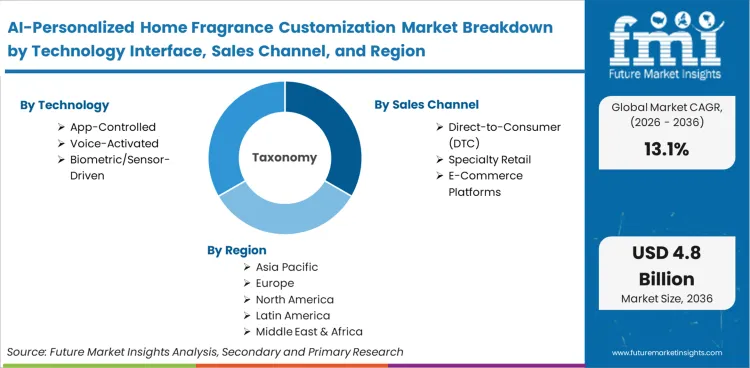
The AI-personalized home fragrance customization market was valued at USD 1.2 billion in 2025. The industry is expected to surpass USD 1.4 billion in 2026 at a CAGR of 13.1% during the forecast period. Rising investment propels the market valuation to USD 4.8 billion through 2036 as consumer appliance manufacturers integrate algorithmic scent profiling directly into core smart home ecosystems rather than treating fragrance as a standalone hardware category.
Brand managers and hardware developers are being forced to shift their primary hardware strategy from fixed-scent diffusion to dynamic atmospheric sequencing. Consumers no longer purchase a device to distribute a single scent continuously; they expect the hardware to interpret environmental data and adjust olfactory outputs dynamically throughout the day. Hardware developers that delay the integration of multi-cartridge blending capabilities forfeit recurring revenue streams, as users rapidly abandon closed-system devices that offer no algorithmic variety.
Summary of AI-Personalized Home Fragrance Customization Market
- AI-Personalized Home Fragrance Customization Market Definition:
- This category covers hardware and software systems that utilize algorithms, user feedback loops, and environmental sensors to dynamically control and blend residential ambient scents, distinguishing itself from static air care through active data integration.
- Demand Drivers in the Market:
- Ecosystem lock-in strategies compel smart home hardware developers to integrate consumable scent cartridges as a reliable recurring revenue stream.
- Changing residential utilization patterns force interior designers to specify atmospheric zoning technologies that separate work environments from relaxation spaces in open floor plans.
- Data privacy normalization pushes app developers to leverage biometric and schedule data to fully automate environmental controls.
- Key Segments Analyzed in the FMI Report:
- Smart Diffusers: Smart Diffusers are poised to hold 48.5% share in 2026, as multi-chamber hardware remains the primary physical requisite for delivering algorithmically blended output.
- App-Controlled: App-Controlled is anticipated to garner a dominant share in 2026, driven by the ubiquity of smartphone interfaces as the central command hub for residential environmental settings.
- Direct-to-Consumer (DTC): DTC holds the majority share as hardware manufacturers require direct software relationships to optimize their predictive algorithms and manage subscription fulfillment.
- China: 15.8% compound growth, driven by aggressive domestic adoption of interconnected residential IoT ecosystems.
- Analyst Opinion at FMI:
- Ronak Shah, Principal Analyst, Consumer Product, at FMI, opines, "Standard market metrics track device sell-through accurately, but they miss the cartridge subscription retention rate entirely, and that is where the actual industry value sits. Hardware sales figure heavily in early-stage growth, but the companies capturing real margin are those whose predictive algorithms are accurate enough to ship the right mood-based refill before the user actively opens the app to order it."
- Strategic Implications / Executive Takeaways:
- Hardware pure-plays must transition to software-as-a-service models to prevent commoditization by low-cost smart diffuser manufacturers.
- Fragrance formulators should engineer stable viscosity profiles to ensure compatibility with high-frequency micro-dosing mechanical components.
- Retail category managers face a requirement to dedicate experiential shelf space to connected platforms rather than traditional packaged air care.
- Methodology:
- Primary Research: Hardware product managers, digital subscription strategists, and connected-home category buyers.
- Desk Research: Consumer electronics certification registries, telecommunication protocol filings, and app-store retention datasets.
- Market-Sizing and Forecasting: Anchored to connected-device activation volumes and cartridge replacement rates.
- Data Validation and Update Cycle: Cross-validated against recurring revenue growth metrics of smart-home pure-plays.
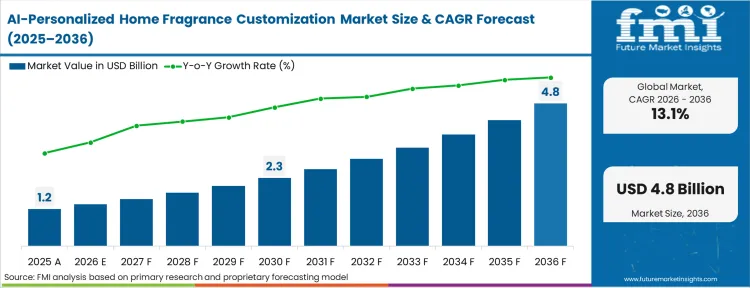
As per FMI's assessment, the true competitive moat is no longer the diffuser hardware itself, but the proprietary predictive algorithms that anticipate user mood and schedule, ensuring the continuous replenishment of fragrance before the user realizes a cartridge is empty. Before algorithmic fragrance becomes a standard fixture in residential development, cross-platform interoperability must be fully resolved. The gate is the native integration of scent dispensers with dominant residential HVAC and smart-hub protocols, allowing ambient scenting to react automatically to occupancy sensors and thermostat schedules. Major consumer electronics companies hold the keys to this transition. Once these ecosystems seamlessly communicate, the barrier to adoption drops entirely, shifting scent from a manual luxury to an automated utility.
China is projected to expand at 15.8%, followed by South Korea at 14.8%, the United States at 14.2%, and the United Kingdom at 13.5%. Japan is expected to advance at 12.4%, Germany is likely to register 11.9%, and France tracks at 10.5%. The divergence across this range reflects a distinct split between markets where consumers view connected devices as integrated household infrastructure versus regions where smart appliances remain isolated novelty purchases.
AI-Personalized Home Fragrance Customization Market Key Takeaways
| Metric | Details |
|---|---|
| Industry Size (2026) | USD 1.4 billion |
| Industry Value (2036) | USD 4.8 billion |
| CAGR (2026-2036) | 13.1% |
Source: Future Market Insights (FMI) analysis, based on proprietary forecasting model and primary research
AI-Personalized Home Fragrance Customization Market Definition
The AI-personalized home fragrance customization sector encompasses algorithmic hardware and software systems designed to dispense, blend, and sequence ambient residential scents based on user data, environmental sensors, or predictive modeling. It separates from traditional air care by requiring active data input, connectivity protocols, and multi-component scent delivery mechanisms that allow software to alter the physical olfactory environment without manual intervention.
AI-Personalized Home Fragrance Customization Market Inclusions
This sector includes multi-chamber smart diffusers, app-controlled fragrance dispensers, biometric scent-adjusting hardware, algorithmically curated subscription cartridge models, and the proprietary software platforms required to operate these devices. Revenue from the sale of the connected hardware, the ongoing digital subscription tiers, and the specifically formatted micro-dosing mechanisms required for these closed-loop systems are fully integrated into the sizing model.
AI-Personalized Home Fragrance Customization Market Exclusions
Standard electric plug-in air fresheners, reed diffusers, manual room sprays, and traditional combustible candles are strictly excluded. The functional reason for this exclusion is the absence of algorithmic data processing and dynamic output control. Products that merely use a timer function without machine learning, app-based feedback loops, or dynamic blending capabilities do not meet the criteria for AI personalization.
AI-Personalized Home Fragrance Customization Market Research Methodology
- Primary Research: Hardware product managers, digital subscription strategists, and connected-home category buyers at tier-1 retail networks.
- Desk Research: Consumer electronics certification registries, telecommunication protocol filings, and proprietary app-store retention data sets.
- Market-Sizing and Forecasting: Baselines are anchored to connected-device activation volumes and subsequent cartridge replacement rates within closed digital ecosystems.
- Data Validation and Update Cycle: Forecasts are cross-validated against recurring revenue growth metrics reported by publicly traded smart-home hardware pure-plays.
Segmental Analysis
AI-Personalized Home Fragrance Customization Market Analysis by Product Type
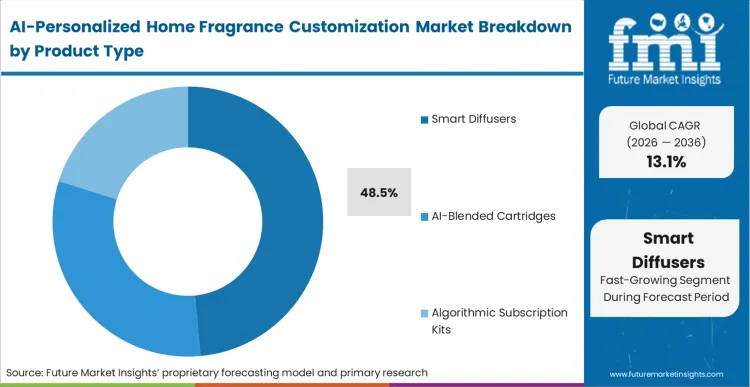
The smart diffusers hold 48.5% of this market owing to a fundamental physical requirement: algorithmic software cannot blend a custom scent profile without hardware capable of micro-dosing from multiple isolated reservoirs simultaneously. According to FMI's estimates, the intelligence of the system resides in the cloud, but the execution remains strictly mechanical. Consumers evaluating these systems base their initial adoption on the aesthetic integration of the device within the home, treating it as a premium appliance rather than a disposable air care product. Once integrated, the hardware establishes a closed ecosystem, locking the user into a specific brand's consumable architecture. Brand managers who fail to secure this initial hardware footprint are relegated to low-margin, third-party cartridge supply, entirely cut off from the algorithmic data stream that dictates future product development.
- Aesthetic integration: The physical design of the multi-chamber unit triggers the initial purchase decision for premium residential spaces. Hardware developers secure early adopter loyalty by masking complex pumping mechanics behind minimalist industrial design.
- Ecosystem lock-in: Proprietary cartridge recognition chips validate the hardware choice during the post-purchase phase. Users are operationally blocked from using third-party refills, securing the brand's consumable revenue loop.
- Predictive fulfillment: Automated usage tracking drives the user to maintain the system long-term. App developers retain consumers by removing the friction of manual reordering through perfectly timed subscription box deliveries.
AI-Personalized Home Fragrance Customization Market Analysis by Technology Interface
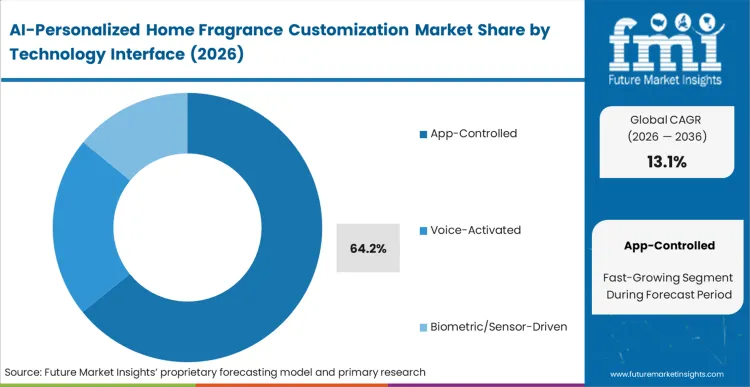
When biometric and voice-activated systems fail to interpret complex user preferences accurately, consumers immediately revert to app-controlled interfaces, solidifying this segment's dominance. According to FMI estimates, the app-controlled holds dominant 64.2% share. In FMI's view, while ambient sensors and facial recognition cameras offer theoretical frictionless operation, they frequently misread intent, triggering energizing citrus profiles when the user actually desires a calming lavender blend. App-controlled interfaces mitigate this risk by providing explicit, deterministic control over the algorithmic output. Users willingly trade the promise of total automation for the reliability of a smartphone dashboard where they can fine-tune intensity and schedule. Manufacturers attempting to force fully autonomous biometric systems before the underlying logic matures face high return rates and rapid subscription cancellations from frustrated early adopters.
- Misinterpretation bypass: Explicit smartphone controls prevent the system from dispensing incorrect scent profiles based on flawed sensor data. Hardware engineers reduce product return rates by ensuring manual overrides are highly visible in the digital interface.
- Network latency: Dependency on local Wi-Fi stability remains a residual risk for cloud-processed commands. Product managers must build local memory caching into the device so scheduled scent events execute even during temporary internet outages.
- Feature discovery: The user must actively explore the app dashboard to unlock the full value of complex algorithmic features. Software developers utilize push notifications to train the user on dynamic blending features they would otherwise ignore.
AI-Personalized Home Fragrance Customization Market Analysis by Sales Channel
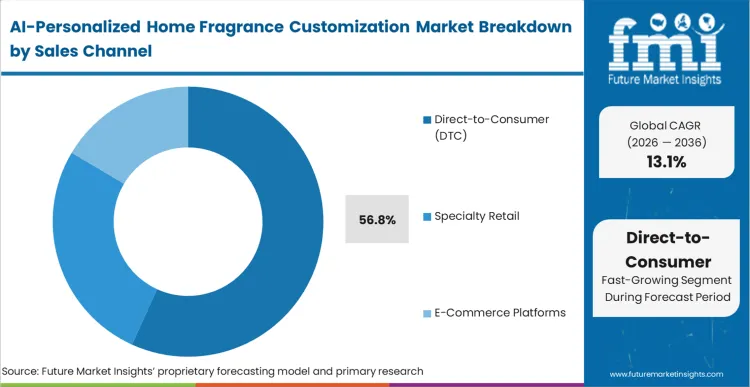
A tension exists between the high customer acquisition costs of the Direct-to-Consumer channel and the margin-crushing wholesale requirements of specialty retail networks. DTC holds its commanding share of 56.8% because algorithmic personalization inherently requires a direct digital relationship with the end user to function correctly. FMI analysts opine that routing these complex, subscription-dependent systems through traditional retail distribution networks strips the manufacturer of critical behavioral data needed to train their predictive models. However, acquiring users entirely through digital ads is increasingly expensive. Brands navigate this by utilizing retail purely for physical discovery, while aggressively funneling the actual hardware purchase and subsequent cartridge subscription through their proprietary DTC platforms.
- Margin retention: Bypassing wholesale distributors allows manufacturers to capture the full margin on recurring cartridge sales. Financial directors utilize these expanded margins to subsidize the upfront cost of the diffuser hardware.
- Acquisition expense: The hidden operational cost emerges in the form of escalating digital advertising spend required to convert cold traffic into hardware buyers. Marketing teams must balance the lifetime value of a subscription against steep initial customer acquisition metrics.
- Data ownership: A lifecycle comparison reveals that owning the direct digital relationship yields exponentially more value than a single retail transaction. Data scientists leverage this direct access to continuously refine the scent algorithms, widening the competitive gap against retail-dependent brands.
AI-Personalized Home Fragrance Customization Market Drivers, Restraints, and Opportunities
The integration of disparate connected home ecosystems forces consumer appliance developers to adopt universal communication protocols like Matter, fundamentally changing how buyers evaluate smart diffusers. Consumers no longer accept isolated apps for every device; they expect their scent dispensers to react automatically to the security system disarming or the smart lighting shifting to an evening hue. This interoperability mandate compels hardware engineers to open their software architectures, allowing broader algorithmic platforms to command their proprietary dispensing mechanics. Manufacturers that successfully embed their hardware into these larger residential choreographies, secure long-term placement, while those clinging to walled-garden apps risk rapid obsolescence as consumers consolidate their digital environments.
The single biggest buyer friction slowing mass adoption is the installed base of legacy HVAC systems that lack the digital sophistication to communicate with localized scent nodes. While consumers desire whole-home atmospheric control, retrofitting a centralized algorithmic dispensing system into existing ductwork requires specialized contracting, elevating the installation cost beyond standard consumer electronics budgets. This friction remains because residential HVAC replacement cycles span decades. The partial solution involves deploying multiple freestanding smart diffusers synchronized via a central app, but this workaround introduces significant maintenance overhead, as users must manually monitor and replace fluid levels across a decentralized fleet of devices rather than managing a single automated hub.
Opportunities in the AI-Personalized Home Fragrance Customization Market
- Commercial hospitality integration: Premium hotel operators seek centralized digital control over their property-wide olfactory branding. Commercial system integrators can capture substantial B2B contracts by scaling algorithmic blending software to manage hundreds of distinct zones from a single dashboard.
- Wellness data synchronization: The rise of wearable health trackers generates precise data on user stress and sleep cycles. Software developers can capture health-conscious demographics by linking essential oils diffusion algorithms directly to real-time biometric APIs.
- Synthetic formulation partnerships: The mechanical demands of micro-dosing require highly specific fluid viscosities. Chemical formulators can lock in lucrative supply agreements by engineering proprietary synthetic fragrance blends explicitly designed to prevent clogging in piezoelectric diffuser heads.
Regional Analysis
Based on the regional analysis, the AI-Personalized Home Fragrance Customization market is segmented into North America, Europe, Asia Pacific, and other regions across 40 plus countries.
.webp "Top Country Growth Comparison Ai Personalized Home Fragrance Customization Market Cagr (2026 2036)")
| Country | CAGR (2026 to 2036) |
|---|---|
| United States | 14.2% |
| United Kingdom | 13.5% |
| China | 15.8% |
| Japan | 12.4% |
| Germany | 11.9% |
| South Korea | 14.8% |
| France | 10.5% |
Source: Future Market Insights (FMI) analysis, based on proprietary forecasting model and primary research
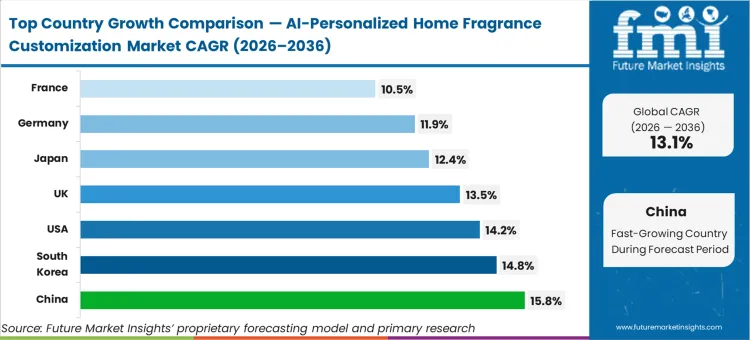
Asia Pacific AI-Personalized Home Fragrance Customization Market Analysis
The condition driving Asia Pacific's trajectory is the extreme density of urban residential real estate paired with rapid deployment of integrated 5G smart-home infrastructure. In this environment, ambient scenting is not utilized to fill massive suburban square footage, but rather to hyper-personalize compact, multi-functional living spaces that must transition seamlessly between work and relaxation modes. Based on FMI's assessment, hardware developers operating in these high-density markets prioritize aggressive miniaturization and ultra-quiet diffusion mechanics over the raw output capacity favored in Western markets. The speed at which major Asian telecom and electronics conglomerates are bundling algorithmic fragrance devices into their broadband and smart-home subscription packages creates an adoption curve that is fundamentally steeper and more integrated than the piecemeal purchasing habits observed elsewhere.
- China: China's dominance in domestic consumer electronics manufacturing enables local brands to iterate on smart diffuser hardware at a pace foreign competitors cannot match. Domestic product managers rapidly integrate emerging sensor technologies into baseline models, forcing the global standard for device capabilities upward. The market is forecast to register a CAGR of 15.8%. Chinese brands leverage this rapid hardware iteration to outmaneuver international prestige labels, capturing the tech-forward millennial demographic before Western luxury houses can deploy their own connected ecosystems.
- South Korea: Broadband providers in the market bundle connected home appliances directly into their high-tier residential internet contracts. This telecom-led distribution model removes the initial hardware cost barrier for the consumer, shifting the immediate focus to subscription cartridge revenue. FMI estimates the AI-personalized home fragrance customization market in South Korea to expand at an annual growth rate of 14.8%. Hardware manufacturers that secure integration into these telecom bundles gain access to millions of pre-networked homes, establishing a massive footprint for recurring consumable sales.
- Japan: Aging demographic profile forces software developers to prioritize extreme ease-of-use and zero-maintenance hardware designs. Elderly users require systems that automate scenting for therapeutic or alertness purposes without demanding complex smartphone interactions. The Japanese landscape is set to achieve a CAGR of 12.4%. This absolute requirement for low-friction, high-reliability operation establishes a rigorous engineering baseline that will eventually dictate the next generation of global product standards.
FMI's report includes secondary Asian markets such as Taiwan and Singapore. These highly urbanized tech hubs exhibit similar reliance on local telecommunication infrastructure, but rely heavily on imported hardware platforms rather than domestic manufacturing pipelines.
North America AI-Personalized Home Fragrance Customization Market Analysis
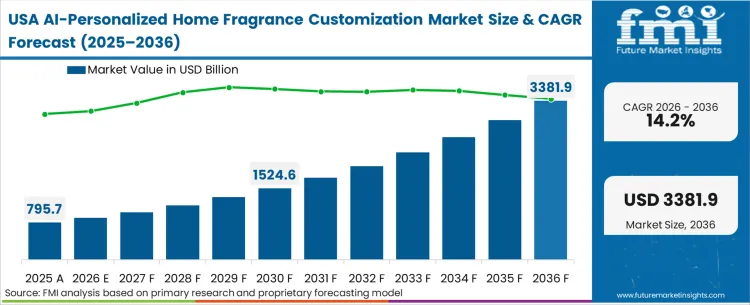
The condition defining North America’s adoption is the deep market penetration of dominant voice-assistant ecosystems like Amazon Alexa and Google Home. Consumers in this region expect any new residential device to plug immediately into their existing voice-command infrastructure, effectively treating the smart diffuser as a peripheral rather than a standalone hub. As per FMI's projection, hardware developers who attempt to force North American buyers into using isolated, proprietary apps face severe activation drop-offs. The primary engineering challenge here is not formulation or fluid dynamics, but software API compliance, ensuring the fragrance hardware can accept commands from and share status updates with the broader tech oligopoly that already controls the home's digital environment.
- United States: The sheer square footage of the average American suburban home necessitates high-output hardware or multi-device mesh networks to achieve meaningful olfactory impact. HVAC integrators in the US have a distinct advantage, as they can bypass standalone diffusers entirely by installing centralized, algorithmically controlled injection systems directly into existing forced-air ductwork. The US AI-personalized home fragrance customization sector is poised to expand at a CAGR of 14.2%. Contractors who master these integrated installations capture high-margin, whole-home retrofitting projects that entirely block out plug-and-play consumer hardware competitors.
FMI's report includes Canada market dynamics. Canadian adoption closely mirrors US technical expectations regarding voice-assistant integration, though hardware distribution is more heavily skewed toward major e-commerce aggregators due to less dense specialty retail footprints.
Europe AI-Personalized Home Fragrance Customization Market Analysis
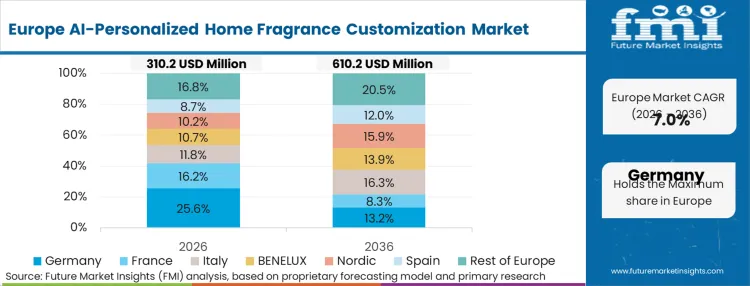
Europe market dynamics are shaped heavily by stringent chemical safety and indoor air quality regulations, which dictate the types of solvents and propellants permissible in automated dispensing systems. European consumers exhibit high skepticism toward synthetic fragrance fixes that operate continuously in enclosed spaces, forcing brands to transparently verify the botanical origin and safety profile of their algorithmic cartridges. According to FMI's estimates, this regulatory and cultural pressure elevates the baseline cost of cartridge formulation, making it difficult for budget-tier hardware to compete. Success in Europe requires brands to lead with their clean-chemistry credentials first, positioning the AI algorithm primarily as a tool for precise dosing and waste reduction rather than just lifestyle enhancement.
- United Kingdom: UK consumers show a marked preference for subscription-based delivery models managed through direct-to-consumer digital channels. Logistics managers at fragrance brands leverage highly efficient domestic courier networks to execute flawless predictive cartridge replenishment. The UK market for AI-personalized home fragrance customization is forecast to register a CAGR of 13.5%. This reliable fulfillment infrastructure eliminates the "empty cartridge" downtime, ensuring the algorithmic system remains continuously operational and the recurring revenue stream remains unbroken.
- Germany: Strict consumer data privacy frameworks severely restrict how much biometric and behavioral data an app can collect to train its scent algorithms. Software engineers must utilize on-device processing and anonymized data pools rather than aggressive cloud-based user profiling. A CAGR of 11.9% is expected for Germany over the forecast period. The reality on the ground is that developers spend as much time navigating compliance documentation and privacy audits as they do refining the actual machine-learning models that power the diffusers.
- France: The legacy power of French luxury perfume houses dictates the aesthetic and aromatic expectations of the domestic market. Consumers demand that smart diffusers deliver complex, multi-layered fine fragrances rather than basic, single-note functional scents. French revenue is anticipated to increase by a CAGR of 10.5%. Heritage fragrance houses that successfully digitize their proprietary blends into algorithmic cartridges create an unassailable premium tier, preventing tech-first startups from commoditizing the luxury end of the spectrum.
FMI's report includes secondary European markets such as Italy and Spain. These markets exhibit similar preferences for premium aesthetic design, though the pace of smart-home infrastructure deployment trails the leading Western European economies.
Competitive Aligners for Market Players
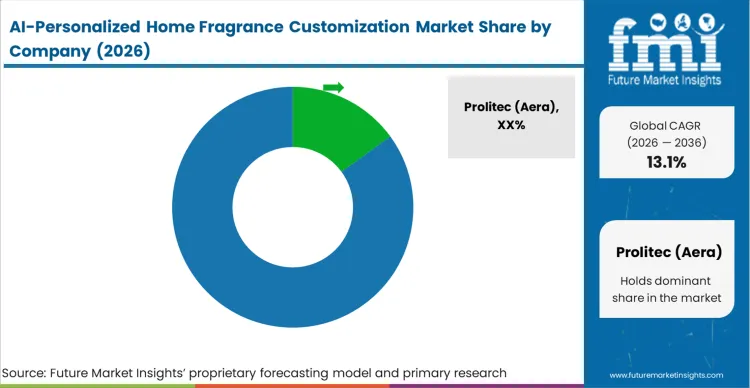
The AI-personalized home fragrance customization space is highly concentrated at the technology platform level, despite appearing fragmented at the hardware level. Buyers, whether individual consumers or commercial property managers, distinguish qualified vendors almost entirely based on the stability of their digital ecosystem and the seamlessness of their API integrations. A brand can engineer an exceptional multi-chamber physical diffuser, but if the accompanying app suffers from latency or fails to sync with universal smart-home protocols, the hardware is quickly discarded. The dominant players secure their positions not through superior plastics manufacturing, but by maintaining robust, zero-friction software environments that ensure the consumable subscription loop operates without interruption.
Incumbents like Pura and Aera command advantages due to their massive, pre-existing datasets of user behavior, which they use to continuously refine their predictive replenishment models. This data advantage creates a self-reinforcing loop: better algorithms lead to perfectly timed cartridge deliveries, which lowers subscription churn, which provides more data. A challenger attempting to disrupt these incumbents must build an equally sophisticated cloud-infrastructure and machine-learning capability. It is not enough to replicate the physical hardware; challengers must deploy predictive analytics that can anticipate a user's schedule changes and adjust the output accordingly without requiring manual app inputs.
Large retail buyers and tech conglomerates are increasingly resisting vendor lock-in, pressuring fragrance companies to open their hardware so it can be controlled by third-party smart home hubs. This dynamic points toward severe market consolidation over the next decade. Hardware pure-plays that refuse to open their APIs will be marginalized, while the survivors will likely transition into software and consumable licensing entities, allowing major consumer electronics giants to manufacture the actual physical devices.
Key Players in AI-Personalized Home Fragrance Customization Market
- Prolitec (Aera)
- ScentAir Technologies
- Pura
- Reckitt (Air Wick)
- S. C. Johnson (Glade)
- Moodo
- Estée Lauder Companies (Jo Malone London)
- Diptyque Paris
Scope of the Report
| Metric | Value |
|---|---|
| Quantitative Units | USD 1.4 billion to USD 4.8 billion, at a CAGR of 13.1% |
| Market Definition | This category covers hardware and software systems that utilize algorithms, user feedback loops, and environmental sensors to dynamically control and blend residential ambient scents, distinguishing itself from static air care through active data integration. |
| Product Type Segmentation | Smart Diffusers, AI-Blended Cartridges, Algorithmic Subscription Kits |
| Technology Interface Segmentation | Voice-Activated, App-Controlled, Biometric/Sensor-Driven |
| Sales Channel Segmentation | Direct-to-Consumer (DTC), Specialty Retail, E-Commerce Platforms |
| Regions Covered | North America, Europe, Asia Pacific |
| Countries Covered | United States, United Kingdom, China, Japan, Germany, South Korea, France, and 40 plus countries |
| Key Companies Profiled | Pura, Aera (Prolitec), Moodo, Diptyque, Jo Malone (Estée Lauder), ScentAir, Air Wick (Reckitt), Glade (SC Johnson) |
| Forecast Period | 2026 to 2036 |
| Approach | Primary research targeted hardware product managers and digital subscription strategists. Baselines were anchored to connected-device activation volumes and subsequent cartridge replacement rates within closed digital ecosystems. Forecasts were cross-validated against recurring revenue growth metrics reported by publicly traded smart-home pure-plays. |
Source: Future Market Insights (FMI) analysis, based on proprietary forecasting model and primary research
AI-Personalized Home Fragrance Customization Market Analysis by Segments
Product Type:
- Smart Diffusers
- AI-Blended Cartridges
- Algorithmic Subscription Kits
Technology Interface:
- Voice-Activated
- App-Controlled
- Biometric/Sensor-Driven
Sales Channel:
- Direct-to-Consumer (DTC)
- Specialty Retail
- E-Commerce Platforms
Region:
- North America
- United States
- Canada
- Europe
- Germany
- United Kingdom
- France
- Italy
- Spain
- Asia Pacific
- China
- Japan
- South Korea
- Taiwan
- Singapore
- Latin America
- Brazil
- Mexico
- Argentina
- Middle East & Africa
- GCC Countries
- South Africa
- Israel
Bibliography
- Yildirim, M., et al. (2025). Digital smell technologies for the built environment: Multisensory integration and user perception. Building and Environment
- Martinez, R. G. (2024, November). Bayesian algorithmic perfumery: Estimating personalized fragrance preferences using machine learning. arXiv.
- International Flavors & Fragrances Inc. (2025, February). IFF introduces AI-powered ScentChat for fragrance creation and consumer feedback.
- Tilley Distribution. (2024, August). How AI-generated perfume is transforming fragrance development
- The Estée Lauder Companies. (2025, December). Jo Malone London launches AI-powered scent advisor for personalized fragrance discovery.
This bibliography is provided for reader reference. The full FMI report contains the complete reference list with primary source documentation.
This Report Addresses
- Market intelligence to support strategic decision making across smart diffusers, AI-blended cartridges, and algorithmic subscription kits.
- Market size estimation and 10-year revenue forecasts from 2026 to 2036, supported by connected-device activation volumes and cartridge replacement rates.
- Growth opportunity mapping across product types and technology interfaces with emphasis on the native integration of scent dispensers with dominant residential HVAC and smart-hub protocols.
- Segment and regional revenue forecasts covering direct-to-consumer and app-controlled platforms across stringent consumer data privacy frameworks in Europe and high-density urban infrastructure in Asia.
- Competition strategy assessment including closed proprietary ecosystems, predictive fulfillment algorithms, and universal communication protocol compliance.
- Product development tracking including multi-chamber hardware architecture, micro-dosing mechanics, Matter protocol interoperability, and biometric sensor integration.
- Market access analysis covering European indoor air quality regulations, telecom-bundled broadband distribution models, and direct-to-consumer acquisition cost structures.
- Market report delivery in PDF, Excel, PPT, and interactive dashboard formats for executive strategy, digital subscription planning, and operational benchmarking use.
Frequently Asked Questions
How large is the AI-Personalized Home Fragrance Customization Market in 2026?What drives rapid growth?
The industry is expected to surpass USD 1.4 billion in 2026. This figure signals the transition of connected scent devices from niche luxury novelties into established components of the broader smart home hardware ecosystem.
What will it be valued at by 2036?
The valuation reaches USD 4.8 billion by 2036. This scale reflects the compounding value of recurring algorithm-driven subscription models rather than just physical device sell-through.
What CAGR is projected?
A CAGR of 13.1% is projected over the forecast period. This rate is heavily anchored to the expansion of direct-to-consumer fulfillment networks and the rising penetration of integrated smart home hubs globally.
Which Product Type segment leads?
Smart Diffusers are anticipated to hold 48.5% share in 2026. Hardware acts as the strict physical gateway for algorithmic blending; software cannot manipulate the olfactory environment without these multi-chamber mechanical systems in place.
Which Technology Interface segment leads?
App-Controlled interfaces capture the dominant share. Smartphone dashboards provide the explicit manual overrides that consumers demand when automated or biometric scent adjustments misinterpret their immediate preferences.
Which Sales Channel segment leads?
Direct-to-Consumer (DTC) channels lead the market. Hardware manufacturers require this direct pipeline to gather the behavioral data necessary to train their predictive scent algorithms and secure full margin on recurring cartridge sales.
What drives rapid growth?
Ecosystem lock-in strategies compel smart home developers to push connected fragrance hardware. Securing the device footprint on a consumer's countertop guarantees a closed-loop revenue stream for proprietary consumable refills.
What is the primary restraint?
The incompatibility of localized scent nodes with legacy central HVAC systems creates massive friction. Consumers wanting whole-home automation face prohibitive retrofitting costs to link algorithmic software directly with their existing ductwork.
Which country grows fastest?
China expands at 15.8%, driven by an aggressive domestic electronics manufacturing base that rapidly iterates on smart hardware. In contrast, the US grows at 14.2%, constrained slightly by the necessity to integrate with highly entrenched, dominant voice-assistant tech oligopolies.
How do European privacy regulations impact app-controlled diffusers?
Germany's strict data privacy frameworks force software engineers to process behavioral scent preferences locally on the device rather than in the cloud. This limits the speed at which machine learning models can be trained across broad, anonymized user pools.
What role does the Matter protocol play in device development?
The interoperability mandate forces fragrance hardware manufacturers to open their software APIs to universal protocols. A diffuser that cannot natively sync with broader residential choreographies, like smart lighting or security systems, rapidly loses relevance.
Why is the competitive structure considered highly concentrated?
While physical hardware production appears fragmented, the actual value resides in predictive analytics. Incumbents like Pura and Aera leverage massive historical datasets to execute flawless cartridge fulfillment, creating a machine-learning moat that new entrants cannot easily replicate.
How does Asian urban density shape hardware engineering?
The extreme density of APAC urban housing pushes manufacturers toward aggressive miniaturization. Diffusers are engineered for hyper-localized, multi-functional zoning in small spaces rather than the high-output capacity required for North American suburban footprints.
Why do specialty retail channels struggle to maintain share?
Wholesale distribution strips the manufacturer of critical post-purchase digital interaction data. Brands utilize physical retail purely for sensory discovery, but immediately funnel the lucrative subscription cartridge lifecycle into their proprietary DTC platforms.
What prevents luxury heritage fragrance brands from dominating the hardware space?
Heritage perfume houses excel in complex synthetic formulation but lack embedded software engineering capabilities. They must form joint ventures with tech startups to translate their fine fragrances into micro-dosed algorithmic formats.
How do telecom bundles influence adoption in South Korea?
Broadband providers bundle smart home devices directly into high-tier internet contracts, removing the initial hardware cost barrier for consumers. This model hyper-accelerates hardware placement, shifting the entire commercial focus to the backend consumable subscription.
What happens to manufacturers who ignore predictive fulfillment?
Users rapidly abandon connected diffusers if they are forced to manually monitor fluid levels and order replacements. Brands lacking the software sophistication to ship refills proactively suffer massive subscription cancellation rates within the first year.
Why are voice-activated systems not the leading interface?
Voice assistants excel at simple binary commands but struggle with nuanced, multi-variable requests regarding scent intensity and scheduling. Users inevitably default to visual app dashboards to fine-tune complex olfactory parameters.
How do aesthetic requirements dictate smart diffuser design?
Consumers treat connected diffusers as premium interior design elements rather than functional utilities. Hardware must mask complex pumping mechanics and Wi-Fi antennas behind minimalist materials to secure placement in high-visibility living spaces.
What is the functional limitation of biometric sensor-driven diffusers?
Current ambient and wearable sensors frequently misinterpret user stress levels or sleep states. Relying entirely on this flawed biometric data leads to inappropriate scent triggers, forcing manufacturers to build in prominent manual override functions.
Why are standard plug-in air fresheners excluded from this analysis?
Traditional plug-ins operate on static timers or continuous heat without data feedback loops. They lack the machine-learning capabilities, connectivity, and multi-chamber blending required to qualify as algorithmically personalized systems.
How do commercial B2B contracts differ from residential deployment?
Hospitality integrators require centralized cloud dashboards capable of managing hundreds of distinct diffuser zones simultaneously. Consumer-grade hardware architectures typically fail under the load of this property-wide synchronization requirement.
Preview the report firsthand - request a free sample
Get SampleGet the brochure for pricing and purchase details.
Get PDFTable of Content
- Executive Summary
- Global Market Outlook
- Demand-side Trends
- Supply-side Trends
- Technology Roadmap Analysis
- Market Overview
- Market Coverage / Taxonomy
- Market Definition / Scope / Limitations
- Research Methodology
- Chapter Orientation
- Analytical Lens and Working Hypotheses
- Market Structure, Signals, and Trend Drivers
- Benchmarking and Cross-market Comparability
- Market Sizing, Forecasting, and Opportunity Mapping
- Research Design and Evidence Framework
- Desk Research Programme (Secondary Evidence)
- Company Annual and Sustainability Reports
- Peer-reviewed Journals and Academic Literature
- Corporate Websites, Product Literature, and Technical Notes
- Earnings Decks and Investor Briefings
- Statutory Filings and Regulatory Disclosures
- Technical White Papers and Standards Notes
- Trade Journals, Industry Magazines, and Analyst Briefs
- Conference Proceedings, Webinars, and Seminar Materials
- Government Statistics Portals and Public Data Releases
- Sector Databases and Reference Repositories
- FMI Internal Proprietary Databases and Historical Market Datasets
- Subscription Datasets and Paid Sources
- Social Channels, Communities, and Digital Listening Inputs
- Additional Desk Sources
- Expert Input and Fieldwork (Primary Evidence)
- Primary Modes
- Qualitative Interviews and Expert Elicitation
- Quantitative Surveys and Structured Data Capture
- Blended Approach
- Why Primary Evidence is Used
- Field Techniques
- Interviews
- Surveys
- Focus Groups
- Observational and In-context Research
- Social and Community Interactions
- Stakeholder Universe Engaged
- C-suite Leaders
- Board Members
- Presidents and Vice Presidents
- R&D and Innovation Heads
- Technical Specialists
- Domain Subject-matter Experts
- Scientists
- Physicians and Other Healthcare Professionals
- Governance, Ethics, and Data Stewardship
- Research Ethics
- Data Integrity and Handling
- Primary Modes
- Tooling, Models, and Reference Databases
- Desk Research Programme (Secondary Evidence)
- Data Engineering and Model Build
- Data Acquisition and Ingestion
- Cleaning, Normalisation, and Verification
- Synthesis, Triangulation, and Analysis
- Quality Assurance and Audit Trail
- Market Background
- Market Dynamics
- Drivers
- Restraints
- Opportunity
- Trends
- Scenario Forecast
- Demand in Optimistic Scenario
- Demand in Likely Scenario
- Demand in Conservative Scenario
- Opportunity Map Analysis
- Product Life Cycle Analysis
- Supply Chain Analysis
- Investment Feasibility Matrix
- Value Chain Analysis
- PESTLE and Porter’s Analysis
- Regulatory Landscape
- Regional Parent Market Outlook
- Production and Consumption Statistics
- Import and Export Statistics
- Market Dynamics
- Global Market Analysis 2021 to 2025 and Forecast, 2026 to 2036
- Historical Market Size Value (USD Million) Analysis, 2021 to 2025
- Current and Future Market Size Value (USD Million) Projections, 2026 to 2036
- Y-o-Y Growth Trend Analysis
- Absolute $ Opportunity Analysis
- Global Market Pricing Analysis 2021 to 2025 and Forecast 2026 to 2036
- Global Market Analysis 2021 to 2025 and Forecast 2026 to 2036, By Technology Interface
- Introduction / Key Findings
- Historical Market Size Value (USD Million) Analysis By Technology Interface , 2021 to 2025
- Current and Future Market Size Value (USD Million) Analysis and Forecast By Technology Interface , 2026 to 2036
- App-Controlled
- Voice-Activated
- Biometric/Sensor-Driven
- App-Controlled
- Y-o-Y Growth Trend Analysis By Technology Interface , 2021 to 2025
- Absolute $ Opportunity Analysis By Technology Interface , 2026 to 2036
- Global Market Analysis 2021 to 2025 and Forecast 2026 to 2036, By Sales Channel
- Introduction / Key Findings
- Historical Market Size Value (USD Million) Analysis By Sales Channel, 2021 to 2025
- Current and Future Market Size Value (USD Million) Analysis and Forecast By Sales Channel, 2026 to 2036
- Direct-to-Consumer (DTC)
- Specialty Retail
- E-Commerce Platforms
- Direct-to-Consumer (DTC)
- Y-o-Y Growth Trend Analysis By Sales Channel, 2021 to 2025
- Absolute $ Opportunity Analysis By Sales Channel, 2026 to 2036
- Global Market Analysis 2021 to 2025 and Forecast 2026 to 2036, By Product Type
- Introduction / Key Findings
- Historical Market Size Value (USD Million) Analysis By Product Type, 2021 to 2025
- Current and Future Market Size Value (USD Million) Analysis and Forecast By Product Type, 2026 to 2036
- Smart Diffusers
- AI-Blended Cartridges
- Algorithmic Subscription Kits
- Smart Diffusers
- Y-o-Y Growth Trend Analysis By Product Type, 2021 to 2025
- Absolute $ Opportunity Analysis By Product Type, 2026 to 2036
- Global Market Analysis 2021 to 2025 and Forecast 2026 to 2036, By Region
- Introduction
- Historical Market Size Value (USD Million) Analysis By Region, 2021 to 2025
- Current Market Size Value (USD Million) Analysis and Forecast By Region, 2026 to 2036
- North America
- Latin America
- Western Europe
- Eastern Europe
- East Asia
- South Asia and Pacific
- Middle East & Africa
- Market Attractiveness Analysis By Region
- North America Market Analysis 2021 to 2025 and Forecast 2026 to 2036, By Country
- Historical Market Size Value (USD Million) Trend Analysis By Market Taxonomy, 2021 to 2025
- Market Size Value (USD Million) Forecast By Market Taxonomy, 2026 to 2036
- By Country
- USA
- Canada
- Mexico
- By Technology Interface
- By Sales Channel
- By Product Type
- By Country
- Market Attractiveness Analysis
- By Country
- By Technology Interface
- By Sales Channel
- By Product Type
- Key Takeaways
- Latin America Market Analysis 2021 to 2025 and Forecast 2026 to 2036, By Country
- Historical Market Size Value (USD Million) Trend Analysis By Market Taxonomy, 2021 to 2025
- Market Size Value (USD Million) Forecast By Market Taxonomy, 2026 to 2036
- By Country
- Brazil
- Chile
- Rest of Latin America
- By Technology Interface
- By Sales Channel
- By Product Type
- By Country
- Market Attractiveness Analysis
- By Country
- By Technology Interface
- By Sales Channel
- By Product Type
- Key Takeaways
- Western Europe Market Analysis 2021 to 2025 and Forecast 2026 to 2036, By Country
- Historical Market Size Value (USD Million) Trend Analysis By Market Taxonomy, 2021 to 2025
- Market Size Value (USD Million) Forecast By Market Taxonomy, 2026 to 2036
- By Country
- Germany
- UK
- Italy
- Spain
- France
- Nordic
- BENELUX
- Rest of Western Europe
- By Technology Interface
- By Sales Channel
- By Product Type
- By Country
- Market Attractiveness Analysis
- By Country
- By Technology Interface
- By Sales Channel
- By Product Type
- Key Takeaways
- Eastern Europe Market Analysis 2021 to 2025 and Forecast 2026 to 2036, By Country
- Historical Market Size Value (USD Million) Trend Analysis By Market Taxonomy, 2021 to 2025
- Market Size Value (USD Million) Forecast By Market Taxonomy, 2026 to 2036
- By Country
- Russia
- Poland
- Hungary
- Balkan & Baltic
- Rest of Eastern Europe
- By Technology Interface
- By Sales Channel
- By Product Type
- By Country
- Market Attractiveness Analysis
- By Country
- By Technology Interface
- By Sales Channel
- By Product Type
- Key Takeaways
- East Asia Market Analysis 2021 to 2025 and Forecast 2026 to 2036, By Country
- Historical Market Size Value (USD Million) Trend Analysis By Market Taxonomy, 2021 to 2025
- Market Size Value (USD Million) Forecast By Market Taxonomy, 2026 to 2036
- By Country
- China
- Japan
- South Korea
- By Technology Interface
- By Sales Channel
- By Product Type
- By Country
- Market Attractiveness Analysis
- By Country
- By Technology Interface
- By Sales Channel
- By Product Type
- Key Takeaways
- South Asia and Pacific Market Analysis 2021 to 2025 and Forecast 2026 to 2036, By Country
- Historical Market Size Value (USD Million) Trend Analysis By Market Taxonomy, 2021 to 2025
- Market Size Value (USD Million) Forecast By Market Taxonomy, 2026 to 2036
- By Country
- India
- ASEAN
- Australia & New Zealand
- Rest of South Asia and Pacific
- By Technology Interface
- By Sales Channel
- By Product Type
- By Country
- Market Attractiveness Analysis
- By Country
- By Technology Interface
- By Sales Channel
- By Product Type
- Key Takeaways
- Middle East & Africa Market Analysis 2021 to 2025 and Forecast 2026 to 2036, By Country
- Historical Market Size Value (USD Million) Trend Analysis By Market Taxonomy, 2021 to 2025
- Market Size Value (USD Million) Forecast By Market Taxonomy, 2026 to 2036
- By Country
- Kingdom of Saudi Arabia
- Other GCC Countries
- Turkiye
- South Africa
- Other African Union
- Rest of Middle East & Africa
- By Technology Interface
- By Sales Channel
- By Product Type
- By Country
- Market Attractiveness Analysis
- By Country
- By Technology Interface
- By Sales Channel
- By Product Type
- Key Takeaways
- Key Countries Market Analysis
- USA
- Pricing Analysis
- Market Share Analysis, 2025
- By Technology Interface
- By Sales Channel
- By Product Type
- Canada
- Pricing Analysis
- Market Share Analysis, 2025
- By Technology Interface
- By Sales Channel
- By Product Type
- Mexico
- Pricing Analysis
- Market Share Analysis, 2025
- By Technology Interface
- By Sales Channel
- By Product Type
- Brazil
- Pricing Analysis
- Market Share Analysis, 2025
- By Technology Interface
- By Sales Channel
- By Product Type
- Chile
- Pricing Analysis
- Market Share Analysis, 2025
- By Technology Interface
- By Sales Channel
- By Product Type
- Germany
- Pricing Analysis
- Market Share Analysis, 2025
- By Technology Interface
- By Sales Channel
- By Product Type
- UK
- Pricing Analysis
- Market Share Analysis, 2025
- By Technology Interface
- By Sales Channel
- By Product Type
- Italy
- Pricing Analysis
- Market Share Analysis, 2025
- By Technology Interface
- By Sales Channel
- By Product Type
- Spain
- Pricing Analysis
- Market Share Analysis, 2025
- By Technology Interface
- By Sales Channel
- By Product Type
- France
- Pricing Analysis
- Market Share Analysis, 2025
- By Technology Interface
- By Sales Channel
- By Product Type
- India
- Pricing Analysis
- Market Share Analysis, 2025
- By Technology Interface
- By Sales Channel
- By Product Type
- ASEAN
- Pricing Analysis
- Market Share Analysis, 2025
- By Technology Interface
- By Sales Channel
- By Product Type
- Australia & New Zealand
- Pricing Analysis
- Market Share Analysis, 2025
- By Technology Interface
- By Sales Channel
- By Product Type
- China
- Pricing Analysis
- Market Share Analysis, 2025
- By Technology Interface
- By Sales Channel
- By Product Type
- Japan
- Pricing Analysis
- Market Share Analysis, 2025
- By Technology Interface
- By Sales Channel
- By Product Type
- South Korea
- Pricing Analysis
- Market Share Analysis, 2025
- By Technology Interface
- By Sales Channel
- By Product Type
- Russia
- Pricing Analysis
- Market Share Analysis, 2025
- By Technology Interface
- By Sales Channel
- By Product Type
- Poland
- Pricing Analysis
- Market Share Analysis, 2025
- By Technology Interface
- By Sales Channel
- By Product Type
- Hungary
- Pricing Analysis
- Market Share Analysis, 2025
- By Technology Interface
- By Sales Channel
- By Product Type
- Kingdom of Saudi Arabia
- Pricing Analysis
- Market Share Analysis, 2025
- By Technology Interface
- By Sales Channel
- By Product Type
- Turkiye
- Pricing Analysis
- Market Share Analysis, 2025
- By Technology Interface
- By Sales Channel
- By Product Type
- South Africa
- Pricing Analysis
- Market Share Analysis, 2025
- By Technology Interface
- By Sales Channel
- By Product Type
- USA
- Market Structure Analysis
- Competition Dashboard
- Competition Benchmarking
- Market Share Analysis of Top Players
- By Regional
- By Technology Interface
- By Sales Channel
- By Product Type
- Competition Analysis
- Competition Deep Dive
- Prolitec (Aera)
- Overview
- Product Portfolio
- Profitability by Market Segments (Product/Age /Sales Channel/Region)
- Sales Footprint
- Strategy Overview
- Marketing Strategy
- Product Strategy
- Channel Strategy
- ScentAir Technologies
- Pura
- Reckitt (Air Wick)
- S. C. Johnson (Glade)
- Moodo
- Estée Lauder Companies (Jo Malone London)
- Diptyque Paris
- Prolitec (Aera)
- Competition Deep Dive
- Assumptions & Acronyms Used


