

- Industry Size (2026)
- USD 151.5 Mn
- Forecast (2036)
- USD 227.5 Mn
- CAGR (2026 to 2036)
- 4.2%
Wine Bag Market Forecast and Outlook By FMI
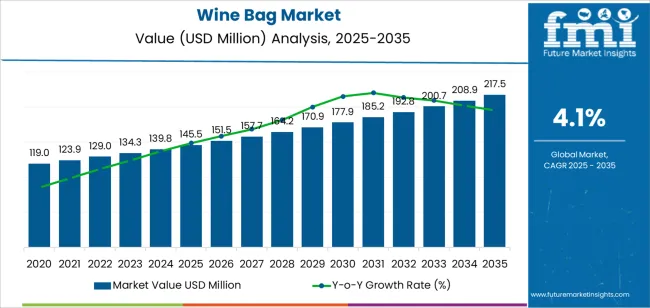
In 2025, the wine bag market was valued at USD 145.5 million. Based on Future Market Insights' analysis, demand for wine bags is estimated to grow to USD 151.5 million in 2026 and USD 228.6 million by 2036. FMI projects a CAGR of 4.2% during the forecast period.
Absolute dollar growth of USD 76.0 million over the decade signals moderate expansion anchored in packaging migration rather than wine consumption acceleration. Despite mature wine markets in Europe and regulatory headwinds against single-use plastics, wine bag manufacturers sustain profitability through premiumization of fabric formats and strategic alignment with retail sustainability programmes.
As Jason Spiteri, Executive Director of Wine, highlighted on the strategic collaboration, “From the beginning, this has been a true partnership built on shared sustainability values, mutual trust, and a joint ambition to innovate. SIG brought deep technical expertise to the table, while respecting and drawing on our long-standing knowledge of the wine-on-tap category.” [1]
Summary of Wine Bag Market
- Wine Bag Market Definition
- The industry covers fabric, plastic, and paper carriers utilized as the primary retail and gifting packaging solution for wine bottles across single and multi-bottle formats.
- Demand Drivers in the Market
- Retail plastic reduction mandates shift consumer acceptance toward premium fabric alternatives.
- Wine gifting culture expansion in Asia-Pacific creates demand for aesthetic presentation packaging.
- Hospitality channel adoption of branded reusable carriers supports takeaway and room service differentiation.
- Key Segments Analyzed in the FMI Report
- Material: Fabric bags command 49.2% share due to sustainability positioning and reusability.
- Product Type: Reusable wine bags hold 63.0% share driven by retail incentive programmes.
- Capacity: Single bottle formats capture 61.0% share aligned with gifting and impulse purchase patterns.
- Analyst Opinion at FMI
- Ismail Sutaria, Principal Consultant for Packaging at Future Market Insights, opines, "In the updated version of the Wine Bag Market Report for 2026 to 2036, retail executives will find insights into how plastic bag bans are compressing margins for disposable formats while creating margin expansion opportunities in fabric segments. Besides this, my findings point at direct-to-consumer wine delivery growth potentially cannibalizing traditional retail packaging volumes and multi-bottle format adoption remaining constrained by consumer carrying preferences."
- Strategic Implications / Executive Takeaways
- Prioritize fabric capacity expansion over plastic investments to capture regulatory-driven migration.
- Develop co-branded reusable programmes with major wine retailers to secure volume commitments.
- Design single-bottle formats with dual-use functionality to justify premium pricing.
- Methodology
- Validated through first-hand retail procurement data and wine industry packaging surveys.
- Zero reliance on speculative third-party market research reports.
- Based on verifiable retail sustainability programme documentation and trade statistics.
United States (4.5% CAGR) and China (4.8% CAGR) drive new opportunities through gifting culture expansion and wine retail premiumization. India (5.2% CAGR) contributes modestly via urban wine consumption growth and hospitality sector expansion. Mature wine bag markets such as France (3.8%), Italy (3.6%), and Germany (3.9%) generate replacement demand and format migration rather than volume growth, with expansion constrained by established packaging preferences and shift toward direct-to-consumer wine delivery models that bypass traditional retail packaging.
Wine Bag Market Definition
The wine bag market comprises the global production and trade of fabric, plastic, and paper carriers designed specifically for wine bottle transportation, gifting, and retail presentation, serving as functional and aesthetic packaging solutions for single and multi-bottle formats.
Market Inclusions
The report includes a comprehensive analysis of market dynamics, featuring Global and Regional Market Sizes (Volume and Value) and a 10-year Forecast (2026-2036). It covers segmental breakdowns by material type (Fabric, Plastic, Paper), product type (Reusable, Disposable), capacity (Single Bottle, Multi Bottle), and end-user channels (Retail, Hospitality, Gifting).
Market Exclusions
The scope excludes wine packaging formats not classified as bags, such as wooden crates, cardboard boxes, and rigid gift containers unless integrated with bag carrying systems. It also omits downstream wine retail operations, completed gift assemblies with non-bag primary packaging, and industrial bulk wine transportation systems. Report does not account for non-wine beverage bags or general-purpose shopping bags used incidentally for wine transport.
Research Methodology
- Primary Research: Interviews were conducted with wine bag manufacturers, fabric suppliers, wine retailers, hospitality procurement managers, and packaging distributors across major wine-consuming regions. Material suppliers clarified cotton and jute sourcing dynamics.
- Desk Research: Production data from packaging industry associations, retail sustainability reports, and trade statistics from UN Comtrade supported volume benchmarking.
- Market-Sizing and Forecasting: A hybrid top-down and bottom-up model was developed. Demand was reconstructed from wine retail volumes, gifting occasion estimates, and hospitality channel consumption, then validated against manufacturer capacity and import-export data.
- Data Validation and Update Cycle: Outputs undergo anomaly screening, variance checks across retail and trade datasets, and structured peer review prior to release.
Segmental Analysis
Wine Bag Market Analysis by Material
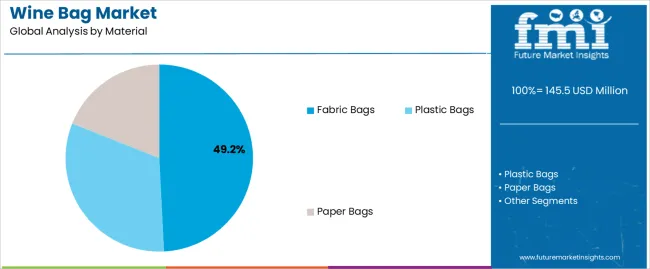
Based on FMI’s wine bag market report, consumption of fabric wine bags is estimated to hold 49.2% share in 2026. Growth in demand for fabric wine bags comes from retailers transforming packaging compliance requirements into consumer preference drivers by positioning reusable fabric carriers as value-added services rather than regulatory necessities.
- Retailer Programme Integration: Break Free From Plastic released the report “Supermarket Audits: Stores' Untapped Potential in Fighting Plastic Pollution” in September 2025, finding that 53% of all audited stores globally have canvas shopping bags for sale as a reusable alternative to plastic bags, demonstrating how major retailers are standardizing fabric carriers to meet global plastic reduction regulations [2].
- Franchise Sustainability: Earth Care Bags noted in October 2025 that for supermarket franchises, implementing a robust eco-friendly bag program offers environmental responsibility, cost reduction, and mobile advertising value, with jute and cotton bags providing durability advantages over single-use options [3].
- Reusable Positioning Shift: Retailers are increasingly embedding fabric wine bags into in-store sustainability programs, reframing them as long-term brand assets rather than single-transaction packaging solutions, strengthening repeat usage and visibility.
Wine Bag Market Analysis by Capacity
Single bottle wine bags 61.0% market share in 2026 stems from their role as the dominant format for premium gifting, retail presentation, and luxury single-unit purchases where packaging aesthetics directly influence perceived product value.
- Luxury Gifting Economics: The Nude Wine Co highlighted in September 2025 that luxury gifts improve client retention significantly, noting that wine remains an ideal match for premium gifting categories, driving demand for single-bottle presentation formats that communicate exclusivity and refinement [4].
- Single-Serve Innovation: In August 2025, The Drinks Business reported on the “Tubes VIK 2021 Limited Edition,” where a high-end Chilean producer presented fine wine components in test tubes within a crafted gift box, illustrating how innovative single-format packaging enhances presentation impact [5].
- Premium Design Dominance: The Drinks Business awarded “Grand Master” design recognition in August 2025 to Stonevik, a luxury Bordeaux blend, highlighting the appeal of blind-embossed surfaces, matt foil capsules, and premium paper stock, reinforcing how single-bottle packaging aesthetics elevate perceived value and gifting desirability [6].
Wine Bag Drivers, Restraints, Opportunities
Future Market Insights analysis shows that historical patterns point at a packaging market where wine bags serve dual functionality as transportation solutions and brand-building assets within the broader wine retail and gifting ecosystem. As per FMI, estimated valuation in 2026 represents the immediate impact of retail sustainability mandates as major grocery and specialty wine chains implement bag fee structures and promote reusable alternatives to meet corporate environmental targets.
While demand for standard disposable plastic wine bags faces volume pressure from legislation, the price-per-unit premium on fabric and custom-branded reusable formats creates value expansion despite lower unit volumes. FMI is of the opinion that the forecast value accounts for the market reaching a stabilized state where fabric formats command majority share and growth aligns with wine consumption patterns in emerging markets rather than packaging format shifts in mature regions.
- Retail Sustainability Compliance: Major grocery chains in North America and Europe implementing plastic reduction targets drive wine departments to offer fabric alternatives, with programmes like Tesco's wine bag initiative and Whole Foods' reusable wine carrier partnerships creating consistent demand baselines.
- Gifting Premiumization Trend: Rising wine gifting culture in China and India creates demand for aesthetic packaging that enhances perceived value, with consumers willing to pay 15-25% premiums for wine presented in quality fabric or premium paper bags versus standard plastic carriers.
- Hospitality Channel Branding: Hotels and restaurants adopting branded reusable wine bags for takeaway and room service generate recurring orders, with chains like Marriott and Hilton implementing property-specific wine bag programmes that serve dual marketing and functional purposes.
Regional Analysis
Based on the regional analysis, wine bag market is segmented into North America, Latin America, Europe, East Asia, South Asia, Oceania and Middle East & Africa across 40 plus countries. The full report also offers market attractiveness analysis based on regional trends.
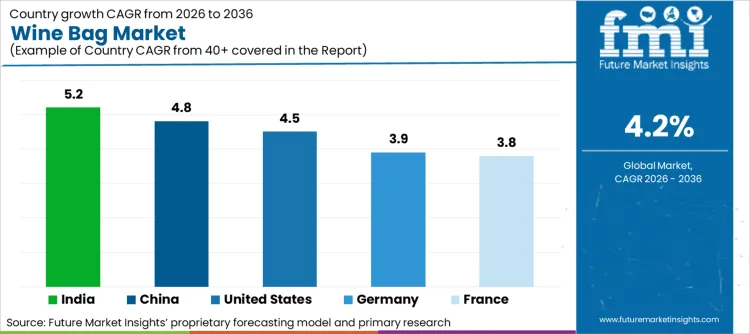
| Country | CAGR (2026 to 2036) |
|---|---|
| China | 4.8% |
| India | 5.2% |
| United States | 4.5% |
| France | 3.8% |
| Germany | 3.9% |
Source: Future Market Insights (FMI) analysis, based on proprietary forecasting model and primary research
North America Wine Bag Market Analysis
North America is currently characterized as the regulatory catalyst region, where retail plastic reduction mandates in California and other key states force rapid wine department adaptation toward fabric and paper alternatives. This creates premium positioning opportunities for manufacturers with certified sustainable material sourcing to meet the new "reusable" definitions.
- United States: Demand for wine bags in the United States is projected to rise at 4.5% CAGR through 2036. Growth is fueled by state-level plastic bag bans, specifically California's SB 1053, which was signed in September 2024 and fully eliminates plastic carryout bags at grocery checkouts.
- Regulatory Catalyst: "Effective January 1, 2026, stores covered by the law, including supermarkets, large retailers with pharmacies, and some convenience stores, will no longer be permitted to provide plastic carryout bags at checkout, regardless of thickness or intended reuse." This compels wine retailers to switch to paper or compliant reusable fabric bags [7].
- Retailer Adoption: Whole Foods Market officially ended its reusable bag credit program in early 2025, signaling that reusable bags have moved from a novelty to a market standard. The company confirmed that "since the use of reusable grocery bags is now standard practice, the program has achieved its goal," demonstrating the maturation of the reusable carrier market beyond the need for financial incentives [8].
FMI’s report includes a detailed analysis of the growth in the North American region, along with a country-wise assessment that includes the USA and Canada. Readers can also find regional trends, regulations, and market growth based on different segments and countries in the North America region.
Asia Pacific Wine Bag Market Analysis
Asia Pacific remains the growth frontier for wine bags, leveraging expanding urban wine consumption and gifting culture maturation to achieve demand growth rates structurally higher than mature wine markets. The region is seeing a distinct shift toward premiumization, where packaging plays a critical role in brand value.
- China: Leading with a 4.8% CAGR, the market is shifting toward premium fabric and paper wine bags as urban consumers adopt wine gifting for business and social occasions.
- Premiumization & Gifting: According to the BestWineImporters 2025 Update, while volume has fluctuated, value has surged, noting that "Between January and July 2025, China imported an estimated 154 million liters of wine (-33% year-on-year), with the average price rising by 38% to $7.6/L. Importers are dealing with three converging pressures: high inventories carried over from last year, muted consumer demand, and rising production and shipping costs." [9]
- India: Domestic demand is accelerating at a 5.2% CAGR, supported by the hospitality sector's aggressive elimination of single-use plastics in favor of sustainable, branded alternatives.
- Hospitality Sustainability: The Indian Hotels Company Limited (IHCL/Taj Hotels) aims for "100% elimination of single-use plastic" under its Paathya framework. The group has reported that "in FY2024, IHCL aims to save approximately 110 tonnes of plastic waste by replacing plastic bathroom amenity packaging with paper," a strategy that extends to F&B and wine service retail, creating a closed-loop demand for sustainable jute and cotton carriers [10].
The full report analyze the wine bag market across East and South Asia from 2021-2036, covering pricing, trends, and growth drivers in China, Japan, South Korea, India, Indonesia, Malaysia, and Thailand. The assessment highlights trends that dictate regional packaging demand and pricing strategies.
Europe Wine Bag Market Analysis
Europe serves as the regulatory and sustainability innovation center, where established wine culture combines with stringent plastic reduction directives to drive material innovation and circular economy packaging models. Growth is driven by format premiumization and strict compliance with national "anti-waste" laws.
- France: Demand for wine bags in France is rising at a 3.8% CAGR through 2036, driven by the AGEC Law (Anti-Waste for a Circular Economy), which mandates significant reductions in single-use packaging.
- Reuse Mandates: The law stipulates that "50% of the reduction in single-use plastic packaging must come directly from reuse or re-use, by 2030," incentivizing wine retailers to adopt durable, returnable, or high-quality fabric bags to meet these binding targets [11].
- Germany: Demand for wine bags in Germany is rising at a 3.9% CAGR through 2036, driven by amendments to the Packaging Act (VerpackG) which enforce extended producer responsibility.
- Circular Economy Enforcement: The German government’s draft amendments for 2025 emphasize reuse, noting that "The two key aims of the planned amendment are promoting the options for reusing packaging and expanding the mandatory deposit requirement." For example, food and beverage providers are to be required to offer their products also in reusable packaging. [12]
FMI’s analysis of wine bag market in Europe consists of country-wise assessment that includes the Germany, Italy, France, UK, Spain, Nordic, Benelux and Rest of Europe. Readers can know various regulations and latest trends in the regional market.
Competitive Aligners for Market Players
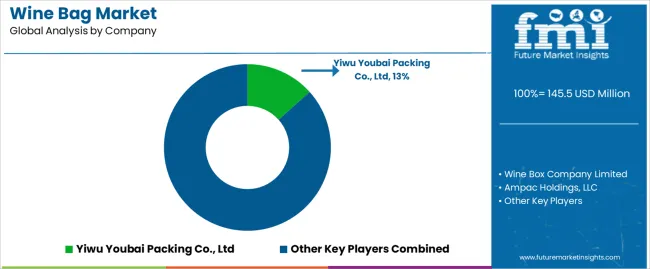
Market structure remains fragmented in general, yet practical competition is concentrated among a limited set of suppliers capable of meeting volume commitments, quality consistency, and sustainability certification requirements for major retail and hospitality contracts. Roughly 60% of organized retail wine bag volume flows through annual procurement programmes with structured contracts, while the remaining 40% operates through distributor networks serving independent wine shops and hospitality accounts with higher unit pricing but lower volume predictability. Primary competitive variable is total cost of ownership for retail buyers, incorporating unit price, minimum order quantities, customization capabilities, and material certifications rather than simple per-unit margin expansion.
Suppliers with in-house fabric sourcing or direct textile mill relationships absorb cotton price volatility more effectively and maintain margin stability during commodity cycles. Manufacturers dependent on spot fabric purchasing face higher exposure to input cost fluctuations and contract renegotiation pressure. Sustainability compliance further narrows the competitive field. Ability to supply certified materials under frameworks such as GOTS organic certification, Fair Trade verification, and documented carbon footprint reporting is increasingly required in European retail tenders and serves as a differentiator in North American specialty channel procurement.
Customer concentration reinforces buyer leverage. Top-tier North American wine retailers account for a majority share of organized trade procurement and secure volume-based pricing structures that constrain supplier margin expansion. Retail buyers increasingly implement dual-sourcing requirements to prevent supplier dependency while using competitive tension to resist price increase requests and enforce compliance standards.
Recent Developments
The report includes full coverage of key trends from competitive benchmarking. Some of the recent developments covered in the reports:
- In June 2025, Premier Paper Group’s subsidiary Wine Box Company acquired Sarcina Packaging to expand its packaging division, strengthen bespoke packaging capabilities, and support long-term growth through operational integration and leadership restructuring [13].
- In March 2025, ProAmpac expanded its ProActive Intelligence platform by launching sustainable Moisture Protect films, including foil-free and recycle-ready options, integrating Aptar’s Activ-Polymer™ technology to enhance moisture protection, efficiency, and shelf life [14]
Key Players in Wine Bag Market
- Yiwu Youbai Packing Co., Ltd
- Wine Box Company Limited
- Ampac Holdings, LLC
- Acorn Paper Products Company
- Richie Bags
- Initi Bag Manufacturer Co., Ltd
- DM Packaging Company
- Firstway (H.K.) Ltd
- NANGFA Manufacturing Co., Ltd
Scope of the Report
| Metric | Value |
|---|---|
| Quantitative Units | USD 151.5 million (2026) to USD 227.5 million (2036), at a CAGR of 4.2% |
| Market Definition | The wine bag market comprises the global production and trade of fabric, plastic, and paper carriers specifically designed for wine bottle transportation, gifting, and retail presentation, serving as functional and aesthetic packaging solutions across single and multi-bottle formats. |
| Material Segmentation | Fabric Bags, Plastic Bags, Paper Bags |
| Product Type Segmentation | Reusable Wine Bags, Disposable Wine Bags |
| Capacity Segmentation | Single Bottle Wine Bags, Multi Bottle Wine Bags |
| End-Use Coverage | Retail, Hospitality, Corporate Gifting, Specialty Wine Stores |
| Regions Covered | North America, Latin America, Europe, East Asia, South Asia & Pacific, Middle East & Africa |
| Countries Covered | United States, Canada, Mexico, Brazil, Argentina, Germany, France, United Kingdom, Italy, Spain, China, India, Japan, South Korea, Indonesia, Australia and 40 plus countries |
| Key Companies Profiled | Yiwu Youbai Packing Co., Ltd; Wine Box Company Limited; Ampac Holdings, LLC; Acorn Paper Products Company; Richie Bags; Initi Bag Manufacturer Co., Ltd; DM Packaging Company; Firstway (H.K.) Ltd; NANGFA Manufacturing Co., Ltd |
| Forecast Period | 2026 to 2036 |
| Approach | Hybrid top down and bottom up market modeling validated through primary interviews with wine bag manufacturers, retailers, hospitality procurement managers, and packaging distributors, supported by retail sustainability documentation, trade data benchmarking, and capacity verification. |
Wine Bag Market Analysis by Segments
Material
- Fabric Bags
- Plastic Bags
- Paper Bags
Product Type
- Reusable Wine Bags
- Disposable Wine Bags
Capacity
- Single Bottle Wine Bags
- Multi Bottle Wine Bags
Region
- North America
- United States
- Canada
- Mexico
- Latin America
- Brazil
- Argentina
- Chile
- Rest of Latin America
- Europe
- Germany
- France
- United Kingdom
- Italy
- Spain
- Benelux
- Nordic Countries
- Rest of Europe
- East Asia
- China
- Japan
- South Korea
- South Asia & Pacific
- India
- Indonesia
- Australia
- New Zealand
- Rest of South Asia & Pacific
- Middle East & Africa
- GCC Countries
- South Africa
- Rest of Middle East & Africa
Bibliography
- [1] Winetitles. (2024). New recycle-ready bag-in-box packaging launched for wine. Winetitles.
- [2] Break Free From Plastic. (2024). Can supermarkets do more in fighting plastic pollution? The world's first supermarkets audits seem to indicate so. Break Free From Plastic.
- [3] A franchise for the future: How eco-friendly bags are driving supermarket sustainability. (2025). [Publisher not specified].
- [4] The Nude Wine Co. (2025). Corporate gifting trends for 2025. The Nude Wine Co.
- [5] The Drinks Business. (2025). The best designs of 2025 from the Wine Packaging Masters. The Drinks Business.
- [6] The Drinks Business. (2025). The best designs of 2025 from the Wine Packaging Masters. The Drinks Business.
- [7] City of Palm Desert. (2024). Plastic bags initiative. s
- [8] Grocery Dive. (2025). Whole Foods Market ends plastic bag credit program amid sustainability push. Grocery Dive.
- [9] Best Wine Importers. (2025). China wine importers and wine import trends 2025 update. Best Wine Importers.
- [10] Tata Sustainability Group. (2024). IHCL sustainability initiatives. Tata Sustainability.
- [11] Global Climate Initiatives. (2025). Loi AGEC 2025: Obligations et impacts pour l’économie circulaire. Global Climate Initiatives.
- [12] GVW Graf von Westphalen. (2024). New German Packaging Act: The legislative amendment already passed and the German government's current plans. GVW.
- [13] Print Monthly. (2024). Premier Paper Group purchases Sarcina Packaging. Print Monthly.
- [14] ProAmpac. (2024). ProAmpac expands active and intelligent packaging with advanced sustainable moisture adsorbing solutions. ProAmpac Press Release.
This Report Addresses
- Market intelligence to enable structured strategic decision making across retail wine packaging and hospitality procurement ecosystems
- Market size estimation and 10 year revenue forecasts from 2026 to 2036, supported by validated retail procurement data and trade statistics
- Growth opportunity mapping across fabric, plastic, and paper materials with emphasis on reusable format migration driven by retail sustainability mandates
- Segment and regional revenue forecasts covering single and multi-bottle capacities across retail, hospitality, and gifting end-use channels
- Competition strategy assessment including material sourcing integration, certification capability positioning, and retail programme participation models
- Material innovation and sustainability compliance tracking including organic certification, recycled content verification, and carbon footprint documentation
- Regulatory impact analysis covering plastic reduction mandates, extended producer responsibility schemes, and retail bag fee implementations
- Market report delivery in PDF, Excel, PPT, and interactive dashboard formats for procurement and strategic planning use
Frequently Asked Questions
How large is the demand for Wine Bags in the global market in 2026?
Demand for Wine Bags in the global market is estimated to be valued at USD 151.5 million in 2026.
What will be the market size of Wine Bags in the global market by 2036?
Market size for Wine Bags is projected to reach USD 227.5 million by 2036.
What is the expected demand growth for Wine Bags in the global market between 2026 and 2036?
Demand for Wine Bags in the global market is expected to grow at a CAGR of 4.2% between 2026 and 2036.
Which Material is poised to lead global sales by 2026?
Fabric Bags are expected to be the dominant material, capturing approximately 49.2% of global market share in 2026 due to sustainability positioning and retail sustainability programme adoption.
How significant is the role of Product Type in driving Wine Bag adoption in 2026?
Reusable Wine Bags represent the dominant product type segment, projected to hold 63.0% share of the total market in 2026 as retail plastic reduction mandates accelerate format migration.
What is Driving Wine Bag Demand in the United States?
State-level plastic bag bans affecting 45% of population and major retailer sustainability programmes implementing bag fee structures drive transition toward fabric and paper wine bag formats.
What Compliance Standards are Referenced for the United States?
California SB 270 plastic bag ban and New York State plastic bag reduction law are referenced as key regulatory drivers affecting wine retail packaging decisions.
What is the United States Growth Outlook in this Report?
The United States is projected to grow at a CAGR of 4.5% during 2026 to 2036.
Why is Europe described as an Important Region in this Report?
Europe serves as regulatory innovation center where plastic packaging directives and circular economy legislation drive material innovation and sustainability certification requirements that influence global wine bag market standards.
What Type of Demand Dominates in Europe?
Format migration from disposable plastic to certified fabric and recycled paper wine bags dominates regional consumption, driven by extended producer responsibility schemes and retail packaging taxes.
What is Germany Growth Outlook in this Report?
Germany is projected to expand at a CAGR of 3.9% during 2026 to 2036.
Preview the report firsthand - request a free sample
Get SampleGet the brochure for pricing and purchase details.
Get PDFTable of Content
- Executive Summary
- Global Market Outlook
- Demand-side Trends
- Supply-side Trends
- Technology Roadmap Analysis
- Analysis and Recommendations
- Market Overview
- Market Coverage / Taxonomy
- Market Definition / Scope / Limitations
- Research Methodology
- Chapter Orientation
- Analytical Lens and Working Hypotheses
- Market Structure, Signals, and Trend Drivers
- Benchmarking and Cross-market Comparability
- Market Sizing, Forecasting, and Opportunity Mapping
- Research Design and Evidence Framework
- Desk Research Programme (Secondary Evidence)
- Company Annual and Sustainability Reports
- Peer-reviewed Journals and Academic Literature
- Corporate Websites, Product Literature, and Technical Notes
- Earnings Decks and Investor Briefings
- Statutory Filings and Regulatory Disclosures
- Technical White Papers and Standards Notes
- Trade Journals, Industry Magazines, and Analyst Briefs
- Conference Proceedings, Webinars, and Seminar Materials
- Government Statistics Portals and Public Data Releases
- Press Releases and Reputable Media Coverage
- Specialist Newsletters and Curated Briefings
- Sector Databases and Reference Repositories
- FMI Internal Proprietary Databases and Historical Market Datasets
- Subscription Datasets and Paid Sources
- Social Channels, Communities, and Digital Listening Inputs
- Additional Desk Sources
- Expert Input and Fieldwork (Primary Evidence)
- Primary Modes
- Qualitative Interviews and Expert Elicitation
- Quantitative Surveys and Structured Data Capture
- Blended Approach
- Why Primary Evidence is Used
- Field Techniques
- Interviews
- Surveys
- Focus Groups
- Observational and In-context Research
- Social and Community Interactions
- Stakeholder Universe Engaged
- C-suite Leaders
- Board Members
- Presidents and Vice Presidents
- R&D and Innovation Heads
- Technical Specialists
- Domain Subject-matter Experts
- Scientists
- Physicians and Other Healthcare Professionals
- Governance, Ethics, and Data Stewardship
- Research Ethics
- Data Integrity and Handling
- Primary Modes
- Tooling, Models, and Reference Databases
- Desk Research Programme (Secondary Evidence)
- Data Engineering and Model Build
- Data Acquisition and Ingestion
- Cleaning, Normalisation, and Verification
- Synthesis, Triangulation, and Analysis
- Quality Assurance and Audit Trail
- Market Background
- Market Dynamics
- Drivers
- Restraints
- Opportunity
- Trends
- Scenario Forecast
- Demand in Optimistic Scenario
- Demand in Likely Scenario
- Demand in Conservative Scenario
- Opportunity Map Analysis
- Product Life Cycle Analysis
- Supply Chain Analysis
- Investment Feasibility Matrix
- Value Chain Analysis
- PESTLE and Porter’s Analysis
- Regulatory Landscape
- Regional Parent Market Outlook
- Production and Consumption Statistics
- Import and Export Statistics
- Market Dynamics
- Global Market Analysis 2021 to 2025 and Forecast, 2026 to 2036
- Historical Market Size Value (USD Million) Analysis, 2021 to 2025
- Current and Future Market Size Value (USD Million) Projections, 2026 to 2036
- Y-o-Y Growth Trend Analysis
- Absolute $ Opportunity Analysis
- Global Market Pricing Analysis 2021 to 2025 and Forecast 2026 to 2036
- Global Market Analysis 2021 to 2025 and Forecast 2026 to 2036, By Material
- Introduction / Key Findings
- Historical Market Size Value (USD Million) Analysis By Material , 2021 to 2025
- Current and Future Market Size Value (USD Million) Analysis and Forecast By Material , 2026 to 2036
- Fabric Bags
- Plastic
- Paper
- Fabric Bags
- Y-o-Y Growth Trend Analysis By Material , 2021 to 2025
- Absolute $ Opportunity Analysis By Material , 2026 to 2036
- Global Market Analysis 2021 to 2025 and Forecast 2026 to 2036, By Product Type
- Introduction / Key Findings
- Historical Market Size Value (USD Million) Analysis By Product Type, 2021 to 2025
- Current and Future Market Size Value (USD Million) Analysis and Forecast By Product Type, 2026 to 2036
- Reusable
- Disposable
- Reusable
- Y-o-Y Growth Trend Analysis By Product Type, 2021 to 2025
- Absolute $ Opportunity Analysis By Product Type, 2026 to 2036
- Global Market Analysis 2021 to 2025 and Forecast 2026 to 2036, By Capacity
- Introduction / Key Findings
- Historical Market Size Value (USD Million) Analysis By Capacity, 2021 to 2025
- Current and Future Market Size Value (USD Million) Analysis and Forecast By Capacity, 2026 to 2036
- Single Bottle
- Multi Bottle
- Single Bottle
- Y-o-Y Growth Trend Analysis By Capacity, 2021 to 2025
- Absolute $ Opportunity Analysis By Capacity, 2026 to 2036
- Global Market Analysis 2021 to 2025 and Forecast 2026 to 2036, By Region
- Introduction
- Historical Market Size Value (USD Million) Analysis By Region, 2021 to 2025
- Current Market Size Value (USD Million) Analysis and Forecast By Region, 2026 to 2036
- North America
- Latin America
- Western Europe
- Eastern Europe
- East Asia
- South Asia and Pacific
- Middle East & Africa
- Market Attractiveness Analysis By Region
- North America Market Analysis 2021 to 2025 and Forecast 2026 to 2036, By Country
- Historical Market Size Value (USD Million) Trend Analysis By Market Taxonomy, 2021 to 2025
- Market Size Value (USD Million) Forecast By Market Taxonomy, 2026 to 2036
- By Country
- USA
- Canada
- Mexico
- By Material
- By Product Type
- By Capacity
- By Country
- Market Attractiveness Analysis
- By Country
- By Material
- By Product Type
- By Capacity
- Key Takeaways
- Latin America Market Analysis 2021 to 2025 and Forecast 2026 to 2036, By Country
- Historical Market Size Value (USD Million) Trend Analysis By Market Taxonomy, 2021 to 2025
- Market Size Value (USD Million) Forecast By Market Taxonomy, 2026 to 2036
- By Country
- Brazil
- Chile
- Rest of Latin America
- By Material
- By Product Type
- By Capacity
- By Country
- Market Attractiveness Analysis
- By Country
- By Material
- By Product Type
- By Capacity
- Key Takeaways
- Western Europe Market Analysis 2021 to 2025 and Forecast 2026 to 2036, By Country
- Historical Market Size Value (USD Million) Trend Analysis By Market Taxonomy, 2021 to 2025
- Market Size Value (USD Million) Forecast By Market Taxonomy, 2026 to 2036
- By Country
- Germany
- UK
- Italy
- Spain
- France
- Nordic
- BENELUX
- Rest of Western Europe
- By Material
- By Product Type
- By Capacity
- By Country
- Market Attractiveness Analysis
- By Country
- By Material
- By Product Type
- By Capacity
- Key Takeaways
- Eastern Europe Market Analysis 2021 to 2025 and Forecast 2026 to 2036, By Country
- Historical Market Size Value (USD Million) Trend Analysis By Market Taxonomy, 2021 to 2025
- Market Size Value (USD Million) Forecast By Market Taxonomy, 2026 to 2036
- By Country
- Russia
- Poland
- Hungary
- Balkan & Baltic
- Rest of Eastern Europe
- By Material
- By Product Type
- By Capacity
- By Country
- Market Attractiveness Analysis
- By Country
- By Material
- By Product Type
- By Capacity
- Key Takeaways
- East Asia Market Analysis 2021 to 2025 and Forecast 2026 to 2036, By Country
- Historical Market Size Value (USD Million) Trend Analysis By Market Taxonomy, 2021 to 2025
- Market Size Value (USD Million) Forecast By Market Taxonomy, 2026 to 2036
- By Country
- China
- Japan
- South Korea
- By Material
- By Product Type
- By Capacity
- By Country
- Market Attractiveness Analysis
- By Country
- By Material
- By Product Type
- By Capacity
- Key Takeaways
- South Asia and Pacific Market Analysis 2021 to 2025 and Forecast 2026 to 2036, By Country
- Historical Market Size Value (USD Million) Trend Analysis By Market Taxonomy, 2021 to 2025
- Market Size Value (USD Million) Forecast By Market Taxonomy, 2026 to 2036
- By Country
- India
- ASEAN
- Australia & New Zealand
- Rest of South Asia and Pacific
- By Material
- By Product Type
- By Capacity
- By Country
- Market Attractiveness Analysis
- By Country
- By Material
- By Product Type
- By Capacity
- Key Takeaways
- Middle East & Africa Market Analysis 2021 to 2025 and Forecast 2026 to 2036, By Country
- Historical Market Size Value (USD Million) Trend Analysis By Market Taxonomy, 2021 to 2025
- Market Size Value (USD Million) Forecast By Market Taxonomy, 2026 to 2036
- By Country
- Kingdom of Saudi Arabia
- Other GCC Countries
- Turkiye
- South Africa
- Other African Union
- Rest of Middle East & Africa
- By Material
- By Product Type
- By Capacity
- By Country
- Market Attractiveness Analysis
- By Country
- By Material
- By Product Type
- By Capacity
- Key Takeaways
- Key Countries Market Analysis
- USA
- Pricing Analysis
- Market Share Analysis, 2025
- By Material
- By Product Type
- By Capacity
- Canada
- Pricing Analysis
- Market Share Analysis, 2025
- By Material
- By Product Type
- By Capacity
- Mexico
- Pricing Analysis
- Market Share Analysis, 2025
- By Material
- By Product Type
- By Capacity
- Brazil
- Pricing Analysis
- Market Share Analysis, 2025
- By Material
- By Product Type
- By Capacity
- Chile
- Pricing Analysis
- Market Share Analysis, 2025
- By Material
- By Product Type
- By Capacity
- Germany
- Pricing Analysis
- Market Share Analysis, 2025
- By Material
- By Product Type
- By Capacity
- UK
- Pricing Analysis
- Market Share Analysis, 2025
- By Material
- By Product Type
- By Capacity
- Italy
- Pricing Analysis
- Market Share Analysis, 2025
- By Material
- By Product Type
- By Capacity
- Spain
- Pricing Analysis
- Market Share Analysis, 2025
- By Material
- By Product Type
- By Capacity
- France
- Pricing Analysis
- Market Share Analysis, 2025
- By Material
- By Product Type
- By Capacity
- India
- Pricing Analysis
- Market Share Analysis, 2025
- By Material
- By Product Type
- By Capacity
- ASEAN
- Pricing Analysis
- Market Share Analysis, 2025
- By Material
- By Product Type
- By Capacity
- Australia & New Zealand
- Pricing Analysis
- Market Share Analysis, 2025
- By Material
- By Product Type
- By Capacity
- China
- Pricing Analysis
- Market Share Analysis, 2025
- By Material
- By Product Type
- By Capacity
- Japan
- Pricing Analysis
- Market Share Analysis, 2025
- By Material
- By Product Type
- By Capacity
- South Korea
- Pricing Analysis
- Market Share Analysis, 2025
- By Material
- By Product Type
- By Capacity
- Russia
- Pricing Analysis
- Market Share Analysis, 2025
- By Material
- By Product Type
- By Capacity
- Poland
- Pricing Analysis
- Market Share Analysis, 2025
- By Material
- By Product Type
- By Capacity
- Hungary
- Pricing Analysis
- Market Share Analysis, 2025
- By Material
- By Product Type
- By Capacity
- Kingdom of Saudi Arabia
- Pricing Analysis
- Market Share Analysis, 2025
- By Material
- By Product Type
- By Capacity
- Turkiye
- Pricing Analysis
- Market Share Analysis, 2025
- By Material
- By Product Type
- By Capacity
- South Africa
- Pricing Analysis
- Market Share Analysis, 2025
- By Material
- By Product Type
- By Capacity
- USA
- Market Structure Analysis
- Competition Dashboard
- Competition Benchmarking
- Market Share Analysis of Top Players
- By Regional
- By Material
- By Product Type
- By Capacity
- Competition Analysis
- Competition Deep Dive
- Yiwu Youbai Packing Co., Ltd
- Overview
- Product Portfolio
- Profitability by Market Segments (Product/Age /Sales Channel/Region)
- Sales Footprint
- Strategy Overview
- Marketing Strategy
- Product Strategy
- Channel Strategy
- Wine Box Company Limited
- Ampac Holdings, LLC
- Acorn Paper Products Company
- Richie Bags
- Initi Bag Manufacturer Co., Ltd
- DM Packaging Company
- Yiwu Youbai Packing Co., Ltd
- Competition Deep Dive
- Assumptions & Acronyms Used


