

- Market Size (2026)
- USD 2860.6 Mn
- Forecast (2036)
- USD 5027.1 Mn
- CAGR (2026 to 2036)
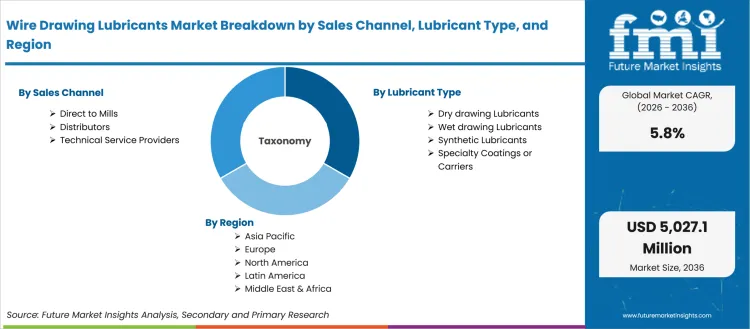
- 5.8%
How big is the Wire Drawing Lubricants Market in 2026?
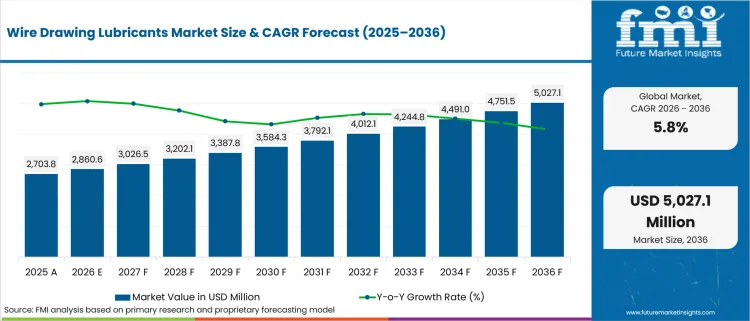
USD 2,860.6 million in 2026 and USD 5,027.1 million by 2036 at a 5.8% CAGR.
Sales of wire drawing lubricants are projected to expand at 5.8% CAGR between 2026 and 2036, increasing valuation from USD 2,860.6 million in 2026 to USD 5,027.1 million by 2036. Wire drawing lubricants are moving from routine mill consumables into process-control inputs used to protect die life and line continuity. Mill buyers assess residue behavior and support response before approving repeat supply. Worldsteel reported total world crude steel production at 1,849.4 Mt in 2025, giving lubricant suppliers a large industrial base linked to wire and long-product conversion.
India and China accounts are expected to review lubricant suppliers around local plant support and batch consistency. United States and Germany accounts are projected to place higher weight on specification files, residue guidance and approval continuity. ACEA reported global car production of 78.7 million units in 2025. Asia accounted for 62.1% of output in the same report. Automotive scale gives industrial lubricant suppliers a clearer route into tire bead, fastener and harness-wire programs.
Key Takeaways
- Demand for wire drawing lubricants is rising as mills place greater emphasis on die protection, stable drawing speeds, controlled residue, and consistent wire surfaces across repeated production runs.
- Direct-to-mill sales are projected to account for 58.5% share in 2026, reflecting the value of direct technical access, faster troubleshooting, and clearer responsibility during line trials and regular production.
- Dry drawing lubricants are anticipated to capture 47.1% share in 2026, supported by stable storage, controlled dosing, and their suitability for high-contact steel wire drawing operations.
- Automotive is expected to represent 45.4% share in 2026, with demand coming from tire bead wire, fasteners, electrical wiring, and other components that require dependable surface quality.
- Steel wire is projected to hold 39.2% share in 2026, owing to the importance of friction control, coating compatibility, and uniform finishes across several drawing passes.
- Tire bead or cord wire is forecast to lead the application category with 37.6% share in 2026, driven by strict tensile-strength, cleanliness, adhesion, and downstream bonding requirements in tire production.
- India is projected to record the strongest country growth at 8.1% CAGR, followed by China at 7.1% CAGR, as steel capacity, cable output, automotive production, and formal lubricant qualification programs expand.
- Weak residue guidance, limited trial evidence, inconsistent product batches, and slow technical response during drawing-line problems remain major restraints on wider product approval.
- The competitive field includes Condat, Blachford, Metalube, Pan Chemicals, FUCHS, Quaker Houghton, Zeller+Gmelin, BECHEM, Chemetall, and RichardsApex, with companies distinguished by wire-process knowledge, product chemistry, documentation, and field support.
Analyst Perspective
“Wire drawing lubricants are increasingly judged as part of overall process control, especially where die life, surface finish, and line stability affect production costs. Wire mills are placing greater value on performance data that links lubricant use with dependable drawing conditions. Companies that provide clear technical records and on-site support are more likely to gain approval. Service at the production-line level also creates stronger customer relationships beyond routine lubricant delivery.”
— Nikhil Kaitwade, Principal Consultant for Chemicals and Materials, Future Market Insights
How is the wire drawing lubricants market segmented?
The wire drawing lubricants industry is segmented by lubricant type, wire material, application, end use, sales channel and region.
The wire drawing lubricants market is segmented by lubricant type, wire material, application, end use, sales channel and region. By lubricant type, coverage includes dry drawing lubricants, wet drawing lubricants, synthetic lubricants and specialty coatings or carriers. By wire material, coverage includes steel wire, copper wire, aluminum wire and stainless or alloy wire. By application, coverage includes tire bead or cord wire, electrical wire, fasteners and welding or spring wire. By end use, coverage includes automotive, electrical and electronics, construction and industrial manufacturing. By sales channel, coverage includes direct to mills, distributors and technical service providers, with regional coverage across North America, Latin America, Europe, East Asia, South Asia and Pacific and Middle East and Africa.
How does direct to mills influence buying within the sales channel segment?
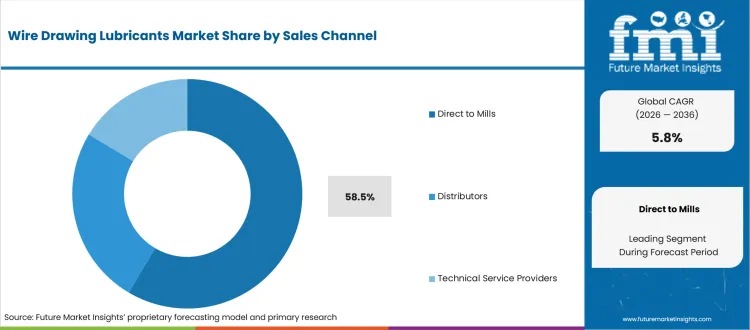
Direct to mills is expected to lead because service control and issue resolution sit close to the drawing line. Wire mills use direct supplier access during trials because die condition and residue behavior need hands-on checks before scale-up. Federal Reserve data showed manufacturing output was unchanged in May 2026 after rising 0.7% in April. Durable goods output rose 0.8% in May, which keeps direct technical service relevant across metalworking operations.
- Direct to mills is expected to account for 58.5% share in 2026, backed by demand for supplier-owned support during qualification and repeat production. Buyer preference is shaped by clearer accountability and easier continuity across repeat orders.
- Distributors and technical service providers remain useful for reach and replenishment. Larger wire producers move toward direct supply once lubricant performance and field support are accepted by line teams.
How do dry drawing lubricants create value within lubricant type?
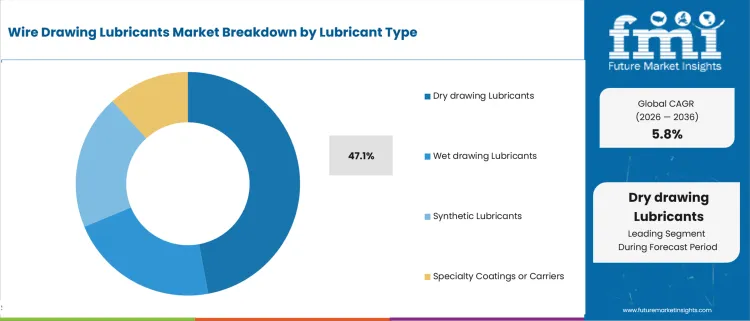
Dry drawing lubricants support mills that need stable storage and lower handling complexity. Steel wire lines use powders and coating systems suited to high-contact drawing. India's Ministry of Steel reported crude steel production of 168.4 million tonnes during April 2025 to March 2026. Output rose 10.7% from the corresponding period, which reinforces demand for drawing inputs used in steel conversion.
- Dry drawing lubricants are anticipated to hold 47.1% share in 2026, led by mills requiring stable lubrication films and cleaner dosage control. Product choice is shaped by film control and operator confidence during line use.
- Wet drawing lubricants and synthetic lubricants remain relevant in copper and aluminum wire programs. Dry systems gain selection attention once mill teams compare die loading and lubricant residue after trial batches.
What keeps automotive central within end use demand?
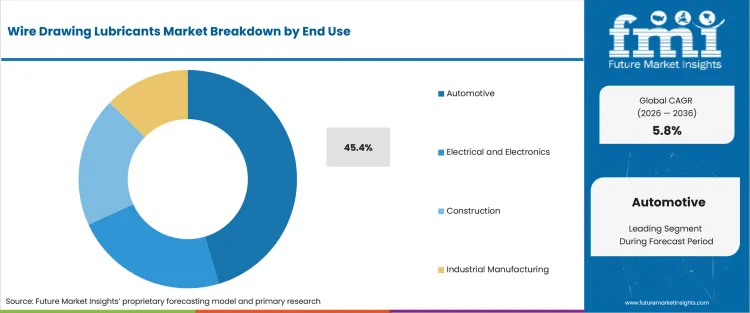
Automotive generates a core demand pool for wire drawing lubricants as electrical wires and cable assemblies depend on consistent drawn-wire output. Vehicle programs require material consistency across approved suppliers and repeated production lots. ACEA reported worldwide vehicle registrations at 77.6 million units in 2025, up 3.5%, giving lubricant suppliers a large conversion base linked to automotive wire and component manufacturing.
- Automotive is expected to represent 45.4% share in 2026, influenced by demand from fastener and electrical wire producers. Buyer review often connects lubricant stability with component acceptance and repeatable supply performance.
- Electrical and electronics and industrial manufacturing use more application-specific lubricant strategies. Automotive operations often need tighter support as coating defects and surface marks affect downstream component acceptance.
How should buyers read steel wire demand within wire material?
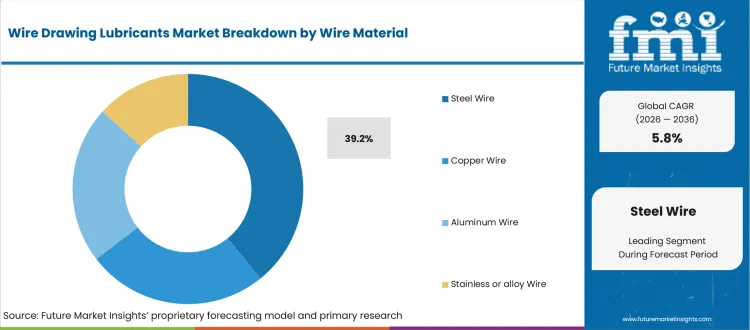
Steel wire guides lubricant selection as drawing pressure and residue behavior remains central to mill economics. Steel wire producers evaluate compatibility with coatings and removal behavior before accepting repeat supply. May 2026 crude steel production from Worldsteel reported 157.9 Mt for 70 reporting countries, down 0.3% from May 2025, keeping steel mills focused on line efficiency and cost control.
- Steel wire is projected to capture 39.2% share in 2026, guided by mills needing surface consistency across cold drawing and long-product conversion. Mill approval often centers on friction control and stable finish across repeated drawing passes.
- Copper and stainless or alloy wire programs keep separate lubricant requirements. Steel wire gains attention once operators link lubricant performance with break reduction and specification compliance.
What keeps tire bead or cord wire central within application demand?
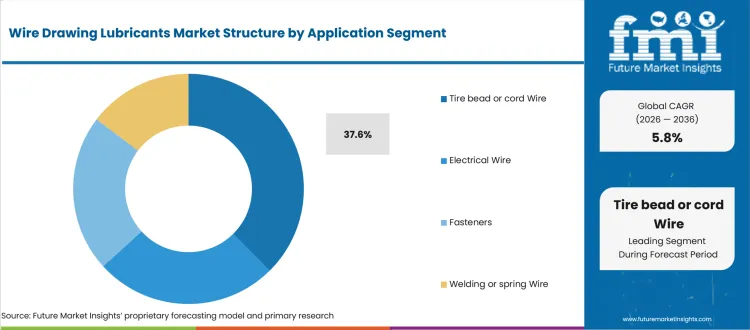
Tire bead or cord wire remains consequential because tire reinforcement requires high tensile strength and adhesion consistency. Lubricant choice affects drawing stability before wire enters plating or rubber-bonding stages. USTMA projected total USA tire shipments at 338.9 million units in 2026. The shipment base keeps tire bead wire close to lubricant trials and downstream cleanliness checks.
- Tire bead or cord wire is expected to hold 37.6% share in 2026, reflected by tire reinforcement programs requiring controlled wire surface quality. Supplier review usually focuses on drawing continuity and compatibility with downstream tire reinforcement requirements.
- Electrical wire and welding or spring wire remain close evaluation areas. Tire bead or cord wire gains approval attention once line teams connect lubricant selection with wire cleanliness and downstream bonding behavior.
What are the drivers, restraints, and opportunities in the wire drawing lubricants market?
Near-term purchases are expected to be shaped by die-life protection, evidence-heavy qualification and application-specific service support.
- Driver: Wire producers are expected to favor lubricants that stabilize line speed and surface finish during repeat drawing operations.
- Restraint: Adoption is anticipated to slow when suppliers lack product characterization, residue guidance and line-trial support.
- Opportunity: Steel and automotive wire programs are projected to create room for lubricant packages tied to material type and plant response.
Wire drawing lubricant demand is projected to rise as mills treat lubricants as operating tools beyond replenishment items. Mill programs need repeatable product behavior to protect die life and surface finish. worldsteel projected EU and UK steel demand to grow 1.3% in 2026 in its April 2026 outlook. The demand signal gives lubricant suppliers a clearer service case across wire, long-product production and adjacent metal forming fluids.
Supplier pressure is expected to increase across mills that need proof before changing an approved lubricant route. OECD reported planned steelmaking capacity additions of 165 million metric tonnes from 2025 to 2027. Asia is expected to account for 58% of that new capacity, which raises qualification discipline across mill supply chains.
Implementation risk remains practical for wire drawing lubricant programs. Line teams need shared acceptance criteria before broader use. UK Department for Business and Trade projected annual steel demand at 14.0 Mt by 2050 under its localization scenario. The long-product route makes line-ready service support more useful than a low drum price.
Which country CAGRs are profiled in the wire drawing lubricants market?
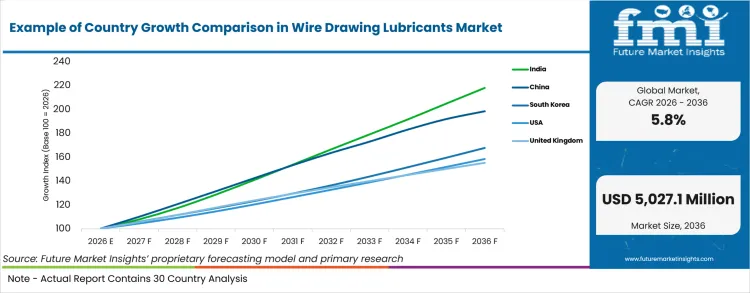
| Country | CAGR |
|---|---|
| India | 8.1% |
| China | 7.1% |
| South Korea | 5.3% |
| United States | 4.7% |
| United Kingdom | 4.5% |
| Germany | 4.1% |
| Japan | 3.9% |
Source: Future Market Insights analysis, 2026.
How do country-level CAGRs compare in the wire drawing lubricants market?
The country comparison spans 4.2 percentage points and reveals three defined growth groups across the wire drawing lubricants market. India and China form the upper tier, with a 1.0-point gap between their forecasts. South Korea, the USA and the UK create the middle group within 0.8 percentage points. Germany and Japan remain closely aligned at the lower end, separated by only 0.2 percentage points. Countries with larger steel conversion volumes, wider wire production and stronger application support generally demonstrate faster lubricant demand growth.
-
India leads the comparison as rising steel consumption and domestic cable and fastener production support broader lubricant trials across drawing operations.
-
China remains 1.0 percentage point below India, reflecting its large automotive, cable and industrial manufacturing base.
-
South Korea remains 1.8 percentage points below China as export-oriented steel production and strict finish requirements guide lubricant selection.
-
The USA remains 0.6 percentage points below South Korea as mills weigh downtime risk, qualification records and regional technical support before changing products.
-
The UK remains only 0.2 percentage points below the USA, supported by wire rod demand and interest in service-ready dry drawing systems.
-
Germany remains 0.4 percentage points below the UK as detailed technical reviews and clean product files shape mill approval.
-
Japan remains only 0.2 percentage points below Germany, reflecting controlled qualification cycles and strong attention to residue and surface quality.
Comparable CAGRs can still produce different market-entry conditions. Differences in steel output, line qualification practices, application service, residue control and production continuity influence lubricant approval and repeat purchasing. The full report provides country-level CAGR analysis across North America, Latin America, Europe, East Asia, South Asia, Oceania and the Middle East and Africa.
Country-wise Analysis
-
India combines expanding steel output with growing cable, fastener and industrial wire production. Wire drawing lubricant demand in India is projected to rise at 8.1% CAGR from 2026 to 2036, driven by domestic steel conversion and wider wire use. Ministry of Steel data recorded finished steel consumption of 163.7 million tonnes from April 2025 to March 2026. The volume gives wire mills a larger operating base for lubricant systems that protect surface finish and line stability. Condat and BECHEM are positioned where plant trials influence repeat orders. Product companies require practical application support and consistent performance across high-volume drawing lines.
-
China offers lubricant companies a high-volume testing base across automotive components, cables and tire bead wire. The China wire drawing lubricants market is forecast to grow at 7.1% CAGR through 2036, supported by wire-intensive manufacturing. ACEA reported that Chinese car production increased by 10.4% in 2025. This expansion strengthens demand for lubricants used across component and reinforcement wire programs. Large factories often require rapid line adjustments without losing surface quality or output stability. FUCHS and Quaker Houghton are likely to be assessed on chemistry consistency, technical response and service reach across major industrial regions.
-
South Korea operates through concentrated steel and wire production networks where inconsistent residue control may disrupt export programs. The South Korea wire drawing lubricants market is projected to record 5.3% CAGR during the study period, shaped by export manufacturing and disciplined technical review. Worldsteel reported crude steel production of 62.2 million tonnes in 2025. The production base supports specialty wire programs with strict surface and finish requirements. Metalube and Pan Chemicals are positioned where rapid technical feedback influences line approval. Mills are likely to favor lubricant companies that maintain repeatable results across successive production lots.
-
United States wire mills remain cautious about product changes because downtime affects production schedules and approved customer programs. The USA wire drawing lubricants market is expected to expand at 4.7% CAGR from 2026 to 2036, backed by controlled metalworking inputs. Federal Reserve data recorded manufacturing capacity utilization of 75.7% in May 2026. The operating rate keeps attention on line reliability and qualification risk during lubricant reviews. RichardsApex and Blachford are positioned where direct access and regional service influence account approval. Mills require clear evidence on downtime, residue control and production consistency before replacing an established lubricant.
-
United Kingdom long-product planning provides lubricant companies with opportunities across wire rod and downstream drawing operations. The UK wire drawing lubricants market is forecast to register 4.5% CAGR during the forecast period, shaped by domestic steel strategy and service requirements. The Department for Business and Trade projected wire rod demand of 0.6 million tonnes in 2025. This volume supports demand for dry drawing systems across smaller and specialized production batches. Condat maintains regional visibility through Wire Eurasia activity and technical support. Mills are expected to favor companies that provide qualification records and practical guidance during line setup.
-
German wire producers place strong weight on technical documentation before changing approved line chemistry. Germany’s wire drawing lubricants market is anticipated to grow at 4.1% CAGR between 2026 and 2036, reflecting disciplined qualification practices. The German Steel Federation reported crude steel production of 37.2 million tonnes in 2024. The production base supports demand across high-specification wire programs requiring stable finish and controlled residue. FUCHS and Zeller+Gmelin are positioned where local service and complete product records shape approval. Wider mill adoption depends on precise files, application assistance and repeatable results during production trials.
-
Japanese steel and wire companies review lubricant efficiency through product cleanliness, residue behavior and repeat performance. The Japan wire drawing lubricants market is expected to post 3.9% CAGR through 2036, guided by controlled approval cycles. ISIJ International reported crude steel production of 80.68 million tonnes in 2025. Slower output growth increases the importance of wire finish and process efficiency during product evaluation. BECHEM and Quaker Houghton are likely to gain attention where documented results support repeat production. Lubricant companies require consistent batches and detailed technical evidence to pass lengthy customer qualification programs.
Who are the notable companies in the wire drawing lubricants market?
Condat, Blachford, Metalube, Pan Chemicals, FUCHS, Quaker Houghton, Zeller+Gmelin, BECHEM, Chemetall, and RichardsApex are notable companies shaping this market.
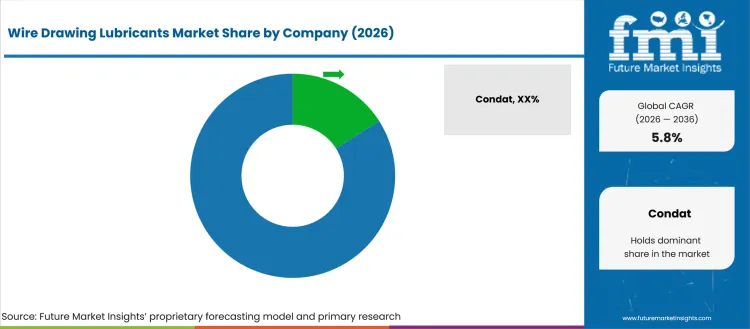
Competition in wire drawing lubricants is grouped by how buyers want product proof to work. Condat and Metalube are relevant for wire drawing specialization and line-focused guidance. Quaker Houghton and FUCHS carry weight through metalworking fluid depth and industrial account coverage. Blachford, Pan Chemicals, Zeller+Gmelin and BECHEM support buyers requiring focused lubricant portfolios. Chemetall and RichardsApex compete based on specialty chemistry and application knowledge.
- Condat has an advantage led by wire drawing lubricant specialization and responsible lubrication product positioning. Buyers connect supplier support with aluminum and steel wire drawing trials.
- Metalube supports buyer review based on copper and non-ferrous wire drawing depth. Its Lubricool product range gives mill teams a focused route for synthetic and water-soluble lubricant evaluation.
- Quaker Houghton and FUCHS strengthen competition driven by metalworking fluid portfolios and industrial service coverage. Buyers use such suppliers as forming fluids and plant support needs overlap across facilities.
- Blachford, Pan Chemicals, Zeller+Gmelin, BECHEM, Chemetall and RichardsApex compete based on specialty formulations and regional account access. Buyers compare suppliers depending on residue behavior and line response speed.
Competitive Benchmarking: Wire Drawing Lubricants Market
| Company | Wire Process Suitability | Technical Documentation | Application Support | Geographic Reach |
|---|---|---|---|---|
| Condat | High | High | High | Global |
| Blachford | High | Medium | High | Global |
| Metalube | High | High | Medium | Global |
| Pan Chemicals | Medium | High | Medium | Regional |
| FUCHS | High | Medium | Medium | Regional or global |
| Quaker Houghton | High | High | High | Global |
| Zeller+Gmelin | High | Medium | High | Global |
| BECHEM | High | High | Medium | Global or regional |
| Chemetall | Medium | High | Medium | Regional |
| RichardsApex | High | Medium | Medium | Regional or global |
Source: Future Market Insights competitive analysis, 2026.
Key Developments in the Wire Drawing Lubricants Market
- In October 2025, Metalube announced Lubricool 960, a fully synthetic and mineral oil-free lubricant for copper wire drawing operations. The company said the product was designed for intermediate, fine and superfine copper wire drawing.
- In April 2025, Quaker Houghton and PETRONAS Lubricants International formed a strategic partnership for India and Malaysia. The arrangement covered industrial customers in transportation and industrial end markets. Quaker Houghton lists rod and wire lubricants within its portfolio, so the partnership is expected to widen service access for steel-mill and wire-related accounts in South Asia.
- In March 2025, Condat confirmed participation at Wire Eurasia 2025 in Istanbul with wire drawing lubricants and borax-free wire drawing soaps. The company highlighted copper and aluminum wire products for visitors from Turkey and Middle East industrial accounts. The event gave Condat a route to discuss line support with regional wire and cable producers.
- In September 2025, Blachford Chemical Group acquired Baum's Castorine Co. Inc. for its specialty lubricant and metalworking-fluid portfolio. Blachford listed Chemdraw ferrous and nonferrous wire drawing lubricants, Dura Draw nonferrous wire drawing lubricants, and related Metalube product families among the acquired portfolio. The acquisition is projected to broaden Blachford's reach in North American wire drawing accounts.
Key Players in the Wire Drawing Lubricants Market
Wire Drawing Lubricant Specialists
- Condat
- Blachford
- Metalube
- Pan Chemicals
Industrial Lubricant Suppliers
- FUCHS
- Quaker Houghton
- Zeller+Gmelin
- BECHEM
Surface Treatment and Specialty Suppliers
- Chemetall
- RichardsApex
Wire Drawing Lubricants Market - Report Scope
| Coverage field | Report scope |
|---|---|
| Market breakdown | Wire drawing lubricants breakdown by lubricant type, wire material, application, end use, sales channel and region |
| Quantitative Units | Revenue in USD Million, CAGR in % |
| Market Definition | Lubricant products, carriers, soaps, emulsions and specialty drawing compounds used in steel, copper, aluminum and alloy wire drawing operations to support die life, surface finish, cooling, friction control and process stability |
| Regions Covered | North America, Latin America, Europe, East Asia, South Asia and Pacific, Middle East and Africa |
| Countries Covered | United States, China, India, Germany, United Kingdom, Japan, South Korea and 30+ countries |
| Key Companies Profiled | Condat, Blachford, Metalube, Pan Chemicals, FUCHS, Quaker Houghton, Zeller+Gmelin, BECHEM, Chemetall and RichardsApex |
| Forecast Period | 2026 to 2036 |
| Approach | Hybrid bottom-up and top-down methodology using wire conversion demand, lubricant adoption, material type, end-use demand, supplier portfolios, sales-channel structure and country-level indicators |
Source: Future Market Insights - analysis driven by proprietary forecasting models and primary research
Wire Drawing Lubricants Market - Research Methodology
| Method | Approach |
|---|---|
| Primary Research | FMI analysts reviewed inputs from wire mills, compounders, converters, OEM buyers, formulators, technical service teams and industrial lubricant suppliers. Discussions focused on product use, qualification barriers, line support and measurable operating value. |
| Desk Research | Desk research covered official government sources, steel industry bodies, automotive associations, company releases, product information, industrial production datasets and public safety or materials guidance. Product coverage was checked against lubricant type, wire material, application, end use, sales-channel route and commercial use. |
| Market Sizing and Forecasting | Model inputs combined 2026 baseline value, lubricant inclusion intensity, material adoption, wire drawing demand, supplier reach, channel structure and country CAGR assumptions. Forecast estimates were adjusted for steel output, automotive wire demand, cable applications and technical service needs. |
| Data Validation | Forecasts were checked against steel production signals, automotive output indicators, company portfolio activity and supplier qualification patterns. Company portfolios were reviewed to avoid counting adjacent lubricants without direct wire drawing use. |
Source: Future Market Insights (FMI) analysis, based on proprietary forecasting model and primary research
Wire Drawing Lubricants Market by Segments
Wire Drawing Lubricants Market segmented by Lubricant Type:
- Dry drawing lubricants
- Wet drawing lubricants
- Synthetic lubricants
- Specialty coatings or carriers
Wire Drawing Lubricants Market segmented by Wire Material:
- Steel wire
- Copper wire
- Aluminum wire
- Stainless or alloy wire
Wire Drawing Lubricants Market segmented by Application:
- Tire bead or cord wire
- Electrical wire
- Fasteners
- Welding or spring wire
Wire Drawing Lubricants Market segmented by End Use:
- Automotive
- Electrical and electronics
- Construction
- Industrial manufacturing
Wire Drawing Lubricants Market segmented by Sales Channel:
- Direct to mills
- Distributors
- Technical service providers
Wire Drawing Lubricants Market by Region:
- North America
- United States
- Canada
- Mexico
- Latin America
- Brazil
- Chile
- Rest of Latin America
- Western Europe
- Germany
- United Kingdom
- Italy
- Spain
- France
- Nordic
- BENELUX
- Rest of Western Europe
- Eastern Europe
- Poland
- Hungary
- Balkan and Baltic
- Rest of Eastern Europe
- East Asia
- China
- Japan
- South Korea
- South Asia and Pacific
- India
- ASEAN
- Australia and New Zealand
- Rest of South Asia and Pacific
- Middle East and Africa
- Kingdom of Saudi Arabia
- Other GCC Countries
- Turkiye
- South Africa
- Other African Union
- Rest of Middle East and Africa
Research Sources and Bibliography
- ACEA. (2026, April 2). Economic and Market Report: Global and EU auto industry - Full year 2025. ACEA.
- CONDAT. (2025, March 3). Welcome to Wire Eurasia 2025 in Istanbul! CONDAT.
- Federal Reserve Board. (2026, June). Industrial Production and Capacity Utilization: G.17. Federal Reserve Board.
- German Steel Federation. (2026, March). Facts and Figures about the Steel Industry. German Steel Federation.
- Iron and Steel Institute of Japan. (2026, June 15). Production and Technology of Iron and Steel in Japan during 2025. ISIJ International.
- Metalube. (2025, October 7). Lubricool 960 a Revolution for Sustainable Copper Wire Production. Metalube.
- Ministry of Steel, Government of India. (2026, April). Monthly Economic Report for the month of March 2026. Ministry of Steel, Government of India.
- OECD. (2025, May 27). OECD Steel Outlook 2025. OECD Publishing.
- Quaker Houghton. (2025, April 17). Quaker Houghton and PETRONAS Lubricants International form strategic partnership in India and Malaysia. Quaker Houghton.
- UK Department for Business and Trade. (2026, March 20). The UK Steel Strategy. UK Department for Business and Trade.
- USA Tire Manufacturers Association. (2026, March 4). USTMA February 2026 Forecast Predicts Slightly Higher 2026 Tire Shipments for USA Tire Market. USA Tire Manufacturers Association.
- World Steel Association. (2026, January 23). December 2025 crude steel production and 2025 global crude steel production totals. World Steel Association.
- World Steel Association. (2026, April 14). worldsteel Short Range Outlook April 2026. World Steel Association.
- Blachford Chemical Group. (2025, September 12). Blachford Chemical Group acquires Baum's Castorine Co. Inc. Blachford Chemical Group.
- World Steel Association. (2026, June). World Steel in Figures 2026. World Steel Association.
This bibliography is provided for reader reference and uses primary government, standards-body, official trade body, and company sources.
This Report Answers
- What is the expected global value of the wire drawing lubricants market in 2026 and 2036?
- What CAGR is forecast for the wire drawing lubricants market during the 2026 to 2036 period?
- Which lubricant type segment is used to assess dry drawing lubricant demand in 2026?
- Why do wire mills buy controlled lubricant systems for repeat drawing operations?
- How do steel wire and tire bead or cord wire shape lubricant choices?
- Which countries are compared in the wire drawing lubricants forecast?
- Which companies compete across wire drawing and metalworking support pathways?
- What lubricant systems and applications are included within the wire drawing lubricants definition?
- How does FMI size and forecast wire drawing lubricant demand across segments and countries?
- What implementation and supplier-selection factors should executives assess?
Frequently Asked Questions
What is driving growth in the wire drawing lubricants market?
Demand is driven by surface finish control and line stability across steel and alloy wire drawing operations. Buyers are also giving more attention to lubricants reducing uncertainty during line trials and repeat production.
Why should executives track the wire drawing lubricants market?
Executives are expected to track this segment since lubricant approval affects mill productivity and supplier accountability. Supplier selection influences line availability and operating cost across downstream automotive and industrial programs.
What business problem does the wire drawing lubricants market address?
Wire drawing lubricants help mills reduce uncertainty around friction and repeatable line behavior. Lubricant programs also support buyers needing clearer links between product chemistry and operating control.
What should sourcing leaders evaluate before selecting suppliers?
Sourcing leaders are likely to compare residue guidance and line-service support before supplier approval. Regional availability and wire-material experience should also guide supplier review.
What limits return on investment for buyers?
Return on investment is expected to be delayed if trial evidence is weak or lubricant use requires process changes without operator support. Buyers reduce such risk by setting line acceptance measures before wider use.
How do suppliers build executive confidence?
Suppliers build confidence based on verified product data and accountable support during drawing-line qualification. Clear trial protocols and consistent batch documentation strengthen buyer approval.
Which companies lead the wire drawing lubricants market?
Competition is based on Condat and Metalube, led by wire drawing specialization and application support. Quaker Houghton and BECHEM gain position depending on metalworking fluid depth and industrial service coverage.
What demand driver supports the wire drawing lubricants market?
Wire mills seek lubricants improving line consistency amid changing alloy use and tighter surface finish needs. Automotive and cable programs strengthen demand led by specification evidence and line-cost control.
Preview the report firsthand - request a free sample
Get SampleGet the brochure for pricing and purchase details.
Get PDFTable of Content
- Key Takeaways
- Market Size and CAGR
- Top Growth Driver
- Fastest Growing Segment
- Leading Region
- Key Companies
- Emerging Opportunities
- Executive Summary
- Global Market Outlook
- Demand-side Trends
- Supply-side Trends
- Technology Roadmap Analysis
- Analysis and Recommendations
- Analyst Perspective (What is happening? Why now? What should investors know?)
- Key Questions Answered
- How large is the market?
- What is the CAGR?
- What are key trends?
- Which region dominates?
- Who are the leaders?
- Market Overview
- Market Coverage / Taxonomy
- Market Definition / Scope / Limitations
- Research Methodology
- Chapter Orientation
- Analytical Lens and Working Hypotheses
- Market Structure, Signals, and Trend Drivers
- Benchmarking and Cross-market Comparability
- Market Sizing, Forecasting, and Opportunity Mapping
- Research Design and Evidence Framework
- Desk Research Programme (Secondary Evidence)
- Expert Input and Fieldwork (Primary Evidence)
- Tooling, Models, and Reference Databases
- Data Engineering and Model Build
- Quality Assurance and Audit Trail
- Market Background
- Market Dynamics (Drivers, Restraints, Opportunity, Trends)
- Scenario Forecast (Optimistic, Likely, Conservative)
- Impact Analysis
- AI Impact
- Sustainability Impact
- Regulatory Impact
- Technology Impact
- Consumer / Buyer Analysis
- Purchase Drivers
- Adoption Barriers
- Buyer Journey
- Opportunity Map Analysis
- Product Life Cycle Analysis
- Supply Chain Analysis
- Investment Feasibility Matrix
- Value Chain Analysis
- PESTLE and Porter's Analysis
- Regulatory Landscape
- Regional Parent Market Outlook
- Production and Consumption Statistics
- Import and Export Statistics
- Global Market Analysis and Forecast, 2021 to 2036
- Historical Market Size Value (USD Million) Analysis, 2021 to 2025
- Current and Future Market Size Value (USD Million) Projections, 2026 to 2036
- Y-o-Y Growth Trend Analysis
- Absolute $ Opportunity Analysis
- Global Market Pricing Analysis, 2021 to 2036
- Global Market Analysis and Forecast, By Sales Channel, 2021 to 2036
- Introduction / Key Findings
- Historical Market Size Value (USD Million) Analysis By Sales Channel, 2021 to 2025
- Current and Future Market Size Value (USD Million) Analysis and Forecast By Sales Channel, 2026 to 2036
- Direct to Mills
- Distributors
- Technical Service Providers
- Direct to Mills
- Y-o-Y Growth Trend Analysis By Sales Channel, 2021 to 2025
- Absolute $ Opportunity Analysis By Sales Channel, 2026 to 2036
- Global Market Analysis and Forecast, By Lubricant Type, 2021 to 2036
- Introduction / Key Findings
- Historical Market Size Value (USD Million) Analysis By Lubricant Type, 2021 to 2025
- Current and Future Market Size Value (USD Million) Analysis and Forecast By Lubricant Type, 2026 to 2036
- Dry drawing Lubricants
- Wet drawing Lubricants
- Synthetic Lubricants
- Specialty Coatings or Carriers
- Dry drawing Lubricants
- Y-o-Y Growth Trend Analysis By Lubricant Type, 2021 to 2025
- Absolute $ Opportunity Analysis By Lubricant Type, 2026 to 2036
- Global Market Analysis and Forecast, By End Use, 2021 to 2036
- Introduction / Key Findings
- Historical Market Size Value (USD Million) Analysis By End Use, 2021 to 2025
- Current and Future Market Size Value (USD Million) Analysis and Forecast By End Use, 2026 to 2036
- Automotive
- Electrical and Electronics
- Construction
- Industrial Manufacturing
- Automotive
- Y-o-Y Growth Trend Analysis By End Use, 2021 to 2025
- Absolute $ Opportunity Analysis By End Use, 2026 to 2036
- Global Market Analysis and Forecast, By Wire Material, 2021 to 2036
- Introduction / Key Findings
- Historical Market Size Value (USD Million) Analysis By Wire Material, 2021 to 2025
- Current and Future Market Size Value (USD Million) Analysis and Forecast By Wire Material, 2026 to 2036
- Steel Wire
- Copper Wire
- Aluminum Wire
- Stainless or alloy Wire
- Steel Wire
- Y-o-Y Growth Trend Analysis By Wire Material, 2021 to 2025
- Absolute $ Opportunity Analysis By Wire Material, 2026 to 2036
- Global Market Analysis and Forecast, By Application, 2021 to 2036
- Introduction / Key Findings
- Historical Market Size Value (USD Million) Analysis By Application, 2021 to 2025
- Current and Future Market Size Value (USD Million) Analysis and Forecast By Application, 2026 to 2036
- Tire bead or cord Wire
- Electrical Wire
- Fasteners
- Welding or spring Wire
- Tire bead or cord Wire
- Y-o-Y Growth Trend Analysis By Application, 2021 to 2025
- Absolute $ Opportunity Analysis By Application, 2026 to 2036
- Global Market Analysis and Forecast, By Region, 2021 to 2036
- Introduction
- Historical Market Size Value (USD Million) Analysis By Region, 2021 to 2025
- Current Market Size Value (USD Million) Analysis and Forecast By Region, 2026 to 2036
- North America
- Latin America
- Western Europe
- Eastern Europe
- East Asia
- South Asia and Pacific
- Middle East & Africa
- Market Attractiveness Analysis By Region
- North America Market Analysis and Forecast, By Country, 2021 to 2036
- Historical Market Size Value (USD Million) Trend Analysis By Market Taxonomy, 2021 to 2025
- Market Size Value (USD Million) Forecast By Market Taxonomy, 2026 to 2036
- By Country
- USA
- Canada
- By Sales Channel
- By Lubricant Type
- By End Use
- By Wire Material
- By Application
- By Country
- Market Attractiveness Analysis
- By Country
- By Sales Channel
- By Lubricant Type
- By End Use
- By Wire Material
- By Application
- Key Takeaways
- Latin America Market Analysis and Forecast, By Country
- Historical Market Size Value (USD Million) Trend Analysis By Market Taxonomy, 2021 to 2025
- Market Size Value (USD Million) Forecast By Market Taxonomy, 2026 to 2036
- By Country
- Brazil
- Mexico
- Chile
- Rest of Latin America
- By Sales Channel
- By Lubricant Type
- By End Use
- By Wire Material
- By Application
- By Country
- Market Attractiveness Analysis
- By Country
- By Sales Channel
- By Lubricant Type
- By End Use
- By Wire Material
- By Application
- Key Takeaways
- Western Europe Market Analysis and Forecast, By Country
- Historical Market Size Value (USD Million) Trend Analysis By Market Taxonomy, 2021 to 2025
- Market Size Value (USD Million) Forecast By Market Taxonomy, 2026 to 2036
- By Country
- Germany
- UK
- Italy
- Spain
- France
- Nordic
- BENELUX
- Rest of Western Europe
- By Sales Channel
- By Lubricant Type
- By End Use
- By Wire Material
- By Application
- By Country
- Market Attractiveness Analysis
- By Country
- By Sales Channel
- By Lubricant Type
- By End Use
- By Wire Material
- By Application
- Key Takeaways
- Eastern Europe Market Analysis and Forecast, By Country
- Historical Market Size Value (USD Million) Trend Analysis By Market Taxonomy, 2021 to 2025
- Market Size Value (USD Million) Forecast By Market Taxonomy, 2026 to 2036
- By Country
- Russia
- Poland
- Hungary
- Balkan & Baltic
- Rest of Eastern Europe
- By Sales Channel
- By Lubricant Type
- By End Use
- By Wire Material
- By Application
- By Country
- Market Attractiveness Analysis
- By Country
- By Sales Channel
- By Lubricant Type
- By End Use
- By Wire Material
- By Application
- Key Takeaways
- East Asia Market Analysis and Forecast, By Country
- Historical Market Size Value (USD Million) Trend Analysis By Market Taxonomy, 2021 to 2025
- Market Size Value (USD Million) Forecast By Market Taxonomy, 2026 to 2036
- By Country
- China
- Japan
- South Korea
- By Sales Channel
- By Lubricant Type
- By End Use
- By Wire Material
- By Application
- By Country
- Market Attractiveness Analysis
- By Country
- By Sales Channel
- By Lubricant Type
- By End Use
- By Wire Material
- By Application
- Key Takeaways
- South Asia and Pacific Market Analysis and Forecast, By Country
- Historical Market Size Value (USD Million) Trend Analysis By Market Taxonomy, 2021 to 2025
- Market Size Value (USD Million) Forecast By Market Taxonomy, 2026 to 2036
- By Country
- India
- ASEAN
- Australia & New Zealand
- Rest of South Asia and Pacific
- By Sales Channel
- By Lubricant Type
- By End Use
- By Wire Material
- By Application
- By Country
- Market Attractiveness Analysis
- By Country
- By Sales Channel
- By Lubricant Type
- By End Use
- By Wire Material
- By Application
- Key Takeaways
- Middle East & Africa Market Analysis and Forecast, By Country
- Historical Market Size Value (USD Million) Trend Analysis By Market Taxonomy, 2021 to 2025
- Market Size Value (USD Million) Forecast By Market Taxonomy, 2026 to 2036
- By Country
- Kingdom of Saudi Arabia
- Other GCC Countries
- Türkiye
- South Africa
- Other African Union
- Rest of Middle East & Africa
- By Sales Channel
- By Lubricant Type
- By End Use
- By Wire Material
- By Application
- By Country
- Market Attractiveness Analysis
- By Country
- By Sales Channel
- By Lubricant Type
- By End Use
- By Wire Material
- By Application
- Key Takeaways
- Key Countries Market Analysis
- USA
- Pricing Analysis
- Market Share Analysis, 2025
- By Sales Channel
- By Lubricant Type
- By End Use
- By Wire Material
- By Application
- Canada
- Pricing Analysis
- Market Share Analysis, 2025
- By Sales Channel
- By Lubricant Type
- By End Use
- By Wire Material
- By Application
- Mexico
- Pricing Analysis
- Market Share Analysis, 2025
- By Sales Channel
- By Lubricant Type
- By End Use
- By Wire Material
- By Application
- Brazil
- Pricing Analysis
- Market Share Analysis, 2025
- By Sales Channel
- By Lubricant Type
- By End Use
- By Wire Material
- By Application
- Chile
- Pricing Analysis
- Market Share Analysis, 2025
- By Sales Channel
- By Lubricant Type
- By End Use
- By Wire Material
- By Application
- Germany
- Pricing Analysis
- Market Share Analysis, 2025
- By Sales Channel
- By Lubricant Type
- By End Use
- By Wire Material
- By Application
- UK
- Pricing Analysis
- Market Share Analysis, 2025
- By Sales Channel
- By Lubricant Type
- By End Use
- By Wire Material
- By Application
- Italy
- Pricing Analysis
- Market Share Analysis, 2025
- By Sales Channel
- By Lubricant Type
- By End Use
- By Wire Material
- By Application
- Spain
- Pricing Analysis
- Market Share Analysis, 2025
- By Sales Channel
- By Lubricant Type
- By End Use
- By Wire Material
- By Application
- France
- Pricing Analysis
- Market Share Analysis, 2025
- By Sales Channel
- By Lubricant Type
- By End Use
- By Wire Material
- By Application
- India
- Pricing Analysis
- Market Share Analysis, 2025
- By Sales Channel
- By Lubricant Type
- By End Use
- By Wire Material
- By Application
- ASEAN
- Pricing Analysis
- Market Share Analysis, 2025
- By Sales Channel
- By Lubricant Type
- By End Use
- By Wire Material
- By Application
- Australia & New Zealand
- Pricing Analysis
- Market Share Analysis, 2025
- By Sales Channel
- By Lubricant Type
- By End Use
- By Wire Material
- By Application
- China
- Pricing Analysis
- Market Share Analysis, 2025
- By Sales Channel
- By Lubricant Type
- By End Use
- By Wire Material
- By Application
- Japan
- Pricing Analysis
- Market Share Analysis, 2025
- By Sales Channel
- By Lubricant Type
- By End Use
- By Wire Material
- By Application
- South Korea
- Pricing Analysis
- Market Share Analysis, 2025
- By Sales Channel
- By Lubricant Type
- By End Use
- By Wire Material
- By Application
- Russia
- Pricing Analysis
- Market Share Analysis, 2025
- By Sales Channel
- By Lubricant Type
- By End Use
- By Wire Material
- By Application
- Poland
- Pricing Analysis
- Market Share Analysis, 2025
- By Sales Channel
- By Lubricant Type
- By End Use
- By Wire Material
- By Application
- Hungary
- Pricing Analysis
- Market Share Analysis, 2025
- By Sales Channel
- By Lubricant Type
- By End Use
- By Wire Material
- By Application
- Kingdom of Saudi Arabia
- Pricing Analysis
- Market Share Analysis, 2025
- By Sales Channel
- By Lubricant Type
- By End Use
- By Wire Material
- By Application
- Türkiye
- Pricing Analysis
- Market Share Analysis, 2025
- By Sales Channel
- By Lubricant Type
- By End Use
- By Wire Material
- By Application
- South Africa
- Pricing Analysis
- Market Share Analysis, 2025
- By Sales Channel
- By Lubricant Type
- By End Use
- By Wire Material
- By Application
- USA
- Market Structure Analysis
- Competition Dashboard
- Competition Benchmarking
- Market Share Analysis of Top Players
- By Regional
- By Sales Channel
- By Lubricant Type
- By End Use
- By Wire Material
- By Application
- Emerging Startups
- Innovation Benchmarking
- Competition Analysis
- Competition Deep Dive
- Condat
- Overview
- Product Portfolio
- Profitability by Market Segments
- Sales Footprint
- Strategy Overview
- Marketing Strategy
- Product Strategy
- Channel Strategy
- Blachford
- Metalube
- Pan Chemicals
- FUCHS
- Quaker Houghton
- Zeller+Gmelin
- BECHEM
- Condat
- Case Studies
- Success Stories
- Recent Developments
- Competition Deep Dive
- Assumptions & Acronyms Used


