

- Market Size (2026)
- USD 543.7 Mn
- Forecast (2036)
- USD 1878.6 Mn
- CAGR (2026 to 2036)
- 13.2%
How big is Women's Healthy-Longevity Nutrition Market in 2026?
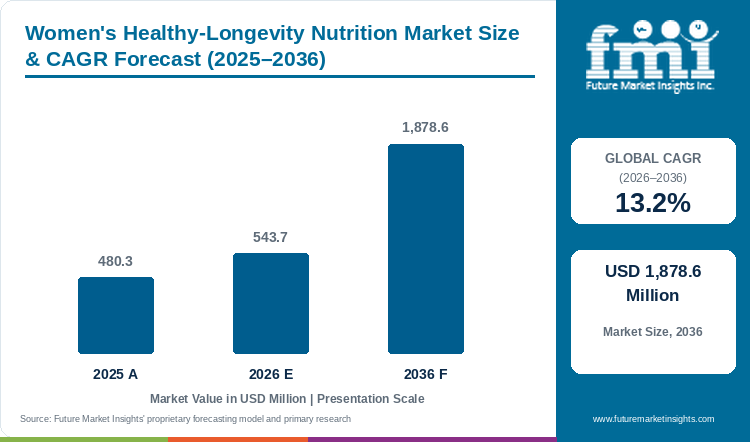
The market was valued at USD 480.3 Million in 2025 and is expected to reach USD 543.7 Million in 2026, with growth at a 13.2% CAGR from 2026 to 2036 taking its value to USD 1,878.6 Million by 2036.
Buyers considering healthy-longevity nutrition need to understand why a specialist formula belongs in a routine that may already include familiar foods and supplements. A biological mechanism can provide a reason for research without demonstrating a meaningful benefit from the finished product, so evidence for the actual ingredient and serving is part of an informed purchase. Perimenopause may prompt a broader review of longer-term habits, whereas an older customer may be reassessing a regimen maintained for years; those situations do not call for an identical proposition. Practical daily use and an affordable continuing cost influence whether interest develops into repeat buying, with flexible replenishment leaving room to review relevance and tolerance. Germany and Japan have substantial older populations, although demographic relevance by itself does not establish willingness to pay for a premium formula. The forecast includes women’s healthy-longevity nutrition and qualifying nutrition-centered paid programs, excluding medicines, unrelated diagnostics and general wellness products without the defined positioning. [5]
Key Market Trends & Insights
- NAD+ & Cellular-Energy Products account for 42.7% of product type in 2026, grouping varied ingredients that need preparation-specific evidence rather than an interchangeable cellular-health claim.
- Perimenopause (40s) represents 56.2% of life stage in 2026, when buyers may review longer-term nutrition alongside more immediate midlife priorities.
- Clinically Studied Ingredients account for 55.2% of evidence positioning in 2026, making the preparation and outcome actually studied relevant to buyers considering prolonged use.
- Capsules / Softgels represent 46.1% of form in 2026, offering a compact daily serving for a routine that may already include food, drinks and other supplements.
Regional Highlights
- South Korea has the highest profiled CAGR at 13.6% during 2026–2036.
- The next two profiled growth rates are UK at 13.0% and USA at 12.7% over the same period.
Market Size & Forecast
| Metric | Value |
|---|---|
| 2025 market value | USD 480.3 Million |
| 2026 market estimate | USD 543.7 Million |
| 2036 market forecast | USD 1,878.6 Million |
| Forecast CAGR, 2026–2036 | 13.2% |
The market covers women’s healthy-longevity nutrition products and qualifying paid nutrition programs in which nutrition or longevity guidance is the central offering. Medicines, unrelated diagnostic services and general wellness products without the defined positioning are excluded.
Healthy-longevity products should remain distinct from clinical nutrition used to address an assessed nutritional problem or a defined care requirement.
Nutrition evidence and practical use
| Documented operating context | Source |
|---|---|
| Timeline introduced Mitopure urolithin A gummies in April 2025, extending its range of delivery formats. | [1] |
| Pharmavite opened a supplement production facility in New Albany, Ohio, in May 2025. | [2] |
| Thorne announced a women’s health campaign in April 2026. | [3] |
| FDA distinguishes permissible structure/function claims from claims to diagnose, treat, cure or prevent disease. | [4] |
Analyst Perspective
A healthy-aging formula needs a nutritional purpose that buyers can understand and reassess over time. Evidence relevant to the actual ingredient and serving, together with a manageable daily routine, gives the product a clearer basis for continued use than cellular-health language that leaves the expected personal benefit undefined.
- Nandini Roy Choudhury, Principal Analyst at Future Market Insights
How is the women's healthy-longevity nutrition market segmented?
Product Type covers NAD+ & Cellular-Energy Products, Urolithin A & Mitochondrial Support, Bone-Muscle-Joint Longevity Blends, Skin & Collagen Longevity Products and Others. Life Stage covers Perimenopause (40s), Postmenopause (50s-60s) and 65+ Years. Evidence Positioning covers Clinically Studied Ingredients, Biomarker-Paired Programs and General Wellness. Form covers Capsules / Softgels, Powders, RTD & Gummies and Others. Sales Channel covers Online / DTC, Retail Pharmacy, Supermarkets & Hypermarkets, Specialty & Health Stores and Others.
The women’s health supplements channel can connect a healthy-aging proposition to a life stage, but the formulation still needs evidence relevant to its stated purpose.
Why do NAD+ & Cellular-Energy Products lead product type demand?
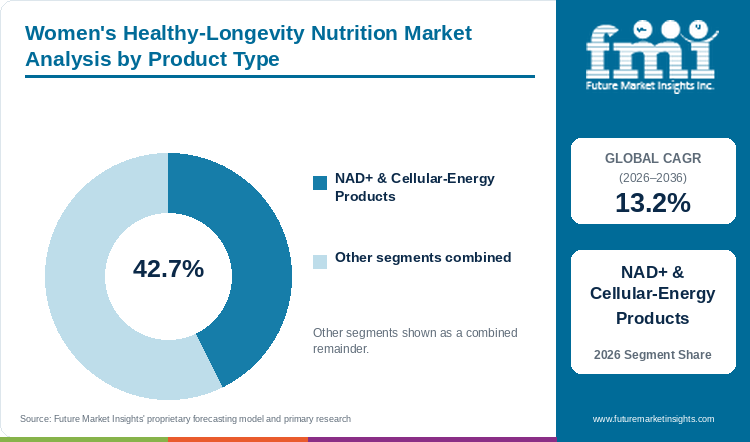
NAD+ & Cellular-Energy Products: 42.7% of product type in 2026.
NAD+ and cellular-energy positioning brings varied ingredients together under a recognizable biological concept, but the common label leaves important differences in material, serving and evidence. Buyers need an explanation of what the research assessed and how that relates to the formula being sold, since a laboratory marker alone does not demonstrate longer life or protection from age-related disease. A defined nutritional role helps customers compare the proposed addition with ordinary dietary priorities, giving a specialist product a clearer place than an elaborate pathway description without an understandable intended contribution.
- The NAD+ & Cellular-Energy Products segment accounts for 42.7% of product type in 2026.
- Transparent ingredient amounts let buyers compare cellular-energy products that otherwise appear similar under a shared healthy-aging description.
Why does Perimenopause (40s) lead life stage demand?
Perimenopause (40s): 56.2% of life stage in 2026.
Perimenopause in the 40s can prompt women to reconsider longer-term nutrition while attending to more immediate changes, placing a longevity product within a wider set of priorities and costs. A clear serving and evidence for the intended ingredient allow the offer to be assessed alongside the current regimen without framing every midlife concern as a deficiency. Life-stage branding helps buyers find the category, while a specific nutritional role provides the reason to consider continued use.
- The Perimenopause (40s) segment accounts for 56.2% of life stage in 2026.
- Life-stage education is most useful when it helps a buyer distinguish ordinary nutritional needs from a specialist ingredient's more limited proposed role.
What are the drivers, restraints, and opportunities in the women's healthy-longevity nutrition market?
Healthy-aging routines support recurring purchases
Interest in healthy aging can bring consumers to the category before later-life difficulties emerge. This creates demand for products that fit a routine maintained over months rather than a brief response to a symptom. Brands need to give customers a realistic reason to continue using the formula. A defined benefit and understandable serving are more useful than an open-ended promise of rejuvenation. The offer also has to remain affordable alongside the person's other nutritional priorities. Recurring purchases are more likely to endure when the product has a clear place in that routine.
Biological narratives can exceed product evidence
Mechanism studies and finished-product trials answer different questions, so a finding at one dose cannot automatically establish an outcome for another formulation. Long-term benefits may also remain less certain than the marketing suggests, making the preparation and result actually studied relevant to continued use. Clear product information gives buyers a firmer comparison without presenting every biological change as a demonstrated personal health benefit.
Life-stage relevance improves the long-term proposition
Suppliers can make the category easier to navigate by separating products according to their intended purpose instead of assembling ever-larger supplement stacks. Buyers then have a clearer basis for choosing what belongs in their regimen. Where measurement forms part of a program it should help determine whether continued use remains relevant. Flexible replenishment can also accommodate changes in need or tolerance. The useful distinction is between a focused service that supports an informed decision and a subscription that encourages more products without explaining their separate roles.
Within dietary supplements, cellular-health language creates a premium comparison that should be tested against product-specific outcomes rather than broad biological concepts.
Which country and market CAGRs are profiled for women's healthy-longevity nutrition?
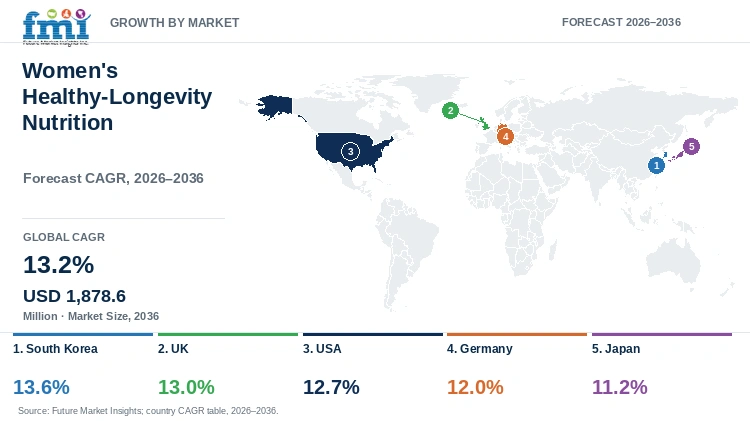
| Country | CAGR |
|---|---|
| South Korea | 13.6% |
| UK | 13.0% |
| USA | 12.7% |
| Germany | 12.0% |
| Japan | 11.2% |
Country-wise Analysis
South Korea
- Digital channels give South Korean suppliers room to explain unfamiliar longevity ingredients before purchase, provided the information connects the studied outcome to the actual serving. The market has the fastest profiled forecast, at a 13.6% CAGR from 2026 to 2036, but sustained use still requires a routine the buyer considers worthwhile. Understandable evidence and a renewal that can be reassessed help turn initial interest into an informed purchasing decision.
UK
- UK retailers need an explanation of healthy-aging products that remains within applicable nutrition and health-claim requirements while helping shoppers compare specialist formulas with familiar supplements. Daily amounts and a description of the outcome studied are useful within that review, rather than an implication that a longevity label demonstrates lifespan extension. The 13.0% CAGR forecast for 2026 to 2036 places continued attention on information that can remain consistent beyond a launch campaign.
USA
- A specialist ingredient may reach American buyers through direct selling before they encounter it in a pharmacy or practitioner setting, with those channels providing different opportunities to review an existing regimen. For a customer already taking several products, an explanation of overlap can be more useful than another broad benefit claim. Clear composition and adjustable replenishment support that continuing review as the USA market grows at a forecast 12.7% CAGR from 2026 to 2036.
Germany
- German distributors considering a new longevity ingredient need to understand the material, its intended use and the evidence supporting that purpose before deciding where it fits in a portfolio. Traceability and transparent formulation can address the questions created by an unfamiliar ingredient, while consumers still need a reason to keep a premium product in an established routine. These purchasing requirements accompany Germany’s 12.0% CAGR forecast for 2026 to 2036.
Japan
- An older population gives healthy-aging nutrition continuing relevance in Japan, where specialist formulas also compete with familiar foods and established nutritional habits. A new offer needs to explain the function it proposes and the cost and effort of daily use, especially when ordinary muscle or bone nutrition already meets the buyer’s priority. Japan is forecast to grow at an 11.2% CAGR from 2026 to 2036, with product differentiation depending on that understandable contribution.
Who are the notable companies in the women's healthy-longevity nutrition market?
Thorne; Ritual; Elysium Health; Timeline; Life Extension
Established supplement brands and specialist cellular-health companies approach this market from different starting points. The former can draw on familiar retail relationships while the latter often need to explain an unfamiliar ingredient. In both cases the product must justify its place in a long-term routine without allowing a broad promise about aging to outrun the evidence.
Competitive Benchmarking: Women's Healthy-Longevity Nutrition Market
| Participant | Commercial focus | Buyer qualification priority |
|---|---|---|
| Thorne | Healthy-aging supplements | Dose transparency and evidence relevance |
| Ritual | Women’s life-stage nutrition | Foundational nutrient coverage |
| Elysium Health | Cellular-health supplements | Endpoint relevance and formulation identity |
| Timeline | Urolithin A products | Product-specific clinical support |
| Life Extension | Healthy-aging supplements | Regimen complexity and interaction screening |
Key Developments in the Women's Healthy-Longevity Nutrition Market
- Timeline introduced Mitopure urolithin A gummies in April 2025, extending its range of delivery formats. [1]
- Pharmavite opened a supplement production facility in New Albany, Ohio, in May 2025. [2]
Key Players in the Women's Healthy-Longevity Nutrition Market
- Thorne
- Ritual
- Elysium Health
- Timeline
- Life Extension
Women's Healthy-Longevity Nutrition Market - Report Scope
| Coverage field | Report scope |
|---|---|
| Market breakdown | Product Type; Life Stage; Evidence Positioning; Form; Sales Channel; Region |
| Quantitative unit | USD Million |
| Market definition | The market covers women’s healthy-longevity nutrition products and qualifying paid nutrition programs in which nutrition or longevity guidance is the central offering. Medicines, unrelated diagnostic services and general wellness products without the defined positioning are excluded. |
| Regions covered | North America; Latin America; Western Europe; Eastern Europe; East Asia; South Asia and Pacific; Middle East and Africa |
| Countries / markets profiled | South Korea; UK; USA; Germany; Japan |
| Key companies profiled | Thorne; Ritual; Elysium Health; Timeline; Life Extension |
| Base year / forecast period | 2026 / 2026–2036 |
| Estimate coverage | 2025 and 2026 market estimates; 2036 forecast; segment shares and country / market CAGRs. |
Women's Healthy-Longevity Nutrition Market - Research Methodology
| Method | Application |
|---|---|
| Market definition | The analysis follows the stated product or service boundary and distinguishes direct category revenue from adjacent activities. |
| Secondary research | Official technical, regulatory, research and company publications provide the documented operating context and recent developments cited in this report. |
| Forecast and segmentation | Market estimates, segment shares and geographic forecasts are presented as analytical estimates within the stated commercial scope. |
| Competitive assessment | Participants are compared by their relevant products or services, commercial role and buyer qualification requirements. |
| Interpretation | The assessment considers purchasing conditions and the scope of the documented product, service or performance claim. |
Women's Healthy-Longevity Nutrition Market by Segments
Product Type
- NAD+ & Cellular-Energy Products
- Urolithin A & Mitochondrial Support
- Bone-Muscle-Joint Longevity Blends
- Skin & Collagen Longevity Products
- Others
Life Stage
- Perimenopause (40s)
- Postmenopause (50s-60s)
- 65+ Years
Evidence Positioning
- Clinically Studied Ingredients
- Biomarker-Paired Programs
- General Wellness
Form
- Capsules / Softgels
- Powders
- RTD & Gummies
- Others
Sales Channel
- Online / DTC
- Retail Pharmacy
- Supermarkets & Hypermarkets
- Specialty & Health Stores
- Others
Women's Healthy-Longevity Nutrition Market by Region
- North America
- United States
- Canada
- Latin America
- Brazil
- Mexico
- Argentina
- Chile
- Western Europe
- Germany
- France
- United Kingdom
- Italy
- Spain
- Benelux
- Nordics
- Eastern Europe
- Poland
- Czech Republic
- Romania
- Hungary
- East Asia
- China
- Japan
- South Korea
- South Asia and Pacific
- India
- ASEAN
- Australia and New Zealand
- Middle East and Africa
- GCC Countries
- South Africa
- Türkiye
- Israel
Research Sources and Bibliography
- [1] Timeline. (2025, April 17). First-of-its-kind longevity gummy launched.
- [2] Pharmavite. (2025, May 8). Pharmavite, Maker of Nature Made® Vitamins, Opens $250 Million Production Facility in New Albany, Ohio.
- [3] Thorne. (2026, April 6). THORNE DEBUTS WOMEN’S HEALTH CAMPAIGN WITH MISTY COPELAND AND LANA CONDOR, INTRODUCING NEW CLINICALLY FORMULATED PRODUCTS.
- [4] U.S. Food and Drug Administration. (n.d.). Structure/function claims.
- [5] Future Market Insights. (2026). Women's Healthy-Longevity Nutrition Market: Global industry analysis and opportunity assessment, 2026–2036.
This Report Answers
- How large is the women's healthy-longevity nutrition market in 2026?
- What value and CAGR are forecast through 2036?
- Which product type segment leads in 2026?
- Which life stage segment has the largest share?
- Which profiled country or market has the fastest forecast growth?
- Which participants are covered in the competitive assessment?
Frequently Asked Questions
How large is the women's healthy-longevity nutrition market in 2026?
The market was valued at USD 480.3 Million in 2025 and is expected to reach USD 543.7 Million in 2026.
What value and CAGR are forecast through 2036?
The market is projected to reach USD 1,878.6 Million by 2036, with a 13.2% CAGR during 2026–2036.
Which product type segment leads in 2026?
The NAD+ & Cellular-Energy Products segment accounts for 42.7% of product type in 2026.
Which life stage segment has the largest share?
The Perimenopause (40s) segment accounts for 56.2% of life stage in 2026.
Which profiled country or market has the fastest forecast growth?
South Korea has the highest profiled CAGR at 13.6% during 2026–2036.
Which participants are covered in the competitive assessment?
The assessment covers Thorne, Ritual, Elysium Health, Timeline and Life Extension.
Preview the report firsthand - request a free sample
Get SampleGet the brochure for pricing and purchase details.
Get PDFTable of Content
- Key Takeaways
- Market Size and CAGR
- Top Growth Driver
- Fastest Growing Segment
- Leading Region
- Key Companies
- Emerging Opportunities
- Executive Summary
- Global Market Outlook
- Demand-side Trends
- Supply-side Trends
- Technology Roadmap Analysis
- Analysis and Recommendations
- Analyst Perspective (What is happening? Why now? What should investors know?)
- Key Questions Answered
- How large is the market?
- What is the CAGR?
- What are key trends?
- Which region dominates?
- Who are the leaders?
- Market Overview
- Market Coverage / Taxonomy
- Market Definition / Scope / Limitations
- Research Methodology
- Chapter Orientation
- Analytical Lens and Working Hypotheses
- Market Structure, Signals, and Trend Drivers
- Benchmarking and Cross-market Comparability
- Market Sizing, Forecasting, and Opportunity Mapping
- Research Design and Evidence Framework
- Desk Research Programme (Secondary Evidence)
- Expert Input and Fieldwork (Primary Evidence)
- Tooling, Models, and Reference Databases
- Data Engineering and Model Build
- Quality Assurance and Audit Trail
- Market Background
- Market Dynamics (Drivers, Restraints, Opportunity, Trends)
- Scenario Forecast (Optimistic, Likely, Conservative)
- Impact Analysis
- AI Impact
- Sustainability Impact
- Regulatory Impact
- Technology Impact
- Consumer / Buyer Analysis
- Purchase Drivers
- Adoption Barriers
- Buyer Journey
- Opportunity Map Analysis
- Product Life Cycle Analysis
- Supply Chain Analysis
- Investment Feasibility Matrix
- Value Chain Analysis
- PESTLE and Porter's Analysis
- Regulatory Landscape
- Regional Parent Market Outlook
- Production and Consumption Statistics
- Import and Export Statistics
- Global Market Analysis and Forecast, 2021 to 2036
- Historical Market Size Value (USD Million) Analysis, 2021 to 2025
- Current and Future Market Size Value (USD Million) Projections, 2026 to 2036
- Y-o-Y Growth Trend Analysis
- Absolute $ Opportunity Analysis
- Global Market Pricing Analysis, 2021 to 2036
- Global Market Analysis and Forecast, By Product Type, 2021 to 2036
- Introduction / Key Findings
- Historical Market Size Value (USD Million) Analysis By Product Type, 2021 to 2025
- Current and Future Market Size Value (USD Million) Analysis and Forecast By Product Type, 2026 to 2036
- NAD+ & Cellular-Energy Products
- Urolithin A & Mitochondrial Support
- Bone-Muscle-Joint Longevity Blends
- Skin & Collagen Longevity Products
- Others
- Y-o-Y Growth Trend Analysis By Product Type, 2021 to 2025
- Absolute $ Opportunity Analysis By Product Type, 2026 to 2036
- Global Market Analysis and Forecast, By Life Stage, 2021 to 2036
- Introduction / Key Findings
- Historical Market Size Value (USD Million) Analysis By Life Stage, 2021 to 2025
- Current and Future Market Size Value (USD Million) Analysis and Forecast By Life Stage, 2026 to 2036
- Perimenopause (40s)
- Postmenopause (50s-60s)
- 65+ Years
- Y-o-Y Growth Trend Analysis By Life Stage, 2021 to 2025
- Absolute $ Opportunity Analysis By Life Stage, 2026 to 2036
- Global Market Analysis and Forecast, By Evidence Positioning, 2021 to 2036
- Introduction / Key Findings
- Historical Market Size Value (USD Million) Analysis By Evidence Positioning, 2021 to 2025
- Current and Future Market Size Value (USD Million) Analysis and Forecast By Evidence Positioning, 2026 to 2036
- Clinically Studied Ingredients
- Biomarker-Paired Programs
- General Wellness
- Y-o-Y Growth Trend Analysis By Evidence Positioning, 2021 to 2025
- Absolute $ Opportunity Analysis By Evidence Positioning, 2026 to 2036
- Global Market Analysis and Forecast, By Form, 2021 to 2036
- Introduction / Key Findings
- Historical Market Size Value (USD Million) Analysis By Form, 2021 to 2025
- Current and Future Market Size Value (USD Million) Analysis and Forecast By Form, 2026 to 2036
- Capsules / Softgels
- Powders
- RTD & Gummies
- Others
- Y-o-Y Growth Trend Analysis By Form, 2021 to 2025
- Absolute $ Opportunity Analysis By Form, 2026 to 2036
- Global Market Analysis and Forecast, By Sales Channel, 2021 to 2036
- Introduction / Key Findings
- Historical Market Size Value (USD Million) Analysis By Sales Channel, 2021 to 2025
- Current and Future Market Size Value (USD Million) Analysis and Forecast By Sales Channel, 2026 to 2036
- Online / DTC
- Retail Pharmacy
- Supermarkets & Hypermarkets
- Specialty & Health Stores
- Others
- Y-o-Y Growth Trend Analysis By Sales Channel, 2021 to 2025
- Absolute $ Opportunity Analysis By Sales Channel, 2026 to 2036
- Global Market Analysis and Forecast, By Region, 2021 to 2036
- Introduction
- Historical Market Size Value (USD Million) Analysis By Region, 2021 to 2025
- Current Market Size Value (USD Million) Analysis and Forecast By Region, 2026 to 2036
- North America
- Latin America
- Western Europe
- Eastern Europe
- East Asia
- South Asia and Pacific
- Middle East and Africa
- Market Attractiveness Analysis By Region
- North America Market Analysis and Forecast, By Country, 2021 to 2036
- Historical Market Size Value (USD Million) Trend Analysis By Market Taxonomy, 2021 to 2025
- Market Size Value (USD Million) Forecast By Market Taxonomy, 2026 to 2036
- By Country
- United States
- Canada
- By Product Type
- By Life Stage
- By Evidence Positioning
- By Form
- By Sales Channel
- By Country
- Market Attractiveness Analysis
- By Country
- By Product Type
- By Life Stage
- By Evidence Positioning
- By Form
- By Sales Channel
- Key Takeaways
- Latin America Market Analysis and Forecast, By Country
- Historical Market Size Value (USD Million) Trend Analysis By Market Taxonomy, 2021 to 2025
- Market Size Value (USD Million) Forecast By Market Taxonomy, 2026 to 2036
- By Country
- Brazil
- Mexico
- Argentina
- Chile
- By Product Type
- By Life Stage
- By Evidence Positioning
- By Form
- By Sales Channel
- By Country
- Market Attractiveness Analysis
- By Country
- By Product Type
- By Life Stage
- By Evidence Positioning
- By Form
- By Sales Channel
- Key Takeaways
- Western Europe Market Analysis and Forecast, By Country
- Historical Market Size Value (USD Million) Trend Analysis By Market Taxonomy, 2021 to 2025
- Market Size Value (USD Million) Forecast By Market Taxonomy, 2026 to 2036
- By Country
- Germany
- France
- United Kingdom
- Italy
- Spain
- Benelux
- Nordics
- By Product Type
- By Life Stage
- By Evidence Positioning
- By Form
- By Sales Channel
- By Country
- Market Attractiveness Analysis
- By Country
- By Product Type
- By Life Stage
- By Evidence Positioning
- By Form
- By Sales Channel
- Key Takeaways
- Eastern Europe Market Analysis and Forecast, By Country
- Historical Market Size Value (USD Million) Trend Analysis By Market Taxonomy, 2021 to 2025
- Market Size Value (USD Million) Forecast By Market Taxonomy, 2026 to 2036
- By Country
- Poland
- Czech Republic
- Romania
- Hungary
- By Product Type
- By Life Stage
- By Evidence Positioning
- By Form
- By Sales Channel
- By Country
- Market Attractiveness Analysis
- By Country
- By Product Type
- By Life Stage
- By Evidence Positioning
- By Form
- By Sales Channel
- Key Takeaways
- East Asia Market Analysis and Forecast, By Country
- Historical Market Size Value (USD Million) Trend Analysis By Market Taxonomy, 2021 to 2025
- Market Size Value (USD Million) Forecast By Market Taxonomy, 2026 to 2036
- By Country
- China
- Japan
- South Korea
- By Product Type
- By Life Stage
- By Evidence Positioning
- By Form
- By Sales Channel
- By Country
- Market Attractiveness Analysis
- By Country
- By Product Type
- By Life Stage
- By Evidence Positioning
- By Form
- By Sales Channel
- Key Takeaways
- South Asia and Pacific Market Analysis and Forecast, By Country
- Historical Market Size Value (USD Million) Trend Analysis By Market Taxonomy, 2021 to 2025
- Market Size Value (USD Million) Forecast By Market Taxonomy, 2026 to 2036
- By Country
- India
- ASEAN
- Australia and New Zealand
- By Product Type
- By Life Stage
- By Evidence Positioning
- By Form
- By Sales Channel
- By Country
- Market Attractiveness Analysis
- By Country
- By Product Type
- By Life Stage
- By Evidence Positioning
- By Form
- By Sales Channel
- Key Takeaways
- Middle East and Africa Market Analysis and Forecast, By Country
- Historical Market Size Value (USD Million) Trend Analysis By Market Taxonomy, 2021 to 2025
- Market Size Value (USD Million) Forecast By Market Taxonomy, 2026 to 2036
- By Country
- GCC Countries
- South Africa
- Türkiye
- Israel
- By Product Type
- By Life Stage
- By Evidence Positioning
- By Form
- By Sales Channel
- By Country
- Market Attractiveness Analysis
- By Country
- By Product Type
- By Life Stage
- By Evidence Positioning
- By Form
- By Sales Channel
- Key Takeaways
- Key Countries Market Analysis
- United States
- Pricing Analysis
- Market Share Analysis, 2025
- By Product Type
- By Life Stage
- By Evidence Positioning
- By Form
- By Sales Channel
- Canada
- Pricing Analysis
- Market Share Analysis, 2025
- By Product Type
- By Life Stage
- By Evidence Positioning
- By Form
- By Sales Channel
- Mexico
- Pricing Analysis
- Market Share Analysis, 2025
- By Product Type
- By Life Stage
- By Evidence Positioning
- By Form
- By Sales Channel
- Brazil
- Pricing Analysis
- Market Share Analysis, 2025
- By Product Type
- By Life Stage
- By Evidence Positioning
- By Form
- By Sales Channel
- Chile
- Pricing Analysis
- Market Share Analysis, 2025
- By Product Type
- By Life Stage
- By Evidence Positioning
- By Form
- By Sales Channel
- Germany
- Pricing Analysis
- Market Share Analysis, 2025
- By Product Type
- By Life Stage
- By Evidence Positioning
- By Form
- By Sales Channel
- United Kingdom
- Pricing Analysis
- Market Share Analysis, 2025
- By Product Type
- By Life Stage
- By Evidence Positioning
- By Form
- By Sales Channel
- Italy
- Pricing Analysis
- Market Share Analysis, 2025
- By Product Type
- By Life Stage
- By Evidence Positioning
- By Form
- By Sales Channel
- Spain
- Pricing Analysis
- Market Share Analysis, 2025
- By Product Type
- By Life Stage
- By Evidence Positioning
- By Form
- By Sales Channel
- France
- Pricing Analysis
- Market Share Analysis, 2025
- By Product Type
- By Life Stage
- By Evidence Positioning
- By Form
- By Sales Channel
- India
- Pricing Analysis
- Market Share Analysis, 2025
- By Product Type
- By Life Stage
- By Evidence Positioning
- By Form
- By Sales Channel
- ASEAN
- Pricing Analysis
- Market Share Analysis, 2025
- By Product Type
- By Life Stage
- By Evidence Positioning
- By Form
- By Sales Channel
- Australia and New Zealand
- Pricing Analysis
- Market Share Analysis, 2025
- By Product Type
- By Life Stage
- By Evidence Positioning
- By Form
- By Sales Channel
- China
- Pricing Analysis
- Market Share Analysis, 2025
- By Product Type
- By Life Stage
- By Evidence Positioning
- By Form
- By Sales Channel
- Japan
- Pricing Analysis
- Market Share Analysis, 2025
- By Product Type
- By Life Stage
- By Evidence Positioning
- By Form
- By Sales Channel
- South Korea
- Pricing Analysis
- Market Share Analysis, 2025
- By Product Type
- By Life Stage
- By Evidence Positioning
- By Form
- By Sales Channel
- Poland
- Pricing Analysis
- Market Share Analysis, 2025
- By Product Type
- By Life Stage
- By Evidence Positioning
- By Form
- By Sales Channel
- Hungary
- Pricing Analysis
- Market Share Analysis, 2025
- By Product Type
- By Life Stage
- By Evidence Positioning
- By Form
- By Sales Channel
- Türkiye
- Pricing Analysis
- Market Share Analysis, 2025
- By Product Type
- By Life Stage
- By Evidence Positioning
- By Form
- By Sales Channel
- South Africa
- Pricing Analysis
- Market Share Analysis, 2025
- By Product Type
- By Life Stage
- By Evidence Positioning
- By Form
- By Sales Channel
- United States
- Market Structure Analysis
- Competition Dashboard
- Competition Benchmarking
- Market Share Analysis of Top Players
- By Regional
- By Product Type
- By Life Stage
- By Evidence Positioning
- By Form
- By Sales Channel
- Emerging Startups
- Innovation Benchmarking
- Competition Analysis
- Competition Deep Dive
- Thorne
- Overview
- Product Portfolio
- Profitability by Market Segments
- Sales Footprint
- Strategy Overview
- Marketing Strategy
- Product Strategy
- Channel Strategy
- Ritual
- Elysium Health
- Timeline
- Life Extension
- Thorne
- Case Studies
- Success Stories
- Recent Developments
- Competition Deep Dive
- Assumptions & Acronyms Used


