

- Market Size (2026)
- USD 7.5 Bn
- Forecast (2036)
- USD 11.9 Bn
- CAGR (2026 to 2036)
- 4.7%
Latin America Mining Equipment Market Size, Market Forecast and Outlook By FMI
Summary of the Latin America Mining Equipment Market
- Demand and Growth Drivers
- Brownfield fleet replacement at copper and iron ore mines is driving steady equipment demand as operators renew aging surface fleets to protect production reliability.
- Adoption of automation and semi‑autonomous systems is accelerating as mines target higher safety and tighter operational control.
- Lower ore grades and longer haul distances are increasing machine hours and processing intensity, boosting demand for haulage and material‑handling equipment.
- Product and Segment View
- Surface Mining Equipment leads the Product segment with 67.0% share as open-pit sites need excavators and haulage fleets.
- Metal Mining leads the Mining Type segment with 52.1% share since copper and precious metals need high-capacity loading tools.
- New Equipment Sales are expected to lead Sales Channel demand with 58.0% share as miners prefer warranty-backed fleet packages.
- Diesel powered equipment is estimated to lead Power Source demand with 63.0% share while electric fleets scale from pilot use.
- Geography and Competitive Outlook
- Rest of Latin America is projected to record the fastest CAGR at 6.1% during the forecast period due to mechanized upgrades.
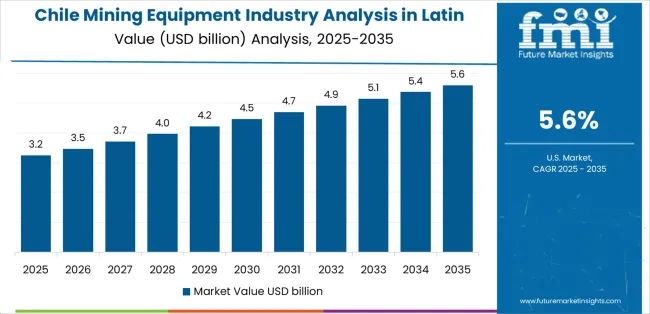
- Chile is expected to expand at 5.6% CAGR across the forecast decade as copper project portfolios renew high-tonnage fleets.
- Competition includes Caterpillar and Komatsu plus Liebherr and Epiroc. SANY and Terex plus Boart Longyear complete the core group.
- Global OEMs lead large mine orders while regional dealers defend parts access and rebuild service positions.
- Analyst Opinion
- Nikhil Kaitwade from FMI says “We are observing Latin America mining equipment moving from a machine purchase decision into an operating continuity decision. The first demand route is brownfield copper and iron ore replacement where older fleets limit mine plan reliability. The second route is automation support where mines want safer haulage and tighter shift control. Cost pressure comes from fuel use and parts availability across remote corridors.”
- Latin America Mining Equipment Market Value Analysis
- Copper and gold sites create a larger equipment wallet as hauling distance and stripping ratios raise machine hours.
- Processing packages gain value as mines add crushing and separation capacity near ore bodies to reduce transport burden.
- Service contracts become a larger value pool when miners want parts certainty and faster rebuild cycles.
- Electric and hybrid units lift order value even where diesel fleets continue to carry the main workload.
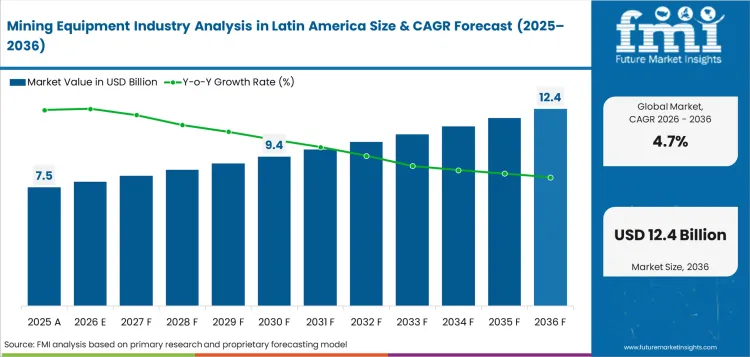
Key Takeaways, Market Size, and Forecast
| Metric | Value |
|---|---|
| Market Size (2025) | USD 7.16 Billion |
| Market Size (2036) | USD 11.9 Billion |
| Incremental Opportunity (2026–2036) | USD 4.4 Billion |
| Leading Product Type (2026) | Surface Mining Equipment |
| Surface Mining Equipment Share (2026) | 67.0% |
| Fastest-Growing Country/Region | Rest of Latin America |
| Rest of Latin America CAGR | 6.1% |
| Leading Material (2026) | Metal Mining |
| Metal Mining Share (2026) | 52.1% |
| Leading Application (2026) | Mining Operators |
| Mining Operators Share (2026) | 71.4% |
Equipment buying is shifting toward fleet uptime and energy cost control across copper and iron ore sites. Latin America mining equipment spending is shaped by brownfield replacement programs and automation retrofits. Cochilco listed 51 Chilean mining projects worth USD 83.18 billion in its 2024 to 2033 portfolio. Komatsu's September 2024 Octodots move shows how mine planning software is becoming part of the equipment order. Suppliers with service coverage and mixed fleet controls are expected to gain share across remote mine corridors.
Latin America Mining Equipment Market Definition
The Latin America mining equipment industry covers mobile and fixed equipment used for extraction and loading plus hauling and drilling. It includes crushing and grinding plus separation and mine support tools. The scope includes surface and underground machines used in metal mining and coal mining plus mineral mining across producing countries. It excludes general construction machines not used in mining and refinery equipment after primary processing.
Latin America Mining Equipment Market Inclusions
Market scope covers surface fleets and underground fleets plus processing lines and haulage systems. It includes drilling machines and material handling units plus support systems. Sales coverage includes new equipment and pre owned equipment plus dealer sales. Technology coverage includes diesel units and electric units plus hybrid units. Automation coverage includes manual equipment and semi autonomous equipment plus autonomous equipment.
Latin America Mining Equipment Market Exclusions
The scope excludes non-mining construction machinery and refinery equipment after concentrate production. It excludes oilfield drilling rigs and rail rolling stock plus ship loaders outside mine sites. Standalone spare parts and civil works services are excluded when they are not sold as mining equipment packages.
Latin America Mining Equipment Market Research Methodology
- Primary Research: FMI analysts reviewed inputs from mine operators and equipment dealers. The review covered component suppliers and fleet service firms plus contract mining companies. Discussions focused on machine replacement timing and parts access plus fuel cost and automation readiness.
- Desk Research: Desk research combined mining project portfolios and customs signals. Official mining statistics and trade body data were used with public OEM product information. The addressable pool was defined around equipment used for extraction and primary material handling.
- Market Sizing and Forecasting: The model combined fleet population and machine price bands. Replacement cycles and country project pipelines were used with equipment use by mine type. Country growth was adjusted for commodity exposure and financing depth.
- Data Validation: Forecasts were checked against mining investment portfolios and equipment import flows. Major operator projects and OEM service footprints were used as cross-checks. FMI analysts compared values with regional mining capex intensity to test scale.
Why is the Latin America Mining Equipment Market Growing?
- Copper project pipelines in Chile and Peru are extending fleet replacement cycles into larger multi-year orders.
- Iron ore capacity in Brazil keeps surface fleets active as Minas Gerais and Pará sites renew high-hour machines.
- Lithium and gold exploration in Argentina and smaller countries creates demand for drills and support equipment.
- Autonomous haulage is gaining budget attention where safety incidents and operator shortages raise operating risk.
- Electric loaders and hybrid haulage receive selective orders as fuel use becomes a measurable mine cost target.
Large mine operators are buying equipment to protect production plans instead of only adding capacity. COCHILCO reported in December 2024 that Chile's 2024 to 2033 mining portfolio covers 51 projects worth USD 83.18 billion. This scale matters for mobile mining equipment since shovel and truck packages are often tied to staged mine plans. Buyers favor suppliers that can prove uptime in the Atacama and support fleets across remote maintenance windows. The practical result is a longer replacement runway for surface fleets across copper corridors.
Processing and material handling are becoming more important as mines work lower-grade ore and longer haul routes. Peru's energy and mines ministry said in January 2024 that 92 projects worth USD 4.47 billion were under evaluation for exploration permits and exploitation permits plus beneficiation permits. That pipeline supports mineral processing equipment since crushers and conveyors are ordered when mine plans move toward ore handling upgrades. Equipment sellers with commissioning teams gain an advantage over firms that only supply a catalog machine. This shifts the forecast toward packaged systems and support contracts.
Market Segmentation Analysis
- Surface mining equipment is projected to account for 67.0% share in 2026 as open-pit copper and iron ore sites need large fleets.
- With an estimated 52.1% share in 2026, metal mining is expected to lead mining type demand through copper and gold exposure.
- Mining operators are anticipated to hold 71.4% of end use demand in 2026 as large owners control fleet planning.
- New equipment sales are expected to represent 58.0% of sales channel demand in 2026 with warranty coverage shaping buying.
- Diesel powered equipment is estimated to hold 63.0% of power source demand in 2026 while electric models start in selected fleets.
- Manual equipment is projected to account for 54.0% of automation level demand in 2026 as full autonomy remains site-limited.
Segmentation follows how mines specify equipment and how suppliers package contracts. Product choices divide between surface mining equipment and underground machines. Processing lines and support systems form the next equipment layer. Mining type separates metal sites and coal sites plus mineral sites since ore type changes payload and drilling needs. End use distinguishes mine owners from contractors and rental firms. Sales channel reflects whether machines are bought new or bought used through dealers. Power source and automation level show the technology shift from conventional diesel machines toward electric and connected fleets.
Insights into the Surface Mining Equipment Product Segment
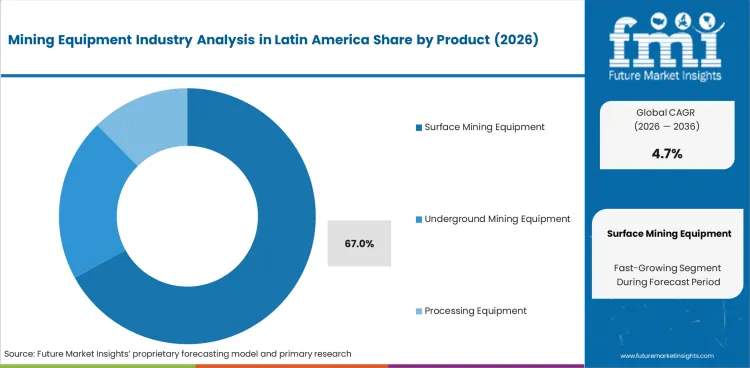
- Surface mining equipment is projected to account for 67.0% of Product demand in 2026 as open-pit copper and iron ore mines require high payload fleets.
- Large surface fleets depend on haulage productivity. underground equipment share comparisons show underground units grow differently since mine access and ventilation shape equipment sizing.
Insights into the Metal Mining Type Segment
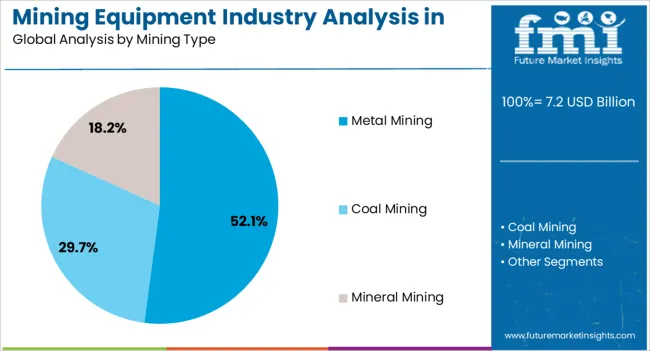
- Metal mining is estimated to hold 52.1% of Mining Type demand in 2026 as copper and gold projects use high-value machines.
- Copper mine plans create repeated equipment orders since shovel pass matching and haul truck payloads must fit ore movement targets.
- Coal sites use continuous miners where underground coal seams justify mechanical cutting.
Insights into the Mining Operators End Use Segment
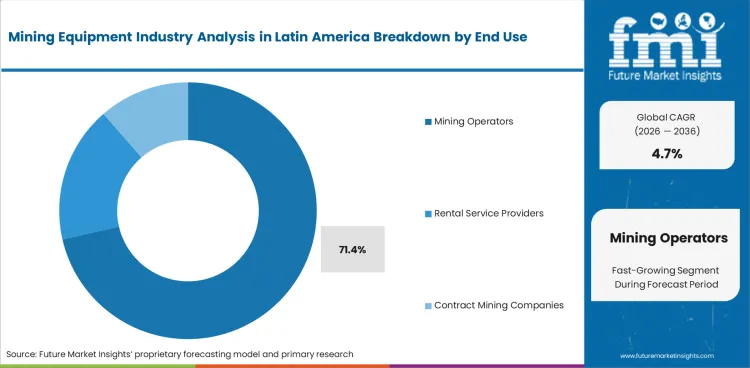
- Mining operators are anticipated to represent 71.4% of End Use demand in 2026 as major mine owners keep control over fleet strategy.
- Contract miners gain work in drilling and hauling packages, but direct buyers usually approve telemetry standards and service terms.
Insights into the New Equipment Sales Sales Channel Segment
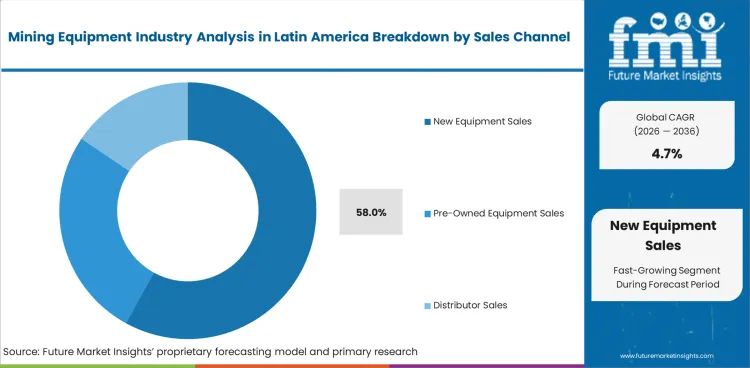
- New equipment sales are expected to hold 58.0% of Sales Channel demand in 2026 as miners prefer warranty-backed machine packages.
- Pre owned units remain useful for small operators. mining remanufacturing components keep rebuild economics visible when cash budgets delay new fleet orders.
Insights into the Diesel Powered Equipment Power Source Segment
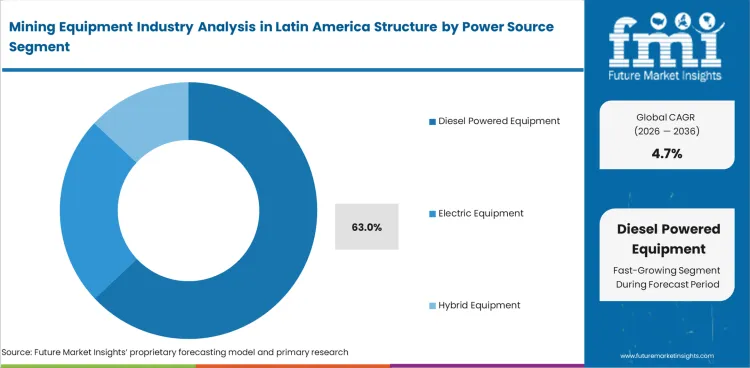
- Diesel powered equipment is projected to account for 63.0% of Power Source demand in 2026 as remote mines need proven fuel logistics.
- Electric haulage gains attention when ventilation and fuel cost rise together. mining lubricants demand remains tied to diesel fleets that operate long shifts.
Insights into the Manual Equipment Automation Level Segment
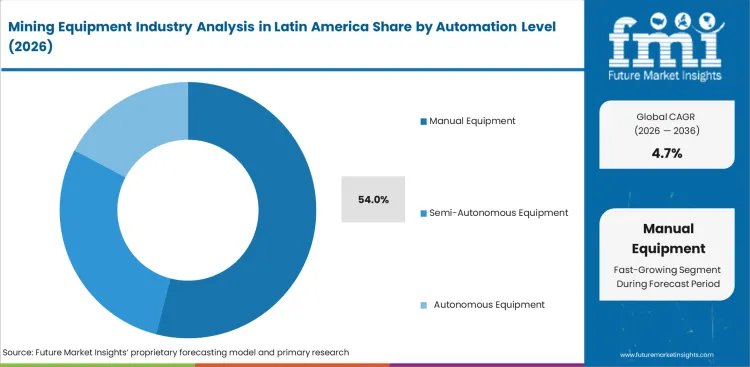
- Manual equipment is estimated to hold 54.0% of Automation Level demand in 2026 as many sites use operator-controlled fleets.
- Semi autonomous systems expand first through drilling and dispatch. underground mining automation fits mines that need safety gains without full fleet conversion.
Latin America Mining Equipment Market Drivers Restraints and Opportunities
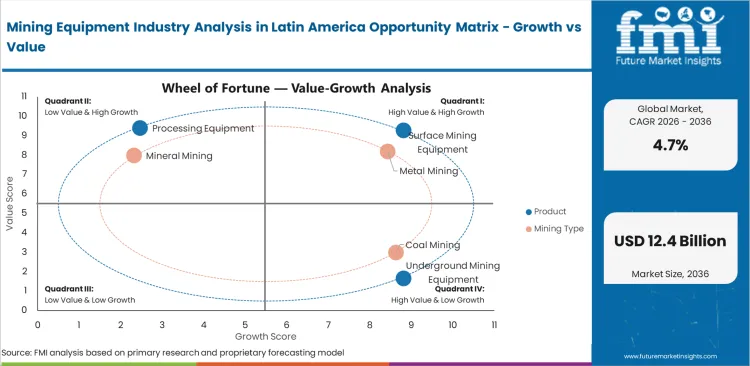
- Copper fleet renewal drives equipment orders where mine plans need larger shovels and higher truck availability.
- Iron ore haulage keeps Brazil important as high-volume pits require steady replacement of loaders and support machines.
- Automation creates opportunity when safety targets and operator shortages make remote operation commercially useful.
- Battery electric equipment faces restraint where charging capacity and high-altitude duty cycles are not proven.
- Dealer-backed rebuild programs open a second value route for miners with tight cash budgets and older fleets.
Copper fleet renewal
Copper assets remain the clearest source of equipment pull in Latin America. Chile's updated mining portfolio for 2024 to 2033 includes 51 projects with USD 83.18 billion of planned investment. This gives suppliers a visible pipeline for loading and haulage plus drilling packages tied to brownfield work. The purchase mechanism is simple since operators replace machines when mine plans require higher availability than old fleets can deliver. OEMs with component rebuild and field technicians gain the first look at tender specifications.
Brazil iron ore haulage
Brazil's equipment outlook is anchored in iron ore and logistics-heavy mining. IBRAM said the mining industry will invest USD 68.4 billion by 2029 and that iron ore projects carry 28.7% of the planned amount. This supports high-capacity trucks and hydraulic shovels plus material handling systems across Minas Gerais and Pará. The mechanism is fleet intensity since iron ore movement depends on large daily tonnage and predictable conveyor support. Suppliers that pair machines with parts distribution can defend share against lower-priced entrants.
Ore plants create a linked package around crushing and screening. aggregate mining and mineral processing equipment is relevant when mine sites combine raw extraction with primary sizing.
Autonomy retrofit gap
Automation demand is strongest where large mines already have disciplined dispatch systems. BHP said in July 2024 that its Spence operation in Chile moved 80 million tons of material with zero safety incidents after reaching 100% autonomy. This shifts smart mining from a software idea into a mine productivity tool. The restraint is site readiness since mixed fleets and older roads limit full conversion. Suppliers that offer staged retrofit plans can win before a mine commits to driverless haulage.
Analysis of Latin America Mining Equipment Market By Key Countries
.webp "Top Country Growth Comparison Latin America Mining Equipment Market Cagr (2026 2036)")
| Country | CAGR |
|---|---|
| Rest of Latin America | 6.1% |
| Chile | 5.6% |
| Brazil | 4.9% |
| Peru | 4.5% |
| Colombia | 4.4% |
| Mexico | 4.0% |
| Argentina | 3.5% |
Source: FMI analysis based on primary research and proprietary forecasting model.
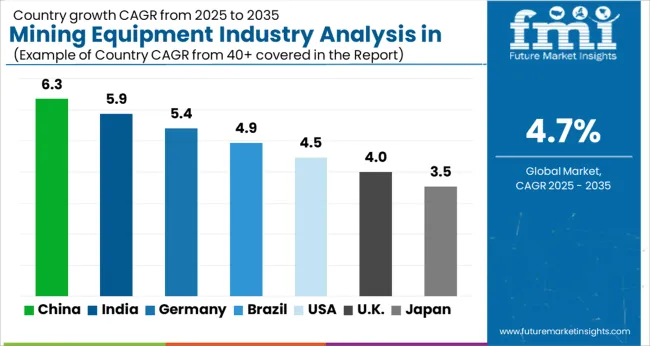
Latin America Mining Equipment Market CAGR Analysis By Country
- Rest of Latin America is projected to record a 6.1% CAGR through 2036 as smaller producers mechanize drilling and haulage fleets.
- Chile is expected to expand at 5.6% CAGR through 2036 since copper project depth supports high-capacity equipment replacement.
- Brazil is forecast to grow at 4.9% CAGR through 2036 as iron ore mines keep surface fleets active.
- Peru is expected to advance at 4.5% CAGR through 2036 given copper and gold project evaluations.
- Colombia is projected to rise at 4.4% CAGR through 2036 as coal and mineral sites retain replacement demand.
- Mexico is forecast at 4.0% CAGR through 2036 as regulatory caution slows new projects but supports existing mines.
- Argentina is expected to post 3.5% CAGR through 2036 as lithium projects grow but mine scale remains uneven.
The regional average of 4.7% shows an established industrial equipment cycle. Rest of Latin America and Chile are forecast above the average as mechanization and copper replacement orders move faster. Mexico and Argentina track below the average as project approvals and financing pace limit near-term fleet conversion. The spread shows that equipment growth follows capex release more closely than mineral resources alone.
Demand Outlook for Latin America Mining Equipment Market in Rest of Latin America
Smaller producing states create the fastest regional pace as miners replace manual extraction with compact fleets. Bolivia and Ecuador plus the Caribbean mineral belts do not match Chile or Brazil in value. Their upgrade need is visible. Rest of Latin America is projected to record a 6.1% CAGR over the assessment period as smaller mines add drills and loaders plus support tools. The effect is strongest in operations where one machine can replace multiple manual work steps. Suppliers should use modular offers and dealer financing instead of only large fleet bids.
- Bolivia's Potosí mining belt supports compact drilling and haulage demand around silver and zinc plus tin operations.
- Ecuador's Mirador copper corridor supports loading equipment and road support tools for open-pit mine growth.
- The Dominican Republic gold sector supports support equipment sales around Pueblo Viejo and nearby service hubs.
Sales Analysis of Latin America Mining Equipment Market in Chile
Chile is the region's clearest high-tonnage equipment buyer due to copper concentration and project depth. COCHILCO reported 51 projects worth USD 83.18 billion in its 2024 to 2033 mining portfolio. This creates repeated need for shovels and haul trucks plus surface mining in northern regions. Chile is expected to expand at 5.6% CAGR by 2036 since mine life extension projects need reliable fleet replacement. Service capacity in Antofagasta and Tarapacá will influence supplier selection.
- Antofagasta remains the main service corridor for large copper fleets and mine maintenance labor.
- BHP's Spence operation used 33 autonomous CAEX 980E-5 AT trucks and five drilling rigs in 2024.
- Codelco projects keep replacement demand active across state-owned copper assets and supplier service contracts.
Demand Analysis of Latin America Mining Equipment Market in Brazil
Brazil demand is driven by iron ore scale and mine logistics instead of only new mine openings. IBRAM said the sector will invest USD 68.4 billion by 2029 with Minas Gerais and Pará leading planned investment shares. This supports loaders and haul trucks plus aggregate mining and mineral processing equipment near high-volume pits. Brazil is forecast to grow at 4.9% CAGR across the forecast decade as large producers renew surface fleets. Local parts stock and rebuild capacity will decide repeat orders.
- Minas Gerais leads planned mining investment with 24.1% share according to IBRAM's 2025 outlook.
- Pará follows with 19.7% planned investment share and remains central to iron ore fleet activity.
- Bahia carries 13.2% planned investment share and supports equipment demand beyond the iron ore corridor.
Opportunity Analysis of Latin America Mining Equipment Market in Peru
Peru equipment orders follow the movement from project evaluation into operating approvals. The energy and mines ministry said in January 2024 that 92 projects worth USD 4.47 billion were under evaluation. This creates equipment demand before construction as mines specify drilling and loading plus processing layouts. Peru is expected to advance at 4.5% CAGR during the forecast period given copper and gold project flow. Suppliers need local technical teams that can support high-altitude sites.
- Ayacucho includes the Reposición Inmaculada project and supports underground equipment renewal.
- Pasco includes Yumpag and Raura projects that require drilling and support equipment.
- Apurímac includes Chalcobamba Fase I and needs earthmoving tools tied to copper operations.
Future Outlook for Latin America Mining Equipment Market in Colombia
Colombia's equipment outlook is more mixed than copper-led countries due to coal exposure. The International Energy Agency records Colombia coal production under its 2024 country profile and classifies other bituminous coal as the main production type. This supports underground and surface replacement needs in coal regions even as energy transition pressure limits new coal enthusiasm. Colombia is projected to rise at 4.4% CAGR over the assessment period as existing mines retain maintenance demand. Suppliers should focus on safer haulage and dust control instead of greenfield volume.
- Cesar coal operations shape demand for haulage and support equipment around export-oriented mines.
- La Guajira remains tied to large-scale coal logistics and mine transport equipment.
- Cundinamarca coal mines create a smaller need for ventilation and ground support equipment.
Demand Outlook for Latin America Mining Equipment Market in Mexico
Mexico remains a sizable equipment buyer despite slower project approval signals. The USA International Trade Administration said in February 2026 that Mexico's 2024 mining sector generated USD 17.07 billion in production value. The same guide reported USD 1.33 billion of USA mining equipment exports to Mexico in 2024. Mexico is forecast at 4.0% CAGR by the end of 2036 as existing mines replace equipment while new concessions face caution. Dealer financing and parts availability will matter more than aggressive fleet expansion.
- Sonora supports equipment orders around copper and gold operations near established service bases.
- Zacatecas remains important for underground silver and base metal equipment demand.
- Chihuahua mines create demand for haulage and drilling plus mobile support machines.
In-depth Analysis of Latin America Mining Equipment Market in Argentina
Argentina's market is younger than Chile or Brazil and remains tied to project conversion. The USA International Trade Administration reported in August 2025 that Argentina's 2024 mining exports were about USD 4.5 billion. The same guide noted a USD 30 billion mining portfolio with over 100 projects. Argentina is expected to post 3.5% CAGR over the ten-year period as lithium and copper projects add equipment gradually. Suppliers should plan for uneven order timing across provinces.
- Salta lithium projects support demand for drilling and compact site support tools.
- Jujuy salt flats require transport equipment and water-handling support for lithium operations.
- Catamarca copper and lithium prospects create demand for staged exploration equipment packages.
Competitive Landscape and Strategic Positioning
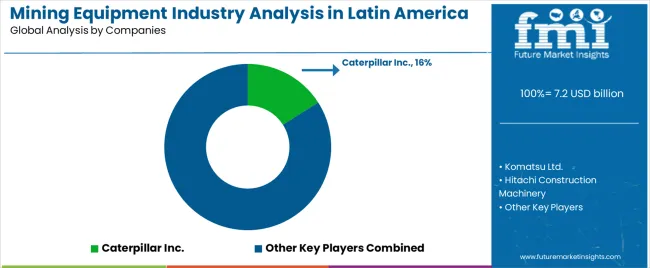
- Competition is concentrated among global OEMs that can supply large machines and service them across remote mine corridors.
- Regional dealers compete on parts stock and rebuild speed plus operator training near producing belts.
- Specialist firms stand out in drilling and crushing plus automation modules that fit mixed fleets.
- Entry barriers include warranty risk and field service coverage plus proof of uptime in high-altitude mines.
Large OEMs lead the most valuable orders as mines want a fleet partner instead of a one-machine seller. Caterpillar's MINExpo 2024 releases included Dynamic Energy Transfer and electric-drive equipment updates for mining customers. These tools connect machine supply with site energy planning and power transmission gearbox reliability. The same pattern supports Komatsu and Liebherr where machine platforms combine with digital service. Buyers use these capabilities to reduce failure risk before they approve long-term fleet packages.
Automation is becoming a direct competitive divider across Chile and Peru. Komatsu announced in September 2024 that it planned to acquire Octodots Analytics, a Chile-based digital solutions provider. The move shows that dispatch and mine optimization software are now part of equipment value. BHP's Spence autonomous fleet reinforces this shift because it links Komatsu trucks and drills with mine safety outcomes. Regional firms can participate through installation work and training support. The core software layer favors larger suppliers.
Specialist suppliers win where the job is narrow and technically demanding. Epiroc's September 2024 MINExpo update included an electric mine truck and a battery electric surface drill rig plus OEM-agnostic automation capabilities. That gives the company a clear position in mining drills and underground support. Terex and SANY compete in crushing and screening plus electric truck niches where buyers need lower capital entry points. The practical result is a layered market with global OEMs above and specialist packages below.
Smaller entrants face a service burden that is hard to overcome. Mines in Brazil and Chile plus Peru expect field technicians and component exchange pools before they accept new brands. Reliable warranties shape the same choice. Liebherr reported that its 2024 mining segment revenue reached EUR 1.67 billion and that IoMine expanded its technology portfolio. This helps explain why hydraulic anchor drilling vehicles and other specialist systems often enter through proven service partners. The barrier is not only machine price but lifecycle support.
Key Companies in the Latin America Mining Equipment Market
Competition is led by global OEMs and specialist equipment suppliers with local service partners.
- Global Leaders: Caterpillar and Komatsu plus Liebherr and Volvo Construction Equipment compete with broad mining portfolios. Their advantage is strongest in haul trucks and excavators plus loaders and fleet systems. Large mine operators need these rebuild programs across Chile and Brazil plus Peru.
- Specialist Equipment Suppliers: Boart Longyear and Epiroc plus Terex and SANY Heavy Industry compete in drilling and crushing. Electric trucks and processing support form the second focus area. Their strength lies in focused technology packages that fit specific mine tasks without replacing the full fleet relationship.
Competitive Benchmarking: Latin America Mining Equipment Market
| Company | Surface Fleet Depth | Automation and Dispatch Fit | Regional Service Coverage | Geographic Footprint |
|---|---|---|---|---|
| Caterpillar | High | High | High | Global with Latin America depth |
| Komatsu | High | High | High | Global with Chile strength |
| Liebherr Group | High | High | Medium | Global |
| Epiroc | Medium | High | High | Global |
| Volvo Construction Equipment | Medium | Medium | Medium | Global |
| SANY Heavy Industry | Medium | Medium | Medium | Global with Brazil push |
| Terex Corporation | Medium | Medium | Medium | Global |
| Boart Longyear | Low | Medium | High | Global drilling |
Source: Future Market Insights competitive analysis 2026. Ratings reflect relative positioning based on surface fleet depth and automation fit plus regional service coverage.
Key Developments in Latin America Mining Equipment Market
- In September 2024, Komatsu announced plans to acquire Octodots Analytics in Chile. The move strengthens mine optimization software around fleet productivity.
- In September 2024, Caterpillar listed MINExpo releases covering Dynamic Energy Transfer and electric-drive mining equipment. The updates support energy planning for large mine fleets.
- In March 2026, Liebherr launched the R 9100 Generation 8 excavator with 20% lower fuel use than its predecessor. The model targets 100-tonne class loading.
- In September 2024, Epiroc presented an electric mine truck and battery-electric surface drill rig. The launch shows supplier focus on electrified mining tasks.
- In April 2024, SANY presented electric and heavy mining machines at M&T Expo in Brazil. The lineup included the SKT110E mining truck.
Key Players in the Latin America Mining Equipment Market
Global Leaders
- Caterpillar
- Komatsu
- Liebherr Group
- Volvo Construction Equipment
Specialist Equipment Suppliers
- Boart Longyear
- Epiroc
- Terex Corporation
- SANY Heavy Industry
Report Scope and Coverage
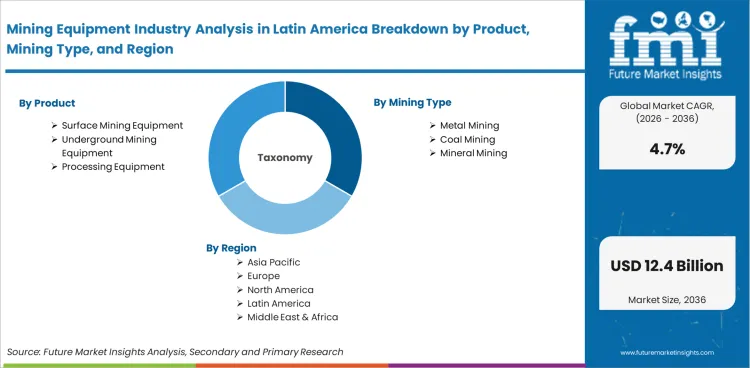
| Parameter | Details |
|---|---|
| Quantitative Units | USD 7.5 billion in 2026 to USD 11.9 billion by 2036 at a CAGR of 4.7% |
| Market Definition | Commercially sold equipment used for mining extraction and loading plus hauling and drilling plus processing support across Latin America |
| Product | Surface Mining Equipment; Underground Mining Equipment; Processing Equipment; Material Handling and Support Equipment |
| Mining Type | Metal Mining; Coal Mining; Mineral Mining |
| End Use | Mining Operators; Rental Service Providers; Contract Mining Companies |
| Sales Channel | New Equipment Sales; Pre Owned Equipment Sales; Distributor Sales |
| Power Source | Diesel Powered Equipment; Electric Equipment; Hybrid Equipment |
| Automation Level | Manual Equipment; Semi Autonomous Equipment; Autonomous Equipment |
| Regions Covered | Latin America |
| Countries Covered | Rest of Latin America; Chile; Brazil; Peru; Colombia; Mexico; Argentina |
| Key Companies Profiled | Caterpillar; Komatsu; Liebherr Group; Epiroc; Volvo Construction Equipment; SANY Heavy Industry; Terex Corporation; Boart Longyear |
| Forecast Period | 2026 to 2036 |
| Approach | Hybrid bottom-up and top-down method using mine capex signals and fleet replacement timing plus country adoption velocity |
Latin America Mining Equipment Market by Segments
Latin America Mining Equipment Market Segmented by Product:
- Surface Mining Equipment
- Excavation Equipment
- Hydraulic Excavators
- Electric Rope Shovels
- Loading Equipment
- Wheel Loaders
- Front End Loaders
- Excavation Equipment
- Underground Mining Equipment
- Drilling Equipment
- JumbDrills
- Bolting Machines
- Haulage Equipment
- Underground Trucks
- Load Haul Dump Loaders
- Drilling Equipment
- Processing Equipment
- Comminution Equipment
- Crushers
- Grinding Mills
- Separation Equipment
- Flotation Cells
- Magnetic Separators
- Comminution Equipment
- Material Handling and Support Equipment
- Transport Equipment
- Conveyor Systems
- Stackers and Reclaimers
- Support Equipment
- Ventilation Systems
- Dust Suppression Systems
- Transport Equipment
Latin America Mining Equipment Market Segmented by Mining Type
- Metal Mining
- Precious Metals
- Gold Mining
- Silver Mining
- Base Metals
- Copper Mining
- Iron Ore Mining
- Precious Metals
- Coal Mining
- Thermal Coal
- Power Generation Coal
- Coking Coal
- Steel Production Coal
- Thermal Coal
- Mineral Mining
- Industrial Minerals
- Phosphate Mining
- Potash Mining
- Construction Minerals
- Limestone Mining
- Sand and Gravel Mining
- Industrial Minerals
Latin America Mining Equipment Market Segmented by End Use
- Mining Operators
- Large Scale Mining Companies
- Integrated Mining Operations
- Multi-Site Operators
- Large Scale Mining Companies
- Rental Service Providers
- Equipment Leasing
- Short Term Rentals
- Long Term Leasing
- Equipment Leasing
- Contract Mining Companies
- Outsourced Mining Services
- Full Service Mining Contracts
- Specialized Mining Services
- Outsourced Mining Services
Latin America Mining Equipment Market Segmented by Sales Channel
- New Equipment Sales
- OEM Direct Sales
- Fleet Expansion Purchases
- Project-Based Procurement
- OEM Direct Sales
- Pre-Owned Equipment Sales
- Refurbished Equipment
- Certified Used Equipment
- Reconditioned Machinery
- Distributor Sales
- Regional Dealers
- Authorized Distributors
- Independent Dealers
Latin America Mining Equipment Market Segmented by Power Source
- Diesel Powered Equipment
- Conventional Equipment
- High Capacity Diesel Engines
- Fuel Efficient Systems
- Conventional Equipment
- Electric Equipment
- Battery Electric Equipment
- Electric Haul Trucks
- Electric Loaders
- Battery Electric Equipment
- Hybrid Equipment
- Diesel Electric Systems
- Energy Efficient Hybrid Machines
- Low Emission Equipment
Latin America Mining Equipment Market Segmented by Automation Level
- Manual Equipment
- Operator Controlled Systems
- Basic Machinery
- Standard Equipment
- Operator Controlled Systems
- Semi-Autonomous Equipment
- Assisted Operations
- Remote Controlled Equipment
- Operator Assist Systems
- Autonomous Equipment
- Fully Automated Systems
- Driverless Haul Trucks
- Automated Drilling Systems
- Fully Automated Systems
Latin America Mining Equipment Market by Country/Region:
- Rest of Latin America
- Chile
- Brazil
- Peru
- Colombia
- Mexico
- Argentina
Research Sources and Bibliography
- Comisión Chilena del Cobre. (2024, December 5). Inversión en la Minería Chilena: Cartera de Proyectos 2024-2033. COCHILCO.
- Instituto Brasileiro de Mineração. (2025, April). Brazil's mining trade balance accounts for 77% of its total trade balance in the first quarter. IBRAM.
- Ministerio de Energía y Minas del Perú. (2024, January 23). MINEM inicia evaluación de 92 proyectos mineros que generarán más de US$ 4,470 millones. Plataforma del Estado Peruano.
- International Energy Agency. (2026). Colombia coal profile. IEA.
- International Trade Administration. (2026, February 12). Mexico: Mining and minerals. USA Department of Commerce.
- International Trade Administration. (2025, August 1). Argentina: Mining. USA Department of Commerce.
- Organisation for Economic Co-operation and Development. (2025, May 27). How Latin America is strengthening commitment to responsible minerals supply chains. OECD.
- Caterpillar. (2024, September). Caterpillar MINExpo 2024 press releases. Caterpillar.
- Komatsu. (2024, September 25). Komatsu plans to acquire mining optimization software developer. Komatsu
- Komatsu. (2024, September 24). Komatsu launches interoperable mine management platform. Komatsu.
- BHP. (2024, July 23). Spence celebrates 3 months of 100% autonomous operation with visit from Komatsu executives. BHP.
- Liebherr. (2026, March 30). Liebherr launches the new R 9100 Generation 8 mining excavator. Liebherr.
- Liebherr. (2025). Annual report 2024: Mining. Liebherr.
- Epiroc. (2024, September 9). Epiroc blazes a trail for electrified and digitalized mining at MINExpo 2024. Epiroc.
- SANY Group. (2024, April 15). M&T Expo 2024: SANY presents more than 30 machines for the Brazilian market. SANY.
- Terex MPS. (2024, June 10). Terex MPS to unveil new portable crushers at Hillhead 2024. Terex.
- Boart Longyear. (2024, April 11). Closing of transaction with American Industrial Partners. Boart Longyear.
The bibliography is provided for reader reference and uses primary government sources plus official trade body pages. Company and FMI source pages are used for supplier activity and related category context.
This Report Answers
- What is the 2026 value of the Latin America Mining Equipment Market?
- What value is forecast for the Latin America Mining Equipment Market by 2036?
- What CAGR is projected for the Latin America Mining Equipment Market from 2026 to 2036?
- Which product segment is projected to lead the Latin America Mining Equipment Market in 2026?
- Which mining type is expected to hold the largest share in the Latin America Mining Equipment Market?
- Which countries or regional groups are expected to shape mining equipment growth in Latin America?
- Which companies compete in the Latin America Mining Equipment Market?
- How do automation and electric equipment change buying decisions for Latin America mines?
- What methodology supports the Latin America Mining Equipment Market forecast?
Frequently Asked Questions
What is the Latin America Mining Equipment Market value in 2026?
The Latin America Mining Equipment Market is expected to reach USD 7.5 billion in 2026 based on FMI analysis.
What is the Latin America Mining Equipment Market forecast value by 2036?
The Latin America Mining Equipment Market is projected to reach USD 11.9 billion by 2036 as fleet renewal continues.
What CAGR is projected for the Latin America Mining Equipment Market?
The Latin America Mining Equipment Market is projected to grow at 4.7% CAGR from 2026 to 2036.
Which product segment leads the Latin America Mining Equipment Market in 2026?
Surface mining equipment is projected to lead with 67.0% share in 2026 due to copper and iron ore open pits.
Which mining type leads the Latin America Mining Equipment Market in 2026?
Metal mining is expected to lead with 52.1% share in 2026 as copper and gold plus iron ore drive equipment use.
Which country group records the fastest growth in the Latin America Mining Equipment Market?
Rest of Latin America is projected to record 6.1% CAGR by 2036 as smaller producers mechanize equipment use.
What is included in the Latin America Mining Equipment Market?
The scope includes extraction and drilling plus hauling and loading. It covers processing and material handling plus ventilation and support equipment used in mining operations.
How was the Latin America Mining Equipment Market forecast built?
The forecast combines mine capex signals and fleet replacement timing. It uses country project pipelines and segment shares plus supplier service coverage.
Which mining equipment is best for large open-pit copper mines?
Large open-pit copper mines usually need hydraulic shovels and electric rope shovels plus haul trucks and drills. Support equipment is sized to ore movement plans.
What is the difference between manual and semi autonomous mining equipment?
Manual equipment relies on operators for each task. Semi autonomous equipment uses software support for drilling and dispatch plus safety tools and remote control.
Why do mines buy new equipment instead of used equipment?
Mines buy new equipment when uptime and warranty cover matter. Emissions targets and technology fit can outweigh the lower purchase price of used machines.
Which Latin American countries use mining equipment most?
Chile and Brazil plus Peru use the most mining equipment. Copper and iron ore plus gold operations create large fleet requirements.
How long does heavy mining equipment last in Latin America?
Heavy mining equipment often works for several years before rebuild. Service life depends on duty cycle and maintenance quality plus payload discipline and site conditions.
Preview the report firsthand - request a free sample
Get SampleGet the brochure for pricing and purchase details.
Get PDFTable of Content
- Executive Summary
- Latin America Market Outlook
- Demand-side Trends
- Supply-side Trends
- Technology Roadmap Analysis
- Analysis and Recommendations
- Market Overview
- Market Coverage / Taxonomy
- Market Definition / Scope / Limitations
- Research Methodology
- Chapter Orientation
- Analytical Lens and Working Hypotheses
- Market Structure, Signals, and Trend Drivers
- Benchmarking and Cross-market Comparability
- Market Sizing, Forecasting, and Opportunity Mapping
- Research Design and Evidence Framework
- Desk Research Programme (Secondary Evidence)
- Company Annual and Sustainability Reports
- Peer-reviewed Journals and Academic Literature
- Corporate Websites, Product Literature, and Technical Notes
- Earnings Decks and Investor Briefings
- Statutory Filings and Regulatory Disclosures
- Technical White Papers and Standards Notes
- Trade Journals, Industry Magazines, and Analyst Briefs
- Conference Proceedings, Webinars, and Seminar Materials
- Government Statistics Portals and Public Data Releases
- Press Releases and Reputable Media Coverage
- Specialist Newsletters and Curated Briefings
- Sector Databases and Reference Repositories
- FMI Internal Proprietary Databases and Historical Market Datasets
- Subscription Datasets and Paid Sources
- Social Channels, Communities, and Digital Listening Inputs
- Additional Desk Sources
- Expert Input and Fieldwork (Primary Evidence)
- Primary Modes
- Qualitative Interviews and Expert Elicitation
- Quantitative Surveys and Structured Data Capture
- Blended Approach
- Why Primary Evidence is Used
- Field Techniques
- Interviews
- Surveys
- Focus Groups
- Observational and In-context Research
- Social and Community Interactions
- Stakeholder Universe Engaged
- C-suite Leaders
- Board Members
- Presidents and Vice Presidents
- R&D and Innovation Heads
- Technical Specialists
- Domain Subject-matter Experts
- Scientists
- Physicians and Other Healthcare Professionals
- Governance, Ethics, and Data Stewardship
- Research Ethics
- Data Integrity and Handling
- Primary Modes
- Tooling, Models, and Reference Databases
- Desk Research Programme (Secondary Evidence)
- Data Engineering and Model Build
- Data Acquisition and Ingestion
- Cleaning, Normalisation, and Verification
- Synthesis, Triangulation, and Analysis
- Quality Assurance and Audit Trail
- Market Background
- Market Dynamics
- Drivers
- Restraints
- Opportunity
- Trends
- Scenario Forecast
- Demand in Optimistic Scenario
- Demand in Likely Scenario
- Demand in Conservative Scenario
- Opportunity Map Analysis
- Product Life Cycle Analysis
- Supply Chain Analysis
- Investment Feasibility Matrix
- Value Chain Analysis
- PESTLE and Porter’s Analysis
- Regulatory Landscape
- Regional Parent Market Outlook
- Production and Consumption Statistics
- Import and Export Statistics
- Market Dynamics
- Latin America Market Analysis 2021 to 2025 and Forecast, 2026 to 2036
- Historical Market Size Value (USD Billion) Analysis, 2021 to 2025
- Current and Future Market Size Value (USD Billion) Projections, 2026 to 2036
- Y-o-Y Growth Trend Analysis
- Absolute $ Opportunity Analysis
- Latin America Market Pricing Analysis 2021 to 2025 and Forecast 2026 to 2036
- Latin America Market Analysis 2021 to 2025 and Forecast 2026 to 2036, By Product
- Introduction / Key Findings
- Historical Market Size Value (USD Billion) Analysis By Product , 2021 to 2025
- Current and Future Market Size Value (USD Billion) Analysis and Forecast By Product , 2026 to 2036
- Surface Mining Equipment
- Underground Mining Equipment
- Processing Equipment
- Surface Mining Equipment
- Y-o-Y Growth Trend Analysis By Product , 2021 to 2025
- Absolute $ Opportunity Analysis By Product , 2026 to 2036
- Latin America Market Analysis 2021 to 2025 and Forecast 2026 to 2036, By Mining Type
- Introduction / Key Findings
- Historical Market Size Value (USD Billion) Analysis By Mining Type, 2021 to 2025
- Current and Future Market Size Value (USD Billion) Analysis and Forecast By Mining Type, 2026 to 2036
- Metal Mining
- Coal Mining
- Mineral Mining
- Metal Mining
- Y-o-Y Growth Trend Analysis By Mining Type, 2021 to 2025
- Absolute $ Opportunity Analysis By Mining Type, 2026 to 2036
- Latin America Market Analysis 2021 to 2025 and Forecast 2026 to 2036, By End Use
- Introduction / Key Findings
- Historical Market Size Value (USD Billion) Analysis By End Use, 2021 to 2025
- Current and Future Market Size Value (USD Billion) Analysis and Forecast By End Use, 2026 to 2036
- Mining Operators
- Rental Service Providers
- Contract Mining Companies
- Mining Operators
- Y-o-Y Growth Trend Analysis By End Use, 2021 to 2025
- Absolute $ Opportunity Analysis By End Use, 2026 to 2036
- Latin America Market Analysis 2021 to 2025 and Forecast 2026 to 2036, By Sales Channel
- Introduction / Key Findings
- Historical Market Size Value (USD Billion) Analysis By Sales Channel, 2021 to 2025
- Current and Future Market Size Value (USD Billion) Analysis and Forecast By Sales Channel, 2026 to 2036
- New Equipment Sales
- Pre-Owned Equipment Sales
- Distributor Sales
- New Equipment Sales
- Y-o-Y Growth Trend Analysis By Sales Channel, 2021 to 2025
- Absolute $ Opportunity Analysis By Sales Channel, 2026 to 2036
- Latin America Market Analysis 2021 to 2025 and Forecast 2026 to 2036, By Power Source
- Introduction / Key Findings
- Historical Market Size Value (USD Billion) Analysis By Power Source, 2021 to 2025
- Current and Future Market Size Value (USD Billion) Analysis and Forecast By Power Source, 2026 to 2036
- Diesel Powered Equipment
- Electric Equipment
- Hybrid Equipment
- Diesel Powered Equipment
- Y-o-Y Growth Trend Analysis By Power Source, 2021 to 2025
- Absolute $ Opportunity Analysis By Power Source, 2026 to 2036
- Latin America Market Analysis 2021 to 2025 and Forecast 2026 to 2036, By Automation Level
- Introduction / Key Findings
- Historical Market Size Value (USD Billion) Analysis By Automation Level, 2021 to 2025
- Current and Future Market Size Value (USD Billion) Analysis and Forecast By Automation Level, 2026 to 2036
- Manual Equipment
- Semi-Autonomous Equipment
- Autonomous Equipment
- Manual Equipment
- Y-o-Y Growth Trend Analysis By Automation Level, 2021 to 2025
- Absolute $ Opportunity Analysis By Automation Level, 2026 to 2036
- Latin America Market Analysis 2021 to 2025 and Forecast 2026 to 2036, By Region
- Introduction
- Historical Market Size Value (USD Billion) Analysis By Region, 2021 to 2025
- Current Market Size Value (USD Billion) Analysis and Forecast By Region, 2026 to 2036
- North America
- Latin America
- Western Europe
- Eastern Europe
- East Asia
- South Asia and Pacific
- Middle East & Africa
- Market Attractiveness Analysis By Region
- Latin America Market Analysis 2021 to 2025 and Forecast 2026 to 2036, By Country
- Historical Market Size Value (USD Billion) Trend Analysis By Market Taxonomy, 2021 to 2025
- Market Size Value (USD Billion) Forecast By Market Taxonomy, 2026 to 2036
- By Country
- Rest of Latin America
- Chile
- Brazil
- Peru
- Colombia
- Mexico
- Argentina
- By Product
- By Mining Type
- By End Use
- By Sales Channel
- By Power Source
- By Automation Level
- By Country
- Market Attractiveness Analysis
- By Country
- By Product
- By Mining Type
- By End Use
- By Sales Channel
- By Power Source
- By Automation Level
- Key Takeaways
- Market Structure Analysis
- Competition Dashboard
- Competition Benchmarking
- Market Share Analysis of Top Players
- By Country/Region
- By Product
- By Mining Type
- By End Use
- By Sales Channel
- By Power Source
- By Automation Level
- Competition Analysis
- Competition Deep Dive
- Caterpillar
- Overview
- Product Portfolio
- Profitability by Market Segments (Product/Mining Type/Sales Channel/Region)
- Sales Footprint
- Strategy Overview
- Marketing Strategy
- Product Strategy
- Channel Strategy
- Komatsu
- Liebherr Group
- Volvo Construction Equipment
- Epiroc
- Terex Corporation
- SANY Heavy Industry
- Boart Longyear
- Caterpillar
- Competition Deep Dive
- Assumptions & Acronyms Used


