

- Industry Size (2026)
- USD 9.2 Bn
- Forecast (2036)
- USD 18.1 Bn
- CAGR (2026 to 2036)
- 7.0%
IT Software and Service Analysis in Poland Outlook 2026 to 2036
The IT software and services market in Poland is projected to expand from USD 9.2 billion in 2026 to USD 18.1 billion by 2036, registering a 7.0% CAGR. Funding conversion remains a core demand trigger. Poland’s National Recovery Plan framework indicates digital transformation is a defined allocation line within the programme, creating sustained procurement pull for cloud migration, cybersecurity, and systems integration across public administration and regulated sectors.
Hyperscale and AI infrastructure investment is also translating into local delivery demand. Microsoft announced a PLN 2.8 billion investment in cloud and AI infrastructure, skilling and cybersecurity in Poland, reinforcing enterprise cloud adoption and expanding local implementation workloads across regulated buyers that require security-aligned cloud execution. Asseco’s 2024 management report describes 2024 as record-breaking and references its strategy focus, signalling sustained domestic scale in public sector and regulated workloads that typically demand integration-heavy delivery rather than pure licence resale.
A measurable adoption base supports the forecast. Statistics Poland reported that 55.3% of enterprises purchased cloud computing services, showing that cloud is already an active buying behaviour rather than an emerging concept, which sustains recurring managed services and migration waves through 2036. A quote that captures the operational reality of this market is visible in Microsoft’s Poland investment announcement, where Brad Smith stated the investment will cover cloud and AI infrastructure, skilling, and cybersecurity in Poland, framing spend as both platform build and capability build, not a one-time project.
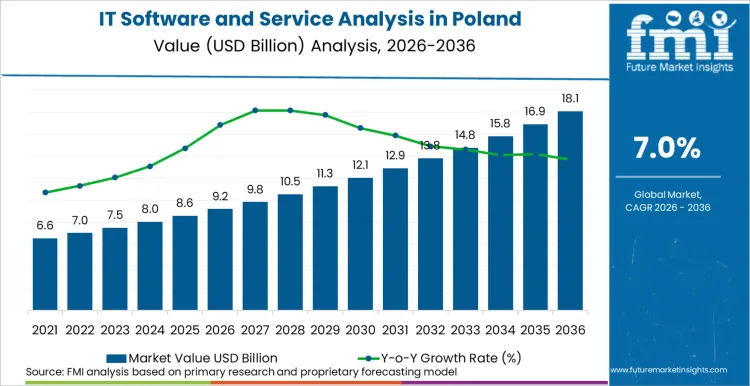
Summary of the IT Software and Service Analysis in Poland
What is the IT Software and Service Analysis in Poland size in 2026 and 2036 as per FMI projection?
It is projected to be USD 9.2 billion in 2026 and USD 18.1 billion by 2036, expanding at a 7.0% CAGR.
FMI Research Approach: Forecast anchored to enterprise cloud adoption, EU and national digitisation programme conversion into procurement, and recurring managed services and application modernisation demand across regulated sectors.
Which offering leads in 2026 and what sustains its leadership?
IT services lead with a 58.0% share in 2026, sustained by multi-year implementation and run commitments for cloud migration, integration, and security operations that outlast software purchasing cycles.
FMI Research Approach: Offering split mapped to delivery-heavy procurement patterns and recurring run-rate services attached to platform modernisation.
Which service type leads in 2026 and what does it signal about buyer priorities?
Managed services lead with a 34.0% share in 2026, signalling that buyers are prioritising uptime, security controls, and cost predictability for cloud and hybrid estates over one-off transformation projects.
FMI Research Approach: Service type mix derived from cloud operations intensity, cybersecurity operations needs, and enterprise outsourcing patterns.
Which software type leads in 2026 and what does it reveal about budget concentration?
Enterprise applications lead with a 31.0% share in 2026, reflecting budget concentration in core ERP, CRM, and line-of-business systems that require ongoing integration, upgrades, and compliance-aligned configuration.
FMI Research Approach: Software mix estimated using installed-base renewal and upgrade cycles and application modernisation throughput.
Which deployment model dominates in 2026 and why is it structurally advantaged?
Cloud leads with a 52.0% share in 2026, structurally advantaged by enterprise adoption momentum and by hyperscale investment that expands local capacity and security-aligned cloud options.
FMI Research Approach: Deployment mix anchored to enterprise cloud purchase rates and hyperscale infrastructure expansion signals.
IT Software and Service Analysis in Poland Key Takeaways
| Metric | Value |
|---|---|
| Market Size (2026E) | USD 9.2 billion |
| Forecast Value (2036F) | USD 18.1 billion |
| CAGR (2026 to 2036) | 7.0% |
Which forces are structurally expanding Poland’s IT software and services wallet?
Poland’s growth is being pulled by funding conversion, cloud adoption, and institutional pressure to raise cyber resilience. The National Recovery Plan framework identifies digital transformation as a defined allocation line, which converts modernisation into multi-year procurement for cloud enablement, integration, and security operations. Enterprise demand is reinforced by an active adoption base. Statistics Poland reported 55.3% of enterprises purchased cloud computing services, which sustains migration, optimisation, and managed services demand beyond initial moves. Hyperscale investment strengthens the execution pipeline. Microsoft’s PLN 2.8 billion cloud and AI investment in Poland expands capacity and skills initiatives, which increases delivery demand for cloud platforms, data workloads, and cybersecurity programmes that must be operationalised locally.
How is the IT Software and Services Market in Poland Segmented?
The IT software and services market in Poland is segmented by offering, service type, software type, deployment model, and end-use vertical to reflect how demand is formed through long-duration delivery commitments rather than one-off technology purchases. By offering, the market is split between IT services and software, with services acting as the dominant execution layer that converts platform decisions into operational outcomes. By service type, spending spans managed services, system integration, consulting, application development and maintenance, and outsourcing, mirroring the shift from transformation projects toward steady-state operations. By software type, demand concentrates around enterprise applications, cybersecurity, data and analytics, and cloud platforms that require continuous integration and upgrades. By deployment model, cloud and hybrid architectures dominate as enterprises standardise operating environments. By end-use vertical, BFSI, public sector, and industrial enterprises lead adoption due to regulatory, uptime, and security requirements. FMI analysis indicates that Poland’s segmentation is governed less by experimentation and more by execution discipline, where recurring run-state delivery anchors the market structure.
Why do IT services hold the majority share of spend in 2026?
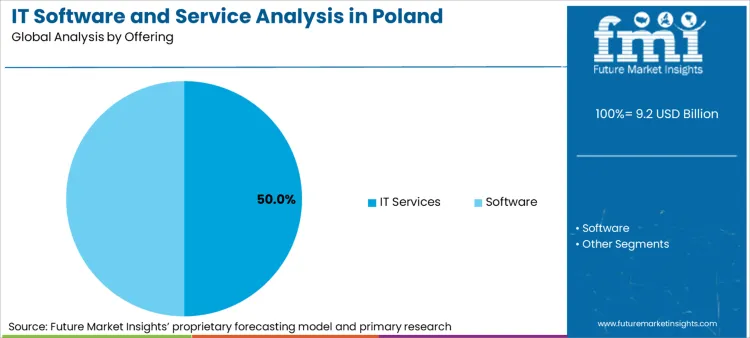
IT services lead with a 50.0% share in 2026 because Poland’s demand is execution-heavy. Buyers are funding platform moves that require implementation, integration, and long-run operational support, not only software purchase. Microsoft’s PLN 2.8 billion investment in cloud and AI infrastructure, skilling and cybersecurity in Poland is a structural indicator that cloud adoption is paired with capability build, which expands the services wallet for migration, governance, security engineering, and managed operations. Statistics Poland’s evidence that 55.3% of enterprises already purchase cloud services reinforces that the market is in an operating phase where optimisation and run activities scale faster than greenfield procurement. Asseco’s 2024 management report framing 2024 as record-breaking is consistent with a services-led market logic where local players capture integration-heavy public sector and regulated workloads that require delivery presence and domain-specific implementation depth. The repeated behaviour is clear: hyperscalers expand, local champions scale delivery, enterprise cloud adoption rises, and services remain the binding layer that converts platform direction into working outcomes.
Why are managed services the largest service type in 2026?
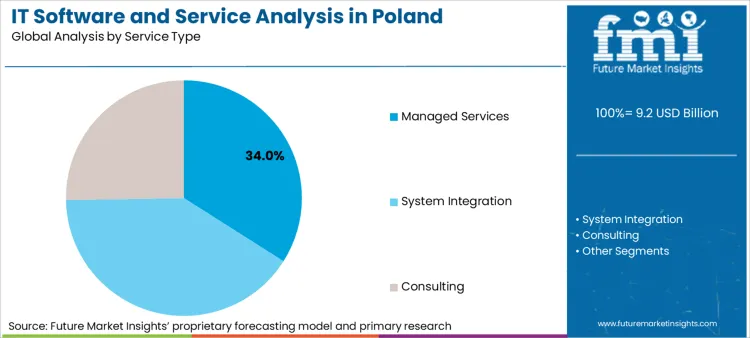
Managed services lead with a 34.0% share in 2026 because Poland’s buyers are shifting from project delivery into steady-state operations for cloud and hybrid estates. Statistics Poland’s enterprise cloud purchasing rate implies that many organisations now require continuous governance, monitoring, backup, identity, and security operations rather than sporadic transformation work. The National Recovery Plan’s digital transformation allocation reinforces recurring operational demand in public administration where service continuity and compliance are procurement priorities, which structurally favours managed service contracts over ad hoc engagements. Poland’s business services ecosystem also supports this model by providing scaled delivery labour pools in major cities, enabling providers to industrialise run services and keep unit economics competitive for large enterprises. The ABSL Business Services Sector in Poland 2024 report frames the sector’s progression toward more advanced services, which aligns with managed services scaling as a repeatable, standardised delivery model. The market signal is recurring: cloud adoption becomes normal, cyber pressure rises, and run-state operations become the largest service wallet.
Why do enterprise applications dominate software mix in 2026?
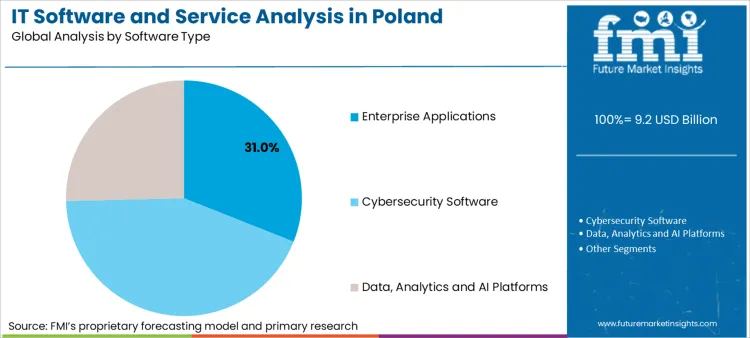
Enterprise applications lead with a 31.0% share in 2026 because core business systems are the budget anchor for regulated reporting, transactional resilience, and end-to-end process control. These systems produce recurring spend through upgrades, integration, and compliance-driven changes, which keeps application portfolios central even as analytics and cybersecurity grow. Global system integrators are signalling this logic through repeated SAP and enterprise modernisation investments. Accenture’s acquisition of Camelot Management Consultants expanded SAP-focused capabilities in supply chain and data and analytics, indicating that enterprise application modernisation remains a strategic priority for scaled service firms operating across Europe. In Poland, the same logic translates into steady demand for ERP and core application integration across manufacturing, logistics, and BFSI buyers, sustaining software and the attached services spine.
What trends and restraints are shaping IT software and services in Poland?
A defining trend is cloud normalisation combined with hyperscale capacity build, which increases platform and services intensity. Statistics Poland reported 55.3% of enterprises purchased cloud computing services, showing cloud is already in active use across the economy, which increases demand for cloud platforms, middleware, security tooling, and the managed services required to operate hybrid estates. Microsoft’s PLN 2.8 billion investment in cloud and AI infrastructure, skilling and cybersecurity in Poland reinforces this by expanding the execution pipeline for cloud migration and AI readiness programmes across enterprises and government-adjacent buyers.
A key restraint is delivery friction created by talent constraints and public sector procurement complexity, which can slow implementation throughput even when funding exists. Poland’s recovery programme channels large digital allocations into projects that must be specified, tendered, and delivered across many entities, which increases the dependency on scarce senior architects, cybersecurity specialists, and programme governance capacity. As demand concentrates in Warsaw, Kraków, and Wrocław delivery hubs, suppliers face wage pressure and retention risk, which can raise delivery costs and elongate project timelines for buyers seeking multi-year managed service commitments.
What is the IT Software and Services Market Regional Outlook in Poland?
Growth across Poland’s IT software and services market is being driven by concentrated demand in major delivery and procurement hubs rather than uniform national expansion. While the overall market expands at a 7.0% CAGR, leading cities are outpacing the national average as public administration, regulated enterprises, and hyperscale cloud programmes cluster procurement and delivery capacity. Warsaw leads growth with a 7.4% CAGR, followed closely by Kraków at 7.2% and Wrocław at 7.1%, forming a high-intensity axis of demand anchored in government platforms, enterprise cloud operations, and managed services delivery. In contrast, secondary regions such as Tri-City (6.9%) and Poznań (6.7%) grow at a steadier pace, shaped by enterprise operations, manufacturing, and shared-service demand rather than centralised public procurement. FMI analysis indicates that future growth will be concentrated in regions where delivery talent density, regulatory workloads, and long-duration managed service contracts converge, reinforcing urban-led expansion rather than broad geographic diffusion.
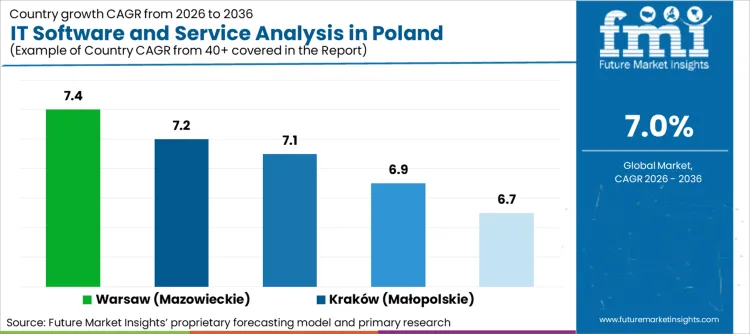
| City/Region | CAGR (2026 to 2036) |
|---|---|
| Warsaw (Mazowieckie) | 7.4% |
| Kraków (Małopolskie) | 7.2% |
| Wrocław (Dolnośląskie) | 7.1% |
| Tri-City (Pomorskie) | 6.9% |
| Poznań (Wielkopolskie) | 6.7% |
Source: Future Market Insights (FMI) analysis, based on proprietary forecasting model and primary research.
Why will Warsaw remain the fastest-expanding regional IT market through 2036?
Warsaw grows at a 7.4% CAGR across 2026 to 2036 because it concentrates national public administration, regulated headquarters, and the largest procurement density for e-government platforms, cybersecurity, and enterprise integration. The National Recovery Plan’s digital transformation allocation increases the volume of centrally coordinated programmes that typically anchor vendor frameworks and multi-year managed service contracts, which disproportionately route through Warsaw-based institutions and delivery leadership. Microsoft’s Poland cloud and AI investment further strengthens Warsaw’s role as an enterprise decision node for cloud migration and security programmes, driving high-value consulting, integration, and operations spend. Warsaw’s scale advantage also supports the managed services share logic because large buyers in the capital are more likely to standardise operations and outsource run-state controls for cloud and hybrid estates.
What sustains Kraków as a leading delivery hub for IT software and services?
Kraków expands at a 7.2% CAGR through 2036 because it remains one of Poland’s deepest delivery ecosystems for technology and business services, supporting scalable managed services and application development workloads for international and domestic clients. The ABSL Business Services Sector in Poland 2024 report documents the sector’s scale and its move into more advanced services, which reinforces Kraków’s role in higher-value engineering and digital delivery rather than transactional support. As enterprise cloud usage increases, Kraków-based teams are pulled into cloud operations, DevOps, cybersecurity operations, and application modernisation delivery, supporting the 34.0% managed services share and the 52.0% cloud deployment share in 2026. This delivery concentration sustains a steady pipeline of long-duration contracts, which supports recurring revenue models for providers and predictable capacity for buyers.
Why does Wrocław sustain growth driven by engineering-led IT demand?
Wrocław grows at a 7.1% CAGR across 2026 to 2036 because it combines an established business services base with strong engineering and industrial adjacency that pulls demand for enterprise application integration, industrial IT, and analytics-enabled operations. The ABSL 2024 sector report frames the evolution toward advanced services, which aligns with Wrocław’s role in higher-complexity delivery work that supports enterprise applications leadership at 31.0% and cloud platform adoption at 52.0% in 2026. As manufacturing and industrial end-use accounts for 13.0% of spend in 2026, Wrocław’s buyer mix sustains integration and application maintenance demand tied to ERP modernisation, OT-IT integration, and supply chain visibility initiatives, reinforcing the services-heavy spend structure.
What differentiates Tri-City’s IT software and services demand formation?
Tri-City grows at a 6.9% CAGR through 2036 because its coastal economy and services base increase demand for logistics-adjacent IT, digital commerce infrastructure, and shared-service delivery that supports enterprise cloud operations and application modernisation. Cloud adoption at enterprise level, evidenced by Statistics Poland’s 55.3% cloud purchase rate, supports recurring run-state demand for distributed organisations, which is structurally compatible with Tri-City delivery models. The region’s growth is shaped less by central public procurement density than Warsaw and more by enterprise operations, logistics flows, and services delivery scaling, which sustains managed services and application development demand without requiring national-level programme concentration.
Why is Poznań positioned as a steady-growth IT market rather than a top-tier hub?
Poznań grows at a 6.7% CAGR across 2026 to 2036 because demand formation is anchored in manufacturing, industrial services, and mid-to-large enterprise modernisation rather than the densest public administration and HQ concentration. The market still benefits from Poland’s enterprise cloud adoption base and from EU and national digital funding conversion, but the procurement intensity and multi-agency platform concentration is lower than Warsaw’s. This positions Poznań as a steady growth market for application development, ERP modernisation, and managed infrastructure operations, with growth paced by enterprise refresh cycles and delivery capacity rather than major national programme centralisation.
How is competitive intensity structured in Poland’s IT software and services market?
Scope for this competitive landscape includes IT services delivery (managed services, system integration, consulting, application development and maintenance, IT outsourcing) and software (enterprise applications, cybersecurity, data and analytics and AI platforms, cloud platforms and middleware, collaboration and productivity) sold into Poland. It includes cloud and hybrid deployments delivered through local delivery centres and partner ecosystems. It excludes telecom connectivity sold without IT transformation delivery, consumer software, and hardware-only infrastructure not bundled with software and services.
Global scale leadership is anchored by Accenture, given its disclosed scale and recurring emphasis on large transformation programmes in its SEC filings, with Capgemini and IBM competing on European delivery breadth and hybrid cloud and AI stacks, and SAP and Microsoft shaping application and cloud platform direction that pulls services demand through partner ecosystems. In Poland, domestic scale is most visible in Asseco and Comarch through persistent public sector and enterprise execution, while Sii Poland, TTMS, and Sygnity compete through delivery throughput and integration-heavy contracts. North America leadership tends to over-index to Accenture and IBM due to breadth and scale, Europe shows stronger relative weight for Capgemini and SAP ecosystems, and Asia leadership patterns differ. Japan is explicitly distinct because domestic incumbents such as NTT DATA have deep public sector and enterprise adjacency that can outweigh global brand scale in local awards, illustrating where global leadership does not automatically translate into regional leadership.
Recent developments
- In March 2025, Asseco Group reported a record 2024 performance with PLN 520 million net profit, strong international growth, 14 acquisitions, and a solid 2025 order backlog exceeding PLN 10.8 billion across proprietary software and services.
- In February 2025, Microsoft announced a $700 million investment in Poland to expand cloud, AI, and cybersecurity infrastructure by 2026, strengthening Azure services, national cyber resilience, and digital skills training in partnership with the Polish government.
Key Players
- Asseco Poland / Asseco Group
- Comarch
- Sii Poland
- Transition Technologies MS (TTMS)
- Sygnity
- Accenture
- Capgemini
- IBM Poland
- Microsoft
- SAP
Market Definition
The Poland IT software and services market covers revenues generated from enterprise software and IT services delivered to organisations operating in Poland, including public sector bodies and commercial enterprises. It includes software categories such as enterprise applications, cybersecurity software, data and analytics and AI platforms, cloud platforms and middleware, and collaboration tools. It includes IT services such as managed services, system integration, consulting, application development and maintenance, and IT outsourcing that design, implement, integrate, and operate these platforms across cloud, hybrid, and on-premise environments.
Market Inclusion
Included are contracts and subscriptions sold to buyers in Poland for cloud and hybrid deployments, enterprise application modernisation, cybersecurity tools and operations, data and analytics platforms, and productivity stacks when coupled with implementation, integration, and managed operations. Included are public sector digital programmes and e-government platforms tied to national and EU funding conversion, and regulated-industry deployments in BFSI, telecom, healthcare, and transportation that require security-aligned architectures and continuous operations. Included are domestic champions and global integrators delivering through Polish delivery centres and partner ecosystems.
Market Exclusion
Excluded are telecom connectivity and network access services sold without IT transformation delivery, consumer and gaming software, hardware-only infrastructure sales without bundled software and services, and BPO services that do not include IT delivery or technology operations. Excluded are projects limited to isolated app builds with no integration, no platform migration, and no operational responsibility. Also excluded are revenues from global delivery performed in Poland for foreign end customers if the contracting buyer is outside Poland and the work is not delivered into Polish operations.
Scope of Report
| Items | Values |
|---|---|
| Quantitative Units | USD 9.2 Billion |
| Offering | IT Services; Software |
| Service Type | Managed Services; System Integration; Consulting; Application Development and Maintenance; IT Outsourcing, Staff Augmentation and BPO-IT |
| Software Type | Enterprise Applications; Cybersecurity Software; Data, Analytics and AI Platforms; Cloud Platforms and Middleware; Collaboration and Productivity Software; Other Software |
| Deployment Model | Cloud (Public and Private); Hybrid; On-premise |
| End-use Vertical | BFSI; Public Sector & E-government; Telecom, Media and Entertainment; Manufacturing and Industrial; Retail and E-commerce; Healthcare and Life Sciences; Transportation and Logistics; Other Verticals |
| Regions Covered | Poland |
| Key Regions / Cities | Warsaw (Mazowieckie); Kraków (Małopolskie); Wrocław (Dolnośląskie); Tri-City (Pomorskie); Poznań (Wielkopolskie) |
| Key Companies Profiled | Asseco Poland / Asseco Group; Comarch; Sii Poland; Transition Technologies MS (TTMS); Sygnity; Accenture; Capgemini; IBM Poland; Microsoft; SAP |
| Additional Attributes | Dollar sales measured for IT software and IT services delivered to public sector and enterprise buyers in Poland, analysed by offering mix, service delivery model, software category, deployment architecture, and end-use vertical, with emphasis on EU and national funding conversion into procurement, cloud and hybrid adoption economics, managed services intensity, enterprise application modernisation cycles, cybersecurity and compliance-driven demand, delivery capacity concentration by region, and competitive positioning based on delivery footprint, partner ecosystem leverage, and repeat public-sector programme execution. |
IT Software and Service Analysis in Poland by Key Segmentation
By Offering
- IT Services
- Software
By Service Type
- Managed Services
- System Integration
- Consulting
- Application Development and Maintenance
- IT Outsourcing, staff augmentation and BPO-IT
By Software Type
- Enterprise Applications
- Cybersecurity Software
- Data, Analytics and AI Platforms
- Cloud Platforms and Middleware
- Collaboration and Productivity
- Other Software
By Deployment Model
- Cloud, Public and Private
- Hybrid
- On-premise
By End-use Vertical
- BFSI
- Public Sector, e-government
- Telecom, Media and Entertainment
- Manufacturing and Industrial
- Retail and E-commerce
- Healthcare and Life Sciences
- Transportation and Logistics
- Other Verticals
Bibliography
- Association of Business Service Leaders. (2024). Business services sector in Poland 2024. ABSL Poland.
- Organisation for Economic Co-operation and Development. (2025). OECD digital economy outlook 2025: Poland country note. OECD Publishing.
- Ministry of Digital Affairs. (2024). State of digital competency and infrastructure in Poland 2024. Government of Poland.
Frequently Asked Questions
How big is the IT software and services market in Poland?
The IT software and services market in Poland is valued at USD 9.2 billion in 2026 and is projected to reach USD 18.1 billion by 2036.
What is the growth outlook for the IT software and services market in Poland over the next 10 years?
The market is expected to grow at a steady 7.0% CAGR from 2026 to 2036, driven by EU-funded digitisation, cloud adoption, and recurring managed services demand.
Which product segments or formats drive demand in this market?
Demand is driven primarily by IT services, especially managed services, cloud deployments, and enterprise application modernisation tied to long-term operations and compliance needs.
How does consumer behavior differ by region?
Warsaw leads demand due to public sector procurement and HQ concentration, while Kraków and Wrocław act as delivery hubs and Tri-City and Poznań show steadier enterprise-led adoption.
What are the main risks and constraints affecting this market?
Key constraints include delivery talent shortages, wage inflation in major hubs, and the complexity of public-sector procurement slowing execution despite available funding.
Preview the report firsthand - request a free sample
Get SampleGet the brochure for pricing and purchase details.
Get PDFTable of Content
- Executive Summary
- Global Market Outlook
- Demand-side Trends
- Supply-side Trends
- Technology Roadmap Analysis
- Analysis and Recommendations
- Market Overview
- Market Coverage / Taxonomy
- Market Definition / Scope / Limitations
- Research Methodology
- Chapter Orientation
- Analytical Lens and Working Hypotheses
- Market Structure, Signals, and Trend Drivers
- Benchmarking and Cross-market Comparability
- Market Sizing, Forecasting, and Opportunity Mapping
- Research Design and Evidence Framework
- Desk Research Programme (Secondary Evidence)
- Company Annual and Sustainability Reports
- Peer-reviewed Journals and Academic Literature
- Corporate Websites, Product Literature, and Technical Notes
- Earnings Decks and Investor Briefings
- Statutory Filings and Regulatory Disclosures
- Technical White Papers and Standards Notes
- Trade Journals, Industry Magazines, and Analyst Briefs
- Conference Proceedings, Webinars, and Seminar Materials
- Government Statistics Portals and Public Data Releases
- Press Releases and Reputable Media Coverage
- Specialist Newsletters and Curated Briefings
- Sector Databases and Reference Repositories
- FMI Internal Proprietary Databases and Historical Market Datasets
- Subscription Datasets and Paid Sources
- Social Channels, Communities, and Digital Listening Inputs
- Additional Desk Sources
- Expert Input and Fieldwork (Primary Evidence)
- Primary Modes
- Qualitative Interviews and Expert Elicitation
- Quantitative Surveys and Structured Data Capture
- Social and Community Interactions
- Stakeholder Universe Engaged
- C-suite Leaders
- Board Members
- Presidents and Vice Presidents
- R&D and Innovation Heads
- Technical Specialists
- Domain Subject-matter Experts
- Scientists
- Physicians and Other Healthcare Professionals
- Governance, Ethics, and Data Stewardship
- Research Ethics
- Data Integrity and Handling
- Primary Modes
- Tooling, Models, and Reference Databases
- Desk Research Programme (Secondary Evidence)
- Data Engineering and Model Build
- Data Acquisition and Ingestion
- Cleaning, Normalisation, and Verification
- Synthesis, Triangulation, and Analysis
- Quality Assurance and Audit Trail
- Market Background
- Market Dynamics
- Drivers
- Restraints
- Opportunity
- Trends
- Scenario Forecast
- Demand in Optimistic Scenario
- Demand in Likely Scenario
- Demand in Conservative Scenario
- Opportunity Map Analysis
- Product Life Cycle Analysis
- Supply Chain Analysis
- Investment Feasibility Matrix
- Value Chain Analysis
- PESTLE and Porter’s Analysis
- Regulatory Landscape
- Regional Parent Market Outlook
- Production and Consumption Statistics
- Import and Export Statistics
- Market Dynamics
- Global Market Analysis 2021 to 2025 and Forecast, 2026 to 2036
- Historical Market Size Value (USD Million) Analysis, 2021 to 2025
- Current and Future Market Size Value (USD Million) Projections, 2026 to 2036
- Y-o-Y Growth Trend Analysis
- Absolute $ Opportunity Analysis
- Global Market Pricing Analysis 2021 to 2025 and Forecast 2026 to 2036
- Global Market Analysis 2021 to 2025 and Forecast 2026 to 2036, By Offering
- Introduction / Key Findings
- Historical Market Size Value (USD Million) Analysis By Offering , 2021 to 2025
- Current and Future Market Size Value (USD Million) Analysis and Forecast By Offering , 2026 to 2036
- IT Services
- Software
- IT Services
- Y-o-Y Growth Trend Analysis By Offering , 2021 to 2025
- Absolute $ Opportunity Analysis By Offering , 2026 to 2036
- Global Market Analysis 2021 to 2025 and Forecast 2026 to 2036, By Service Type
- Introduction / Key Findings
- Historical Market Size Value (USD Million) Analysis By Service Type, 2021 to 2025
- Current and Future Market Size Value (USD Million) Analysis and Forecast By Service Type, 2026 to 2036
- Managed Services
- System Integration
- Consulting
- Managed Services
- Y-o-Y Growth Trend Analysis By Service Type, 2021 to 2025
- Absolute $ Opportunity Analysis By Service Type, 2026 to 2036
- Global Market Analysis 2021 to 2025 and Forecast 2026 to 2036, By Software Type
- Introduction / Key Findings
- Historical Market Size Value (USD Million) Analysis By Software Type, 2021 to 2025
- Current and Future Market Size Value (USD Million) Analysis and Forecast By Software Type, 2026 to 2036
- Enterprise Applications
- Cybersecurity Software
- Data, Analytics and AI Platforms
- Enterprise Applications
- Y-o-Y Growth Trend Analysis By Software Type, 2021 to 2025
- Absolute $ Opportunity Analysis By Software Type, 2026 to 2036
- Global Market Analysis 2021 to 2025 and Forecast 2026 to 2036, By Region
- Introduction
- Historical Market Size Value (USD Million) Analysis By Region, 2021 to 2025
- Current Market Size Value (USD Million) Analysis and Forecast By Region, 2026 to 2036
- North America
- Latin America
- Western Europe
- Eastern Europe
- East Asia
- South Asia and Pacific
- Middle East & Africa
- Market Attractiveness Analysis By Region
- North America Market Analysis 2021 to 2025 and Forecast 2026 to 2036, By Country
- Historical Market Size Value (USD Million) Trend Analysis By Market Taxonomy, 2021 to 2025
- Market Size Value (USD Million) Forecast By Market Taxonomy, 2026 to 2036
- By Country
- USA
- Canada
- Mexico
- By Offering
- By Service Type
- By Software Type
- By Country
- Market Attractiveness Analysis
- By Country
- By Offering
- By Service Type
- By Software Type
- Key Takeaways
- Latin America Market Analysis 2021 to 2025 and Forecast 2026 to 2036, By Country
- Historical Market Size Value (USD Million) Trend Analysis By Market Taxonomy, 2021 to 2025
- Market Size Value (USD Million) Forecast By Market Taxonomy, 2026 to 2036
- By Country
- Brazil
- Chile
- Rest of Latin America
- By Offering
- By Service Type
- By Software Type
- By Country
- Market Attractiveness Analysis
- By Country
- By Offering
- By Service Type
- By Software Type
- Key Takeaways
- Western Europe Market Analysis 2021 to 2025 and Forecast 2026 to 2036, By Country
- Historical Market Size Value (USD Million) Trend Analysis By Market Taxonomy, 2021 to 2025
- Market Size Value (USD Million) Forecast By Market Taxonomy, 2026 to 2036
- By Country
- Germany
- UK
- Italy
- Spain
- France
- Nordic
- BENELUX
- Rest of Western Europe
- By Offering
- By Service Type
- By Software Type
- By Country
- Market Attractiveness Analysis
- By Country
- By Offering
- By Service Type
- By Software Type
- Key Takeaways
- Eastern Europe Market Analysis 2021 to 2025 and Forecast 2026 to 2036, By Country
- Historical Market Size Value (USD Million) Trend Analysis By Market Taxonomy, 2021 to 2025
- Market Size Value (USD Million) Forecast By Market Taxonomy, 2026 to 2036
- By Country
- Russia
- Poland
- Hungary
- Balkan & Baltic
- Rest of Eastern Europe
- By Offering
- By Service Type
- By Software Type
- By Country
- Market Attractiveness Analysis
- By Country
- By Offering
- By Service Type
- By Software Type
- Key Takeaways
- East Asia Market Analysis 2021 to 2025 and Forecast 2026 to 2036, By Country
- Historical Market Size Value (USD Million) Trend Analysis By Market Taxonomy, 2021 to 2025
- Market Size Value (USD Million) Forecast By Market Taxonomy, 2026 to 2036
- By Country
- China
- Japan
- South Korea
- By Offering
- By Service Type
- By Software Type
- By Country
- Market Attractiveness Analysis
- By Country
- By Offering
- By Service Type
- By Software Type
- Key Takeaways
- South Asia and Pacific Market Analysis 2021 to 2025 and Forecast 2026 to 2036, By Country
- Historical Market Size Value (USD Million) Trend Analysis By Market Taxonomy, 2021 to 2025
- Market Size Value (USD Million) Forecast By Market Taxonomy, 2026 to 2036
- By Country
- India
- ASEAN
- Australia & New Zealand
- Rest of South Asia and Pacific
- By Offering
- By Service Type
- By Software Type
- By Country
- Market Attractiveness Analysis
- By Country
- By Offering
- By Service Type
- By Software Type
- Key Takeaways
- Middle East & Africa Market Analysis 2021 to 2025 and Forecast 2026 to 2036, By Country
- Historical Market Size Value (USD Million) Trend Analysis By Market Taxonomy, 2021 to 2025
- Market Size Value (USD Million) Forecast By Market Taxonomy, 2026 to 2036
- By Country
- Kingdom of Saudi Arabia
- Other GCC Countries
- Turkiye
- South Africa
- Other African Union
- Rest of Middle East & Africa
- By Offering
- By Service Type
- By Software Type
- By Country
- Market Attractiveness Analysis
- By Country
- By Offering
- By Service Type
- By Software Type
- Key Takeaways
- Key Countries Market Analysis
- USA
- Pricing Analysis
- Market Share Analysis, 2025
- By Offering
- By Service Type
- By Software Type
- Canada
- Pricing Analysis
- Market Share Analysis, 2025
- By Offering
- By Service Type
- By Software Type
- Mexico
- Pricing Analysis
- Market Share Analysis, 2025
- By Offering
- By Service Type
- By Software Type
- Brazil
- Pricing Analysis
- Market Share Analysis, 2025
- By Offering
- By Service Type
- By Software Type
- Chile
- Pricing Analysis
- Market Share Analysis, 2025
- By Offering
- By Service Type
- By Software Type
- Germany
- Pricing Analysis
- Market Share Analysis, 2025
- By Offering
- By Service Type
- By Software Type
- UK
- Pricing Analysis
- Market Share Analysis, 2025
- By Offering
- By Service Type
- By Software Type
- Italy
- Pricing Analysis
- Market Share Analysis, 2025
- By Offering
- By Service Type
- By Software Type
- Spain
- Pricing Analysis
- Market Share Analysis, 2025
- By Offering
- By Service Type
- By Software Type
- France
- Pricing Analysis
- Market Share Analysis, 2025
- By Offering
- By Service Type
- By Software Type
- India
- Pricing Analysis
- Market Share Analysis, 2025
- By Offering
- By Service Type
- By Software Type
- ASEAN
- Pricing Analysis
- Market Share Analysis, 2025
- By Offering
- By Service Type
- By Software Type
- Australia & New Zealand
- Pricing Analysis
- Market Share Analysis, 2025
- By Offering
- By Service Type
- By Software Type
- China
- Pricing Analysis
- Market Share Analysis, 2025
- By Offering
- By Service Type
- By Software Type
- Japan
- Pricing Analysis
- Market Share Analysis, 2025
- By Offering
- By Service Type
- By Software Type
- South Korea
- Pricing Analysis
- Market Share Analysis, 2025
- By Offering
- By Service Type
- By Software Type
- Russia
- Pricing Analysis
- Market Share Analysis, 2025
- By Offering
- By Service Type
- By Software Type
- Poland
- Pricing Analysis
- Market Share Analysis, 2025
- By Offering
- By Service Type
- By Software Type
- Hungary
- Pricing Analysis
- Market Share Analysis, 2025
- By Offering
- By Service Type
- By Software Type
- Kingdom of Saudi Arabia
- Pricing Analysis
- Market Share Analysis, 2025
- By Offering
- By Service Type
- By Software Type
- Turkiye
- Pricing Analysis
- Market Share Analysis, 2025
- By Offering
- By Service Type
- By Software Type
- South Africa
- Pricing Analysis
- Market Share Analysis, 2025
- By Offering
- By Service Type
- By Software Type
- USA
- Market Structure Analysis
- Competition Dashboard
- Competition Benchmarking
- Market Share Analysis of Top Players
- By Regional
- By Offering
- By Service Type
- By Software Type
- Competition Analysis
- Competition Deep Dive
- Asseco Poland / Asseco Group
- Overview
- Product Portfolio
- Profitability by Market Segments (Product/Age /Sales Channel/Region)
- Sales Footprint
- Strategy Overview
- Marketing Strategy
- Product Strategy
- Channel Strategy
- Comarch
- Sii Poland
- Transition Technologies MS (TTMS)
- Sygnity
- Asseco Poland / Asseco Group
- Competition Deep Dive
- Assumptions & Acronyms Used


