

- Market Size (2026)
- USD 2.8 Bn
- Forecast (2036)
- USD 6.5 Bn
- CAGR (2026 to 2036)
- 8.8%
How big is Site Layout Software Market in 2026?
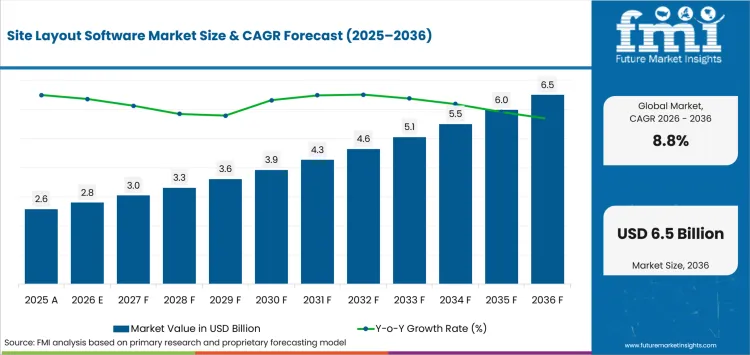
USD 2.8 billion in 2026 and USD 6.5 billion by 2036 at an 8.8% CAGR.
Demand for site layout software is projected to expand at 8.8% CAGR between 2026 and 2036, increasing valuation from USD 2.8 billion in 2026 to USD 6.5 billion by 2036. Contractors increasingly connect construction tech with field execution so coordinated geometry remains usable during setting-out work. Autodesk brought Autodesk Construction Cloud into Forma in March 2026 and connected design plus construction workflows around shared project data.
The United States is projected to grow faster than Japan as public infrastructure agencies standardize model-based delivery. The Federal Highway Administration reported in June 2026 that three state DOTs had multi-year digital-delivery plans and Pennsylvania plus Iowa were testing 3D model-based project delivery. These programs widen the addressable construction management software workflow around shared models but Japan's contractor-specific handoffs make enterprise standardization less uniform.
Key Takeaways of Site Layout Software Market
- =Based on application, construction layout is projected to account for 29.0% in 2026 due to recurring point placement across building trades.
- By deployment, cloud-based deployment is estimated to hold 38.0% in 2026 owing to current model access across dispersed project teams.
- In 2026, general contractors are expected to lead end use with 31.0% share because they coordinate layout across trades.
- Interoperability gaps delay adoption if model coordinates and instrument software require manual conversion during layout preparation.
- The profiled company set comprises Autodesk, Inc., Trimble Inc., Leica Geosystems AG, Topcon Positioning Systems, Inc., Bentley Systems, Incorporated, Bluebeam, Inc., Procore Technologies, Inc. and Hilti Group.
Analyst Perspective
"Site layout software is judged at the handoff between approved geometry and field positioning as errors there reach installed work. Platforms compete more effectively if they preserve coordinates across revisions without adding setup or retraining work."
- Nikhil Kaitwade, Principal Consultant, Future Market Insights
How is the Site Layout Software Market segmented?
The site layout software market is segmented by application, deployment, function, end use, sales model and region.
Market taxonomy covers application, deployment, function, end use, sales model, and region. Applications include construction layout, survey field software, BIM-to-field, machine-control layout, and AR or mixed reality layout. Deployment includes cloud-based, mobile or tablet-based, desktop or on-premise, and hybrid models. Functions cover point layout, model coordination, as-built capture, robotic total station control, and field reporting. End users include general contractors, surveying firms, MEP contractors, concrete contractors, and infrastructure contractors. Sales models include annual subscription, hardware bundled, perpetual plus maintenance, and enterprise seat licensing.
What makes construction layout central to the application category?
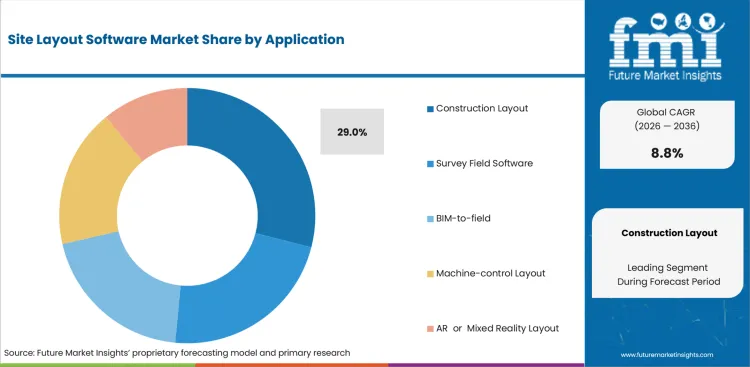
Construction layout converts coordinated geometry into field-ready points for foundations and interior systems across active building projects. Related building information modeling and 3D laser scanner workflows add value by keeping coordinates consistent between model review and setting-out.
- Based on application, construction layout is projected to account for 29.0% in 2026 due to recurring point placement across building trades.
- Topcon launched the LN-1000i Layout Navigator with Digital Layout 2.0 in October 2025 for building construction workflows. Its reflectorless measurement and integrated viewing keep digital design information beside field placement decisions and reduce repeated instrument repositioning on active floors.
How does cloud-based deployment shape selection within the deployment category?
Cloud delivery lets office teams update models and project information without distributing separate desktop files to every active jobsite. Procore expanded its common data environment in June 2026 with BIM Model Manager streaming models to mobile devices.
- In 2026, cloud-based deployment is expected to lead the deployment category with 38.0% share supported by contractors needing current models across locations and devices.
- Field teams can reference current model information beside project records without maintaining separate local copies across active portfolios. The deployment model fits construction SaaS workflows that depend on revision control and field access across distributed project teams.
How do general contractors evaluate site layout software within the end-use category?
General contractors coordinate geometry across structural and specialty trades that often work from different drawing or model packages.
- The end-use category is forecast to be led by general contractors at 31.0% share in 2026 due to cross-trade layout responsibility. Trimble introduced three Works subscription tiers in January 2025 that combine civil construction software with hardware coverage under one contract.
- General contractors connect field layout with construction design software so approved changes reach crews ahead of installation sequences. The subscription structure gives contractors a defined route for scaling field technology and keeps software maintenance with device support aligned.
What supports annual subscription demand within the sales model category?
Annual subscriptions align software access with active project portfolios and give contractors a recurring path for updates plus cloud services. The model also fits computer-aided design environments that require field tools to remain compatible with frequently revised authoring workflows.
- Annual subscription is set to lead the sales model category with 52.0% share in 2026 due to recurring software access and support.
- The premium tier ties automation and advanced review tools to a recurring license that fits active project portfolios and frequent software updates. Bluebeam launched its Max premium subscription globally in May 2026 and made the plan available as an upgrade for existing customers.
What are the drivers, restraints and opportunities in the Site Layout Software Market?
Repeatable model-to-field handoffs support adoption, but disconnected systems add reconciliation work and digital twins extend layout data into progress and as-built workflows.
- Driver: Contractors gain more from layout software as approved geometry moves directly into field positioning without repeated coordinate rebuilding.
- Restraint: Disconnected project and field systems add reconciliation work as layout points or measured quantities move between applications.
- Opportunity: Digital twins and reality capture allow layout geometry to support progress checks and as-built records beyond initial set-out.
Direct Model-to-Field Handoffs Reduce Rebuilding
Contractors gain more from digital layout as field crews move from model geometry to positioning without rebuilding points or calibrating several tools. Topcon introduced Origo for interior building layout at CONEXPO in March 2026 using reusable spatial reference maps for real-time positioning without line-of-sight limits. That operating model raises the value of geospatial solutions that preserve field coordinates as crews move across changing rooms and trades.
Disconnected Systems Add Reconciliation Work in Field Reporting
Disconnected field and project systems add manual reconciliation as measured quantities and layout records move between applications. Trimble connected Siteworks with B2W Track in April 2025 so survey-grade quantities could return directly from field devices to office reporting. The integration addresses a specific data handoff that otherwise makes contractors check the same progress record in separate systems.
Digital Twins Extend Layout Geometry Beyond Initial Set-Out
Layout geometry becomes more useful once the same spatial record supports progress checks and later as-built comparison. EARTHBRAIN and Bentley Systems partnered in November 2025 to combine digital-twin technology with Smart Construction. Contractors can pair that model with 3D scanning to compare field conditions against planned geometry without rebuilding a separate project record.
Which country CAGRs are profiled in the Site Layout Software Market?
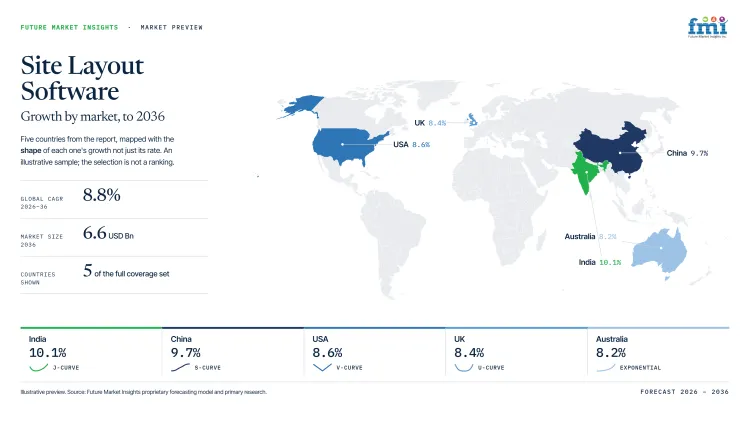
| Country | CAGR |
|---|---|
| United States | 8.6% |
| United Kingdom | 8.4% |
| Australia | 8.2% |
| Germany | 8.0% |
| Japan | 7.4% |
How do country-level CAGRs compare in the Site Layout Software Market?
The country comparison spans 1.2 percentage points and reveals three distinct growth groups across the site layout software market. The United States and United Kingdom form the upper tier with a 0.2-point difference, while Australia and Germany create a closely aligned middle group separated by 0.2 percentage points. Japan remains at the lower end with a 0.6-point gap from Germany.
- The United States leads the comparison at an 8.6% CAGR through 2036, supported by established construction technology adoption, digital project workflows and demand for accurate site planning and layout.
- The United Kingdom follows at an 8.4% CAGR, remaining 0.2 percentage points below the United States. Construction digitalization, structured project management and adoption of connected layout tools support continued demand.
- Australia records an 8.2% CAGR, creating a 0.2-percentage-point gap from the United Kingdom. Infrastructure development, construction activity and demand for efficient field surveying support software adoption.
- Germany grows at an 8.0% CAGR, remaining 0.2 percentage points below Australia. Engineering-led construction practices, digital workflows and accuracy requirements support steady adoption of site layout software.
- Japan records a 7.4% CAGR, 0.6 percentage points below Germany and the lowest among the profiled countries. Mature construction practices, labor constraints and continued digitalization support gradual market expansion.
Comparable CAGRs can still produce different market-entry conditions. Differences in construction activity, digital adoption, labor availability, project complexity and integration with surveying and building workflows influence site layout software demand across countries. The full report provides country-level CAGR analysis across major regions and individual markets within the site layout software market
Country-wise Analysis
- Sizable USA construction portfolios place field crews on commercial and infrastructure sites using different instruments and subcontractor handoffs, further mixed positioning systems increase setup and training demands during phased rollouts. The USA Census Bureau estimated June 2026 construction spending at a USD 2,166.5 billion seasonally adjusted annual rate and established a broad national project base for repeatable model-to-field deployment across contractor organizations. In the United States, site layout software demand is predicted to advance at 8.6% CAGR through 2036 supported by contractor scale and recurring field coordination across national project portfolios plus public works programs nationwide.
- British contractors manage new work alongside repair and maintenance packages that require controlled model revisions across specialist firms with separate scopes and field responsibilities during tightly sequenced construction projects nationwide. The United Kingdom's site layout software outlook is anticipated to advance at 8.4% CAGR over the assessment period supported by recurring coordination needs across dispersed multi-company construction programs and established national digital delivery requirements. Office for National Statistics reported construction output grew 1.6% in the three months to May 2026 and recurring software orders depend on reliable model exchange plus mobile access and local support nationwide.
- Australian contractors work across metropolitan sites plus regional and remote projects and field crews rely on mobile access with dependable instrument support across long travel distances during short construction windows and changing crew rotations. The Australian Bureau of Statistics reported total construction work rose 3.4% in the March 2026 quarter and confirmed an active workload base across building plus engineering projects that require repeated field measurement. By 2036, Australia is projected to grow at 8.2% CAGR supported by dispersed operating needs but .wider deployment depends on local training and specialist service reaching short-duration projects outside established regional construction corridors.
- German contractors move between building and civil projects that use different surveying routines so field software must accommodate vertical construction plus infrastructure workflows without forcing one setup across specialist teams and regional delivery partners. Destatis reported building-construction orders rose 9.2% month on month in March 2026 and provided a current national workload signal for firms coordinating model data with precise field measurement across changing project pipelines. Adoption of site layout software in Germany is estimated to expand at 8.0% CAGR through 2036 aided by precision-oriented delivery as uneven project mixes shift purchase timing around installed equipment and regional service coverage.
- Japanese construction teams often work on dense urban sites with tightly staged trades so precise positioning protects later installation sequences across constrained building projects and layered subcontractor handoffs during narrow urban access windows. Site layout software sales in Japan are forecast to expand at 7.4% CAGR by 2036 reinforced by established surveying expertise and recurring need for precise field handoffs across project teams and specialist trades. Japan's Ministry of Land Infrastructure Transport and Tourism reported new housing starts increased 11.4% year on year in April 2026 but contractor-specific routines can slow standardization across teams using software and positioning equipment.
Who are the notable companies in the Site Layout Software Market?
Autodesk, Inc., Trimble Inc., Leica Geosystems AG, Topcon Positioning Systems, Inc., Bentley Systems, Incorporated, Bluebeam, Inc., Procore Technologies, Inc. and Hilti Group are notable companies serving this market.
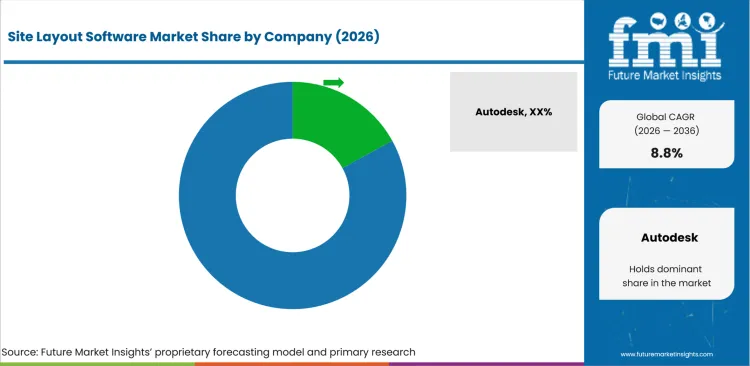
The competitive field spans construction software platforms and positioning specialists that connect approved geometry with physical jobsite execution. Entry barriers depend on model interoperability, field reliability and established technical support networks as much as software feature depth.
- Autodesk, Trimble and Bentley Systems connect design or model management with construction workflows that extend project information toward field execution.
- Leica Geosystems, Topcon Positioning Systems and Hilti Group combine positioning hardware with software that supports precise layout or measurement activities.
- Procore Technologies and Bluebeam focus more heavily on cloud coordination, document control and field collaboration around construction information.
Competitive Benchmarking: Site Layout Software Market
| Company | Project-Data Coordination | Field Positioning Integration | Mobile / Cloud Field Access | Geographic Reach |
|---|---|---|---|---|
| Autodesk, Inc. | High | Low | High | Global |
| Trimble Inc. | High | High | High | Global |
| Leica Geosystems AG | Medium | High | High | Global |
| Topcon Positioning Systems, Inc. | Medium | High | Medium | Global |
| Bentley Systems, Incorporated | High | Low | Medium | Global |
| Bluebeam, Inc. | High | Low | High | Global |
| Procore Technologies, Inc. | High | Low | High | Global |
| Hilti Group | Medium | High | High | Global |
Key Developments in the Site Layout Software Market
- In March 2026, Trimble introduced the 2026 Tekla software release with connected workflows linking constructible BIM and structural engineering with construction execution from office to site.
- In November 2025, Hilti Group opened new Hillos facilities in Jena for high-precision laser measuring devices and positioning systems with a 60-meter testing field for total stations and laser scanners.
- In October 2025, Bentley Systems placed OpenSite+ in limited availability for civil site design with generative AI and digital-twin-native workflows connected to Bentley Infrastructure Cloud.
Key Players in the Site Layout Software Market
Integrated Model-to-Field Platforms
- Autodesk, Inc.
- Trimble Inc.
- Bentley Systems, Incorporated
Precision Layout and Positioning Systems
- Leica Geosystems AG
- Topcon Positioning Systems, Inc.
- Hilti Group
Cloud Construction Collaboration
- Procore Technologies, Inc.
- Bluebeam, Inc.
Site Layout Software Market - Report Scope
| Coverage field | Report scope |
|---|---|
| Market breakdown | By application, deployment, function, end use, sales model and region. |
| Quantitative Units | Revenue in USD billion and CAGR in %. |
| Market Definition | Software used to transfer, coordinate, position and verify construction layout information between digital project models and field execution workflows. |
| Regions Covered | North America, Latin America, Europe, East Asia, South Asia and Pacific and Middle East and Africa. |
| Countries Covered | United States, United Kingdom, Australia, Germany, Japan, and 20+ countries included in the full report. |
| Key Companies Profiled | Autodesk, Inc., Trimble Inc., Leica Geosystems AG, Topcon Positioning Systems, Inc., Bentley Systems, Incorporated, Bluebeam, Inc., Procore Technologies, Inc., Hilti Group. |
| Forecast Period | 2026 to 2036. |
| Approach | Primary and secondary research with market triangulation. |
Site Layout Software Market - Research Methodology
| Method | Approach |
|---|---|
| Primary Research | FMI analysts gathered input from manufacturers, service providers, technology developers, distributors, end users, procurement teams, and subject-matter experts. Interviews examined purchasing decisions, product or service evaluation, adoption barriers, approval requirements, pricing considerations, and expectations for technical or commercial support. Respondents were also asked what evidence is required before a trial, pilot, or initial order develops into regular purchasing. |
| Desk Research | Desk research covered government statistics, regulatory publications, trade data, industry associations, technical literature, standards, company filings, product information, and official corporate announcements. Sources were reviewed for relevance, publication date, geographic coverage, and consistency with the defined market scope. Claims relating to performance, applications, approvals, capacity, investment, and commercial activity were retained only when supported by credible public evidence. |
| Market Sizing and Forecasting | The market model combined the baseline value with historical performance, segment structure, pricing and volume indicators, adoption levels, company participation, and country-level demand conditions. Forecast assumptions considered economic activity, investment trends, regulatory developments, technology adoption, purchasing cycles, supply availability, and barriers to wider market use. Segment and regional estimates were reconciled before the final market total was calculated. |
| Data Validation | Estimates were checked against multiple independent indicators, including public data, company activity, trade patterns, industry developments, and findings from primary interviews. Validation also tested whether products, services, applications, and company revenues fell within the defined market boundaries. Adjacent categories, unsupported claims, overlapping revenues, and activities without direct market relevance were excluded to reduce double counting and maintain consistency across segments and countries. |
Site Layout Software Market by Segments
Site Layout Software Market segmented by Application:
- Construction Layout
- Survey Field Software
- BIM-to-field
- Machine-control Layout
- AR or Mixed Reality Layout
Site Layout Software Market segmented by Deployment:
- Cloud-based
- Mobile or Tablet-based
- Desktop or On-premise
- Hybrid
Site Layout Software Market segmented by Function:
- Point Layout
- Model Coordination
- As-built Capture
- Robotic Total Station Control
- Field Reporting
Site Layout Software Market segmented by End Use:
- General Contractors
- Surveying Firms
- MEP Contractors
- Concrete Contractors
- Infrastructure Contractors
Site Layout Software Market segmented by Sales Model:
- Annual Subscription
- Hardware Bundled
- Perpetual + Maintenance
- Enterprise Seat License
Site Layout Software Market by Region:
- North America
- United States
- Canada
- Latin America
- Brazil
- Mexico
- Chile
- Rest of Latin America
- Western Europe
- Germany
- United Kingdom
- Italy
- Spain
- France
- Nordics
- Benelux
- Rest of Western Europe
- Eastern Europe
- Russia
- Poland
- Hungary
- Balkan and Baltic States
- Rest of Eastern Europe
- East Asia
- China
- Japan
- South Korea
- South Asia and Pacific
- India
- ASEAN
- Australia and New Zealand
- Rest of South Asia and Pacific
- Middle East and Africa
- Kingdom of Saudi Arabia
- Other GCC Countries
- Türkiye
- South Africa
- Other African Union Countries
- Rest of Middle East and Africa
Research Sources and Bibliography
- Autodesk, Inc. (2026, March 24). Autodesk Construction Cloud is now Autodesk Forma.
- Federal Highway Administration. (2026, June 12). Integrated Digital Project Delivery.
- Topcon Positioning Systems, Inc. (2025, October 7). Topcon launches latest Geomatics innovations at INTERGEO 2025 for simplified, connected mass data workflows.
- Procore Technologies, Inc. (2026, June 1). Procore Redefines the Common Data Environment with Connected Data and Agentic AI.
- Trimble Inc. (2025, January 14). Trimble Introduces New Tiered Subscription Bundles for Contractors to Take Advantage of Civil Construction Technology.
- Bluebeam, Inc. (2026, May 19). Bluebeam Max Launches Globally, Bringing AI-Powered Productivity to AEC Teams Everywhere.
- Topcon Positioning Systems, Inc. (2026, March 2). Topcon unveils new machine control, safety, and geomatics innovations at CONEXPO 2026.
- Trimble Inc. (2025, April 24). Trimble Expands Field-to-Office Connectivity for Heavy Civil Contractors.
- EARTHBRAIN. (2025, November 4). EARTHBRAIN Smart Construction®.
- USA Census Bureau. (2026, August 3). Monthly Construction Spending, June 2026.
- Office for National Statistics. (2026, July 16). Construction output in Great Britain: May 2026.
- Australian Bureau of Statistics. (2026, May 27). Construction Work Done, Australia, Preliminary.
- Statistisches Bundesamt. (2026, May 22). Auftragseingang im Bauhauptgewerbe im März 2026: -1,6 % zum Vormonat.
- Ministry of Land, Infrastructure, Transport and Tourism. (2026, May 29).
- Hexagon AB. (2025, February 18). Hexagon at bauma 2025 - Enabling construction professionals to put data to work.
- Trimble Inc. (2026, March 11). Trimble Unveils 2026 Tekla Software: Accelerating BIM, Engineering and Construction Productivity Through Streamlined Workflows and AI.
- Hilti Group. (2025, November 25). Hillos GmbH New Location in Jena.
- Bentley Systems, Incorporated. (2025, October 15). Bentley Systems Advances Infrastructure AI with New Applications and Industry Collaboration.
- Bluebeam, Inc. (2026, June 9). Bluebeam Accelerates AI Strategy with New Bluebeam Max Capabilities and mbue Acquisition.
- Hexagon AB. (2026, June 9). Leica RTC series sets new benchmark in scanning accuracy and productivity.
- Buildots. (2025, October 23). From drones to data: How we’re transforming underground utility tracking.
- Fieldwire by Hilti. (n.d.). How jobsite management software standardizes work across multiple jobsites. Retrieved August 9, 2026.
- Autodesk, Inc. (n.d.). Compliance | Autodesk Trust Center. Retrieved August 9, 2026.
- Procore Technologies, Inc. (n.d.). Procore Trust Center | Powered by SafeBase. Retrieved August 9, 2026.
- Trimble Inc. (2026, March 18). Trimble, Hitachi Construction Machinery Europe Expand Collaboration to Provide Trimble Earthworks 3D Grade Control Platform Direct to Customers.
- Topcon Positioning Systems, Inc. (n.d.). About Topcon Positioning Systems | We help the people who build and feed the world work smarter and faster. Retrieved August 9, 2026.
This bibliography is provided for reader reference and is not exhaustive. The full report contains the complete reference list and detailed citations
This Report Answers
- How large is the site layout software market in 2026 and 2036?
- Which operating conditions support adoption of model-to-field layout workflows?
- Which application segment accounts for 29.0% of demand in 2026?
- Why does cloud-based deployment account for 38.0% of demand in 2026?
- Why do general contractors represent 31.0% of end-use demand in 2026?
- Why does annual subscription account for 52.0% of sales-model demand in 2026?
- How do country growth rates differ across the profiled site layout software market?
- Which companies connect construction models with positioning and field execution?
- What limits broader adoption across interoperability, setup and training requirements?
Frequently Asked Questions
How big is the site layout software market in 2026?
The site layout software market is estimated at USD 2.8 billion in 2026 and is projected to reach USD 6.5 billion by 2036. Growth is driven by increasing adoption of model-to-field workflows that improve construction layout accuracy and project coordination.
What is the CAGR of the site layout software market from 2026 to 2036?
The site layout software market is projected to grow at a CAGR of 8.8% between 2026 and 2036. Expansion is supported by wider use of cloud-based platforms, mobile applications, and connected positioning technologies.
Which sales model is projected to account for 52.0% of the site layout software market?
Annual subscription is projected to account for 52.0% of the market in 2026. Its leading share is driven by flexible licensing, continuous software updates, and access to cloud-based services and support.
How much incremental opportunity is projected for the site layout software market by 2036?
The site layout software market is expected to add USD 3.8 billion in value between 2026 and 2036. Growth reflects increasing demand for integrated digital construction workflows and field-layout solutions.
Which companies are active in the site layout software market?
Key companies operating in the market include Autodesk, Inc., Trimble Inc., Leica Geosystems AG, Topcon Positioning Systems, Inc., Bentley Systems, Incorporated, Bluebeam, Inc., Procore Technologies, Inc., and Hilti Group. These companies provide software, positioning technologies, and model-to-field construction solutions.
Preview the report firsthand - request a free sample
Get SampleGet the brochure for pricing and purchase details.
Get PDFTable of Content
- Key Takeaways
- Market Size and CAGR
- Top Growth Driver
- Fastest Growing Segment
- Leading Region
- Key Companies
- Emerging Opportunities
- Executive Summary
- Global Market Outlook
- Demand-side Trends
- Supply-side Trends
- Technology Roadmap Analysis
- Analysis and Recommendations
- Analyst Perspective (What is happening? Why now? What should investors know?)
- Key Questions Answered
- How large is the market?
- What is the CAGR?
- What are key trends?
- Which region dominates?
- Who are the leaders?
- Market Overview
- Market Coverage / Taxonomy
- Market Definition / Scope / Limitations
- Research Methodology
- Chapter Orientation
- Analytical Lens and Working Hypotheses
- Market Structure, Signals, and Trend Drivers
- Benchmarking and Cross-market Comparability
- Market Sizing, Forecasting, and Opportunity Mapping
- Research Design and Evidence Framework
- Desk Research Programme (Secondary Evidence)
- Expert Input and Fieldwork (Primary Evidence)
- Tooling, Models, and Reference Databases
- Data Engineering and Model Build
- Quality Assurance and Audit Trail
- Market Background
- Market Dynamics (Drivers, Restraints, Opportunity, Trends)
- Scenario Forecast (Optimistic, Likely, Conservative)
- Impact Analysis
- AI Impact
- Sustainability Impact
- Regulatory Impact
- Technology Impact
- Consumer / Buyer Analysis
- Purchase Drivers
- Adoption Barriers
- Buyer Journey
- Opportunity Map Analysis
- Product Life Cycle Analysis
- Supply Chain Analysis
- Investment Feasibility Matrix
- Value Chain Analysis
- PESTLE and Porter's Analysis
- Regulatory Landscape
- Regional Parent Market Outlook
- Production and Consumption Statistics
- Import and Export Statistics
- Global Market Analysis and Forecast, 2021 to 2036
- Historical Market Size Value (USD Billion) Analysis, 2021 to 2025
- Current and Future Market Size Value (USD Billion) Projections, 2026 to 2036
- Y-o-Y Growth Trend Analysis
- Absolute $ Opportunity Analysis
- Global Market Pricing Analysis, 2021 to 2036
- Global Market Analysis and Forecast, By Application, 2021 to 2036
- Introduction / Key Findings
- Historical Market Size Value (USD Billion) Analysis By Application, 2021 to 2025
- Current and Future Market Size Value (USD Billion) Analysis and Forecast By Application, 2026 to 2036
- Construction Layout
- Survey Field Software
- BIM-to-field
- Machine-control Layout
- AR or Mixed Reality Layout
- Construction Layout
- Y-o-Y Growth Trend Analysis By Application, 2021 to 2025
- Absolute $ Opportunity Analysis By Application, 2026 to 2036
- Global Market Analysis and Forecast, By Deployment, 2021 to 2036
- Introduction / Key Findings
- Historical Market Size Value (USD Billion) Analysis By Deployment, 2021 to 2025
- Current and Future Market Size Value (USD Billion) Analysis and Forecast By Deployment, 2026 to 2036
- Cloud-based
- Mobile or Tablet-based
- Desktop or On-premise
- Hybrid
- Cloud-based
- Y-o-Y Growth Trend Analysis By Deployment, 2021 to 2025
- Absolute $ Opportunity Analysis By Deployment, 2026 to 2036
- Global Market Analysis and Forecast, By Function, 2021 to 2036
- Introduction / Key Findings
- Historical Market Size Value (USD Billion) Analysis By Function, 2021 to 2025
- Current and Future Market Size Value (USD Billion) Analysis and Forecast By Function, 2026 to 2036
- Point Layout
- Model Coordination
- As-built Capture
- Robotic Total Station Control
- Field Reporting
- Point Layout
- Y-o-Y Growth Trend Analysis By Function, 2021 to 2025
- Absolute $ Opportunity Analysis By Function, 2026 to 2036
- Global Market Analysis and Forecast, By End Use, 2021 to 2036
- Introduction / Key Findings
- Historical Market Size Value (USD Billion) Analysis By End Use, 2021 to 2025
- Current and Future Market Size Value (USD Billion) Analysis and Forecast By End Use, 2026 to 2036
- General Contractors
- Surveying Firms
- MEP Contractors
- Concrete Contractors
- Infrastructure Contractors
- General Contractors
- Y-o-Y Growth Trend Analysis By End Use, 2021 to 2025
- Absolute $ Opportunity Analysis By End Use, 2026 to 2036
- Global Market Analysis and Forecast, By Sales Model, 2021 to 2036
- Introduction / Key Findings
- Historical Market Size Value (USD Billion) Analysis By Sales Model, 2021 to 2025
- Current and Future Market Size Value (USD Billion) Analysis and Forecast By Sales Model, 2026 to 2036
- Annual Subscription
- Hardware Bundled
- Perpetual + Maintenance
- Enterprise Seat License
- Annual Subscription
- Y-o-Y Growth Trend Analysis By Sales Model, 2021 to 2025
- Absolute $ Opportunity Analysis By Sales Model, 2026 to 2036
- Global Market Analysis and Forecast, By Region, 2021 to 2036
- Introduction
- Historical Market Size Value (USD Billion) Analysis By Region, 2021 to 2025
- Current Market Size Value (USD Billion) Analysis and Forecast By Region, 2026 to 2036
- North America
- Latin America
- Western Europe
- Eastern Europe
- East Asia
- South Asia and Pacific
- Middle East & Africa
- Market Attractiveness Analysis By Region
- North America Market Analysis and Forecast, By Country, 2021 to 2036
- Historical Market Size Value (USD Billion) Trend Analysis By Market Taxonomy, 2021 to 2025
- Market Size Value (USD Billion) Forecast By Market Taxonomy, 2026 to 2036
- By Country
- USA
- Canada
- By Application
- By Deployment
- By Function
- By End Use
- By Sales Model
- By Country
- Market Attractiveness Analysis
- By Country
- By Application
- By Deployment
- By Function
- By End Use
- By Sales Model
- Key Takeaways
- Latin America Market Analysis and Forecast, By Country
- Historical Market Size Value (USD Billion) Trend Analysis By Market Taxonomy, 2021 to 2025
- Market Size Value (USD Billion) Forecast By Market Taxonomy, 2026 to 2036
- By Country
- Brazil
- Mexico
- Chile
- Rest of Latin America
- By Application
- By Deployment
- By Function
- By End Use
- By Sales Model
- By Country
- Market Attractiveness Analysis
- By Country
- By Application
- By Deployment
- By Function
- By End Use
- By Sales Model
- Key Takeaways
- Western Europe Market Analysis and Forecast, By Country
- Historical Market Size Value (USD Billion) Trend Analysis By Market Taxonomy, 2021 to 2025
- Market Size Value (USD Billion) Forecast By Market Taxonomy, 2026 to 2036
- By Country
- Germany
- UK
- Italy
- Spain
- France
- Nordic
- BENELUX
- Rest of Western Europe
- By Application
- By Deployment
- By Function
- By End Use
- By Sales Model
- By Country
- Market Attractiveness Analysis
- By Country
- By Application
- By Deployment
- By Function
- By End Use
- By Sales Model
- Key Takeaways
- Eastern Europe Market Analysis and Forecast, By Country
- Historical Market Size Value (USD Billion) Trend Analysis By Market Taxonomy, 2021 to 2025
- Market Size Value (USD Billion) Forecast By Market Taxonomy, 2026 to 2036
- By Country
- Russia
- Poland
- Hungary
- Balkan & Baltic
- Rest of Eastern Europe
- By Application
- By Deployment
- By Function
- By End Use
- By Sales Model
- By Country
- Market Attractiveness Analysis
- By Country
- By Application
- By Deployment
- By Function
- By End Use
- By Sales Model
- Key Takeaways
- East Asia Market Analysis and Forecast, By Country
- Historical Market Size Value (USD Billion) Trend Analysis By Market Taxonomy, 2021 to 2025
- Market Size Value (USD Billion) Forecast By Market Taxonomy, 2026 to 2036
- By Country
- China
- Japan
- South Korea
- By Application
- By Deployment
- By Function
- By End Use
- By Sales Model
- By Country
- Market Attractiveness Analysis
- By Country
- By Application
- By Deployment
- By Function
- By End Use
- By Sales Model
- Key Takeaways
- South Asia and Pacific Market Analysis and Forecast, By Country
- Historical Market Size Value (USD Billion) Trend Analysis By Market Taxonomy, 2021 to 2025
- Market Size Value (USD Billion) Forecast By Market Taxonomy, 2026 to 2036
- By Country
- India
- ASEAN
- Australia & New Zealand
- Rest of South Asia and Pacific
- By Application
- By Deployment
- By Function
- By End Use
- By Sales Model
- By Country
- Market Attractiveness Analysis
- By Country
- By Application
- By Deployment
- By Function
- By End Use
- By Sales Model
- Key Takeaways
- Middle East & Africa Market Analysis and Forecast, By Country
- Historical Market Size Value (USD Billion) Trend Analysis By Market Taxonomy, 2021 to 2025
- Market Size Value (USD Billion) Forecast By Market Taxonomy, 2026 to 2036
- By Country
- Kingdom of Saudi Arabia
- Other GCC Countries
- Türkiye
- South Africa
- Other African Union
- Rest of Middle East & Africa
- By Application
- By Deployment
- By Function
- By End Use
- By Sales Model
- By Country
- Market Attractiveness Analysis
- By Country
- By Application
- By Deployment
- By Function
- By End Use
- By Sales Model
- Key Takeaways
- Key Countries Market Analysis
- USA
- Pricing Analysis
- Market Share Analysis, 2025
- By Application
- By Deployment
- By Function
- By End Use
- By Sales Model
- Canada
- Pricing Analysis
- Market Share Analysis, 2025
- By Application
- By Deployment
- By Function
- By End Use
- By Sales Model
- Mexico
- Pricing Analysis
- Market Share Analysis, 2025
- By Application
- By Deployment
- By Function
- By End Use
- By Sales Model
- Brazil
- Pricing Analysis
- Market Share Analysis, 2025
- By Application
- By Deployment
- By Function
- By End Use
- By Sales Model
- Chile
- Pricing Analysis
- Market Share Analysis, 2025
- By Application
- By Deployment
- By Function
- By End Use
- By Sales Model
- Germany
- Pricing Analysis
- Market Share Analysis, 2025
- By Application
- By Deployment
- By Function
- By End Use
- By Sales Model
- UK
- Pricing Analysis
- Market Share Analysis, 2025
- By Application
- By Deployment
- By Function
- By End Use
- By Sales Model
- Italy
- Pricing Analysis
- Market Share Analysis, 2025
- By Application
- By Deployment
- By Function
- By End Use
- By Sales Model
- Spain
- Pricing Analysis
- Market Share Analysis, 2025
- By Application
- By Deployment
- By Function
- By End Use
- By Sales Model
- France
- Pricing Analysis
- Market Share Analysis, 2025
- By Application
- By Deployment
- By Function
- By End Use
- By Sales Model
- India
- Pricing Analysis
- Market Share Analysis, 2025
- By Application
- By Deployment
- By Function
- By End Use
- By Sales Model
- ASEAN
- Pricing Analysis
- Market Share Analysis, 2025
- By Application
- By Deployment
- By Function
- By End Use
- By Sales Model
- Australia & New Zealand
- Pricing Analysis
- Market Share Analysis, 2025
- By Application
- By Deployment
- By Function
- By End Use
- By Sales Model
- China
- Pricing Analysis
- Market Share Analysis, 2025
- By Application
- By Deployment
- By Function
- By End Use
- By Sales Model
- Japan
- Pricing Analysis
- Market Share Analysis, 2025
- By Application
- By Deployment
- By Function
- By End Use
- By Sales Model
- South Korea
- Pricing Analysis
- Market Share Analysis, 2025
- By Application
- By Deployment
- By Function
- By End Use
- By Sales Model
- Russia
- Pricing Analysis
- Market Share Analysis, 2025
- By Application
- By Deployment
- By Function
- By End Use
- By Sales Model
- Poland
- Pricing Analysis
- Market Share Analysis, 2025
- By Application
- By Deployment
- By Function
- By End Use
- By Sales Model
- Hungary
- Pricing Analysis
- Market Share Analysis, 2025
- By Application
- By Deployment
- By Function
- By End Use
- By Sales Model
- Kingdom of Saudi Arabia
- Pricing Analysis
- Market Share Analysis, 2025
- By Application
- By Deployment
- By Function
- By End Use
- By Sales Model
- Türkiye
- Pricing Analysis
- Market Share Analysis, 2025
- By Application
- By Deployment
- By Function
- By End Use
- By Sales Model
- South Africa
- Pricing Analysis
- Market Share Analysis, 2025
- By Application
- By Deployment
- By Function
- By End Use
- By Sales Model
- USA
- Market Structure Analysis
- Competition Dashboard
- Competition Benchmarking
- Market Share Analysis of Top Players
- By Regional
- By Application
- By Deployment
- By Function
- By End Use
- By Sales Model
- Emerging Startups
- Innovation Benchmarking
- Competition Analysis
- Competition Deep Dive
- Autodesk
- Overview
- Product Portfolio
- Profitability by Market Segments
- Sales Footprint
- Strategy Overview
- Marketing Strategy
- Product Strategy
- Channel Strategy
- Trimble
- Leica Geosystems
- Topcon Positioning
- Bentley Systems
- Bluebeam
- Procore
- Fieldwire
- Hilti
- Buildots
- Autodesk
- Case Studies
- Success Stories
- Recent Developments
- Competition Deep Dive
- Assumptions & Acronyms Used


