

- Market Size (2026)
- USD 5.7 Bn
- Forecast (2036)
- USD 9.4 Bn
- CAGR (2026 to 2036)
- 5.1%
How big is Switchgear Market in 2026?
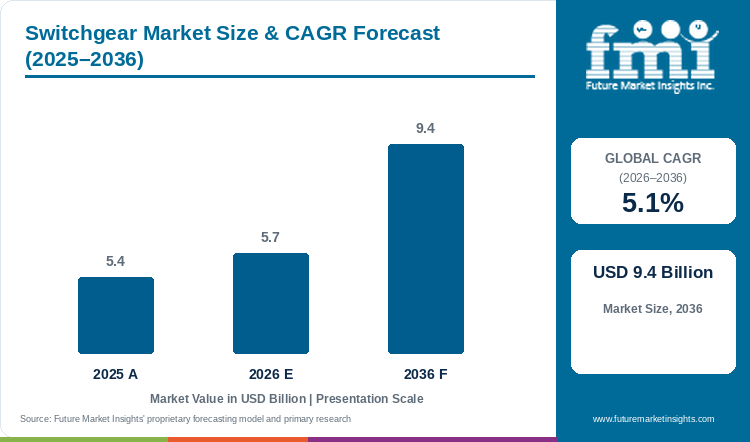
Demand is projected to expand at 5.1% CAGR from 2026 to 2036. Market value rises from USD 5.4 billion in 2025 to USD 5.7 billion in 2026 and USD 9.4 billion by 2036.
The global switchgear market, covering electrical switching, protection and isolation equipment across utility, industrial, commercial and residential networks, is valued at USD 5.4 billion in 2025 and is projected to reach USD 5.7 billion in 2026, expanding to USD 9.4 billion by 2036 at a CAGR of 5.1%. By component type, circuit breakers are estimated to hold 34% of demand in 2026, reflecting their central role in fault interruption and protection coordination. By voltage class, medium-voltage equipment accounts for 46%, underpinned by ongoing distribution-network expansion and asset renewal.
Demand is shaped by three converging forces: new grid connections and industrial electrification, the replacement of ageing installations, and the technical complexity of integrating specialised interruption duties such as high-voltage DC switching. Procurement decisions extend beyond equipment specifications to encompass delivery scheduling, commissioning responsibilities and post-installation service capability. The European Commission's 2025 certification framework for gas-containing stationary switchgear [1] and the IEC's dedicated DC circuit-breaker specification [2] illustrate how regulatory and standards developments now feed directly into buyer evaluation. Meanwhile, the IEA's transmission-grid analysis highlights coordinated, longer-term procurement as a response to component supply constraints. [3]
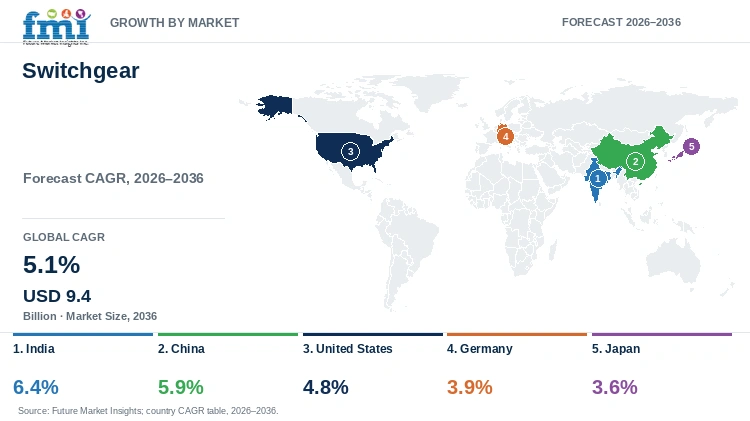
Regionally, India (6.4% CAGR) and China (5.9%) lead profiled growth through 2036, driven by network build-out. The United States is projected to grow at 4.8%, Germany at 3.9% and Japan at 3.6%.
The competitive landscape includes Siemens AG, ABB Ltd., Schneider Electric SE, Eaton Corporation PLC and Hitachi Energy Ltd. Differentiation increasingly rests on the supplier's ability to define a clear scope of supply, covering engineering interfaces, installation support, commissioning and lifecycle maintenance, rather than on equipment price alone. Suppliers that align equipment delivery with project sequencing and provide credible long-term service arrangements are better positioned to secure repeat orders across utility, industrial and commercial accounts through the forecast period.
Key Market Trends & Insights
- Grid owners are placing greater weight on procurement schedules because transmission expansion requires coordinated orders for equipment with different manufacturing and delivery cycles. [3]
- Work on gas-containing stationary switchgear increasingly requires attention to service qualifications, as the European Commission updated the relevant certification framework in 2025. [1]
- DC interruption remains a distinct engineering requirement: the 2025 IEC specification addresses circuit-breakers for direct voltages of 100 kV and above. [2]
Regional Highlights
- India and China carry the highest profiled growth rates, at 6.4% and 5.9% respectively, linking the country outlook to continuing network investment through 2036.
- The United States is projected to grow at 4.8% from 2026 to 2036.
- Germany and Japan have projected growth rates of 3.9% and 3.6%, with installation constraints and the maintenance of existing networks shaping purchasing decisions.
Market Size & Forecast
Table 1: Market Size and Forecast for Switchgear Market (USD billion and percentage), 2025 to 2036
| Metric | Value |
|---|---|
| 2025 market value | USD 5.4 billion |
| 2026 market value | USD 5.7 billion |
| 2036 market value | USD 9.4 billion |
| CAGR 2026 to 2036 | 5.1% |
| Revenue increase 2026 to 2036 | USD 3.7 billion |
| Market expansion 2026 to 2036 | 1.65 times |
Equipment selection is tied to the electrical duty at each installation, so demand does not rise uniformly across voltage classes or cabinet designs. A utility adding a feeder and a factory replacing a protection panel may procure different configurations within the same investment cycle. The market therefore combines new connections with renewal work, with delivery schedules and commissioning requirements influencing when an order becomes revenue.
Specialised interruption duties also connect this equipment category with the Dc Switchgear Market, where the direction of current and the system design affect breaker selection.
Equipment delivery and service qualification shape grid procurement
Grid investment creates equipment demand only when projects reach specification and procurement. The IEA's 2025 review highlights coordination and longer-term purchasing as responses to transmission supply constraints. [3] European service rules and the IEC's DC-breaker specification address different stages of the same process: maintaining an installed asset and qualifying specialised interruption equipment. [1] [2] These references help buyers distinguish broad investment plans from the technical requirements of an individual order.
Table 2: Industry evidence relevant to the switchgear market
| Indicator | Data point or observation | Market relevance | Source |
|---|---|---|---|
| Service qualifications | Regulation (EU) 2025/627 establishes certification requirements for relevant work on stationary electrical switchgear containing fluorinated gases. | Installation and maintenance planning must include suitably qualified personnel. | [1] |
| DC interruption | IEC TS 62271-313:2025 covers DC circuit-breakers rated at 100 kV and above. | HVDC interruption must be assessed separately from ordinary AC switching duties. | [2] |
| Transmission procurement | The IEA identifies coordinated planning and longer-term procurement as responses to grid-component supply constraints. | Equipment lead times influence project sequencing and order commitments. | [3] |
Analyst Perspective
“Digital monitoring gives switchgear owners information for maintenance planning and the management of installed assets. Its value depends on how well the monitoring arrangement fits the electrical duty, protection settings and service responsibilities of the installation.”
- Nikhil Kaitwade, Principal Consultant for Industrial Automation, Future Market Insights
How is the Switchgear Market segmented?
The market is segmented by Component Type, Voltage Type, Construction Type, Insulation Type, End User, and Region.
Component type identifies the switching, protection or isolation function being purchased. Voltage type describes the network duty, while construction and insulation distinguish the installation format. End-user categories separate utility projects from industrial, commercial and residential procurement. A medium-voltage assembly, for example, can contain several protective components and serve either a utility network or an industrial site. Combining those categories into one ranking would obscure what the buyer is actually specifying.
Why do circuit breakers lead component demand?
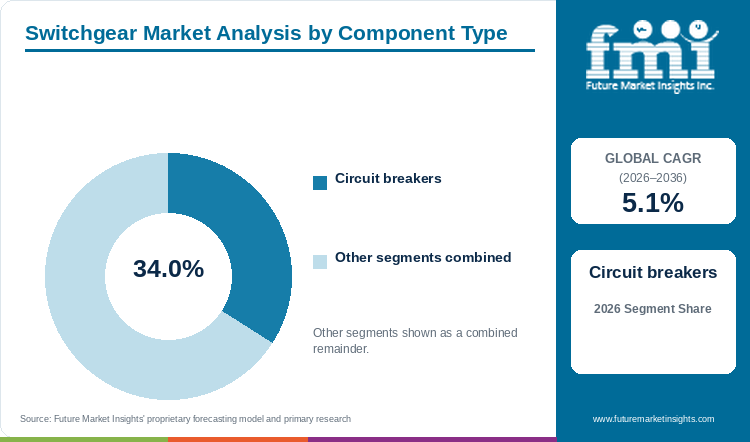
Table 3: Component Type Share for Switchgear Market (percentage share), 2026
| Component Type | Estimated share (2026) |
|---|---|
| Circuit breakers | 34.0% |
| Other component types | 66.0% |
| Total | 100.0% |
Table 4: Segment Position and Market Growth for Switchgear Market, 2026 to 2036
| Metric | Value |
|---|---|
| Global CAGR (2026 to 2036) | 5.1% |
| Profiled component type segment | Circuit breakers |
A circuit breaker provides the interruption function around which protection and operating procedures are designed. Its value to the buyer depends on the fault duty, operating sequence and coordination with the rest of the installation. The estimated 34% component share in 2026 reflects this central role across network and site applications. Selecting a breaker also commits the owner to a maintenance arrangement, suitable spares and a method for testing the protection scheme. The requirements become more specialised in DC networks: IEC TS 62271-313:2025 addresses high-voltage DC breakers and their associated switching, electronic and control elements. [2] That distinction helps explain why apparently similar switching devices cannot be treated as interchangeable products.
The Circuit breakers segment is projected to account for 34.0% of component type demand in 2026.
- Circuit breakers are estimated to hold 34% of component-type demand in 2026, with the remaining 66% covering other components in the same breakdown.
- A breaker proposal should state its interruption duty, operating requirements and protection interfaces so the purchaser can compare configurations for the intended installation.
What sustains medium-voltage switchgear demand?
Table 5: Voltage Type Share for Switchgear Market (percentage share), 2026
| Voltage Type | Estimated share (2026) |
|---|---|
| Medium voltage | 46.0% |
| Other voltage type segments | 54.0% |
| Total | 100.0% |
Medium-voltage demand spans the connection between bulk electricity supply and local distribution or industrial loads. The segment is estimated to represent 46% of the voltage-type breakdown in 2026. Its purchasing base includes owners adding capacity and those renewing equipment that must continue to fit an established network. A replacement panel needs compatible ratings and operating arrangements; a new installation must also accommodate the wider substation design. These practical requirements give layout, protection coordination and commissioning support a direct commercial role. Equipment delivery can become a scheduling constraint when several assets are ordered together, as the IEA's transmission procurement analysis illustrates for the wider grid. [3] The resulting demand combines equipment orders with the work needed to place those assets into service.
The Medium voltage segment is projected to account for 46.0% of voltage type demand in 2026.
- Medium voltage is estimated to account for 46% of voltage-type demand in 2026; other voltage classes together represent the remaining 54%.
- A purchaser comparing medium-voltage offers must consider the installation footprint, network interfaces and commissioning sequence alongside the stated electrical ratings.
- Network planning and installation requirements vary by location. The South Korea Switchgear Market provides related coverage for buyers comparing procurement conditions across East Asian systems.
What are the drivers, restraints, and opportunities in the Switchgear Market?
Grid connections and equipment renewal support demand; project sequencing and service qualifications constrain delivery; clear interfaces and lifecycle support create opportunities for suppliers.
Driver
Network additions and the renewal of existing installations create recurring requirements for switching and protection. New electricity loads need connections, while equipment already in service must remain compatible with the network around it. Orders are therefore influenced by the owner's investment programme and the availability of the other equipment needed to complete the installation.
Restraint
A suitable cabinet cannot be commissioned in isolation from the rest of the project. Delivery schedules, civil works, protection settings and the availability of qualified personnel can delay an otherwise planned order. For gas-containing equipment, European certification requirements also make the service arrangement relevant to implementation. [1] These constraints favour early technical clarification between the asset owner, installer and supplier, particularly when replacing equipment inside a functioning site where outage time is limited.
Opportunity
Suppliers can make a stronger offer by defining the equipment and its implementation responsibilities together. Clear interface drawings, documented operating duties and an agreed commissioning plan reduce the work left for the buyer to reconcile. For transmission projects, earlier coordination of procurement can help align equipment orders with the construction schedule. [3] The opportunity extends into installed assets, where maintenance support, replacement planning and compatible revisions can determine whether a customer returns for the next panel or substation extension.
Asset renewal requires attention to existing network interfaces as well as the new cabinet. The United Kingdom Switchgears Market examines a related setting for replacement and distribution-equipment demand.
Which country CAGRs are profiled in the Switchgear Market?
Table 6: Country CAGR Comparison for Switchgear Market (CAGR percentage), 2026 to 2036
| Country | CAGR |
|---|---|
| India | 6.4% |
| China | 5.9% |
| United States | 4.8% |
| Germany | 3.9% |
| Japan | 3.6% |
Country-wise Analysis
India Switchgear Market Outlook (2026 to 2036)
Expansion projects create opportunities across several stages of a network, from switching at new connections to protection inside industrial sites. For the purchaser, the useful unit of comparison is a complete installation that meets its intended electrical duty. The supplier must therefore make the ratings, layout and commissioning requirements clear early enough for the wider project to be planned. A portfolio covering different network applications can address more than one procurement package, although each package still needs its own technical qualification. The resulting growth opportunity is tied to the pace at which funded network work reaches equipment ordering.
China Switchgear Market Outlook (2026 to 2036)
Long-distance power transfer and local industrial connections create different requirements within China's switchgear outlook. The market is projected to grow at 5.9% over 2026 to 2036. A transmission installation can involve specialised interruption and control systems, while a local distribution project has a different operating duty and installation format. The distinction is particularly relevant when assessing DC equipment: the IEC's 2025 technical specification defines a dedicated scope for high-voltage DC circuit-breakers. [2] Buyers need suppliers that can explain which parts of an offer are standard and which depend on the network design. Procurement decisions then turn on qualification, delivery and integration with the rest of the project rather than an undifferentiated comparison of switching capacity.
United States Switchgear Market Outlook (2026 to 2036)
The United States faces equipment demand from both existing networks and additional electricity loads. The switchgear market is projected to expand at a CAGR of 4.8% from 2026 to 2036. An owner renewing a substation must consider how replacement equipment will work with assets that remain in service, including the available space and protection arrangements. A new connection gives the design team more flexibility but introduces coordination with other project equipment. Both types of buyer benefit from a supplier that states delivery milestones and installation responsibilities clearly enough to support the planned commissioning date.
Germany Switchgear Market Outlook (2026 to 2036)
Service arrangements have a practical role in Germany's switchgear purchasing decisions, particularly where gas-containing stationary equipment remains in use. The European certification framework adopted in 2025 covers relevant installation, maintenance, repair and decommissioning work. [1] Buyers must therefore consider who will perform those tasks and how the chosen equipment fits their existing maintenance organisation. Against that operating context, the market is projected to grow at 3.9% from 2026 to 2036. Replacement orders can involve a constrained footprint and a short outage window, making compatibility and installation planning commercially valuable. Suppliers have room to differentiate through a well-defined retrofit proposal and continuing support, alongside the electrical performance required by the asset owner.
Japan Switchgear Market Outlook (2026 to 2036)
Japan's projected 3.6% CAGR from 2026 to 2036 describes a more gradual expansion than the other profiled Asian markets. For an owner maintaining an established installation, the purchasing question is often how to introduce replacement equipment without disrupting the surrounding system. The supplier's proposal must address the physical arrangement, operating procedures and protection interfaces of the site. A technically suitable product may still require engineering work before it becomes a practical replacement. This makes the ability to document compatibility and support commissioning relevant to repeat business. Buyers also need a credible route for future maintenance and spares so that the replacement order supports the operating life of the wider installation, rather than resolving only the immediate equipment requirement.
Who are the notable companies in the Switchgear Market?
Siemens AG; ABB Ltd.; Schneider Electric SE; Eaton Corporation PLC; Hitachi Energy Ltd.
Siemens, ABB, Schneider Electric, Eaton and Hitachi Energy are among the participants in the switchgear market. Buyers compare a proposed configuration against a defined network duty, then assess the work needed to install and maintain it. The commercial distinction is often found in the responsibilities surrounding the equipment: engineering interfaces, commissioning, support and the handling of later changes. That makes a comparable scope of supply important when bids differ in what they include.
Competitive Benchmarking: Switchgear Market
Table 7: Competitive positioning for the switchgear market
| Company | Positioning | Buyer comparison focus |
|---|---|---|
| Siemens AG | Electrical switching and protection | Compare the proposed voltage range and the installation interfaces required by the project. |
| ABB Ltd. | Electrical switching and protection | Assess the protection functions, commissioning scope and continuing maintenance responsibilities. |
| Schneider Electric SE | Electrical switching and protection | Examine how the offered assembly fits the site layout and operating procedures. |
| Eaton Corporation PLC | Electrical switching and protection | Compare interruption ratings, service access and the proposed spares arrangement. |
| Hitachi Energy Ltd. | Electrical switching and protection | Evaluate the network duty, control interfaces and implementation schedule. |
Key Developments in the Switchgear Market
- In March 2025, the European Commission adopted a certification framework covering relevant work on gas-containing stationary electrical switchgear, bringing service qualifications into the purchasing discussion. [1]
- IEC published its high-voltage DC circuit-breaker technical specification in March 2025, providing a defined reference scope for specialised DC interruption equipment. [2]
- The IEA's February 2025 transmission-grid report examined supply constraints and procurement coordination, directing attention to the timing of equipment orders within grid projects. [3]
Key Players in the Switchgear Market
Electrical switching and protection
- Siemens AG
- ABB Ltd.
- Schneider Electric SE
- Eaton Corporation PLC
- Hitachi Energy Ltd.
Switchgear Market Report Scope
Table 8: Report Scope for Switchgear Market, 2026 to 2036
| Coverage field | Report scope |
|---|---|
| Market definition | Electrical switching, protection and isolation equipment for utility, industrial, commercial and residential networks. |
| Quantitative units | USD billion and percentage |
| Historical reference year | 2025 |
| Forecast period | 2026 to 2036 |
| Market breakdown | Component Type; Voltage Type; Construction Type; Insulation Type; End User |
| Country CAGR profiles | India; China; United States; Germany; Japan |
| Regions covered | North America; Latin America; Western Europe; Eastern Europe; East Asia; South Asia and Pacific; Middle East and Africa |
| Representative companies | Siemens AG; ABB Ltd.; Schneider Electric SE; Eaton Corporation PLC; Hitachi Energy Ltd. |
| Exclusions | Standalone power generation equipment, consumer appliances and application-specific automotive or aerospace switching systems. |
Switchgear Market Research Methodology
Table 9: Research Methodology for Switchgear Market, 2026 edition
| Method | Approach |
|---|---|
| Market definition | Separate switching, interruption and isolation equipment from unrelated power-generation and consumer-electrical products. |
| Market sizing | Use FMI market-value estimates and the stated 2026 to 2036 forecast series. |
| Secondary evidence | Review public regulator, standards-body, energy-agency and government publications dated 2025 onward. |
| Segment assessment | Compare component and voltage-type shares on their own axes; distinguish network duty from construction and insulation choices. |
| Country assessment | Keep each country CAGR attached to the 2026 to 2036 period and distinguish country growth from segment share. |
| Company assessment | Describe representative participants and the scope a buyer should compare, without assigning unsupported company revenue shares. |
Switchgear Market by Segments
Switchgear Market segmented by Component Type:
- Circuit breakers
- Switch Disconnector
- MCCB
- HRC Fuse
- Earth Switch
- MCB
Switchgear Market segmented by Voltage Type:
- Low Voltage (less than 1 kV)
- Medium Voltage (1 kV to 75 kV)
- High Voltage (75 kV to 230 kV)
- Extra High Voltage (230 kV to 500 kV)
- Ultra-High Voltage (above 500 kV)
Switchgear Market segmented by Construction Type:
- Outdoor
- Indoor
- Others
Switchgear Market segmented by Insulation Type:
- Air Insulated
- Gas Insulated
- Oil Insulated
- Vacuum Insulated
Switchgear Market segmented by End User:
- T&D Utilities
- Commercial
- Industrial
- Residential
Switchgear Market by Region
- North America
- United States
- Canada
- Mexico
- Latin America
- Brazil
- Western Europe
- Germany
- France
- United Kingdom
- Italy
- Spain
- Eastern Europe
- Rest of Eastern Europe
- East Asia
- China
- Japan
- South Korea
- South Asia and Pacific
- India
- Indonesia
- Australia
- Middle East and Africa
- Rest of Middle East and Africa
Research Sources and Bibliography
- [1] European Commission. 31 March 2025. Commission Implementing Regulation (EU) 2025/627
- [2] International Electrotechnical Commission. 31 March 2025. IEC TS 62271-313:2025 — Direct current circuit-breakers
- [3] International Energy Agency. 25 February 2025. Building the Future Transmission Grid
This Report Answers
- How big is the Switchgear Market in 2026?
- What is the projected market value in 2036?
- Which component leads the market?
- What share does medium voltage hold?
- Which profiled country has the highest projected growth?
- What do buyers need to compare across switchgear offers?
Frequently Asked Questions
What is the estimated market size in 2026?
The market is estimated at USD 5.7 billion in 2026, compared with USD 5.4 billion in 2025.
What is the projected market value in 2036?
The market is projected to reach USD 9.4 billion by 2036, with a CAGR of 5.1% from 2026 to 2036.
Which component leads the market?
Circuit breakers are estimated to represent 34% of the component-type breakdown in 2026.
What share does medium voltage hold?
Medium-voltage equipment is estimated to hold 46% of the voltage-type breakdown in 2026.
Which profiled country has the highest projected growth?
India has the highest profiled CAGR at 6.4% for 2026 to 2036.
What do buyers need to compare across switchgear offers?
Buyers compare the intended electrical duty, protection and control interfaces, installation requirements, commissioning responsibilities and maintenance support.
Preview the report firsthand - request a free sample
Get SampleGet the brochure for pricing and purchase details.
Get PDFTable of Content
- Key Takeaways
- Market Size and CAGR
- Top Growth Driver
- Fastest Growing Segment
- Leading Region
- Key Companies
- Emerging Opportunities
- Executive Summary
- Global Market Outlook
- Demand-side Trends
- Supply-side Trends
- Technology Roadmap Analysis
- Analysis and Recommendations
- Analyst Perspective (What is happening? Why now? What should investors know?)
- Key Questions Answered
- How large is the market?
- What is the CAGR?
- What are key trends?
- Which region dominates?
- Who are the leaders?
- Market Overview
- Market Coverage / Taxonomy
- Market Definition / Scope / Limitations
- Research Methodology
- Chapter Orientation
- Analytical Lens and Working Hypotheses
- Market Structure, Signals, and Trend Drivers
- Benchmarking and Cross-market Comparability
- Market Sizing, Forecasting, and Opportunity Mapping
- Research Design and Evidence Framework
- Desk Research Programme (Secondary Evidence)
- Expert Input and Fieldwork (Primary Evidence)
- Tooling, Models, and Reference Databases
- Data Engineering and Model Build
- Quality Assurance and Audit Trail
- Market Background
- Market Dynamics (Drivers, Restraints, Opportunity, Trends)
- Scenario Forecast (Optimistic, Likely, Conservative)
- Impact Analysis
- AI Impact
- Sustainability Impact
- Regulatory Impact
- Technology Impact
- Consumer / Buyer Analysis
- Purchase Drivers
- Adoption Barriers
- Buyer Journey
- Opportunity Map Analysis
- Product Life Cycle Analysis
- Supply Chain Analysis
- Investment Feasibility Matrix
- Value Chain Analysis
- PESTLE and Porter's Analysis
- Regulatory Landscape
- Regional Parent Market Outlook
- Production and Consumption Statistics
- Import and Export Statistics
- Global Market Analysis and Forecast, 2021 to 2036
- Historical Market Size Value (USD Billion) Analysis, 2021 to 2025
- Current and Future Market Size Value (USD Billion) Projections, 2026 to 2036
- Y-o-Y Growth Trend Analysis
- Absolute $ Opportunity Analysis
- Global Market Pricing Analysis, 2021 to 2036
- Global Market Analysis and Forecast, By Component Type, 2021 to 2036
- Introduction / Key Findings
- Historical Market Size Value (USD Billion) Analysis By Component Type, 2021 to 2025
- Current and Future Market Size Value (USD Billion) Analysis and Forecast By Component Type, 2026 to 2036
- Circuit breakers
- Switch Disconnector
- MCCB
- HRC Fuse
- Earth Switch
- MCB
- Y-o-Y Growth Trend Analysis By Component Type, 2021 to 2025
- Absolute $ Opportunity Analysis By Component Type, 2026 to 2036
- Global Market Analysis and Forecast, By Voltage Type, 2021 to 2036
- Introduction / Key Findings
- Historical Market Size Value (USD Billion) Analysis By Voltage Type, 2021 to 2025
- Current and Future Market Size Value (USD Billion) Analysis and Forecast By Voltage Type, 2026 to 2036
- Low Voltage (less than 1 kV)
- Medium Voltage (1 kV to 75 kV)
- High Voltage (75 kV to 230 kV)
- Extra High Voltage (230 kV to 500 kV)
- Ultra-High Voltage (above 500 kV)
- Y-o-Y Growth Trend Analysis By Voltage Type, 2021 to 2025
- Absolute $ Opportunity Analysis By Voltage Type, 2026 to 2036
- Global Market Analysis and Forecast, By Construction Type, 2021 to 2036
- Introduction / Key Findings
- Historical Market Size Value (USD Billion) Analysis By Construction Type, 2021 to 2025
- Current and Future Market Size Value (USD Billion) Analysis and Forecast By Construction Type, 2026 to 2036
- Outdoor
- Indoor
- Others
- Y-o-Y Growth Trend Analysis By Construction Type, 2021 to 2025
- Absolute $ Opportunity Analysis By Construction Type, 2026 to 2036
- Global Market Analysis and Forecast, By Insulation Type, 2021 to 2036
- Introduction / Key Findings
- Historical Market Size Value (USD Billion) Analysis By Insulation Type, 2021 to 2025
- Current and Future Market Size Value (USD Billion) Analysis and Forecast By Insulation Type, 2026 to 2036
- Air Insulated
- Gas Insulated
- Oil Insulated
- Vacuum Insulated
- Y-o-Y Growth Trend Analysis By Insulation Type, 2021 to 2025
- Absolute $ Opportunity Analysis By Insulation Type, 2026 to 2036
- Global Market Analysis and Forecast, By End User, 2021 to 2036
- Introduction / Key Findings
- Historical Market Size Value (USD Billion) Analysis By End User, 2021 to 2025
- Current and Future Market Size Value (USD Billion) Analysis and Forecast By End User, 2026 to 2036
- T&D Utilities
- Commercial
- Industrial
- Residential
- Y-o-Y Growth Trend Analysis By End User, 2021 to 2025
- Absolute $ Opportunity Analysis By End User, 2026 to 2036
- Global Market Analysis and Forecast, By Region, 2021 to 2036
- Introduction
- Historical Market Size Value (USD Billion) Analysis By Region, 2021 to 2025
- Current Market Size Value (USD Billion) Analysis and Forecast By Region, 2026 to 2036
- North America
- Latin America
- Western Europe
- Eastern Europe
- East Asia
- South Asia and Pacific
- Middle East and Africa
- Market Attractiveness Analysis By Region
- North America Market Analysis and Forecast, By Country, 2021 to 2036
- Historical Market Size Value (USD Billion) Trend Analysis By Market Taxonomy, 2021 to 2025
- Market Size Value (USD Billion) Forecast By Market Taxonomy, 2026 to 2036
- By Country
- United States
- Canada
- Mexico
- By Component Type
- By Voltage Type
- By Construction Type
- By Insulation Type
- By End User
- By Country
- Market Attractiveness Analysis
- By Country
- By Component Type
- By Voltage Type
- By Construction Type
- By Insulation Type
- By End User
- Key Takeaways
- Latin America Market Analysis and Forecast, By Country
- Historical Market Size Value (USD Billion) Trend Analysis By Market Taxonomy, 2021 to 2025
- Market Size Value (USD Billion) Forecast By Market Taxonomy, 2026 to 2036
- By Country
- Brazil
- By Component Type
- By Voltage Type
- By Construction Type
- By Insulation Type
- By End User
- By Country
- Market Attractiveness Analysis
- By Country
- By Component Type
- By Voltage Type
- By Construction Type
- By Insulation Type
- By End User
- Key Takeaways
- Western Europe Market Analysis and Forecast, By Country
- Historical Market Size Value (USD Billion) Trend Analysis By Market Taxonomy, 2021 to 2025
- Market Size Value (USD Billion) Forecast By Market Taxonomy, 2026 to 2036
- By Country
- Germany
- France
- United Kingdom
- Italy
- Spain
- By Component Type
- By Voltage Type
- By Construction Type
- By Insulation Type
- By End User
- By Country
- Market Attractiveness Analysis
- By Country
- By Component Type
- By Voltage Type
- By Construction Type
- By Insulation Type
- By End User
- Key Takeaways
- Eastern Europe Market Analysis and Forecast, By Country
- Historical Market Size Value (USD Billion) Trend Analysis By Market Taxonomy, 2021 to 2025
- Market Size Value (USD Billion) Forecast By Market Taxonomy, 2026 to 2036
- By Country
- Rest of Eastern Europe
- By Component Type
- By Voltage Type
- By Construction Type
- By Insulation Type
- By End User
- By Country
- Market Attractiveness Analysis
- By Country
- By Component Type
- By Voltage Type
- By Construction Type
- By Insulation Type
- By End User
- Key Takeaways
- East Asia Market Analysis and Forecast, By Country
- Historical Market Size Value (USD Billion) Trend Analysis By Market Taxonomy, 2021 to 2025
- Market Size Value (USD Billion) Forecast By Market Taxonomy, 2026 to 2036
- By Country
- China
- Japan
- South Korea
- By Component Type
- By Voltage Type
- By Construction Type
- By Insulation Type
- By End User
- By Country
- Market Attractiveness Analysis
- By Country
- By Component Type
- By Voltage Type
- By Construction Type
- By Insulation Type
- By End User
- Key Takeaways
- South Asia and Pacific Market Analysis and Forecast, By Country
- Historical Market Size Value (USD Billion) Trend Analysis By Market Taxonomy, 2021 to 2025
- Market Size Value (USD Billion) Forecast By Market Taxonomy, 2026 to 2036
- By Country
- India
- Indonesia
- Australia
- By Component Type
- By Voltage Type
- By Construction Type
- By Insulation Type
- By End User
- By Country
- Market Attractiveness Analysis
- By Country
- By Component Type
- By Voltage Type
- By Construction Type
- By Insulation Type
- By End User
- Key Takeaways
- Middle East and Africa Market Analysis and Forecast, By Country
- Historical Market Size Value (USD Billion) Trend Analysis By Market Taxonomy, 2021 to 2025
- Market Size Value (USD Billion) Forecast By Market Taxonomy, 2026 to 2036
- By Country
- Rest of Middle East and Africa
- By Component Type
- By Voltage Type
- By Construction Type
- By Insulation Type
- By End User
- By Country
- Market Attractiveness Analysis
- By Country
- By Component Type
- By Voltage Type
- By Construction Type
- By Insulation Type
- By End User
- Key Takeaways
- Key Countries Market Analysis
- United States
- Pricing Analysis
- Market Share Analysis, 2025
- By Component Type
- By Voltage Type
- By Construction Type
- By Insulation Type
- By End User
- Canada
- Pricing Analysis
- Market Share Analysis, 2025
- By Component Type
- By Voltage Type
- By Construction Type
- By Insulation Type
- By End User
- Mexico
- Pricing Analysis
- Market Share Analysis, 2025
- By Component Type
- By Voltage Type
- By Construction Type
- By Insulation Type
- By End User
- Brazil
- Pricing Analysis
- Market Share Analysis, 2025
- By Component Type
- By Voltage Type
- By Construction Type
- By Insulation Type
- By End User
- Germany
- Pricing Analysis
- Market Share Analysis, 2025
- By Component Type
- By Voltage Type
- By Construction Type
- By Insulation Type
- By End User
- United Kingdom
- Pricing Analysis
- Market Share Analysis, 2025
- By Component Type
- By Voltage Type
- By Construction Type
- By Insulation Type
- By End User
- Italy
- Pricing Analysis
- Market Share Analysis, 2025
- By Component Type
- By Voltage Type
- By Construction Type
- By Insulation Type
- By End User
- Spain
- Pricing Analysis
- Market Share Analysis, 2025
- By Component Type
- By Voltage Type
- By Construction Type
- By Insulation Type
- By End User
- France
- Pricing Analysis
- Market Share Analysis, 2025
- By Component Type
- By Voltage Type
- By Construction Type
- By Insulation Type
- By End User
- India
- Pricing Analysis
- Market Share Analysis, 2025
- By Component Type
- By Voltage Type
- By Construction Type
- By Insulation Type
- By End User
- China
- Pricing Analysis
- Market Share Analysis, 2025
- By Component Type
- By Voltage Type
- By Construction Type
- By Insulation Type
- By End User
- Japan
- Pricing Analysis
- Market Share Analysis, 2025
- By Component Type
- By Voltage Type
- By Construction Type
- By Insulation Type
- By End User
- South Korea
- Pricing Analysis
- Market Share Analysis, 2025
- By Component Type
- By Voltage Type
- By Construction Type
- By Insulation Type
- By End User
- United States
- Market Structure Analysis
- Competition Dashboard
- Competition Benchmarking
- Market Share Analysis of Top Players
- By Regional
- By Component Type
- By Voltage Type
- By Construction Type
- By Insulation Type
- By End User
- Emerging Startups
- Innovation Benchmarking
- Competition Analysis
- Competition Deep Dive
- Siemens AG
- Overview
- Product Portfolio
- Profitability by Market Segments
- Sales Footprint
- Strategy Overview
- Marketing Strategy
- Product Strategy
- Channel Strategy
- ABB Ltd.
- Schneider Electric SE
- Eaton Corporation PLC
- Hitachi Energy Ltd.
- Siemens AG
- Case Studies
- Success Stories
- Recent Developments
- Competition Deep Dive
- Assumptions & Acronyms Used


