

- Market Size (2026)
- USD 107.5 Bn
- Forecast (2036)
- USD 238.7 Bn
- CAGR (2026 to 2036)
- 8.3%
How big is Vehicle Electrification Market in 2026?
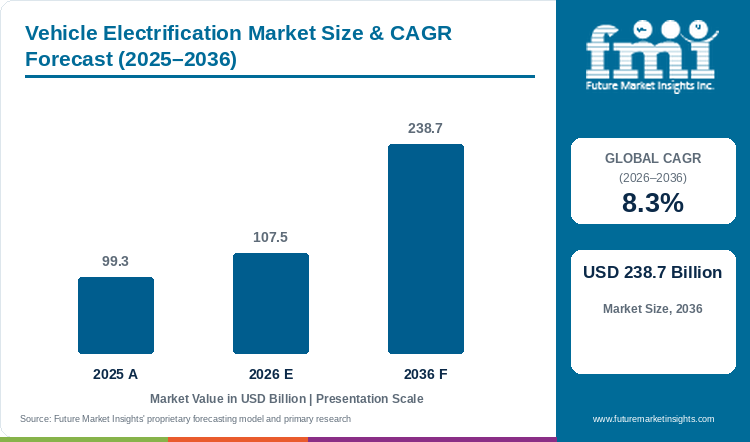
The vehicle electrification market is estimated at USD 99.3 billion in 2025 and is expected to reach USD 107.5 billion in 2026. Vehicle electrification sales are projected to grow at an 8.3% CAGR and reach USD 238.7 billion by 2036.
Adoption of vehicle electrification systems underpins an estimated USD 99.3 billion of 2025 sales, and USD 107.5 billion is expected for 2026. Hybrid orders drive FMI's model, and vehicle electrification sales are predicted to grow at an 8.3% CAGR between 2026 and 2036, reaching USD 238.7 billion in 2036. An adoption review shows car buyers choosing full hybrids first, since a hybrid needs no charger. Hybrid-electric cars were the most popular powertrain in the EU over January to June 2026, with 2,198,148 registrations and a 37.3% share, against 20.7% for battery-electric cars.[1] Every hybrid carries electric steering, a compressor, pumps and a starter generator, so suppliers sell several electrified parts per car even in markets with slow battery electric sales.
Competition among carmakers is shifting to hybrid capacity close to the buyer. Hyundai will invest USD 500 million in the Alabama plant to build the Tucson Hybrid, now imported from Ulsan, as a 15% US tariff raises the cost of imported cars, and Hyundai and Kia reached a combined 12.1% share of US sales in July and August, ahead of Ford.[2] Local hybrid assembly opens a new phase of vehicle electrification market expansion for parts makers with US plants. Importers of those parts are squeezed hardest, since US hybrid plants will source electrified components locally to avoid duties.
Key Market Trends & Insights
- Steering motors on nearly every new car give electric power steering 29% of product type sales in 2026, ahead of start-stop systems at about 10.8% and electric air-conditioner compressors near 9.6%. Bosch said the global ramp-up of electromobility is lagging behind earlier expectations, in the half-year release of 23 September 2026.[3]
- Demand from full hybrids is estimated at 38% of degree of hybridization sales in 2026, with combustion and micro-hybrid vehicles at about 21.5% and mild hybrids near 17.2%.
- Passenger vehicles will hold about 58.4% of application sales in 2026, with electric vehicles about 17.3% and commercial vehicles near 14.1%. Electric car sales are expected to reach 23 million in 2026, close to 30% of all cars sold, the IEA said in May 2026.[4]
- Line-fit purchases by carmakers make up a projected 84.6% of end use sales in 2026, and fleet operators about 15.4%.
Regional Highlights
- China grows at a 20% CAGR in FMI's country figures, the highest rate in the profiled set, on the largest electric car and battery output.
- Purchase subsidies give India 15%, a new grant gives Germany 12%, and hybrids keep the United States near 10%. Japan, with hybrids already common in the domestic fleet, grows 6.2%, about two points behind the 8.3% vehicle electrification market figure.
- Battery-electric cars reached a 28.3% share of UK new car registrations in September 2026, and all electrified vehicles a 58.4% share, SMMT reported.[5]
Market Size & Forecast
Table 1: Market Size and Forecast for the Vehicle Electrification Market (USD billion and percentage), 2025 to 2036
| Metric | Value |
|---|---|
| 2025 Market Size | USD 99.3 billion |
| Estimated Market Size in 2026 | USD 107.5 billion |
| Projected Market Size by 2036 | USD 238.7 billion |
| CAGR, 2026 to 2036 | 8.3% |
| Added Revenue, 2026 to 2036 | USD 131.2 billion |
| Market Expansion Multiple | 2.2x |
Electrified parts are sourced per platform, and a supplier secures volume two to four years before a model launches, so today's awards follow carmaker powertrain plans for 2028 and later. Bosch reported Mobility sales of EUR 27.8 billion for January to June 2026, down 0.5%, with EUR 270 million of impairments on production facilities.[3] Battery packs set the price of each electrified car, and an 8.5% CAGR for the electric vehicle battery market points to falling pack costs as volumes rise. Between the 2026 base and 2036, the FMI outlook adds about USD 131.2 billion to the vehicle electrification market, and 2036 sales are expected at 2.2 times the starting figure. Slower electric car growth in the United States is the main risk, since carmakers there are cancelling and delaying electric programmes.
Hybrid Demand, Policy Support and Battery Supply
Government support is setting the pace of adoption in Europe and India. Germany opened an electric car grant of EUR 1,500 to EUR 6,000 per vehicle on 19 May 2026, with a EUR 3 billion budget for about 800,000 vehicles over 2026 to 2029.[6] India extended PM E-Drive support for electric two-wheelers to 31 March 2028 and raised the allocation to INR 2,767 crore.[7] Grants of this size bring forward purchases of battery electric and plug-in cars, so suppliers of electric pumps, heaters and compressors will see orders rise in those markets first.
Battery supply is growing faster than vehicle output. Chinese EV battery installations reached 79.0 GWh in August 2026, up 26.3%, and LFP cells held an all-time high 85.6% share.[8] Mahle presented a magnet-free MCT motor for heavy trucks with 370 kW of peak power at IAA Transportation 2026.[9] Cheaper LFP packs and rare-earth-free motors will widen electrification from cars to trucks and buses, which adds demand for high-voltage pumps, heaters and compressors.
Table 2: Registration, Policy and Battery Indicators for the Vehicle Electrification Market (units, shares and funding), 2026
| Indicator | Data Point | Relevance | Source |
|---|---|---|---|
| EU hybrid-electric registrations, H1 2026 | 2,198,148; 37.3% share | Hybrids carry several electrified parts each. | [1] |
| UK electrified share, September 2026 | 58.4% of registrations | Electrified parts spread across the fleet. | [5] |
| Germany electric car grant, 2026 | EUR 1,500 to 6,000 per car; EUR 3 billion budget | Grants bring forward purchases. | [6] |
| China EV battery installations, August 2026 | 79.0 GWh; up 26.3% | Battery volume sets electrified output. | [8] |
| Global electric car sales, 2026 forecast | 23 million; close to 30% of cars | Electric share keeps rising. | [4] |
| Bosch Mobility sales, H1 2026 | EUR 27.8 billion; down 0.5% | Supplier volumes lag earlier plans. | [3] |
Analyst Perspective
“Hybrids have become the volume engine of vehicle electrification, and I expect suppliers of steering, thermal and starter generator systems for full hybrids to gain the steadiest orders through 2036. The largest opportunity lies in local production of electrified parts in the United States and India. Tariffs and subsidies in both countries reward suppliers that build close to the assembly line, a fresh pipeline of work for local parts makers.”
- Nikhil Kaitwade, Principal Consultant, Future Market Insights.
How is the vehicle electrification market segmented?
The market is segmented into product type, degree of hybridization, application, end use, and region. Electric power steering is expected to lead product type with 29% share in 2026, and hybrid electric vehicles lead degree of hybridization with 38%.
By product type: start-stop system, electric power steering, electric air-conditioner compressor, electric vacuum pump, electric oil pump, electric water pump, liquid heater PTC, integrated starter generator, starter motor, alternator, and actuator.
By degree of hybridization: internal combustion engine and micro-hybrid vehicle, mild hybrid system, hybrid electric vehicle, plug-in hybrid electric vehicle, and battery electric vehicle.
By application: passenger vehicles, commercial vehicles, electric vehicles, and hybrid vehicles.
By end use: automotive manufacturers, and fleet operators.
By region: vehicle assembly and electrified parts supply in North America, Latin America, Western Europe, Eastern Europe, East Asia, South Asia and Pacific, and Middle East and Africa.
Why does electric power steering lead vehicle electrification sales by product type?
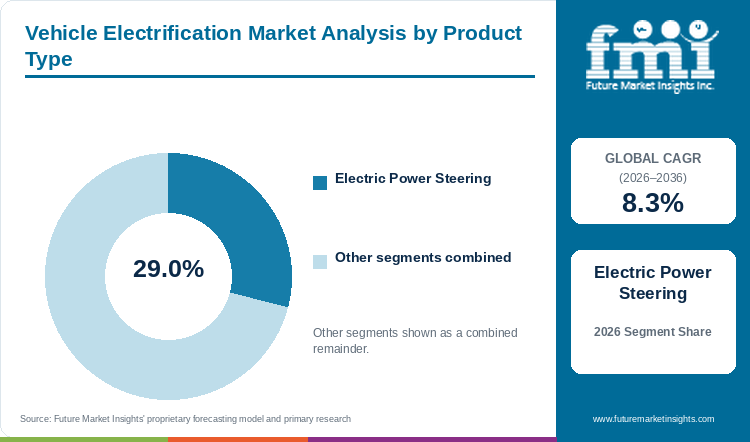
Electric power steering is estimated at 29% of product type sales in 2026, ahead of start-stop systems at about 10.8%, electric air-conditioner compressors near 9.6% and integrated starter generators roughly 8.7%.
Table 3: Product Type Share for the Vehicle Electrification Market (percentage share), 2026
| Product Type | Estimated Share (2026) |
|---|---|
| Electric Power Steering | 29% |
| Start-Stop System | 10.8% |
| Electric Air-Conditioner Compressor | 9.6% |
| Integrated Starter Generator | 8.7% |
| Starter Motor | 8.1% |
| Alternator | 7.5% |
| Electric Water Pump | 6.3% |
| Liquid Heater PTC | 5.4% |
| Actuator | 5.3% |
| Electric Oil Pump | 5.1% |
| Electric Vacuum Pump | 4.2% |
| Total | 100.0% |
Table 4: Product Type Leadership and Market Growth for the Vehicle Electrification Market (segment and CAGR percentage), 2026 to 2036
| Metric | Value |
|---|---|
| Global CAGR (2026 to 2036) | 8.3% |
| Leading Segment | Electric Power Steering |
Nearly every new car, from petrol models to battery electric cars, now steers with an electric motor, and driver-assist systems need that motor to turn the wheel. For 2026, electric power steering is forecast to lead with 29% share of product type sales. Start-stop systems, about 10.8%, cut idling fuel in combustion and micro-hybrid cars, though full hybrids replace them with larger motors. Electric compressors, near 9.6%, are standard in hybrids and EVs that cannot drive air conditioning from the engine. Integrated starter generators, an estimated 8.7%, power mild hybrids. Starter motors and alternators, 8.1% and 7.5%, serve combustion cars and shrink as electric share grows. The remaining 26.3% is estimated for electric water, oil and vacuum pumps, PTC heaters and actuators. Each steering unit runs on a dedicated controller, and growth of the automotive semiconductor market at a 6.8% CAGR adds chip content to every electrified system. A carmaker electrifying a platform step by step will fit electric steering first, since steering serves every powertrain.
- Column-assist, pinion-assist and rack-assist steering units make up the electric power steering segment.
- Bosch reported a Mobility EBIT margin from operations of 4.7% for H1 2026, down from 5.8%.[3]
Why do hybrid electric vehicles lead vehicle electrification sales by degree of hybridization?
Hybrid electric vehicles are projected at 38% of degree of hybridization sales in 2026, with combustion and micro-hybrid vehicles at about 21.5%, mild hybrids near 17.2%, battery electric vehicles 13.5% and plug-in hybrids 9.8%.
Table 5: Degree of Hybridization Share for the Vehicle Electrification Market (percentage share), 2026
| Degree of Hybridization | Estimated Share (2026) |
|---|---|
| Hybrid Electric Vehicle | 38% |
| Internal Combustion Engine and Micro-Hybrid Vehicle | 21.5% |
| Mild Hybrid System | 17.2% |
| Battery Electric Vehicle | 13.5% |
| Plug-In Hybrid Electric Vehicle | 9.8% |
| Total | 100.0% |
With 38% share in 2026, hybrid electric vehicles are projected to lead degree of hybridization, as each full hybrid adds a traction motor, inverter, electric compressor, pumps and steering to a petrol engine, and buyers pay a modest premium without needing a charger. Combustion and micro-hybrid vehicles, an estimated 21.5%, use start-stop systems, alternators and electric steering. Mild hybrids, near 17.2%, add a 48-volt starter generator. Battery electric vehicles, about 13.5%, carry the most electrified content per car but sell in smaller numbers. Plug-in hybrids, 9.8%, combine large batteries with engines, and a 10.3% CAGR projected for the sodium-ion EV battery market points to cheaper cells for small plug-in and city cars. A carmaker planning a new model range will add a full hybrid variant first, since hybrids sell in every market without charging networks.
- Power-split, two-motor and parallel full hybrids from Japanese, Korean and European carmakers form the leading group.
- AISIN, DENSO and BluE Nexus developed a two-motor hybrid drive module adopted for the new Jeep Cherokee, DENSO announced in August 2026.[10]
Why do passenger vehicles lead vehicle electrification sales by application?
Passenger vehicles are likely to hold 58.4% of application sales in 2026, with electric vehicles at about 17.3%, commercial vehicles near 14.1% and hybrid vehicles roughly 10.2%.
Table 6: Application Share for the Vehicle Electrification Market (percentage share), 2026
| Application | Estimated Share (2026) |
|---|---|
| Passenger Vehicles | 58.4% |
| Electric Vehicles | 17.3% |
| Commercial Vehicles | 14.1% |
| Hybrid Vehicles | 10.2% |
| Total | 100.0% |
Combustion and mild hybrid cars built in the largest numbers now carry electric steering, start-stop and electric pumps as standard. Passenger vehicles therefore will lead application sales in 2026 with 58.4% share. Electric vehicles, an estimated 17.3%, are counted separately for traction-related systems and grow fastest. Commercial vehicles, near 14.1%, add electric compressors, steering and pumps to trucks and buses, and Mahle presented a 370 kW magnet-free truck motor at IAA Transportation in September 2026.[9] Hybrid vehicles, about 10.2%, cover dedicated hybrid systems. High-voltage cables link every electrified part, and the automotive wiring harness market will expand at a 6.4% CAGR as 400-volt and 800-volt systems spread. A supplier placing new capacity will serve passenger car platforms first, since those carry the largest unit volumes.
- Hatchbacks, sedans, SUVs and pickups make up the passenger vehicle application.
- Electric trucks made up nearly one in ten trucks sold globally in 2025, the IEA said in May 2026.[4]
Why do automotive manufacturers lead vehicle electrification sales by end use?
Automotive manufacturers are projected at 84.6% of end use sales in 2026, and fleet operators about 15.4%.
Table 7: End Use Share for the Vehicle Electrification Market (percentage share), 2026
| End Use | Estimated Share (2026) |
|---|---|
| Automotive Manufacturers | 84.6% |
| Fleet Operators | 15.4% |
| Total | 100.0% |
Since electrified systems are fitted on the assembly line and validated with each platform, automotive manufacturers are predicted to lead end use sales with 84.6% share in 2026. Fleet operators, about 15.4%, buy retrofit and replacement systems for buses, delivery vans and taxis, and depots convert to electric operation in batches. Depot charging pairs with stationary storage, and with a 9.1% CAGR forecast for the battery energy storage system market, fleets will find more storage options for peak power costs. A fleet manager weighing a retrofit against a new electric vehicle will usually buy new, so line-fit sales stay far ahead.
- Global and regional carmakers buy line-fit electrified systems on multi-year platform contracts.
- Bosch expects global passenger car and light commercial vehicle production to decline again in 2026, the company said in September 2026.[3]
What are the drivers, restraints, and opportunities in the vehicle electrification market?
Hybrid and electric car sales add several electrified parts to each new vehicle. Slower electric car growth and supplier losses strain margins, and local production for tariff-protected and subsidised markets opens new contracts.
- Driver: Every hybrid and electric car needs electric steering, pumps, compressors and heaters, so each gain in electrified share adds several parts per vehicle.
- Restraint: Electric car programmes delayed by carmakers leave suppliers with idle capacity and impairments, which squeezes margins on electrified parts.
- Opportunity: Tariffs and subsidies reward suppliers that build electrified parts close to assembly plants in the United States and India.
Electrified Share Adds Parts per Vehicle
Popularity of hybrids and electric cars raises the electrified content of every new vehicle. Electric car sales are expected to reach 23 million in 2026, close to 30% of all cars sold, after more than 20 million in 2025, the IEA said.[4] Battery-electric cars reached a 20.7% share of EU registrations over January to June 2026, up from 15.6% a year earlier.[1] Suppliers of pumps, heaters and compressors will add volume in step with that share.
Slower Electric Growth Strains Supplier Margins
Producers of electrified systems carry capacity planned for faster electric growth. Mobility at Bosch carried EUR 270 million of impairments on production facilities over the six months to June 2026.[3] UK battery-electric registrations reached 26.2% over the first nine months of 2026, below the 33% mandate target, SMMT said.[5] FMI's analysis treats programme timing as the main risk to supplier margins through 2036. Suppliers will shift capacity from BEV-only parts to systems that serve hybrids as well.
Local Production Opens New Contracts
Demand for locally built electrified parts is rising in markets with tariffs or subsidies that favour local assembly. Hyundai is moving Tucson Hybrid production to Alabama with a USD 500 million investment.[2] India raised the PM E-Drive scheme outlay to INR 11,900 crore and kept the electric two-wheeler subsidy at INR 2,500 per kWh.[7] Suppliers with plants in the United States and India will gain hybrid and two-wheeler contracts first, and buyers identifying new engines of industry expansion will look to those two plant networks.
Which country CAGRs are profiled in the vehicle electrification market?
Table 8: Country CAGR Comparison for the Vehicle Electrification Market (CAGR percentage), 2026 to 2036
| Country | CAGR (2026 to 2036) |
|---|---|
| China | 20% |
| India | 15% |
| Germany | 12% |
| United States | 10% |
| United Kingdom | 8% |
| South Korea | 7.4% |
| Japan | 6.2% |
How do country-level CAGRs compare in the vehicle electrification market?
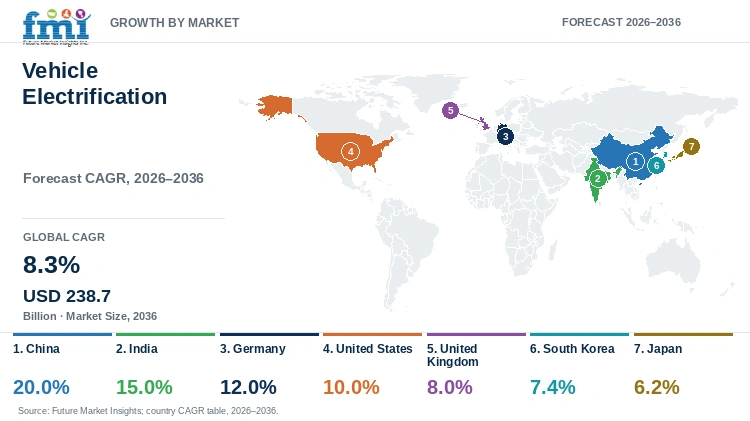
China installed 489.1 GWh of EV batteries from January to August 2026, 17% more than a year earlier.[8] That battery base gives China a 20% CAGR in FMI's model, against the 8.3% rate for the vehicle electrification market. Subsidies for electric two-wheelers and cars give India 15%. The new electric car grant supports 12% growth in Germany. Hybrids gaining ground over battery electric cars hold the United States at 10%. With the ZEV mandate target running ahead of buyer demand, the United Kingdom is likely to grow at 8%, a little under the vehicle electrification market rate. Hybrid exports from Ulsan keep South Korea at 7.4%. Japan grows slowest, at 6.2%, as hybrids already make up much of the fleet.
- Chinese battery makers are installing more LFP cells than ever.
- Indian two-wheeler buyers receive PM E-Drive subsidies until March 2028.
- German buyers can claim up to EUR 6,000 per electric car.
- US carmakers are building hybrids locally to avoid import tariffs.
- British registrations of battery electric cars fall short of the ZEV target.
- Korean plants export hybrids to the United States.
- Japanese suppliers develop hybrid modules for overseas carmakers.
Full report country CAGRs cover: Four of the seven rated countries, China, India, Germany and the United States, are projected to outpace the 8.3% vehicle electrification market CAGR, the other three to grow more slowly, and remaining regions receive summaries.
Country-wise Analysis
China Vehicle Electrification Market Outlook (2026 to 2036)
Chinese EV battery installations reached 79.0 GWh in August 2026, and LFP cells made up an all-time high 85.6% of installations, CABIA data reported by CnEVPost show.[8] Low-cost LFP packs let Chinese carmakers price electric cars close to petrol models, and the FMI outlook gives China a 20% CAGR. Exports of electric cars add volume for electrified parts made in China.
Key takeaway: China leads the country table on cheap batteries and high output.
India Vehicle Electrification Market Outlook (2026 to 2036)
Electric two-wheeler sales in India rose to 1.46 million in FY2026 from 252,787 in FY2022, and PM E-Drive support now runs until 31 March 2028, Autocar Professional reported on 11 August 2026.[7] Scooter, three-wheeler and car makers will add electric steering, pumps and controllers as volumes rise, and FMI projects India at 15%.
Key takeaway: Subsidised two-wheelers and cars keep India well above the vehicle electrification market rate.
Germany Vehicle Electrification Market Outlook (2026 to 2036)
Germany opened an income-linked electric car grant on 19 May 2026, retroactive to registrations from 1 January 2026, and about 224,000 battery electric cars were registered from January to April.[6] Battery-electric registrations in Germany rose 48% in the first half of 2026.[1] Germany is projected to grow at 12%, as grants pull electric car purchases forward.
Key takeaway: The new grant scheme raises electric car buying in Germany.
United States Vehicle Electrification Market Outlook (2026 to 2036)
US hybrid sales rose 33% in August 2026, led by the Tucson Hybrid, and Hyundai plans to build the model in Alabama, The Korea Herald reported on 1 October 2026.[2] AISIN North Carolina makes the transaxle and motors for a new two-motor hybrid module used in the Jeep Cherokee.[10] The United States is expected to grow at 10%, as hybrids carry most electrified volume.
Key takeaway: Locally built hybrids drive electrification in the United States.
United Kingdom Vehicle Electrification Market Outlook (2026 to 2036)
UK buyers registered 99,201 battery electric cars in September 2026, a 28.3% share, and electrified vehicles reached 58.4% of the market, SMMT said on 5 October 2026.[5] The year-to-date BEV share of 26.2% remains below the 33% ZEV mandate target. Plug-in growth and mandate pressure point to an 8% CAGR for the United Kingdom.
Key takeaway: Mandate pressure and plug-in growth keep the United Kingdom near the rate for vehicle electrification overall.
South Korea Vehicle Electrification Market Outlook (2026 to 2036)
All Tucson Hybrids sold in the United States are now built in Ulsan, and Hyundai plans to move that production to Alabama.[2] Korean plants will keep supplying hybrids to other export markets and the domestic market, for a 7.4% CAGR in South Korea.
Key takeaway: Export shifts to US plants hold South Korea below the vehicle electrification market rate.
Japan Vehicle Electrification Market Outlook (2026 to 2036)
AISIN and DENSO announced on 27 August 2026 a two-motor hybrid drive module, developed with BluE Nexus, with a DENSO inverter and an AISIN transaxle.[10] Japanese carmakers already sell a high share of hybrids at home, so new electrified content grows from a high base, and Japan's rate is 6.2%.
Key takeaway: A mature hybrid fleet leaves Japan with the smallest gain.
Who are the notable companies in the vehicle electrification market?
Bosch, Continental, DENSO, Hitachi, JTEKT, AISIN, Magna, Valeo, Marelli and Mahle are the profiled companies.
Ten system suppliers make up the FMI company coverage, from global groups to steering and thermal specialists. Group sales at Bosch were EUR 46.4 billion in H1 2026, 3.6% higher, and the company confirmed a 2026 outlook of 2% to 5% sales growth.[3] Mahle showed a range extender and a magnet-free truck motor at IAA Transportation 2026.[9] DENSO and AISIN supply the inverter and transaxle for a new two-motor hybrid module.[10] Continental, Hitachi, JTEKT, Magna, Valeo and Marelli complete the group.
- Global system suppliers: Bosch, Continental, DENSO, Magna, Valeo and Mahle.
- Steering and drive specialists: JTEKT, AISIN and Hitachi.
- Lighting, electronics and powertrain specialists: Marelli.
Competitive Benchmarking: Vehicle Electrification Market
Table 9: Competitive Benchmarking for the Vehicle Electrification Market (qualitative documentation ratings), 2026
| Company | Hybrid Systems | Thermal and Pumps | Truck Electrification | Recency |
|---|---|---|---|---|
| Bosch | High | High | High | High |
| DENSO | High | High | Medium | High |
| AISIN | High | Medium | Low | High |
| Mahle | Medium | High | High | High |
| Valeo | Medium | High | Low | Low |
Ratings here measure dated 2026 company disclosures on electrified products and are not a measure of market share.
Key Developments in the Vehicle Electrification Market
- On 5 October 2026, SMMT reported a 28.3% battery-electric share of UK registrations for September.[5]
- Tucson Hybrid production is moving to Alabama under a USD 500 million Hyundai plan made public on 1 October 2026.[2]
- On 23 September 2026, Bosch reaffirmed the 2026 outlook with half-year sales of EUR 46.4 billion.[3]
- On 16 September 2026, CABIA data showed Chinese EV battery installations of 79.0 GWh for August.[8]
- On 14 September 2026, Mahle unveiled a range extender and the MCT motor at IAA Transportation 2026.[9]
- On 27 August 2026, DENSO said the new Jeep Cherokee uses a two-motor hybrid module with a DENSO inverter.[10]
- On 11 August 2026, India extended PM E-Drive support for electric two-wheelers to March 2028.[7]
- On 23 July 2026, ACEA reported a 37.3% hybrid-electric share of EU registrations for the first half.[1]
- On 20 May 2026, the IEA forecast 23 million electric car sales for 2026.[4]
- On 19 May 2026, Germany opened applications for the electric car grant scheme.[6]
Key Players in the Vehicle Electrification Market
Global System Suppliers
- Bosch
- Continental
- DENSO
- Magna
- Valeo
- Mahle
Steering and Drive Specialists
- JTEKT
- AISIN
- Hitachi
Lighting, Electronics and Powertrain Specialists
- Marelli
Vehicle Electrification Market - Report Scope
Table 10: Report Scope for the Vehicle Electrification Market (coverage fields and definitions), 2026 to 2036
| Coverage field | Report scope |
|---|---|
| Market breakdown | Product type; degree of hybridization; application; end use; region |
| Quantitative units | USD billion |
| Market definition | Electrically driven vehicle systems, including electric power steering, start-stop, electric compressors, pumps, PTC heaters, starter generators, starter motors, alternators and actuators, fitted to combustion, hybrid and electric vehicles. |
| Regions covered | North America; Latin America; Western Europe; Eastern Europe; East Asia; South Asia and Pacific; Middle East and Africa |
| Countries covered | United States; Canada; Brazil; Mexico; Argentina; Chile; Germany; France; United Kingdom; Italy; Spain; Benelux; Nordics; Poland; Czech Republic; Romania; Hungary; China; Japan; South Korea; India; ASEAN; Australia and New Zealand; GCC Countries; South Africa; Türkiye; Israel |
| Key companies profiled | Bosch, Continental, DENSO, Hitachi, JTEKT, AISIN, Magna, Valeo, Marelli, Mahle |
| Forecast period | 2026 to 2036 |
Vehicle Electrification Market - Research Methodology
Table 11: Research Methodology for the Vehicle Electrification Market (research methods and approach), 2026 edition
| Method | Approach |
|---|---|
| Data Sources | Supplier and carmaker releases, registration data from industry associations, government incentive notices, energy agency outlooks and automotive trade press from May 2025 onward. |
| Desk Research | Desk research covers hybrid and electric car sales, incentives, battery supply, supplier results and local production plans. |
| Market Sizing and Forecasting | Sizing starts from the 2026 base of USD 107.5 billion and an 8.3% CAGR for the ten years to 2036. |
| Data Validation | Registrations, budgets and company figures were checked against the association, ministry or company that released them. |
Vehicle Electrification Market by Segments
Vehicle Electrification Market segmented by Product Type:
- Start-Stop System
- Electric Power Steering
- Electric Air-Conditioner Compressor
- Electric Vacuum Pump
- Electric Oil Pump
- Electric Water Pump
- Liquid Heater PTC
- Integrated Starter Generator
- Starter Motor
- Alternator
- Actuator
Vehicle Electrification Market segmented by Degree of Hybridization:
- Internal Combustion Engine and Micro-Hybrid Vehicle
- Mild Hybrid System
- Hybrid Electric Vehicle
- Plug-In Hybrid Electric Vehicle
- Battery Electric Vehicle
Vehicle Electrification Market segmented by Application:
- Passenger Vehicles
- Commercial Vehicles
- Electric Vehicles
- Hybrid Vehicles
Vehicle Electrification Market segmented by End Use:
- Automotive Manufacturers
- Fleet Operators
Vehicle Electrification Market by Region
- North America
- United States
- Canada
- Latin America
- Brazil
- Mexico
- Argentina
- Chile
- Western Europe
- Germany
- France
- United Kingdom
- Italy
- Spain
- Benelux
- Nordics
- Eastern Europe
- Poland
- Czech Republic
- Romania
- Hungary
- East Asia
- China
- Japan
- South Korea
- South Asia and Pacific
- India
- ASEAN
- Australia and New Zealand
- Middle East and Africa
- GCC Countries
- South Africa
- Türkiye
- Israel
Research Sources and Bibliography
- [1] European Automobile Manufacturers' Association (ACEA). (2026, July 23). New car registrations: +5.7% in H1 2026; battery-electric 20.7% market share. https://www.acea.auto/pc-registrations/new-car-registrations-5-7-in-h1-2026-battery-electric-20-7-market-share/
- [2] The Korea Herald. (2026, October 1). Hyundai to build Tucson Hybrid in US with $500m investment. https://www.koreaherald.com/article/10890612
- [3] Robert Bosch GmbH. (2026, September 23). Half-year figures 2026: Bosch reaffirms outlook. https://www.bosch-presse.de/pressportal/de/en/half-year-figures-2026-bosch-reaffirms-outlook-285632.html
- [4] International Energy Agency. (2026, May 20). Close to 30% of cars sold this year are set to be electric as countries and consumers respond to energy crisis. https://www.iea.org/news/close-to-30-of-cars-sold-this-year-are-set-to-be-electric-as-countries-and-consumers-respond-to-energy-crisis
- [5] Society of Motor Manufacturers and Traders. (2026, October 5). Record electric car market powers bumper September. https://www.smmt.co.uk/record-electric-car-market-powers-bumper-september/
- [6] Federal Ministry for the Environment, Climate Action, Nature Conservation and Nuclear Safety. (2026, May 19). EV grant scheme open for applications (Press release No. 057/26). https://www.bundesumweltministerium.de/PM11760-1
- [7] Autocar Professional. (2026, August 11). Govt extends PM E-Drive subsidy for e2Ws till FY28, increases allocation. https://www.autocarpro.in/news/govt-extends-pm-e-drive-subsidy-for-e2ws-till-fy28-increases-allocation-134036?amp=1
- [8] CnEVPost. (2026, September 16). China's EV battery installations rise 26.3% in August to year-to-date high. https://cnevpost.com/2026/09/16/china-ev-battery-installations-aug-2026/
- [9] Automotive World. (2026, September 14). Mahle unveils range extender and MCT motor at IAA 2026. https://www.automotiveworld.com/news/mahle-unveils-range-extender-and-mct-motor-at-iaa-2026/
- [10] DENSO Corporation. (2026, August 27). Newly developed two-motor hybrid drive module adopted for STELLANTIS new Jeep Cherokee. https://www.denso.com/global/en/newsroom/news/2026/20260827-g01
This bibliography is provided for reader reference. The full report contains the complete reference list and detailed citations.
This Report Answers
- How big is the vehicle electrification market during 2026?
- What market size is projected by 2036?
- Which product type holds notable share?
- Which degree of hybridization holds notable share?
- Which countries have notable growth?
- Which companies are notable in the market?
Frequently Asked Questions
How large is the vehicle electrification market expected in 2026?
The 2026 vehicle electrification market figure is USD 107.5 billion in the FMI forecast, against USD 99.3 billion in 2025. Vehicle electrification sales are projected to reach USD 238.7 billion by 2036.
What CAGR is projected for the vehicle electrification market through 2036?
An 8.3% CAGR is projected by FMI for the vehicle electrification market over the ten years to 2036. Hybrid and electric cars carrying more electrified parts per vehicle drive that growth.
Which product type holds a notable market share in 2026?
With 29% share expected in 2026, electric power steering is the largest product type. Start-stop systems follow at an estimated 10.8%.
Which degree of hybridization holds a notable market share in 2026?
Full hybrids are projected to account for 38% share in 2026. Combustion and micro-hybrid vehicles follow at an estimated 21.5%.
Which country has a notable expansion outlook through 2036?
China is projected at a 20% CAGR, the highest profiled rate. India follows at 15%.
Who are the key companies in the vehicle electrification market?
Bosch, Continental, DENSO, Magna, Valeo and Mahle are the profiled global system suppliers. JTEKT, AISIN, Hitachi and Marelli complete the group.
Preview the report firsthand - request a free sample
Get SampleGet the brochure for pricing and purchase details.
Get PDFTable of Content
- Key Takeaways
- Market Size and CAGR
- Top Growth Driver
- Fastest Growing Segment
- Leading Region
- Key Companies
- Emerging Opportunities
- Executive Summary
- Global Market Outlook
- Demand-side Trends
- Supply-side Trends
- Technology Roadmap Analysis
- Analysis and Recommendations
- Analyst Perspective (What is happening? Why now? What should investors know?)
- Key Questions Answered
- How large is the market?
- What is the CAGR?
- What are key trends?
- Which region dominates?
- Who are the leaders?
- Market Overview
- Market Coverage / Taxonomy
- Market Definition / Scope / Limitations
- Research Methodology
- Chapter Orientation
- Analytical Lens and Working Hypotheses
- Market Structure, Signals, and Trend Drivers
- Benchmarking and Cross-market Comparability
- Market Sizing, Forecasting, and Opportunity Mapping
- Research Design and Evidence Framework
- Desk Research Programme (Secondary Evidence)
- Expert Input and Fieldwork (Primary Evidence)
- Tooling, Models, and Reference Databases
- Data Engineering and Model Build
- Quality Assurance and Audit Trail
- Market Background
- Market Dynamics (Drivers, Restraints, Opportunity, Trends)
- Scenario Forecast (Optimistic, Likely, Conservative)
- Impact Analysis
- AI Impact
- Sustainability Impact
- Regulatory Impact
- Technology Impact
- Consumer / Buyer Analysis
- Purchase Drivers
- Adoption Barriers
- Buyer Journey
- Opportunity Map Analysis
- Product Life Cycle Analysis
- Supply Chain Analysis
- Investment Feasibility Matrix
- Value Chain Analysis
- PESTLE and Porter's Analysis
- Regulatory Landscape
- Regional Parent Market Outlook
- Production and Consumption Statistics
- Import and Export Statistics
- Global Market Analysis and Forecast, 2021 to 2036
- Historical Market Size Value (USD Billion) Analysis, 2021 to 2025
- Current and Future Market Size Value (USD Billion) Projections, 2026 to 2036
- Y-o-Y Growth Trend Analysis
- Absolute $ Opportunity Analysis
- Global Market Pricing Analysis, 2021 to 2036
- Global Market Analysis and Forecast, By Product Type, 2021 to 2036
- Introduction / Key Findings
- Historical Market Size Value (USD Billion) Analysis By Product Type, 2021 to 2025
- Current and Future Market Size Value (USD Billion) Analysis and Forecast By Product Type, 2026 to 2036
- Start-Stop System
- Electric Power Steering
- Electric Air-Conditioner Compressor
- Electric Vacuum Pump
- Electric Oil Pump
- Electric Water Pump
- Liquid Heater PTC
- Integrated Starter Generator
- Starter Motor
- Alternator
- Actuator
- Y-o-Y Growth Trend Analysis By Product Type, 2021 to 2025
- Absolute $ Opportunity Analysis By Product Type, 2026 to 2036
- Global Market Analysis and Forecast, By Degree of Hybridization, 2021 to 2036
- Introduction / Key Findings
- Historical Market Size Value (USD Billion) Analysis By Degree of Hybridization, 2021 to 2025
- Current and Future Market Size Value (USD Billion) Analysis and Forecast By Degree of Hybridization, 2026 to 2036
- Internal Combustion Engine and Micro-Hybrid Vehicle
- Mild Hybrid System
- Hybrid Electric Vehicle
- Plug-In Hybrid Electric Vehicle
- Battery Electric Vehicle
- Y-o-Y Growth Trend Analysis By Degree of Hybridization, 2021 to 2025
- Absolute $ Opportunity Analysis By Degree of Hybridization, 2026 to 2036
- Global Market Analysis and Forecast, By Application, 2021 to 2036
- Introduction / Key Findings
- Historical Market Size Value (USD Billion) Analysis By Application, 2021 to 2025
- Current and Future Market Size Value (USD Billion) Analysis and Forecast By Application, 2026 to 2036
- Passenger Vehicles
- Commercial Vehicles
- Electric Vehicles
- Hybrid Vehicles
- Y-o-Y Growth Trend Analysis By Application, 2021 to 2025
- Absolute $ Opportunity Analysis By Application, 2026 to 2036
- Global Market Analysis and Forecast, By End Use, 2021 to 2036
- Introduction / Key Findings
- Historical Market Size Value (USD Billion) Analysis By End Use, 2021 to 2025
- Current and Future Market Size Value (USD Billion) Analysis and Forecast By End Use, 2026 to 2036
- Automotive Manufacturers
- Fleet Operators
- Y-o-Y Growth Trend Analysis By End Use, 2021 to 2025
- Absolute $ Opportunity Analysis By End Use, 2026 to 2036
- Global Market Analysis and Forecast, By Region, 2021 to 2036
- Introduction
- Historical Market Size Value (USD Billion) Analysis By Region, 2021 to 2025
- Current Market Size Value (USD Billion) Analysis and Forecast By Region, 2026 to 2036
- North America
- Latin America
- Western Europe
- Eastern Europe
- East Asia
- South Asia and Pacific
- Middle East and Africa
- Market Attractiveness Analysis By Region
- North America Market Analysis and Forecast, By Country, 2021 to 2036
- Historical Market Size Value (USD Billion) Trend Analysis By Market Taxonomy, 2021 to 2025
- Market Size Value (USD Billion) Forecast By Market Taxonomy, 2026 to 2036
- By Country
- United States
- Canada
- By Product Type
- By Degree of Hybridization
- By Application
- By End Use
- By Country
- Market Attractiveness Analysis
- By Country
- By Product Type
- By Degree of Hybridization
- By Application
- By End Use
- Key Takeaways
- Latin America Market Analysis and Forecast, By Country
- Historical Market Size Value (USD Billion) Trend Analysis By Market Taxonomy, 2021 to 2025
- Market Size Value (USD Billion) Forecast By Market Taxonomy, 2026 to 2036
- By Country
- Brazil
- Mexico
- Argentina
- Chile
- By Product Type
- By Degree of Hybridization
- By Application
- By End Use
- By Country
- Market Attractiveness Analysis
- By Country
- By Product Type
- By Degree of Hybridization
- By Application
- By End Use
- Key Takeaways
- Western Europe Market Analysis and Forecast, By Country
- Historical Market Size Value (USD Billion) Trend Analysis By Market Taxonomy, 2021 to 2025
- Market Size Value (USD Billion) Forecast By Market Taxonomy, 2026 to 2036
- By Country
- Germany
- France
- United Kingdom
- Italy
- Spain
- Benelux
- Nordics
- By Product Type
- By Degree of Hybridization
- By Application
- By End Use
- By Country
- Market Attractiveness Analysis
- By Country
- By Product Type
- By Degree of Hybridization
- By Application
- By End Use
- Key Takeaways
- Eastern Europe Market Analysis and Forecast, By Country
- Historical Market Size Value (USD Billion) Trend Analysis By Market Taxonomy, 2021 to 2025
- Market Size Value (USD Billion) Forecast By Market Taxonomy, 2026 to 2036
- By Country
- Poland
- Czech Republic
- Romania
- Hungary
- By Product Type
- By Degree of Hybridization
- By Application
- By End Use
- By Country
- Market Attractiveness Analysis
- By Country
- By Product Type
- By Degree of Hybridization
- By Application
- By End Use
- Key Takeaways
- East Asia Market Analysis and Forecast, By Country
- Historical Market Size Value (USD Billion) Trend Analysis By Market Taxonomy, 2021 to 2025
- Market Size Value (USD Billion) Forecast By Market Taxonomy, 2026 to 2036
- By Country
- China
- Japan
- South Korea
- By Product Type
- By Degree of Hybridization
- By Application
- By End Use
- By Country
- Market Attractiveness Analysis
- By Country
- By Product Type
- By Degree of Hybridization
- By Application
- By End Use
- Key Takeaways
- South Asia and Pacific Market Analysis and Forecast, By Country
- Historical Market Size Value (USD Billion) Trend Analysis By Market Taxonomy, 2021 to 2025
- Market Size Value (USD Billion) Forecast By Market Taxonomy, 2026 to 2036
- By Country
- India
- ASEAN
- Australia and New Zealand
- By Product Type
- By Degree of Hybridization
- By Application
- By End Use
- By Country
- Market Attractiveness Analysis
- By Country
- By Product Type
- By Degree of Hybridization
- By Application
- By End Use
- Key Takeaways
- Middle East and Africa Market Analysis and Forecast, By Country
- Historical Market Size Value (USD Billion) Trend Analysis By Market Taxonomy, 2021 to 2025
- Market Size Value (USD Billion) Forecast By Market Taxonomy, 2026 to 2036
- By Country
- GCC Countries
- South Africa
- Türkiye
- Israel
- By Product Type
- By Degree of Hybridization
- By Application
- By End Use
- By Country
- Market Attractiveness Analysis
- By Country
- By Product Type
- By Degree of Hybridization
- By Application
- By End Use
- Key Takeaways
- Key Countries Market Analysis
- United States
- Pricing Analysis
- Market Share Analysis, 2025
- By Product Type
- By Degree of Hybridization
- By Application
- By End Use
- Canada
- Pricing Analysis
- Market Share Analysis, 2025
- By Product Type
- By Degree of Hybridization
- By Application
- By End Use
- Mexico
- Pricing Analysis
- Market Share Analysis, 2025
- By Product Type
- By Degree of Hybridization
- By Application
- By End Use
- Brazil
- Pricing Analysis
- Market Share Analysis, 2025
- By Product Type
- By Degree of Hybridization
- By Application
- By End Use
- Chile
- Pricing Analysis
- Market Share Analysis, 2025
- By Product Type
- By Degree of Hybridization
- By Application
- By End Use
- Germany
- Pricing Analysis
- Market Share Analysis, 2025
- By Product Type
- By Degree of Hybridization
- By Application
- By End Use
- United Kingdom
- Pricing Analysis
- Market Share Analysis, 2025
- By Product Type
- By Degree of Hybridization
- By Application
- By End Use
- Italy
- Pricing Analysis
- Market Share Analysis, 2025
- By Product Type
- By Degree of Hybridization
- By Application
- By End Use
- Spain
- Pricing Analysis
- Market Share Analysis, 2025
- By Product Type
- By Degree of Hybridization
- By Application
- By End Use
- France
- Pricing Analysis
- Market Share Analysis, 2025
- By Product Type
- By Degree of Hybridization
- By Application
- By End Use
- India
- Pricing Analysis
- Market Share Analysis, 2025
- By Product Type
- By Degree of Hybridization
- By Application
- By End Use
- ASEAN
- Pricing Analysis
- Market Share Analysis, 2025
- By Product Type
- By Degree of Hybridization
- By Application
- By End Use
- Australia and New Zealand
- Pricing Analysis
- Market Share Analysis, 2025
- By Product Type
- By Degree of Hybridization
- By Application
- By End Use
- China
- Pricing Analysis
- Market Share Analysis, 2025
- By Product Type
- By Degree of Hybridization
- By Application
- By End Use
- Japan
- Pricing Analysis
- Market Share Analysis, 2025
- By Product Type
- By Degree of Hybridization
- By Application
- By End Use
- South Korea
- Pricing Analysis
- Market Share Analysis, 2025
- By Product Type
- By Degree of Hybridization
- By Application
- By End Use
- Poland
- Pricing Analysis
- Market Share Analysis, 2025
- By Product Type
- By Degree of Hybridization
- By Application
- By End Use
- Hungary
- Pricing Analysis
- Market Share Analysis, 2025
- By Product Type
- By Degree of Hybridization
- By Application
- By End Use
- Türkiye
- Pricing Analysis
- Market Share Analysis, 2025
- By Product Type
- By Degree of Hybridization
- By Application
- By End Use
- South Africa
- Pricing Analysis
- Market Share Analysis, 2025
- By Product Type
- By Degree of Hybridization
- By Application
- By End Use
- United States
- Market Structure Analysis
- Competition Dashboard
- Competition Benchmarking
- Market Share Analysis of Top Players
- By Regional
- By Product Type
- By Degree of Hybridization
- By Application
- By End Use
- Emerging Startups
- Innovation Benchmarking
- Competition Analysis
- Competition Deep Dive
- Bosch
- Overview
- Product Portfolio
- Profitability by Market Segments
- Sales Footprint
- Strategy Overview
- Marketing Strategy
- Product Strategy
- Channel Strategy
- DENSO
- AISIN
- Mahle
- Valeo
- Continental
- Magna
- JTEKT
- Hitachi
- Marelli
- Bosch
- Case Studies
- Success Stories
- Recent Developments
- Competition Deep Dive
- Assumptions & Acronyms Used


