


- Ceiling tile procurement is shifting from basic finish selection toward acoustic control, low-emitting materials, recycled content, fire performance, moisture resistance, and lifecycle documentation.
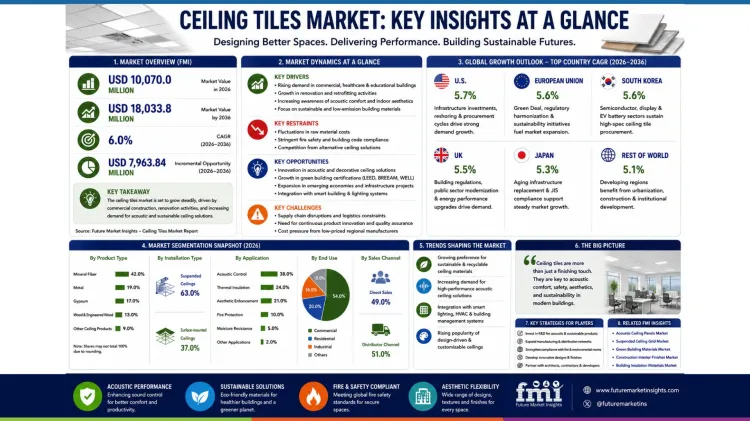
- FMI lists acoustic control, thermal insulation, and aesthetic enhancement as key ceiling tile applications.
- Commercial demand holds 54.0% share, making offices, healthcare, education, retail, and institutional facilities central to performance-led procurement.
- LEED v5 emphasizes decarbonization, responsible resource use, and low-emitting building materials, which raises the documentation burden for ceiling products.
- The WELL sound concept encourages project teams to address noise control, acoustic planning, speech intelligibility, and acoustic privacy.
- The buying shift is not only toward green ceiling tiles. It is toward products that can prove comfort, compliance, carbon, circularity, and indoor-air-quality value.
The ceiling has become a performance surface. It still covers building services and completes the interior design, and in many commercial projects it now carries a broader job, namely to absorb sound, support indoor air quality, contribute to fire and moisture performance, reflect light, help building certifications, and reduce maintenance disruption.
This change is visible in procurement language. Ceiling tiles are no longer specified only by size, texture, color, and price. Buyers increasingly ask for acoustic ratings, low-emitting documentation, recycled content, environmental product declarations, fire ratings, sag resistance, mold resistance, and compatibility with green building systems. That shift is reshaping which suppliers can compete.
The FMI Ceiling Tiles Market identifies acoustic control, thermal insulation, and aesthetic enhancement as application categories. It also shows that commercial end use accounts for 54.0% of demand and suspended systems hold 63.0% of installation demand. This combination matters. Commercial suspended ceilings are the area where acoustic and sustainability requirements are most frequently converted into product specifications.
The acoustic driver is straightforward. Offices need speech privacy and lower distraction. Classrooms need intelligibility. Healthcare spaces need comfort and reduced stress. Retail and hospitality spaces need controlled ambience. Airports, transport buildings, and public facilities need noise reduction in large open areas. A hard ceiling surface can reflect sound and increase reverberation. Acoustic ceiling tiles can reduce that effect.
The WELL v2 Sound concept addresses noise control and intentional acoustic design. The International WELL Building Institute describes options ranging from sound mapping and planning to HVAC and façade design, along with products that can improve speech intelligibility and acoustic privacy. This shifts ceilings into the wellness conversation rather than treating them only as construction finishes.
For ceiling tile suppliers, that creates a stronger case for acoustic product differentiation. Mineral fiber products are well placed because they can provide sound absorption at scale. Perforated metal panels with acoustic backing can serve premium spaces. Wood systems can provide design value and may need acoustic treatment. Gypsum may require additional acoustic design measures where absorption is needed. Product selection depends on room function, not only material.
FMI notes that application areas involving acoustic control face regional certification, environmental standards, and product safety testing that extend time-to-market and add per-unit costs. This is commercially important. Acoustic performance is not just a sales claim. Many projects expect tested values, published data, and compatibility with local standards or rating systems. Suppliers with existing documentation have a time advantage.
Sustainability is adding a second procurement filter. USGBC describes LEED v5 as a framework pushing the market toward a near-zero-carbon future with emphasis on decarbonization, human and ecological health, and resilience. It highlights reductions in operational, embodied, refrigerant, and transportation emissions. Ceiling tiles may not be the largest carbon item in a building, and they are part of interior material selection and can contribute to low-emitting and material documentation credits.
The USGBC low-emitting materials credit framework explicitly includes ceilings among product categories in relevant credits. This matters because ceiling panels, suspension systems, coatings, adhesives, and associated products can influence indoor air quality. A supplier that cannot provide VOC emissions documentation may be disadvantaged in projects pursuing certification.
Green building requirements also raise interest in recycled content and circularity. Mineral fiber ceiling tiles often use mineral wool, perlite, clay, starch, recycled paper, or other inputs depending on product design. Metal ceiling tiles can contain recycled metal and may be recyclable at end of life. Gypsum products can incorporate recycled content and may be recovered in certain markets, and contamination and collection systems remain constraints.
The EPA sustainable materials guidance gives priority to source reduction because it reduces lifecycle material use, energy use, and waste generation before waste is created. For ceiling tiles, this points to longer service life, replacement compatibility, reduced breakage, lighter packaging, lower installation waste, and renovation-friendly systems. A tile that lasts longer and can be replaced selectively may support sustainability even when it is not made from a fully recycled material.
The procurement change is particularly visible in institutional buyers. Hospitals, universities, government buildings, corporate campuses, and large commercial portfolios often maintain sustainability policies. They may require EPDs, health product declarations, low-emitting certificates, recycled-content declarations, or responsible sourcing information. Suppliers lacking these documents may still sell into price-sensitive projects, and they can be excluded from higher-specification tenders.
Performance standards also affect sales channels. Direct sales account for 49.0% of demand in the FMI segmentation. Project-based direct selling is useful when product documentation, acoustic data, and sustainability credentials must be reviewed before specification. Distributors remain important for renovation and smaller projects, and performance-led procurement often starts earlier with architects, consultants, facility managers, and sustainability teams.
The USA and European Union are strong examples. FMI projects USA growth at 5.7% and EU growth at 5.6% through 2036. In the USA, infrastructure allocations, reshoring, Buy America provisions, and local content requirements can shape procurement. In the EU, Green Deal and circular economy mandates are pushing specification changes and supporting suppliers with pan-European certification. These conditions make acoustic and sustainable documentation more valuable.
South Korea 5.6% CAGR has another performance angle. Semiconductor, display, and EV battery manufacturing sectors sustain high-specification procurement, according to FMI. In such facilities, ceiling tiles may need to meet clean interior, acoustic, maintenance, and quality expectations. Product consistency and technical support can matter more than the lowest price.
The UK 5.5% growth is linked by FMI to building regulations, fire safety standards, public sector modernization, and energy performance requirements. That makes fire, acoustic, and sustainability documentation central to institutional ceiling procurement. Japan 5.3% growth reflects JIS compliance and aging infrastructure replacement, creating a quality-led replacement environment.
For suppliers, the shift has practical consequences. Basic commodity tiles will still sell, particularly in cost-sensitive projects. Premium growth is more likely where tiles solve multiple problems. A product that combines high acoustic absorption, low emissions, recycled content, sag resistance, mold resistance, and attractive design can compete on total value rather than only price.
Metal suppliers can position around durability, cleanability, recyclability, and premium aesthetics. Mineral fiber suppliers can position around acoustics, cost effectiveness, recycled content, and broad commercial suitability. Gypsum suppliers can emphasize fire performance, smooth finish, and integrated ceiling design. Wood and engineered wood products can emphasize aesthetics and biophilic design, and fire, emissions, and sustainability documentation must be clear.
A common procurement shortcut is to treat sustainable ceiling tiles and acoustic ceiling tiles as separate product categories. In real projects, these requirements often arrive together. An office fit-out may need acoustic control, low-emitting materials, recycled content, fast installation, and design flexibility. A school renovation may need noise reduction, durability, fire performance, and public procurement compliance. A hospital may need cleanability, acoustic comfort, mold resistance, and approved documentation.
The market is moving toward proof. Claims need test reports, certifications, rating-system alignment, and supply reliability. The FMI point that companies with multi-jurisdiction certifications hold 12 to 18 month time advantages over new entrants is a useful signal. Documentation speed can be a competitive advantage.
The practical analyst finding is that performance standards are not only raising product quality. They are changing the buyer map. Architects, acoustic consultants, sustainability managers, facility managers, and procurement teams now influence ceiling tile decisions together. Suppliers need to sell to all of them.
Acoustic and sustainable building requirements are therefore reshaping procurement in a layered way. They reward ceiling systems that make interiors quieter, healthier, more documented, easier to maintain, and more aligned with building certification goals. Cost still matters, and the ceiling tile is increasingly judged by what it contributes to the building, not only by what it costs per square meter.

