

- Industry Size (2026)
- USD 2.3 Bn
- Forecast (2036)
- USD 7.4 Bn
- CAGR (2026 to 2036)
- 12.4%
Ceiling Light Packaging Market Forecast and Outlook 2026 to 2036
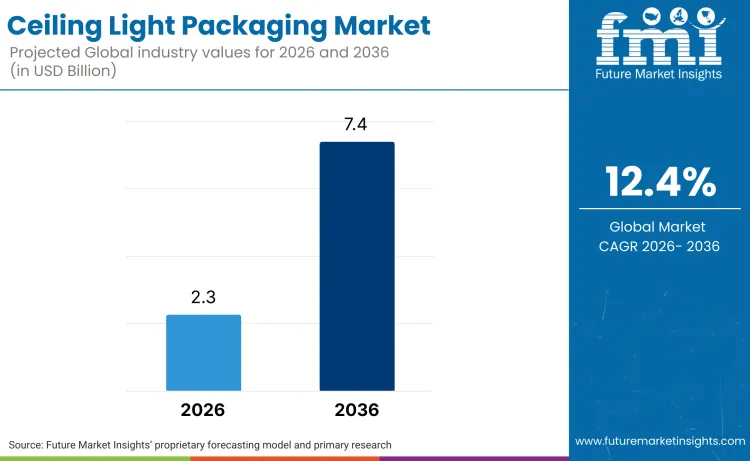
The global ceiling light packaging sector is poised to record a valuation of USD 2.3 billion in 2026, advancing toward USD 7.4 billion by 2036, representing a robust 12.4% CAGR. As per FMI analysis, this robust trajectory is the sustained demand for safe transit solutions; as the complexity of lighting product designs increases, so does the need for specialized protection. The "EPS Exit" will accelerate rapidly between 2026 and 2028. As the EU PPWR fully enforces void-fill reduction and reusability targets, lighting manufacturers (especially for flush mounts and chandeliers) will have no choice but to adopt high-performance molded pulp or mycelium composites.
Leading manufacturers are responding to these signals by restructuring operations to capture value across diverse material types, moving aggressively away from legacy plastics toward fiber-based alternatives that can withstand the rigors of modern logistics. A surge in "hybrid" packaging is observed where structural corrugated board (Smurfit Westrock) is combined with bio-foam inserts (Ecovative) to meet the "Extreme-fragility" requirements without incurring plastic taxes. Emerging markets will lag in bio-material adoption but will lead in "reuse" models due to lower labor costs for reverse logistics, utilizing durable crates for B2B delivery to construction sites.
Major industry players are moving faster than regulation requires to secure their position in a plastic-free future. Tony Smurfit, CEO of the newly formed Smurfit Westrock, emphasized the strategic nature of this material shift in 2024: "We innovate and partner with our customers to create packaging solutions that can replace less sustainable materials and reduce their carbon footprint." Paper-based packaging offers the most versatile and sustainable solution for manufacturers, retailers, and consumers. Such commitment ensures that sustainability targets are treated as immutable operational KPIs rather than optional marketing initiatives
Summary of Ceiling Light Packaging Market
What Is the Growth Outlook for the Ceiling Light Packaging Market as per Future Market Insights Projection?
Future Market Insights projects the global ceiling light packaging industry to grow from USD 2.3 billion in 2026 to USD 7.4 billion by 2036, representing a robust 12.4% CAGR over the forecast period.
FMI Research Approach: Based on FMI’s proprietary global modeling framework incorporating regulatory compliance costs (EU PPWR), e-commerce return rate analysis validating fragility requirements, and industrial capacity assessments informed by recent merger activities in the paper sector.
How Do FMI Analysts Perceive the Ceiling Light Packaging Market to Evolve?
FMI analysts perceive the industry transitioning away from mixed-material boxes and foam inserts toward mono-material corrugated solutions and bio-composites.
FMI Research Approach: Developed using analysis of the European Union's void-fill regulations, examination of material innovation pipelines such as Ranpak’s "Cut'it! EVO," and facility expansion disclosures from integrated fiber manufacturers in Asia and North America.
Which Country Holds the Largest Share in the Global Ceiling Light Packaging Market?
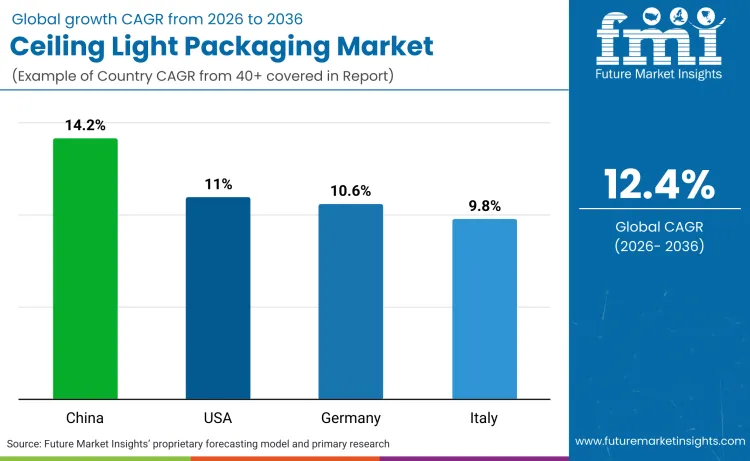
China is projected to lead global expansion with a 14.2% CAGR, driven by massive increases in paper production capacity and a pivot toward export-grade sustainable packaging.
FMI Research Approach: Built using country-level manufacturing output data, analysis of packaging material shifts driven by "Nine Dragons" capacity reports, and mapping of supplier concentration among Asia’s integrated packaging manufacturers.
How Large Will the Ceiling Light Packaging Market Be by 2036?
The global industry is expected to reach USD 7.4 billion by 2036, supported by sustained demand from the high-fragility fixture segment, which currently necessitates advanced cushioning systems.
FMI Research Approach: Long-term forecasts rely on urbanization trends in emerging markets, construction sector growth data supporting lighting fixture installation demand, and channel-specific scaling assumptions for premium e-commerce logistics.
What Is the Definition of the Ceiling Light Packaging Market?
The ceiling light packaging market encompasses all revenue generated from purpose-designed primary and secondary packaging solutions used for protecting and transporting ceiling-mounted lighting fixtures, including chandeliers, flush mounts, and pendant lights. It includes corrugated boxes, molded pulp inserts, foam cushioning, and smart labeling systems, explicitly excluding general household bulb packaging.
FMI Research Approach: Definition structured using FMI’s segmentation taxonomy covering product types, end-use channels, and material compositions. The classification draws from operational inclusion criteria for fragile industrial goods and consumer e-commerce shipments.
What Are Globally Unique Trends Shaping the Ceiling Light Packaging Market?
Globally, the sector is shaped by the "EPS Exit" strategies of major manufacturers and the integration of automated dunnage systems to reduce void fill.
FMI Research Approach: Insights derived from global regulatory tracking (EU PPWR), sustainability performance disclosures from major players like Smurfit Westrock, and assessment of patent filings related to expandable mailers and shock-absorbing liners.
Ceiling Light Packaging Market Key Takeaways
| Metric | Details |
|---|---|
| Industry Size (2026) | USD 2.3 billion |
| Industry Value (2036) | USD 7.4 billion |
| CAGR (2026-2036) | 12.4% |
Source: Future Market Insights (FMI) analysis, based on proprietary forecasting model and primary research.
Why Is the Elimination of Plastic Void Fill Reshaping the Supply Chain?
The enforcement of stringent environmental regulations is forcing a radical redesign of how fragile lighting fixtures are protected during transit. The European Union’s Packaging and Packaging Waste Regulation (PPWR) has altered the compliance landscape by mandating that from January 1, 2030, at least 40% of transport packaging must be reusable within a reuse system. This regulatory pressure is compelling manufacturers to abandon traditional expanded polystyrene (EPS) in favor of advanced protective packaging solutions like molded pulp and mycelium. The urgency is underscored by the fact that inadequate packaging currently wastes 20-50% of goods in developing countries, compared to only 3-5% in developed nations where fit-for-purpose solutions are employed. This disparity highlights the critical need for robust, yet sustainable, material innovation in the global supply chain.
By proactively adopting paper-based alternatives that offer high recycling rates, companies are ensuring their high-fragility lighting products remain viable in strictly regulated regions. This strategy avoids potential market exclusion penalties while appealing to the 66% of global consumers who are now willing to pay more for sustainable goods, effectively turning compliance into a competitive advantage for forward-thinking brands.
How is the Ceiling Light Packaging Market Segmented?
The ceiling light packaging market is segmented across three core dimensions: luminaire type, fragility class, and cushion system. This multi‑layered segmentation reflects the industry's shift toward delivering packaging solutions that can accommodate the diverse structural and material requirements of modern lighting products. As luminaires such as chandeliers, designer fixtures, and glass‑panel downlights become more intricate, packaging must provide enhanced protection against vibration, drops, and compression during increasingly automated logistics processes. By categorizing products based on fragility levels and matching them with engineered cushioning systems, ranging from molded pulp inserts to mycelium composites, the industry ensures that each fixture receives optimized protection. This structured segmentation framework also supports sustainability goals by aligning material choice and structural design with environmental standards, enabling manufacturers to balance durability, recyclability, and cost‑effectiveness in a highly regulated global market.
Why do Flush Mounts dominate the Luminaire Type Segment?
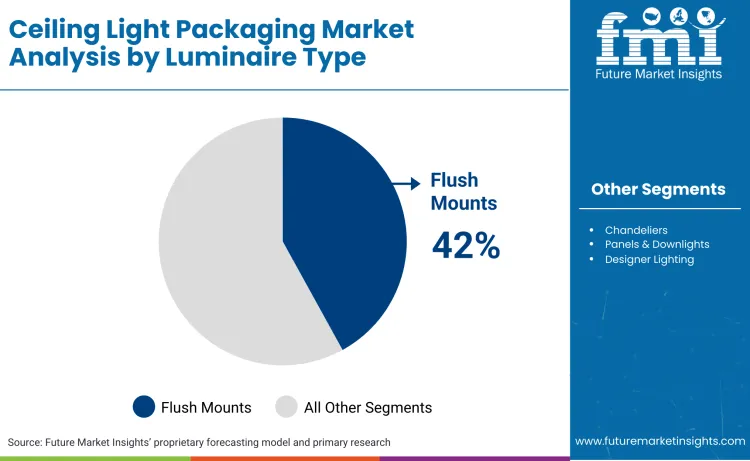
Flush mounts currently command 42% of the sector, serving as the foundational volume driver due to their ubiquity in both residential and commercial construction. These fixtures, often featuring flat glass panels and standardized dimensions, are ideally suited for automated packing lines, which favors the use of high-volume packaging foam alternatives like die-cut corrugated inserts. The sheer volume of flush mount installations in multi-family housing units drives the demand for cost-effective, stackable packaging solutions that minimize shipping volume, a critical factor given that "empty space" is now a regulatory liability in the EU.
Why is High-fragility the leading Fragility Class?
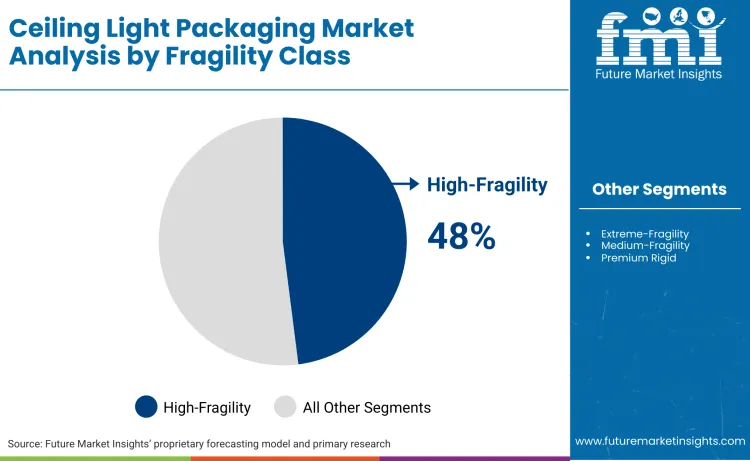
High-fragility items account for 48% of the share, necessitating robust protection that traditional single-wall corrugated board cannot provide on its own. The rising popularity of intricate solid state lighting designs with integrated electronics and glass elements has raised the bar for shock absorption. This segment is the primary battleground for material innovation, where startups like Mushroom Material are deploying mycelium composites to replace EPS. The high breakage rates in e-commerce, where parcels face automated sorting drops, compel manufacturers to invest in "extreme-performance" cushioning to avoid the reverse logistics costs associated with damaged goods.
Why is Molded Pulp the preferred Cushion System?
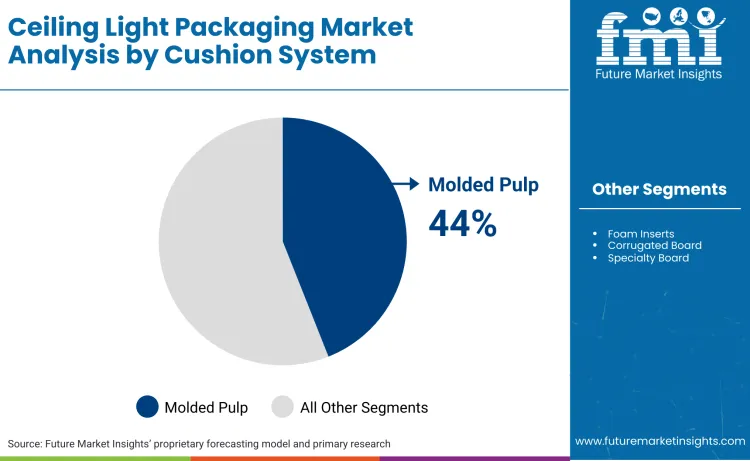
Molded pulp holds a dominant 44% share of the cushioning market, rapidly replacing expanded polystyrene (EPS) as the industry standard. Its dominance is driven by its ability to be precisely engineered to the contours of LED lights, providing superior immobilization and vibration dampening. Unlike plastic foams, molded pulp is universally curbside recyclable, aligning perfectly with the sustainability goals of global retailers. Advancements in "wet press" technology have refined the surface finish of molded pulp, making it suitable for the "unboxing" experience of premium designer lighting brands that previously relied on flock-lined plastic trays.
Why Is the Consolidation of Global Manufacturers Accelerating?
Strategic M&A activity is reshaping the supply chain as leaders seek to unify production capabilities and secure sustainable material sources across continents. The completion of the merger between Smurfit Kappa and WestRock in July 2024 created a trans-Atlantic powerhouse with approximately USD 34 billion in combined revenue, capable of delivering standardized, sustainable solutions at a global scale. This consolidation allows for the uniform deployment of lighting as a service packaging specifications, ensuring that a chandelier sold in Berlin meets the same sustainability criteria as one sold in New York. Smaller regional converters are increasingly facing pressure to compete with these integrated giants who possess the capital to invest in massive recycling infrastructure and secure long-term fiber supplies.
Simultaneously, financial discipline is driving operational restructuring among major protective packaging providers. Sealed Air, for instance, invested USD 220 million in capital expenditures in 2024 to support automation and digital systems but also incurred significant restructuring costs to streamline its portfolio. This focus on efficiency extends to the e-commerce packaging sector, where the integration of digital tools is becoming standard. Innovations like LivingPackets' "The Box," a durable and smart shipping container with electronic locks, highlight the trend toward reusable systems for high-value items. These technologies allow retailers to automate logistics and reduce labor burdens, a critical advantage as the e-commerce packaging sector is expected to grow at a 12% CAGR through 2029.
What is the Regional Outlook for Ceiling Light Packaging Market?
The regional outlook for the ceiling light packaging market shows strong yet distinct growth patterns across major global regions. Asia, particularly China, continues to dominate, driven by rapid urbanization and massive industrial capacity expansion, resulting in a leading CAGR of 14.2%. In contrast, the United States is experiencing steady growth at 11.0% as its e‑commerce sector matures and packaging systems become more automated and efficiency‑driven. Europe shows a different trajectory: markets like Germany (10.6%) and Italy (9.8%) are emphasizing sustainability, retrofitting, and premium design integrity, which is pushing companies toward recyclable materials and higher‑quality protective solutions rather than sheer volume growth. Together, these regional dynamics highlight how economic structure, regulatory pressure, and consumer expectations shape the future of ceiling light packaging around the world.
| Country | CAGR (2026 to 2036) |
|---|---|
| China | 14.2% |
| USA | 11.0% |
| Germany | 10.6% |
| Italy | 9.8% |
Source: FMI historical analysis and forecast data.
Why Is China Leading Global Volume Growth?
China is projected to expand at a 14.2% CAGR, anchored by a massive expansion in industrial paper production capacity. The region is transitioning from a low-cost manufacturing hub to a sophisticated supplier of high-quality fiber materials. Nine Dragons Paper, a bellwether for the sector, reported that its total design production capacity for paper reached 21.67 million tonnes per annum as of June 2024.
Surge in capacity positions China as the primary material source for global LED displays lighting and fixtures packaging exports. The Board of Directors at Nine Dragons Paper noted the economic context in their 2024 report: "In FY2024, the Chinese economy faced the triple pressure of shrinking demand, supply shocks and weakening expectations with a sustained weakness in consumer confidence, which restrained the rebound of sales in the packaging paper industry to a certain extent." Despite these headwinds, the company achieved a turnaround to profitability, ensuring affordable, recycled-content packaging is available for export markets.
Why Is the USA Prioritizing Automation and Efficiency?
The United States is forecast to expand at an 11.0% CAGR, driven by the relentless growth of e-commerce and the need for efficient fulfillment solutions. The market here is defined by a struggle between rising logistics volumes and the need to reduce operational costs. Major players are seeing shifts in demand patterns; for instance, Sealed Air reported a decrease in protective packaging sales in late 2024. This contraction in traditional segments is pushing companies to pivot toward automated and "right-sized" packaging solutions for residential lighting fixtures. Dustin J. Semach, CFO of Sealed Air, highlighted these challenges: "Volumes decreased by $26 million, or 5%, resulting from continued weakness in our industrial and fulfillment portfolios." This signals that American lighting distributors will increasingly adopt smart, automated packaging lines that custom-fit boxes to fixtures on demand.
Why Is Germany Focusing on Sustainable Retrofitting?
Germany is anticipated to grow at a 10.6% CAGR, reflecting a stringent focus on sustainability and energy efficiency in building materials. The demand for modular packaging that can be easily recycled is high, driven by EU Green Deal regulations. With strict laws regarding void fill and material recovery, German manufacturers of panels and downlights are aggressively adopting corrugated board solutions over plastic. This region serves as the testing ground for "circular" packaging models, where the responsibility for packaging waste is increasingly shifted back to the producer, fostering innovation in reusable crates and heavy-duty paperboard crates for commercial lighting projects.
Why Is Italy Focusing on Premium and Luxury Resilience?
Italy is anticipated to grow at a 9.8% CAGR, reflecting a market deeply rooted in high-end design and luxury manufacturing. The demand here is for high-end lighting packaging that offers an unboxing experience commensurate with the product's value. Companies like Fedrigoni are leading this niche, executing strategic acquisitions to enhance their capabilities in special papers. Marco Nespolo, CEO of Fedrigoni, commented in 2024: " Despite a complex and volatile global environment, Fedrigoni has proved remarkable resilience and adaptability. Our commitment to our long-term strategy and our ability to navigate through uncertainty have been key. 2024 saw a first half of the year with a good recovery" This suggests the Italian market will continue to prioritize quality over pure volume. This focus on premium materials ensures that Italian designer lighting retains its brand equity during transit.
How Is Competition Evolving in the Ceiling Light Packaging Market?
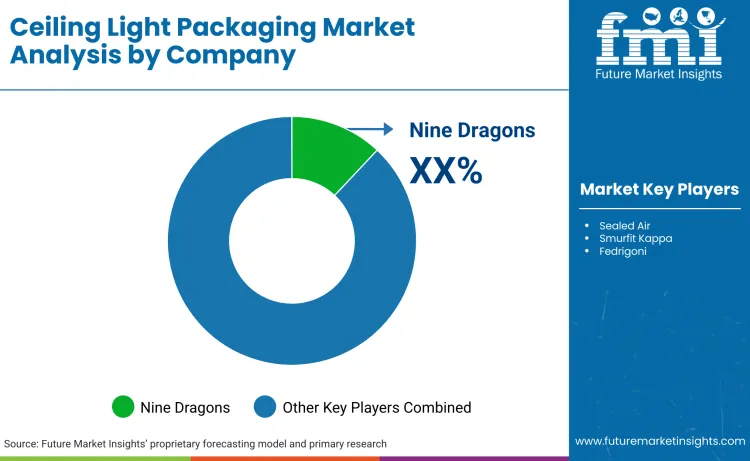
The competitive outlook is driven by a wave of strategic consolidation and operational optimization as major players seek to defend margins in a high-cost environment. The 2024 merger of Smurfit Kappa and WestRock fundamentally altered the supply chain by creating a fiber-based powerhouse capable of servicing global wireless lighting providers with uniform, plastic-free solutions. This move forces smaller regional converters to specialize or merge to survive.
Innovation is also a key differentiator; Ranpak’s focus on "physical AI" and robotics aims to bring packaging efficiency to the next level for end-of-line fulfillment, directly addressing labor shortages in warehouses. Companies are focusing on intellectual property to secure their footing; Ranpak secured multiple patents in 2024, including one for an expandable padded mailer, positioning itself as a leader in flexible protection for fragile items. Meanwhile, Nine Dragons Paper has aggressively expanded capacity to over 21 million tonnes, leveraging scale to dominate the Asian export market.
Recent Developments:
- In April 2025, Amcor completed its $10.4 billion all-stock merger with Berry Global, creating a global leader in consumer packaging with enhanced capabilities in flexible and rigid solutions. This strengthens Amcor's offerings in the ceiling light packaging market by integrating Berry's expertise in protective closures and films, improving durability and sustainability for shipping and retail of lighting fixtures.
- In April 2025, Toppan Holdings Inc. completed the acquisition of Sonoco's Thermoformed & Flexibles Packaging (TFP) business, enhancing its capabilities in sustainable packaging formats. This development advances protective solutions in the ceiling light packaging market, incorporating thermoformed trays and flexible barriers to reduce damage during transport and improve eco-friendly options for lighting products.
Key Players in Ceiling Light Packaging Market
- Smurfit Westrock
- Nine Dragons Paper
- Sealed Air Corporation
- Ranpak Holdings Corp.
- DS Smith
- Fedrigoni
- Pregis Corporation
- Mushroom Material
- Ecovative
- LivingPackets
Market Definition
The ceiling light packaging market is defined as the aggregate of commercial activities related to the design, manufacturing, distribution, and sale of material coverings applied to protect ceiling-mounted lighting fixtures during transit. It encompasses a diverse range of products including corrugated boxes, die-cut inserts, molded pulp trays, and foam cushioning. The market value is derived from the manufacturer-level revenue generated from the sale of these goods to lighting manufacturers, e-commerce fulfillment centers, and industrial distributors. The market is characterized by its dual role in providing structural integrity for high-fragility items like glass chandeliers and ensuring compliance with sustainability mandates.
The scope explicitly includes revenue from the sale of primary and secondary packaging materials. It covers sustainable alternatives such as mycelium composites and recycled paperboard, as well as smart labeling systems (RFID) when integrated into the packaging. The market excludes general household bulb packaging sold independently of a fixture and raw material extraction industries unless vertically integrated.
Scope of Report
| Items | Values |
|---|---|
| Quantitative Units (2026) | USD 2.3 Billion |
| Product Type | Corrugated Boxes, Molded Pulp Inserts, Foam Cushions, Smart Labels, Flexible Mailers |
| Fragility Class | High-fragility (48%), Extreme-fragility, Medium-fragility |
| Cushion System | Molded Pulp (44%), Foam Inserts, Corrugated Board, Mycelium Composites |
| Luminaire Type | Flush Mounts (42%), Chandeliers, Panels & Downlights, Designer Lighting |
| Regions Covered | North America, Europe, Asia Pacific, Latin America, Middle East & Africa |
| Countries Covered | China, United States, Germany, Italy |
| Key Companies Profiled | Smurfit Westrock, Nine Dragons, Sealed Air, Ranpak, Fedrigoni |
| Additional Attributes | Revenue and volume analysis by luminaire type, channel-wise demand assessment across e-commerce and retail, material mix optimization, recyclability compliance analysis (EU PPWR), and competitive positioning across global lighting brands. |
Ceiling Light Packaging Market by Segments
By Luminaire Type:
- Flush Mounts
- Chandeliers
- Panels & Downlights
- Designer Lighting
By Fragility Class:
- High-fragility
- Extreme-fragility
- Medium-fragility
- Premium Rigid
By Cushion System:
- Molded Pulp
- Foam Inserts
- Corrugated Board
- Specialty Board/Mycelium
By Region:
- North America
- Europe
- Asia Pacific
- Latin America
- Middle East & Africa
Bibliography
- European Directorate for the Quality of Medicines & HealthCare (EDQM). (2024). Technical guidance on materials used for primary pharmaceutical packaging. Council of Europe.
- USA Pharmacopeia. (2024). USP <661.1> and <661.2>: Plastic materials of construction and packaging systems for pharmaceuticals. USP.
- European Committee for Standardization. (2023). EN 13430: Packaging - Requirements for packaging recoverable by material recycling. CEN.
- ASTM International. (2024). ASTM D6868: Biodegradable plastics used as coatings on paperboard packaging. ASTM.
- German Federal Institute for Risk Assessment (BfR). (2024). Recommendations on paper and board for food contact. BfR.
- French Agency for Food, Environmental and Occupational Health & Safety (ANSES). (2024). Safety of recycled paper and board in food packaging. ANSES.
- Health and Safety Executive. (2024). Packaging and contamination control in sterile product handling environments. HSE UK.
- United Nations Industrial Development Organization. (2024). Resource efficiency and circular material use in packaging-intensive industries. UNIDO.
- International Atomic Energy Agency. (2023). Radiation sterilization of medical products and packaging materials. IAEA.
Frequently Asked Questions
What is the current global market size for Ceiling Light Packaging?
The global market is valued at USD 2.3 billion in 2026, driven by the increasing complexity of lighting fixtures and e-commerce demand.
What is the projected CAGR for the Ceiling Light Packaging market?
The market is projected to grow at a robust 12.4% CAGR from 2026 to 2036, reaching USD 7.4 billion.
Which product segment dominates the market?
Flush mounts hold the largest share at 42%, serving as the foundational volume driver due to their ubiquity in residential and commercial construction.
Which country is experiencing the fastest growth?
China is growing at the fastest rate of 14.2%, fueled by massive investments in paper production capacity and export manufacturing.
Who are the leading players in the Ceiling Light Packaging market?
Smurfit Westrock leads the sector following its major merger, alongside key players like Nine Dragons Paper, Sealed Air, and Ranpak.
Preview the report firsthand - request a free sample
Get SampleGet the brochure for pricing and purchase details.
Get PDFTable of Content
- Executive Summary
- Global Market Outlook
- Demand Side Trends
- Supply Side Trends
- Technology Roadmap Analysis
- Analysis and Recommendations
- Market Overview
- Market Coverage / Taxonomy
- Market Definition / Scope / Limitations
- Research Methodology
- Chapter Orientation
- Analytical Lens and Working Hypotheses
- Market Structure, Signals, and Trend Drivers
- Benchmarking and Cross-market Comparability
- Market Sizing, Forecasting, and Opportunity Mapping
- Research Design and Evidence Framework
- Desk Research Programme (Secondary Evidence)
- Company Annual and Sustainability Reports
- Peer-reviewed Journals and Academic Literature
- Corporate Websites, Product Literature, and Technical Notes
- Earnings Decks and Investor Briefings
- Statutory Filings and Regulatory Disclosures
- Technical White Papers and Standards Notes
- Trade Journals, Industry Magazines, and Analyst Briefs
- Conference Proceedings, Webinars, and Seminar Materials
- Government Statistics Portals and Public Data Releases
- Press Releases and Reputable Media Coverage
- Specialist Newsletters and Curated Briefings
- Sector Databases and Reference Repositories
- FMI Internal Knowledge Base and Historical Datasets
- Subscription Datasets and Paid Sources
- Social Channels, Communities, and Digital Listening Inputs
- Additional Desk Sources
- Expert Input and Fieldwork (Primary Evidence)
- Primary Modes
- Qualitative Interviews and Expert Elicitation
- Quantitative Surveys and Structured Data Capture
- Blended Approach
- Why Primary Evidence is Used
- Field Techniques
- Interviews
- Surveys
- Focus Groups
- Observational and In-context Research
- Social and Community Interactions
- Stakeholder Universe Engaged
- C-suite Leaders
- Board Members
- Presidents and Vice Presidents
- R&D and Innovation Heads
- Technical Specialists
- Domain Subject-matter Experts
- Scientists
- Physicians and Other Healthcare Professionals
- Governance, Ethics, and Data Stewardship
- Research Ethics
- Data Integrity and Handling
- Primary Modes
- Tooling, Models, and Reference Databases
- Desk Research Programme (Secondary Evidence)
- Data Engineering and Model Build
- Data Acquisition and Ingestion
- Cleaning, Normalisation, and Verification
- Synthesis, Triangulation, and Analysis
- Quality Assurance and Audit Trail
- Market Background
- Market Dynamics
- Drivers
- Restraints
- Opportunity
- Trends
- Scenario Forecast
- Demand in Optimistic Scenario
- Demand in Likely Scenario
- Demand in Conservative Scenario
- Opportunity Map Analysis
- Product Life Cycle Analysis
- Supply Chain Analysis
- Investment Feasibility Matrix
- Value Chain Analysis
- PESTLE and Porter's Analysis
- Regulatory Landscape
- Regional Parent Market Outlook
- Production and Consumption Statistics
- Import and Export Statistics
- Market Dynamics
- Global Market Analysis 2021 to 2025 and Forecast, 2026 to 2036
- Historical Market Size Value (USD Billion) Analysis, 2021 to 2025
- Current and Future Market Size Value (USD Billion) Projections, 2026 to 2036
- Y-o-Y Growth Trend Analysis
- Absolute $ Opportunity Analysis
- Global Market Pricing Analysis 2021 to 2025 and Forecast 2026 to 2036
- Y-o-Y Growth Trend Analysis 2021 to 2025
- Absolute $ Opportunity Analysis 2026 to 2036
- Global Market Analysis 2021 to 2025 and Forecast 2026 to 2036, By Luminaire Type
- Introduction / Key Findings
- Historical Market Size Value (USD Billion) Analysis By Luminaire Type, 2021 to 2025
- Current and Future Market Size Value (USD Billion) Analysis and Forecast By Luminaire Type, 2026 to 2036
- Flush Mounts
- Chandeliers
- Panels & Downlights
- Designer Lighting
- Y-o-Y Growth Trend Analysis By Luminaire Type, 2021 to 2025
- Absolute $ Opportunity Analysis By Luminaire Type, 2026 to 2036
- Global Market Analysis 2021 to 2025 and Forecast 2026 to 2036, By Fragility Class
- Introduction / Key Findings
- Historical Market Size Value (USD Billion) Analysis By Fragility Class, 2021 to 2025
- Current and Future Market Size Value (USD Billion) Analysis and Forecast By Fragility Class, 2026 to 2036
- High-fragility
- Extreme-fragility
- Medium-fragility
- Premium Rigid
- Y-o-Y Growth Trend Analysis By Fragility Class, 2021 to 2025
- Absolute $ Opportunity Analysis By Fragility Class, 2026 to 2036
- Global Market Analysis 2021 to 2025 and Forecast 2026 to 2036, By Cushion System
- Introduction / Key Findings
- Historical Market Size Value (USD Billion) Analysis By Cushion System, 2021 to 2025
- Current and Future Market Size Value (USD Billion) Analysis and Forecast By Cushion System, 2026 to 2036
- Molded Pulp
- Foam Inserts
- Corrugated Board
- Specialty Board/Mycelium
- Y-o-Y Growth Trend Analysis By Cushion System, 2021 to 2025
- Absolute $ Opportunity Analysis By Cushion System, 2026 to 2036
- Global Market Analysis 2021 to 2025 and Forecast 2026 to 2036, By Region
- Introduction
- Historical Market Size Value (USD Billion) Analysis By Region, 2021 to 2025
- Current Market Size Value (USD Billion) Analysis and Forecast By Region, 2026 to 2036
- North America
- Latin America
- Western Europe
- Eastern Europe
- East Asia
- South Asia and Pacific
- Middle East & Africa
- Market Attractiveness Analysis By Region
- North America Market Analysis 2021 to 2025 and Forecast 2026 to 2036, By Country
- Historical Market Size Value (USD Billion) Trend Analysis By Market Taxonomy, 2021 to 2025
- Market Size Value (USD Billion) Forecast By Market Taxonomy, 2026 to 2036
- By Country
- USA
- Canada
- Mexico
- By Luminaire Type
- By Fragility Class
- By Cushion System
- By Country
- Market Attractiveness Analysis
- By Country
- By Luminaire Type
- By Fragility Class
- By Cushion System
- Key Takeaways
- Latin America Market Analysis 2021 to 2025 and Forecast 2026 to 2036, By Country
- Historical Market Size Value (USD Billion) Trend Analysis By Market Taxonomy, 2021 to 2025
- Market Size Value (USD Billion) Forecast By Market Taxonomy, 2026 to 2036
- By Country
- Brazil
- Chile
- Rest of Latin America
- By Luminaire Type
- By Fragility Class
- By Cushion System
- By Country
- Market Attractiveness Analysis
- By Country
- By Luminaire Type
- By Fragility Class
- By Cushion System
- Key Takeaways
- Western Europe Market Analysis 2021 to 2025 and Forecast 2026 to 2036, By Country
- Historical Market Size Value (USD Billion) Trend Analysis By Market Taxonomy, 2021 to 2025
- Market Size Value (USD Billion) Forecast By Market Taxonomy, 2026 to 2036
- By Country
- Germany
- UK
- Italy
- Spain
- France
- Nordic
- BENELUX
- Rest of Western Europe
- By Luminaire Type
- By Fragility Class
- By Cushion System
- By Country
- Market Attractiveness Analysis
- By Country
- By Luminaire Type
- By Fragility Class
- By Cushion System
- Key Takeaways
- Eastern Europe Market Analysis 2021 to 2025 and Forecast 2026 to 2036, By Country
- Historical Market Size Value (USD Billion) Trend Analysis By Market Taxonomy, 2021 to 2025
- Market Size Value (USD Billion) Forecast By Market Taxonomy, 2026 to 2036
- By Country
- Russia
- Poland
- Hungary
- Balkan & Baltic
- Rest of Eastern Europe
- By Luminaire Type
- By Fragility Class
- By Cushion System
- By Country
- Market Attractiveness Analysis
- By Country
- By Luminaire Type
- By Fragility Class
- By Cushion System
- Key Takeaways
- East Asia Market Analysis 2021 to 2025 and Forecast 2026 to 2036, By Country
- Historical Market Size Value (USD Billion) Trend Analysis By Market Taxonomy, 2021 to 2025
- Market Size Value (USD Billion) Forecast By Market Taxonomy, 2026 to 2036
- By Country
- China
- Japan
- South Korea
- By Luminaire Type
- By Fragility Class
- By Cushion System
- By Country
- Market Attractiveness Analysis
- By Country
- By Luminaire Type
- By Fragility Class
- By Cushion System
- Key Takeaways
- South Asia and Pacific Market Analysis 2021 to 2025 and Forecast 2026 to 2036, By Country
- Historical Market Size Value (USD Billion) Trend Analysis By Market Taxonomy, 2021 to 2025
- Market Size Value (USD Billion) Forecast By Market Taxonomy, 2026 to 2036
- By Country
- India
- ASEAN
- Australia & New Zealand
- Rest of South Asia and Pacific
- By Luminaire Type
- By Fragility Class
- By Cushion System
- By Country
- Market Attractiveness Analysis
- By Country
- By Luminaire Type
- By Fragility Class
- By Cushion System
- Key Takeaways
- Middle East & Africa Market Analysis 2021 to 2025 and Forecast 2026 to 2036, By Country
- Historical Market Size Value (USD Billion) Trend Analysis By Market Taxonomy, 2021 to 2025
- Market Size Value (USD Billion) Forecast By Market Taxonomy, 2026 to 2036
- By Country
- Kingdom of Saudi Arabia
- Other GCC Countries
- Turkiye
- South Africa
- Other African Union
- Rest of Middle East & Africa
- By Luminaire Type
- By Fragility Class
- By Cushion System
- By Country
- Market Attractiveness Analysis
- By Country
- By Luminaire Type
- By Fragility Class
- By Cushion System
- Key Takeaways
- Key Countries Market Analysis
- USA
- Pricing Analysis
- Market Share Analysis, 2026
- By Luminaire Type
- By Fragility Class
- By Cushion System
- Canada
- Pricing Analysis
- Market Share Analysis, 2026
- By Luminaire Type
- By Fragility Class
- By Cushion System
- Mexico
- Pricing Analysis
- Market Share Analysis, 2026
- By Luminaire Type
- By Fragility Class
- By Cushion System
- Brazil
- Pricing Analysis
- Market Share Analysis, 2026
- By Luminaire Type
- By Fragility Class
- By Cushion System
- Chile
- Pricing Analysis
- Market Share Analysis, 2026
- By Luminaire Type
- By Fragility Class
- By Cushion System
- Germany
- Pricing Analysis
- Market Share Analysis, 2026
- By Luminaire Type
- By Fragility Class
- By Cushion System
- UK
- Pricing Analysis
- Market Share Analysis, 2026
- By Luminaire Type
- By Fragility Class
- By Cushion System
- Italy
- Pricing Analysis
- Market Share Analysis, 2026
- By Luminaire Type
- By Fragility Class
- By Cushion System
- Spain
- Pricing Analysis
- Market Share Analysis, 2026
- By Luminaire Type
- By Fragility Class
- By Cushion System
- France
- Pricing Analysis
- Market Share Analysis, 2026
- By Luminaire Type
- By Fragility Class
- By Cushion System
- India
- Pricing Analysis
- Market Share Analysis, 2026
- By Luminaire Type
- By Fragility Class
- By Cushion System
- ASEAN
- Pricing Analysis
- Market Share Analysis, 2026
- By Luminaire Type
- By Fragility Class
- By Cushion System
- Australia & New Zealand
- Pricing Analysis
- Market Share Analysis, 2026
- By Luminaire Type
- By Fragility Class
- By Cushion System
- China
- Pricing Analysis
- Market Share Analysis, 2026
- By Luminaire Type
- By Fragility Class
- By Cushion System
- Japan
- Pricing Analysis
- Market Share Analysis, 2026
- By Luminaire Type
- By Fragility Class
- By Cushion System
- South Korea
- Pricing Analysis
- Market Share Analysis, 2026
- By Luminaire Type
- By Fragility Class
- By Cushion System
- Russia
- Pricing Analysis
- Market Share Analysis, 2026
- By Luminaire Type
- By Fragility Class
- By Cushion System
- Poland
- Pricing Analysis
- Market Share Analysis, 2026
- By Luminaire Type
- By Fragility Class
- By Cushion System
- Hungary
- Pricing Analysis
- Market Share Analysis, 2026
- By Luminaire Type
- By Fragility Class
- By Cushion System
- Kingdom of Saudi Arabia
- Pricing Analysis
- Market Share Analysis, 2026
- By Luminaire Type
- By Fragility Class
- By Cushion System
- Turkiye
- Pricing Analysis
- Market Share Analysis, 2026
- By Luminaire Type
- By Fragility Class
- By Cushion System
- South Africa
- Pricing Analysis
- Market Share Analysis, 2026
- By Luminaire Type
- By Fragility Class
- By Cushion System
- USA
- Market Structure Analysis
- Competition Dashboard
- Competition Benchmarking
- Market Share Analysis of Top Players
- By Regional
- By Luminaire Type
- By Fragility Class
- By Cushion System
- Competition Analysis
- Competition Deep Dive
- Smurfit Westrock
- Nine Dragons Paper
- Sealed Air Corporation
- Ranpak Holdings Corp.
- DS Smith
- Fedrigoni
- Pregis Corporation
- Mushroom Material
- Ecovative
- LivingPackets
- Competition Deep Dive
- Assumptions & Acronyms Used


