

- Industry Size (2026)
- USD 740.0 Mn
- Forecast (2036)
- USD 1497.0 Mn
- CAGR (2026 to 2036)
- 7.3%
Constrained-Layer Damping Tiles Market Forecast and Outlook 2026 to 2036
The constrained-layer damping tiles market is likely to be valued at USD 740.0 million in 2026 and reach USD 1,497.0 million by 2036, expanding at a CAGR of 7.3%. Value formation is closely linked to how vibration and structure-borne noise are increasingly managed through material-level intervention rather than structural redesign. Constrained-layer damping tiles are specified where lightweight panels, floor systems, and enclosures exhibit resonance under mechanical excitation, creating noise and performance degradation. Demand concentrates in buildings and facilities housing elevators, HVAC systems, generators, data infrastructure, and precision equipment, where low-frequency vibration control is essential.
Summary of Constrained-layer Damping Tiles Market
- Market Snapshot
- The constrained-layer damping tiles market is valued at USD 740.0 million in 2026.
- The constrained-layer damping tiles market is projected to reach USD 1,497.0 million by 2036.
- The market is expanding at a CAGR of 7.3% during 2026 to 2036.
- Demand and Growth Drivers
- Rising need for vibration and structure-borne noise control in equipment-heavy buildings is driving adoption.
- Increasing use of lightweight construction materials is amplifying resonance issues requiring damping solutions.
- Growth in retrofit projects is supporting demand due to ease of selective installation without structural redesign.
- Product and Segment View
- Self-adhesive CLD tiles hold 54.0% share driven by ease of installation and consistent performance.
- Building and architectural damping accounts for 36.0% share due to widespread panel resonance control needs.
- Industrial distributors represent 34.0% share supported by established procurement networks and inventory availability.
- Geography and Competitive Outlook
- India leads growth at 9.1% CAGR followed by Vietnam at 8.6% and Indonesia at 8.2%.
- China and Mexico grow at 7.6% and 7.1% respectively driven by infrastructure and industrial demand.
- Key companies include 3M, Trelleborg, Henkel, Nitto Denko, Parker LORD, Hutchinson, Saint-Gobain, Rogers Corporation, and Sika.
Specification decisions depend on loss factor stability, shear behavior across temperature ranges, and adhesion reliability, since damping performance must remain consistent over long service lives. Cost behavior reflects targeted application at vibration hotspots rather than broad surface coverage, placing emphasis on predictable performance and installation efficiency rather than volume-driven pricing.
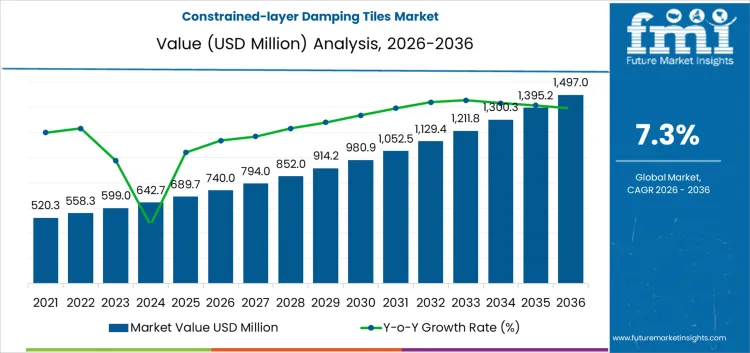
Operational sensitivity to vibration increasingly exposes shortcomings of conventional insulation, reshaping procurement priorities toward damping solutions that act directly on structural response. Lightweight construction methods and compact mechanical layouts intensify resonance risk, particularly in commercial and institutional projects. Retrofit activity adds momentum, as damping tiles can be applied selectively without altering structural geometry. Constraints persist around material cost, added weight, and temperature-dependent behavior, limiting indiscriminate use. Performance outcomes remain highly dependent on correct placement and bonding quality, increasing reliance on technical guidance during installation.
Supplier advantage favors those offering validated test data, consistent material properties, and compatibility with common substrates. Distribution aligns with industrial supply channels and specialist contractors rather than general building finishes. Expansion remains anchored in functional vibration mitigation requirements tied to equipment operation, occupant comfort, and compliance, positioning constrained-layer damping tiles as engineered control elements rather than standard acoustic finishes.
Constrained-Layer Damping Tiles Market Key Takeaways
| Metric | Value |
|---|---|
| Market Value (2026) | USD 740.0 million |
| Market Forecast Value (2036) | USD 1,497.0 million |
| Forecast CAGR 2026 to 2036 | 7.3% |
Why is the Demand for Constrained-Layer Damping Tiles Growing?
Demand for constrained-layer damping tiles is increasing as building designers and mechanical engineers seek effective vibration and noise control solutions in structures with high mechanical equipment activity and human occupancy sensitivity. Constrained-layer damping (CLD) tiles consist of viscoelastic materials bonded between stiff layers, enabling conversion of vibrational energy into heat and reducing structural borne noise transmission through walls, floors, ceilings, and enclosures. Architects specify CLD tiles where reduction of low-frequency vibration and rattles is critical, such as near mechanical rooms, elevator shafts, HVAC zones, and studio or performance spaces where conventional insulation cannot address dynamic excitation.
Procurement teams assess loss factor performance, shear modulus stability, and dimensional tolerances because tiles must maintain consistent damping properties across expected temperature ranges and sustain compressive loads without permanent deformation. Growth in high-activity commercial buildings, mixed-use developments, and institutional facilities reinforces need for CLD solutions that integrate with conventional acoustic and structural assemblies to achieve targeted comfort and compliance outcomes.
Expansion of advanced interior environments such as broadcast studios, healthcare imaging suites, and precision manufacturing plants further supports uptake of constrained-layer damping tiles because these environments demand reliable control of equipment-induced vibration that affects sensitive operations. Facility planners prioritize installation ease and long-term stability in maintenance planning because consistent damping over the full service life reduces operational disruptions and retrofit requirements.
Advances in viscoelastic polymers and bond integrity improve performance consistency, enabling tiles to retain damping characteristics after repeated load cycles. Coordination between structural designers, mechanical contractors, and acoustic consultants ensures that CLD tile placement supports integrated vibration control strategies without compromising adjacent system performance. These application-specific functional and integration considerations are contributing to sustained demand growth in the constrained-layer damping tiles market.
How Are the Segments Classified in the Constrained-Layer Damping Tiles Market?
Demand for constrained-layer damping tiles is shaped by vibration control requirements, structure-borne noise mitigation needs, and durability expectations across engineered surfaces. These products are applied to reduce resonance and energy transmission in panels and enclosures. Adoption aligns with stricter noise control standards, equipment longevity goals, and increased use of lightweight structural materials. Product selection prioritizes damping efficiency, installation practicality, and surface compatibility. Segment classification reflects differentiation by product format, application environment, and sales channel, each influencing installation scale, performance consistency, and procurement behavior.
By Product Format, Self-Adhesive CLD Tiles Hold the Largest Share
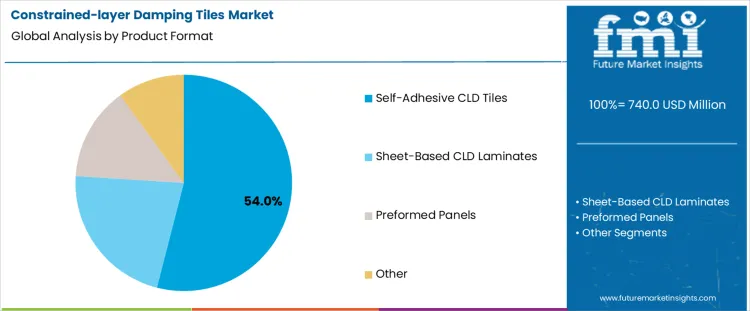
Self-adhesive CLD tiles hold 54.0%, representing the largest share due to ease of installation and consistent damping performance. Integrated adhesive layers enable direct application to metal or composite panels without additional bonding agents. Uniform thickness supports predictable vibration attenuation across treated surfaces. Installation speed reduces labor requirements in both retrofit and new installations. Sheet-based CLD laminates support larger surface coverage with added handling complexity. Preformed panels address specific geometries with lower flexibility. Product format segmentation reflects preference for solutions that combine reliable damping behavior with fast deployment and minimal surface preparation.
Key Points
- Self-adhesive tiles simplify installation processes.
- Uniform construction supports predictable damping outcomes.
- Other formats address large surfaces or fixed geometries.
By Application, Building and Architectural Damping Accounts for the Highest Share
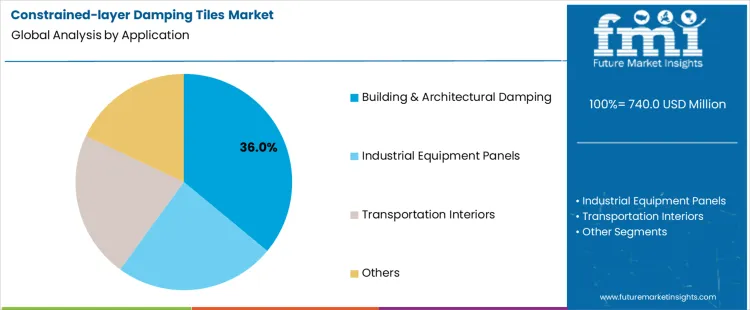
Building and architectural damping holds 36.0%, representing the largest share due to widespread panel resonance control needs. Wall systems, façades, and partitions benefit from added damping to limit vibration-induced noise. Lightweight construction methods increase susceptibility to resonance, elevating demand for damping layers. Consistent surface areas support scalable tile application. Industrial equipment panels apply damping to reduce operational noise with moderate volume. Transportation interiors require lightweight solutions with strict performance constraints. Application segmentation reflects concentration where surface availability, regulatory noise limits, and occupant comfort requirements converge.
Key Points
- Architectural panels require resonance control.
- Lightweight structures increase damping necessity.
- Other applications apply tiles for equipment or vehicle interiors.
By Sales Channel, Industrial Distributors Represent the Leading Share
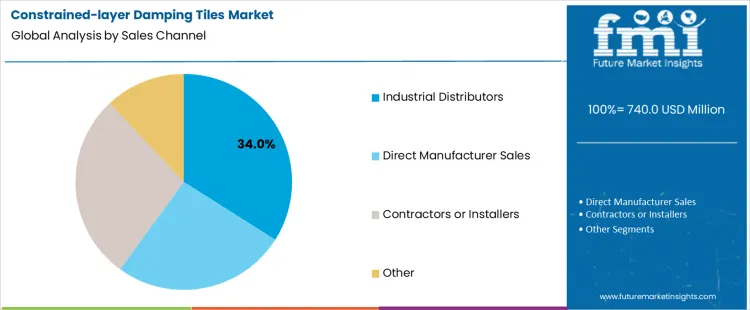
Industrial distributors hold 34.0%, representing the largest share due to established procurement networks. Distributors supply standardized damping products to diverse end users with consistent availability. Stocked inventory supports rapid fulfillment for maintenance and retrofit projects. Technical support and specification alignment aid product selection. Contractors and installers source products directly for project-based needs with comparable volume. Direct manufacturer sales address customized requirements and large orders. Sales channel segmentation reflects reliance on distribution networks where availability, technical familiarity, and procurement efficiency support widespread adoption.
Key Points
- Stocked inventory supports rapid project execution.
- Other channels serve customized or project-specific needs.
What are the Key Dynamics in the Constrained-Layer Damping Tiles Market?
Demand for constrained-layer damping tiles reflects vibration and structure-borne noise control requirements in buildings, transportation interiors, and industrial enclosures. Adoption concentrates in commercial buildings, data centers, studios, rail vehicles, and machinery rooms where low-frequency vibration affects performance or comfort. Global scope aligns with acoustic compliance and equipment isolation needs. Usage centers on multilayer tiles combining viscoelastic cores with rigid constraining layers to dissipate vibrational energy.
How do vibration attenuation requirements and system integration shape adoption?
Vibration transmitted through floors and panels degrades acoustic performance and equipment reliability. Demand increases where low-frequency vibration cannot be addressed by absorptive materials alone. Constrained-layer damping tiles convert mechanical energy into heat through shear deformation of viscoelastic layers. Data centers adopt tiles to limit vibration transfer to sensitive IT racks and rotating equipment. Rail and transit interiors use tiles to reduce panel resonance and cabin noise. Industrial enclosures rely on damping tiles to control machinery-induced vibration without increasing mass excessively. Tile-based formats support modular installation and targeted placement at vibration hotspots. Adoption reflects requirement for predictable damping performance integrated within space-constrained assemblies.
How do material performance limits, installation sensitivity, and cost pressure influence market scalability?
Damping effectiveness depends on viscoelastic material properties that vary with temperature and frequency. Demand sensitivity rises where operating conditions fall outside optimal damping ranges. Installation quality affects layer bonding and contact pressure, influencing real-world performance. Added weight and thickness constrain use in retrofit projects with structural limits. Material cost remains higher than basic acoustic treatments, affecting budget-driven projects. Long-term aging and creep alter damping behavior over time. Fire and emissions compliance add formulation and certification burden. Project-specific tuning and testing requirements limit standardization, constraining scalable deployment across cost-sensitive construction and industrial programs.
How Is Demand for Constrained-Layer Damping Tiles Evolving Globally?
Demand for constrained-layer damping tiles is expanding globally due to vibration control requirements, structural noise mitigation, and performance-led building specifications. Adoption aligns with commercial buildings, industrial facilities, transport infrastructure, and institutional projects requiring reduction of structure-borne noise. Retrofit activity rises where mechanical vibration and footfall noise exceed acceptable thresholds. Material selection emphasizes damping efficiency, durability, and compatibility with substrates. Growth rates in India at 9.1%, Vietnam at 8.6%, Indonesia at 8.2%, China at 7.6%, and Mexico at 7.1% indicate strong expansion driven by urban construction intensity, infrastructure upgrades, and functional noise control needs rather than aesthetic flooring preferences.
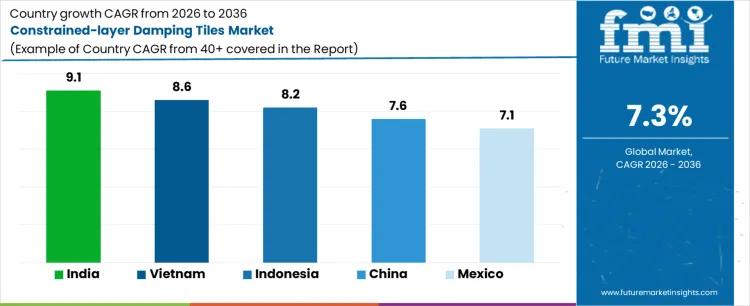
| Country | CAGR (%) |
|---|---|
| India | 9.1% |
| Vietnam | 8.6% |
| Indonesia | 8.2% |
| China | 7.6% |
| Mexico | 7.1% |
What Is Driving Strong Growth of Constrained-Layer Damping Tile Demand in India?
Demand for constrained-layer damping tiles in India is growing at a CAGR of 9.1%, supported by rapid infrastructure development and vibration-sensitive facilities. Metro stations, data centers, and industrial buildings require effective control of structure-borne noise. High-rise commercial projects specify damping layers to manage mechanical equipment vibration. Urban density increases sensitivity to vibration transmission between floors. Retrofit demand emerges from operational complaints and compliance reviews. Domestic manufacturing improves access to standardized damping solutions. Growth reflects infrastructure-led specifications and functional vibration control requirements rather than decorative interior applications.
- Metro and transit infrastructure vibration control
- Mechanical equipment noise mitigation needs
- High-rise commercial floor vibration management
- Compliance-driven retrofit installations
Why Is Vietnam Experiencing Rapid Uptake of Constrained-Layer Damping Tiles?
Constrained-layer damping tile demand in Vietnam is expanding at a CAGR of 8.6%, driven by industrial parks and commercial construction. Manufacturing facilities require vibration damping to protect equipment and improve worker conditions. Office buildings adopt damping systems to control footfall noise in multi-storey layouts. Urban redevelopment increases focus on building performance standards. Local suppliers expand availability of modular damping tile systems. Growth reflects industrial usage intensity and commercial construction activity rather than residential flooring upgrades.
- Industrial facility equipment vibration reduction
- Multi-storey office footfall noise control
- Urban redevelopment performance standards
- Improved access to modular damping systems
How Is Indonesia Supporting Growth in Constrained-Layer Damping Tile Sales?
Sales of constrained-layer damping tiles in Indonesia are growing at a CAGR of 8.2%, shaped by institutional buildings and transport infrastructure. Airports, hospitals, and government facilities require vibration isolation for sensitive zones. High ambient noise and vibration from urban activity increased reliance on damping layers. Educational facilities specify damping tiles for laboratories and technical rooms. Budget discipline favors standardized products with certified damping performance. Growth reflects institutional demand and functional vibration management rather than broad residential adoption.
- Airport and hospital vibration isolation needs
- Urban activity-induced structure-borne noise
- Laboratory and technical room specifications
- Preference for certified standardized products
What Factors Are Driving Constrained-Layer Damping Tile Demand in China?
Constrained-layer damping tile demand in China is expanding at a CAGR of 7.6%, supported by infrastructure modernization and high-density construction. Rail projects, commercial towers, and industrial plants require vibration control within structural assemblies. Proximity of mechanical systems to occupied spaces increases damping requirements. State-led projects integrate vibration mitigation at design stage. Retrofit activity arises from performance optimization in existing buildings. Growth reflects infrastructure-led specifications and operational noise management rather than decorative flooring trends.
- Rail and infrastructure vibration mitigation needs
- High-density commercial building specifications
- Design-stage integration in state-led projects
- Performance optimization retrofits
Why Is Mexico Showing Sustained Growth in Constrained-Layer Damping Tiles?
Demand for constrained-layer damping tiles in Mexico is growing at a CAGR of 7.1%, driven by industrial manufacturing and commercial facilities. Automotive and electronics plants require vibration damping to protect precision equipment. Office buildings adopt damping layers to reduce structure-borne noise. Proximity to industrial zones increases sensitivity to vibration transmission. Cost efficiency encourages use of modular damping tile solutions. Growth remains steady, reflecting industrial activity and functional noise control priorities rather than expansion of high-end architectural flooring.
- Manufacturing facility equipment protection
- Commercial building structure-borne noise control
- Industrial zone proximity vibration sensitivity
- Modular solution adoption for cost control
What is the competitive landscape of demand for the constrained-layer damping tiles market globally?
Demand for constrained-layer damping tiles is driven by structure-borne vibration control requirements in vehicles, machinery enclosures, rail interiors, and building services. Buyers evaluate loss factor performance, frequency bandwidth effectiveness, adhesive stability, thickness tolerance, temperature resistance, and compatibility with steel or aluminum substrates. Engineering teams assess damping efficiency under operational loads rather than nominal material properties alone. Procurement behavior prioritizes tiles with validated vibration reduction data, repeatable bonding behavior, and predictable aging characteristics. Purchasing decisions emphasize ease of installation, weight contribution, and performance consistency across production batches. Trend in the constrained-layer damping tiles market reflects wider adoption for lightweight noise mitigation where redesign options remain limited.
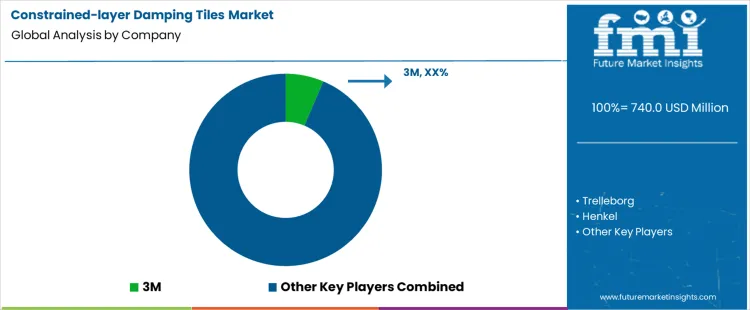
3M leads competitive positioning through viscoelastic damping tile technologies validated across transportation, industrial equipment, and building acoustics applications. Trelleborg competes with elastomer-based damping solutions engineered for mechanical vibration control and harsh operating environments. Henkel supports demand through adhesive-integrated damping systems designed for automated assembly and durable substrate bonding. Nitto Denko maintains relevance with precision damping materials tailored for electronics housings and transportation interiors. Parker LORD participates by supplying vibration damping materials aligned with aerospace, rail, and industrial noise control requirements. Competitive differentiation centers on damping efficiency across frequency ranges, adhesive reliability, thermal stability, and engineering support during application design.
Key Players in the Constrained-Layer Damping Tiles Market
- 3M
- Trelleborg
- Henkel
- Nitto Denko
- Parker LORD
- Hutchinson
- Saint-Gobain
- Rogers Corporation
- Sika
Scope of the Report
| Items | Values |
|---|---|
| Quantitative Units | USD million |
| Product Format | Self-Adhesive CLD Tiles; Sheet-Based CLD Laminates; Preformed Panels; Other |
| Application | Building & Architectural Damping; Industrial Equipment Panels; Transportation Interiors; Others |
| Sales Channel | Industrial Distributors; Direct Manufacturer Sales; Contractors or Installers; Other |
| Regions Covered | Asia Pacific, Europe, North America, Latin America, Middle East & Africa |
| Countries Covered | India, Vietnam, Indonesia, China, Mexico, and 40+ countries |
| Key Companies Profiled | 3M; Trelleborg; Henkel; Nitto Denko; Hutchinson; Parker LORD; Saint-Gobain; Rogers Corporation; Sika |
| Additional Attributes | Dollar sales by product format, application, and sales channel; damping loss factor performance and vibration attenuation efficiency across self-adhesive tiles, laminates, and preformed panels; temperature stability and adhesion strength under operational loads; compatibility with metal and composite substrates; installation labor intensity and retrofit suitability; procurement patterns spanning industrial distributors, direct manufacturer supply, and contractor-led installations. |
Constrained-Layer Damping Tiles Market by Segment
Product Format:
- Self-Adhesive CLD Tiles
- Sheet-Based CLD Laminates
- Preformed Panels
- Other
Application:
- Building & Architectural Damping
- Industrial Equipment Panels
- Transportation Interiors
- Others
Sales Channel:
- Industrial Distributors
- Direct Manufacturer Sales
- Contractors or Installers
- Other
Region:
- Asia Pacific
- China
- Japan
- South Korea
- India
- Australia & New Zealand
- ASEAN
- Rest of Asia Pacific
- Europe
- Germany
- United Kingdom
- France
- Italy
- Spain
- Nordic
- BENELUX
- Rest of Europe
- North America
- United States
- Canada
- Mexico
- Latin America
- Brazil
- Chile
- Rest of Latin America
- Middle East & Africa
- Kingdom of Saudi Arabia
- Other GCC Countries
- Turkey
- South Africa
- Other African Union
- Rest of Middle East & Africa
Bibliography
- American Society for Testing and Materials. (2024). ASTM E756‑23a: Standard test method for measuring vibration‑damping properties of materials. ASTM International.
- American Society of Heating, Refrigerating and Air‑Conditioning Engineers. (2024). ASHRAE HVAC applications handbook: Sound and vibration control. ASHRAE.
- European Committee for Standardization. (2024). EN 12354‑5:2024 Building acoustics. Estimation of acoustic performance of buildings from the performance of elements. Part 5: Sound levels due to services equipment. CEN.
- International Organization for Standardization. (2024). ISO 10846‑5:2024 Acoustics — Laboratory measurement of vibro‑acoustic transfer properties — Part 5: Indirect method for determination of the dynamic stiffness of resilient supports. ISO.
- International Organization for Standardization. (2023). ISO 6721‑3:2023 Plastics — Determination of dynamic mechanical properties — Part 3: Flexural vibration — Resonance‑curve method. ISO.
- National Institute for Occupational Safety and Health. (2024). NIOSH engineering controls for vibration and structure‑borne noise in industrial facilities. U.S. Department of Health & Human Services.
Frequently Asked Questions
How big is the constrained-layer damping tiles market in 2026?
The global constrained-layer damping tiles market is estimated to be valued at USD 740.0 million in 2026.
What will be the size of constrained-layer damping tiles market in 2036?
The market size for the constrained-layer damping tiles market is projected to reach USD 1,497.0 million by 2036.
How much will be the constrained-layer damping tiles market growth between 2026 and 2036?
The constrained-layer damping tiles market is expected to grow at a 7.3% CAGR between 2026 and 2036.
What are the key product types in the constrained-layer damping tiles market?
The key product types in constrained-layer damping tiles market are self-adhesive cld tiles, sheet-based cld laminates, preformed panels and other.
Which application segment to contribute significant share in the constrained-layer damping tiles market in 2026?
In terms of application, building & architectural damping segment to command 36.0% share in the constrained-layer damping tiles market in 2026.
Preview the report firsthand - request a free sample
Get SampleGet the brochure for pricing and purchase details.
Get PDFTable of Content
- Executive Summary
- Global Market Outlook
- Demand-side Trends
- Supply-side Trends
- Technology Roadmap Analysis
- Analysis and Recommendations
- Market Overview
- Market Coverage / Taxonomy
- Market Definition / Scope / Limitations
- Market Background
- Market Dynamics
- Drivers
- Restraints
- Opportunity
- Trends
- Scenario Forecast
- Demand in Optimistic Scenario
- Demand in Likely Scenario
- Demand in Conservative Scenario
- Opportunity Map Analysis
- Product Life Cycle Analysis
- Supply Chain Analysis
- Investment Feasibility Matrix
- Value Chain Analysis
- PESTLE and Porter’s Analysis
- Regulatory Landscape
- Regional Parent Market Outlook
- Production and Consumption Statistics
- Import and Export Statistics
- Market Dynamics
- Global Market Analysis 2021 to 2025 and Forecast, 2026 to 2036
- Historical Market Size Value (USD Million) Analysis, 2021 to 2025
- Current and Future Market Size Value (USD Million) Projections, 2026 to 2036
- Y-o-Y Growth Trend Analysis
- Absolute $ Opportunity Analysis
- Global Market Pricing Analysis 2021 to 2025 and Forecast 2026 to 2036
- Global Market Analysis 2021 to 2025 and Forecast 2026 to 2036, By Product Format
- Introduction / Key Findings
- Historical Market Size Value (USD Million) Analysis By Product Format , 2021 to 2025
- Current and Future Market Size Value (USD Million) Analysis and Forecast By Product Format , 2026 to 2036
- Self-Adhesive CLD Tiles
- Sheet-Based CLD Laminates
- Preformed Panels
- Other
- Self-Adhesive CLD Tiles
- Y-o-Y Growth Trend Analysis By Product Format , 2021 to 2025
- Absolute $ Opportunity Analysis By Product Format , 2026 to 2036
- Global Market Analysis 2021 to 2025 and Forecast 2026 to 2036, By Application
- Introduction / Key Findings
- Historical Market Size Value (USD Million) Analysis By Application, 2021 to 2025
- Current and Future Market Size Value (USD Million) Analysis and Forecast By Application, 2026 to 2036
- Building & Architectural Damping
- Industrial Equipment Panels
- Transportation Interiors
- Others
- Building & Architectural Damping
- Y-o-Y Growth Trend Analysis By Application, 2021 to 2025
- Absolute $ Opportunity Analysis By Application, 2026 to 2036
- Global Market Analysis 2021 to 2025 and Forecast 2026 to 2036, By Sales Channel
- Introduction / Key Findings
- Historical Market Size Value (USD Million) Analysis By Sales Channel, 2021 to 2025
- Current and Future Market Size Value (USD Million) Analysis and Forecast By Sales Channel, 2026 to 2036
- Industrial Distributors
- Direct Manufacturer Sales
- Contractors or Installers
- Other
- Industrial Distributors
- Y-o-Y Growth Trend Analysis By Sales Channel, 2021 to 2025
- Absolute $ Opportunity Analysis By Sales Channel, 2026 to 2036
- Global Market Analysis 2021 to 2025 and Forecast 2026 to 2036, By Region
- Introduction
- Historical Market Size Value (USD Million) Analysis By Region, 2021 to 2025
- Current Market Size Value (USD Million) Analysis and Forecast By Region, 2026 to 2036
- North America
- Latin America
- Western Europe
- Eastern Europe
- East Asia
- South Asia and Pacific
- Middle East & Africa
- Market Attractiveness Analysis By Region
- North America Market Analysis 2021 to 2025 and Forecast 2026 to 2036, By Country
- Historical Market Size Value (USD Million) Trend Analysis By Market Taxonomy, 2021 to 2025
- Market Size Value (USD Million) Forecast By Market Taxonomy, 2026 to 2036
- By Country
- USA
- Canada
- Mexico
- By Product Format
- By Application
- By Sales Channel
- By Country
- Market Attractiveness Analysis
- By Country
- By Product Format
- By Application
- By Sales Channel
- Key Takeaways
- Latin America Market Analysis 2021 to 2025 and Forecast 2026 to 2036, By Country
- Historical Market Size Value (USD Million) Trend Analysis By Market Taxonomy, 2021 to 2025
- Market Size Value (USD Million) Forecast By Market Taxonomy, 2026 to 2036
- By Country
- Brazil
- Chile
- Rest of Latin America
- By Product Format
- By Application
- By Sales Channel
- By Country
- Market Attractiveness Analysis
- By Country
- By Product Format
- By Application
- By Sales Channel
- Key Takeaways
- Western Europe Market Analysis 2021 to 2025 and Forecast 2026 to 2036, By Country
- Historical Market Size Value (USD Million) Trend Analysis By Market Taxonomy, 2021 to 2025
- Market Size Value (USD Million) Forecast By Market Taxonomy, 2026 to 2036
- By Country
- Germany
- UK
- Italy
- Spain
- France
- Nordic
- BENELUX
- Rest of Western Europe
- By Product Format
- By Application
- By Sales Channel
- By Country
- Market Attractiveness Analysis
- By Country
- By Product Format
- By Application
- By Sales Channel
- Key Takeaways
- Eastern Europe Market Analysis 2021 to 2025 and Forecast 2026 to 2036, By Country
- Historical Market Size Value (USD Million) Trend Analysis By Market Taxonomy, 2021 to 2025
- Market Size Value (USD Million) Forecast By Market Taxonomy, 2026 to 2036
- By Country
- Russia
- Poland
- Hungary
- Balkan & Baltic
- Rest of Eastern Europe
- By Product Format
- By Application
- By Sales Channel
- By Country
- Market Attractiveness Analysis
- By Country
- By Product Format
- By Application
- By Sales Channel
- Key Takeaways
- East Asia Market Analysis 2021 to 2025 and Forecast 2026 to 2036, By Country
- Historical Market Size Value (USD Million) Trend Analysis By Market Taxonomy, 2021 to 2025
- Market Size Value (USD Million) Forecast By Market Taxonomy, 2026 to 2036
- By Country
- China
- Japan
- South Korea
- By Product Format
- By Application
- By Sales Channel
- By Country
- Market Attractiveness Analysis
- By Country
- By Product Format
- By Application
- By Sales Channel
- Key Takeaways
- South Asia and Pacific Market Analysis 2021 to 2025 and Forecast 2026 to 2036, By Country
- Historical Market Size Value (USD Million) Trend Analysis By Market Taxonomy, 2021 to 2025
- Market Size Value (USD Million) Forecast By Market Taxonomy, 2026 to 2036
- By Country
- India
- ASEAN
- Australia & New Zealand
- Rest of South Asia and Pacific
- By Product Format
- By Application
- By Sales Channel
- By Country
- Market Attractiveness Analysis
- By Country
- By Product Format
- By Application
- By Sales Channel
- Key Takeaways
- Middle East & Africa Market Analysis 2021 to 2025 and Forecast 2026 to 2036, By Country
- Historical Market Size Value (USD Million) Trend Analysis By Market Taxonomy, 2021 to 2025
- Market Size Value (USD Million) Forecast By Market Taxonomy, 2026 to 2036
- By Country
- Kingdom of Saudi Arabia
- Other GCC Countries
- Turkiye
- South Africa
- Other African Union
- Rest of Middle East & Africa
- By Product Format
- By Application
- By Sales Channel
- By Country
- Market Attractiveness Analysis
- By Country
- By Product Format
- By Application
- By Sales Channel
- Key Takeaways
- Key Countries Market Analysis
- USA
- Pricing Analysis
- Market Share Analysis, 2025
- By Product Format
- By Application
- By Sales Channel
- Canada
- Pricing Analysis
- Market Share Analysis, 2025
- By Product Format
- By Application
- By Sales Channel
- Mexico
- Pricing Analysis
- Market Share Analysis, 2025
- By Product Format
- By Application
- By Sales Channel
- Brazil
- Pricing Analysis
- Market Share Analysis, 2025
- By Product Format
- By Application
- By Sales Channel
- Chile
- Pricing Analysis
- Market Share Analysis, 2025
- By Product Format
- By Application
- By Sales Channel
- Germany
- Pricing Analysis
- Market Share Analysis, 2025
- By Product Format
- By Application
- By Sales Channel
- UK
- Pricing Analysis
- Market Share Analysis, 2025
- By Product Format
- By Application
- By Sales Channel
- Italy
- Pricing Analysis
- Market Share Analysis, 2025
- By Product Format
- By Application
- By Sales Channel
- Spain
- Pricing Analysis
- Market Share Analysis, 2025
- By Product Format
- By Application
- By Sales Channel
- France
- Pricing Analysis
- Market Share Analysis, 2025
- By Product Format
- By Application
- By Sales Channel
- India
- Pricing Analysis
- Market Share Analysis, 2025
- By Product Format
- By Application
- By Sales Channel
- ASEAN
- Pricing Analysis
- Market Share Analysis, 2025
- By Product Format
- By Application
- By Sales Channel
- Australia & New Zealand
- Pricing Analysis
- Market Share Analysis, 2025
- By Product Format
- By Application
- By Sales Channel
- China
- Pricing Analysis
- Market Share Analysis, 2025
- By Product Format
- By Application
- By Sales Channel
- Japan
- Pricing Analysis
- Market Share Analysis, 2025
- By Product Format
- By Application
- By Sales Channel
- South Korea
- Pricing Analysis
- Market Share Analysis, 2025
- By Product Format
- By Application
- By Sales Channel
- Russia
- Pricing Analysis
- Market Share Analysis, 2025
- By Product Format
- By Application
- By Sales Channel
- Poland
- Pricing Analysis
- Market Share Analysis, 2025
- By Product Format
- By Application
- By Sales Channel
- Hungary
- Pricing Analysis
- Market Share Analysis, 2025
- By Product Format
- By Application
- By Sales Channel
- Kingdom of Saudi Arabia
- Pricing Analysis
- Market Share Analysis, 2025
- By Product Format
- By Application
- By Sales Channel
- Turkiye
- Pricing Analysis
- Market Share Analysis, 2025
- By Product Format
- By Application
- By Sales Channel
- South Africa
- Pricing Analysis
- Market Share Analysis, 2025
- By Product Format
- By Application
- By Sales Channel
- USA
- Market Structure Analysis
- Competition Dashboard
- Competition Benchmarking
- Market Share Analysis of Top Players
- By Regional
- By Product Format
- By Application
- By Sales Channel
- Competition Analysis
- Competition Deep Dive
- 3M
- Overview
- Product Portfolio
- Profitability by Market Segments (Product/Age /Sales Channel/Region)
- Sales Footprint
- Strategy Overview
- Marketing Strategy
- Product Strategy
- Channel Strategy
- Trelleborg
- Henkel
- Nitto Denko
- Hutchinson
- Parker LORD
- Saint-Gobain
- Rogers Corporation
- Sika
- 3M
- Competition Deep Dive
- Assumptions & Acronyms Used
- Research Methodology


