


By Sabyasachi Ghosh
- Renal cell carcinoma drugs are moving from single agents to combination regimens with survival gains and higher spend per patient.
- Regulators and guidelines now back multiple IO/TKI pairs as first line, which reshapes contracting and sequencing.
- Buyers face faster label changes and a broader second-line pool.
What is shaping the Advanced Renal Cell Carcinoma Therapeutics Market
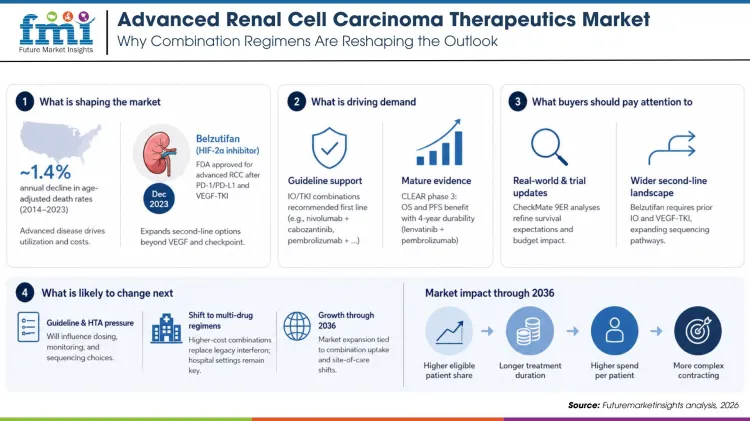
Kidney and renal pelvis cancers account for a sizeable USA burden, with SEER tracking rising prevalence and detailed stage and survival trends used in reimbursement and planning. Age-adjusted death rates have fallen about 1.4% per year from 2014 to 2023. Advanced disease still drives drug utilization and costs.
New mechanisms have reached market. The FDA approved belzutifan, a first-in-class HIF-2α inhibitor, on December 14, 2023 for adults with advanced RCC previously treated with a PD-1/PD-L1 inhibitor and a VEGF-TKI, expanding options beyond VEGF and checkpoint targets. This shifts second-line competition and informs value-based contracting around prior-therapy requirements.
What is driving demand in the Advanced Renal Cell Carcinoma Therapeutics Market
- USA and global guidelines recommend checkpoint and VEGF-TKI combinations in the first line for advanced RCC, including nivolumab plus cabozantinib and pembrolizumab plus.
- Mature readouts sustain the case for combinations.
USA and global guidelines recommend checkpoint and VEGF-TKI combinations in the first line for advanced RCC, including nivolumab plus cabozantinib and pembrolizumab plus. These endorsements increase eligible patient share and extend treatment durations compared with older monotherapies.
Mature readouts sustain the case for combinations. The phase 3 CLEAR program reported superior overall survival and progression-free survival for lenvatinib plus pembrolizumab versus sunitinib, with durability seen at four-year follow-up in peer-reviewed and conference updates. Such data support premium pricing and formulary priority.
What should buyers Pay Attention to in the Advanced Renal Cell Carcinoma Therapeutics Market
- Real-world and trial updates continue to refine sequence value.
- Second-line diversity is widening.
Real-world and trial updates continue to refine sequence value. Analyses from CheckMate 9ER presented at ASCO 2024 examined survival states over four years for nivolumab plus cabozantinib versus sunitinib, informing expectations for. Payers should map these survival partitions to budget impact and stop-rules.
Second-line diversity is widening. The belzutifan label requires prior PD-1/PD-L1 and VEGF-TKI exposure, encouraging earlier IO/TKI use and creating a defined belzutifan-addressable cohort. NCCN and NCI PDQ sequencing notes frequent movement to VEGF-TKIs after IO-based regimens, which interacts with HIF-2α uptake and combination trials.
What is likely to Change next in the Advanced Renal Cell Carcinoma Therapeutics Market
- Guideline refreshes and cost-effectiveness work will pressure dosing, monitoring, and sequencing choices.
- The FMI outlook points to a move away from legacy interferon use and toward higher-cost multi-drug regimens, while hospital oncology settings still anchor administration.
- For deeper sizing, forecasts, and regional growth rates across 2026-2036, see Advance Renal Cell Carcinoma Therapeutics Market on Future Market Insights: Advance Renal Cell Carcinoma Therapeutics Market (2026 - 2036)
Guideline refreshes and cost-effectiveness work will pressure dosing, monitoring, and sequencing choices. Continuing CLEAR follow-ups and methodologic reviews show how dose intensity and risk mix affect outcomes, a factor that procurement teams should test in outcomes-based. Market growth through 2036 will track combination penetration and outpatient infusion shifts.
The FMI outlook points to a move away from legacy interferon use and toward higher-cost multi-drug regimens, while hospital oncology settings still anchor administration. Buyers should model site-of-care shifts as ambulatory centers take more volume.
For deeper sizing, forecasts, and regional growth rates across 2026-2036, see Advance Renal Cell Carcinoma Therapeutics Market on Future Market Insights.
Bibliography
- FDA approves belzutifan for advanced renal cell carcinoma. Https://www.fda.gov/drugs/resources-information-approved-drugs/fda-approves-belzutifan-advanced-renal-cell-carcinoma
- SEER Cancer Stat Facts: Kidney and Renal Pelvis. Https://seer.cancer.gov/statfacts/html/kidrp.html
- NCI PDQ: Renal Cell Cancer Treatment (Health Professional Version). Https://www.cancer.gov/types/kidney/hp/kidney-treatment-pdq
- NCCN Guidelines Insights: Kidney Cancer, Version 2.2024. Https://education.nccn.org/node/94825
- Final prespecified OS analysis of CLEAR, Journal of Clinical Oncology. Https://pubmed.ncbi.nlm.nih.gov/38227898/
- CLEAR trial open-access article, JCO. Https://pmc.ncbi.nlm.nih.gov/articles/PMC11095851/
- ASCO 2024 CheckMate 9ER analysis coverage. Https://www.urotoday.com/conference-highlights/asco-2024/asco-2024-kidney-cancer/152602-asco-2024-partitioned-overall-survival-comprehensive-analysis-of-survival-states-over-4-years-in-checkmate-9er-comparing-first-line-nivolumab-plus-cabozantinib-versus-sunitinib-in-advanced-renal-cell-carcinoma-arcc.html
- Urology Times coverage of CLEAR 4-year update. Https://www.urologytimes.com/view/lenvatinib-pembrolizumab-efficacy-in-renal-cell-carcinoma-sustained-at-4-year-follow-up

