

- Market Size (2026)
- USD 506.0 Mn
- Forecast (2036)
- USD 1643.0 Mn
- CAGR (2026 to 2036)
- 12.5%
How big is the UV-C Disinfection Robots Market in 2026?
USD 506.0 million in 2026 to USD 1,643.0 million by 2036 at a 12.5% CAGR.
Demand for UV-C disinfection robots is projected to grow at a 12.5% CAGR from 2026 to 2036, increasing the valuation from USD 506.0 million in 2026 to USD 1,643.0 million through 2036, as hospitals place UV-C cycles inside formal terminal-cleaning routines. The CDC reported in July 2026 that hospital-onset C. difficile infections fell 11% during 2024 from the previous year. The decline shows that structured controls can improve outcomes yet it does not remove the need for repeatable room treatment. Hospitals therefore assess robotic systems through cycle records and room coverage. This operating focus links the category with hospital-acquired infection controls and sterilization equipment demand across high-risk clinical areas.
Hospital capacity and purchasing rules create different economic cases for robotic disinfection across national health systems. United States facilities operate within a health system that rewards documented workflows and clear product status. CMS reported in June 2026 that national health expenditure reached USD 5.3 trillion during 2024. China offers a wider installation base through hospital expansion and domestic robot supply that can reduce equipment and service costs. Hospitals in both countries assess room-cycle time and local field service across the complete installed fleet. Lamp replacement and reporting expenses then shape ownership decisions throughout the expected service life of each robot.
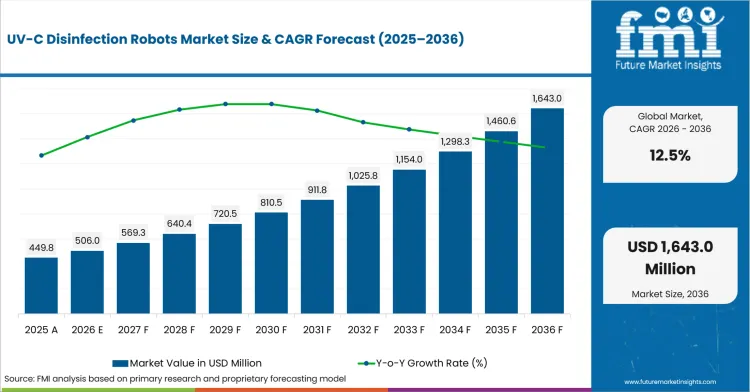
Key Takeaways of UV-C Disinfection Robots Market
- Routine adoption depends on clinical fit and accountable workflow ownership, requiring hospitals to see evidence that robots can supplement manual cleaning without delaying room turnover or creating unclear staff duties.
- Autonomous mobile systems are expected to lead the robot type category with 48.0% share in 2026, as hospitals seek consistent coverage with limited staff handling.
- Operating rooms and intensive care units are the dominant application segment, projected to hold 38.0% share in 2026, reflecting the consequences of contamination and schedule disruption in these areas.
- Hardware remains the primary spending category, as the installed robot carries the UV source and safety systems, while software and service gain value through reporting and uptime across recurring operations.
- Field support and service contracts remain critical to utilization, since a robot waiting for repair cannot contribute to scheduled infection-control work during periods of high occupancy.
- The United States, European Union, Japan, and India show distinct adoption patterns, with the US growing at 13.0% CAGR under stricter product-status requirements, while India develops more gradually as hospital groups test leases before committing capital.
- Competition centers on UVD Robots, Akara, Xenex, Surfacide, Tru-D SmartUVC, and Finsen Technologies, with vendors differentiating through autonomous navigation, FDA-authorized whole-room UV systems, and reporting/training-based service models.
Analyst Perspective
"The long-term value of healthcare service robots is determined by how well they integrate into routine hospital operations rather than by automation capabilities alone. Hospitals are investing in systems that improve workflow efficiency, sustain high equipment utilization, and operate reliably across multiple shifts without increasing operational burden. Facilities with lower patient volumes will continue to weigh ownership models against expected utilization, making deployment planning, fleet management, and user training just as important as the technology itself."
- Anurag Sharma, Principal Analyst at Future Market Insights
Source: FMI's proprietary forecasting model and primary research.
How is the UV-C Disinfection Robots Market segmented?
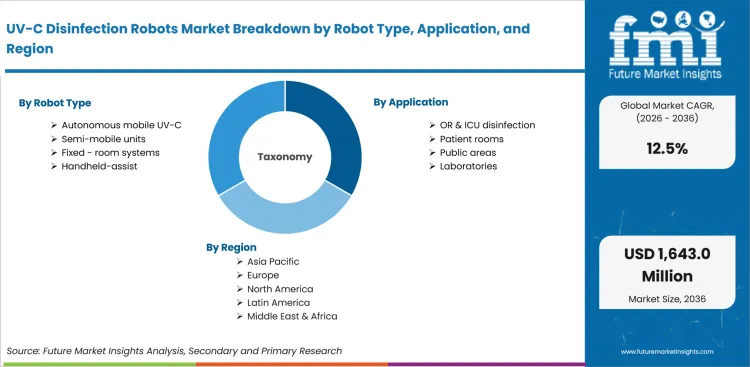
The industry is segmented by robot type, application, component, end user, business model, and region.
Segmentation separates mobility design from the clinical task and the payment route used by each facility. Robot type compares autonomous mobile systems with semi-mobile and fixed-room units that need different levels of staff handling. Application analysis separates high-acuity rooms from patient areas and public spaces with different turnover needs. Component analysis distinguishes the physical robot from reporting software and recurring service that supports uptime across several departments. End-user coverage compares hospitals with clinics and extends to pharmaceutical plants and laboratories that apply different validation needs. Business models compare direct ownership with leases and service contracts that transfer maintenance responsibility across the agreement term. This structure connects device design with surface disinfection systems and wider robotics investment patterns that influence hospital automation budgets.
How does autonomous mobile UV-C shape demand within the robot type category?
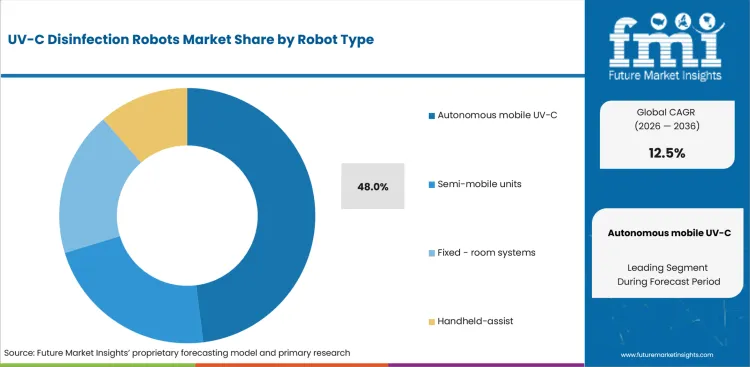
Autonomous platforms reduce the handling required to treat several rooms during one hospital cleaning shift. UVD Robots announced in March 2026 that AB Scientific became its United Kingdom partner for pharmaceutical facilities. The agreement covers the UVD Robot Pharma and its digital treatment records for GMP-controlled pharmaceutical cleanrooms. This development shows why self-navigation has value beyond hospitals since controlled production sites need repeatable coverage and traceable cycles. Commercial success depends on route setup and dependable local technical support throughout routine use across several controlled rooms.
- By robot type, autonomous mobile UV-C robots are projected to account for 48.0% of 2026 revenue due to lower handling needs and repeatable route execution. Their share reflects demand for repeatable treatment across several rooms without frequent staff repositioning during each cleaning shift. This operating benefit becomes valuable during busy terminal-cleaning schedules that require consistent room coverage across several departments.
- Hospital and pharmaceutical operators are expected to favor autonomous units in areas with predictable layouts and repeated cleaning cycles. Navigation reduces repositioning work yet technical teams must examine mapping support and obstacle handling during live trials. Restart procedures require the same attention so a stopped unit does not interrupt scheduled treatment across several departments.
What supports demand for operating room and intensive care disinfection?
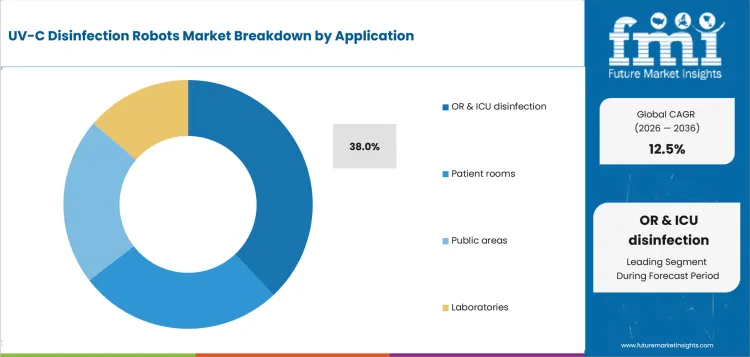
High-acuity rooms receive closer attention since contamination can affect vulnerable patients and disrupt costly clinical schedules. The CDC reported in July 2026 that surgical-site infections following abdominal hysterectomy increased 8% during 2024 from the previous year. The increase contrasts with declines in several other hospital infection measures during the same reporting period. UV-C robots therefore compete on room coverage and cycle time that fit the interval between procedures without delaying the next clinical task.
- In 2026, operating room and intensive care disinfection is expected to represent 38.0% of application revenue due to high clinical consequences and strict turnover schedules. Hospitals place greater value on systems that complete supplemental treatment within established turnover windows and produce a reviewable cycle record.
- Surgical departments and critical-care units are expected to support purchases that create a clear record for every completed room cycle. Demand comes from infection-prevention protocols that require supplemental treatment to follow manual cleaning in a controlled sequence. Reliable records support audit preparation and help clinical managers decide whether another cycle is needed following a contamination event.
How is hardware positioned within the component category?
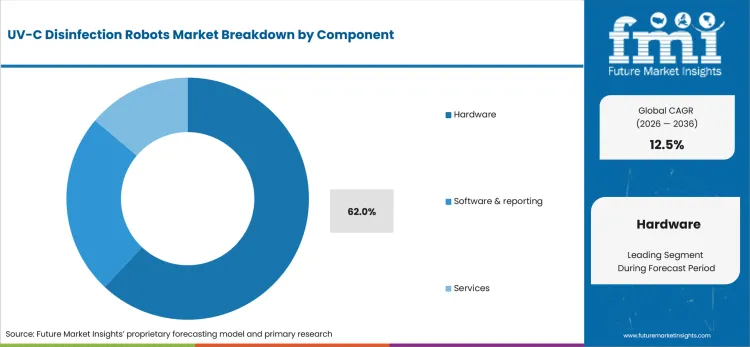
Hardware determines UV dose delivery and room coverage even though software supports reporting and fleet oversight. The FDA classified LightStrike+ in September 2023 as a Class II whole-room microbial reduction device for use following manual cleaning in unoccupied clinical rooms. That decision shows why UV sources and integrated safety controls remain central to healthcare product qualification. Hardware design therefore shapes both authorization cost and the maintenance burden carried throughout the equipment life cycle.
- By component, hardware is estimated to hold 62.0% of 2026 revenue owing to the cost of UV sources and mobility systems. Safety sensors and control hardware raise capital needs across each installed unit and must meet the operating requirements of clinical areas. The share reflects the investment required to place a complete robot into service, including a funded replacement plan that protects treatment capacity during maintenance.
- Hospital engineering departments are expected to evaluate lamp life and replacement procedures alongside battery performance and sensor reliability. Hardware economics affect total ownership cost because downtime can remove a robot from the cleaning schedule and force a return to manual alternatives. Local service access therefore becomes a purchasing condition that should be tested during the evaluation period.
What makes hospitals central to the end-user category?
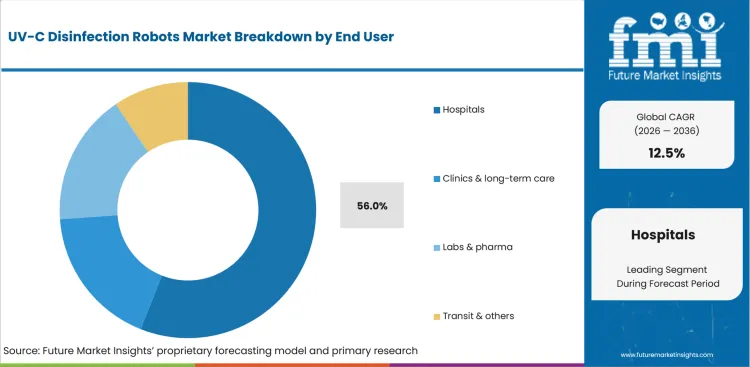
Hospitals combine frequent room turnover with formal infection-prevention oversight and larger equipment budgets than most alternative users. The CDC reported in July 2026 that central line-associated bloodstream infections fell 9% in acute-care hospitals during 2024 from the previous year. Continued performance measurement keeps environmental controls visible during hospital quality reviews and annual budget discussions. Robotic UV-C systems gain commercial relevance through treatment records that support oversight across high-risk wards.
- By end user, hospitals are projected to account for 56.0% of 2026 revenue due to the range of high-risk rooms within acute-care facilities. Their share reflects larger cleaning operations and greater demand for cycle records across several departments. Central oversight makes it easier to compare utilization across wards and identify units that do not receive enough use.
- Private hospital groups and public health systems are expected to expand fleets once pilots show dependable performance during normal shifts. Smaller clinics may adopt through leases or service contracts since low room volume can weaken the case for direct ownership. Flexible placement across treatment areas can raise utilization and improve the financial return from each installed unit.
How do flexible contracts influence the business model category?
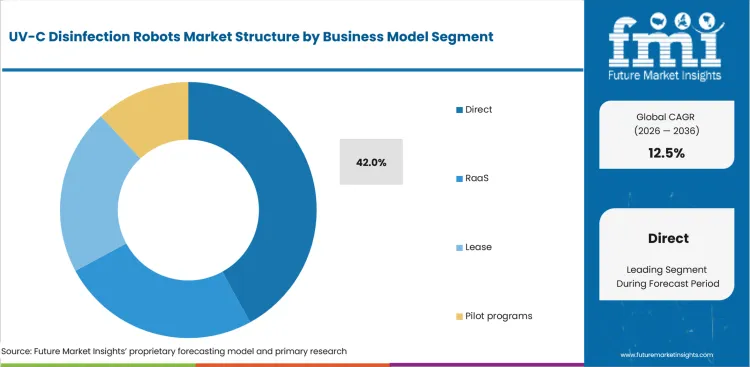
Capital budgets can delay adoption despite support from infection-prevention leaders who want more consistent supplemental room treatment. Akara states on its current corporate platform that hospitals can install its automation system without upfront capital spending. This approach shifts the decision from asset ownership toward operating value and clearly assigned service responsibility. Flexible contracts help managers establish real utilization before they approve a larger purchase across several departments.
- By business model, direct sales are estimated to account for 42.0% of 2026 revenue as hospital groups seek control over equipment and scheduling. Direct purchase supports asset control yet it requires funded maintenance and software support, with training and lamp replacement remaining visible throughout each annual operating budget for reliable daily use.
- Mid-sized hospitals and long-term care operators are expected to consider leases or service contracts that align payments with operating budgets. These models reduce the entry barrier yet contract value depends on utilization and response times for scheduled cleaning work. Renewal decisions require evidence that the robot completes enough room cycles to justify recurring fees across the full agreement.
What are the drivers, restraints, and opportunities in the UV-C Disinfection Robots Market?
Documented clinical use supports demand while regulatory evidence requirements constrain entry and flexible contracts widen access for smaller facilities.
- Driver: Hospital investment is expected to rise as documented cycles show that robotic UV-C can fit routine terminal cleaning without disrupting room turnover.
- Restraint: United States authorization and clinical validation are anticipated to extend development schedules for companies that claim whole-room microbial reduction.
- Opportunity: Lease and service contracts are projected to widen access by reducing the initial capital burden for mid-sized hospitals and care facilities.
Clinical adoption improves once a robot proves dependable inside an established cleaning schedule instead of a short demonstration. Tru-D SmartUVC reported in July 2025 that a Bethpage facility had completed more than 1,200 Tru-D iQ cycles during routine operations. The operating record shows that utilization evidence can support budget renewal and wider fleet use. Commercial value develops through a repeatable process that staff can sustain during normal shifts across several clinical departments.
Regulatory requirements create a cost and timing barrier for systems that claim whole-room microbial reduction in United States healthcare settings. The FDA cleared Surfacide Helios+ in May 2025 under the Class II QXJ product code for use following manual cleaning in unoccupied clinical rooms. That decision requires new entrants to support stated claims through performance testing and quality controls. Companies unable to fund this work may remain outside regulated hospital applications even if their UV equipment is available in other settings.
Flexible contracts create an opening among facilities that cannot justify a large purchase before they understand utilization. A service agreement can combine equipment access with maintenance and reporting under one operating payment. The model creates value if the provider accepts clear uptime duties and the hospital commits enough room volume to support the fee. Growth in service-based robotics may broaden access yet finance leaders must compare total contract payments with direct ownership costs.
Which country CAGRs are profiled in the UV-C Disinfection Robots Market?
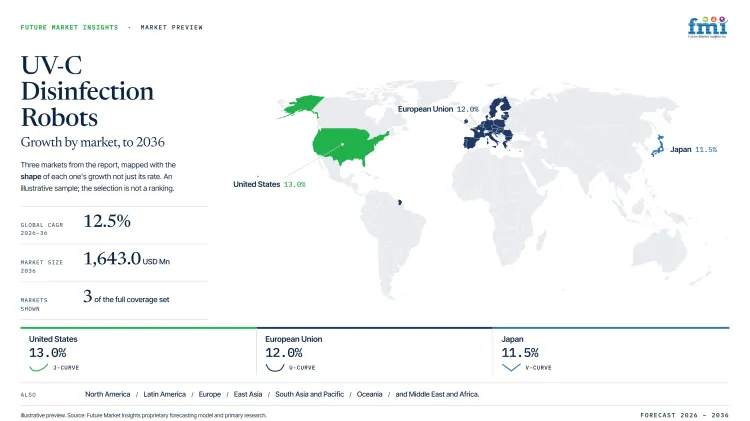
| Country | CAGR |
|---|---|
| United States | 13.0% |
| European Union | 12.0% |
| Japan | 11.5% |
Source: FMI's proprietary forecasting model and primary research.
How do country-level CAGRs compare in the UV-C Disinfection Robots Market?
The comparison covers a 1.5 percentage point range, indicating that the three profiled markets are advancing at a similar pace in the UV-C disinfection robots market. The United States records the highest CAGR at 13.0%, followed by the European Union at 12.0% and Japan at 11.5%. The limited spread reflects continued interest in automated disinfection technologies across healthcare environments, while procurement cycles, facility modernization and infection control strategies influence adoption rates.
-
The United States leads with a CAGR of 13.0%. Hospitals and healthcare facilities continue incorporating UV-C disinfection robots into environmental cleaning protocols to automate room disinfection, improve workflow efficiency and support infection prevention practices.
-
The European Union follows at 12.0%, 1.0 percentage point below the United States. Healthcare providers are evaluating autonomous UV-C systems for patient rooms, operating theatres and other clinical spaces as part of broader hospital automation and hygiene management initiatives. Adoption differs across member states because healthcare infrastructure and capital investment priorities are not uniform.
-
Japan records a CAGR of 11.5%, only 0.5 percentage points below the European Union. Medical facilities are integrating robotic disinfection technologies into routine cleaning operations to improve consistency and reduce manual intervention in selected hospital environments.
Comparable CAGRs do not indicate identical commercial conditions. Differences in healthcare infrastructure, infection control protocols, hospital investment priorities and equipment replacement cycles influence purchasing decisions and long-term market development. The full report provides country-level CAGR analysis across North America, Latin America, Europe, East Asia, South Asia, Oceania and the Middle East and Africa.
Country-wise Analysis
Country growth reflects hospital capacity and the approval rules applied to infection-control equipment within each health system. Clear product requirements allow hospitals to progress from evaluation to routine use with fewer commercial delays. United States facilities place greater weight on regulated claims, while European Union hospitals use formal public budgets and local service evidence. Japan requires careful integration with established clinical routines and dependable local service. These differences connect robotic disinfection with wider infection prevention programs.
- United States hospitals operate under clear controls for whole-room microbial reduction claims and often demand records from every completed cycle. Industry is estimated to grow at 13.0% CAGR by 2036 due to established infection-prevention budgets and regulated product pathways. The CDC recorded a 7% reduction in hospital-onset MRSA bacteremia during 2024 in its July 2026 progress report. The result shows that prevention programs are judged through clinical measures rather than equipment installation alone. Health systems are likely to favor companies that combine authorized claims with responsive service across several campuses.
- European Union hospitals operate through public and private funding systems that often use formal tenders for infection-control equipment. Sales in the industry are forecast to expand at 12.0% CAGR from 2026 to 2036 becayse health systems add supplemental disinfection within planned capital programs. Eurostat reported in July 2026 that the EU had 507 hospital beds per 100,000 people during 2024. This established hospital base supports replacement demand and selective fleet expansion rather than one uniform rollout. Companies with regional training and spare-parts support can reduce implementation risk across contracts that cover several hospitals.
- Japan offers a technically demanding hospital environment that values measured performance and careful integration with established cleaning routines. UV-C disinfection robot revenue is estimated to expand at 11.5% CAGR from 2026 to 2036 owing to staffing pressure which increases interest in automated room treatment. Japan's Statistics Dashboard reported in September 2025 that the country had 7,003 general hospitals during 2024. This broad but mature base creates replacement and selective fleet opportunities rather than rapid new-site deployment. Hospital engineering departments are expected to examine device safety and local service arrangements during wider evaluations.
Who are the notable companies in the UV-C Disinfection Robots Market?
UVD Robots, Xenex Disinfection Services, Surfacide, Tru-D SmartUVC, Finsen Technologies, Akara, OTSAW, and Time Medical Systems.
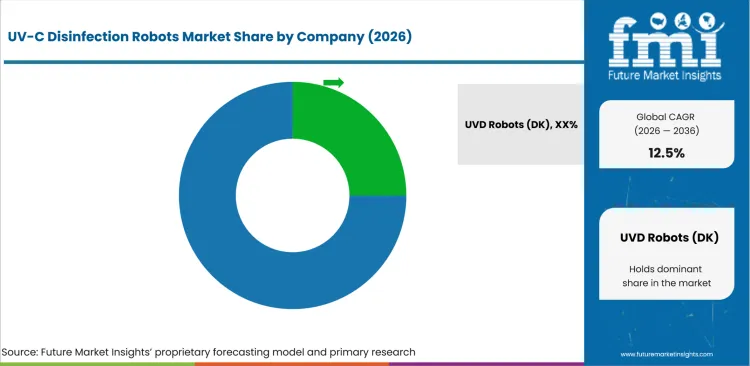
Competition depends on navigation and UV delivery together with reporting quality during daily hospital use. Product status and field-service coverage then shape decisions across repeated deployments in several clinical departments. UVD Robots and Akara focus on autonomous movement, and Xenex and Surfacide provide authorized whole-room systems for healthcare use. Tru-D SmartUVC and Finsen Technologies support measured treatment through reporting and operator training programs across routine room cycles. OTSAW and Time Medical Systems extend robotic disinfection into public facilities or systems that combine several treatment methods. Hospital evaluations should connect product features with infection control spending since field support often determines regular equipment use. Related medical cleaning devices provide a useful comparison for maintenance and workflow planning across the equipment life.
- UVD Robots and Akara focus on autonomous navigation that reduces manual repositioning across planned treatment routes. Official company pages document self-driving UV-C operation and digital coordination features, which support route planning and cycle records during regular use. Hospitals should test obstacle handling and restart procedures before approving wider deployment across several clinical departments.
- Xenex Disinfection Services and Surfacide compete through authorized whole-room systems designed for use following manual cleaning in unoccupied healthcare rooms. Xenex uses pulsed xenon ultraviolet light with cloud reporting, while Surfacide uses three continuous-wave emitters during one treatment cycle. Hospitals must compare room coverage and workflow time because authorization does not establish the same operating result for every layout.
- Tru-D SmartUVC and Finsen Technologies compete through measured treatment and ongoing service support programs for hospitals. Tru-D documents each treatment through connected reporting, while Finsen combines equipment with training and maintenance under multi-year agreements. These models create value where hospitals need repeatable cycles and clear technical responsibility beyond the initial installation.
- OTSAW and Time Medical Systems provide mobile platforms for facilities that need broader room coverage or more than one disinfection method. OTSAW markets the TREX UV-C platform while Time Medical Systems combines UV light with hydrogen peroxide fog and plasma filtration in TMiRob. Added functions may widen use cases yet they increase validation and maintenance requirements.
Competitive Benchmarking: UV-C Disinfection Robots Market
| Company | Autonomous Navigation | Healthcare Authorization | Cycle Reporting | Service Support | Geographic Reach |
|---|---|---|---|---|---|
| UVD Robots | High | Low | High | High | High |
| Xenex Disinfection Services | Low | High | High | High | High |
| Surfacide | Low | High | Medium | Medium | Medium |
| Tru-D SmartUVC | Low | Low | High | High | Medium |
| Finsen Technologies | Medium | Low | Medium | High | High |
| Akara | High | Low | High | Medium | Medium |
| OTSAW | High | Low | Medium | Medium | Medium |
| Time Medical Systems | High | Low | Medium | Medium | Medium |
Source: Future Market Insights
Key Developments in the UV-C Disinfection Robots Market
- In March 2025, Blue Ocean Robotics announced that 3C Groups became its majority owner and provided new capital. The company confirmed continued investment in UVD Robots across healthcare and pharmaceutical settings during the initial ownership transition. The ownership change strengthened the financial base that supports product service and ongoing software development. Hospital customers benefit from that continuity because robotic equipment requires technical support throughout a multi-year operating life.
- In June 2025, OTSAW announced a partnership with Hong Kong medical distributor SYNERGY to introduce the TREX UV-C disinfection platform. The agreement targets healthcare institutions and eldercare facilities together with other high-traffic settings that require routine environmental treatment.
- In July 2025, Finsen Technologies completed the first annual maintenance and operator-training visit under its five-year PAHO and WHO arrangement in Trinidad and Tobago. Two THOR UVC robots had already been commissioned at Arima General Hospital and Scarborough Hospital during the initial deployment period.
- In January 2026, Xenex Disinfection Services announced Health Canada registration for its LightStrike6 ultraviolet disinfection robot. The registration permits sale and distribution to Canadian healthcare facilities under the country's medical-device requirements. This development gives hospitals a clearer product-status record during evaluation and expands Xenex beyond its United States base.
Key Players in the UV-C Disinfection Robots Market
Autonomous Mobile UV-C Platforms
- UVD Robots
- Akara
- OTSAW
- Time Medical Systems
FDA-Authorized Whole-Room Systems
- Xenex Disinfection Services
- Surfacide
Measured-Dose and Service-Led Systems
- Tru-D SmartUVC
- Finsen Technologies
UV-C Disinfection Robots Market - Report Scope
| Coverage field | Report scope |
|---|---|
| Market breakdown | Robot type, application, component, end user, business model, and region. |
| Quantitative Units | Revenue in USD Million, CAGR in %. |
| Market Definition | Robotic UV-C systems that supplement manual cleaning in unoccupied healthcare, pharmaceutical, laboratory, and public-use spaces. |
| Regions Covered | North America, Latin America, Europe, East Asia, South Asia and Pacific, Oceania, and Middle East and Africa. |
| Countries Covered | United States, Canada, China, Japan, India, major European countries, and more than 20 countries within the regional model. |
| Key Companies Profiled | UVD Robots, Xenex Disinfection Services, Surfacide, Tru-D SmartUVC, Finsen Technologies, Akara, OTSAW, and Time Medical Systems. |
| Forecast Period | 2026 to 2036 |
| Approach | Facility-based revenue modeling supported by primary interviews and official healthcare, regulatory, and industry data. |
UV-C Disinfection Robots Market - Research Methodology
| Method | Approach |
|---|---|
| Primary Research | FMI analysts gathered input from manufacturers, service providers, technology developers, distributors, end users, procurement teams, and subject-matter experts. Interviews examined purchasing decisions, product or service evaluation, adoption barriers, approval requirements, pricing considerations, and expectations for technical or commercial support. Respondents were also asked what evidence is required before a trial, pilot, or initial order develops into regular purchasing. |
| Desk Research | Desk research covered government statistics, regulatory publications, trade data, industry associations, technical literature, standards, company filings, product information, and official corporate announcements. Sources were reviewed for relevance, publication date, geographic coverage, and consistency with the defined market scope. Claims relating to performance, applications, approvals, capacity, investment, and commercial activity were retained only when supported by credible public evidence. |
| Market Sizing and Forecasting | The market model combined the baseline value with historical performance, segment structure, pricing and volume indicators, adoption levels, company participation, and country-level demand conditions. Forecast assumptions considered economic activity, investment trends, regulatory developments, technology adoption, purchasing cycles, supply availability, and barriers to wider market use. Segment and regional estimates were reconciled before the final market total was calculated. |
| Data Validation | Estimates were checked against multiple independent indicators, including public data, company activity, trade patterns, industry developments, and findings from primary interviews. Validation also tested whether products, services, applications, and company revenues fell within the defined market boundaries. Adjacent categories, unsupported claims, overlapping revenues, and activities without direct market relevance were excluded to reduce double counting and maintain consistency across segments and countries. |
UV-C Disinfection Robots Market by Segments
Robot Type
- Autonomous mobile UV-C robots
- Semi-mobile UV-C units
- Fixed-room UV-C systems
- Handheld-assist UV-C devices
Application
- Operating room and intensive care disinfection
- Patient room disinfection
- Public area disinfection
- Laboratory disinfection
Component
- Hardware
- Software and reporting
- Services
End User
- Hospitals
- Clinics and long-term care facilities
- Laboratories and pharmaceutical facilities
- Transit and other public-use facilities
Business Model
- Direct sales
- Robotics-as-a-service
- Lease
- Pilot program
UV-C Disinfection Robots Market by Region:
- North America
- United States
- Canada
- Latin America
- Brazil
- Mexico
- Rest of Latin America
- Europe
- Germany
- United Kingdom
- France
- Italy
- Spain
- Nordics
- Rest of Europe
- East Asia
- China
- Japan
- South Korea
- South Asia and Pacific
- India
- ASEAN
- Rest of South Asia and Pacific
- Oceania
- Australia
- New Zealand
- Middle East and Africa
- Gulf Cooperation Council countries
- South Africa
- Rest of Middle East and Africa
Research Sources and Bibliography
- Akara. (n.d.). Violet UV disinfection robot and hospital automation platform. R
- Blue Ocean Robotics. (2025, March 18). New majority owner of the Blue Ocean Robotics Group.
- UVD Robots. (2026, March 20). UVD Robots appoints AB Scientific as UK partner for pharmaceutical sector.
- Centers for Disease Control and Prevention. (2026, July 15). Current HAI progress report.
- Centers for Medicare & Medicaid Services. (2026, June 24). NHE fact sheet.
- Eurostat. (2026, July 13). EU hospital bed count at 507 per 100,000 people.
- Finsen Technologies. (2025, July 9). Year one maintenance and training with two THOR systems in Trinidad and Tobago under the PAHO and WHO partnership.
- Government of India, Ministry of Health and Family Welfare. (2025, July 29). Steps taken to strengthen district-level health systems.
- National Bureau of Statistics of China. (2025, February 28). Statistical communique of the People's Republic of China on the 2024 national economic and social development.
- Statistics Bureau of Japan. (2025, September 29). Statistics Dashboard: Number of general hospitals in 2024.
- OTSAW. (2025, June 13). OTSAW partners with SYNERGY to introduce the TREX UV-C disinfection platform in Hong Kong.
- USA Food and Drug Administration. (2025, May 27). 510(k) summary for the Helios+ whole room microbial reduction device.
- Surfacide. (2025, June 3). Surfacide unveils Helios+ UV-C system following FDA 510(k) clearance.
- Time Medical Systems. (n.d.). Intelligent sterilization robot.
- Tru-D SmartUVC. (2025, July 29). Facility uses Tru-D SmartUVC to streamline processes and increase confidence in cleanliness.
- USA Food and Drug Administration. (2023, September 1). De Novo classification request for LightStrike+.
- Xenex Disinfection Services. (2026, January 20). Xenex receives Health Canada registration for LightStrike6 UV robot.
- Xenex Disinfection Services. (n.d.). LightStrike+ product information.
This bibliography is provided for reader reference and uses primary government, standards-body, official trade body, and company sources.
This Report Answers
- How large is the UV-C disinfection robots market in 2026 and what value is projected for 2036?
- Which robot type accounts for the main share of revenue during the base forecast year?
- Why do operating rooms and intensive care units attract a substantial share of UV-C robot spending?
- How do hardware and reporting software contribute differently to the commercial value of a deployed system?
- Which national health-system conditions explain the different country growth rates through 2036?
- How do product authorization and clinical validation affect company entry and hospital purchasing?
- Which companies compete through autonomous navigation and measured dosing alongside multi-emitter room coverage within this market?
- How do direct sales and leases compare with service contracts for smaller facilities?
- Which operating tests should hospitals complete before expanding a pilot into a fleet?
Frequently Asked Questions
What is driving growth in the UV-C disinfection robots market?
Growth comes from hospitals that need repeatable supplemental disinfection and clear cycle records. Autonomous movement helps place that work inside routine terminal-cleaning schedules.
Who are the key players in the UV-C disinfection robots market?
UVD Robots and Xenex compete with Surfacide and Tru-D SmartUVC. Finsen Technologies and Akara operate alongside OTSAW and Time Medical Systems.
What is a notable restraint in the UV-C disinfection robots market?
Regulatory testing can extend development schedules and raise entry costs. Hospitals may delay purchases if product claims lack suitable evidence or service support.
Why should executives track the UV-C disinfection robots market?
The category links infection prevention with hospital automation and recurring service revenue. Growth indicates how health systems value repeatable controls that fit room turnover.
What business problem does the UV-C disinfection robots market address?
UV-C robots reduce variation in supplemental room treatment following manual cleaning. They provide a repeatable cycle and a record that supports infection-prevention review.
What should hospitals evaluate during a UV-C disinfection robot purchase?
Evaluation should cover product status and room coverage together with cycle time. Navigation and reporting must be supported by dependable maintenance during regular use.
What limits return on investment for purchasers?
Low utilization weakens returns even if a robot performs well during a pilot. Maintenance delays and poor routing can leave expensive equipment idle.
What supports long-term commercial confidence?
Reliable service and documented cycle performance support renewal decisions. Clear training and maintenance responsibilities help hospitals sustain use through the expected equipment life.
Preview the report firsthand - request a free sample
Get SampleGet the brochure for pricing and purchase details.
Get PDFTable of Content
- Key Takeaways
- Market Size and CAGR
- Top Growth Driver
- Fastest Growing Segment
- Leading Region
- Key Companies
- Emerging Opportunities
- Executive Summary
- Global Market Outlook
- Demand-side Trends
- Supply-side Trends
- Technology Roadmap Analysis
- Analysis and Recommendations
- Analyst Perspective (What is happening? Why now? What should investors know?)
- Key Questions Answered
- How large is the market?
- What is the CAGR?
- What are key trends?
- Which region dominates?
- Who are the leaders?
- Market Overview
- Market Coverage / Taxonomy
- Market Definition / Scope / Limitations
- Research Methodology
- Chapter Orientation
- Analytical Lens and Working Hypotheses
- Market Structure, Signals, and Trend Drivers
- Benchmarking and Cross-market Comparability
- Market Sizing, Forecasting, and Opportunity Mapping
- Research Design and Evidence Framework
- Desk Research Programme (Secondary Evidence)
- Expert Input and Fieldwork (Primary Evidence)
- Tooling, Models, and Reference Databases
- Data Engineering and Model Build
- Quality Assurance and Audit Trail
- Market Background
- Market Dynamics (Drivers, Restraints, Opportunity, Trends)
- Scenario Forecast (Optimistic, Likely, Conservative)
- Impact Analysis
- AI Impact
- Sustainability Impact
- Regulatory Impact
- Technology Impact
- Consumer / Buyer Analysis
- Purchase Drivers
- Adoption Barriers
- Buyer Journey
- Opportunity Map Analysis
- Product Life Cycle Analysis
- Supply Chain Analysis
- Investment Feasibility Matrix
- Value Chain Analysis
- PESTLE and Porter's Analysis
- Regulatory Landscape
- Regional Parent Market Outlook
- Production and Consumption Statistics
- Import and Export Statistics
- Global Market Analysis and Forecast, 2021 to 2036
- Historical Market Size Value (USD Mn) Analysis, 2021 to 2025
- Current and Future Market Size Value (USD Mn) Projections, 2026 to 2036
- Y-o-Y Growth Trend Analysis
- Absolute $ Opportunity Analysis
- Global Market Pricing Analysis, 2021 to 2036
- Global Market Analysis and Forecast, By Robot Type, 2021 to 2036
- Introduction / Key Findings
- Historical Market Size Value (USD Mn) Analysis By Robot Type, 2021 to 2025
- Current and Future Market Size Value (USD Mn) Analysis and Forecast By Robot Type, 2026 to 2036
- Autonomous mobile UV-C
- Semi-mobile units
- Fixed - room systems
- Handheld-assist
- Autonomous mobile UV-C
- Y-o-Y Growth Trend Analysis By Robot Type, 2021 to 2025
- Absolute $ Opportunity Analysis By Robot Type, 2026 to 2036
- Global Market Analysis and Forecast, By Application, 2021 to 2036
- Introduction / Key Findings
- Historical Market Size Value (USD Mn) Analysis By Application, 2021 to 2025
- Current and Future Market Size Value (USD Mn) Analysis and Forecast By Application, 2026 to 2036
- OR & ICU disinfection
- Patient rooms
- Public areas
- Laboratories
- OR & ICU disinfection
- Y-o-Y Growth Trend Analysis By Application, 2021 to 2025
- Absolute $ Opportunity Analysis By Application, 2026 to 2036
- Global Market Analysis and Forecast, By Component, 2021 to 2036
- Introduction / Key Findings
- Historical Market Size Value (USD Mn) Analysis By Component, 2021 to 2025
- Current and Future Market Size Value (USD Mn) Analysis and Forecast By Component, 2026 to 2036
- Hardware
- Software & reporting
- Services
- Hardware
- Y-o-Y Growth Trend Analysis By Component, 2021 to 2025
- Absolute $ Opportunity Analysis By Component, 2026 to 2036
- Global Market Analysis and Forecast, By End User, 2021 to 2036
- Introduction / Key Findings
- Historical Market Size Value (USD Mn) Analysis By End User, 2021 to 2025
- Current and Future Market Size Value (USD Mn) Analysis and Forecast By End User, 2026 to 2036
- Hospitals
- Clinics & long-term care
- Labs & pharma
- Transit & others
- Hospitals
- Y-o-Y Growth Trend Analysis By End User, 2021 to 2025
- Absolute $ Opportunity Analysis By End User, 2026 to 2036
- Global Market Analysis and Forecast, By Business Model, 2021 to 2036
- Introduction / Key Findings
- Historical Market Size Value (USD Mn) Analysis By Business Model, 2021 to 2025
- Current and Future Market Size Value (USD Mn) Analysis and Forecast By Business Model, 2026 to 2036
- Direct
- RaaS
- Lease
- Pilot programs
- Direct
- Y-o-Y Growth Trend Analysis By Business Model, 2021 to 2025
- Absolute $ Opportunity Analysis By Business Model, 2026 to 2036
- Global Market Analysis and Forecast, By Region, 2021 to 2036
- Introduction
- Historical Market Size Value (USD Mn) Analysis By Region, 2021 to 2025
- Current Market Size Value (USD Mn) Analysis and Forecast By Region, 2026 to 2036
- North America
- Latin America
- Western Europe
- Eastern Europe
- East Asia
- South Asia and Pacific
- Middle East & Africa
- Market Attractiveness Analysis By Region
- North America Market Analysis and Forecast, By Country, 2021 to 2036
- Historical Market Size Value (USD Mn) Trend Analysis By Market Taxonomy, 2021 to 2025
- Market Size Value (USD Mn) Forecast By Market Taxonomy, 2026 to 2036
- By Country
- USA
- Canada
- By Robot Type
- By Application
- By Component
- By End User
- By Business Model
- By Country
- Market Attractiveness Analysis
- By Country
- By Robot Type
- By Application
- By Component
- By End User
- By Business Model
- Key Takeaways
- Latin America Market Analysis and Forecast, By Country
- Historical Market Size Value (USD Mn) Trend Analysis By Market Taxonomy, 2021 to 2025
- Market Size Value (USD Mn) Forecast By Market Taxonomy, 2026 to 2036
- By Country
- Brazil
- Mexico
- Chile
- Rest of Latin America
- By Robot Type
- By Application
- By Component
- By End User
- By Business Model
- By Country
- Market Attractiveness Analysis
- By Country
- By Robot Type
- By Application
- By Component
- By End User
- By Business Model
- Key Takeaways
- Western Europe Market Analysis and Forecast, By Country
- Historical Market Size Value (USD Mn) Trend Analysis By Market Taxonomy, 2021 to 2025
- Market Size Value (USD Mn) Forecast By Market Taxonomy, 2026 to 2036
- By Country
- Germany
- UK
- Italy
- Spain
- France
- Nordic
- BENELUX
- Rest of Western Europe
- By Robot Type
- By Application
- By Component
- By End User
- By Business Model
- By Country
- Market Attractiveness Analysis
- By Country
- By Robot Type
- By Application
- By Component
- By End User
- By Business Model
- Key Takeaways
- Eastern Europe Market Analysis and Forecast, By Country
- Historical Market Size Value (USD Mn) Trend Analysis By Market Taxonomy, 2021 to 2025
- Market Size Value (USD Mn) Forecast By Market Taxonomy, 2026 to 2036
- By Country
- Russia
- Poland
- Hungary
- Balkan & Baltic
- Rest of Eastern Europe
- By Robot Type
- By Application
- By Component
- By End User
- By Business Model
- By Country
- Market Attractiveness Analysis
- By Country
- By Robot Type
- By Application
- By Component
- By End User
- By Business Model
- Key Takeaways
- East Asia Market Analysis and Forecast, By Country
- Historical Market Size Value (USD Mn) Trend Analysis By Market Taxonomy, 2021 to 2025
- Market Size Value (USD Mn) Forecast By Market Taxonomy, 2026 to 2036
- By Country
- China
- Japan
- South Korea
- By Robot Type
- By Application
- By Component
- By End User
- By Business Model
- By Country
- Market Attractiveness Analysis
- By Country
- By Robot Type
- By Application
- By Component
- By End User
- By Business Model
- Key Takeaways
- South Asia and Pacific Market Analysis and Forecast, By Country
- Historical Market Size Value (USD Mn) Trend Analysis By Market Taxonomy, 2021 to 2025
- Market Size Value (USD Mn) Forecast By Market Taxonomy, 2026 to 2036
- By Country
- India
- ASEAN
- Australia & New Zealand
- Rest of South Asia and Pacific
- By Robot Type
- By Application
- By Component
- By End User
- By Business Model
- By Country
- Market Attractiveness Analysis
- By Country
- By Robot Type
- By Application
- By Component
- By End User
- By Business Model
- Key Takeaways
- Middle East & Africa Market Analysis and Forecast, By Country
- Historical Market Size Value (USD Mn) Trend Analysis By Market Taxonomy, 2021 to 2025
- Market Size Value (USD Mn) Forecast By Market Taxonomy, 2026 to 2036
- By Country
- Kingdom of Saudi Arabia
- Other GCC Countries
- Türkiye
- South Africa
- Other African Union
- Rest of Middle East & Africa
- By Robot Type
- By Application
- By Component
- By End User
- By Business Model
- By Country
- Market Attractiveness Analysis
- By Country
- By Robot Type
- By Application
- By Component
- By End User
- By Business Model
- Key Takeaways
- Key Countries Market Analysis
- USA
- Pricing Analysis
- Market Share Analysis, 2025
- By Robot Type
- By Application
- By Component
- By End User
- By Business Model
- Canada
- Pricing Analysis
- Market Share Analysis, 2025
- By Robot Type
- By Application
- By Component
- By End User
- By Business Model
- Mexico
- Pricing Analysis
- Market Share Analysis, 2025
- By Robot Type
- By Application
- By Component
- By End User
- By Business Model
- Brazil
- Pricing Analysis
- Market Share Analysis, 2025
- By Robot Type
- By Application
- By Component
- By End User
- By Business Model
- Chile
- Pricing Analysis
- Market Share Analysis, 2025
- By Robot Type
- By Application
- By Component
- By End User
- By Business Model
- Germany
- Pricing Analysis
- Market Share Analysis, 2025
- By Robot Type
- By Application
- By Component
- By End User
- By Business Model
- UK
- Pricing Analysis
- Market Share Analysis, 2025
- By Robot Type
- By Application
- By Component
- By End User
- By Business Model
- Italy
- Pricing Analysis
- Market Share Analysis, 2025
- By Robot Type
- By Application
- By Component
- By End User
- By Business Model
- Spain
- Pricing Analysis
- Market Share Analysis, 2025
- By Robot Type
- By Application
- By Component
- By End User
- By Business Model
- France
- Pricing Analysis
- Market Share Analysis, 2025
- By Robot Type
- By Application
- By Component
- By End User
- By Business Model
- India
- Pricing Analysis
- Market Share Analysis, 2025
- By Robot Type
- By Application
- By Component
- By End User
- By Business Model
- ASEAN
- Pricing Analysis
- Market Share Analysis, 2025
- By Robot Type
- By Application
- By Component
- By End User
- By Business Model
- Australia & New Zealand
- Pricing Analysis
- Market Share Analysis, 2025
- By Robot Type
- By Application
- By Component
- By End User
- By Business Model
- China
- Pricing Analysis
- Market Share Analysis, 2025
- By Robot Type
- By Application
- By Component
- By End User
- By Business Model
- Japan
- Pricing Analysis
- Market Share Analysis, 2025
- By Robot Type
- By Application
- By Component
- By End User
- By Business Model
- South Korea
- Pricing Analysis
- Market Share Analysis, 2025
- By Robot Type
- By Application
- By Component
- By End User
- By Business Model
- Russia
- Pricing Analysis
- Market Share Analysis, 2025
- By Robot Type
- By Application
- By Component
- By End User
- By Business Model
- Poland
- Pricing Analysis
- Market Share Analysis, 2025
- By Robot Type
- By Application
- By Component
- By End User
- By Business Model
- Hungary
- Pricing Analysis
- Market Share Analysis, 2025
- By Robot Type
- By Application
- By Component
- By End User
- By Business Model
- Kingdom of Saudi Arabia
- Pricing Analysis
- Market Share Analysis, 2025
- By Robot Type
- By Application
- By Component
- By End User
- By Business Model
- Türkiye
- Pricing Analysis
- Market Share Analysis, 2025
- By Robot Type
- By Application
- By Component
- By End User
- By Business Model
- South Africa
- Pricing Analysis
- Market Share Analysis, 2025
- By Robot Type
- By Application
- By Component
- By End User
- By Business Model
- USA
- Market Structure Analysis
- Competition Dashboard
- Competition Benchmarking
- Market Share Analysis of Top Players
- By Regional
- By Robot Type
- By Application
- By Component
- By End User
- By Business Model
- Emerging Startups
- Innovation Benchmarking
- Competition Analysis
- Competition Deep Dive
- UVD Robots (DK)
- Overview
- Product Portfolio
- Profitability by Market Segments
- Sales Footprint
- Strategy Overview
- Marketing Strategy
- Product Strategy
- Channel Strategy
- Xenex (US)
- Blue Ocean Robotics family (DK)
- UVD Robots (DK)
- Case Studies
- Success Stories
- Recent Developments
- Competition Deep Dive
- Assumptions & Acronyms Used


