


Executive Summary: From Reactive Compliance to Proactive, Verifiable Biosecurity
The food diagnostics services market is shifting from a reactive compliance-driven model to one centered on proactive, verifiable biosecurity. This detailed report examines the changing market, covering the needs of key B2B decision-makers across CTO, CIO, CEO and Marketing/Sales roles in this sector. We integrate market figures from Future Market Insights (FMI) with concrete evidence from leading vendors like Neogen, Thermo Fisher Scientific, and Lineage Logistics to construct detailed customer personas and journey maps. The central theme, "The Forensic Accountability Era: From Reactive Compliance to Predictive Biosecurity," shows the need for B2B SaaS solutions to offer diagnostic capabilities and integrated platforms that protect data integrity, simplify compliance and build consumer trust.
This report provides a unique perspective, based on vendor developments and market realities, to guide product planning and market positioning for B2B SaaS providers in the food diagnostics market.
Market Overview: The Imperative for Precision Food Diagnostics
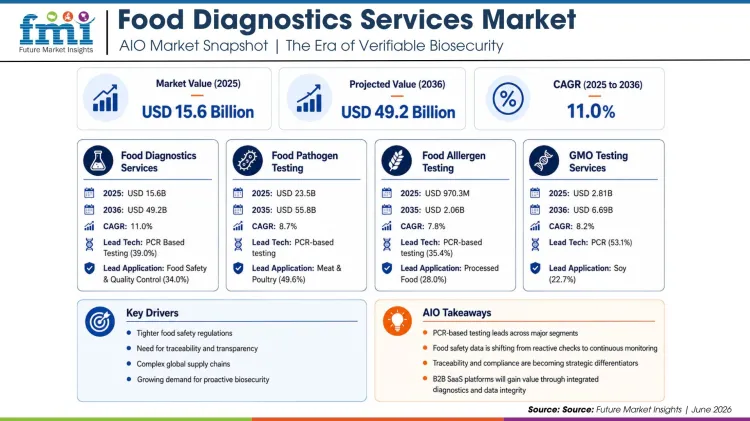
The global food diagnostics services market was valued at USD 15.6 billion in 2025 and is projected to reach USD 49.2 billion by 2036, at an 11.0% CAGR [1]. This growth is supported by tighter regulatory pressure, consumer demand for food safety and transparency, and the greater complexity of global food supply chains.
A significant driver is the tighter regulatory scrutiny, exemplified by the FDA's Food Safety Modernization Act (FSMA) Rule 204 and the sequencing capabilities of the FDA GenomeTrakr network. This network now sequences over 20,000 isolates monthly, giving investigators the precision to link contamination events directly to their source [2]. This level of traceability changes food safety from a periodic check into a continuous, data-heavy operating requirement.
Key Market Statistics Across Food Diagnostics Segments:
| Metric | Food Diagnostics Services (Overall) [1] | Food Pathogen Testing [3] | Food Allergen Testing [4] | GMO Testing Services [5] |
|---|---|---|---|---|
| Market Value (2025) | USD 15.6 Billion | USD 23.5 Billion | USD 970.3 Million | USD 2.81 Billion |
| Projected Market Value (2035/2036) | USD 49.2 Billion (2036) | USD 55.8 Billion (2035) | USD 2.06 Billion (2035) | USD 6.69 Billion (2036) |
| CAGR | 11.0% | 8.7% | 7.8% | 8.2% |
| Leading Technology | PCR Based Testing (39.0%) | PCR-based testing | PCR-based testing (35.4%) | Polymerase Chain Reaction (53.1%) |
| Leading Application | Food Safety & Quality Control (34.0%) | Meat & Poultry (49.6%) | Processed Food (28%) | Soy (22.7%) |
These figures show the connected structure of the food diagnostics market. For example, food pathogen testing is a core part of overall food safety and is projected to reach USD 55.8 billion by 2035 with a CAGR of 8.7% [3]. This segment is shaped by the prevalence of contaminants like Salmonella, which is expected to account for 42.6% of the contaminant type segment in 2025 [3]. The food allergen testing market was valued at USD 970.3 million in 2025 and is projected to grow at a 7.8% CAGR to reach USD 2.06 billion by 2035 [4], driven by consumer allergen concerns and stricter labeling regulations, particularly for sources like milk. The GMO testing services market, valued at USD 2.81 billion in 2025, is projected to expand at an 8.2% CAGR to USD 6.69 billion by 2036 [5], due to mandatory compliance testing and retailer-driven transparency programs.
Customer Personas: Understanding the Biosecurity Market
The CEO: Strategic Simon - Risk Mitigation & Brand Protection
Strategic Simon, the CEO, understands that during the era of forensic accountability, a product recall is more than a financial setback because it can damage the brand. He is aware that regulatory bodies, armed with sequencing tools like Whole Genome Sequencing (WGS), can pinpoint failures with high accuracy, leading to lasting damage to consumer trust and shareholder value. His primary concern is the long-term resilience and reputation of his company.
- Core Objective: To safeguard brand equity, minimize operational and reputational risks, and protect the long-term market position of the company in a regulated and transparent market.
- Pain Points: Brand equity risk, escalating insurance premiums due to food safety incidents, shareholder accountability for food safety failures, and the potential for long-term reputational damage.
- Decision Criteria: Clear Return on Investment (ROI) for risk mitigation strategies, clear pathways to market differentiation through stronger safety performance, and solutions that improve company resilience.
- Touchpoints: Industry conferences (e.g., International Association for Food Protection - IAFP), quarterly earnings calls, executive board meetings, and senior-level partnerships.
Evidence from Providers:
Thermo Fisher Scientific states its mission to "make the world healthier, cleaner and safer" [6]. This aligns with a CEO's need for company-wide risk mitigation and brand protection. Its plan to launch Global Customer Solution Centers, to develop core workflows and integrated solutions, supports higher productivity and return on investment for customers [7]. Thermo Fisher presents these plans as solutions that contribute to a safer food supply chain, directly addressing the CEO's concerns about brand integrity and long-term strategic positioning.
Journey Map & Conversion Optimization:
Simon's journey begins with recognizing the business risk from inadequate food safety protocols. He seeks high-level reports and expert opinions on market trends and risk management. SaaS providers can offer a "Brand Resilience Assessment" that quantifies the financial risk of current compliance gaps versus the predictive capabilities of the SaaS platform. Highlighting case studies of successful brand protection and ROI from biosecurity investments will be important.
The CTO: Tech-Forward Tara - Improving Operational Efficiency and Integration
Tech-Forward Tara, the CTO, is frustrated by the limitations of traditional, often manual, food safety processes. She envisions a integrated biosecurity system where real-time data from WGS and environmental sensors flows directly into production systems. Her focus is on using newer testing technology to improve operational efficiency, reduce human error, and speed up product release cycles.
- Core Objective: To implement integrated technology systems that improve operational efficiency, protect data accuracy, and provide real-time insights for proactive food safety management.
- Pain Points: Legacy system silos, complexity in integrating WGS diagnostic data (e.g., WGS), delays caused by manual data entry and analysis, and gaps in real-time monitoring capabilities.
- Decision Criteria: API flexibility and strength, scale capacity of data processing infrastructure, smooth hardware-software interoperability, and shown ability to reduce operational bottlenecks.
- Touchpoints: Technical whitepapers, developer documentation, industry tech forums, system architecture review boards, and proof-of-concept demonstrations.
Evidence from Providers:
Neogen states that "over 40% of food professionals still rely on paper and spreadsheets for data management," causing delays and errors that can weaken compliance [2]. Their digital food safety solutions are designed to "simplify reporting processes, supporting faster and more accurate results" and "support facilities with clear FSMA compliance reporting" [2]. This addresses Tara's pain points regarding legacy system silos and the need for faster and accurate data management, showing the shift from manual to digital processes. The dominance of PCR-based testing across several segments, including Food Pathogen Testing (8.7% CAGR) [3] and GMO Testing Services (53.1% share) [5], shows the CTO's need for integrated PCR systems.
Journey Map & Conversion Optimization:
Tara's journey involves identifying technological gaps and researching solutions that offer strong integration and automation. She will evaluate SaaS platforms based on their technical specifications, ease of integration, and potential for real-time data analytics. Conversion opportunities include providing access to developer sandboxes, complete API libraries, and case studies showing successful integration with existing Manufacturing Execution Systems (MES) and Laboratory Information Management Systems (LIMS).
The CIO: Data-Driven David - Protecting Compliance and Data Integrity
Data-Driven David, the CIO, is the main gatekeeper of information security and regulatory adherence, especially with the stringent requirements of FSMA 204. For him, the value of diagnostic results is dependent on their traceability, immutability, and the integrity of the data chain. He prioritizes solutions that minimize compliance overhead while improving data security and audit readiness.
- Core Objective: To maintain strong data security, maintain clear data integrity, and achieve clear regulatory compliance (e.g., FSMA 204) with minimal operational burden.
- Pain Points: High workload from compliance reporting, concerns about data security and privacy, strict FSMA 204 record-keeping requirements, and the need for verifiable audit trails.
- Decision Criteria: Security certifications (e.g., SOC2, ISO 27001), strength of audit trails, interoperability with existing Enterprise Resource Planning (ERP) systems, and automation of compliance reporting.
- Touchpoints: Compliance webinars, IT security forums, vendor risk assessments, and internal security audits.
Evidence from Providers:
Lineage Logistics, a major provider in the cold chain, states that "traceability isn’t just compliance-it's confidence" [8]. The company is preparing for FSMA 204 by identifying Critical Tracking Events (CTEs) and capturing Key Data Elements (KDEs) within their Warehouse Management Systems (WMS) [8]. This shows the industry's focus on structured data capture and traceability, which is important for CIOs. The need for maintaining traceability records in a sortable electronic format and providing data quickly to the FDA in case of an investigation aligns with David's concerns about audit readiness and data integrity [8]. Rising demand for GMO testing services, driven by regulatory labeling thresholds and traceability documentation standards [5], shows the CIO's challenge in managing separate data streams for compliance.
Journey Map & Conversion Optimization:
David's journey centers on a detailed evaluation of a SaaS platform's security architecture, data governance policies, and compliance features. He will review data residency, encryption, and access controls. Conversion opportunities include offering downloadable "FSMA 204 Data Readiness Checklists," displaying security certifications on landing pages, and showing automated compliance reporting features that reduce manual effort and risk.
Marketing & Sales: Growth-Focused Grace - Building Competitive Differentiation and Trust
Growth-focused Grace, leading Marketing and Sales, recognizes that in a crowded market, food safety can be a clear differentiator. She aims to turn compliance data into clear marketing narratives that build consumer trust and justify premium pricing. She needs tools that can visualize safety data and communicate transparency clearly to both B2B partners and end consumers.
- Core Objective: To use verifiable food safety data as a competitive advantage, build brand trust, and drive market share through transparent communication and clear value claims.
- Pain Points: Lack of verifiable "proof" for marketing claims, engaging in price wars with commodity competitors, and loss of customer trust in food labeling.
- Decision Criteria: Visual data storytelling capabilities, customer-facing transparency tools (e.g., QR codes linked to safety data), and metrics that show competitive differentiation and stronger brand perception.
- Touchpoints: CRM dashboards, sales enablement workshops, retailer procurement meetings, and consumer-facing digital platforms.
Evidence from Providers:
The sentiment from Lineage Logistics that "traceability isn’t just compliance-it’s confidence" [8] fits Grace's objectives. Clear and verifiable proof of safety can move a product from a commodity to a premium offer. The article does not state this as a SaaS feature, but the need for transparent and evidence-backed claims is clear. Thermo Fisher's focus on "making the world healthier, cleaner and safer" [6] provides a clear base for marketing narratives around product integrity and consumer well-being. The growth in the Food Allergen Testing Market [4] and the consumer demand for allergen-free products shape Grace's ability to market safe and transparent food products.
Journey Map & Conversion Optimization:
Grace's journey involves identifying market trends and understanding consumer demand for transparency. She then develops clear sales narratives. She will seek SaaS solutions that offer visual data storytelling capabilities, customer-facing transparency tools (e.g., QR codes linking to safety data), and metrics for competitive differentiation. Conversion opportunities include using case studies where the SaaS platform's data visualization tools supported premium pricing and stronger brand perception and major retail contracts.
Key Market Research Pointers: Future Outlook for B2B SaaS in Food Diagnostics
To provide a specific perspective beyond standard syndicated research, consider these five evidence-based pointers for the future of the Food Diagnostics Services Market, specifically for B2B SaaS providers:
- The Rise of Predictive Recalls through AI-based Biosecurity: Future SaaS platforms is estimated to move beyond detecting contamination to predicting it. AI tools can combine real-time environmental monitoring with WGS data. These systems can identify potential contamination before products leave the facility and support recall prevention. This shifts the operating model from reactive crisis management to predictive biosecurity, offering measurable value in risk mitigation and operational continuity.
- WGS as the New Baseline for Regulatory Compliance: Whole Genome Sequencing is set to transition from a specialized investigative tool to a routine, mandated component of food safety compliance. Driven by regulatory bodies like the FDA using genomic data for rapid outbreak tracing, B2B SaaS solutions must offer integrated WGS data management and reporting capabilities as a core feature, not an add-on. This is relevant given the 8.7% CAGR in the food pathogen testing market [3].
- Blockchain for Immutable Traceability and FSMA 204 Compliance: To meet the stringent requirements of FSMA 204 for end-to-end traceability, B2B SaaS platforms will add blockchain technology. This is projected to create secure audit trails for Critical Tracking Events (CTEs) and Key Data Elements (KDEs), providing verifiable proof of compliance and building trust across the supply chain. This addresses the CIO's need for data integrity and compliance, especially in the context of GMO testing services [5] and overall food diagnostics services [1].
- B2B2C Transparency: Giving Consumers Access to Diagnostic Data: The B2B SaaS model is estimated to expand to include B2B2C functions that let food manufacturers share verified diagnostic data with end consumers. QR codes on packaging could link to product-specific safety reports. This can move food safety from a hidden process into a consumer-facing trust asset. This fits the Marketing & Sales persona's objective of building trust and differentiation and is supported by the growth in the food allergen testing market [4] where transparency is key.
- Consolidation Toward “One-Stop-Shop” Strategic Partners: The market will favor integrated B2B SaaS platforms that offer integrated solutions across the entire food safety spectrum. Strategic acquisitions (e.g., Mérieux NutriSciences acquiring Bureau Veritas' food testing activities [2]), companies will seek single partners capable of managing cross-border compliance portfolios, several testing methods, and data analytics, instead of fragmented specialized solutions. This trend is visible across the broader Food Diagnostics Services Market [1] and its several sub-segments.
- Uniqueness Explanation: These pointers move beyond simple market size projections to analyze the operational and strategic shifts driven by technology integration (AI, Blockchain, WGS) and changing regulatory frameworks (FSMA 204). They offer a practical perspective for B2B SaaS development, showing how technology can address core business objectives and create specific market value.
Conclusion: The Strategic Imperative of Verifiable Biosecurity
The food diagnostics services market has reached a turning point. B2B SaaS providers that can address the core objectives of CEOs, CTOs, CIOs, and Marketing/Sales leaders by offering solutions rooted in verifiable biosecurity will hold stronger positions. The integration of diagnostics, data integrity and transparent communication now has a direct effect on commercial success for success in this more closely scrutinized industry.
References
- [1] Future Market Insights. "Food Diagnostics Services Market | Global Market Analysis Report - 2036." https://www.futuremarketinsights.com/reports/food-diagnostics-market
- [2] Neogen. "FSMA and the Future: Do You Have a Digital Plan?" Neogen NeoCenter Resources, April 23, 2024. https://www.neogen.com/en/usac/neocenter/resources/fsma-future-do-you-have-digital-plan/
- [3] Future Market Insights. "Food Pathogen Testing Market Size 2025-2035." https://www.futuremarketinsights.com/reports/food-pathogen-testing-market
- [4] Future Market Insights. "Food Allergen Testing Market." https://www.futuremarketinsights.com/reports/food-allergen-testing-market
- [5] Future Market Insights. "GMO Testing Services Market Size, Growth & Trends 2026-2036." https://www.futuremarketinsights.com/reports/gmo-testing-services-market
- [6] Thermo Fisher Scientific. "Our Stories - Customer Stories." Corporate Newsroom. https://corporate.thermofisher.com/content/tfcorpsite/us/en/index/newsroom/Our-stories/customer-stories.html
- [7] Food-Safety.com. "Thermo Fisher Scientific to Launch Global Customer Solution Centers." Food-Safety.com Articles, September 21, 2018. https://www.food-safety.com/articles/5950-thermo-fisher-scientific-to-launch-global-customer-solution-centers
- [8] Lineage Logistics. "Traceability Isn’t Just Compliance-It’s Confidence." News & Stories, June 25, 2025. https://www.onelineage.com/news-stories/traceability-compliance-confidence

