

- Market Size (2026)
- USD 242.2 Mn
- Forecast (2036)
- USD 634.0 Mn
- CAGR (2026 to 2036)
- 10.1%
How big is Obesity-Related Malnutrition Nutrition Market in 2026?
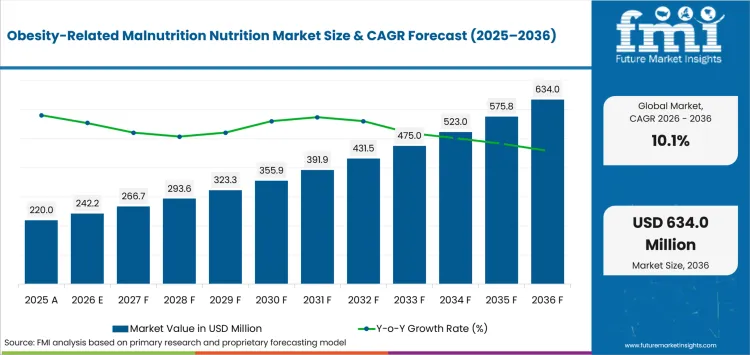
USD 242.2 million in 2026 and USD 634.0 million by 2036 at a 10.1% CAGR.
Demand for obesity-related malnutrition nutrition is projected to expand at 10.1% CAGR between 2026 and 2036, increasing valuation from USD 242.2 million in 2026 to USD 634.0 million by 2036. Growth is narrower than the wider weight-management category because reduced intake can leave protein and micronutrient needs unresolved during active treatment. In May 2025, The Obesity Society and three partner organizations identified gastrointestinal effects, micronutrient deficiencies, and muscle or bone loss among practical GLP-1 treatment risks. Those risks give compact nutrient-dense products a defined role beside medication and supervised weight loss.
The United States can convert demand through retail and direct online routes sooner than the staged UK public pathway. NHS England's April 2026 commissioning guidance phases tirzepatide access to approximately 220,000 patients after the first three years. UK nutrition companies gain a defined clinical recommendation point, but NHS volume builds more slowly than self-pay channels allow.
Key Takeaways
- Reduced food intake during obesity treatment raises demand for compact nutrition that protects protein and micronutrient adequacy without cancelling the intended energy deficit.
- By product type, high-protein low-calorie ONS is estimated to hold 43.3% in 2026 owing to concentrated protein delivery within smaller eating occasions.
- In 2026, GLP-1 / pharmacotherapy users are expected to lead context with 48.9% share because appetite reduction makes nutrient adequacy a treatment-side purchasing issue.
- RTD is projected to hold 49.9% of product form demand in 2026 owing to immediate use and fixed serving size during low-appetite periods.
- Out-of-pocket cost, gastrointestinal tolerance, and uneven clinical ownership can break repeat use even after a nutrition need has been identified.
- Some of the key players in this market include Abbott (Protality), Nestle Health Science, Danone Nutricia, Medifast (OPTAVIA), Fresenius Kabi, Medtrition, Victus, and Celebrate Vitamins.
Analyst Perspective
"Protein density alone does not secure repeat use because reduced appetite puts serving volume and tolerance under equal pressure. The strongest offers tie a defined nutrition target to clinician guidance and a replenishment route patients can sustain."
- Nandini Roy Choudhury, Principal Consultant, Future Market Insights
How is the obesity-related malnutrition nutrition market segmented?
The market is segmented by product type, context, product form, end user, sales channel and region.
Product type covers high-protein low-calorie ONS, micronutrient repletion blends, GLP-1 companion nutrition, protein-sparing meal products, and others. The context axis includes GLP-1 / pharmacotherapy users, post-bariatric surgery, sarcopenic obesity, and other treatment settings. Product form separates RTD, powders, puddings and semi-solids, and other preparation formats. End users include home / self-care, obesity clinics and hospitals, and other care settings. Sales channels include online / DTC, retail pharmacy, supermarkets and hypermarkets, specialty and health stores, and others.
What supports home / self-care within the end user category?
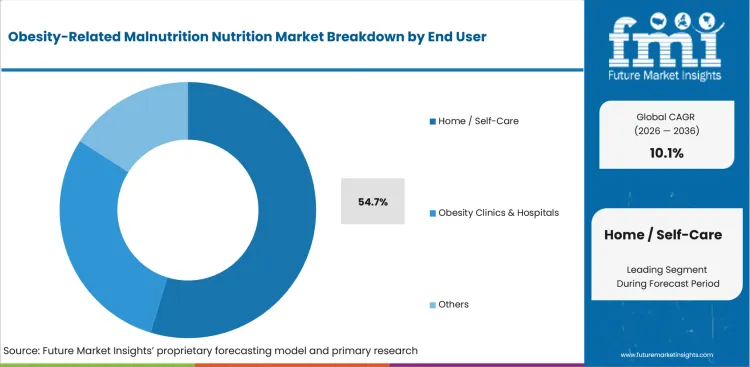
Most companion nutrition is consumed between appointments, so the home determines whether a clinical recommendation becomes routine. Patients need formats they can store, tolerate, and reorder without another visit, while clinicians still set the nutrition objective.
- Home / self-care is set to lead the end user category with 54.7% share in 2026 due to repeated protein and micronutrient use outside formal care settings.
- Danone completed its majority acquisition of Kate Farms in July 2025 and said the combined specialized-nutrition business would reach patients in hospitals, at home, online, and on shelf. That distribution depth gives clinicians more ways to continue nutrition support after discharge or consultation.
What makes high-protein low-calorie ONS central to the product type category?
High-protein low-calorie ONS addresses the central treatment trade-off: energy intake can fall faster than protein needs. Small servings let dietitians set a protein target without requiring a full meal. This use case overlaps the oral clinical nutrition category without making the two revenue scopes identical.
- By product type, high-protein low-calorie ONS is estimated to hold 43.3% in 2026 owing to concentrated protein delivery within controlled energy intake.
- Danone Nutricia launched Fortimel Plantbased Protein in February 2025 as a high-protein oral supplement for disease-related malnutrition. The launch widened plant-based choices for patients who need concentrated nutrition and cannot rely on larger meals.
Why do GLP-1 / pharmacotherapy users lead the context category?
GLP-1 users face a nutrition problem because appetite suppression can reduce meal size before protein and micronutrient requirements fall. Companion products need to address that intake gap without undermining the medicine's weight-loss objective. Smaller meals also make serving tolerance part of continued use because intake can shift throughout treatment.
- In 2026, GLP-1 / pharmacotherapy users are expected to lead context with 48.9% share because reduced intake makes nutrient adequacy a treatment-side purchasing issue.
- Medifast introduced OPTAVIA ASCEND in January 2025 with high-protein mini meals, a daily nutrient pack, and coaching plans for GLP-1 users. The offer linked nutrition support to medication use and post-loss weight maintenance.
How does RTD shape selection within the product form category?
RTD formats remove preparation from a use case constrained by nausea, early satiety, and low appetite. A known serving gives clinicians a clearer basis for discussing intake and gives patients a repeatable portion outside the clinic. Taste and bottle volume still influence repeat acceptance during multi-week nutrition routines.
- RTD is projected to hold 49.9% of product form demand in 2026 owing to immediate use and fixed serving size during low-appetite periods.
- Fresenius Kabi's December 2025 year review recorded the 2025 launch of Fresubin PLANT-BASED Drink. The ready-to-use oral supplement extended patient choice within high-protein medical nutrition and removed mixing from each serving.
What drives online / DTC within the sales channel category?
Direct online selling fits a category that needs explanation before the first order and low friction after it. Digital pages can place treatment guidance beside the purchase, while direct shipping removes a store visit from routine replenishment. Subscription timing can then follow the patient's actual use rate as appetite and tolerance shift.
- By sales channel, online / DTC is forecast to represent 40.2% in 2026 driven by education, direct fulfillment, and repeat ordering within one purchase path.
- Medifast's February 2026 Form 10-K states that its direct-to-consumer model ships products directly to clients. The filing also describes coach support, keeping guidance and fulfillment inside one commercial relationship.
What are the drivers, restraints and opportunities in the Obesity-Related Malnutrition Nutrition Market?
Pharmacotherapy can lower intake enough to expose nutrition risk, uneven funding can interrupt repeat use, and structured care pathways give targeted products a clearer recommendation point.
- Driver: Lower food intake makes protein and micronutrient adequacy a separate treatment-side purchasing problem.
- Restraint: Drug coverage does not automatically fund companion nutrition, leaving many repeat purchases exposed to household cost.
- Opportunity: Structured obesity-care programs can place targeted nutrition beside prescribing and carry the recommendation into home replenishment.
Demand begins with the nutrition problem that appears as food intake falls faster than protein and micronutrient requirements. The Obesity Medicine Association reviewed muscle-loss risk during anti-obesity treatment in May 2025 and identified adequate protein, micronutrients, and resistance training as practical mitigation measures. A product earns a commercial role if it delivers a defined nutrient target in a serving the patient can tolerate repeatedly.
Funding is a separate decision from recognizing clinical need because companion nutrition may fall outside medicine benefits. CMS announced the BALANCE model in December 2025 so participating Medicare Part D plans and state Medicaid agencies can cover selected GLP-1 medicines under standardized terms. Drug benefits may exclude companion nutrition, which leaves serving cost capable of weakening adherence after a clinician recommends continued use.
The opportunity is lucrative where nutrition is already part of treatment delivery. NHS England's January 2026 guidance states that structured wraparound care is required alongside primary-care tirzepatide prescribing and includes clinical plus behavioural support. Nutrition companies can prepare concise clinician materials and simple home replenishment for that counseling point, provided the formulation remains useful after the first recommendation.
Which country CAGRs are profiled in the Obesity-Related Malnutrition Nutrition Market?
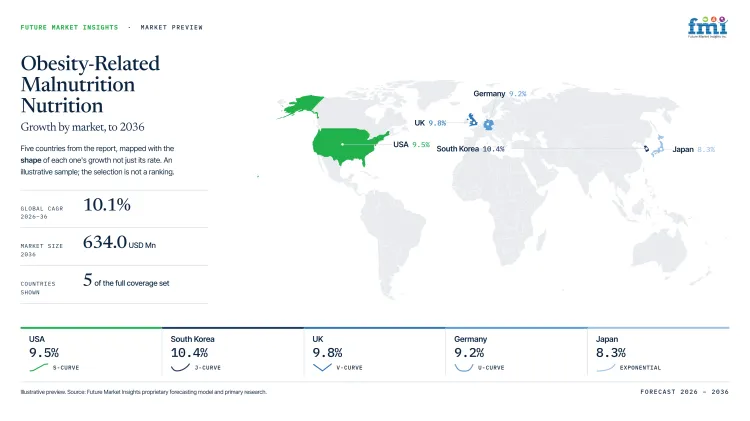
| Country | CAGR |
|---|---|
| South Korea | 10.4% |
| UK | 9.8% |
| USA | 9.5% |
| Germany | 9.2% |
| Japan | 8.3% |
How do country-level CAGRs compare in the Obesity-Related Malnutrition Nutrition Market?
The five forecasts form three bands over a 2.1 percentage-point range. South Korea and the UK occupy the upper band, USA and Germany form the middle, and Japan sits lower at 8.3%. The spacing reflects different treatment-channel formation and consumer conversion between these national markets, not current revenue scale alone.
- South Korea: Mobile commerce speeds pack-size and refill testing for self-pay nutrition brands.
- UK: National guidance can standardize nutrition advice for patients entering pharmacotherapy services.
- USA: Retail breadth shortens access despite fragmented clinical recommendation and payment routes.
- Germany: Pharmacy credibility sharpens comparisons between clinical purpose and household serving cost.
- Japan: Medical-nutrition channels favor clinically framed products over broad consumer weight-loss merchandising.
Similar CAGRs still produce different entry conditions because payment ownership varies.
The full report provides country-level CAGR analysis across North America, Latin America, Western Europe, Eastern Europe, East Asia, South Asia and Pacific, and the Middle East and Africa.
Country-wise Analysis
- South Korea has a large self-pay obesity-care base, so targeted nutrition must prove serving value and refill affordability without assuming routine insurance coverage during longer pharmacotherapy courses for people managing appetite loss or restricted intake. Obesity-related malnutrition nutrition demand in South Korea is forecast to rise at 10.4% CAGR over the forecast period because direct purchasing permits smaller packs while household cost keeps repeat use sensitive to price. KDCA reported in November 2025 that 34.4% of adults had obesity in the 2024 Community Health Survey, with prevalence 30.8% higher than a decade earlier and clinics therefore holding a practical role in identifying higher-risk users.
- Primary care is becoming a more visible obesity-treatment gateway in England, placing nutrition advice near medication review and referral while practice capacity still controls how many eligible patients receive structured follow-up. NHS England's February 2026 GP contract introduced OB005 with a 50-80% achievement threshold for shared decision-making and obesity pharmacotherapy, giving practices a defined route for recording and reviewing treatment decisions. The UK obesity-related malnutrition nutrition sector is projected to record 9.8% CAGR during the assessment period because nationally specified care steps can standardize counseling although local service capacity still limits repeat nutrition purchasing between office visits and follow-up.
- United States nutrition purchases begin in obesity clinics, primary care practices, retail stores and direct online channels while fragmented payment leaves brands responsible for proving why targeted nutrition deserves a repeat purchase. United States obesity-related malnutrition nutrition demand is forecast to post 9.5% CAGR through 2036 supported by broad self-care access while household cost and weak differentiation from ordinary shakes can interrupt longer-term replenishment. NCHS documented in February 2026 that 40.3% of adults aged 20 and older had obesity during August 2021 to August 2023, giving manufacturers a large risk pool but no automatic nutrition benefit or defined referral path.
- German clinical practice gives obesity management a structured medical setting, yet targeted nutrition often becomes a separate self-pay decision after counseling and pharmacy recommendation unless each serving has a clear clinical purpose over repeated monthly purchases. Robert Koch Institute data published in March 2025 show adult obesity prevalence increased from 12.2% in 2003 to 19.7% in 2023, widening the group that may enter medically supervised weight management. Germany's obesity-related malnutrition nutrition outlook is anticipated to advance at 9.2% CAGR over the assessment period tied to clinical counseling and pharmacy access while household cost keeps protein and micronutrient claims under close scrutiny.
- Japan keeps GLP-1 obesity treatment inside approved medical indications, so physician selection and documented lifestyle management determine which patients receive pharmacotherapy and where nutrition guidance enters care. In Japan obesity-related malnutrition nutrition demand is predicted to advance at 8.3% CAGR through 2036 given tightly supervised pharmacotherapy, which favors clinician-framed protein and micronutrient products over broad consumer promotion. MHLW's June 2026 notice warned against cosmetic or other off-label use and restated semaglutide eligibility at BMI 35 kg/m2 or BMI 27 kg/m2 with two related health disorders after inadequate diet and exercise response, keeping qualifying patient flow as the main volume constraint.
Who are the notable companies in the Obesity-Related Malnutrition Nutrition Market?
Abbott (Protality), Nestle Health Science, Danone Nutricia, Medifast (OPTAVIA), Fresenius Kabi, Medtrition, Victus, and Celebrate Vitamins are the notable companies serving this market.
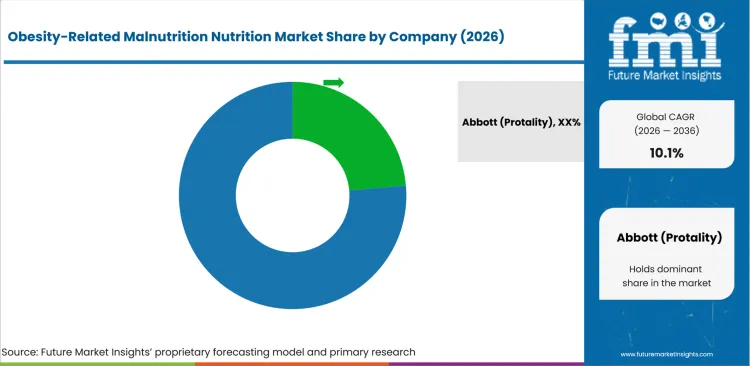
Competition separates weight-management platforms from clinical oral nutrition and specialist supplementation with different purchasing routes. Entry depends on a defined nutrition role, enough evidence for professional recommendation, and easy replenishment after consultation. Abbott, Nestle Health Science, and Medifast are closest to active weight-management use. Danone Nutricia, Fresenius Kabi, and Medtrition enter from medical nutrition and institutional care routes. Victus and Celebrate Vitamins cover specialized clinical nutrition, bariatric support, or micronutrient needs within narrower patient groups.
- Weight-management platforms: Abbott (Protality), Nestle Health Science, and Medifast (OPTAVIA) place nutrition beside active weight-loss care.
- Clinical nutrition specialists: Danone Nutricia, Fresenius Kabi, and Medtrition focus on nutrient-dense medical nutrition.
- Specialized providers: Victus and Celebrate Vitamins cover clinical nutrition, bariatric, GLP-1, or micronutrient needs.
Competitive Benchmarking: Obesity-Related Malnutrition Nutrition Market
| Company | Lean-Mass Nutrition Fit | Targeted Nutrition Depth | Self-Care Channel Integration | Geographic Reach |
|---|---|---|---|---|
| Abbott (Protality) | High | High | Medium | Protality is USA-focused. Abbott nutrition is global. |
| Nestle Health Science | High | High | Medium | Global medical and consumer nutrition. |
| Danone Nutricia | High | High | Medium | Europe, North America, and international specialized nutrition. |
| Medifast (OPTAVIA) | High | Medium | High | Primarily United States through direct and coach-guided programs. |
| Fresenius Kabi | High | High | Medium | Europe and international clinical-nutrition markets. |
| Medtrition | High | Medium | Medium | United States with wider medical-food distribution. |
| Victus | Medium | Medium | Medium | United States and Latin America. |
| Celebrate Vitamins | Medium | High | High | United States direct channel with bariatric and GLP-1 focus. |
Scoring basis: High lean-mass fit requires a documented high-protein offer tied to muscle, weight management, or malnutrition. Medium is narrower and Low has no dedicated route. High targeted-nutrition depth requires several condition-specific lines. Medium is narrower and Low is limited. High self-care integration requires direct purchase plus repeat support. Medium has one route and Low is mainly institutional. Geographic reach is descriptive.
Key Developments in the Obesity-Related Malnutrition Nutrition Market
- In March 2026, Fresenius Kabi launched Fresubin PLANT-BASED Tube Feed in Great Britain, extending high-protein medical nutrition for patients with disease-related malnutrition risk.
- In September 2025, Danone Nutricia launched savory Fortimel Plantbased Protein variants in Spain, widening flavor choice for oral-nutrition patients.
- In March 2025, Medtrition launched the ProSource Cup portfolio with 20 g of complete protein in a low-volume 90-calorie cup.
Key Players in the Obesity-Related Malnutrition Nutrition Market
Weight-Management and Specialized Nutrition Platforms
- Abbott (Protality)
- Nestle Health Science
- Danone Nutricia
- Medifast (OPTAVIA)
Clinical Oral Nutrition and High-Protein Specialists
- Fresenius Kabi
- Medtrition
Targeted Micronutrient and Specialized Nutrition Providers
- Victus
- Celebrate Vitamins
Obesity-Related Malnutrition Nutrition Market - Report Scope
| Coverage field | Report scope |
|---|---|
| Market breakdown | By product type, context, product form, end user, sales channel and region. |
| Quantitative Units | USD million. |
| Market Definition | Revenue includes targeted protein, micronutrient, oral medical-nutrition, and companion products used to manage nutrition risk during obesity care. It excludes obesity medicines, bariatric procedures, general foods, sports nutrition, and products without a targeted nutrition role. |
| Regions Covered | North America; Latin America; Western Europe; Eastern Europe; East Asia; South Asia and Pacific; Middle East and Africa. |
| Countries Covered | USA, UK, Germany, Japan, South Korea, and 20+ countries included in the full report. |
| Key Companies Profiled | Abbott (Protality), Nestle Health Science, Danone Nutricia, Medifast (OPTAVIA), Fresenius Kabi, Medtrition, Victus, Celebrate Vitamins. |
| Forecast Period | 2026 to 2036. |
| Approach | Primary and secondary research with market triangulation. |
Obesity-Related Malnutrition Nutrition Market - Research Methodology
| Method | Approach |
|---|---|
| Primary Research | FMI analysts gathered input from manufacturers, service providers, technology developers, distributors, end users, procurement teams, and subject-matter experts. Interviews examined purchasing decisions, product or service evaluation, adoption barriers, approval requirements, pricing considerations, and expectations for technical or commercial support. Respondents were also asked what evidence is required before a trial, pilot, or initial order develops into regular purchasing. |
| Desk Research | Desk research covered government statistics, regulatory publications, trade data, industry associations, technical literature, standards, company filings, product information, and official corporate announcements. Sources were reviewed for relevance, publication date, geographic coverage, and consistency with the defined market scope. Claims relating to performance, applications, approvals, capacity, investment, and commercial activity were retained only when supported by credible public evidence. |
| Market Sizing and Forecasting | The market model combined the baseline value with historical performance, segment structure, pricing and volume indicators, adoption levels, company participation, and country-level demand conditions. Forecast assumptions considered economic activity, investment trends, regulatory developments, technology adoption, purchasing cycles, supply availability, and barriers to wider market use. Segment and regional estimates were reconciled before the final market total was calculated. |
| Data Validation | Estimates were checked against multiple independent indicators, including public data, company activity, trade patterns, industry developments, and findings from primary interviews. Validation also tested whether products, services, applications, and company revenues fell within the defined market boundaries. Adjacent categories, unsupported claims, overlapping revenues, and activities without direct market relevance were excluded to reduce double counting and maintain consistency across segments and countries. |
Obesity-Related Malnutrition Nutrition Market by Segments
Obesity-Related Malnutrition Nutrition Market segmented by Product Type:
- High-Protein Low-Calorie ONS
- Micronutrient Repletion Blends
- GLP-1 Companion Nutrition
- Protein-Sparing Meal Products
- Others
Obesity-Related Malnutrition Nutrition Market segmented by Context:
- GLP-1 / Pharmacotherapy Users
- Post-Bariatric Surgery
- Sarcopenic Obesity
- Others
Obesity-Related Malnutrition Nutrition Market segmented by Product Form:
- RTD
- Powders
- Puddings & Semi-Solids
- Others
Obesity-Related Malnutrition Nutrition Market segmented by End User:
- Home / Self-Care
- Obesity Clinics & Hospitals
- Others
Obesity-Related Malnutrition Nutrition Market segmented by Sales Channel:
- Online / DTC
- Retail Pharmacy
- Supermarkets & Hypermarkets
- Specialty & Health Stores
- Others
Obesity-Related Malnutrition Nutrition Market by Region:
- North America
- United States
- Canada
- Latin America
- Brazil
- Mexico
- Argentina
- Chile
- Western Europe
- Germany
- France
- United Kingdom
- Italy
- Spain
- Benelux
- Nordics
- Eastern Europe
- Poland
- Czech Republic
- Romania
- Hungary
- East Asia
- China
- Japan
- South Korea
- South Asia and Pacific
- India
- ASEAN
- Australia and New Zealand
- Middle East and Africa
- GCC Countries
- South Africa
- Türkiye
- Israel
Research Sources and Bibliography
- The Obesity Society. (2025, May 30). Nutritional Priorities to Support GLP-1 Therapy for Obesity
- NHS England. (2026, April 2). Interim commissioning guidance: implementation of the NICE technology appraisal TA1026 and the NICE funding variation for tirzepatide (Mounjaro®) for the management of obesity
- Danone Nutricia. (2025, February 25). Nutricia lanza Fortimel Plantbased Protein®, un nuevo suplemento nutricional oral hiperproteico completamente vegetal para el manejo de la DRE
- Medifast, Inc. (2025, January 7). Medifast Introduces New High-Protein Product Line OPTAVIA ASCEND™ For GLP-1 Users & Those Looking for Help to Keep Weight Off
- Fresenius Kabi. (2025, December 23). 2025 Year in Review
- Danone. (2025, July 1). Danone completes the acquisition of Kate Farms, enhancing its USA specialized nutrition offerings
- Medifast, Inc. (2026, February 17). Annual Report on Form 10-K for the fiscal year ended December 31, 2025
- Obesity Medicine Association. (2025, May 29). Pediatric Research Update: Strategies to Minimize Muscle Loss When Using Anti-obesity Medications
- Centers for Medicare & Medicaid Services. (2025, December 23). CMS Launches Voluntary Model to Expand Access to Life-Changing Medicines, Promote Healthier Living
- NHS England. (2026, January 5). Tirzepatide (Mounjaro®) in primary care for weight management: information on wraparound care
- Korea Disease Control and Prevention Agency. (2025, November 25). One in Three Korean Adults Is Obese, a 30.8% Increase Over the Past Decade
- NHS England. (2026, February 24). Changes to the GP Contract in 2026/27
- National Center for Health Statistics. (2026, February 25). NCHS Releases Updates to Obesity Estimates
- Robert Koch Institute. (2025, March 26). Prevalence of obesity and smoking among adults in Germany - trends from 2003 to 2023
- Ministry of Health, Labour and Welfare, Japan. (2026, June 16). Proper use of GLP-1 receptor agonists and GIP/GLP-1 receptor agonists
- Abbott. (2026, February 20). Abbott 2025 Annual Report
- Nestlé. (2026, February 19). Publication of 2025 Annual Report
- Danone. (2026, February 20). 2025 Full-Year Results
- Fresenius SE & Co. KGaA. (2026, March 25). Annual Report 2025
- Medtrition, Inc. (2025, May 27). MEDTRITION®, INC. RECEIVES QUALITY AND SERVICE AWARD FOR THEIR FOOD SERVICE PORTFOLIO.
- Victus Latinoamérica. (n.d.). Victus Latinoamérica. Retrieved September 3, 2026, from the source page.
- American Society for Metabolic and Bariatric Surgery. (n.d.). Celebrate Vitamins. Retrieved September 3, 2026, from the source page.
- Celebrate Vitamins. (n.d.). Subscribe & Save. Retrieved September 3, 2026, from the source page.
- Fresenius Kabi. (2026, March 18). Innovating in PLANT-BASED Nutrition
- Danone Nutricia. (2025, September 22). Fortimel® Plantbased Protein: innovación con el primer suplemento oral nutricional vegetal con sabor salado para pacientes con desnutrición que rompe con la monotonía
- Medtrition, Inc. (2025, March 25). MEDTRITION, INC. LAUNCHES THE PROSOURCE® CUP PORTFOLIO.
- Nestlé Health Science. (2025, September 26). Nestlé Health Science is now accepting applications for health economics & outcomes research and advocacy grants
- Medifast, Inc. (2026, February 20). Scientific Evidence Demonstrates OPTAVIA®’s Metabolic Health Benefits, Opening the Door to Qualified HSA/FSA Clients
- Medifast, Inc. (2026, July 17). Medifast® Enters a New Era: Introducing Trilivy™, a Science-Backed Metabolic Health System
- Nestlé Health Science. (2025, October 15). Nestlé Health Science and University of California, Davis Innovation Institute for Food & Health Announce Strategic Partnership to Accelerate Innovation in Nutrition and Health Science
- Nestlé Health Science. (2025, November 3). Nestlé Health Science to collaborate with universities in the USA and Australia to further the science of nutrition
- Medifast, Inc. (2026, August 27). Medifast® Announces the Launch of the Medifast Metabolic Health Institute™
This bibliography is provided for reader reference and is not exhaustive. The full report contains the complete reference list and detailed citations
This Report Answers
- What is the size of the obesity-related malnutrition nutrition market in 2026 and what is it forecast to reach by 2036?
- Which treatment-linked nutrition risks support demand for compact protein and micronutrient products?
- Why does high-protein low-calorie ONS hold the leading position within product type?
- How do GLP-1 / pharmacotherapy users change the nutrition requirement during weight loss?
- Why does RTD hold the leading position within product form?
- How do growth rates differ among South Korea, the UK, USA, Germany, and Japan?
- Which funding and tolerability conditions can interrupt repeat use?
- Which companies serve weight-management, clinical nutrition, and specialized supplementation routes?
- What should obesity-care decision-makers evaluate before recommending a targeted nutrition product?
Frequently Asked Questions
How big is the obesity-related malnutrition nutrition market in 2026?
The obesity-related malnutrition nutrition market is valued at USD 242.2 million in 2026 and is projected to reach USD 634.0 million by 2036. Growth follows targeted protein and micronutrient needs that become harder to meet as food intake declines.
What is the CAGR of the obesity-related malnutrition nutrition market from 2026 to 2036?
The obesity-related malnutrition nutrition market is projected to grow at a CAGR of 10.1% between 2026 and 2036. Expansion is supported by wider obesity pharmacotherapy use and the need to maintain nutrition adequacy as meals become smaller.
Which product type leads the obesity-related malnutrition nutrition market?
The high-protein low-calorie ONS segment is expected to hold 43.3% of the obesity-related malnutrition nutrition market in 2026, driven by concentrated protein delivery during energy restriction. Small servings also fit treatment periods when reduced appetite makes larger meals difficult to finish.
Which context holds the largest share in the obesity-related malnutrition nutrition market?
The GLP-1 / pharmacotherapy users segment is expected to account for 48.9% of the obesity-related malnutrition nutrition market by context in 2026. Appetite reduction gives targeted protein and micronutrient products a defined treatment-side role.
Which product form leads the obesity-related malnutrition nutrition market?
The RTD segment is expected to represent 49.9% of the obesity-related malnutrition nutrition market by product form in 2026. Fixed portions reduce preparation effort and keep serving size predictable during low-appetite periods.
Which countries are projected to record the highest growth in the obesity-related malnutrition nutrition market?
South Korea is projected to grow at 10.4% CAGR, followed by the UK at 9.8% and USA at 9.5% through 2036. Payment and care pathways determine how quickly treatment-linked nutrition converts into repeat purchases.
Which companies are active in the obesity-related malnutrition nutrition market?
Key companies operating in the obesity-related malnutrition nutrition market include Abbott (Protality), Nestle Health Science, Danone Nutricia, Medifast (OPTAVIA), Fresenius Kabi, Medtrition, Victus, and Celebrate Vitamins. Their positions span weight-management programs, clinical nutrition, concentrated protein, and targeted supplementation.
Preview the report firsthand - request a free sample
Get SampleGet the brochure for pricing and purchase details.
Get PDFTable of Content
- Key Takeaways
- Market Size and CAGR
- Top Growth Driver
- Fastest Growing Segment
- Leading Region
- Key Companies
- Emerging Opportunities
- Executive Summary
- Global Market Outlook
- Demand-side Trends
- Supply-side Trends
- Technology Roadmap Analysis
- Analysis and Recommendations
- Analyst Perspective (What is happening? Why now? What should investors know?)
- Key Questions Answered
- How large is the market?
- What is the CAGR?
- What are key trends?
- Which region dominates?
- Who are the leaders?
- Market Overview
- Market Coverage / Taxonomy
- Market Definition / Scope / Limitations
- Research Methodology
- Chapter Orientation
- Analytical Lens and Working Hypotheses
- Market Structure, Signals, and Trend Drivers
- Benchmarking and Cross-market Comparability
- Market Sizing, Forecasting, and Opportunity Mapping
- Research Design and Evidence Framework
- Desk Research Programme (Secondary Evidence)
- Expert Input and Fieldwork (Primary Evidence)
- Tooling, Models, and Reference Databases
- Data Engineering and Model Build
- Quality Assurance and Audit Trail
- Market Background
- Market Dynamics (Drivers, Restraints, Opportunity, Trends)
- Scenario Forecast (Optimistic, Likely, Conservative)
- Impact Analysis
- AI Impact
- Sustainability Impact
- Regulatory Impact
- Technology Impact
- Consumer / Buyer Analysis
- Purchase Drivers
- Adoption Barriers
- Buyer Journey
- Opportunity Map Analysis
- Product Life Cycle Analysis
- Supply Chain Analysis
- Investment Feasibility Matrix
- Value Chain Analysis
- PESTLE and Porter's Analysis
- Regulatory Landscape
- Regional Parent Market Outlook
- Production and Consumption Statistics
- Import and Export Statistics
- Global Market Analysis and Forecast, 2021 to 2036
- Historical Market Size Value (USD Million) Analysis, 2021 to 2025
- Current and Future Market Size Value (USD Million) Projections, 2026 to 2036
- Y-o-Y Growth Trend Analysis
- Absolute $ Opportunity Analysis
- Global Market Pricing Analysis, 2021 to 2036
- Global Market Analysis and Forecast, By Product Type, 2021 to 2036
- Introduction / Key Findings
- Historical Market Size Value (USD Million) Analysis By Product Type, 2021 to 2025
- Current and Future Market Size Value (USD Million) Analysis and Forecast By Product Type, 2026 to 2036
- High-Protein Low-Calorie ONS
- Micronutrient Repletion Blends
- GLP-1 Companion Nutrition
- Protein-Sparing Meal Products
- Others
- High-Protein Low-Calorie ONS
- Y-o-Y Growth Trend Analysis By Product Type, 2021 to 2025
- Absolute $ Opportunity Analysis By Product Type, 2026 to 2036
- Global Market Analysis and Forecast, By Context, 2021 to 2036
- Introduction / Key Findings
- Historical Market Size Value (USD Million) Analysis By Context, 2021 to 2025
- Current and Future Market Size Value (USD Million) Analysis and Forecast By Context, 2026 to 2036
- GLP-1 / Pharmacotherapy Users
- Post-Bariatric Surgery
- Sarcopenic Obesity
- Others
- GLP-1 / Pharmacotherapy Users
- Y-o-Y Growth Trend Analysis By Context, 2021 to 2025
- Absolute $ Opportunity Analysis By Context, 2026 to 2036
- Global Market Analysis and Forecast, By Product Form, 2021 to 2036
- Introduction / Key Findings
- Historical Market Size Value (USD Million) Analysis By Product Form, 2021 to 2025
- Current and Future Market Size Value (USD Million) Analysis and Forecast By Product Form, 2026 to 2036
- RTD
- Powders
- Puddings & Semi-Solids
- Others
- RTD
- Y-o-Y Growth Trend Analysis By Product Form, 2021 to 2025
- Absolute $ Opportunity Analysis By Product Form, 2026 to 2036
- Global Market Analysis and Forecast, By End User, 2021 to 2036
- Introduction / Key Findings
- Historical Market Size Value (USD Million) Analysis By End User, 2021 to 2025
- Current and Future Market Size Value (USD Million) Analysis and Forecast By End User, 2026 to 2036
- Home / Self-Care
- Obesity Clinics & Hospitals
- Others
- Home / Self-Care
- Y-o-Y Growth Trend Analysis By End User, 2021 to 2025
- Absolute $ Opportunity Analysis By End User, 2026 to 2036
- Global Market Analysis and Forecast, By Sales Channel, 2021 to 2036
- Introduction / Key Findings
- Historical Market Size Value (USD Million) Analysis By Sales Channel, 2021 to 2025
- Current and Future Market Size Value (USD Million) Analysis and Forecast By Sales Channel, 2026 to 2036
- Online / DTC
- Retail Pharmacy
- Supermarkets & Hypermarkets
- Specialty & Health Stores
- Others
- Online / DTC
- Y-o-Y Growth Trend Analysis By Sales Channel, 2021 to 2025
- Absolute $ Opportunity Analysis By Sales Channel, 2026 to 2036
- Global Market Analysis and Forecast, By Region, 2021 to 2036
- Introduction
- Historical Market Size Value (USD Million) Analysis By Region, 2021 to 2025
- Current Market Size Value (USD Million) Analysis and Forecast By Region, 2026 to 2036
- North America
- Latin America
- Western Europe
- Eastern Europe
- East Asia
- South Asia and Pacific
- Middle East & Africa
- Market Attractiveness Analysis By Region
- North America Market Analysis and Forecast, By Country, 2021 to 2036
- Historical Market Size Value (USD Million) Trend Analysis By Market Taxonomy, 2021 to 2025
- Market Size Value (USD Million) Forecast By Market Taxonomy, 2026 to 2036
- By Country
- USA
- Canada
- By Product Type
- By Context
- By Product Form
- By End User
- By Sales Channel
- By Country
- Market Attractiveness Analysis
- By Country
- By Product Type
- By Context
- By Product Form
- By End User
- By Sales Channel
- Key Takeaways
- Latin America Market Analysis and Forecast, By Country
- Historical Market Size Value (USD Million) Trend Analysis By Market Taxonomy, 2021 to 2025
- Market Size Value (USD Million) Forecast By Market Taxonomy, 2026 to 2036
- By Country
- Brazil
- Mexico
- Chile
- Rest of Latin America
- By Product Type
- By Context
- By Product Form
- By End User
- By Sales Channel
- By Country
- Market Attractiveness Analysis
- By Country
- By Product Type
- By Context
- By Product Form
- By End User
- By Sales Channel
- Key Takeaways
- Western Europe Market Analysis and Forecast, By Country
- Historical Market Size Value (USD Million) Trend Analysis By Market Taxonomy, 2021 to 2025
- Market Size Value (USD Million) Forecast By Market Taxonomy, 2026 to 2036
- By Country
- Germany
- UK
- Italy
- Spain
- France
- Nordic
- BENELUX
- Rest of Western Europe
- By Product Type
- By Context
- By Product Form
- By End User
- By Sales Channel
- By Country
- Market Attractiveness Analysis
- By Country
- By Product Type
- By Context
- By Product Form
- By End User
- By Sales Channel
- Key Takeaways
- Eastern Europe Market Analysis and Forecast, By Country
- Historical Market Size Value (USD Million) Trend Analysis By Market Taxonomy, 2021 to 2025
- Market Size Value (USD Million) Forecast By Market Taxonomy, 2026 to 2036
- By Country
- Russia
- Poland
- Hungary
- Balkan & Baltic
- Rest of Eastern Europe
- By Product Type
- By Context
- By Product Form
- By End User
- By Sales Channel
- By Country
- Market Attractiveness Analysis
- By Country
- By Product Type
- By Context
- By Product Form
- By End User
- By Sales Channel
- Key Takeaways
- East Asia Market Analysis and Forecast, By Country
- Historical Market Size Value (USD Million) Trend Analysis By Market Taxonomy, 2021 to 2025
- Market Size Value (USD Million) Forecast By Market Taxonomy, 2026 to 2036
- By Country
- China
- Japan
- South Korea
- By Product Type
- By Context
- By Product Form
- By End User
- By Sales Channel
- By Country
- Market Attractiveness Analysis
- By Country
- By Product Type
- By Context
- By Product Form
- By End User
- By Sales Channel
- Key Takeaways
- South Asia and Pacific Market Analysis and Forecast, By Country
- Historical Market Size Value (USD Million) Trend Analysis By Market Taxonomy, 2021 to 2025
- Market Size Value (USD Million) Forecast By Market Taxonomy, 2026 to 2036
- By Country
- India
- ASEAN
- Australia & New Zealand
- Rest of South Asia and Pacific
- By Product Type
- By Context
- By Product Form
- By End User
- By Sales Channel
- By Country
- Market Attractiveness Analysis
- By Country
- By Product Type
- By Context
- By Product Form
- By End User
- By Sales Channel
- Key Takeaways
- Middle East & Africa Market Analysis and Forecast, By Country
- Historical Market Size Value (USD Million) Trend Analysis By Market Taxonomy, 2021 to 2025
- Market Size Value (USD Million) Forecast By Market Taxonomy, 2026 to 2036
- By Country
- Kingdom of Saudi Arabia
- Other GCC Countries
- Türkiye
- South Africa
- Other African Union
- Rest of Middle East & Africa
- By Product Type
- By Context
- By Product Form
- By End User
- By Sales Channel
- By Country
- Market Attractiveness Analysis
- By Country
- By Product Type
- By Context
- By Product Form
- By End User
- By Sales Channel
- Key Takeaways
- Key Countries Market Analysis
- USA
- Pricing Analysis
- Market Share Analysis, 2025
- By Product Type
- By Context
- By Product Form
- By End User
- By Sales Channel
- Canada
- Pricing Analysis
- Market Share Analysis, 2025
- By Product Type
- By Context
- By Product Form
- By End User
- By Sales Channel
- Mexico
- Pricing Analysis
- Market Share Analysis, 2025
- By Product Type
- By Context
- By Product Form
- By End User
- By Sales Channel
- Brazil
- Pricing Analysis
- Market Share Analysis, 2025
- By Product Type
- By Context
- By Product Form
- By End User
- By Sales Channel
- Chile
- Pricing Analysis
- Market Share Analysis, 2025
- By Product Type
- By Context
- By Product Form
- By End User
- By Sales Channel
- Germany
- Pricing Analysis
- Market Share Analysis, 2025
- By Product Type
- By Context
- By Product Form
- By End User
- By Sales Channel
- UK
- Pricing Analysis
- Market Share Analysis, 2025
- By Product Type
- By Context
- By Product Form
- By End User
- By Sales Channel
- Italy
- Pricing Analysis
- Market Share Analysis, 2025
- By Product Type
- By Context
- By Product Form
- By End User
- By Sales Channel
- Spain
- Pricing Analysis
- Market Share Analysis, 2025
- By Product Type
- By Context
- By Product Form
- By End User
- By Sales Channel
- France
- Pricing Analysis
- Market Share Analysis, 2025
- By Product Type
- By Context
- By Product Form
- By End User
- By Sales Channel
- India
- Pricing Analysis
- Market Share Analysis, 2025
- By Product Type
- By Context
- By Product Form
- By End User
- By Sales Channel
- ASEAN
- Pricing Analysis
- Market Share Analysis, 2025
- By Product Type
- By Context
- By Product Form
- By End User
- By Sales Channel
- Australia & New Zealand
- Pricing Analysis
- Market Share Analysis, 2025
- By Product Type
- By Context
- By Product Form
- By End User
- By Sales Channel
- China
- Pricing Analysis
- Market Share Analysis, 2025
- By Product Type
- By Context
- By Product Form
- By End User
- By Sales Channel
- Japan
- Pricing Analysis
- Market Share Analysis, 2025
- By Product Type
- By Context
- By Product Form
- By End User
- By Sales Channel
- South Korea
- Pricing Analysis
- Market Share Analysis, 2025
- By Product Type
- By Context
- By Product Form
- By End User
- By Sales Channel
- Russia
- Pricing Analysis
- Market Share Analysis, 2025
- By Product Type
- By Context
- By Product Form
- By End User
- By Sales Channel
- Poland
- Pricing Analysis
- Market Share Analysis, 2025
- By Product Type
- By Context
- By Product Form
- By End User
- By Sales Channel
- Hungary
- Pricing Analysis
- Market Share Analysis, 2025
- By Product Type
- By Context
- By Product Form
- By End User
- By Sales Channel
- Kingdom of Saudi Arabia
- Pricing Analysis
- Market Share Analysis, 2025
- By Product Type
- By Context
- By Product Form
- By End User
- By Sales Channel
- Türkiye
- Pricing Analysis
- Market Share Analysis, 2025
- By Product Type
- By Context
- By Product Form
- By End User
- By Sales Channel
- South Africa
- Pricing Analysis
- Market Share Analysis, 2025
- By Product Type
- By Context
- By Product Form
- By End User
- By Sales Channel
- USA
- Market Structure Analysis
- Competition Dashboard
- Competition Benchmarking
- Market Share Analysis of Top Players
- By Regional
- By Product Type
- By Context
- By Product Form
- By End User
- By Sales Channel
- Emerging Startups
- Innovation Benchmarking
- Competition Analysis
- Competition Deep Dive
- Abbott (Protality)
- Overview
- Product Portfolio
- Profitability by Market Segments
- Sales Footprint
- Strategy Overview
- Marketing Strategy
- Product Strategy
- Channel Strategy
- Nestle Health Science
- Danone Nutricia
- Medifast (OPTAVIA)
- Fresenius Kabi
- Medtrition
- Victus
- Celebrate Vitamins
- Abbott (Protality)
- Case Studies
- Success Stories
- Recent Developments
- Competition Deep Dive
- Assumptions & Acronyms Used


