

- Market Size (2026)
- USD 153.7 Mn
- Forecast (2036)
- USD 334.9 Mn
- CAGR (2026 to 2036)
- 8.1%
How big is Piadina Market in 2026?
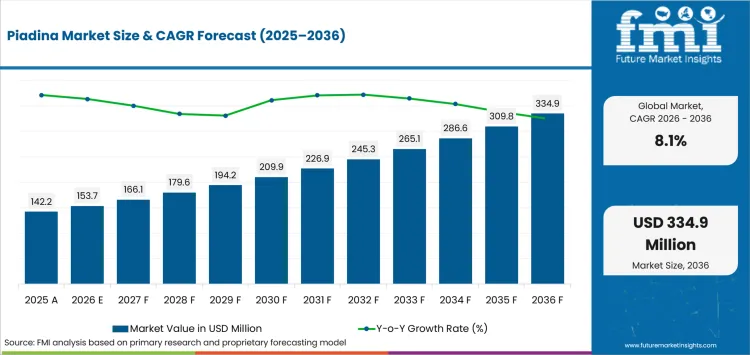
USD 153.7 million in 2026 and USD 334.9 million by 2036 at an 8.1% CAGR.
Sales of piadina are estimated to rise at 8.1% CAGR through 2036, increasing valuation from USD 153.7 million in 2026 to USD 334.9 million by 2036. Retail and foodservice orders depend on bread that reheats quickly and folds without tearing during service. In November 2025, the Piadina Romagnola IGP consortium recorded 4.7% growth for the protected product, giving distributors a demand signal tied to organized retail.
Saudi Arabia is forecast to rise at a notable pace as compared to France because imported-food distribution and retail provide a faster route to trial. USDA Foreign Agricultural Service reported in September 2025 that imports supply about 70% of Saudi food demand. France has local bread substitution and concentrated buying, so piadina needs a clearer eating occasion and price position before retailers broaden listings.
Key Takeaways
- Convenience-led meal assembly supports piadina demand because one flatbread can serve household meals, prepared-food counters and quick-service menus.
- Based on product type, classic - original is projected to account for 39.0% in 2026 owing to broad filling compatibility and familiar sensory cues.
- By claim - nature, conventional is estimated to hold 55.0% in 2026 because mainstream pricing and texture remain the widest purchase tests.
- In 2026, fresh is expected to lead format with 40.0% share attributable to sensory quality that is easiest to protect on short replenishment cycles.
- Shelf-life failures can erase the convenience advantage by increasing waste or leaving a dry product after distribution and reheating.
- Some of the key players in this market include Gruma, Mission Foods, Ole Mexican Foods, Toufayan Bakeries, Kontos Foods, FGF Brands, Signature Flatbreads, Angel Bakeries, Grupo Bimbo, and Europastry.
Analyst Perspective
"Piadina earns repeat listings if the bread stays pliable after reheating and pack size matches the meal occasion retailers are selling. Margin is won through lower stale-stock loss and dependable foldability, especially where tortillas and wraps already set the shelf-performance benchmark."
- Nandini Roy Choudhury, Principal Consultant, Future Market Insights
How is the piadina market segmented?
Piadina is segmented by product type, claim - nature, format, packaging format, sales channel and region.
Product type covers classic - original, whole grain & seeded, flavored & filled, mini & snacking formats and premium - artisan. Claim - nature includes conventional, clean label, organic, gluten-free and high-protein - fortified. Format includes fresh, frozen, ambient packaged, chilled and par-baked - thaw-and-serve. Packaging format covers multipack, single-serve, family - loaf pack and bulk foodservice. Sales channel includes supermarkets & hypermarkets, artisan & specialty bakeries, convenience & forecourt, online - DTC and foodservice distributors.
Why does conventional lead the claim - nature category?
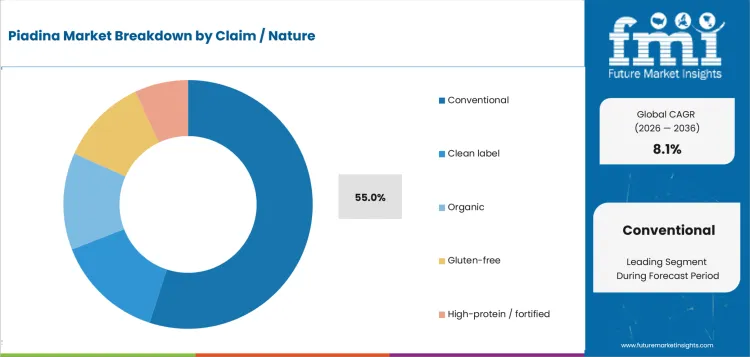
Conventional piadina clears initial retail testing on texture, handling and price before a dietary claim changes the buying decision. Gluten-free and organic variants widen the assortment later, but they also narrow ingredient choices and may raise cost.
- By claim - nature, conventional is estimated to hold 55.0% in 2026 owing to standard recipes that protect price flexibility and familiar texture.
- Germany's 36.2% private-label share, recorded by USDA Foreign Agricultural Service in September 2025, keeps unfamiliar claims under a tighter value test until repeat sales justify a premium. Retail pressure favors familiar formulations until repeat sales justify narrower claims or higher prices.
What makes classic - original central to the product type category?
Classic - original gives retailers a neutral bakery carrier that accepts savory or sweet fillings without changing the meal concept. A first listing is easier to justify because the bread can serve lunch, dinner and snack occasions without a narrow flavor commitment.
- Based on product type, classic - original is projected to account for 39.0% in 2026 owing to familiar flavor and lower assortment risk than narrower variants.
- GRUMA's 2025 annual report lists piadina within its flatbread portfolio in Europe, Asia and Oceania. The filing confirms exact-product participation without treating tortilla scale alone as proof of piadina production.
How does fresh shape demand within the format category?
Fresh piadina is judged quickly on pliability and aroma after heating, which makes bakery-to-shelf timing part of the commercial specification. The format works best in stores with replenishment frequent enough to limit stale stock and markdowns.
- In 2026, fresh is expected to lead format with 40.0% share attributable to sensory quality that is easiest to protect on short replenishment cycles.
- The Piadina Romagnola IGP consortium reported in June 2025 that the protected product ranked among Emilia-Romagna's six most active certified foods for events and promotion. Those trial occasions reinforce the value of serving a product close to its intended fresh eating profile.
What supports multipack within the packaging format category?
Multipack fits households that need several breads for one meal without leaving a large opened pack for later use. Resealable formats also give retailers enough panel space for preparation guidance and claims without increasing shelf width unnecessarily.
- Multipack is set to lead the packaging format with 32.0% share in 2026 due to household meal occasions that commonly require several breads.
- Korea's Ministry of Data and Statistics reported in December 2025 that one-person households represented 36.1% of all households in 2024. Smaller household units strengthen the case for controlled portion counts and packs that limit waste after opening.
What drives supermarkets & hypermarkets within the sales channel category?
Supermarkets place piadina beside bread, wraps and prepared meal components, allowing shoppers to compare price and use without seeking a specialist bakery. The same channel can support fresh, ambient and frozen formats under one retailer category plan.
- By sales channel, supermarkets & hypermarkets are forecast to represent 39.0% in 2026 due to discovery, comparison and repeat replenishment in one store.
- USDA Economic Research Service calculated that grocery stores captured 56.2% of USA food-at-home sales in 2025. A channel with that scale gives retail-ready bakery formats broad exposure, but it also raises the cost of a weak shelf proposition.
What are the drivers, restraints and opportunities in the Piadina Market?
Fast meal assembly raises demand, distribution losses restrict repeat orders, and channel-specific formats widen the addressable route.
- Driver: Piadina fits fast meal assembly because operators can heat one flatbread and use it with multiple fillings or dayparts.
- Restraint: Moisture loss and handling damage reduce foldability, raising waste and weakening repeat purchase before wider distribution is justified.
- Opportunity: Frozen, ambient and portion-controlled formats can extend piadina into digital grocery and longer foodservice routes without relying on daily fresh delivery.
Limited-service restaurants value breads that heat quickly and hold fillings without adding another preparation step. USDA Economic Research Service calculated that limited-service restaurants represented 36.5% of USA food-away-from-home sales in 2025. Piadina gains repeat foodservice orders where portion control and reheating remain consistent during peak service.
Distribution becomes less attractive if piadina loses moisture or needs protective handling that raises delivered cost. USDA Economic Research Service found marketing services represented 92.9 cents of each USA food-away-from-home dollar in 2024. Extra waste or rework therefore reaches operators inside a cost structure already dominated by services and distribution.
Channel-specific packs can extend piadina beyond short fresh-delivery routes without forcing every account into the same shelf-life model. USA Census Bureau data published in June 2026 showed food services and drinking places up 2.7% from May 2025. Frozen or longer-life formats can serve distant routes if reheating preserves foldability at the point of use.
Which country CAGRs are profiled in the Piadina Market?
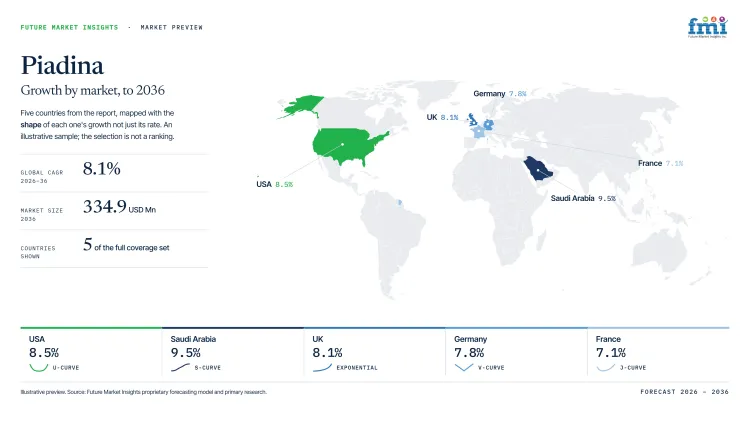
| Country | CAGR |
|---|---|
| Saudi Arabia | 9.5% |
| UAE | 9.1% |
| South Korea | 8.8% |
| USA | 8.5% |
| UK | 8.1% |
| Germany | 7.8% |
| Japan | 7.4% |
| France | 7.1% |
How do country-level CAGRs compare in the Piadina Market?
The 2.4-percentage-point range forms a Gulf-led upper band and a slower Western European tail. Saudi Arabia and UAE exceed 9%, followed by South Korea and USA. UK and Germany form the middle band, with Japan and France below them. The spacing reflects different route-to-market conditions more than current demand scale alone.
- Saudi foodservice routes reward high-throughput pack formats.
- UAE hotel channels widen trial beyond grocery shelves.
- South Korea convenience stores reward single-meal portions.
- USA private-label production lowers risk for national accounts.
- UK meal-deal merchandising gives flatbreads prepared-food adjacency.
- Germany's bakery culture raises sensory expectations for imports.
- Japan premium retail permits smaller initial trial volumes.
- France's specialist bakeries provide another premium trial route.
Similar CAGRs can carry different distribution costs and substitution risks. The full report provides country-level CAGR analysis across North America, Latin America, Western Europe, Eastern Europe, East Asia, South Asia and Pacific and the Middle East and Africa.
Country-wise Analysis
- Saudi food retail gives imported bakery formats direct access to modern chains and growing digital ordering without requiring a specialist Italian-food route. General Authority for Statistics data released in December 2025 show the retail e-commerce sales index rose 33.9% year over year in the third quarter. Piadina demand is projected to expand at 9.5% CAGR over the assessment period, because established import distribution can place packaged bakery products quickly into supermarket or delivery inventory. Longer inbound lead times expose thin bread to moisture loss, so entry depends on local distributors that rotate stock quickly and packaging that protects foldability during warm-climate transport.
- UAE supermarkets and delivery applications give imported bakery brands frequent trial opportunities because international residents already buy routine food through both channels regularly. The Central Bank of the UAE recorded 560.7 million point-of-sale transactions in 2025, confirming high retail transaction density for packaged food purchases. Repeated picking and last-mile handling raise edge-damage and moisture-loss risk, so thin breads need packaging that protects texture without slowing store fulfillment. Piadina sales are forecast to expand at 9.1% CAGR by 2036, supported by digital retail access and frequent replenishment. Compact packs fit that route better than oversized inventory carried through repeated delivery cycles.
- South Korean grocery demand favors compact packs because small households compare products online and expect fast delivery from mobile shopping platforms. Adoption of piadina is estimated to expand at 8.8% CAGR through 2036, attributable to convenience-led meal assembly that fits smaller household portions and quick reheating. Ministry of Data and Statistics figures published in February 2026 show online food and beverage transactions rose 10.2% year over year in December 2025. Oversized packs work against that route by increasing open-pack waste and weakening portion control after delivery. Initial assortments therefore need texture that survives last-mile handling before retailers broaden the range beyond a few high-turning formats.
- USA retailers can place piadina beside tortillas, wraps and pita, but those substitutes already carry household familiarity and faster expected shelf turns. USDA Economic Research Service reported in June 2026 that food away from home accounted for 56.3% of total USA food expenditures in 2025. The split keeps retail and foodservice relevant to flat bread formats, with national accounts retaining strong influence over pack economics. The USA piadina sector is projected to record 8.5% CAGR during the assessment period, given national channel depth that can scale a proven listing. New entrants need a distinct reheating or eating-quality advantage before chains accept slower turnover than familiar flatbread alternatives.
- Online grocery provides a practical discovery route for imported bakery formats in the UK, where shoppers can compare new products against private-label prices quickly. The Office for National Statistics found online retail values were 8.3% higher year over year in November 2025, confirming the channel's continuing reach. In the UK, piadina demand is predicted to advance at 8.1% CAGR through 2036, tied to digital grocery access and mature supermarkets that can test a new meal carrier. Branded offers need retailer-specific pack counts and a visible texture or usage difference that protects margin during line reviews focused on rate of sale.
- German retailers test unfamiliar bakery formats against shelf productivity and price discipline before extending an initial listing into wider distribution. The Federal Statistical Office reported in January 2026 that food prices increased 2.0% on average during 2025, keeping value comparisons active beside established breads and wraps. Long testing cycles and discounter alternatives make a weak premium difficult to defend without repeatable case performance during early retailer trials. Germany is estimated to post 7.8% CAGR over the forecast period, on the back of concentrated grocery distribution. A successful trial can scale quickly once price and product performance pass national retailer review.
- Japanese importers spend longer on product review because retailers expect repeatable quality, clear preparation guidance and dependable documentation from overseas bakery partners. Piadina demand in Japan is forecast to rise at 7.4% CAGR over the forecast period, aided by convenience preferences that favor easy preparation and controlled portions. Japan Finance Corporation measured convenience preference at 40.3% in its February 2025 food survey, the first reading above 40% since the survey began. Ingredient scrutiny and slower negotiation raise the cost of weak documentation, so localized heating instructions and stable foldability give distributors a stronger category case than rapid SKU expansion alone.
- French grocery access depends heavily on centralized buying, and strong local bread habits force imported flatbreads to justify a distinct meal occasion before sustained listings. Insee published in February 2026 that food consumer prices increased 1.2% on average during 2025, keeping price comparison active for differentiated bakery products. Buyer concentration and familiar substitutes limit the room for packaging or positioning that raises the delivered price without a clear use benefit during national retailer review. France's piadina outlook is anticipated to advance at 7.1% CAGR over the assessment period, driven by supermarket exposure that can scale products with a distinct serving case.
Who are the notable companies in the Piadina Market?
Gruma, Mission Foods, Ole Mexican Foods, Toufayan Bakeries, Kontos Foods, FGF Brands, Signature Flatbreads, Angel Bakeries, Grupo Bimbo and Europastry are notable companies serving this market.
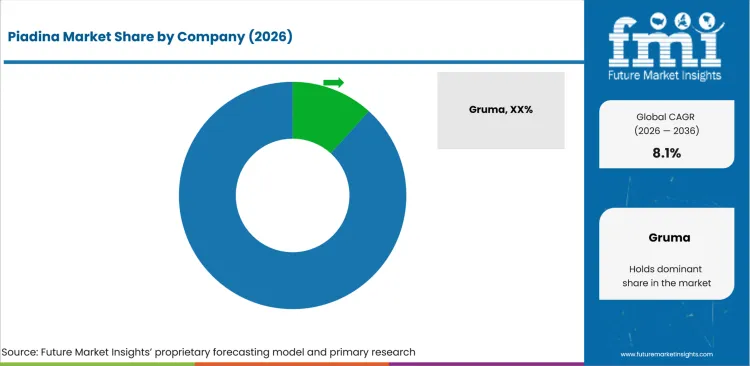
Competition spans direct piadina production, tortilla platforms, Mediterranean flatbread specialists and scaled bakery groups. Entry depends on thin-bread texture control, channel support and repeatable manufacturing more than corporate size alone.
- Gruma and Mission Foods provide the clearest scaled piadina adjacency through GRUMA European operations that explicitly include the product.
- Toufayan Bakeries, Kontos Foods, Signature Flatbreads and Angel Bakeries compete from specialist wrap, pita, naan and other world-flatbread platforms.
- Ole Mexican Foods, FGF Brands, Grupo Bimbo and Europastry extend the field through tortilla, naan, packaged-bakery and frozen-bakery manufacturing routes.
Competitive Benchmarking: Piadina Market
| Company | Thin Flatbread Adjacency | Channel Coverage | Format and Claim Breadth | Geographic Reach |
|---|---|---|---|---|
| Gruma | High | High | High | Global |
| Mission Foods | High | High | High | Global |
| Ole Mexican Foods | Low | Low | High | North America |
| Toufayan Bakeries | Medium | Medium | High | North America |
| Kontos Foods | High | High | High | North America and export markets |
| FGF Brands | Low | High | Low | North America |
| Signature Flatbreads | High | High | High | Europe and international markets |
| Angel Bakeries | Low | Medium | Medium | North America and selected export markets |
| Grupo Bimbo | Medium | High | High | Global |
| Europastry | Medium | High | High | Europe, Americas and international markets |
Scoring basis: High thin-flatbread adjacency requires direct piadina or at least three documented thin-flatbread families. Medium requires two and Low identifies one documented family. High channel coverage requires retail plus foodservice and broader regional reach. Medium covers two routes and Low one. High format and claim breadth requires at least three documented variants, Medium two and Low one.
Key Developments in the Piadina Market
- In February 2026, Gruma reported fourth-quarter 2025 results documenting European tortilla and flatbread operations, including six plants serving retail and foodservice channels.
- In December 2025, Toufayan Bakeries introduced seed oil-free wraps for nationwide rollout in 2026, extending its thin-flatbread range with an ingredient-led retail proposition.
- In September 2025, Grupo Bimbo received regulatory approval to acquire Wickbold in Brazil, extending its packaged-bakery footprint in a market where bread and flatbread channels overlap.
Key Players in the Piadina Market
Scaled Piadina and Tortilla Platforms
- Gruma
- Mission Foods
- Ole Mexican Foods
Specialist Flatbread Producers
- Toufayan Bakeries
- Kontos Foods
- FGF Brands
- Signature Flatbreads
- Angel Bakeries
Diversified Bakery Groups
- Grupo Bimbo
- Europastry
Piadina Market - Report Scope
| Coverage field | Report scope |
|---|---|
| Market breakdown | By product type, claim - nature, format, packaging format, sales channel and region. |
| Quantitative Units | USD million. |
| Market Definition | Revenue includes piadina sold as a bakery product within the defined product, claim, format, packaging and sales-channel categories. It excludes downstream prepared meals and substitute flatbreads sold without piadina positioning. |
| Regions Covered | North America, Latin America, Western Europe, Eastern Europe, East Asia, South Asia and Pacific and Middle East and Africa. |
| Countries Covered | Saudi Arabia, UAE, South Korea, USA, UK, Germany, Japan, France, and 20+ countries included in the full report. |
| Key Companies Profiled | Gruma, Mission Foods, Ole Mexican Foods, Toufayan Bakeries, Kontos Foods, FGF Brands, Signature Flatbreads, Angel Bakeries, Grupo Bimbo, Europastry. |
| Forecast Period | 2026 to 2036. |
| Approach | Primary and secondary research with market triangulation. |
Piadina Market - Research Methodology
| Method | Approach |
|---|---|
| Primary Research | FMI analysts gathered input from manufacturers, service providers, technology developers, distributors, end users, procurement teams, and subject-matter experts. Interviews examined purchasing decisions, product or service evaluation, adoption barriers, approval requirements, pricing considerations, and expectations for technical or commercial support. Respondents were also asked what evidence is required before a trial, pilot, or initial order develops into regular purchasing. |
| Desk Research | Desk research covered government statistics, regulatory publications, trade data, industry associations, technical literature, standards, company filings, product information, and official corporate announcements. Sources were reviewed for relevance, publication date, geographic coverage, and consistency with the defined market scope. Claims relating to performance, applications, approvals, capacity, investment, and commercial activity were retained only when supported by credible public evidence. |
| Market Sizing and Forecasting | The market model combined the baseline value with historical performance, segment structure, pricing and volume indicators, adoption levels, company participation, and country-level demand conditions. Forecast assumptions considered economic activity, investment trends, regulatory developments, technology adoption, purchasing cycles, supply availability, and barriers to wider market use. Segment and regional estimates were reconciled before the final market total was calculated. |
| Data Validation | Estimates were checked against multiple independent indicators, including public data, company activity, trade patterns, industry developments, and findings from primary interviews. Validation also tested whether products, services, applications, and company revenues fell within the defined market boundaries. Adjacent categories, unsupported claims, overlapping revenues, and activities without direct market relevance were excluded to reduce double counting and maintain consistency across segments and countries. |
Piadina Market by Segments
Piadina Market segmented by Product Type:
- Classic - original
- Whole grain & seeded
- Flavored & filled
- Mini & snacking formats
- Premium - artisan
Piadina Market segmented by Claim - Nature:
- Conventional
- Clean label
- Organic
- Gluten-free
- High-protein - fortified
Piadina Market segmented by Format:
- Fresh
- Frozen
- Ambient packaged
- Chilled
- Par-baked - thaw-and-serve
Piadina Market segmented by Packaging Format:
- Multipack
- Single-serve
- Family - loaf pack
- Bulk foodservice
Piadina Market segmented by Sales Channel:
- Supermarkets & hypermarkets
- Artisan & specialty bakeries
- Convenience & forecourt
- Online - DTC
- Foodservice distributors
Piadina Market by Region:
- North America
- United States
- Canada
- Latin America
- Brazil
- Mexico
- Argentina
- Chile
- Western Europe
- Germany
- France
- United Kingdom
- Italy
- Spain
- Benelux
- Nordics
- Eastern Europe
- Poland
- Czech Republic
- Romania
- Hungary
- East Asia
- China
- Japan
- South Korea
- South Asia and Pacific
- India
- ASEAN
- Australia and New Zealand
- Middle East and Africa
- GCC Countries
- South Africa
- Türkiye
- Israel
Research Sources and Bibliography
- Consorzio di Promozione e Tutela della Piadina Romagnola IGP. (2025, November 28). XXIII Rapporto Ismea-Qualivita: Piadina Romagnola IGP tra le prime 20 IG italiane per valore e al 1° posto tra i panificati nella DOP economy.
- USA Department of Agriculture, Foreign Agricultural Service. (2025, September 24). Retail Foods Annual: Saudi Arabia, SA2025-0015.
- GRUMA, S.A.B. de C.V. (2026). 2025 Annual Report.
- USA Department of Agriculture, Foreign Agricultural Service. (2025, September 24). Retail Foods Annual: Germany, GM2025-0016.
- Consorzio di Promozione e Tutela della Piadina Romagnola IGP. (2025, June 26). La Piadina Romagnola IGP sul podio nel primo Rapporto sul turismo DOP.
- Ministry of Data and Statistics, Republic of Korea. (2025, December 9). 2025 Statistics of One-person Households.
- USA Department of Agriculture, Economic Research Service. (2026, August 17). Retail trends.
- USA Department of Agriculture, Economic Research Service. (2026, July 8). Market segments.
- USA Department of Agriculture, Economic Research Service. (2026, May 14). Food Dollar Series data show food processing share of USA food spending reached an all-time high in 2024.
- USA Census Bureau. (2026, June 17). Advance Monthly Sales for Retail and Food Services.
- General Authority for Statistics. (2025, December 30). Wholesale and Retail Trade Statistics, Q3 2025.
- Central Bank of the UAE. (2026, April 9). Annual Report 2025.
- Ministry of Data and Statistics, Republic of Korea. (2026, February 2). Online Shopping in December 2025.
- USA Department of Agriculture, Economic Research Service. (2026, June 11). Total USA food spending reached $2.51 trillion in 2025.
- Office for National Statistics. (2025, December 19). Retail sales, Great Britain: November 2025.
- German Federal Statistical Office. (2026, January 16). CORRECTION: Inflation rate at +2.2% in 2025.
- Japan Finance Corporation. (2025, February 27).
- Institut national de la statistique et des études économiques. (2026, February 27). Annual Consumer Price Index - Base 2025 - Annual change - All households - France - Food.
- GRUMA, S.A.B. de C.V. (2026, February 18). GRUMA reports fourth quarter 2025 results.
- Toufayan Bakeries. (2025, December 17). Introducing Seed Oil-Free Wraps.
- Grupo Bimbo. (2025, September 17). GRUPO BIMBO Receives Regulatory Approval to Acquire Wickbold in Brazil.
- Ole Mexican Foods. (n.d.). Ole Mexican Foods. Retrieved September 4, 2026.
- Kontos Foods, Inc. (2025, June 17). IFANCA halal certificate.
- FGF Brands. (n.d.). Our Company. Retrieved September 4, 2026.
- Signature Flatbreads. (n.d.). Our Company. Retrieved September 4, 2026.
- Angel Bakeries. (n.d.). FAQ. Retrieved September 4, 2026.
- Grupo Bimbo. (2026). Annual Report 2025.
- Europastry. (2025). 2024 Annual Report.
- Grupo Bimbo. (2026, May 5). Grupo Bimbo Announces Approximately US $1 Billion Investment in the United States Between 2026 and 2028.
- Signature Flatbreads. (2025, August 27). Curious Kids Club | Deli Kitchen x Rethink Food.
- GRUMA, S.A.B. de C.V. (2026, April 22). GRUMA reports first quarter 2026 results.
- Grupo Bimbo. (2025, July 24). Second Quarter 2025 Results.
- GRUMA, S.A.B. de C.V. (2026, July 22). GRUMA reports second quarter 2026 results.
This bibliography is provided for reader reference and is not exhaustive. The full report contains the complete reference list and detailed citations.
This Report Answers
- How large is the piadina market in 2026 and 2036?
- Which operating conditions convert convenience demand into repeat piadina orders?
- Why does classic - original lead the product type category in 2026?
- How do claim - nature and format choices change retailer economics?
- Which sales channel holds the largest approved share in 2026?
- How do country growth rates differ among the eight profiled markets?
- Which companies provide the strongest thin-flatbread adjacency to piadina?
- What limits wider distribution without sacrificing pliability or shelf performance?
Frequently Asked Questions
How big is the piadina market in 2026?
The piadina market is valued at USD 153.7 million in 2026 and is projected to reach USD 334.9 million by 2036. Repeat orders depend on foldability after reheating and reliable shelf performance.
What is the CAGR of the piadina market from 2026 to 2036?
The piadina market is projected to grow at a CAGR of 8.1% between 2026 and 2036. Convenience-led meal assembly supports expansion where packaged bread retains texture through distribution and service.
Which product type leads the piadina market?
The classic - original segment is expected to hold 39.0% of the piadina market in 2026, attributable to broad filling compatibility. Its neutral profile also lowers assortment risk during first listings.
Which sales channel leads the piadina market?
The supermarkets & hypermarkets segment is expected to hold 39.0% of the piadina market in 2026, supported by shelf discovery and repeat replenishment. Retailers can place piadina beside bread, wraps or prepared meal components.
Which countries are projected to record the highest growth in the piadina market?
Saudi Arabia is projected to grow at 9.5% CAGR, followed by UAE at 9.1% and South Korea at 8.8% through 2036. Import-oriented retail and digital food purchasing support the upper growth band.
Which companies are active in the piadina market?
Key companies operating in the market include Gruma, Mission Foods, Ole Mexican Foods, Toufayan Bakeries, Kontos Foods, FGF Brands, Signature Flatbreads, Angel Bakeries, Grupo Bimbo, and Europastry. Their positions differ by flatbread manufacturing depth and channel reach.
Preview the report firsthand - request a free sample
Get SampleGet the brochure for pricing and purchase details.
Get PDFTable of Content
- Key Takeaways
- Market Size and CAGR
- Top Growth Driver
- Fastest Growing Segment
- Leading Region
- Key Companies
- Emerging Opportunities
- Executive Summary
- Global Market Outlook
- Demand-side Trends
- Supply-side Trends
- Technology Roadmap Analysis
- Analysis and Recommendations
- Analyst Perspective (What is happening? Why now? What should investors know?)
- Key Questions Answered
- How large is the market?
- What is the CAGR?
- What are key trends?
- Which region dominates?
- Who are the leaders?
- Market Overview
- Market Coverage / Taxonomy
- Market Definition / Scope / Limitations
- Research Methodology
- Chapter Orientation
- Analytical Lens and Working Hypotheses
- Market Structure, Signals, and Trend Drivers
- Benchmarking and Cross-market Comparability
- Market Sizing, Forecasting, and Opportunity Mapping
- Research Design and Evidence Framework
- Desk Research Programme (Secondary Evidence)
- Expert Input and Fieldwork (Primary Evidence)
- Tooling, Models, and Reference Databases
- Data Engineering and Model Build
- Quality Assurance and Audit Trail
- Market Background
- Market Dynamics (Drivers, Restraints, Opportunity, Trends)
- Scenario Forecast (Optimistic, Likely, Conservative)
- Impact Analysis
- AI Impact
- Sustainability Impact
- Regulatory Impact
- Technology Impact
- Consumer / Buyer Analysis
- Purchase Drivers
- Adoption Barriers
- Buyer Journey
- Opportunity Map Analysis
- Product Life Cycle Analysis
- Supply Chain Analysis
- Investment Feasibility Matrix
- Value Chain Analysis
- PESTLE and Porter's Analysis
- Regulatory Landscape
- Regional Parent Market Outlook
- Production and Consumption Statistics
- Import and Export Statistics
- Global Market Analysis and Forecast, 2021 to 2036
- Historical Market Size Value (USD Million) Analysis, 2021 to 2025
- Current and Future Market Size Value (USD Million) Projections, 2026 to 2036
- Y-o-Y Growth Trend Analysis
- Absolute $ Opportunity Analysis
- Global Market Pricing Analysis, 2021 to 2036
- Global Market Analysis and Forecast, By Product Type, 2021 to 2036
- Introduction / Key Findings
- Historical Market Size Value (USD Million) Analysis By Product Type, 2021 to 2025
- Current and Future Market Size Value (USD Million) Analysis and Forecast By Product Type, 2026 to 2036
- Classic / original
- Whole grain & seeded
- Flavored & filled
- Mini & snacking formats
- Premium / artisan
- Classic / original
- Y-o-Y Growth Trend Analysis By Product Type, 2021 to 2025
- Absolute $ Opportunity Analysis By Product Type, 2026 to 2036
- Global Market Analysis and Forecast, By Claim / Nature, 2021 to 2036
- Introduction / Key Findings
- Historical Market Size Value (USD Million) Analysis By Claim / Nature, 2021 to 2025
- Current and Future Market Size Value (USD Million) Analysis and Forecast By Claim / Nature, 2026 to 2036
- Conventional
- Clean label
- Organic
- Gluten-free
- High-protein / fortified
- Conventional
- Y-o-Y Growth Trend Analysis By Claim / Nature, 2021 to 2025
- Absolute $ Opportunity Analysis By Claim / Nature, 2026 to 2036
- Global Market Analysis and Forecast, By Format, 2021 to 2036
- Introduction / Key Findings
- Historical Market Size Value (USD Million) Analysis By Format, 2021 to 2025
- Current and Future Market Size Value (USD Million) Analysis and Forecast By Format, 2026 to 2036
- Fresh
- Frozen
- Ambient packaged
- Chilled
- Par-baked / thaw-and-serve
- Fresh
- Y-o-Y Growth Trend Analysis By Format, 2021 to 2025
- Absolute $ Opportunity Analysis By Format, 2026 to 2036
- Global Market Analysis and Forecast, By Packaging Format, 2021 to 2036
- Introduction / Key Findings
- Historical Market Size Value (USD Million) Analysis By Packaging Format, 2021 to 2025
- Current and Future Market Size Value (USD Million) Analysis and Forecast By Packaging Format, 2026 to 2036
- Multipack
- Single-serve
- Family / loaf pack
- Bulk foodservice
- Multipack
- Y-o-Y Growth Trend Analysis By Packaging Format, 2021 to 2025
- Absolute $ Opportunity Analysis By Packaging Format, 2026 to 2036
- Global Market Analysis and Forecast, By Sales Channel, 2021 to 2036
- Introduction / Key Findings
- Historical Market Size Value (USD Million) Analysis By Sales Channel, 2021 to 2025
- Current and Future Market Size Value (USD Million) Analysis and Forecast By Sales Channel, 2026 to 2036
- Supermarkets & hypermarkets
- Artisan & specialty bakeries
- Convenience & forecourt
- Online & DTC
- Foodservice distributors
- Supermarkets & hypermarkets
- Y-o-Y Growth Trend Analysis By Sales Channel, 2021 to 2025
- Absolute $ Opportunity Analysis By Sales Channel, 2026 to 2036
- Global Market Analysis and Forecast, By Region, 2021 to 2036
- Introduction
- Historical Market Size Value (USD Million) Analysis By Region, 2021 to 2025
- Current Market Size Value (USD Million) Analysis and Forecast By Region, 2026 to 2036
- North America
- Latin America
- Western Europe
- Eastern Europe
- East Asia
- South Asia and Pacific
- Middle East & Africa
- Market Attractiveness Analysis By Region
- North America Market Analysis and Forecast, By Country, 2021 to 2036
- Historical Market Size Value (USD Million) Trend Analysis By Market Taxonomy, 2021 to 2025
- Market Size Value (USD Million) Forecast By Market Taxonomy, 2026 to 2036
- By Country
- USA
- Canada
- By Product Type
- By Claim / Nature
- By Format
- By Packaging Format
- By Sales Channel
- By Country
- Market Attractiveness Analysis
- By Country
- By Product Type
- By Claim / Nature
- By Format
- By Packaging Format
- By Sales Channel
- Key Takeaways
- Latin America Market Analysis and Forecast, By Country
- Historical Market Size Value (USD Million) Trend Analysis By Market Taxonomy, 2021 to 2025
- Market Size Value (USD Million) Forecast By Market Taxonomy, 2026 to 2036
- By Country
- Brazil
- Mexico
- Chile
- Rest of Latin America
- By Product Type
- By Claim / Nature
- By Format
- By Packaging Format
- By Sales Channel
- By Country
- Market Attractiveness Analysis
- By Country
- By Product Type
- By Claim / Nature
- By Format
- By Packaging Format
- By Sales Channel
- Key Takeaways
- Western Europe Market Analysis and Forecast, By Country
- Historical Market Size Value (USD Million) Trend Analysis By Market Taxonomy, 2021 to 2025
- Market Size Value (USD Million) Forecast By Market Taxonomy, 2026 to 2036
- By Country
- Germany
- UK
- Italy
- Spain
- France
- Nordic
- BENELUX
- Rest of Western Europe
- By Product Type
- By Claim / Nature
- By Format
- By Packaging Format
- By Sales Channel
- By Country
- Market Attractiveness Analysis
- By Country
- By Product Type
- By Claim / Nature
- By Format
- By Packaging Format
- By Sales Channel
- Key Takeaways
- Eastern Europe Market Analysis and Forecast, By Country
- Historical Market Size Value (USD Million) Trend Analysis By Market Taxonomy, 2021 to 2025
- Market Size Value (USD Million) Forecast By Market Taxonomy, 2026 to 2036
- By Country
- Russia
- Poland
- Hungary
- Balkan & Baltic
- Rest of Eastern Europe
- By Product Type
- By Claim / Nature
- By Format
- By Packaging Format
- By Sales Channel
- By Country
- Market Attractiveness Analysis
- By Country
- By Product Type
- By Claim / Nature
- By Format
- By Packaging Format
- By Sales Channel
- Key Takeaways
- East Asia Market Analysis and Forecast, By Country
- Historical Market Size Value (USD Million) Trend Analysis By Market Taxonomy, 2021 to 2025
- Market Size Value (USD Million) Forecast By Market Taxonomy, 2026 to 2036
- By Country
- China
- Japan
- South Korea
- By Product Type
- By Claim / Nature
- By Format
- By Packaging Format
- By Sales Channel
- By Country
- Market Attractiveness Analysis
- By Country
- By Product Type
- By Claim / Nature
- By Format
- By Packaging Format
- By Sales Channel
- Key Takeaways
- South Asia and Pacific Market Analysis and Forecast, By Country
- Historical Market Size Value (USD Million) Trend Analysis By Market Taxonomy, 2021 to 2025
- Market Size Value (USD Million) Forecast By Market Taxonomy, 2026 to 2036
- By Country
- India
- ASEAN
- Australia & New Zealand
- Rest of South Asia and Pacific
- By Product Type
- By Claim / Nature
- By Format
- By Packaging Format
- By Sales Channel
- By Country
- Market Attractiveness Analysis
- By Country
- By Product Type
- By Claim / Nature
- By Format
- By Packaging Format
- By Sales Channel
- Key Takeaways
- Middle East & Africa Market Analysis and Forecast, By Country
- Historical Market Size Value (USD Million) Trend Analysis By Market Taxonomy, 2021 to 2025
- Market Size Value (USD Million) Forecast By Market Taxonomy, 2026 to 2036
- By Country
- Kingdom of Saudi Arabia
- Other GCC Countries
- Türkiye
- South Africa
- Other African Union
- Rest of Middle East & Africa
- By Product Type
- By Claim / Nature
- By Format
- By Packaging Format
- By Sales Channel
- By Country
- Market Attractiveness Analysis
- By Country
- By Product Type
- By Claim / Nature
- By Format
- By Packaging Format
- By Sales Channel
- Key Takeaways
- Key Countries Market Analysis
- USA
- Pricing Analysis
- Market Share Analysis, 2025
- By Product Type
- By Claim / Nature
- By Format
- By Packaging Format
- By Sales Channel
- Canada
- Pricing Analysis
- Market Share Analysis, 2025
- By Product Type
- By Claim / Nature
- By Format
- By Packaging Format
- By Sales Channel
- Mexico
- Pricing Analysis
- Market Share Analysis, 2025
- By Product Type
- By Claim / Nature
- By Format
- By Packaging Format
- By Sales Channel
- Brazil
- Pricing Analysis
- Market Share Analysis, 2025
- By Product Type
- By Claim / Nature
- By Format
- By Packaging Format
- By Sales Channel
- Chile
- Pricing Analysis
- Market Share Analysis, 2025
- By Product Type
- By Claim / Nature
- By Format
- By Packaging Format
- By Sales Channel
- Germany
- Pricing Analysis
- Market Share Analysis, 2025
- By Product Type
- By Claim / Nature
- By Format
- By Packaging Format
- By Sales Channel
- UK
- Pricing Analysis
- Market Share Analysis, 2025
- By Product Type
- By Claim / Nature
- By Format
- By Packaging Format
- By Sales Channel
- Italy
- Pricing Analysis
- Market Share Analysis, 2025
- By Product Type
- By Claim / Nature
- By Format
- By Packaging Format
- By Sales Channel
- Spain
- Pricing Analysis
- Market Share Analysis, 2025
- By Product Type
- By Claim / Nature
- By Format
- By Packaging Format
- By Sales Channel
- France
- Pricing Analysis
- Market Share Analysis, 2025
- By Product Type
- By Claim / Nature
- By Format
- By Packaging Format
- By Sales Channel
- India
- Pricing Analysis
- Market Share Analysis, 2025
- By Product Type
- By Claim / Nature
- By Format
- By Packaging Format
- By Sales Channel
- ASEAN
- Pricing Analysis
- Market Share Analysis, 2025
- By Product Type
- By Claim / Nature
- By Format
- By Packaging Format
- By Sales Channel
- Australia & New Zealand
- Pricing Analysis
- Market Share Analysis, 2025
- By Product Type
- By Claim / Nature
- By Format
- By Packaging Format
- By Sales Channel
- China
- Pricing Analysis
- Market Share Analysis, 2025
- By Product Type
- By Claim / Nature
- By Format
- By Packaging Format
- By Sales Channel
- Japan
- Pricing Analysis
- Market Share Analysis, 2025
- By Product Type
- By Claim / Nature
- By Format
- By Packaging Format
- By Sales Channel
- South Korea
- Pricing Analysis
- Market Share Analysis, 2025
- By Product Type
- By Claim / Nature
- By Format
- By Packaging Format
- By Sales Channel
- Russia
- Pricing Analysis
- Market Share Analysis, 2025
- By Product Type
- By Claim / Nature
- By Format
- By Packaging Format
- By Sales Channel
- Poland
- Pricing Analysis
- Market Share Analysis, 2025
- By Product Type
- By Claim / Nature
- By Format
- By Packaging Format
- By Sales Channel
- Hungary
- Pricing Analysis
- Market Share Analysis, 2025
- By Product Type
- By Claim / Nature
- By Format
- By Packaging Format
- By Sales Channel
- Kingdom of Saudi Arabia
- Pricing Analysis
- Market Share Analysis, 2025
- By Product Type
- By Claim / Nature
- By Format
- By Packaging Format
- By Sales Channel
- Türkiye
- Pricing Analysis
- Market Share Analysis, 2025
- By Product Type
- By Claim / Nature
- By Format
- By Packaging Format
- By Sales Channel
- South Africa
- Pricing Analysis
- Market Share Analysis, 2025
- By Product Type
- By Claim / Nature
- By Format
- By Packaging Format
- By Sales Channel
- USA
- Market Structure Analysis
- Competition Dashboard
- Competition Benchmarking
- Market Share Analysis of Top Players
- By Regional
- By Product Type
- By Claim / Nature
- By Format
- By Packaging Format
- By Sales Channel
- Emerging Startups
- Innovation Benchmarking
- Competition Analysis
- Competition Deep Dive
- Gruma
- Overview
- Product Portfolio
- Profitability by Market Segments
- Sales Footprint
- Strategy Overview
- Marketing Strategy
- Product Strategy
- Channel Strategy
- Mission Foods
- Ole Mexican Foods
- Toufayan Bakeries
- Kontos Foods
- FGF Brands
- Signature Flatbreads
- Angel Bakeries
- Grupo Bimbo
- Europastry
- Gruma
- Case Studies
- Success Stories
- Recent Developments
- Competition Deep Dive
- Assumptions & Acronyms Used


