

- Market Size (2026)
- USD 251.5 Mn
- Forecast (2036)
- USD 948.7 Mn
- CAGR (2026 to 2036)
- 14.2%
How big is Continuous-Glucose-Monitor-Guided Nutrition Market in 2026?
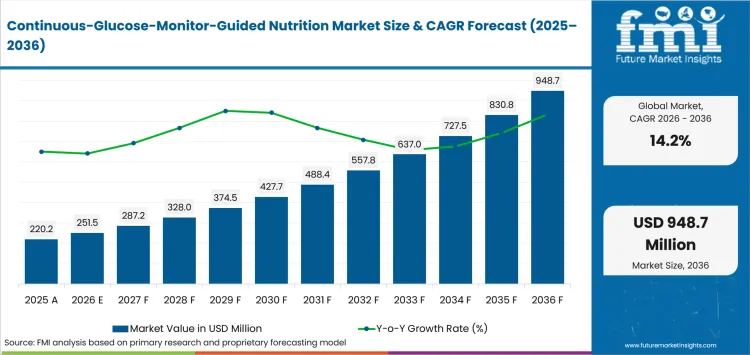
USD 251.5 million in 2026 and USD 948.7 million by 2036 at a 14.2% CAGR.
Demand for continuous-glucose-monitor-guided nutrition is projected to expand at 14.2% CAGR between 2026 and 2036, increasing valuation from USD 251.5 million in 2026 to USD 948.7 million by 2036. Consumer access widened after the FDA cleared the Signos Glucose Monitoring System for over-the-counter use on March 21, 2025. That route lets eligible adults begin glucose-guided food experiments without a prescription. Comparable continuous glucose monitoring systems show how consumer access can widen before reimbursement reaches wellness use.
Country economics alter that conversion path because public prevention can substitute for paid coaching. NHS England reported on May 27, 2025 that 166,360 adults entered Healthier You during the prior year and more than 900,000 had enrolled since 2016. A nine-month public service raises the UK benchmark for private CGM-guided nutrition. Related personalized nutrition offers still need meal-level feedback that routine prevention does not provide.
Key Takeaways
- Over-the-counter glucose access lowers the first enrollment barrier, but paid demand depends on guidance that changes repeat food decisions.
- Based on offering, CGM + nutrition program bundles are projected to account for 46.1% in 2026 due to one purchase covering sensing and interpretation.
- In 2026, metabolic health & prediabetes is expected to lead user goal with 46.7% share owing to demand for earlier food-response feedback.
- The 1-3 month programs segment is likely to capture 51.8% share in 2026 attributable to bounded learning cycles and lower upfront commitment.
- Evidence limits and repeat self-pay costs weaken renewal after users learn the most obvious meal-response patterns from an initial sensor period.
- Some of the key players in this market include Abbott (Lingo), Signos, Dexcom (Stelo), Levels Health, Nutrisense, Veri (ŌURA), January AI, and Hello Inside.
Analyst Perspective
"The commercial question is whether glucose data changes several meals before the first sensor period ends. Stronger programs then give members a new reason to return after the obvious food-response patterns are already known."
- Nandini Roy Choudhury, Principal Consultant, Future Market Insights
How is the continuous-glucose-monitor-guided nutrition market segmented?
The market is segmented by offering, user goal, program length, form and sales channel.
Offering, user goal, program length, form and sales channel define the market taxonomy. Offering includes CGM + nutrition program bundles, glucose-optimized food products, app-guided supplement stacks and others. User goals cover metabolic health & prediabetes, weight management, athletic fueling optimization and longevity & wellness. Program length includes 1-3 month programs, 6-12 month programs and ongoing subscription. Form covers program bundles, foods & shakes, supplements and others. Sales channels include online / DTC, retail pharmacy, supermarkets & hypermarkets, specialty & health stores and others.
What role do program bundles play within the form category?
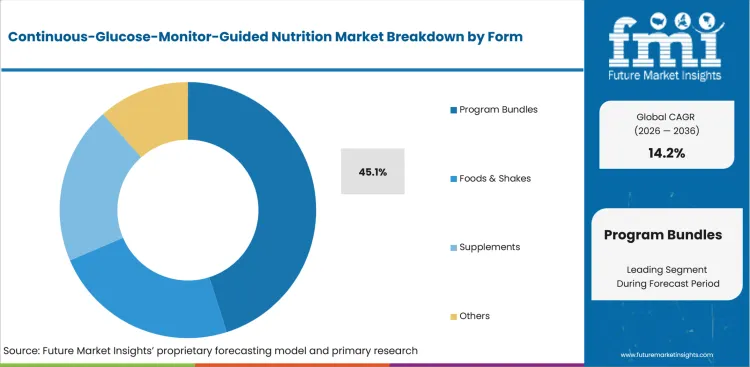
Program bundles give users one service relationship for sensing, interpretation and nutrition guidance instead of making them assemble separate tools. In May 2025, ŌURA introduced Meals and Glucose for USA members so Stelo readings could appear beside photo-based meal analysis in the Oura app. The format works best if the same program explains both measurement and action.
- Program bundles are projected to hold 45.1% share in 2026 owing to coordinated glucose interpretation and nutrition guidance under one service relationship.
- Foods, shakes and supplements become more relevant after a program identifies the meal pattern a member intends to change.
What supports demand for CGM + nutrition program bundles within the offering category?
Integrated offers reduce setup work by keeping sensor access, food logging and interpretation inside one enrollment. In August 2025, Twin Health announced Cleveland Clinic-led results from a program that used sensor data with personalized nutrition guidance and clinical support. The operating model gives one team responsibility for turning a glucose trace into the next food decision.
- By offering, CGM + nutrition program bundles are estimated to hold 46.1% in 2026 owing to lower setup friction and one accountable program relationship.
- Renewal improves if each sensor period answers a new nutrition question instead of repeating the same first-week glucose experiment.
How does metabolic health & prediabetes shape demand within the user goal category?
Prediabetes users enter before intensive diabetes treatment, making meal composition and timing practical targets for prevention-oriented guidance. CDC's January 2026 National Diabetes Statistics Report estimated that 115.2 million USA adults had prediabetes. The addressable population is large, but a wellness program still needs a clear reason for users to pay for glucose interpretation.
- In 2026, metabolic health & prediabetes is expected to lead user goal with 46.7% share because earlier feedback can test daily food choices before treatment intensifies.
- Programs must keep wellness claims separate from diagnosis so metabolic-risk users understand what the service can and cannot replace.
What makes 1-3 month programs central to the program length category?
Short programs fit the first learning cycle because users can establish a baseline, test several meals and decide which habits deserve continued attention. January AI published a February 2025 analysis of 944 users whose app tracked food, activity and glucose responses during a 14-day intervention. A defined end point also limits payment for measurements that stop changing decisions.
- The 1-3 month programs segment is set to lead program length with 51.8% share in 2026 due to a bounded learning window and lower commitment.
- Longer subscriptions need fresh coaching goals once users can already predict their most common meal-response patterns without another continuous sensor cycle.
How does online / DTC influence selection within the sales channel category?
Online distribution matches diet nutrition apps because enrollment, education and the customer relationship already sit inside software. Dexcom released AI-powered photo meal logging for Stelo in July 2025 so users could record food inside the glucose app and review meal-linked responses. The workflow keeps interpretation active without a separate food diary.
- Online / DTC is forecast to represent 47.3% in 2026 driven by software-based enrollment, education and subscription administration in one channel.
- Self-directed enrollment puts more responsibility on program operators to explain intended use before consumers treat wellness feedback as medical advice.
What are the drivers, restraints and opportunities in the Continuous-Glucose-Monitor-Guided Nutrition Market?
OTC sensor access broadens trial demand, medical evidence boundaries limit reimbursement and follow-on guidance offers the clearest revenue route after the first sensor cycle.
- Driver: Over-the-counter biosensor access lets nutrition programs test meal responses without a prescription-led enrollment path.
- Restraint: Medical CGM coverage and consumer wellness claims follow different evidence routes, limiting reimbursement for self-pay nutrition programs.
- Opportunity: Clinician review and lower-cost follow-on guidance can extend paid support after a short sensor-learning period ends.
Prevention need widens the audience for early metabolic feedback, but risk prevalence alone does not guarantee paid enrollment. CDC's December 2025 obesity maps showed adult obesity prevalence of at least 25% in every USA state and territory during 2024. Related glucose monitoring devices convert that need into revenue only if meal feedback changes a decision enough to justify another sensor or coaching period.
Medical coverage sets a boundary that wellness programs cannot blur during enrollment. NICE updated its type 2 diabetes quality standard in February 2026 and retained CGM recommendations for defined insulin-treated adults who need monitoring support. Self-pay nutrition programs therefore need separate evidence, pricing and claims discipline because medical reimbursement does not automatically extend to wellness use outside that care pathway.
Program operators can retain members between sensor periods if interpretation stays useful after the first glucose experiment. Levels introduced Core and Complete memberships in July 2026 with CGM, blood testing, clinician review and personalized support. The model permits follow-on coaching without continuous sensor wear, giving providers another paid service period once basic meal-response patterns are already familiar.
Which country CAGRs are profiled in the Continuous-Glucose-Monitor-Guided Nutrition Market?
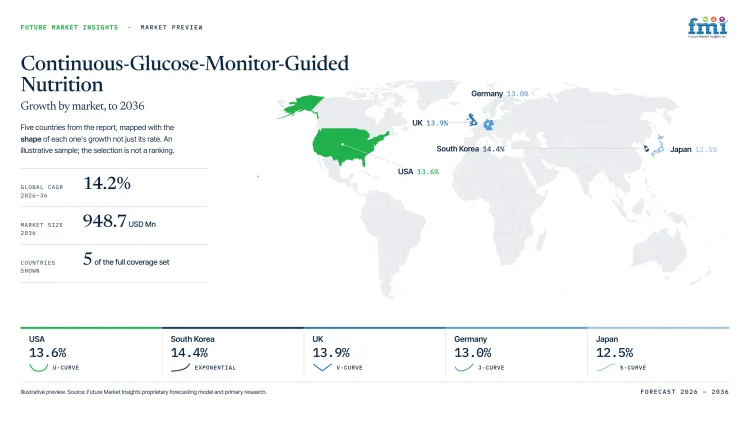
| Country | CAGR |
|---|---|
| South Korea | 14.4% |
| United Kingdom | 13.9% |
| United States | 13.6% |
| Germany | 13.0% |
| Japan | 12.5% |
How do country-level CAGRs compare in the Continuous-Glucose-Monitor-Guided Nutrition Market?
A 1.9 percentage-point spread keeps the five country forecasts tightly grouped, but the route to paid demand differs. South Korea and the United Kingdom form the upper band, the United States occupies the middle, and Germany and Japan follow below. The pattern reflects acquisition friction and existing care alternatives rather than current market size.
- South Korea lets digital bundles test paid acquisition faster.
- UK programs face a high bar for private differentiation.
- USA digital-health channels widen direct consumer acquisition options.
- German privacy expectations raise localization work for app-led services.
- Japanese food data quality determines whether meal feedback feels useful.
Comparable CAGRs can still produce different entry economics because acquisition routes, public alternatives and localization costs vary by country. The full report provides country-level CAGR analysis for North America, Latin America, Western Europe, Eastern Europe, East Asia, South Asia and Pacific, and the Middle East and Africa.
Country-wise Analysis
- Using app-led onboarding suits a market where consumers already manage many daily services on mobile devices. KDCA reported in November 2025 that 34.4% of Korean adults had obesity in 2024, giving prevention-focused programs a large audience for food-response guidance. Continuous-glucose-monitor-guided nutrition demand in South Korea is projected to expand at 14.4% CAGR through 2036, aided by fast digital enrollment and visible meal feedback. Mixed Korean dishes make automated food recognition harder, so renewal depends on localized meal libraries and coaching that gives members a new question to test after the first sensor cycle. Regional food variation also raises the cost of maintaining accurate nutrition data.
- In the United Kingdom, paid CGM guidance competes with a mature public prevention service that already covers diet and activity. Continuous-glucose-monitor-guided nutrition demand is forecast to grow at 13.9% CAGR over the assessment period, owing to consumer interest in faster meal-level feedback. GOV.UK reported in May 2025 that 64.5% of adults in England were overweight or living with obesity during 2023 to 2024. The prevention audience is large, but generic coaching has a free alternative. Private programs need short experiments that answer specific food questions without implying medical treatment or duplicating a nine-month public service.
- OTC biosensors give USA wellness programs a direct enrollment path that does not start with a prescription visit. CDC data published in February 2026 found that 8 in 10 adults with prediabetes did not know they had it, leaving prevention programs with a substantial awareness gap. USA demand is forecast to advance at 13.6% CAGR by 2036, tied to interest in faster food-response feedback outside scheduled care. The market is crowded with digital-health subscriptions and recognized prevention programs. Operators that separate wellness interpretation from diagnosis can use another sensor period to answer a new food question instead of repeating the first trial.
- Because medical CGM already follows a defined diabetes-care pathway, consumer nutrition programs need a clearly separate wellness proposition. The German continuous-glucose-monitor-guided nutrition sector is expected to register 13.0% CAGR during the forecast period, supported by prevention interest and digital access. Destatis reported in June 2026 that 53.4% of German adults were overweight in 2025. The figure expands the prevention audience without removing competition from conventional counseling or insured diabetes care. German-language interpretation and privacy controls remain structural entry requirements for app-led programs that collect sensitive glucose and food data.
- Japanese preventive care already uses structured health checks, so another measurement service must answer questions that periodic screening leaves unresolved. MHLW's July 2026 data put the fiscal 2024 specific health-check implementation rate at 61.5%, showing how familiar scheduled metabolic assessment already is. Local services also need meal data that handles portion context before food guidance feels practical. Adoption of continuous-glucose-monitor-guided nutrition in Japan is projected to progress at 12.5% CAGR through 2036, given interest in more frequent food-response feedback. Renewal will depend on whether continuous sensing produces a decision that scheduled health guidance could not provide.
Who are the notable companies in the Continuous-Glucose-Monitor-Guided Nutrition Market?
Abbott (Lingo), Signos, Dexcom (Stelo), Levels Health, Nutrisense, Veri (ŌURA), January AI, and Hello Inside are notable companies serving this market.
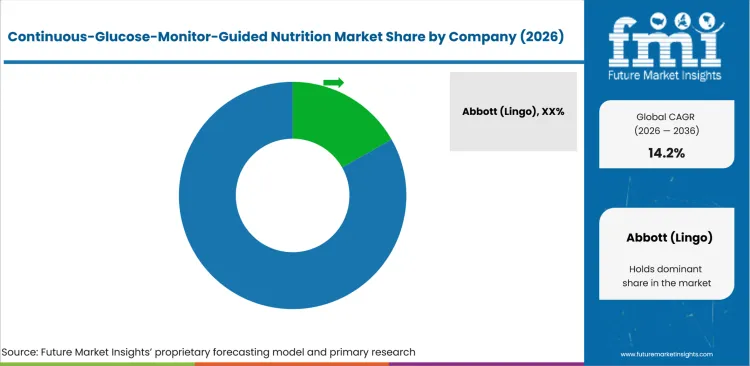
Competition divides between biosensor owners and programs that interpret glucose against meals, activity and other behavior data. Abbott, Dexcom and Signos control direct sensor pathways or regulated glucose access. Levels Health, Nutrisense and Veri (ŌURA) emphasize guided nutrition and metabolic support. January AI and Hello Inside focus on food-response software. New entrants need credible sensor access and enough follow-on value to earn payment after the first learning cycle.
- Biosensor-integrated platforms: Abbott (Lingo), Signos and Dexcom (Stelo) pair consumer glucose access with app-based interpretation or program guidance.
- Guidance-led programs: Levels Health, Nutrisense and Veri (ŌURA) focus on nutrition interpretation, coaching and follow-on metabolic support.
- Nutrition-data specialists: January AI and Hello Inside focus on food-response prediction and meal analysis without owning the biosensor platform.
Competitive Benchmarking: Continuous-Glucose-Monitor-Guided Nutrition Market
| Company | Sensor Access | Nutrition Interpretation | Program Integration | Geographic Reach |
|---|---|---|---|---|
| Abbott (Lingo) | High | High | High | United States and United Kingdom |
| Signos | High | High | High | United States |
| Dexcom (Stelo) | High | High | High | United States; UK, Australia, New Zealand and South Korea expansion announced |
| Levels Health | High | High | High | United States |
| Nutrisense | High | High | High | United States |
| Veri (ŌURA) | Medium | High | High | United States CGM integration; wider Oura app distribution |
| January AI | Medium | High | Medium | United States digital service |
| Hello Inside | High | High | High | Selected European consumer markets |
Scoring basis: High sensor access requires direct CGM supply or an established integration. Medium reflects compatible CGM-data use, while Low means no direct sensor path. High nutrition interpretation requires personalized meal analysis or human coaching tied to glucose. Medium covers narrower food-response analysis and Low covers basic nutrition support. High program integration requires at least three documented components, while Medium requires two and Low requires one. Geographic reach records documented commercial access instead of corporate office locations.
Key Developments in the Continuous-Glucose-Monitor-Guided Nutrition Market
- In June 2026, Signos documented a Berry Street partnership that gives eligible members access to one-on-one registered-dietitian sessions. The partnership extends glucose interpretation into human nutrition support without making sensor renewal the only paid service.
- In December 2025, Abbott released Lingo for Android users in the United States. Wider device compatibility increases the addressable consumer base for glucose-guided food feedback without changing the product’s wellness-use boundary.
- In July 2025, January AI introduced a bring-your-own-CGM connection that initially supported Abbott Libre data. The update lets existing sensor users bring glucose readings into food-response prediction without buying a separate January sensor package.
Key Players in the Continuous-Glucose-Monitor-Guided Nutrition Market
Biosensor-integrated consumer platforms
- Abbott (Lingo)
- Signos
- Dexcom (Stelo)
Metabolic guidance platforms
- Levels Health
- Nutrisense
- Veri (ŌURA)
Nutrition-data specialists
- January AI
- Hello Inside
Continuous-Glucose-Monitor-Guided Nutrition Market - Report Scope
| Coverage field | Report scope |
|---|---|
| Market breakdown | By offering, user goal, program length, form, sales channel and region. |
| Quantitative Units | USD million. |
| Market Definition | Commercial programs that use continuous glucose monitor data to guide nutrition, food choices, metabolic-health goals or related behavior support. |
| Regions Covered | North America, Latin America, Western Europe, Eastern Europe, East Asia, South Asia and Pacific, Middle East and Africa. |
| Countries Covered | South Korea, United Kingdom, United States, Germany, Japan, and 20+ countries included in the full report. |
| Key Companies Profiled | Abbott (Lingo), Signos, Dexcom (Stelo), Levels Health, Nutrisense, Veri (ŌURA), January AI, Hello Inside. |
| Forecast Period | 2026 to 2036. |
| Approach | Primary and secondary research with market triangulation. |
Continuous-Glucose-Monitor-Guided Nutrition Market - Research Methodology
| Method | Approach |
|---|---|
| Primary Research | FMI analysts gathered input from manufacturers, service providers, technology developers, distributors, end users, procurement teams, and subject-matter experts. Interviews examined purchasing decisions, product or service evaluation, adoption barriers, approval requirements, pricing considerations, and expectations for technical or commercial support. Respondents were also asked what evidence is required before a trial, pilot, or initial order develops into regular purchasing. |
| Desk Research | Desk research covered government statistics, regulatory publications, trade data, industry associations, technical literature, standards, company filings, product information, and official corporate announcements. Sources were reviewed for relevance, publication date, geographic coverage, and consistency with the defined market scope. Claims relating to performance, applications, approvals, capacity, investment, and commercial activity were retained only when supported by credible public evidence. |
| Market Sizing and Forecasting | The market model combined the baseline value with historical performance, segment structure, pricing and volume indicators, adoption levels, company participation, and country-level demand conditions. Forecast assumptions considered economic activity, investment trends, regulatory developments, technology adoption, purchasing cycles, supply availability, and barriers to wider market use. Segment and regional estimates were reconciled before the final market total was calculated. |
| Data Validation | Estimates were checked against multiple independent indicators, including public data, company activity, trade patterns, industry developments, and findings from primary interviews. Validation also tested whether products, services, applications, and company revenues fell within the defined market boundaries. Adjacent categories, unsupported claims, overlapping revenues, and activities without direct market relevance were excluded to reduce double counting and maintain consistency across segments and countries. |
Continuous-Glucose-Monitor-Guided Nutrition Market by Segments
Continuous-Glucose-Monitor-Guided Nutrition Market segmented by Offering:
- CGM + Nutrition Program Bundles
- Glucose-Optimized Food Products
- App-Guided Supplement Stacks
- Others
Continuous-Glucose-Monitor-Guided Nutrition Market segmented by User Goal:
- Metabolic Health & Prediabetes
- Weight Management
- Athletic Fueling Optimization
- Longevity & Wellness
Continuous-Glucose-Monitor-Guided Nutrition Market segmented by Program Length:
- 1-3 Month Programs
- 6-12 Month Programs
- Ongoing Subscription
Continuous-Glucose-Monitor-Guided Nutrition Market segmented by Form:
- Program Bundles
- Foods & Shakes
- Supplements
- Others
Continuous-Glucose-Monitor-Guided Nutrition Market segmented by Sales Channel:
- Online / DTC
- Retail Pharmacy
- Supermarkets & Hypermarkets
- Specialty & Health Stores
- Others
Continuous-Glucose-Monitor-Guided Nutrition Market by Region:
- North America
- United States
- Canada
- Latin America
- Brazil
- Mexico
- Argentina
- Chile
- Western Europe
- Germany
- France
- United Kingdom
- Italy
- Spain
- Benelux
- Nordics
- Eastern Europe
- Poland
- Czech Republic
- Romania
- Hungary
- East Asia
- China
- Japan
- South Korea
- South Asia and Pacific
- India
- ASEAN
- Australia and New Zealand
- Middle East and Africa
- GCC Countries
- South Africa
- Türkiye
- Israel
Research Sources and Bibliography
- USA Food and Drug Administration. (2025, March 21). 510(k) Premarket Notification K250106: Signos Glucose Monitoring System.
- NHS England. (2025, May 27). NHS initiative helps thousands more tackle their diabetes risk.
- Twin Health. (2025, August 20). New Peer-Reviewed Study in New England Journal of Medicine Catalyst Finds Twin Health’s AI Precision Treatment Significantly Improves Outcomes in Patients with Type 2 Diabetes and Reduces Reliance on Costly Medications, Including GLP-1s.
- Centers for Disease Control and Prevention. (2026, January 21). National Diabetes Statistics Report.
- January AI. (2025, February 3). Impact of digital health interventions on glycemic control and weight management.
- ŌURA. (2025, May 6). Introducing Metabolic Health at Oura.
- Dexcom. (2025, July 28). Dexcom Launches Revolutionary AI-Powered Meal Logging Feature Across Glucose Biosensing Portfolio.
- Centers for Disease Control and Prevention. (2025, December 3). Adult Obesity Prevalence Maps.
- National Institute for Health and Care Excellence. (2026, February 18). Quality statement 4: Continuous glucose monitoring for adults who use insulin and need help monitoring their blood glucose.
- Levels Health. (2026, July 22). The new Levels: Expert guidance for real results.
- Korea Disease Control and Prevention Agency. (2025, November 25). One in Three Korean Adults Is Obese, a 30.8% Increase Over the Past Decade.
- Office for Health Improvement and Disparities. (2025, May). Obesity profile: short statistical commentary, May 2025.
- Centers for Disease Control and Prevention. (2026, February 17). Prediabetes: Could It Be You?
- Statistisches Bundesamt. (2026, June 2). Der Durchschnittsmensch in Deutschland ist 1,73 Meter groß und wiegt 78,3 Kilo.
- Ministry of Health, Labour and Welfare, Japan. (2026, July 30). FY2024 implementation status of Specific Health Checkups and Specific Health Guidance.
- Signos. (2026, June 18). How do I get support from a dietitian through the Signos and Berry Street Partnership?
- Abbott. (2025, December 8). Abbott’s Lingo Now on Android, Expanding Access to Real-Time Glucose Data.
- January AI. (2025, July 22). New in January: Connect your own CGM for smarter, more personalized predictions.
- Dexcom. (2026, June 23). Dexcom Further Advances Vision of Glucose Biosensing for All.
- Abbott. (2026, August 11). Abbott and Google launch first-of-its-kind partnership to transform everyday health through glucose insights and AI.
- USA Food and Drug Administration. (2026, June 12). FDA Clears First Over-the-Counter Continuous Glucose Monitor for Children.
- Levels Health. (2026, February 24). What is Levels Pro and who does it benefit?
- ŌURA. (2026, June 23). ŌURA and LillyDirect to Expand Support for People Using GLP-1 Therapies with New Tools and Savings Options.
- Abbott. (2026, January 5). Abbott’s new Libre Assist app feature tackles a top need for people living with diabetes: in-the-moment food decisions.
- Signos. (2026, July 20). About Signos+.
- Dexcom. (2026, July 22). Dexcom Announced as First Participant Selected for FDA’s TEMPO Digital Health Devices Pilot Program.
- Levels Health. (2026, July 22). Affordable glucose monitoring: Levels now offers Stelo.
- Dexcom. (2026, June 4). Dexcom Reaffirms CGM Benefits for All People With Diabetes and Continues Momentum Toward Earlier Stage Intervention and Preventative Care at ADA 2026.
- ŌURA. (2025, June 17). Veri Has Joined Oura!
- January AI. (2025, June 30). Introducing blood test uploads in the January app.
- Hello Inside. (2025, December 23). AI Meal Tracker: Glucose & Weight in Balance.
This bibliography is provided for reader reference and is not exhaustive. The full report contains the complete reference list and detailed citations
This Report Answers
- What is the continuous-glucose-monitor-guided nutrition market size in 2026 and what value is forecast for 2036?
- How does over-the-counter glucose access change the commercial path for nutrition programs?
- Why do CGM + nutrition program bundles hold the largest offering share?
- Why does metabolic health & prediabetes hold the largest user-goal share?
- Why do 1-3 month programs hold the largest program-length share?
- How do country growth rates differ among South Korea, the United Kingdom, the United States, Germany and Japan?
- Which companies compete on biosensor access, nutrition interpretation and integrated programs?
- What limits renewal after users learn their first meal-response patterns?
- Which operating models can extend paid guidance between active sensor periods?
Frequently Asked Questions
How big is the continuous-glucose-monitor-guided nutrition market in 2026?
The continuous-glucose-monitor-guided nutrition market is valued at USD 251.5 million in 2026 and is projected to reach USD 948.7 million by 2036. Growth depends on easier OTC biosensor access and guidance that converts glucose readings into repeat food decisions.
What is the CAGR of the continuous-glucose-monitor-guided nutrition market from 2026 to 2036?
The continuous-glucose-monitor-guided nutrition market is projected to grow at a CAGR of 14.2% between 2026 and 2036. Expansion follows wider consumer sensor access and demand for meal-level metabolic feedback before intensive diabetes treatment.
Which offering leads the continuous-glucose-monitor-guided nutrition market?
The CGM + nutrition program bundles segment is expected to hold 46.1% of the continuous-glucose-monitor-guided nutrition market in 2026, driven by one purchase covering sensing and interpretation. Integrated enrollment also reduces the setup work required to connect glucose data with food decisions.
Which user goal leads the continuous-glucose-monitor-guided nutrition market?
The metabolic health & prediabetes segment is expected to hold 46.7% of the continuous-glucose-monitor-guided nutrition market in 2026, attributable to demand for earlier food-response feedback. Programs still need clear wellness boundaries because glucose patterns do not replace diagnosis or clinical care.
Which companies are active in the continuous-glucose-monitor-guided nutrition market?
Key companies operating in the market include Abbott (Lingo), Signos, Dexcom (Stelo), Levels Health, Nutrisense, Veri (ŌURA), January AI, and Hello Inside. Their positions differ by sensor access, meal interpretation, coaching depth and control of the consumer program relationship.
Preview the report firsthand - request a free sample
Get SampleGet the brochure for pricing and purchase details.
Get PDFTable of Content
- Key Takeaways
- Market Size and CAGR
- Top Growth Driver
- Fastest Growing Segment
- Leading Region
- Key Companies
- Emerging Opportunities
- Executive Summary
- Global Market Outlook
- Demand-side Trends
- Supply-side Trends
- Technology Roadmap Analysis
- Analysis and Recommendations
- Analyst Perspective (What is happening? Why now? What should investors know?)
- Key Questions Answered
- How large is the market?
- What is the CAGR?
- What are key trends?
- Which region dominates?
- Who are the leaders?
- Market Overview
- Market Coverage / Taxonomy
- Market Definition / Scope / Limitations
- Research Methodology
- Chapter Orientation
- Analytical Lens and Working Hypotheses
- Market Structure, Signals, and Trend Drivers
- Benchmarking and Cross-market Comparability
- Market Sizing, Forecasting, and Opportunity Mapping
- Research Design and Evidence Framework
- Desk Research Programme (Secondary Evidence)
- Expert Input and Fieldwork (Primary Evidence)
- Tooling, Models, and Reference Databases
- Data Engineering and Model Build
- Quality Assurance and Audit Trail
- Market Background
- Market Dynamics (Drivers, Restraints, Opportunity, Trends)
- Scenario Forecast (Optimistic, Likely, Conservative)
- Impact Analysis
- AI Impact
- Sustainability Impact
- Regulatory Impact
- Technology Impact
- Consumer / Buyer Analysis
- Purchase Drivers
- Adoption Barriers
- Buyer Journey
- Opportunity Map Analysis
- Product Life Cycle Analysis
- Supply Chain Analysis
- Investment Feasibility Matrix
- Value Chain Analysis
- PESTLE and Porter's Analysis
- Regulatory Landscape
- Regional Parent Market Outlook
- Production and Consumption Statistics
- Import and Export Statistics
- Global Market Analysis and Forecast, 2021 to 2036
- Historical Market Size Value (USD Million) Analysis, 2021 to 2025
- Current and Future Market Size Value (USD Million) Projections, 2026 to 2036
- Y-o-Y Growth Trend Analysis
- Absolute $ Opportunity Analysis
- Global Market Pricing Analysis, 2021 to 2036
- Global Market Analysis and Forecast, By Offering, 2021 to 2036
- Introduction / Key Findings
- Historical Market Size Value (USD Million) Analysis By Offering, 2021 to 2025
- Current and Future Market Size Value (USD Million) Analysis and Forecast By Offering, 2026 to 2036
- CGM + Nutrition Program Bundles
- Glucose-Optimized Food Products
- App-Guided Supplement Stacks
- Others
- CGM + Nutrition Program Bundles
- Y-o-Y Growth Trend Analysis By Offering, 2021 to 2025
- Absolute $ Opportunity Analysis By Offering, 2026 to 2036
- Global Market Analysis and Forecast, By User Goal, 2021 to 2036
- Introduction / Key Findings
- Historical Market Size Value (USD Million) Analysis By User Goal, 2021 to 2025
- Current and Future Market Size Value (USD Million) Analysis and Forecast By User Goal, 2026 to 2036
- Metabolic Health & Prediabetes
- Weight Management
- Athletic Fueling Optimization
- Longevity & Wellness
- Metabolic Health & Prediabetes
- Y-o-Y Growth Trend Analysis By User Goal, 2021 to 2025
- Absolute $ Opportunity Analysis By User Goal, 2026 to 2036
- Global Market Analysis and Forecast, By Program Length, 2021 to 2036
- Introduction / Key Findings
- Historical Market Size Value (USD Million) Analysis By Program Length, 2021 to 2025
- Current and Future Market Size Value (USD Million) Analysis and Forecast By Program Length, 2026 to 2036
- 1-3 Month Programs
- 6-12 Month Programs
- Ongoing Subscription
- 1-3 Month Programs
- Y-o-Y Growth Trend Analysis By Program Length, 2021 to 2025
- Absolute $ Opportunity Analysis By Program Length, 2026 to 2036
- Global Market Analysis and Forecast, By Form, 2021 to 2036
- Introduction / Key Findings
- Historical Market Size Value (USD Million) Analysis By Form, 2021 to 2025
- Current and Future Market Size Value (USD Million) Analysis and Forecast By Form, 2026 to 2036
- Program Bundles
- Foods & Shakes
- Supplements
- Others
- Program Bundles
- Y-o-Y Growth Trend Analysis By Form, 2021 to 2025
- Absolute $ Opportunity Analysis By Form, 2026 to 2036
- Global Market Analysis and Forecast, By Sales Channel, 2021 to 2036
- Introduction / Key Findings
- Historical Market Size Value (USD Million) Analysis By Sales Channel, 2021 to 2025
- Current and Future Market Size Value (USD Million) Analysis and Forecast By Sales Channel, 2026 to 2036
- Online / DTC
- Retail Pharmacy
- Supermarkets & Hypermarkets
- Specialty & Health Stores
- Others
- Online / DTC
- Y-o-Y Growth Trend Analysis By Sales Channel, 2021 to 2025
- Absolute $ Opportunity Analysis By Sales Channel, 2026 to 2036
- Global Market Analysis and Forecast, By Region, 2021 to 2036
- Introduction
- Historical Market Size Value (USD Million) Analysis By Region, 2021 to 2025
- Current Market Size Value (USD Million) Analysis and Forecast By Region, 2026 to 2036
- North America
- Latin America
- Western Europe
- Eastern Europe
- East Asia
- South Asia and Pacific
- Middle East & Africa
- Market Attractiveness Analysis By Region
- North America Market Analysis and Forecast, By Country, 2021 to 2036
- Historical Market Size Value (USD Million) Trend Analysis By Market Taxonomy, 2021 to 2025
- Market Size Value (USD Million) Forecast By Market Taxonomy, 2026 to 2036
- By Country
- USA
- Canada
- By Offering
- By User Goal
- By Program Length
- By Form
- By Sales Channel
- By Country
- Market Attractiveness Analysis
- By Country
- By Offering
- By User Goal
- By Program Length
- By Form
- By Sales Channel
- Key Takeaways
- Latin America Market Analysis and Forecast, By Country
- Historical Market Size Value (USD Million) Trend Analysis By Market Taxonomy, 2021 to 2025
- Market Size Value (USD Million) Forecast By Market Taxonomy, 2026 to 2036
- By Country
- Brazil
- Mexico
- Chile
- Rest of Latin America
- By Offering
- By User Goal
- By Program Length
- By Form
- By Sales Channel
- By Country
- Market Attractiveness Analysis
- By Country
- By Offering
- By User Goal
- By Program Length
- By Form
- By Sales Channel
- Key Takeaways
- Western Europe Market Analysis and Forecast, By Country
- Historical Market Size Value (USD Million) Trend Analysis By Market Taxonomy, 2021 to 2025
- Market Size Value (USD Million) Forecast By Market Taxonomy, 2026 to 2036
- By Country
- Germany
- UK
- Italy
- Spain
- France
- Nordic
- BENELUX
- Rest of Western Europe
- By Offering
- By User Goal
- By Program Length
- By Form
- By Sales Channel
- By Country
- Market Attractiveness Analysis
- By Country
- By Offering
- By User Goal
- By Program Length
- By Form
- By Sales Channel
- Key Takeaways
- Eastern Europe Market Analysis and Forecast, By Country
- Historical Market Size Value (USD Million) Trend Analysis By Market Taxonomy, 2021 to 2025
- Market Size Value (USD Million) Forecast By Market Taxonomy, 2026 to 2036
- By Country
- Russia
- Poland
- Hungary
- Balkan & Baltic
- Rest of Eastern Europe
- By Offering
- By User Goal
- By Program Length
- By Form
- By Sales Channel
- By Country
- Market Attractiveness Analysis
- By Country
- By Offering
- By User Goal
- By Program Length
- By Form
- By Sales Channel
- Key Takeaways
- East Asia Market Analysis and Forecast, By Country
- Historical Market Size Value (USD Million) Trend Analysis By Market Taxonomy, 2021 to 2025
- Market Size Value (USD Million) Forecast By Market Taxonomy, 2026 to 2036
- By Country
- China
- Japan
- South Korea
- By Offering
- By User Goal
- By Program Length
- By Form
- By Sales Channel
- By Country
- Market Attractiveness Analysis
- By Country
- By Offering
- By User Goal
- By Program Length
- By Form
- By Sales Channel
- Key Takeaways
- South Asia and Pacific Market Analysis and Forecast, By Country
- Historical Market Size Value (USD Million) Trend Analysis By Market Taxonomy, 2021 to 2025
- Market Size Value (USD Million) Forecast By Market Taxonomy, 2026 to 2036
- By Country
- India
- ASEAN
- Australia & New Zealand
- Rest of South Asia and Pacific
- By Offering
- By User Goal
- By Program Length
- By Form
- By Sales Channel
- By Country
- Market Attractiveness Analysis
- By Country
- By Offering
- By User Goal
- By Program Length
- By Form
- By Sales Channel
- Key Takeaways
- Middle East & Africa Market Analysis and Forecast, By Country
- Historical Market Size Value (USD Million) Trend Analysis By Market Taxonomy, 2021 to 2025
- Market Size Value (USD Million) Forecast By Market Taxonomy, 2026 to 2036
- By Country
- Kingdom of Saudi Arabia
- Other GCC Countries
- Türkiye
- South Africa
- Other African Union
- Rest of Middle East & Africa
- By Offering
- By User Goal
- By Program Length
- By Form
- By Sales Channel
- By Country
- Market Attractiveness Analysis
- By Country
- By Offering
- By User Goal
- By Program Length
- By Form
- By Sales Channel
- Key Takeaways
- Key Countries Market Analysis
- USA
- Pricing Analysis
- Market Share Analysis, 2025
- By Offering
- By User Goal
- By Program Length
- By Form
- By Sales Channel
- Canada
- Pricing Analysis
- Market Share Analysis, 2025
- By Offering
- By User Goal
- By Program Length
- By Form
- By Sales Channel
- Mexico
- Pricing Analysis
- Market Share Analysis, 2025
- By Offering
- By User Goal
- By Program Length
- By Form
- By Sales Channel
- Brazil
- Pricing Analysis
- Market Share Analysis, 2025
- By Offering
- By User Goal
- By Program Length
- By Form
- By Sales Channel
- Chile
- Pricing Analysis
- Market Share Analysis, 2025
- By Offering
- By User Goal
- By Program Length
- By Form
- By Sales Channel
- Germany
- Pricing Analysis
- Market Share Analysis, 2025
- By Offering
- By User Goal
- By Program Length
- By Form
- By Sales Channel
- UK
- Pricing Analysis
- Market Share Analysis, 2025
- By Offering
- By User Goal
- By Program Length
- By Form
- By Sales Channel
- Italy
- Pricing Analysis
- Market Share Analysis, 2025
- By Offering
- By User Goal
- By Program Length
- By Form
- By Sales Channel
- Spain
- Pricing Analysis
- Market Share Analysis, 2025
- By Offering
- By User Goal
- By Program Length
- By Form
- By Sales Channel
- France
- Pricing Analysis
- Market Share Analysis, 2025
- By Offering
- By User Goal
- By Program Length
- By Form
- By Sales Channel
- India
- Pricing Analysis
- Market Share Analysis, 2025
- By Offering
- By User Goal
- By Program Length
- By Form
- By Sales Channel
- ASEAN
- Pricing Analysis
- Market Share Analysis, 2025
- By Offering
- By User Goal
- By Program Length
- By Form
- By Sales Channel
- Australia & New Zealand
- Pricing Analysis
- Market Share Analysis, 2025
- By Offering
- By User Goal
- By Program Length
- By Form
- By Sales Channel
- China
- Pricing Analysis
- Market Share Analysis, 2025
- By Offering
- By User Goal
- By Program Length
- By Form
- By Sales Channel
- Japan
- Pricing Analysis
- Market Share Analysis, 2025
- By Offering
- By User Goal
- By Program Length
- By Form
- By Sales Channel
- South Korea
- Pricing Analysis
- Market Share Analysis, 2025
- By Offering
- By User Goal
- By Program Length
- By Form
- By Sales Channel
- Russia
- Pricing Analysis
- Market Share Analysis, 2025
- By Offering
- By User Goal
- By Program Length
- By Form
- By Sales Channel
- Poland
- Pricing Analysis
- Market Share Analysis, 2025
- By Offering
- By User Goal
- By Program Length
- By Form
- By Sales Channel
- Hungary
- Pricing Analysis
- Market Share Analysis, 2025
- By Offering
- By User Goal
- By Program Length
- By Form
- By Sales Channel
- Kingdom of Saudi Arabia
- Pricing Analysis
- Market Share Analysis, 2025
- By Offering
- By User Goal
- By Program Length
- By Form
- By Sales Channel
- Türkiye
- Pricing Analysis
- Market Share Analysis, 2025
- By Offering
- By User Goal
- By Program Length
- By Form
- By Sales Channel
- South Africa
- Pricing Analysis
- Market Share Analysis, 2025
- By Offering
- By User Goal
- By Program Length
- By Form
- By Sales Channel
- USA
- Market Structure Analysis
- Competition Dashboard
- Competition Benchmarking
- Market Share Analysis of Top Players
- By Regional
- By Offering
- By User Goal
- By Program Length
- By Form
- By Sales Channel
- Emerging Startups
- Innovation Benchmarking
- Competition Analysis
- Competition Deep Dive
- Abbott (Lingo)
- Overview
- Product Portfolio
- Profitability by Market Segments
- Sales Footprint
- Strategy Overview
- Marketing Strategy
- Product Strategy
- Channel Strategy
- Supergut
- January AI
- Signos
- Veri
- Levels Health
- Nutrisense
- Dexcom (Stelo Ecosystem)
- Abbott (Lingo)
- Case Studies
- Success Stories
- Recent Developments
- Competition Deep Dive
- Assumptions & Acronyms Used


