

- Market Size (2026)
- USD 972.9 Mn
- Forecast (2036)
- USD 2367.3 Mn
- CAGR (2026 to 2036)
- 9.3%
How big is Glucose Friendly Desserts Market in 2026?
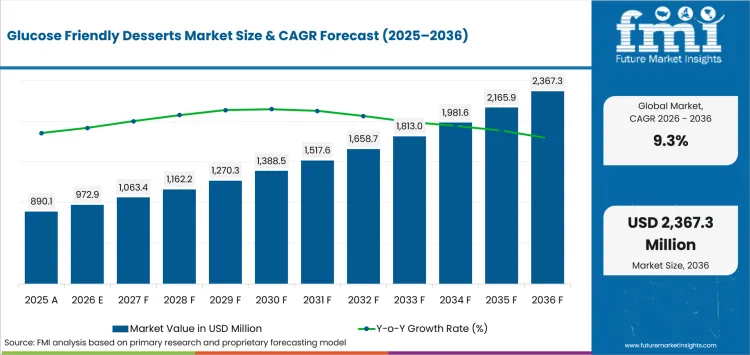
USD 972.9 million in 2026 and USD 2,367.3 million by 2036 at a 9.3% CAGR.
Demand for glucose friendly desserts is projected to expand at 9.3% CAGR between 2026 and 2036, increasing valuation from USD 972.9 million in 2026 to USD 2,367.3 million by 2036. Growth depends on whether familiar dessert formats can lower sugar exposure while retaining taste and portion satisfaction.
The USA Centers for Disease Control and Prevention reported in January 2026 that 40.1 million people in the United States had diabetes in 2023 and 115.2 million adults had prediabetes. FDA guidance also gives allulose a distinct USA labeling treatment by allowing its exclusion from Total Sugars and Added Sugars declarations under enforcement discretion and using 0.4 kcal per gram for calorie calculation.
Key Takeaways
- Glucose management creates a recurring reason to inspect dessert sugar and carbohydrate information, but repeat purchase still depends on familiar sensory performance.
- Ice Cream & Frozen Desserts is projected at 47.2% share in 2026 because frozen formats offer a direct substitution route within established dessert occasions.
- Allulose is estimated at 41.4% of sweetener-system demand in 2026 because it can contribute sweetness and bulk within reduced-sugar formulations.
- Low-Glycemic is forecast at 48.6% by claim in 2026, while People with Diabetes / Prediabetes represents 36.9% by consumer group.
- Supermarkets & Hypermarkets is projected at 44.9% of sales-channel demand in 2026 as frozen and packaged desserts compete directly with conventional alternatives.
- Halo Top (Wells Enterprises), Rebel Creamery, Nick's, Quest Nutrition (Simply Good Foods), Catalina Crunch, HighKey and Keto Pint compete across the defined market categories, while Enlightened (Beyond Better Foods) remains part of the competitive set during its stated production pause.
Analyst Perspective
"Glucose friendly desserts have to work first as desserts. The commercial test is whether brands can reduce sugar or support a glucose-oriented proposition without making texture, taste or label interpretation harder for the buyer. Regulatory differences around sweeteners mean formula portability will remain a practical constraint across markets."
- Nandini Roy Choudhury, Principal Consultant, Future Market Insights
How is the Glucose Friendly Desserts Market segmented?
The glucose friendly desserts market is segmented by product type, sweetener system, claim, consumer group, sales channel and region.
Glucose friendly desserts are segmented across five commercial dimensions. Product Type covers Ice Cream & Frozen Desserts, Cookies & Baked Goods, Chocolate & Confections, Puddings & Cups and Others. Sweetener System covers Allulose, Monk Fruit, Erythritol Blends, Stevia and Others. Claim covers Low-Glycemic, Keto-Friendly, Diabetic-Friendly, No Added Sugar and Others. Consumer Group includes People with Diabetes / Prediabetes, Keto & Low-Carb Consumers, GLP-1 Users, General Wellness and Others. Sales Channel includes Supermarkets & Hypermarkets, Online / DTC, Convenience Stores, Specialty & Health Stores and Others.
Why does Ice Cream & Frozen Desserts lead the product type category?
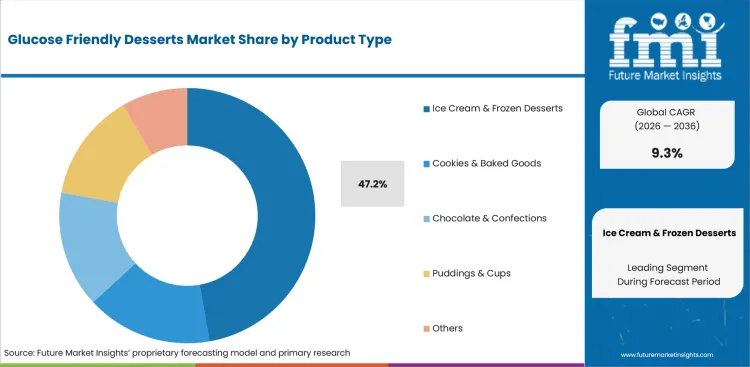
Frozen formats provide a direct replacement route for consumers who still want ice cream occasions while paying closer attention to sugar and carbohydrates. The category also benefits from established freezer merchandising, portioned bars and pints, and manufacturing systems already used across the broader frozen desserts category. Texture remains formulation-sensitive because sweetener behavior changes freezing point and scoopability.
- Based on product type, Ice Cream & Frozen Desserts is projected to account for 47.2% in 2026 as brands adapt a familiar indulgent format to lower-sugar nutrition targets.
- Halo Top introduced a mix-in pint platform in 2025 across eight flavors, showing how lower-sugar frozen brands continue to compete through conventional indulgence cues rather than medical positioning.
Why does Allulose lead the sweetener system category?
Allulose contributes bulk as well as sweetness, which gives formulators more flexibility than a high-intensity sweetener used alone. USA labeling treatment strengthens its fit for products built around reduced sugar. The same formula cannot be assumed to travel across jurisdictions because the ingredient remains subject to different authorization and safety-review paths. The broader sugar substitutes market gives formulators additional routes when allulose is unsuitable for a specific jurisdiction.
- Allulose is expected to account for 41.4% of sweetener-system demand in 2026 because it supports sugar reduction while retaining functions needed in frozen, baked and confectionery desserts.
- FDA guidance supports its USA use, while sweetener selection also spans monk fruit, erythritol blends and stevia across the wider sugar substitutes landscape. UK and EU review status makes market-specific formulation planning necessary.
Why does Low-Glycemic lead the claim category?
Low-glycemic positioning addresses the glucose response that motivates several buyer groups without tying the product to one named diet. The claim can appear across frozen, baked and confectionery formats, but it also raises a substantiation burden because consumers may interpret it as a physiological promise. Clear nutrition information therefore matters alongside front-of-pack language.
- Low-Glycemic is forecast to capture 48.6% of claim demand in 2026 because it connects dessert choice with glucose-management intent across more than one consumer group.
- Brands using this claim need substantiation and careful wording so the proposition remains understandable alongside sugar, carbohydrate and serving-size information.
Why do People with Diabetes / Prediabetes lead the consumer group category?
People managing diabetes or prediabetes have a direct reason to review carbohydrate and sugar information before choosing dessert. CDC estimates show the scale of this need in the United States, although the condition itself does not guarantee purchase of a specialized product. Conversion depends on taste, portion fit and confidence in the label. Similar purchase trade-offs appear across the broader diabetic food market, where nutrition needs still compete with familiar formats and everyday convenience.
- People with Diabetes / Prediabetes is projected at 36.9% of consumer-group demand in 2026 because glucose management creates a recurring reason to compare dessert nutrition profiles.
- Mainstream product cues can matter as much as a health claim because many purchases occur within households where dietary needs differ between members.
Why do Supermarkets & Hypermarkets lead the sales channel category?
Supermarkets and hypermarkets place glucose friendly desserts inside the same trip where households buy conventional treats. Frozen products benefit from existing cold-chain infrastructure, while packaged cookies and confectionery gain from direct shelf comparison. The channel therefore tests whether a product can sustain repeat purchase beyond specialist health retail or online discovery.
- Supermarkets & Hypermarkets is expected to account for 44.9% of sales-channel demand in 2026 because the channel combines household access with direct comparison against standard dessert alternatives.
- Quest Nutrition expanded its Bake Shop line through USA retail and e-commerce channels, illustrating how lower-sugar bakery-style products can move from performance nutrition into routine grocery purchasing.
What are the drivers, restraints and opportunities in the Glucose Friendly Desserts Market?
Glucose-management demand supports lower-sugar dessert adoption, while sweetener authorization and claim discipline limit formula portability. Familiar formats create room for products that preserve taste with a clearer nutrition proposition.
- Driver: Diabetes and prediabetes increase routine attention to sugars and carbohydrates during dessert selection.
- Restraint: Sweetener authorization differs across markets, and physiological claims require careful substantiation.
- Opportunity: Frozen and bakery-style formats can reach mainstream shoppers when lower-sugar formulation remains compatible with familiar taste and texture.
The demand base begins with a simple consumer problem: dessert is optional, but glucose management can make conventional options harder to fit into a routine. CDC estimates for diabetes and prediabetes in the United States show why a substantial audience reviews sugar and carbohydrate information. The commercial opportunity appears when a product solves that constraint without asking the buyer to abandon a familiar dessert occasion.
Regulatory divergence limits one-formula global expansion. The UK Advisory Committee on Novel Foods and Processes reviewed allulose RP1130 again in June 2025 and identified data gaps requiring further assessment. EFSA concluded in June 2025 that D-allulose safety could not be established from the application before it. Brands using allulose therefore need jurisdiction-specific regulatory planning rather than assuming USA labeling treatment applies elsewhere. The allulose market remains closely tied to country-specific authorization pathways.
Mainstream format extension creates a practical route to growth. Halo Top has used mix-ins inside lower-calorie pints, while Quest Nutrition extended lower-sugar positioning into donuts and other bakery-style products. Similar product development is visible across low sugar bakery categories, where familiar formats can carry a clearer nutrition proposition into routine grocery purchasing. These moves keep the product within recognizable dessert occasions and let retailers evaluate the offer using familiar category economics rather than a separate clinical purchase mission.
Which country CAGRs apply in the Glucose Friendly Desserts Market?
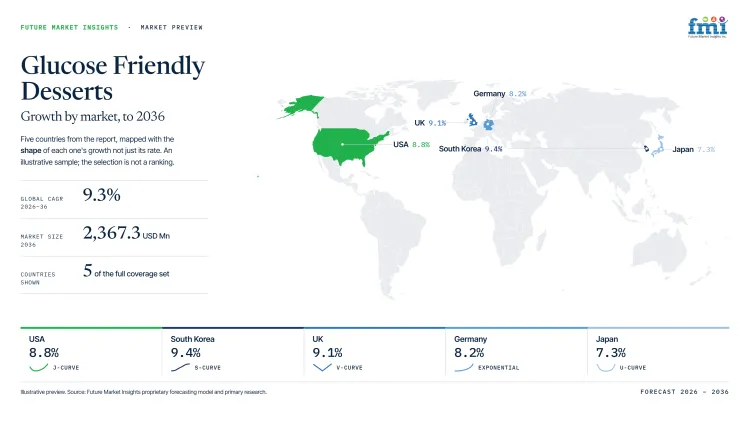
| Country | CAGR |
|---|---|
| USA | 8.8% |
| UK | 9.1% |
| Germany | 8.2% |
| Japan | 7.3% |
| South Korea | 9.4% |
How do country-level CAGRs compare in the Glucose Friendly Desserts Market?
The five country CAGRs span 2.1 percentage points. The range reflects different ingredient rules, nutrition-label environments and consumer access conditions rather than a common starting market size.
- USA is projected at 8.8% CAGR, supported by a broad glucose-management audience and a defined FDA labeling approach for allulose.
- UK is forecast at 9.1% CAGR, while novel-food review conditions can affect which sweetener systems reach commercial shelves.
- Germany is estimated at 8.2% CAGR as diabetes prevalence supports demand but EU-level ingredient assessments influence formulation options.
- Japan is expected at 7.3% CAGR, with nutrition labeling and local food-additive rules shaping how products communicate reduced-sugar propositions.
- South Korea is projected at 9.4% CAGR as diabetes prevalence and packaged-food innovation support demand for glucose-oriented dessert choices.
Comparable growth rates can produce different entry conditions. The full report provides additional country analysis across North America, Latin America, Western Europe, Eastern Europe, East Asia, South Asia and Pacific, and the Middle East and Africa.
Country-wise Analysis
- USA: The glucose friendly desserts market is projected to expand at 8.8% CAGR through 2036. CDC reported 40.1 million people with diabetes in 2023 and 115.2 million adults with prediabetes, while FDA allulose guidance gives USA formulators a defined label treatment for one key sweetener system.
- UK: Demand is forecast to rise at 9.1% CAGR through 2036. The ACNFP reviewed allulose RP1130 again in June 2025 and recorded information gaps that required further consideration, making sweetener authorization an important product-planning variable.
- Germany: The market is estimated to advance at 8.2% CAGR through 2036. Robert Koch Institute reporting places diabetes prevalence among German adults at 10.3%, while EFSA concluded in June 2025 that it could not establish D-allulose safety from the application before it.
- Japan: Demand is projected at 7.3% CAGR through 2036. Japan requires food labeling in Japanese, and the Consumer Affairs Agency maintains rules for nutrition and health claims as well as a positive-list framework for food additives, so localized label design and ingredient status remain central to market entry.
- South Korea: The market is forecast at 9.4% CAGR through 2036. Korea Disease Control and Prevention Agency reporting continues to track diabetes as a closely monitored chronic condition, reinforcing the relevance of sugar and carbohydrate management within routine food purchasing.
Who are the notable companies in the Glucose Friendly Desserts Market?
Enlightened (Beyond Better Foods), Halo Top (Wells Enterprises), Rebel Creamery, Nick's, Quest Nutrition (Simply Good Foods), Catalina Crunch, HighKey and Keto Pint are notable companies serving the glucose friendly desserts market.
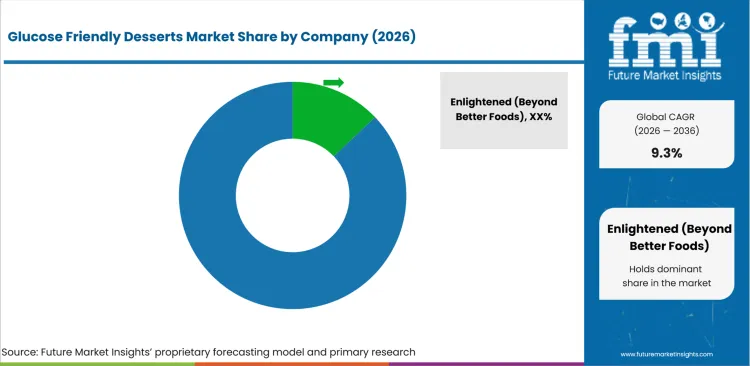
Competition spans frozen desserts and packaged bakery-style products. Differentiation comes from combining a clear lower-sugar proposition with repeatable taste and accessible retail distribution. Enlightened has announced a production pause, while the other companies continue to compete through frozen, baked or confectionery formats.
- Frozen dessert platforms: Halo Top (Wells Enterprises), Nick's and Enlightened (Beyond Better Foods) compete around familiar ice-cream occasions and freezer access.
- Glucose-oriented frozen specialists: Rebel Creamery and Keto Pint use low-sugar or zero-added-sugar formulation as a central part of their product architecture.
- Baked and confectionery platforms: Quest Nutrition (Simply Good Foods), Catalina Crunch and HighKey extend reduced-sugar nutrition into familiar cookies, brownies and related dessert-style formats.
Competitive Benchmarking: Glucose Friendly Desserts Market
| Company | Dessert Format Coverage | Glucose-Oriented Fit | Mainstream Retail Access | Geographic Reach |
|---|---|---|---|---|
| Enlightened (Beyond Better Foods) | Low | High | Low | North America and beyond historically; production paused |
| Halo Top (Wells Enterprises) | Low | Medium | High | United States national distribution through Wells |
| Rebel Creamery | Low | High | Medium | United States DTC and retail presence |
| Nick's | Low | High | Medium | United States DTC and retail presence |
| Quest Nutrition (Simply Good Foods) | Medium | Medium | High | United States mass retail, grocery and e-commerce |
| Catalina Crunch | Medium | Medium | Medium | United States DTC with retail expansion |
| HighKey | Low | Medium | Medium | United States e-commerce and select retail |
| Keto Pint | Low | High | High | United States multi-chain grocery and DTC |
Scoring basis: Dessert Format Coverage is High for several qualifying formats, Medium for more than one format and Low for a narrower focus. Glucose-Oriented Fit is High when reduced-sugar or low-carb formulation defines the platform and Medium when it applies at selected product level. Mainstream Retail Access is High for broad mass or multi-chain distribution, Medium for narrower retail availability and Low when current access is limited.
Key Developments in the Glucose Friendly Desserts Market
- In May 2026, Wells Enterprises reported that its multi-phase Dunkirk, New York expansion had reached a combined USD 512 million across three phases. The project increased production capacity for Wells brands, including Halo Top.
- In October 2025, Quest Nutrition expanded Quest Bake Shop with Chocolate Frosted Donuts containing 14g of protein and less than 1g of sugar per serving, with availability through Amazon and retailers across the United States.
- In 2025, Halo Top added a mix-in pint platform across eight flavors, extending its lower-sugar frozen dessert proposition through more conventional indulgence cues.
Key Players in the Glucose Friendly Desserts Market
Frozen Dessert Platforms
- Enlightened (Beyond Better Foods)
- Halo Top (Wells Enterprises)
- Nick's
Glucose-Oriented Frozen Specialists
- Rebel Creamery
- Keto Pint
Baked and Confectionery Platforms
- Quest Nutrition (Simply Good Foods)
- Catalina Crunch
- HighKey
Glucose Friendly Desserts Market - Report Scope
| Coverage field | Report scope |
|---|---|
| Market breakdown | By product type, sweetener system, claim, consumer group, sales channel and region. |
| Quantitative Units | USD million. |
| Market Definition | Packaged desserts positioned for glucose-conscious selection through low-glycemic, keto-friendly, diabetic-friendly, no-added-sugar or related lower-sugar formulation within the defined dessert categories. |
| Regions Covered | North America, Latin America, Western Europe, Eastern Europe, East Asia, South Asia and Pacific, and Middle East and Africa. |
| Countries Covered | USA, UK, Germany, Japan, South Korea and additional countries included in the full report. |
| Key Companies | Enlightened (Beyond Better Foods), Halo Top (Wells Enterprises), Rebel Creamery, Nick's, Quest Nutrition (Simply Good Foods), Catalina Crunch, HighKey, Keto Pint. |
| Forecast Period | 2026 to 2036. |
| Approach | Primary and secondary research with market triangulation. |
Glucose Friendly Desserts Market - Research Methodology
| Method | Approach |
|---|---|
| Primary Research | FMI analysts gather input from food manufacturers, ingredient suppliers, retailers, distributors, procurement teams and subject-matter experts. Interviews examine product evaluation, purchasing behavior, formulation constraints, channel requirements and factors that influence trial, repeat purchasing and channel adoption. |
| Desk Research | Desk research covers public-health statistics, food-labeling rules, regulatory publications, technical literature, company filings, product information and corporate announcements relevant to the defined market. |
| Market Sizing and Forecasting | The market model combines the baseline value with segment structure, pricing and volume indicators, adoption levels, company activity and country demand conditions. Forecast assumptions consider consumer behavior, ingredient rules, product availability and channel development over the assessment period. |
| Data Validation | Final estimates are reconciled across segment and country totals to maintain consistent market boundaries throughout the forecast period. |
Glucose Friendly Desserts Market by Segments
Glucose Friendly Desserts Market segmented by Product Type:
- Ice Cream & Frozen Desserts
- Cookies & Baked Goods
- Chocolate & Confections
- Puddings & Cups
- Others
Glucose Friendly Desserts Market segmented by Sweetener System:
- Allulose
- Monk Fruit
- Erythritol Blends
- Stevia
- Others
Glucose Friendly Desserts Market segmented by Claim:
- Low-Glycemic
- Keto-Friendly
- Diabetic-Friendly
- No Added Sugar
- Others
Glucose Friendly Desserts Market segmented by Consumer Group:
- People with Diabetes / Prediabetes
- Keto & Low-Carb Consumers
- GLP-1 Users
- General Wellness
- Others
Glucose Friendly Desserts Market segmented by Sales Channel:
- Supermarkets & Hypermarkets
- Online / DTC
- Convenience Stores
- Specialty & Health Stores
- Others
Glucose Friendly Desserts Market by Region:
- North America
- United States
- Canada
- Latin America
- Brazil
- Mexico
- Argentina
- Chile
- Western Europe
- Germany
- France
- United Kingdom
- Italy
- Spain
- Benelux
- Nordics
- Eastern Europe
- Poland
- Czech Republic
- Romania
- Hungary
- East Asia
- China
- Japan
- South Korea
- South Asia and Pacific
- India
- ASEAN
- Australia and New Zealand
- Middle East and Africa
- GCC Countries
- South Africa
- Türkiye
- Israel
Research Sources and Bibliography
- Centers for Disease Control and Prevention. (2026, January 21). National Diabetes Statistics Report.
- USA Food and Drug Administration. (2020, October 16). Guidance for Industry: The Declaration of Allulose and Calories from Allulose on Nutrition and Supplement Facts Labels.
- World Health Organization. (2026, January 26). Healthy diet.
- World Health Organization. (2015, March 4). Guideline: sugars intake for adults and children.
- Advisory Committee on Novel Foods and Processes. (2025, June 24). 172nd Meeting of the ACNFP: Allulose RP1130.
- Advisory Committee on Novel Foods and Processes. (2024, November 20). Minutes of the 169th Meeting: Allulose RP1130.
- European Food Safety Authority. (2025, June 5). Safety of D-allulose as a novel food pursuant to Regulation (EU) 2015/2283.
- Robert Koch Institute. (2025). Diabetes mellitus: prevalence (from 18 years).
- Ministry of Health, Labour and Welfare, Japan. (2024, November 25). Results of the 2023 National Health and Nutrition Survey.
- Consumer Affairs Agency, Japan. Food Labelling.
- Consumer Affairs Agency, Japan. Food Additives.
- Korea Disease Control and Prevention Agency. (2025, December 29). Chronic Disease Status and Issues 2025.
- Wells Enterprises. (2026, May 21). Wells Enterprises Expansion Project Named NYSEDC Project of the Year for 2026.
- Halo Top. (2025, February 3). Halo Top Unveils Its Most Indulgent Light Ice Cream Yet - Now Packed with Mix-Ins!.
- The Simply Good Foods Company. (2025, October 22). Quest Nutrition Expands Its Lineup with Protein Donuts.
- Enlightened. Production pause notice.
- Rebel Creamery. Current product portfolio.
- Nick's. Current ice cream portfolio.
- Catalina Crunch. About Us.
- HighKey. Original Sandwich Cookies.
- Keto Pint. Keto Ice Cream collection.
This bibliography is provided for reader reference and is not exhaustive. The full report contains the complete reference list and detailed citations.
This Report Answers
- How large is the Glucose Friendly Desserts Market in 2026 and 2036?
- Which consumer need supports recurring demand for lower-sugar dessert options?
- Which product type accounts for 47.2% of demand in 2026?
- How does allulose influence formulation and market entry conditions?
- Which claim accounts for 48.6% of demand in 2026?
- How do the USA, UK, Germany, Japan and South Korea growth rates compare through 2036?
- Which companies serve frozen, baked and confectionery-style glucose friendly dessert formats?
- Which regulatory differences can affect sweetener-system portability across markets?
Frequently Asked Questions
How big is the glucose friendly desserts market in 2026?
USD 972.9 million represents the glucose friendly desserts market value in 2026. The market is projected to reach USD 2,367.3 million by 2036 as lower-sugar formulations move across frozen and packaged dessert occasions.
What is the CAGR of the glucose friendly desserts market from 2026 to 2036?
A 9.3% CAGR is projected for the glucose friendly desserts market between 2026 and 2036. Growth depends on consumer demand for sugar management as well as product taste and jurisdiction-specific ingredient rules.
Which product type is projected to account for 47.2% of the glucose friendly desserts market?
Ice Cream & Frozen Desserts is projected to account for 47.2% of product-type demand in 2026. The format gives shoppers a direct replacement route within familiar frozen dessert occasions.
How much will the glucose friendly desserts market add between 2026 and 2036?
USD 1,394.4 million is expected to be added to the glucose friendly desserts market between 2026 and 2036. The increase reflects wider retail access and continued reformulation across frozen and packaged dessert categories.
Which companies are active in the glucose friendly desserts market?
Companies in the glucose friendly desserts market include Enlightened (Beyond Better Foods), Halo Top (Wells Enterprises), Rebel Creamery, Nick's, Quest Nutrition (Simply Good Foods), Catalina Crunch, HighKey and Keto Pint. Enlightened has announced a production pause; the remaining companies span frozen desserts and lower-sugar bakery-style products.
Preview the report firsthand - request a free sample
Get SampleGet the brochure for pricing and purchase details.
Get PDFTable of Content
- Key Takeaways
- Market Size and CAGR
- Top Growth Driver
- Fastest Growing Segment
- Leading Region
- Key Companies
- Emerging Opportunities
- Executive Summary
- Global Market Outlook
- Demand-side Trends
- Supply-side Trends
- Technology Roadmap Analysis
- Analysis and Recommendations
- Analyst Perspective (What is happening? Why now? What should investors know?)
- Key Questions Answered
- How large is the market?
- What is the CAGR?
- What are key trends?
- Which region dominates?
- Who are the leaders?
- Market Overview
- Market Coverage / Taxonomy
- Market Definition / Scope / Limitations
- Research Methodology
- Chapter Orientation
- Analytical Lens and Working Hypotheses
- Market Structure, Signals, and Trend Drivers
- Benchmarking and Cross-market Comparability
- Market Sizing, Forecasting, and Opportunity Mapping
- Research Design and Evidence Framework
- Desk Research Programme (Secondary Evidence)
- Expert Input and Fieldwork (Primary Evidence)
- Tooling, Models, and Reference Databases
- Data Engineering and Model Build
- Quality Assurance and Audit Trail
- Market Background
- Market Dynamics (Drivers, Restraints, Opportunity, Trends)
- Scenario Forecast (Optimistic, Likely, Conservative)
- Impact Analysis
- AI Impact
- Sustainability Impact
- Regulatory Impact
- Technology Impact
- Consumer / Buyer Analysis
- Purchase Drivers
- Adoption Barriers
- Buyer Journey
- Opportunity Map Analysis
- Product Life Cycle Analysis
- Supply Chain Analysis
- Investment Feasibility Matrix
- Value Chain Analysis
- PESTLE and Porter's Analysis
- Regulatory Landscape
- Regional Parent Market Outlook
- Production and Consumption Statistics
- Import and Export Statistics
- Global Market Analysis and Forecast, 2021 to 2036
- Historical Market Size Value (USD Million) Analysis, 2021 to 2025
- Current and Future Market Size Value (USD Million) Projections, 2026 to 2036
- Y-o-Y Growth Trend Analysis
- Absolute $ Opportunity Analysis
- Global Market Pricing Analysis, 2021 to 2036
- Global Market Analysis and Forecast, By Product Type, 2021 to 2036
- Introduction / Key Findings
- Historical Market Size Value (USD Million) Analysis By Product Type, 2021 to 2025
- Current and Future Market Size Value (USD Million) Analysis and Forecast By Product Type, 2026 to 2036
- Ice Cream & Frozen Desserts
- Cookies & Baked Goods
- Chocolate & Confections
- Puddings & Cups
- Others
- Ice Cream & Frozen Desserts
- Y-o-Y Growth Trend Analysis By Product Type, 2021 to 2025
- Absolute $ Opportunity Analysis By Product Type, 2026 to 2036
- Global Market Analysis and Forecast, By Sweetener System, 2021 to 2036
- Introduction / Key Findings
- Historical Market Size Value (USD Million) Analysis By Sweetener System, 2021 to 2025
- Current and Future Market Size Value (USD Million) Analysis and Forecast By Sweetener System, 2026 to 2036
- Allulose
- Monk Fruit
- Erythritol Blends
- Stevia
- Others
- Allulose
- Y-o-Y Growth Trend Analysis By Sweetener System, 2021 to 2025
- Absolute $ Opportunity Analysis By Sweetener System, 2026 to 2036
- Global Market Analysis and Forecast, By Claim, 2021 to 2036
- Introduction / Key Findings
- Historical Market Size Value (USD Million) Analysis By Claim, 2021 to 2025
- Current and Future Market Size Value (USD Million) Analysis and Forecast By Claim, 2026 to 2036
- Low-Glycemic
- Keto-Friendly
- Diabetic-Friendly
- No Added Sugar
- Others
- Low-Glycemic
- Y-o-Y Growth Trend Analysis By Claim, 2021 to 2025
- Absolute $ Opportunity Analysis By Claim, 2026 to 2036
- Global Market Analysis and Forecast, By Consumer Group, 2021 to 2036
- Introduction / Key Findings
- Historical Market Size Value (USD Million) Analysis By Consumer Group, 2021 to 2025
- Current and Future Market Size Value (USD Million) Analysis and Forecast By Consumer Group, 2026 to 2036
- People with Diabetes / Prediabetes
- Keto & Low-Carb Consumers
- GLP-1 Users
- General Wellness
- Others
- People with Diabetes / Prediabetes
- Y-o-Y Growth Trend Analysis By Consumer Group, 2021 to 2025
- Absolute $ Opportunity Analysis By Consumer Group, 2026 to 2036
- Global Market Analysis and Forecast, By Sales Channel, 2021 to 2036
- Introduction / Key Findings
- Historical Market Size Value (USD Million) Analysis By Sales Channel, 2021 to 2025
- Current and Future Market Size Value (USD Million) Analysis and Forecast By Sales Channel, 2026 to 2036
- Supermarkets & Hypermarkets
- Online / DTC
- Convenience Stores
- Specialty & Health Stores
- Others
- Supermarkets & Hypermarkets
- Y-o-Y Growth Trend Analysis By Sales Channel, 2021 to 2025
- Absolute $ Opportunity Analysis By Sales Channel, 2026 to 2036
- Global Market Analysis and Forecast, By Region, 2021 to 2036
- Introduction
- Historical Market Size Value (USD Million) Analysis By Region, 2021 to 2025
- Current Market Size Value (USD Million) Analysis and Forecast By Region, 2026 to 2036
- North America
- Latin America
- Western Europe
- Eastern Europe
- East Asia
- South Asia and Pacific
- Middle East & Africa
- Market Attractiveness Analysis By Region
- North America Market Analysis and Forecast, By Country, 2021 to 2036
- Historical Market Size Value (USD Million) Trend Analysis By Market Taxonomy, 2021 to 2025
- Market Size Value (USD Million) Forecast By Market Taxonomy, 2026 to 2036
- By Country
- USA
- Canada
- By Product Type
- By Sweetener System
- By Claim
- By Consumer Group
- By Sales Channel
- By Country
- Market Attractiveness Analysis
- By Country
- By Product Type
- By Sweetener System
- By Claim
- By Consumer Group
- By Sales Channel
- Key Takeaways
- Latin America Market Analysis and Forecast, By Country
- Historical Market Size Value (USD Million) Trend Analysis By Market Taxonomy, 2021 to 2025
- Market Size Value (USD Million) Forecast By Market Taxonomy, 2026 to 2036
- By Country
- Brazil
- Mexico
- Chile
- Rest of Latin America
- By Product Type
- By Sweetener System
- By Claim
- By Consumer Group
- By Sales Channel
- By Country
- Market Attractiveness Analysis
- By Country
- By Product Type
- By Sweetener System
- By Claim
- By Consumer Group
- By Sales Channel
- Key Takeaways
- Western Europe Market Analysis and Forecast, By Country
- Historical Market Size Value (USD Million) Trend Analysis By Market Taxonomy, 2021 to 2025
- Market Size Value (USD Million) Forecast By Market Taxonomy, 2026 to 2036
- By Country
- Germany
- UK
- Italy
- Spain
- France
- Nordic
- BENELUX
- Rest of Western Europe
- By Product Type
- By Sweetener System
- By Claim
- By Consumer Group
- By Sales Channel
- By Country
- Market Attractiveness Analysis
- By Country
- By Product Type
- By Sweetener System
- By Claim
- By Consumer Group
- By Sales Channel
- Key Takeaways
- Eastern Europe Market Analysis and Forecast, By Country
- Historical Market Size Value (USD Million) Trend Analysis By Market Taxonomy, 2021 to 2025
- Market Size Value (USD Million) Forecast By Market Taxonomy, 2026 to 2036
- By Country
- Russia
- Poland
- Hungary
- Balkan & Baltic
- Rest of Eastern Europe
- By Product Type
- By Sweetener System
- By Claim
- By Consumer Group
- By Sales Channel
- By Country
- Market Attractiveness Analysis
- By Country
- By Product Type
- By Sweetener System
- By Claim
- By Consumer Group
- By Sales Channel
- Key Takeaways
- East Asia Market Analysis and Forecast, By Country
- Historical Market Size Value (USD Million) Trend Analysis By Market Taxonomy, 2021 to 2025
- Market Size Value (USD Million) Forecast By Market Taxonomy, 2026 to 2036
- By Country
- China
- Japan
- South Korea
- By Product Type
- By Sweetener System
- By Claim
- By Consumer Group
- By Sales Channel
- By Country
- Market Attractiveness Analysis
- By Country
- By Product Type
- By Sweetener System
- By Claim
- By Consumer Group
- By Sales Channel
- Key Takeaways
- South Asia and Pacific Market Analysis and Forecast, By Country
- Historical Market Size Value (USD Million) Trend Analysis By Market Taxonomy, 2021 to 2025
- Market Size Value (USD Million) Forecast By Market Taxonomy, 2026 to 2036
- By Country
- India
- ASEAN
- Australia & New Zealand
- Rest of South Asia and Pacific
- By Product Type
- By Sweetener System
- By Claim
- By Consumer Group
- By Sales Channel
- By Country
- Market Attractiveness Analysis
- By Country
- By Product Type
- By Sweetener System
- By Claim
- By Consumer Group
- By Sales Channel
- Key Takeaways
- Middle East & Africa Market Analysis and Forecast, By Country
- Historical Market Size Value (USD Million) Trend Analysis By Market Taxonomy, 2021 to 2025
- Market Size Value (USD Million) Forecast By Market Taxonomy, 2026 to 2036
- By Country
- Kingdom of Saudi Arabia
- Other GCC Countries
- Türkiye
- South Africa
- Other African Union
- Rest of Middle East & Africa
- By Product Type
- By Sweetener System
- By Claim
- By Consumer Group
- By Sales Channel
- By Country
- Market Attractiveness Analysis
- By Country
- By Product Type
- By Sweetener System
- By Claim
- By Consumer Group
- By Sales Channel
- Key Takeaways
- Key Countries Market Analysis
- USA
- Pricing Analysis
- Market Share Analysis, 2025
- By Product Type
- By Sweetener System
- By Claim
- By Consumer Group
- By Sales Channel
- Canada
- Pricing Analysis
- Market Share Analysis, 2025
- By Product Type
- By Sweetener System
- By Claim
- By Consumer Group
- By Sales Channel
- Mexico
- Pricing Analysis
- Market Share Analysis, 2025
- By Product Type
- By Sweetener System
- By Claim
- By Consumer Group
- By Sales Channel
- Brazil
- Pricing Analysis
- Market Share Analysis, 2025
- By Product Type
- By Sweetener System
- By Claim
- By Consumer Group
- By Sales Channel
- Chile
- Pricing Analysis
- Market Share Analysis, 2025
- By Product Type
- By Sweetener System
- By Claim
- By Consumer Group
- By Sales Channel
- Germany
- Pricing Analysis
- Market Share Analysis, 2025
- By Product Type
- By Sweetener System
- By Claim
- By Consumer Group
- By Sales Channel
- UK
- Pricing Analysis
- Market Share Analysis, 2025
- By Product Type
- By Sweetener System
- By Claim
- By Consumer Group
- By Sales Channel
- Italy
- Pricing Analysis
- Market Share Analysis, 2025
- By Product Type
- By Sweetener System
- By Claim
- By Consumer Group
- By Sales Channel
- Spain
- Pricing Analysis
- Market Share Analysis, 2025
- By Product Type
- By Sweetener System
- By Claim
- By Consumer Group
- By Sales Channel
- France
- Pricing Analysis
- Market Share Analysis, 2025
- By Product Type
- By Sweetener System
- By Claim
- By Consumer Group
- By Sales Channel
- India
- Pricing Analysis
- Market Share Analysis, 2025
- By Product Type
- By Sweetener System
- By Claim
- By Consumer Group
- By Sales Channel
- ASEAN
- Pricing Analysis
- Market Share Analysis, 2025
- By Product Type
- By Sweetener System
- By Claim
- By Consumer Group
- By Sales Channel
- Australia & New Zealand
- Pricing Analysis
- Market Share Analysis, 2025
- By Product Type
- By Sweetener System
- By Claim
- By Consumer Group
- By Sales Channel
- China
- Pricing Analysis
- Market Share Analysis, 2025
- By Product Type
- By Sweetener System
- By Claim
- By Consumer Group
- By Sales Channel
- Japan
- Pricing Analysis
- Market Share Analysis, 2025
- By Product Type
- By Sweetener System
- By Claim
- By Consumer Group
- By Sales Channel
- South Korea
- Pricing Analysis
- Market Share Analysis, 2025
- By Product Type
- By Sweetener System
- By Claim
- By Consumer Group
- By Sales Channel
- Russia
- Pricing Analysis
- Market Share Analysis, 2025
- By Product Type
- By Sweetener System
- By Claim
- By Consumer Group
- By Sales Channel
- Poland
- Pricing Analysis
- Market Share Analysis, 2025
- By Product Type
- By Sweetener System
- By Claim
- By Consumer Group
- By Sales Channel
- Hungary
- Pricing Analysis
- Market Share Analysis, 2025
- By Product Type
- By Sweetener System
- By Claim
- By Consumer Group
- By Sales Channel
- Kingdom of Saudi Arabia
- Pricing Analysis
- Market Share Analysis, 2025
- By Product Type
- By Sweetener System
- By Claim
- By Consumer Group
- By Sales Channel
- Türkiye
- Pricing Analysis
- Market Share Analysis, 2025
- By Product Type
- By Sweetener System
- By Claim
- By Consumer Group
- By Sales Channel
- South Africa
- Pricing Analysis
- Market Share Analysis, 2025
- By Product Type
- By Sweetener System
- By Claim
- By Consumer Group
- By Sales Channel
- USA
- Market Structure Analysis
- Competition Dashboard
- Competition Benchmarking
- Market Share Analysis of Top Players
- By Regional
- By Product Type
- By Sweetener System
- By Claim
- By Consumer Group
- By Sales Channel
- Emerging Startups
- Innovation Benchmarking
- Competition Analysis
- Competition Deep Dive
- Enlightened (Beyond Better Foods)
- Overview
- Product Portfolio
- Profitability by Market Segments
- Sales Footprint
- Strategy Overview
- Marketing Strategy
- Product Strategy
- Channel Strategy
- Halo Top (Wells Enterprises)
- Rebel Creamery
- Nick's
- Quest Nutrition (Simply Good Foods)
- Catalina Crunch
- HighKey
- Keto Pint
- Enlightened (Beyond Better Foods)
- Case Studies
- Success Stories
- Recent Developments
- Competition Deep Dive
- Assumptions & Acronyms Used


