

- Industry Size (2026)
- USD 8402.5 Mn
- Forecast (2036)
- USD 15772.7 Mn
- CAGR (2026 to 2036)
- 6.5%
Glucose Oxidase Market Size and Share Forecast Outlook 2026 to 2036
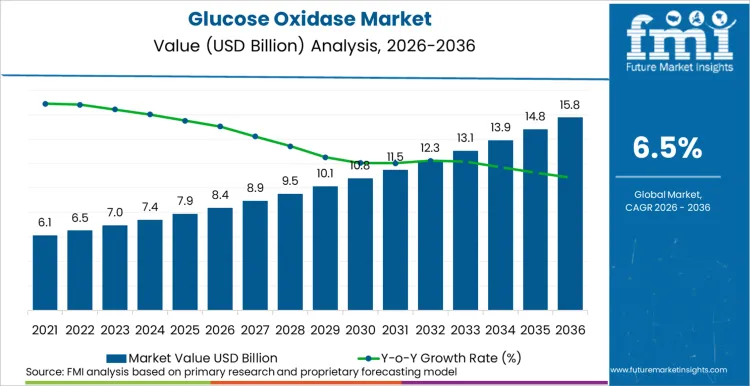
The global glucose oxidase sector is on track to achieve a valuation of USD 15,772.7 Million by 2036, progressing from USD 8,402.5 Million in 2026 at a CAGR of 6.5%. As per Future Market Insights, expansion is structurally underpinned by the accelerating global ban on antibiotic growth promoters in animal feed, which positions glucose oxidase as a primary enzymatic substitute for gut health management in livestock. The European Commission regulation banning the use of antibiotics as growth promoters in animal feed, enforced since 2006 and progressively tightened through 2024 surveillance protocols, continues to set the global standard that emerging markets are now replicating. This sustained regulatory pressure compels feed additive manufacturers to invest in enzyme production capacity for glucose oxidase-based alternatives. Simultaneously, the diagnostics segment is shifting from intermittent blood glucose testing to continuous glucose monitoring (CGM) systems, which forces sensor manufacturers to source higher-purity glucose oxidase for electrode coating.
Peter Arduini, CEO of GE HealthCare, stated: 'GE HealthCare is on a mission to deliver technologies that address radiologists' biggest areas of concern.' While this statement addresses broader diagnostics, it frames the strategic direction of connected sensor-based medical devices that rely on enzymatic detection chemistry, including glucose oxidase-based biosensors. FMI opines that the convergence of AI-driven edge computing with enzymatic sensor technology is the primary value creation mechanism in the diagnostics segment. NXP Semiconductors and GE HealthCare announced a collaboration in January 2026 to develop edge AI solutions for acute care monitoring, which directly supports the development of smarter, more responsive glucose monitoring platforms.
FMI analysts note that the animal feed segment was reshaped in 2024 and 2025 by two major transactions. In January 2024, Novozymes and Chr. Hansen completed their statutory merger to form Novonesis, uniting the world's largest enzyme and microbial technology portfolios, with glucose oxidase being a core component of their animal feed biosolutions. In February 2025, dsm-firmenich sold its stake in the Feed Enzymes Alliance to Novonesis for EUR 1.5 billion, consolidating ownership of major industrial enzyme assets and allowing Novonesis to fully integrate glucose oxidase solutions into their global platform. In June 2024, Beijing Challenge Group, in collaboration with the Chinese Academy of Agricultural Sciences, announced the large-scale industrial promotion of Challen GOX, a specialized glucose oxidase formulation with enhanced heat resistance designed to survive the pelleting process in animal feed.
Key Takeaways
- Power in the glucose oxidase value chain is bifurcated. In the feed enzyme segment, Novonesis now controls the dominant share following the Novozymes-Chr. Hansen merger and the dsm-firmenich feed enzyme acquisition. In the diagnostics segment, power is held by sensor manufacturers including Abbott, Roche, and Medtronic, who specify glucose oxidase purity and sourcing requirements for their CGM electrode assemblies.
- Pricing asymmetry between feed-grade and diagnostic-grade glucose oxidase is extreme. Feed-grade enzyme is a commodity priced per kilogram of formulation, while diagnostic-grade glucose oxidase for biosensor electrodes is priced per unit of specific activity, with purity premiums that can be 50 to 100 times higher per milligram of active enzyme.
- Sourcing fragility in the diagnostics segment is concentrated in recombinant glucose oxidase production, where a limited number of fermentation facilities meet the purity standards required for medical device applications. Any contamination event or batch failure at these facilities can disrupt CGM sensor production timelines for downstream device manufacturers.
- Compliance risks are rising as the FDA issued updated cybersecurity guidance for medical devices in February 2026, emphasizing quality management for connected devices like glucose monitors. Enzyme suppliers serving the diagnostics segment must ensure their production processes meet not only enzyme purity standards but also the traceability requirements demanded by device manufacturers under these evolving regulatory frameworks.
- Geographic leverage varies by segment: North America leads in diagnostics demand driven by high CGM adoption rates; Europe sets the regulatory standard for antibiotic-free animal feed; East Asia, led by China, is the largest feed enzyme production and consumption market; South Asia is a rapidly growing animal feed additive market; Latin America is expanding enzyme adoption in poultry and swine production; and the Middle East and Africa are emerging markets for both feed enzymes and diabetes diagnostics.
- FMI analysts reframe the glucose oxidase market as a dual-track platform story. Executive strategy must address both the high-volume, low-margin feed enzyme segment, where scale and cost efficiency determine success, and the low-volume, high-margin diagnostics segment, where purity, traceability, and regulatory compliance are the primary value drivers.
Summary of Glucose Oxidase Market
What Is Growth Outlook for Glucose Oxidase Market as per Future Market Insights Projection?
Future Market Insights projects the glucose oxidase market to expand at a CAGR of 6.5% from 2026 to 2036, increasing from USD 8,402.5 Million in 2026 to USD 15,772.7 Million by 2036.
FMI Research Approach: FMI proprietary forecasting model based on animal feed enzyme adoption rates and CGM device installation base projections.
How Do FMI Analysts Perceive Glucose Oxidase Market to Evolve?
FMI analysts perceive the market evolving toward a dual-track structure where high-volume feed enzyme demand is served by consolidated biosolutions firms while high-value diagnostics demand is driven by medical device companies requiring ultra-pure enzymatic formulations.
FMI Research Approach: Segment-level demand modeling based on EU antibiotic ban enforcement and CGM market penetration analysis.
Which Country Holds Largest Share in Global Glucose Oxidase Market?
China holds the largest share of the global glucose oxidase market by volume, supported by its dominant position in both industrial enzyme fermentation capacity and the largest livestock population driving feed enzyme demand.
FMI Research Approach: FMI country-level revenue modeling based on enzyme production output, livestock population data, and CGM adoption rates.
How Large Will Glucose Oxidase Market Be by 2036?
The global glucose oxidase market is projected to reach USD 15,772.7 Million by 2036.
FMI Research Approach: FMI long-term revenue forecast derived from feed additive consumption projections and medical biosensor electrode production volumes.
What Is Definition of Glucose Oxidase Market?
The glucose oxidase market includes revenue generated from the production and sale of glucose oxidase enzymes (EC 1.1.3.4) used in animal feed additives, food preservation and processing, clinical diagnostics and biosensors, and industrial applications.
FMI Research Approach: FMI market taxonomy and inclusion-exclusion framework based on enzyme classification and dual end-use application mapping.
What Are Globally Unique Trends Shaping Glucose Oxidase Market?
Globally unique trends include the consolidation of feed enzyme assets under Novonesis, the development of heat-resistant glucose oxidase formulations for animal feed pelleting, and the integration of AI-driven edge computing with enzymatic biosensor platforms for continuous glucose monitoring.
FMI Research Approach: Biosolutions M&A tracking and medical device regulatory filing analysis.
Glucose Oxidase Market Key Takeaways
| Metric | Details |
|---|---|
| Industry Size (2026) | USD 8,402.5 Million |
| Industry Value (2036) | USD 15,772.7 Million |
| CAGR (2026 to 2036) | 6.5% |
Source: Future Market Insights (FMI) analysis, based on proprietary forecasting model and primary research
Key Industry Highlights
Increasing Prevalence of Diabetes and the Need for Glucose Monitoring Propelling the Glucose Oxidase Market
The rising global prevalence of diabetes is a major driver of the glucose oxidase market, particularly in the diagnostics and healthcare sectors. The development and enhancement of diabetes monitoring devices is mainly reliant on the use of glucose oxidase. Diabetes is a disorder in which the body is unable to maintain adequate blood sugar levels, demanding reliable and accurate glucose monitoring for effective management and avoidance of consequences.
Glucose oxidase biosensors are frequently employed in current glucose monitoring systems. Patients may simply track their blood sugar levels with these biosensors, which oxidize glucose. As a result, they produce an electrical signal representing the glucose concentration in each sample. This is essential for safety. Many types of equipment include implantable glucose sensors, CGM systems, and glucometers. They rely on this biosensor.
Additionally, the emergence of new glucose monitoring technologies such as CGM systems and smart insulin delivery devices. It has increased the demand for glucose oxidase in health care. However, these developments require accurate, real-time glucose monitoring to offer personalized diabetes management solutions and enhance the quality of life of a diabetic patient.
Integration of Glucose Oxidase with Emerging Technologies Boosting the Market Growth
The glucose oxidase marketplace is experiencing a growing trend of integration with rising technology, mainly inside the fields of biofuel cells, biosensors, and biotechnology applications. The adaptability and remarkable properties of glucose oxidase have made it an attractive option for modern technologies as the need for sophisticated and forward-thinking solutions grows across several sectors. The biosensor industry requires glucose oxidase to produce highly sensitive and accurate glucose monitoring devices.
During glucose metabolism, an enzyme produces and receives a visible electrical signal, which is necessary for the development of modern glucose biosensors. Treatment of diabetes and other metabolic disorders is often performed using these devices. With the growth of the biosensors industry and the development of more advanced and user-friendly devices, there is no doubt that demand for glucose oxidase (GFC)-based bio-sensors will continue to rise.
Furthermore, a new trend in the glucose oxidase market is being developed to integrate glucose into biofuel mobile manufacturing. The conversion of chemical energy into electrical current is achieved through electrochemical means in biofuel cells, which use either microorganisms or enzymes as catalysts. The development of sustained strength solutions relies on the utilization of glucose oxidase, which is essential because it can efficiently metabolize glucose and provide power.
Developing Novel Applications of Glucose Oxidase in the Food and Beverage Industry Boosts the Market
High-gluten flour, eggs, water, and yeast are the ingredients used as the base for bread. The reaction between potassium bromate and the gluten tissue of wheat protein after the addition of potassium bromate gives the gluten the strength and flexibility required for the effective baking of yeast-fermented items. Bread can grow larger and taste better due to the glucose oxidase enzyme. Hence, many manufacturers from the bakery industry use glucose oxidase in baking.
Furthermore, the glucose oxidase market can benefit from the rising trend of personalized and customized food products. The ability to incorporate glucose oxidase in customized food formulations might provide companies a competitive edge as customers grow more discriminating and seek customized solutions to satisfy their unique dietary requirements and preferences. Manufacturers may utilize glucose oxidase's adaptability to create specialized foods and beverages that address dietary needs, individual tastes, or health issues.
Other important factors, such as the rising need for staple foods and animal feed in emerging nations, are anticipated to fuel the expansion of the global glucose oxidase market. Consumers are consuming more processed foods, such as frozen meat products, as a result of the increased per capita income, shifting dietary tastes, and growing knowledge of healthy eating practices.
The popularity of processed foods might increase demand for goods like glucose oxidases, which enable effective processing techniques that result in superior final products at cheaper costs without sacrificing nutritional value.
Market Concentration
Tier 1 companies in Glucose Oxidase, account for a significant share of the global market. Roche Diagnostics, Sigma-Aldrich Co. LLC, and BBI Solutions. These companies account for a major share of the global market and are at the forefront of innovation. They have a significant global presence aimed at a variety of sectors, including food and beverage, and healthcare. These companies are known for their remarkable research and development skills, which enable them to consistently create new trends and meet shifting market demands.
Tier 2 Companies are the regional players with adequate market coverage and are known for offering niche products. They are typically more localized and address specific issues of more general ones.
Tier 3 Companies are smaller players who are usually limited to the local or regional areas. They tend to service localized areas and do not possess the same level of research & development as bigger companies but are nonetheless helpful in satisfying local needs. These companies are smaller in size but remain strong in their target industries due to their deep-rooted innovations and customer service.
Country-wise Insights
The following table shows the estimated growth rates of the top three territories. China and Japan are set to exhibit high consumption, recording CAGRs of 5.7% and 6.4%, respectively, through 2036.
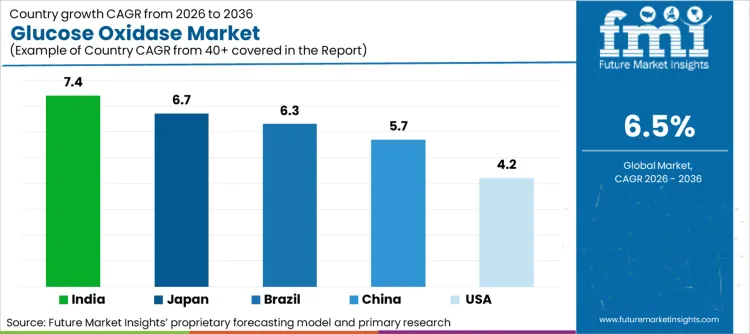
| Countries | CAGR 2026 to 2036 |
|---|---|
| The USA | 4.2% |
| Brazil | 6.3% |
| India | 7.4% |
| Japan | 6.7% |
| China | 5.7% |
Advancements in Glucose Monitoring Technologies is Surging in the USA
The USA is the leader in advanced glucose monitoring technologies which is a key part of the global glucose oxidase market. Diabetes is getting more common and there is more emphasis on patient outcomes so there is a need for new and reliable glucose monitoring systems. The development of these advanced glucose monitoring devices depends heavily on oxidase-based glucose biosensors.
The ability of enzymes to catalyze glucose oxidation and offer an electrical signal serves as the foundation for modern glucose meters. CCGM systems and other glucose monitoring devices are gaining popularity in the United States. These new technologies integrate glucose monitoring with automated insulin administration.
A more effective and tailored approach to diabetes management. The increased use of these integrated systems in the United States has been fueled by a strong emphasis on improving patient outcomes and the availability of payment coverage for proficient glucose monitoring devices.
Emphasis on Sustainability and Environmental Regulations of Glucose Oxidase is Boosting the Market in Germany.
Germany's strong emphasis on environmental protection and sustainability is a significant element driving the global glucose oxidase market. The German government has implemented strong rules and policies to encourage the utilization of environmentally friendly and natural products. The natural presence of glucose oxidase is consistent with Germany's commitment to sustainability and the growing demand for ecologically friendly solutions among consumers.
Owing to its ability to serve as a natural preservative and be manufactured from renewable and biodegradable feedstock, the enzyme is highly valued due to its potential advantages over synthetic additives and conventional chemical-based processes. The German regulatory context has facilitated the promotion of glucose oxidation. The establishment of regulations and guidelines, such as those related to natural ingredients and food labeling, has created a favorable environment for the growth of the glucose oxidase market.
Category-Wise Insights
High Yield and Efficiency Propelling the Source Segment for Higher Sales
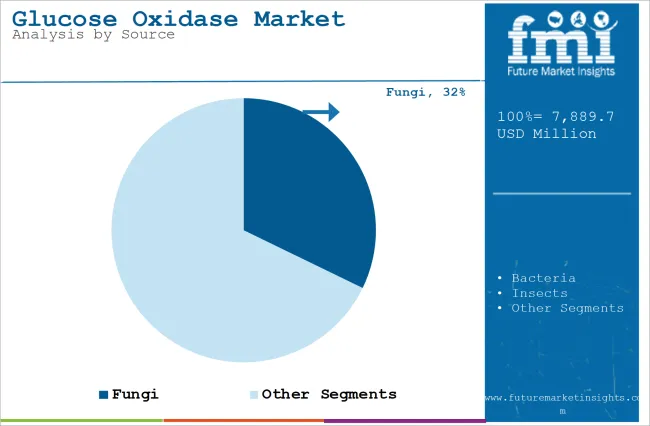
| Segment | Fungi (By Source) |
|---|---|
| Value Share (2026) | 32.2% |
The majority of glucose oxidase production comes from fungi, which naturally produce significant amounts of this enzyme. Species like Penicillium and Aspergillus niger are responsible for the majority of contributions. They have been found to generate glucose oxidase while under the influence of metabolism. Besides being scalable, the fungus can be grown on various inexpensive surfaces, including agricultural by-products, making glucose oxidase production more economically viable.
In the food and beverage industry, fungal glucose oxidase is frequently utilized as a natural preservative. Limits the oxygenation of packed products, thereby reducing contamination. Advances the formation of dough during baking and extends bread shelf life in the food industry.
Glucose biosensors for diabetes control are heavily dependent on fungal glucose oxidase, particularly in the pharmaceutical and healthcare sectors. It is highly specific and reliable. The efficiency and stability of enzyme production have been enhanced through strain optimization and genetic engineering, which have also aided the growth of fungal cells as a source of glucose oxidase.
Fungal strains that produce high levels of glucose oxidase can be produced using recombinant DNA technology, as an illustration.
Competition Outlook
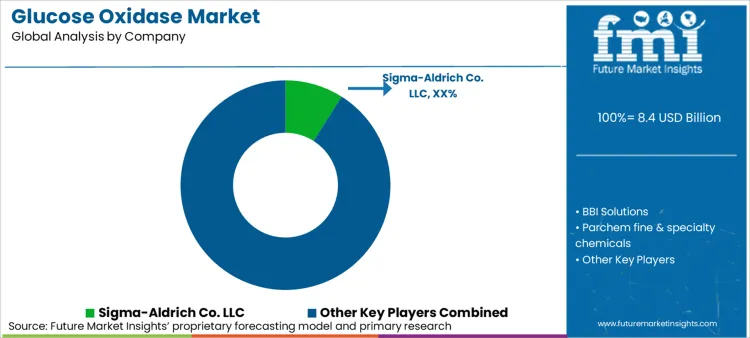
The competition landscape of the Glucose Oxidase market is intense. Sigma Aldrich, Roche Diagnostics, and Parchem Fine & Specialty Chemicals are some of the major market players and contribute significantly in terms of research & development investment exploring enzymatic or microbial-based production methods that minimize the usage of harsh chemicals, diminish energy consumption, and produce fewer waste streams.
To expand their sales, producers are implementing numerous strategies including strategic and vertical acquisitions. For instance, BBI Solutions is focused on providing cutting-edge biosensor solutions that improve accuracy, sensitivity, and usability while meeting the evolving demands of the healthcare industry. This investment and innovation aimed at developing efficient and effective fungicide solutions.
Recent Developments:
- In January 2024, Novozymes and Chr. Hansen completed their statutory merger to form Novonesis, creating a global leader in biosolutions with a combined enzyme and microbial technology portfolio that includes glucose oxidase for food, feed, and industrial applications.
- In February 2025, dsm-firmenich announced the sale of its stake in the Feed Enzymes Alliance to Novonesis for EUR 1.5 billion, consolidating ownership of major industrial enzyme assets including glucose oxidase formulations used as antibiotic substitutes in animal feed.
- In June 2024, Beijing Challenge Group, in collaboration with the Chinese Academy of Agricultural Sciences, announced the large-scale industrial promotion of Challen GOX, a specialized glucose oxidase formulation with enhanced heat resistance and enzymatic hydrolysis efficiency designed to survive the pelleting process in animal feed manufacturing.
Leading Brands
- Sigma-Aldrich Co. LLC
- BBI Solutions
- Parchem fine & specialty chemicals
- Lee BioSolutions
- MP Biomedicals LLC
- Innova Biosciences Ltd
- Fischer Scientific International, Inc.
- Thomas Scientific
- Roche Diagnostics
- Nanning Doing-Higher Bio-Tech Co., Ltd.
- Others
Market Definition
The glucose oxidase market represents revenue generated from the production, sale, and application of glucose oxidase enzymes (EC 1.1.3.4) across animal feed, food processing, clinical diagnostics, and industrial applications. The market measures the value of enzyme formulations sold to feed additive manufacturers, food processors, medical device companies, and industrial chemical distributors.
Inclusions cover microbial glucose oxidase derived from Aspergillus niger and recombinant production systems, feed-grade formulations for antibiotic replacement, food-grade enzymes for dough conditioning and preservation, diagnostic-grade enzymes for biosensor electrode coating, and industrial-grade enzymes for gluconic acid production.
Exclusions include general-purpose oxidoreductase enzymes not classified as glucose oxidase, complete CGM medical devices (only the enzyme component is in scope), and glucose test strips sold as finished consumer products without separate enzyme component revenue attribution.
Research Scope
| Items | Values |
|---|---|
| Quantitative Units (2026) | USD 8,402.5 Million |
| Product Type | Feed-Grade GOx, Food-Grade GOx, Diagnostic-Grade GOx, Industrial-Grade GOx |
| Application | Animal Feed, Food Processing, Clinical Diagnostics/Biosensors, Industrial Chemistry |
| Regions Covered | North America, Europe, East Asia, South Asia, Latin America, Middle East & Africa |
| Key Companies Profiled | Novonesis, dsm-firmenich, Beijing Challenge Group, Roche, Abbott, Amano Enzyme |
Key Segments of the Report
By Source:
As per Source, the industry has been categorized into Fungi, Bacteria, Insects, and Plant.
By End Use:
As per End Use, the industry has been categorized into Food & Beverage, Healthcare, and Packaging.
By Region:
Industry analysis has been carried out in key countries of North America, Latin America, Western Europe, Eastern Europe, East Asia, South Asia & Pacific, Central Asia, Russia and Belarus, Balkan & Baltics, and the Middle East & Africa.
Bibliography
- Novonesis. (2024, January). Completion of Novozymes-Chr. Hansen Merger. Novonesis Corporate.
- dsm-firmenich. (2025, February). Sale of Feed Enzymes Alliance Stake to Novonesis. dsm-firmenich Investor Relations.
- Beijing Challenge Group. (2024, June). Industrial Promotion of Challen GOX. Chinese Academy of Agricultural Sciences.
- U.S. Food and Drug Administration. (2026, February). Cybersecurity in Medical Devices: Quality Management System Considerations. FDA.
- GE HealthCare. (2026, January). NXP and GE HealthCare Collaboration for Edge AI Innovation. GE HealthCare Newsroom.
Frequently Asked Questions
What is the current value of the Glucose Oxidase industry?
The global industry is estimated at a value of USD 8,402.5 Million in 2026.
At what rate did the sales for Glucose Oxidase grow between 2021 and 2025?
Sales increased at 5.8% CAGR between 2021 and 2025.
Who are the leading manufacturers of Glucose Oxidase?
Some of the leaders in this industry include Sigma-Aldrich Co. LLC, BBI Solutions, Parchem fine & specialty chemicals, Lee BioSolutions, MP Biomedicals LLC, Innova Biosciences Ltd, Fischer Scientific International, Inc., Thomas Scientific, Roche Diagnostics, and Nanning Doing-Higher Bio-Tech Co., Ltd., among others.
Which region will garner a significant value share by 2026?
The North American territory is projected to hold a revenue share of 29.6% over the forecast period.
At what CAGR is the global forecast to grow from 2026 to 2036?
The industry is projected to grow at a forecast CAGR of 6.5% from 2026 to 2036.
Preview the report firsthand - request a free sample
Get SampleGet the brochure for pricing and purchase details.
Get PDFTable of Content
- Executive Summary
- Global Market Outlook
- Demand-side Trends
- Supply-side Trends
- Technology Roadmap Analysis
- Analysis and Recommendations
- Market Overview
- Market Coverage / Taxonomy
- Market Definition / Scope / Limitations
- Research Methodology
- Chapter Orientation
- Analytical Lens and Working Hypotheses
- Market Structure, Signals, and Trend Drivers
- Benchmarking and Cross-market Comparability
- Market Sizing, Forecasting, and Opportunity Mapping
- Research Design and Evidence Framework
- Desk Research Programme (Secondary Evidence)
- Company Annual and Sustainability Reports
- Peer-reviewed Journals and Academic Literature
- Corporate Websites, Product Literature, and Technical Notes
- Earnings Decks and Investor Briefings
- Statutory Filings and Regulatory Disclosures
- Technical White Papers and Standards Notes
- Trade Journals, Industry Magazines, and Analyst Briefs
- Conference Proceedings, Webinars, and Seminar Materials
- Government Statistics Portals and Public Data Releases
- Press Releases and Reputable Media Coverage
- Specialist Newsletters and Curated Briefings
- Sector Databases and Reference Repositories
- FMI Internal Proprietary Databases and Historical Market Datasets
- Subscription Datasets and Paid Sources
- Social Channels, Communities, and Digital Listening Inputs
- Additional Desk Sources
- Expert Input and Fieldwork (Primary Evidence)
- Primary Modes
- Qualitative Interviews and Expert Elicitation
- Quantitative Surveys and Structured Data Capture
- Blended Approach
- Why Primary Evidence is Used
- Field Techniques
- Interviews
- Surveys
- Focus Groups
- Observational and In-context Research
- Social and Community Interactions
- Stakeholder Universe Engaged
- C-suite Leaders
- Board Members
- Presidents and Vice Presidents
- R&D and Innovation Heads
- Technical Specialists
- Domain Subject-matter Experts
- Scientists
- Physicians and Other Healthcare Professionals
- Governance, Ethics, and Data Stewardship
- Research Ethics
- Data Integrity and Handling
- Primary Modes
- Tooling, Models, and Reference Databases
- Desk Research Programme (Secondary Evidence)
- Data Engineering and Model Build
- Data Acquisition and Ingestion
- Cleaning, Normalisation, and Verification
- Synthesis, Triangulation, and Analysis
- Quality Assurance and Audit Trail
- Market Background
- Market Dynamics
- Drivers
- Restraints
- Opportunity
- Trends
- Scenario Forecast
- Demand in Optimistic Scenario
- Demand in Likely Scenario
- Demand in Conservative Scenario
- Opportunity Map Analysis
- Product Life Cycle Analysis
- Supply Chain Analysis
- Investment Feasibility Matrix
- Value Chain Analysis
- PESTLE and Porter’s Analysis
- Regulatory Landscape
- Regional Parent Market Outlook
- Production and Consumption Statistics
- Import and Export Statistics
- Market Dynamics
- Global Market Analysis 2021 to 2025 and Forecast, 2026 to 2036
- Historical Market Size Value (USD Million) Analysis, 2021 to 2025
- Current and Future Market Size Value (USD Million) Projections, 2026 to 2036
- Y-o-Y Growth Trend Analysis
- Absolute $ Opportunity Analysis
- Global Market Pricing Analysis 2021 to 2025 and Forecast 2026 to 2036
- Global Market Analysis 2021 to 2025 and Forecast 2026 to 2036, By Source
- Introduction / Key Findings
- Historical Market Size Value (USD Million) Analysis By Source , 2021 to 2025
- Current and Future Market Size Value (USD Million) Analysis and Forecast By Source , 2026 to 2036
- Fungi
- Bacteria
- Insects
- Plant
- Fungi
- Y-o-Y Growth Trend Analysis By Source , 2021 to 2025
- Absolute $ Opportunity Analysis By Source , 2026 to 2036
- Global Market Analysis 2021 to 2025 and Forecast 2026 to 2036, By End Use
- Introduction / Key Findings
- Historical Market Size Value (USD Million) Analysis By End Use, 2021 to 2025
- Current and Future Market Size Value (USD Million) Analysis and Forecast By End Use, 2026 to 2036
- Food & Beverage
- Healthcare
- Packaging
- Food & Beverage
- Y-o-Y Growth Trend Analysis By End Use, 2021 to 2025
- Absolute $ Opportunity Analysis By End Use, 2026 to 2036
- Global Market Analysis 2021 to 2025 and Forecast 2026 to 2036, By Region
- Introduction
- Historical Market Size Value (USD Million) Analysis By Region, 2021 to 2025
- Current Market Size Value (USD Million) Analysis and Forecast By Region, 2026 to 2036
- North America
- Latin America
- Western Europe
- Eastern Europe
- East Asia
- South Asia and Pacific
- Middle East & Africa
- Market Attractiveness Analysis By Region
- North America Market Analysis 2021 to 2025 and Forecast 2026 to 2036, By Country
- Historical Market Size Value (USD Million) Trend Analysis By Market Taxonomy, 2021 to 2025
- Market Size Value (USD Million) Forecast By Market Taxonomy, 2026 to 2036
- By Country
- USA
- Canada
- Mexico
- By Source
- By End Use
- By Country
- Market Attractiveness Analysis
- By Country
- By Source
- By End Use
- Key Takeaways
- Latin America Market Analysis 2021 to 2025 and Forecast 2026 to 2036, By Country
- Historical Market Size Value (USD Million) Trend Analysis By Market Taxonomy, 2021 to 2025
- Market Size Value (USD Million) Forecast By Market Taxonomy, 2026 to 2036
- By Country
- Brazil
- Chile
- Rest of Latin America
- By Source
- By End Use
- By Country
- Market Attractiveness Analysis
- By Country
- By Source
- By End Use
- Key Takeaways
- Western Europe Market Analysis 2021 to 2025 and Forecast 2026 to 2036, By Country
- Historical Market Size Value (USD Million) Trend Analysis By Market Taxonomy, 2021 to 2025
- Market Size Value (USD Million) Forecast By Market Taxonomy, 2026 to 2036
- By Country
- Germany
- UK
- Italy
- Spain
- France
- Nordic
- BENELUX
- Rest of Western Europe
- By Source
- By End Use
- By Country
- Market Attractiveness Analysis
- By Country
- By Source
- By End Use
- Key Takeaways
- Eastern Europe Market Analysis 2021 to 2025 and Forecast 2026 to 2036, By Country
- Historical Market Size Value (USD Million) Trend Analysis By Market Taxonomy, 2021 to 2025
- Market Size Value (USD Million) Forecast By Market Taxonomy, 2026 to 2036
- By Country
- Russia
- Poland
- Hungary
- Balkan & Baltic
- Rest of Eastern Europe
- By Source
- By End Use
- By Country
- Market Attractiveness Analysis
- By Country
- By Source
- By End Use
- Key Takeaways
- East Asia Market Analysis 2021 to 2025 and Forecast 2026 to 2036, By Country
- Historical Market Size Value (USD Million) Trend Analysis By Market Taxonomy, 2021 to 2025
- Market Size Value (USD Million) Forecast By Market Taxonomy, 2026 to 2036
- By Country
- China
- Japan
- South Korea
- By Source
- By End Use
- By Country
- Market Attractiveness Analysis
- By Country
- By Source
- By End Use
- Key Takeaways
- South Asia and Pacific Market Analysis 2021 to 2025 and Forecast 2026 to 2036, By Country
- Historical Market Size Value (USD Million) Trend Analysis By Market Taxonomy, 2021 to 2025
- Market Size Value (USD Million) Forecast By Market Taxonomy, 2026 to 2036
- By Country
- India
- ASEAN
- Australia & New Zealand
- Rest of South Asia and Pacific
- By Source
- By End Use
- By Country
- Market Attractiveness Analysis
- By Country
- By Source
- By End Use
- Key Takeaways
- Middle East & Africa Market Analysis 2021 to 2025 and Forecast 2026 to 2036, By Country
- Historical Market Size Value (USD Million) Trend Analysis By Market Taxonomy, 2021 to 2025
- Market Size Value (USD Million) Forecast By Market Taxonomy, 2026 to 2036
- By Country
- Kingdom of Saudi Arabia
- Other GCC Countries
- Turkiye
- South Africa
- Other African Union
- Rest of Middle East & Africa
- By Source
- By End Use
- By Country
- Market Attractiveness Analysis
- By Country
- By Source
- By End Use
- Key Takeaways
- Key Countries Market Analysis
- USA
- Pricing Analysis
- Market Share Analysis, 2025
- By Source
- By End Use
- Canada
- Pricing Analysis
- Market Share Analysis, 2025
- By Source
- By End Use
- Mexico
- Pricing Analysis
- Market Share Analysis, 2025
- By Source
- By End Use
- Brazil
- Pricing Analysis
- Market Share Analysis, 2025
- By Source
- By End Use
- Chile
- Pricing Analysis
- Market Share Analysis, 2025
- By Source
- By End Use
- Germany
- Pricing Analysis
- Market Share Analysis, 2025
- By Source
- By End Use
- UK
- Pricing Analysis
- Market Share Analysis, 2025
- By Source
- By End Use
- Italy
- Pricing Analysis
- Market Share Analysis, 2025
- By Source
- By End Use
- Spain
- Pricing Analysis
- Market Share Analysis, 2025
- By Source
- By End Use
- France
- Pricing Analysis
- Market Share Analysis, 2025
- By Source
- By End Use
- India
- Pricing Analysis
- Market Share Analysis, 2025
- By Source
- By End Use
- ASEAN
- Pricing Analysis
- Market Share Analysis, 2025
- By Source
- By End Use
- Australia & New Zealand
- Pricing Analysis
- Market Share Analysis, 2025
- By Source
- By End Use
- China
- Pricing Analysis
- Market Share Analysis, 2025
- By Source
- By End Use
- Japan
- Pricing Analysis
- Market Share Analysis, 2025
- By Source
- By End Use
- South Korea
- Pricing Analysis
- Market Share Analysis, 2025
- By Source
- By End Use
- Russia
- Pricing Analysis
- Market Share Analysis, 2025
- By Source
- By End Use
- Poland
- Pricing Analysis
- Market Share Analysis, 2025
- By Source
- By End Use
- Hungary
- Pricing Analysis
- Market Share Analysis, 2025
- By Source
- By End Use
- Kingdom of Saudi Arabia
- Pricing Analysis
- Market Share Analysis, 2025
- By Source
- By End Use
- Turkiye
- Pricing Analysis
- Market Share Analysis, 2025
- By Source
- By End Use
- South Africa
- Pricing Analysis
- Market Share Analysis, 2025
- By Source
- By End Use
- USA
- Market Structure Analysis
- Competition Dashboard
- Competition Benchmarking
- Market Share Analysis of Top Players
- By Regional
- By Source
- By End Use
- Competition Analysis
- Competition Deep Dive
- Sigma-Aldrich Co. LLC
- Overview
- Product Portfolio
- Profitability by Market Segments (Product/Age /Sales Channel/Region)
- Sales Footprint
- Strategy Overview
- Marketing Strategy
- Product Strategy
- Channel Strategy
- BBI Solutions
- Parchem fine & specialty chemicals
- MP Biomedicals LLC
- Innova Biosciences Ltd
- Fischer Scientific International, Inc.
- Sigma-Aldrich Co. LLC
- Competition Deep Dive
- Assumptions & Acronyms Used


