


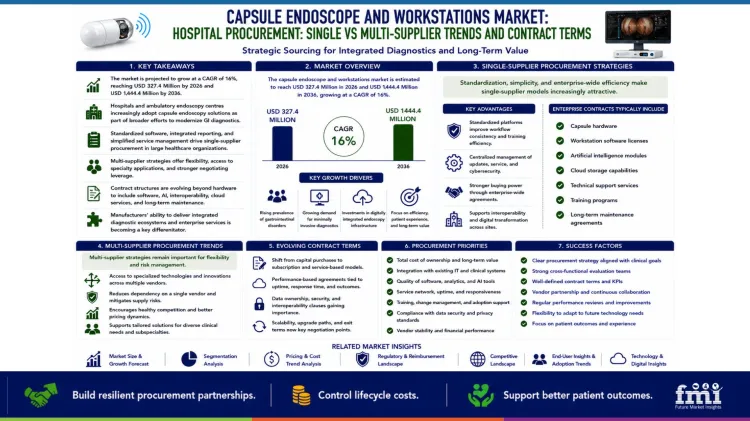
- The capsule endoscope and workstations market is projected to grow at a CAGR of 16% during the forecast period to reach USD 327.4 Million by 2026 and USD 1,444.4 Million by 2036 due to rising investments in minimally invasive gastrointestinal diagnostics and digital endoscopy infrastructure.
- Hospitals and ambulatory endoscopy centres increasingly adopt capsule endoscopy solutions as part of the broader effort to modernise gastrointestinal diagnostics, rather than as a standalone diagnostic tool.
- Benefits of standardized software environments, integrated reporting and simplified service management are driving large healthcare organizations to adopt a single-supplier procurement model.
- Multi-supplier strategies are still important to health care providers seeking technological flexibility, access to specialty applications and greater negotiating leverage.
- Contract structures are evolving from simply purchasing the capsule hardware to purchasing software subscriptions, artificial intelligence capabilities, interoperability support, cloud services, and long-term maintenance agreements.
- In addition to capsule technology, the ability of manufacturers to provide integrated diagnostic ecosystems and enterprise service capabilities is increasingly important for competitive positioning.
Introduction
Gastrointestinal Diagnostic Technology Buying Strategies Are About to Change Dramatically More and more healthcare providers are realizing that capsule endoscopy is not a replacement for traditional diagnostic techniques, but a strategic technology that can improve efficiency in workflow, patient experience and long-term operational performance.
The market for capsule endoscope and workstations is estimated to be USD 327.4 Million in 2026 and USD 1,444.4 Million in 2036 (CAGR of 16%). Factors driving market growth include increasing demand for minimally invasive diagnostics, rising prevalence of gastrointestinal disorders, and increasing investments in digitally integrated endoscopy infrastructures.
In the past, the selection of capsule endoscopy technology was mainly based on image quality and hardware function. Today, healthcare providers are looking for more complete diagnostic ecosystems that incorporate software platforms, analytics capabilities, interoperability and even long-term service support.
Procurement strategies, supplier relationships and competitive dynamics are all being reshaped by changing priorities in the capsule endoscope and workstation market.
Market Context
Gastrointestinal diseases continue to represent a major clinical and economic burden worldwide. Often, conditions such as occult gastrointestinal bleeding, inflammatory bowel disease, and small bowel tumours are diagnosed after extensive diagnostic workups and require long-term patient management.
Healthcare providers are seeking technologies that will optimize diagnostic efficiency, while reducing complexity and resource utilization.
Capsule endoscopy techniques are well suited for these purposes, facilitating minimally invasive visualization of gastrointestinal structures and outpatient diagnostic workflows.
Capsule endoscopy technology is increasingly being adopted by a growing number of healthcare organizations, such as hospitals, ambulatory endoscopy centres and specialized gastrointestinal clinics. Extended use is complicating procurement and making vendor selection more critical.
Healthcare systems are increasingly seeing capsule endoscopy technologies as part of wider digital gastroenterology ecosystems rather than as standalone diagnostic tools.
This is resulting in more strategic and long-term nature of procurement strategies.
Single-Supplier Procurement Strategies
One increasing trend among healthcare providers is to purchase capsule endoscopy technology from a single vendor.
Single-supplier strategies have a number of operational advantages. Standardizing capsule technologies and workstation platforms across sites allows for training of clinicians, reduces variability in workflow and improves uniformity in image interpretation and reporting practices.
Enterprise agreements also allow for centralised management of software updates, service requirements and cyber security protocols. These efficiencies are increasingly appreciated by healthcare providers as they reduce administrative complexity and help enable integrated diagnostic pathways.
Large healthcare systems that begin their digital transformation often choose single vendor strategies to standardize the endoscopy infrastructure and to promote interoperability across departments and sites.
You can also gain buying leverage through single-vendor arrangements. Hospitals often negotiate enterprise contracts that include:
- Capsule hardware
- Workstation software licenses
- Artificial intelligence modules
- Cloud storage capabilities
- Technical support services
- Training programs
- Long-term maintenance agreements
Bundled contracts can lower total ownership costs and simplify technology governance.
As capsule endoscopy increasingly becomes integrated into enterprise diagnostic strategies, supplier consolidation is becoming a more attractive procurement approach.
Multi-Supplier Procurement Trends
Standardization certainly has its operational advantages, but the bulk of the market is still using multi-supplier procurement strategies.
Many large academic medical centres and integrated delivery networks have relationships with multiple vendors to maintain flexibility and reduce the risks of technology concentration.
The multi-supplier approach allows healthcare providers to evaluate new innovations and add specialized technologies for specific gastrointestinal applications.
Procurement teams also know that diversified vendor relationships can help strengthen pricing negotiations and improve access to technological advancements.
Another important consideration has been supplying chain resilience. Health care providers are growing more wary of relying too much on a single technology partner, especially when it comes to diagnostic systems that support important patient care processes.
In addition, having more than one supplier can be useful when health care systems have heterogeneous information technology environments that require customized integration solutions.
As a result, many organizations continue to balance the efficiencies of standardization with the flexibility and resilience of diversified procurement strategies.
Contract Terms Are Expanding Beyond Hardware
The contract structures in the capsule endoscopy and workstations market have changed quite a lot.
The conventional procurement contracts were mostly for obtaining devices and basic maintenance services. Modern contracts are increasingly incorporating digital capabilities and long-term service obligations.
Healthcare providers are increasingly looking for contractual commitments around:
- Artificial intelligence-assisted image analysis
- Software upgrade pathways
- Electronic health record integration
- Cloud storage and data management
- Cybersecurity protections
- System interoperability
- Technical support response times
- User training programs
- Predictive maintenance services
- Scalability and future upgrade capabilities
The subscription model is becoming more prevalent, particularly for sophisticated analytics platforms and cloud-based services.
Performance-oriented service contracts are also becoming more important. Procurement teams are increasingly looking for quantifiable commitments on system uptime, implementation timeframes and technical support responsiveness.
These increased contractual requirements underscore the growing strategic importance of capsule endoscopy technologies within enterprise gastrointestinal management programs.
Segment Insights
Small bowel capsule endoscopy continues to be one of the leading application areas on the market.
Evaluation of the small bowel with conventional endoscopy has been difficult in the past. Capsule technologies offer minimally invasive visualization capabilities that improve diagnostic efficiency and patient experiences.
Healthcare providers are increasingly looking for technologies that can allow for complete GI evaluations while decreasing the procedural burden and resource usage.
Workstations are also taking on an increasingly important role in procurement decisions.
Advanced software platforms provide image interpretation, reporting and analytics capabilities that dramatically improve workflow efficiency. Procurement teams are looking more and more closely at the functionality of the workstation as well as the performance of the capsule itself.
As the importance of software and analytics capabilities increases, a fundamental change is taking place in the market.
Buyer Behaviour and Decision Making
Procurement decisions are becoming more and more multi-disciplinary.
Gastroenterologists care about diagnostic accuracy and image quality. Cybersecurity and interoperability requirements are evaluated by information technology departments. Financial stakeholders look at total cost of ownership, long-term return on investment.
As capsule endoscopy technologies become integrated into larger enterprise healthcare infrastructures, digital transformation teams are increasingly involved in the procurement process.
Healthcare organizations are increasingly looking for technology partners that can deliver:
- Long-term software support
- Artificial intelligence innovation
- Interoperability capabilities
- Continuous platform improvements
- Enterprise service agreements
Vendor stability and long-term product development plans are becoming more and more important buying criteria.
These shifting expectations are changing procurement processes across the market.
Competitive Implications
Procurement transformation is reshaping the competitive landscape of the capsule endoscope and workstation market.
Manufacturers that can provide integrated diagnostic ecosystems are becoming more competitive. More and more, healthcare providers are seeking solutions that integrate capsule technologies with advanced workstations, analytics platforms and interoperability support.
Market trends in single-supplier procurement open the door for larger vendors with broad technology portfolios and end-to-end service capabilities.
At the same time, multi-supplier strategies create opportunities for niche manufacturers that can offer differentiated artificial intelligence tools, advanced imaging capabilities, and niche gastrointestinal applications.
The importance of strategic partnerships between healthcare IT companies, cloud service providers and AI firms is growing.
Competitive success is increasingly being determined by ecosystem capabilities, software services and long-term customer support, not just capsule hardware.
Strategic Implications
Hospital purchasing strategies are emerging as key drivers of market structure in the capsule endoscope and workstation industry.
More healthcare providers are looking for technologies that can help with integrated diagnostic workflows, digital transformation initiatives and long-term operational efficiencies. Today’s sourcing decisions are no longer limited to simply acquiring capsules but are increasingly informed by broader enterprise information management and service resilience concerns.
The manufacturers able to provide scalable, interoperable and service orientated solutions will be best placed to capture future growth opportunities.
As minimally invasive diagnostics become more mainstream and healthcare organizations implement digitally integrated gastrointestinal management strategies, procurement excellence and long-term partnership capabilities will become an increasingly important source of competitive advantage.
Bottom Line
In the capsule endoscope and workstation market, procurement is shifting away from transactional device purchases to strategic technology partnerships. Many hospitals and endoscopy centres are seeking single supplier deals to enhance standardization and integration, but multi-supplier strategies still offer flexibility and negotiating power. As capsule endoscopy technologies continue to integrate into the enterprise gastrointestinal diagnostic infrastructure, contract structures, interoperability and long-term service commitments will be key determinants of supplier competitiveness and procurement value.

