


- Chitin is not only a seafood-waste valorization story. Its commercial success depends on whether producers can convert variable biological feedstock into consistent, food-grade functional derivatives.
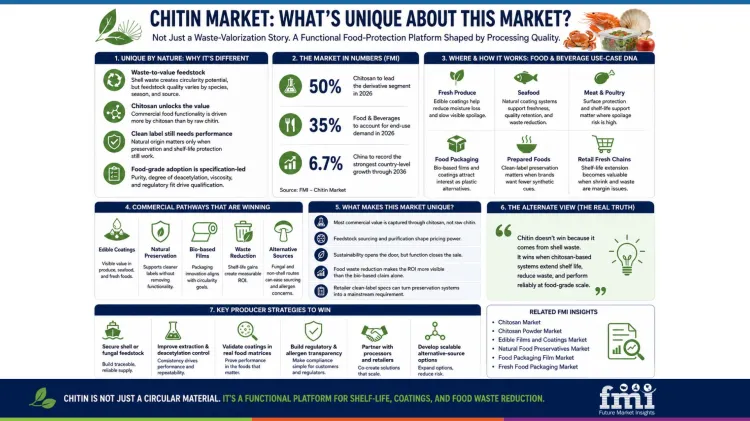
- Chitosan leads the derivative segment because it offers broader commercial functionality than raw chitin, especially in preservation, coatings, films, packaging, and biopolymer applications.
- Food & Beverage demand is important because manufacturers are seeking natural preservation systems, edible coatings, shelf-life extension, and bio-based packaging inputs.
- The real bottleneck is not demand creation. It is feedstock quality, extraction efficiency, deacetylation control, purification standards, and regulatory readiness.
- China’s stronger growth outlook is linked to seafood processing scale, aquaculture throughput, and industrial biomanufacturing capacity.
- The biggest misconception is that shell waste availability automatically creates scalable chitin supply. Food-grade chitin requires controlled processing, not just raw waste access.
The potential of chitin is at the crossroads between seafood processing byproducts’ utilization, food preservation techniques, biopolymer production advancements, and circular ingredients. The idea sounds straightforward enough: the seafood industry produces byproducts in the form of shells that can be transformed into chitin and chitosan. However, the reality is far from simple.
The Chitin Market is not just about collecting shell waste. It is about extracting and processing a naturally occurring polymer into commercially usable derivatives. FMI’s market framing is important because chitin demand is segmented by derivative, end use, and region, with Food & Beverages emerging as a major application area.
The capacity story becomes stronger when viewed through chitosan. FMI identifies chitosan as the leading derivative with 50% share in 2026. This matters because chitin’s commercial value is often unlocked after conversion into chitosan. The Chitosan Market is therefore directly relevant because chitosan has broader functional use across preservation, films, coatings, water treatment, agriculture, and other application areas.
The challenge in producing food-grade materials lies in the variability of the biological source material. Different sources of shell waste – shrimp, crabs, lobsters, insects, and fungi – do not necessarily yield the same quality of material. There are many factors that contribute to variations in the biological source material, including species type, geographic location, season, harvesting, and processing procedures.
This is why the Fish Waste Management Market is relevant to chitin’s capacity story. Chitin production depends on structured by-product recovery, not informal waste availability. Seafood waste must be collected, stabilized, transported, and processed before it can become a reliable input for chitin extraction. Producers that build direct sourcing links with seafood processors may gain a stronger cost and traceability advantage.
The next problem is related to the extraction process. Generally, there is a series of processes involved in extracting chitin from natural sources. Among those processes, there are demineralization, deproteinization, decolorization, and purification. Failure to precisely control these processes means variability in terms of purity, viscosity, solubility, and performance of the final product.
The Chitosan Powder Market supports the same logic because powder format is important for industrial usability. Powdered chitosan can support storage, transport, dosing, blending, and application testing. However, powder format alone does not guarantee quality. Buyers still need clarity on source, degree of deacetylation, particle size, viscosity, microbial quality, and regulatory status.
Deacetylation is highly significant since it affects how chitosan functions. Solubility, film-forming properties, antimicrobial efficacy, viscosity, and food compatibility all depend on the deacetylation percentage. A supplier to the food coating or preservative industry should have consistent product specifications for all batches provided. Failure to do so may result in variable food shelf lives and even disrupt production processes.
Food & Beverage accounts for 35% of end-use demand in FMI’s Chitin Market preview. This is a strong signal that food applications are not peripheral. In food and beverage, chitin and chitosan are linked to natural preservation, edible coatings, bio-based packaging, spoilage reduction, and shelf-life extension. The Edible Films and Coatings Market is relevant here because coating systems can be used to protect fresh produce, seafood, meat, and other perishable foods.
Packaging is also part of the capacity story. Chitin and chitosan-based materials may support bio-based food-contact films and coatings where conventional plastic systems face sustainability pressure. The Food Packaging Film Market provides useful adjacent context because food-contact films must deliver barrier performance, product protection, safety, and shelf-life stability.
The forecast for China to grow at a CAGR of 6.7% until 2036 adds credence to the regional capacity consideration. China’s position as a region with high production capacity of seafood processing, aquaculture, and industrial biomanufacturing provides a significant advantage. However, growing volumes alone does not mean much. Traceability, purification, regulatory compliance, and validation become critical here.
Such organizations would most probably adhere to the integration approach. These companies would ensure the procurement of shell waste or substitute feedstock, adopt the process of controlled extraction, guarantee consistent deacetylation, authenticate food-grade derivatives, and help the customer with the application test. The traceability of feedstock source and derivative specification will always be more desirable than generic chitin powder sales.
Food companies evaluating chitin-based systems should ask practical questions. Is the material food grade? Is it crustacean, fungal, or insect-derived? What are the allergen implications? What is the degree of deacetylation? What is the viscosity range? Has the material been validated in the target food matrix? Does it meet the regulatory requirements of the intended market?
The growth of the market in the long term will rest on the answers to these questions. Chitin has excellent potential within the circular economy, but food & beverage customers will not accept chitin simply because it is made out of shell waste; rather, they will accept it for its functionality and fit for purpose.
Bottom line: Chitin processing capacity is not about having enough shell waste. It is about converting variable biological feedstock into consistent, purified, food-grade functional derivatives that manufacturers can trust at commercial scale.

