

- Industry Size (2026)
- USD 168.0 Mn
- Forecast (2036)
- USD 650.7 Mn
- CAGR (2026 to 2036)
- 14.5%
Fungal Chitin Fiber Market Size, Market Forecast and Outlook By FMI
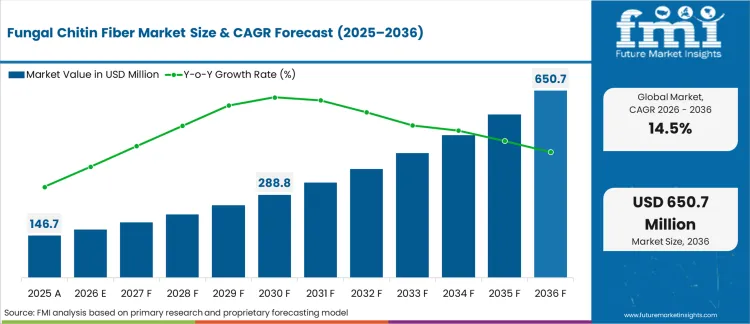
In 2025, the fungal chitin fiber market surpassed a value of USD 145.0 million. Based on Future Market Insights’ analysis, demand is estimated to grow to USD 168.0 million in 2026 and USD 650.7 million by 2036. FMI projects a CAGR of 14.5%, driven by compliance gates and retrofit capex across textile supply chains. Procurement teams actively shift specifications toward bio-based inputs that offer verifiable end-of-life composability, bypassing volatile petrochemical pricing.
The structural transition from petrochemicals to biofibers accelerates as legislation penalizes synthetic waste generation. The European Union generates 12.6 million tons of textile waste yearly, forcing brands to mandate biodegradable inputs earlier in the design phase [1]. Procurement teams actively hedge against future compliance penalties by securing upstream fermentation capacity, shifting specifications toward chitin derivatives.
“In partnership with our new private equity partner, DFX Corporation, MycoWorks is undergoing a necessary sea change in its leadership and operations,” MycoWorks Co-founders Philip Ross [2]
Summary of Fungal Chitin Fiber Market
- Fungal Chitin Fiber Market Definition
- Processed biopolymers extracted from industrial fungal networks serve advanced textile and nonwoven applications.
- Demand Drivers in the Market
- Circular economy legislation penalizes synthetic textile waste generation.
- Fermentation scale-ups lower the unit cost of bio-based fibers.
- Automotive and interior brands mandate sustainable material procurement.
- Key Segments Analyzed in the FMI Report
- Product Form: Dry fibers / powders (46% of total volume) versus mycelium sheets and other formats.
- Application: Biodegradable textiles & nonwovens (35% of total volume) versus specialty chemicals and other uses.
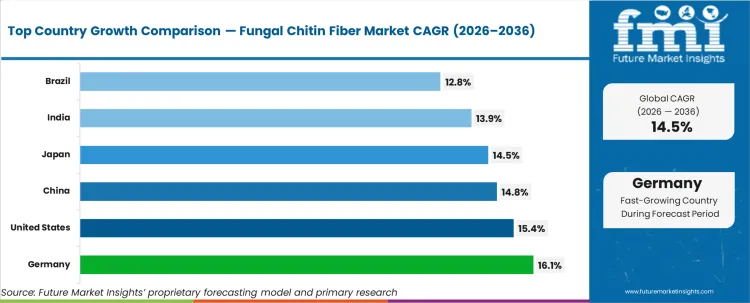
- Geography: High-growth Europe and North America (Germany 16.1%, United States 15.4%) versus emerging Asia-Pacific manufacturing hubs.
- Analyst Opinion at FMI
- Nikhil Kaitwade, Principal Consultant for Chemicals & Materials at Future Market Insights, opines, “In the updated Fungal Chitin Fiber Market report, my team and I have analyzed that industrial buyers are actively seeking non-marine chitin alternatives to stabilize supply chains and mitigate allergen-linked regulatory exposure. Fermentation-derived fungal chitin offers structural consistency and year-round production scalability. However, commercial adoption will depend on deacetylation control, tensile strength optimization, and cost alignment with petrochemical-based reinforcements.”
- Strategic Implications/Executive Takeaways
- Secure long-term supply contracts with automated fermentation facilities.
- Target automotive interior partnerships to capture premium material margins.
- Audit extraction protocols to ensure complete biodegradability compliance.
- Methodology
- Validated through first-hand corporate production and capacity data.
- Zero reliance on speculative third-party market research reports.
- Based on verifiable industrial benchmarks and verified sources.
Country dispersion across Germany, the United States, China, Japan, India, and Brazil reveals distinct regional capabilities. Sourcing clusters align with zones demonstrating high nonwovens infrastructure; specifically, North American nonwovens capacity reached 5.730 million tons in 2024, creating a massive localized demand-pull for structural bio-based binders [3]. Growth concentrates where industrial scale aligns with high regulatory pressure for circular material integration.
Fungal Chitin Fiber Market Key Takeaways
| Metric | Details |
|---|---|
| Industry Size (2026) | USD 168.0 Million |
| Industry Value (2036) | USD 650.7 Million |
| CAGR (2026-2036) | 14.5% |
Fungal Chitin Fiber Market Definition
Fungal chitin fiber captures processed structural biopolymers derived from industrial mushroom cultivation and fermentation. Formulations supply functional and biodegradable benefits for textiles, nonwovens, and specialty materials. Processing involves the extraction and spinning of mycelium networks to achieve standardized tensile specifications. Value represents wholesale ingredient shipments globally.
Fungal Chitin Fiber Market Inclusions
The Fungal Chitin Fiber category includes dry fungal-derived chitin fibers supplied in purified powder form, along with industrial mycelium network sheets engineered for material applications. It also covers bio-based binders formulated for nonwoven integration and composite development. Revenues captured at the business-to-business materials distribution level are included within scope.
Fungal Chitin Fiber Market Exclusions
The scope excludes crustacean-derived chitin and chitosan sources, as well as unprocessed mushroom waste that has not undergone fiber extraction or purification. Synthetic or petrochemical-based textile blends are not considered. Non-commercial academic laboratory samples without industrial-scale production are also excluded.
Fungal Chitin Fiber Market Research Methodology
- Primary Research: Direct interviews with fermentation facility operators and nonwoven material formulators.
- Desk Research: Assessment of European Parliament sustainability directives alongside INDA capacity statistics.
- Market-Sizing and Forecasting: Bottom-up volume modelling validated against commercial plant expansion announcements.
- Data Validation and Update Cycle: Continuous peer review against regulatory compliance mandates and vendor funding disclosures.
Segmental Analysis
Fungal Chitin Fiber Market Analysis by Product Form
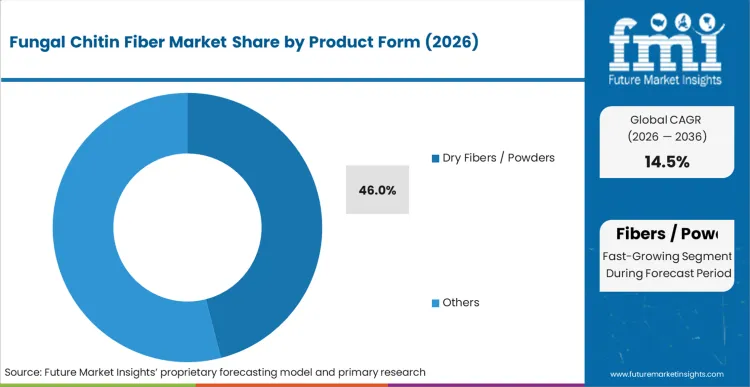
Manufacturers increasingly favor dry fiber and powder formats to overcome shelf-life constraints and lower international transportation costs. These dry ingredients integrate smoothly into existing wet-laid nonwoven production lines without the need for specialized liquid handling systems. FMI estimates that producers are channeling capital into advanced drying and milling technologies to achieve precise particle specifications and consistent performance. The stability of dry chitosan also supports longer storage periods and broad distribution across agricultural and material applications, resulting in dry fibers and powders accounting for 46% of total share in 2026.
- Cross-industry application: Moisture content limits direct integration in some fields, driving the need for purified powders in adjacent agricultural and textile sectors. KitoZyme announced a partnership to commercialize fungal-chitosan seed treatments in June 2024, showcasing strong demand for these dry inputs [5].
- Sector validation: Preventive waste legislation drives ingredient discovery in primary automotive and apparel manufacturing channels. Cadillac collaborated with MycoWorks in June 2024 to develop bio-based interior materials, signaling strong mobility sector interest [6].
- Market diversification: Strategic positioning pivots toward high-end collaborations encompassing sustainable luxury. Antoine Roset, CEO of Ligne Roset, stated, "Our partnership with MycoWorks furthers our commitment to ethical and sustainable development with the high-end quality we’re known for" [7].
Fungal Chitin Fiber Market Analysis by Application
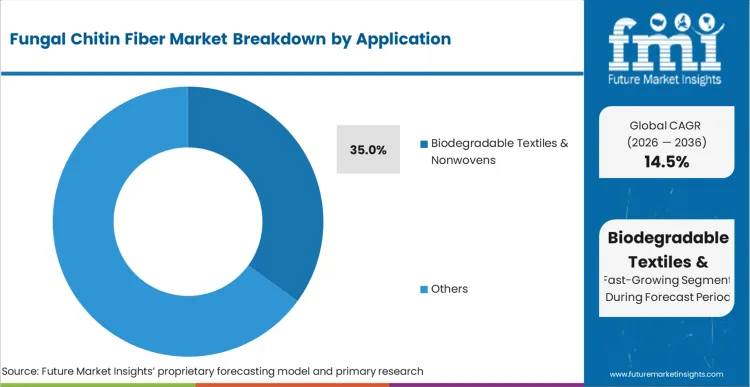
Biodegradable Textiles & Nonwovens command 35% share in 2026. Environmentally conscious consumers and regulators seek sustainable, fully compostable alternatives to petrochemical fabrics. Fungal concentrates offer structural integrity alongside complete end-of-life degradation. FMI analysts opine that premium interior and automotive formats command high wholesale pricing, allowing material suppliers to pass through initial scale-up costs. Brands market these next-generation inputs to justify retail markups while formulating superior vegan clothing.
- Material substitution: Brands target specific consumer groups to drive targeted sales volume in the luxury segment. Eben Bayer, CEO of Ecovative, noted capital from their recent USD 28 million raise will expand products into thousands of stores through 2025 [8].
- Integration constraint: Formulators achieve clean-label declarations without complex synthetic stabilizers by utilizing dry fungal inputs. These materials act as an effective biobased binder for nonwoven applications, reducing dependency on acrylic alternatives.
- Performance engineering: Alternative delivery mechanisms replace traditional synthetics to capture environmentally focused demographics. Massive parallel investment in bio-based manufacturing infrastructure guarantees baseline demand for novel structural sources.
Fungal Chitin Fiber Market Drivers, Restraints, and Opportunities
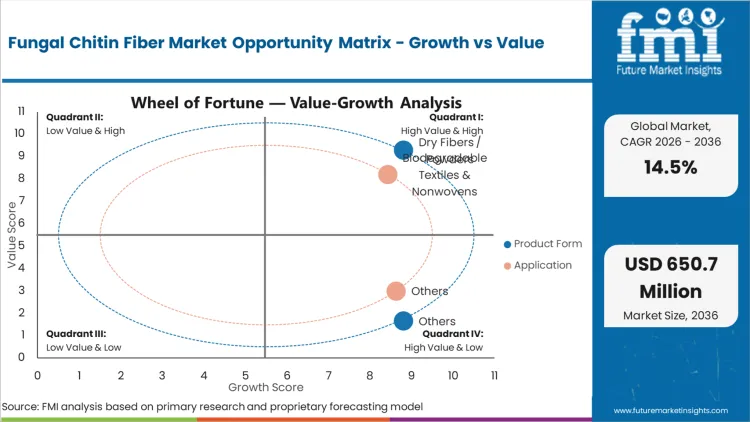
Commercial capacity scaling acts as a primary demand driver. Historical pilot projects struggled to produce consistent material volumes, deterring multinational apparel conglomerates from reformulating core products. Capital deployment into industrial-scale fermentation solves availability bottlenecks. Predictable supply allows materials scientists to list fungal fibers on permanent specification sheets rather than limited capsule collections. Procurement teams shift from spot purchasing to long-term contracts, stabilizing revenues across supply chains. The United Nations Environment Program reported that 92 million tons of textile waste are produced globally each year, intensifying the regulatory push for compostable alternatives [9].
High baseline production costs restrain immediate mass-market substitution. Cultivating pure mycelium requires precise climatic controls, leading to elevated energy consumption compared to traditional cotton or polyester extrusion. Buyers hesitate to replace inexpensive synthetics unless product positioning supports a significant retail premium. Phased capacity additions prevent oversupply while maintaining a strict focus on quality-certified output. The global fiber output remains heavily entrenched in synthetics, with polyester volume reaching approximately 78 million tons in 2024 [10]. Overcoming this price and scale disparity remains the central hurdle for biological textile innovators.
- Biopolymer Ecosystem Expansion: Cosmetic and specialty chemical manufacturers provide a lucrative secondary market for fungal chitin derivatives.
- Capital Market Access: Public listings and business combinations unlock essential capital required for massive infrastructure build-outs. Bolt Threads consummated a business combination with GAMC in August 2024, establishing a clear capital markets pathway affecting its mycelium material programs [12].
- Sector Consolidation: Strategic acquisitions allow established materials networks to absorb pure-play biotechnology startups, accelerating mass production timelines. MycoWorks initiated a bold new chapter in the future of materials by being acquired by DFX Corp in January 2026 [13].
Regional Analysis
Based on the regional analysis, the Fungal Chitin Fiber market is segmented into North America, Latin America, Europe, East Asia, South Asia, Oceania and Middle East & Africa across 40+ countries. The full report also offers market attractiveness analysis based on regional trends.
.webp "Top Country Growth Comparison Fungal Chitin Fiber Market Cagr (2026 2036)")
| Country | CAGR (2026 to 2036) |
|---|---|
| Germany | 16.1% |
| United States | 15.4% |
| China | 14.8% |
| Japan | 14.5% |
| India | 13.9% |
| Brazil | 12.8% |
Source: Future Market Insights (FMI) analysis, based on proprietary forecasting model and primary research
Europe Fungal Chitin Fiber Analysis
European processors excel in strict circularity compliance and advanced biotechnology engineering. Regional demand outpaces domestic cultivation capacity due to aggressive legislative timelines targeting textile waste. Ingredient buyers enforce rigorous traceability and biodegradability testing protocols. Suppliers commanding certified compostable ratings secure long-term contracts. Processors apply technical expertise to refine fungal biomass into high-value nutritional and structural isolates.
-
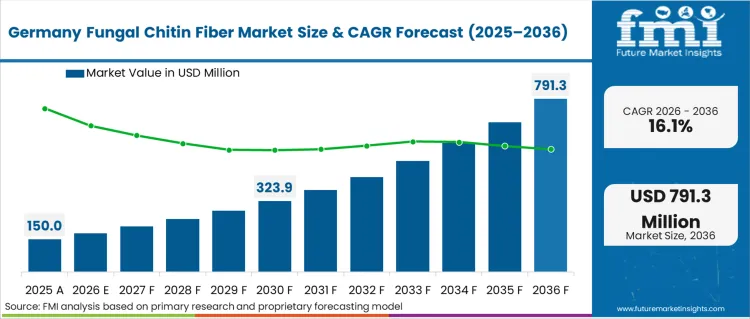
Germany: Germany is expected to record 16.1% CAGR in demand over 2026 to 2036 as EU circularity rules and premium automotive interiors create the fastest pull for mycelium-derived sheets before procurement cycles translate into higher deployment volumes. Qualification cycles compress as luxury brands mandate bio-based alternatives to avoid impending waste penalties, driven by European Parliament findings that clothing and footwear account for 5.2 million tons of annual waste [14].
FMI's report includes extensive coverage profiling France, Italy, and Spain. Sustainable fashion expertise provides technical foundations for localized fermentation projects. Centralized regulatory frameworks ensure stabilized industrial demand ready for sustainable disruption.
North America Fungal Chitin Fiber Analysis
North American demand centers on scalable B2B material platforms and waste reduction mandates. Consumers actively seek clean-label, sustainably sourced alternatives to biodegradable polyester fiber. Suppliers differentiate offerings through domestic production capabilities and closed-loop manufacturing methods. Regional processors invest in automated robotics to ensure absolute batch consistency. Facilities utilize captured agricultural waste to accelerate fungal growth rates, offering significant environmental offsets for major apparel conglomerates.
- United States: Mounting waste pressures are accelerating demand for biodegradable material alternatives across the United States. With 17 million tons of textiles generated and only 14.7% recycled, supply chains face growing sustainability challenges [15]. As platform companies and distribution networks respond to policy signals and procurement demand strengthens, the market is projected to expand at a 15.4% CAGR from 2026 to 2036.
FMI's report includes comprehensive evaluation addressing Canada and Mexico. Cross-border distribution networks facilitate rapid ingredient transport to contract manufacturers. Formulators prioritize reliable supply chains to satisfy growing functional nonwoven consumption.
Asia Pacific Fungal Chitin Fiber Analysis
Asia Pacific remains central to global textile production, supported by deep industrial infrastructure and established manufacturing ecosystems. Processors across the region are moving beyond synthetic exports toward more refined bio-based fibers, enabling them to capture greater downstream value. Rising urbanization is also strengthening domestic demand for sustainable materials, while supportive government policies in agricultural biotechnology are accelerating facility upgrades. Commercial plants are adopting high-throughput processing methods to comply with strict international purity and export standards.
- China: Rapid industrial adoption within nonwoven supply chains is driving large-scale integration of chitin-based blends across manufacturing networks. As global fiber production reaches 124 million tonnes [16], China’s scale advantages allow factories to lower costs and meet rigorous Western brand specifications. With modernization efforts aligning with expanding procurement pipelines, demand in China is projected to grow at a 14.8% CAGR through 2036.
- Japan: Japan is projected to post 14.5% CAGR between 2026 and 2036 as high-performance materials and precision manufacturing favor engineered chitin-based fibers, improving the conversion rate from pilots to enterprise rollouts. Public-backed industrialization across Asia supports this, evidenced when Busan Metropolitan City announced a project focusing on vegan leather using mushroom mycelium for future mobility [17].
- India: India’s growth is increasingly supported by expanding industrial nonwoven applications and rising demand for export-compliant textile materials. As manufacturers adopt scalable integration models, vendors with strong processing capabilities are seeing wider commercial pipelines open. Adoption is particularly strong where structural blends help narrow price gaps with conventional materials, making bio-based inputs more competitive. With global bioplastics capacity continuing to expand from 2.47 million tons [18], India’s positioning within sustainable material supply chains is strengthening, and sales are projected to grow at a 13.9% CAGR through 2036.
FMI's report includes detailed analysis covering South Korea and Indonesia. These nations present lucrative expansion vectors due to massive textile export sectors. Procurement focuses on securing stable supply lines immune to petrochemical price shocks.
Latin America Fungal Chitin Fiber Analysis
Latin American cultivation potential leverages massive agricultural biomass availability. Initial growth stems from circular bioeconomy narratives and sustainable packaging shifts. Infrastructure investments slowly modernize extraction capabilities to meet international export criteria. Local brands partner with multinational biotechnology suppliers to formulate affordable agricultural and textile alternatives. Distributors establish regional hubs to lower industrial price points, navigating fragmented manufacturing networks to reach sustainability-focused sectors.
- Brazil: Over 2026 to 2036, adoption in Brazil is projected to grow at 12.8% CAGR, reflecting agricultural biomass and bioeconomy narratives that steadily raise adoption intensity in core end users. Near-term commercial wins emerge from agricultural spillover, such as chitosan based seed coatings, before transitioning fully into advanced textiles.
FMI's report includes strategic mapping detailing Argentina, Chile, and Peru. Extensive agricultural geography offers compelling sites for future commercial fermentation facilities. Regional conglomerates explore coproduction techniques to maximize biomass utilization efficiency.
Competitive Aligners for Market Players
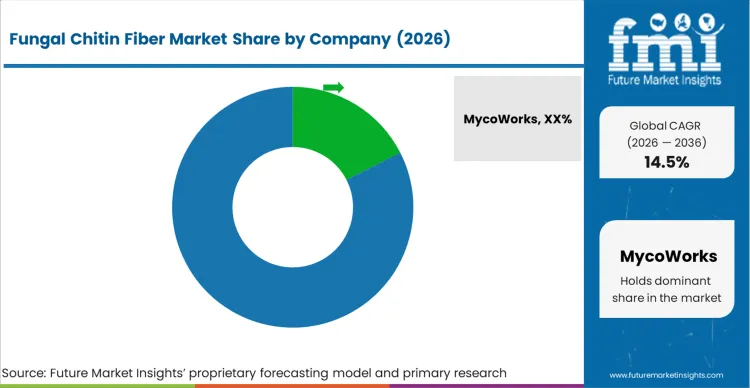
Consolidation strategies accelerate as cultivation operators seek downstream formulation expertise. Mergers combine distinct production technologies to address broader textile categories. FMI analysts opine that joint entities achieve scale economies, reducing per-unit processing expenses and expanding addressable customer bases across international design markets.
As per FMI's projection, strategic positioning pivots toward multi-product business models encompassing both fashion and automotive interiors. Suppliers establish operations in high-volume accessory categories before transitioning to stringent automotive durability protocols. This sequenced approach mitigates initial commercialization risks while funding advanced extraction infrastructure.
Corporate resource allocation shifts toward sustainable platforms to capture premium material valuations. Facilities integrating agricultural waste streams attract tier-one brands seeking scope 3 emission reductions. Focused investments in automated tray-based environments fundamentally alter supply-side dynamics, elevating the quality baseline and consistency required for mass-market adoption.
Recent Developments
The report includes full coverage of key trends from competitive benchmarking. Some of the recent developments covered in the reports:
- In January 2026, Glentham Life Sciences introduced a new range of fungal chitosan products to support supply-side enablement for structural fiber derivatives. [4]
- In September 2025, Greenitio secured USD 1.5 million in seed funding to scale a mushroom-based chitosan platform for specialty chemicals and cosmetics. [11]
Key Players in Fungal Chitin Fiber
- MycoWorks
- Ecovative (MyForest Foods)
- Mogu
- Bolt Threads
- KitoZyme
- Greenitio
- Glentham Life Sciences
- Joil Industries
Scope of the Report
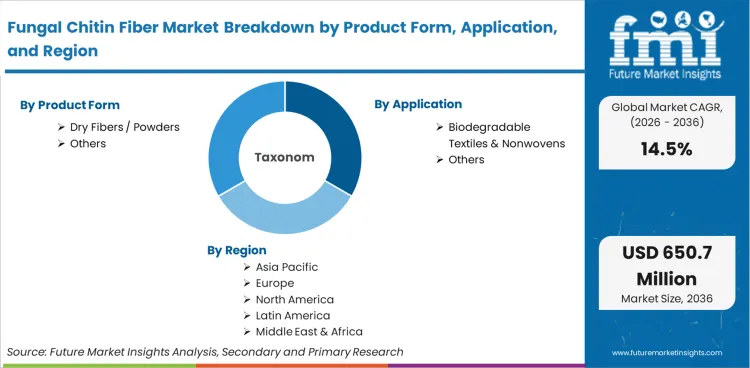
| Metric | Value |
|---|---|
| Quantitative Units | USD 168.0 million (2026) to USD 650.7 million (2036), at a CAGR of 14.5% |
| Market Definition | Fungal chitin fiber captures processed structural biopolymers derived from industrial mushroom cultivation and fermentation. |
| Source Organism Segmentation | Fungal Mycelium, Others |
| Product Form Segmentation | Dry Fibers / Powders, Others |
| Application Coverage | Biodegradable Textiles & Nonwovens, Others |
| Distribution Channel Segmentation | B2B Ingredients / Materials Distribution, Others |
| Regions Covered | North America, Latin America, Europe, East Asia, South Asia, Oceania, Middle East and Africa |
| Countries Covered | United States, United Kingdom, Germany, China, India, Brazil and 40 plus countries |
| Key Companies Profiled | MycoWorks, Ecovative, Mogu, Bolt Threads, KitoZyme, Greenitio, Glentham Life Sciences, Joil Industries |
| Forecast Period | 2026 to 2036 |
| Approach | Bottom-up volume modelling validated against commercial plant capacity announcements. |
Fungal Chitin Fiber Market Analysis by Segments
Source Organism
- Fungal Mycelium
- Others
Product Form
- Dry Fibers / Powders
- Others
Application
- Biodegradable Textiles & Nonwovens
- Others
Distribution Channel
- B2B Ingredients / Materials Distribution
- Others
Region
- Asia Pacific
- India
- China
- Japan
- South Korea
- Indonesia
- Australia & New Zealand
- ASEAN
- Rest of Asia Pacific
- Europe
- Germany
- Italy
- France
- United Kingdom
- Spain
- Benelux
- Nordics
- Central & Eastern Europe
- Rest of Europe
- North America
- United States
- Canada
- Mexico
- Latin America
- Brazil
- Argentina
- Chile
- Rest of Latin America
- Middle East & Africa
- Kingdom of Saudi Arabia
- United Arab Emirates
- South Africa
- Turkey
- Rest of Middle East & Africa
Bibliography
- [1] European Parliament. EU generates 12.6 million tonnes of textile waste yearly.
- [2] Biofuels Digest. (2024). Fungi funds: DFX Corp acquires mycelium leather maker MycoWorks.
- [3] INDA. North American nonwovens capacity reached 5.730 million tonnes in 2024.
- [4] Glentham Life Sciences. Introduced new range of fungal chitosan products.
- [5] KitoZyme. Partnership to commercialize fungal-chitosan seed treatment.
- [6] MycoWorks. Cadillac collaboration to develop bio-based interior material.
- [7] MycoWorks. Quote from Antoine Roset, CEO, Ligne Roset.
- [8] Green Queen. Ecovative reported $28M raise to expand mycelium products.
- [9] UNEP. 92 million tonnes of textile waste produced globally each year.
- [10] Textile Exchange. Total global fiber output ~78 million tonnes in 2024.
- [11] Green Queen. Greenitio $1.5M seed to scale mushroom-based chitosan platform.
- [12] EDGAR Online. Bolt Threads business combination in 2024.
- [13] PRWeb. MycoWorks acquired by DFX Corp.
- [14] European Parliament. Clothing and footwear account for 5.2 million tonnes of waste.
- [15] US EPA. 17 million tons of textiles generated; recycling rate 14.7%.
- [16] Textile Exchange. Global fiber production hit 124 million tonnes in 2023.
- [17] Busan Metropolitan City. Joil Industries and KIMCO project on vegan leather.
- [18] European Bioplastics e.V. Global bioplastics capacity ~2.47 Mt to ~5.73 Mt.
This bibliography is provided for reader reference and is not exhaustive. The full report contains the complete reference list and detailed citations.
This Report Addresses
- Market intelligence to enable structured strategic decision making across mature and emerging biotechnology economies.
- Market size estimation and 10-year revenue forecasts from 2026 to 2036, supported by validated fungal fermentation capacity benchmarks.
- Growth opportunity mapping across dry fibers and mycelium sheets with emphasis on biodegradable textile transitions.
- Segment and regional revenue forecasts covering biodegradable nonwovens, B2B materials distribution, and functional automotive applications.
- Competition strategy assessment including automated tray-based integration models, cost survivability against synthetic fibers, and mycelium leather compliance capability.
- Product reformulation and quality compliance tracking including strict environmental end-of-life compostability protocols.
- Regulatory impact analysis covering EU circularity waste thresholds, US EPA recycling mandates, and export-driven specification upgrades.
- Market report delivery in PDF, Excel, PPT, and interactive dashboard formats for executive and operational use.
Frequently Asked Questions
How large is the demand for Fungal Chitin Fiber in the global market in 2026?
Demand is estimated to be valued at USD 168.0 million in 2026.
What will be the market size of Fungal Chitin Fiber in the global market by 2036?
Valuation is projected to reach USD 610.0 million by 2036.
What is the expected demand growth for Fungal Chitin Fiber in the global market between 2026 and 2036?
Revenues are expected to grow at a CAGR of 14.5% between 2026 and 2036.
Which Source Organism is poised to lead global sales by 2026?
Fungal Mycelium is expected to capture approximately 38% of global volume due to rapid biomass accumulation capabilities.
How significant is the role of Biodegradable Textiles & Nonwovens in driving Fungal Chitin Fiber adoption in 2026?
Biodegradable textiles represent a critical segment holding 35% share as preventive waste legislation drives ingredient discovery.
What is driving demand in Germany?
Demand grows as EU circularity rules and premium automotive interiors create the fastest pull for mycelium-derived sheets.
What compliance standards or regulations are referenced for Germany?
European Union circularity mandates and textile waste generation limits are referenced as key compliance benchmarks.
What is the Germany growth outlook in this report?
Germany is projected to grow at a CAGR of 16.1% during 2026 to 2036.
Why is North America described as a priority region in this report?
Demand focuses on scalable B2B material platforms and waste reduction mandates where consumers actively seek clean-label alternatives.
What type of demand dominates in North America?
Demand driven by biodegradable nonwovens and sustainable packaging shifts dominates regional consumption.
What is the United States growth outlook in this report?
The United States is projected to expand at a CAGR of 15.4% during 2026 to 2036.
Does the report cover China in its regional analysis?
China is included within Asia Pacific under regional analysis.
What are the sources referred to for analyzing China?
Official statistics published by international textile bodies and commercial plant capacity announcements are cited as primary reference sources.
What is the main demand theme linked to China in its region coverage?
Demand is tied to fast manufacturing adoption where nonwoven supply chains industrialize chitin blends at high volume.
Does the report cover United Kingdom in its regional analysis?
United Kingdom is included within Europe under the regional coverage framework.
What is the main United Kingdom related demand theme in its region coverage?
Retail penetration increases the value of reliability and formulation innovation leads regional product launches.
Which product formats or configurations are strategically important for Asia Pacific supply chains?
Dry fibers and powders are prioritized due to extended shelf life and reduced international shipping expenses.
What is Fungal Chitin Fiber and what is it mainly used for?
It captures processed structural biopolymers derived from industrial mushrooms, used primarily in biodegradable textiles and nonwoven fabrics.
What does Fungal Chitin Fiber mean in this report?
It refers to wholesale ingredient shipments of extracted mycelium networks and dry fungal powders globally.
What is included in the scope of this Fungal Chitin Fiber report?
Scope covers dry fungal fibers, industrial mycelium network sheets, bio-based binders, and B2B materials distribution.
What is excluded from the scope of this report?
Crustacean-derived chitin, unprocessed agricultural waste, and synthetic textile blends are excluded.
What does market forecast mean on this page?
Market forecast represents a model-based projection built on defined assumptions for strategic planning purposes.
How does FMI build and validate the Fungal Chitin Fiber forecast?
Forecast is developed using bottom-up volume modelling validated against commercial plant capacity announcements and official trade data.
What does zero reliance on speculative third party market research mean here?
Primary interviews and verifiable public datasets are used instead of unverified syndicated market estimates.
Preview the report firsthand - request a free sample
Get SampleGet the brochure for pricing and purchase details.
Get PDFTable of Content
- Executive Summary
- Global Market Outlook
- Demand-side Trends
- Supply-side Trends
- Technology Roadmap Analysis
- Analysis and Recommendations
- Market Overview
- Market Coverage / Taxonomy
- Market Definition / Scope / Limitations
- Research Methodology
- Chapter Orientation
- Analytical Lens and Working Hypotheses
- Market Structure, Signals, and Trend Drivers
- Benchmarking and Cross-market Comparability
- Market Sizing, Forecasting, and Opportunity Mapping
- Research Design and Evidence Framework
- Desk Research Programme (Secondary Evidence)
- Company Annual and Sustainability Reports
- Peer-reviewed Journals and Academic Literature
- Corporate Websites, Product Literature, and Technical Notes
- Earnings Decks and Investor Briefings
- Statutory Filings and Regulatory Disclosures
- Technical White Papers and Standards Notes
- Subscription Datasets and Paid Sources
- Social Channels, Communities, and Digital Listening Inputs
- Additional Desk Sources
- Expert Input and Fieldwork (Primary Evidence)
- Primary Modes
- Qualitative Interviews and Expert Elicitation
- Quantitative Surveys and Structured Data Capture
- Blended Approach
- Why Primary Evidence is Used
- Field Techniques
- Interviews
- Surveys
- Focus Groups
- Observational and In-context Research
- Social and Community Interactions
- Stakeholder Universe Engaged
- C-suite Leaders
- Board Members
- Presidents and Vice Presidents
- R&D and Innovation Heads
- Technical Specialists
- Domain Subject-matter Experts
- Scientists
- Physicians and Other Healthcare Professionals
- Governance, Ethics, and Data Stewardship
- Research Ethics
- Data Integrity and Handling
- Primary Modes
- Tooling, Models, and Reference Databases
- Desk Research Programme (Secondary Evidence)
- Data Engineering and Model Build
- Data Acquisition and Ingestion
- Cleaning, Normalisation, and Verification
- Synthesis, Triangulation, and Analysis
- Quality Assurance and Audit Trail
- Market Background
- Market Dynamics
- Drivers
- Restraints
- Opportunity
- Trends
- Scenario Forecast
- Demand in Optimistic Scenario
- Demand in Likely Scenario
- Demand in Conservative Scenario
- Opportunity Map Analysis
- Product Life Cycle Analysis
- Supply Chain Analysis
- Investment Feasibility Matrix
- Value Chain Analysis
- PESTLE and Porter’s Analysis
- Regulatory Landscape
- Regional Parent Market Outlook
- Production and Consumption Statistics
- Import and Export Statistics
- Market Dynamics
- Global Market Analysis 2021 to 2025 and Forecast, 2026 to 2036
- Historical Market Size Value (USD Million) Analysis, 2021 to 2025
- Current and Future Market Size Value (USD Million) Projections, 2026 to 2036
- Y-o-Y Growth Trend Analysis
- Absolute $ Opportunity Analysis
- Global Market Pricing Analysis 2021 to 2025 and Forecast 2026 to 2036
- Global Market Analysis 2021 to 2025 and Forecast 2026 to 2036, By Product Form
- Introduction / Key Findings
- Historical Market Size Value (USD Million) Analysis By Product Form , 2021 to 2025
- Current and Future Market Size Value (USD Million) Analysis and Forecast By Product Form , 2026 to 2036
- Dry Fibers / Powders
- Others
- Dry Fibers / Powders
- Y-o-Y Growth Trend Analysis By Product Form , 2021 to 2025
- Absolute $ Opportunity Analysis By Product Form , 2026 to 2036
- Global Market Analysis 2021 to 2025 and Forecast 2026 to 2036, By Application
- Introduction / Key Findings
- Historical Market Size Value (USD Million) Analysis By Application, 2021 to 2025
- Current and Future Market Size Value (USD Million) Analysis and Forecast By Application, 2026 to 2036
- Biodegradable Textiles & Nonwovens
- Others
- Biodegradable Textiles & Nonwovens
- Y-o-Y Growth Trend Analysis By Application, 2021 to 2025
- Absolute $ Opportunity Analysis By Application, 2026 to 2036
- Global Market Analysis 2021 to 2025 and Forecast 2026 to 2036, By Region
- Introduction
- Historical Market Size Value (USD Million) Analysis By Region, 2021 to 2025
- Current Market Size Value (USD Million) Analysis and Forecast By Region, 2026 to 2036
- North America
- Latin America
- Western Europe
- Eastern Europe
- East Asia
- South Asia and Pacific
- Middle East & Africa
- Market Attractiveness Analysis By Region
- North America Market Analysis 2021 to 2025 and Forecast 2026 to 2036, By Country
- Historical Market Size Value (USD Million) Trend Analysis By Market Taxonomy, 2021 to 2025
- Market Size Value (USD Million) Forecast By Market Taxonomy, 2026 to 2036
- By Country
- USA
- Canada
- Mexico
- By Product Form
- By Application
- By Country
- Market Attractiveness Analysis
- By Country
- By Product Form
- By Application
- Key Takeaways
- Latin America Market Analysis 2021 to 2025 and Forecast 2026 to 2036, By Country
- Historical Market Size Value (USD Million) Trend Analysis By Market Taxonomy, 2021 to 2025
- Market Size Value (USD Million) Forecast By Market Taxonomy, 2026 to 2036
- By Country
- Brazil
- Chile
- Rest of Latin America
- By Product Form
- By Application
- By Country
- Market Attractiveness Analysis
- By Country
- By Product Form
- By Application
- Key Takeaways
- Western Europe Market Analysis 2021 to 2025 and Forecast 2026 to 2036, By Country
- Historical Market Size Value (USD Million) Trend Analysis By Market Taxonomy, 2021 to 2025
- Market Size Value (USD Million) Forecast By Market Taxonomy, 2026 to 2036
- By Country
- Germany
- UK
- Italy
- Spain
- France
- Nordic
- BENELUX
- Rest of Western Europe
- By Product Form
- By Application
- By Country
- Market Attractiveness Analysis
- By Country
- By Product Form
- By Application
- Key Takeaways
- Eastern Europe Market Analysis 2021 to 2025 and Forecast 2026 to 2036, By Country
- Historical Market Size Value (USD Million) Trend Analysis By Market Taxonomy, 2021 to 2025
- Market Size Value (USD Million) Forecast By Market Taxonomy, 2026 to 2036
- By Country
- Russia
- Poland
- Hungary
- Balkan & Baltic
- Rest of Eastern Europe
- By Product Form
- By Application
- By Country
- Market Attractiveness Analysis
- By Country
- By Product Form
- By Application
- Key Takeaways
- East Asia Market Analysis 2021 to 2025 and Forecast 2026 to 2036, By Country
- Historical Market Size Value (USD Million) Trend Analysis By Market Taxonomy, 2021 to 2025
- Market Size Value (USD Million) Forecast By Market Taxonomy, 2026 to 2036
- By Country
- China
- Japan
- South Korea
- By Product Form
- By Application
- By Country
- Market Attractiveness Analysis
- By Country
- By Product Form
- By Application
- Key Takeaways
- South Asia and Pacific Market Analysis 2021 to 2025 and Forecast 2026 to 2036, By Country
- Historical Market Size Value (USD Million) Trend Analysis By Market Taxonomy, 2021 to 2025
- Market Size Value (USD Million) Forecast By Market Taxonomy, 2026 to 2036
- By Country
- India
- ASEAN
- Australia & New Zealand
- Rest of South Asia and Pacific
- By Product Form
- By Application
- By Country
- Market Attractiveness Analysis
- By Country
- By Product Form
- By Application
- Key Takeaways
- Middle East & Africa Market Analysis 2021 to 2025 and Forecast 2026 to 2036, By Country
- Historical Market Size Value (USD Million) Trend Analysis By Market Taxonomy, 2021 to 2025
- Market Size Value (USD Million) Forecast By Market Taxonomy, 2026 to 2036
- By Country
- Kingdom of Saudi Arabia
- Other GCC Countries
- Turkiye
- South Africa
- Other African Union
- Rest of Middle East & Africa
- By Product Form
- By Application
- By Country
- Market Attractiveness Analysis
- By Country
- By Product Form
- By Application
- Key Takeaways
- Key Countries Market Analysis
- USA
- Pricing Analysis
- Market Share Analysis, 2025
- By Product Form
- By Application
- Canada
- Pricing Analysis
- Market Share Analysis, 2025
- By Product Form
- By Application
- Mexico
- Pricing Analysis
- Market Share Analysis, 2025
- By Product Form
- By Application
- Brazil
- Pricing Analysis
- Market Share Analysis, 2025
- By Product Form
- By Application
- Chile
- Pricing Analysis
- Market Share Analysis, 2025
- By Product Form
- By Application
- Germany
- Pricing Analysis
- Market Share Analysis, 2025
- By Product Form
- By Application
- UK
- Pricing Analysis
- Market Share Analysis, 2025
- By Product Form
- By Application
- Italy
- Pricing Analysis
- Market Share Analysis, 2025
- By Product Form
- By Application
- Spain
- Pricing Analysis
- Market Share Analysis, 2025
- By Product Form
- By Application
- France
- Pricing Analysis
- Market Share Analysis, 2025
- By Product Form
- By Application
- India
- Pricing Analysis
- Market Share Analysis, 2025
- By Product Form
- By Application
- ASEAN
- Pricing Analysis
- Market Share Analysis, 2025
- By Product Form
- By Application
- Australia & New Zealand
- Pricing Analysis
- Market Share Analysis, 2025
- By Product Form
- By Application
- China
- Pricing Analysis
- Market Share Analysis, 2025
- By Product Form
- By Application
- Japan
- Pricing Analysis
- Market Share Analysis, 2025
- By Product Form
- By Application
- South Korea
- Pricing Analysis
- Market Share Analysis, 2025
- By Product Form
- By Application
- Russia
- Pricing Analysis
- Market Share Analysis, 2025
- By Product Form
- By Application
- Poland
- Pricing Analysis
- Market Share Analysis, 2025
- By Product Form
- By Application
- Hungary
- Pricing Analysis
- Market Share Analysis, 2025
- By Product Form
- By Application
- Kingdom of Saudi Arabia
- Pricing Analysis
- Market Share Analysis, 2025
- By Product Form
- By Application
- Turkiye
- Pricing Analysis
- Market Share Analysis, 2025
- By Product Form
- By Application
- South Africa
- Pricing Analysis
- Market Share Analysis, 2025
- By Product Form
- By Application
- USA
- Market Structure Analysis
- Competition Dashboard
- Competition Benchmarking
- Market Share Analysis of Top Players
- By Regional
- By Product Form
- By Application
- Competition Analysis
- Competition Deep Dive
- MycoWorks
- Overview
- Product Portfolio
- Profitability by Market Segments (Product/Age /Sales Channel/Region)
- Sales Footprint
- Strategy Overview
- Marketing Strategy
- Product Strategy
- Channel Strategy
- Ecovative (MyForest Foods)
- Mogu
- Bolt Threads
- KitoZyme
- Greenitio
- Glentham Life Sciences
- Joil Industries
- MycoWorks
- Competition Deep Dive
- Assumptions & Acronyms Used


