


- A clean-label position can help food-grade chitosan command a premium price-but only if it provides measurable preservation, anti-microbial, coating or shelf-life outcomes.
- Chitosan is not a generic, ‘natural’ ingredient. Food buyers assess it by origin (animal or plant), purity, solubility, molecular weight, viscosity, degree of deacetylation, odor and color as well as regulatory documentation.
- Edible coatings, post-harvest produce protection, beverage processing, food preservation systems +3.7% 4.1% 5.4% $9B stronger premium possibility 13% growing market (non-gmo) Food and personal care systems Dietary supplements Active food packaging
- Offers the highest possible premium opportunity Inferred from consumer Need: Sustainability
- The premium erodes where commodity additive use, low-spec powders, bulk supplement inputs and price-sensitive applications make traditional preservatives a more budget-friendly option that is easier to qualify.
- Fungal or non-crustacean chitosan can see potential in clean-label and allergen-sensitive applications, but only where there is regulatory clarity and the performance profile supports uptake.
- The most common fallacy is that food companies will shell out more dollars because chitosan has a bio-based origin. They are doing only because its protecting accross product quality, reducing spoilage, extending shelf life or better perfomance of formulation.
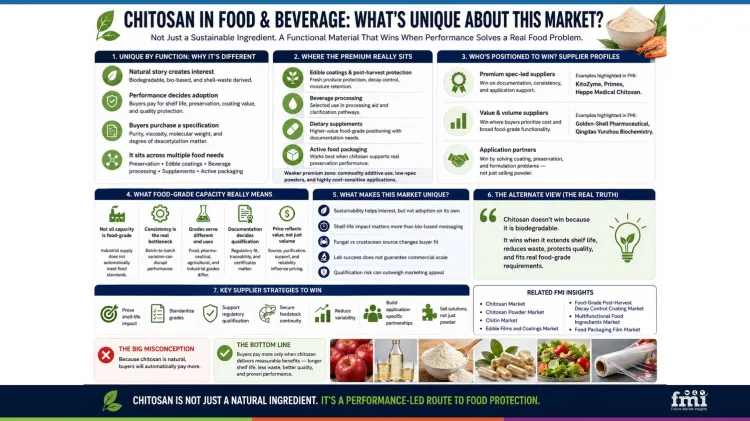
Clean labeling is gaining importance commercially in the market for chitosan, but there is some confusion around the concept. Chitosan can be easily sold to customers as natural, biodegradable, and sourced from discarded shells. While this narrative may pique customer interest, it does not mean that suppliers will benefit financially as a result. The price customers will pay depends on how the product solves a problem.
Chitosan Market of FMI Sees Potential in Focus Areas. According to FMI, chitosan finds its applications in different segments, including food additives, dietary supplements, medicines, cosmetics, etc. The clean label benefits of chitosan for the food and beverage industry are associated more with preservation and protection rather than sustainability.
The most compelling application in the field of food would be shelf-life enhancement. The chitosan could help with the functionality of antimicrobial, films, coatings, and protection of the surface. Such functionalities are important due to the increasing demand for sustainability, longer shelf-life due to longer delivery channels, and formulations with ingredients perceived by consumers as simple or natural. Nonetheless, clean labels alone are insufficient. The chitosan needs to be able to function in practical settings.
FMI’s Edible Films and Coatings Market supports this logic because polysaccharides are identified as a leading ingredient group, while vegetables and fruits are major application areas. Chitosan fits naturally into this discussion because it is a polysaccharide-based material with coating and film-forming potential. In food coatings, the buyer is not paying for a clean label alone. The buyer is paying for better quality retention, lower spoilage, and longer commercial usability.
The clean-label premium is especially relevant in post-harvest applications. FMI’s Food-Grade Post-Harvest Decay Control Coating Market identifies chitosan and biopolymer coatings among the coating material types used to protect fruits and vegetables. This is one of the clearest food-use cases because the benefit can be measured through moisture retention, decay control, appearance preservation, and reduced rejection during storage or transport.
Regulatory benchmarks also show that food-use chitosan is not only a research concept. FDA GRAS notices include chitosan from white button mushrooms for antimicrobial use across specified food categories and chitosan from Aspergillus niger for alcoholic beverage production. These examples matter because they show that commercial use depends on source, intended use, use level, and safety documentation. A supplier cannot simply claim that "chitosan is natural" and expect approval from food manufacturers. The use case must be documented.
Source is also central to the premium. Chitosan from crustaceans is supported by an attractive circular economy story, using shrimp, crab, or lobster shells as feedstock. Such a story is valuable, but it may raise questions regarding the origin of shellfish, perception of allergens, vegan status, and traceability. In certain situations when buyers are looking for non-crustacean chitosan sources, fungal chitosan could be a solution, especially in beverage applications and food systems for plants-based products.
It is highest in those premium applications where even a slight increase in the ingredient price will allow saving on the product price due to its high value. The list includes the coating of fresh produce, extending shelf-life of seafood, stability of beverages, premium quality dietary supplements, clean-label preservative systems, and concepts of active packaging. In such instances, buyers do not purchase chitosan as a regular powder; instead, they purchase a technology.
This premium is lower in more simple applications, for instance, where the buyer requires inexpensive functional ingredients, but their conventional analogs are cheaper, easier to obtain, or simply allowed in the product formula. This is especially the case when the ultimate buyer will not perceive the benefit, when it is difficult to prove the performance gain or when the buyer cannot pass the increased price along the value chain.
The real issue is proof. The food industry needs evidence of shelf-life, sensory properties, usage guidelines, regulations, specifications, and consistency from batch to batch. A supplier might have an excellent backstory regarding a natural ingredient, yet if there is inconsistency in viscosity, odor, color, solubility, and antimicrobial activity, the company buying the ingredient is going to think twice.
The misconception to avoid is that clean label automatically increases willingness to pay. It does not. Clean label increases willingness to pay only when the ingredient protects product quality, reduces waste, supports trust, and performs reliably at commercial scale.
Bottom line: Food-grade chitosan can command a clean-label premium, but only when the premium is tied to preservation performance, shelf-life extension, regulatory confidence, and formulation reliability. In food and beverage, "natural" creates interest; proven functionality creates pricing power.'
Reference
- Chitosan Market
- Chitosan Powder Market
- Chitin Market
- Edible Films and Coatings Market
- Food-Grade Post-Harvest Decay Control Coating Market
- Multifunctional Food Ingredients Market
- Food Packaging Film Market

