

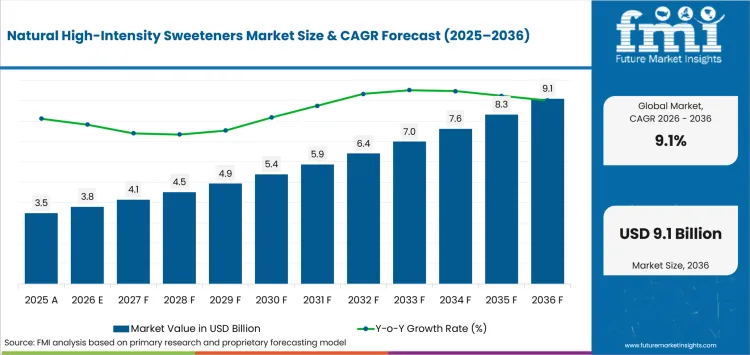
- Market Size (2026)
- USD 3.8 Bn
- Forecast (2036)
- USD 9.1 Bn
- CAGR (2026 to 2036)
- 9.1%
How big is the Natural High-Intensity Sweeteners Market in 2026?
USD 3.8 billion in 2026 and USD 9.1 billion by 2036 at a 9.1% CAGR.
Sales of natural high-intensity sweeteners are projected to increase from USD 3.8 billion in 2026 to USD 9.1 billion by 2036 at a 9.1% CAGR. Food and beverage manufacturers compare high-intensity sweeteners with full-sugar recipes through structured reformulation programs across major consumer categories. Cargill reported in September 2025 that EverSweet held regulatory approval in the United States and three other major markets. Cargill also reported commercial adoption by major food and beverage brands across several established product portfolios. Broader regulatory access expands potential use but food technologists must control sweetness onset and lingering sensory notes. Repeat orders depend on stable taste and process performance across normal production volumes rather than isolated laboratory samples.
Regulatory classification creates different launch paths for identical natural molecules across national food systems and packaged product categories. Tate & Lyle reported in October 2025 that its Manus partnership had brought premium Reb M to market through an all-Americas supply chain. The regional route gives food companies a nearer source for stevia ingredients and strengthens supply continuity across large formulation programs. China permits converted steviol glycosides within approved categories and defined use limits under national food-additive standards. Brazil requires prior authorization for unfamiliar ingredients without established domestic use or a recognized technical specification. German beverage producers face national sugar-reduction targets alongside European additive rules for packaged food and drink products. Indian manufacturers follow FSSAI standards and tight formulation economics across high-volume beverage and dairy channels. Sweetener manufacturers need jurisdiction-specific dossiers and dependable technical support to convert successful trials into recurring production.
Key Takeaways of Natural High-Intensity Sweeteners Market
- Demand for natural high-intensity sweeteners is driven by food and beverage companies lowering added sugar without restoring equivalent calories, with commercial success depending on matching sweetness timing and mouthfeel across full production batches and normal storage periods.
- Stevia holds the leading share at 32.7% in 2026, supported by regulatory familiarity and several glycoside production routes that allow beverage and dairy formulators to manage bitterness and delayed sweetness as sugar replacement rises within sensitive recipes.
- Powder leads the form category at 62.0% share in 2026, owing to concentrated dosing, lower freight volume, and established dry-handling systems, with dissolution performance remaining central to commercial qualification across large manufacturing plants.
- Beverages account for 38.0% application share in 2026, driven by frequent reformulation across carbonated and functional drinks where formulators must balance acidity and flavor release so reduced-sugar products retain familiar sensory profiles throughout normal storage.
- India, China, and Brazil record CAGRs of 9.3%, 8.8%, and 8.5% respectively through 2036, shaped by packaged-food capacity alongside price-sensitive formulation economics, domestic conversion capacity, and beverage reformulation activity.
- Competition separates ingredient production from technical formulation support, with HTBA and Layn contributing plant-derived sweeteners, Cargill and dsm-firmenich connecting precision fermentation through their Avansya venture, and Tate & Lyle and Ingredion providing bioconversion capacity and broad sweetening portfolios across major application categories.
Analyst Perspective
"The natural high-intensity sweeteners market is increasingly driven by formulation performance rather than sweetness intensity alone. Food manufacturers are evaluating taste profile, processing stability, and regulatory compliance as separate factors influencing commercial adoption. Suppliers that deliver consistent ingredient quality, application expertise, and reliable technical support will be better positioned to expand use across diverse food and beverage formulations."
- Nandini Roy Choudhury, Principal Analyst at Future Market Insights
Source: FMI's proprietary forecasting model and primary research
How is the Natural High-Intensity Sweeteners Market segmented?
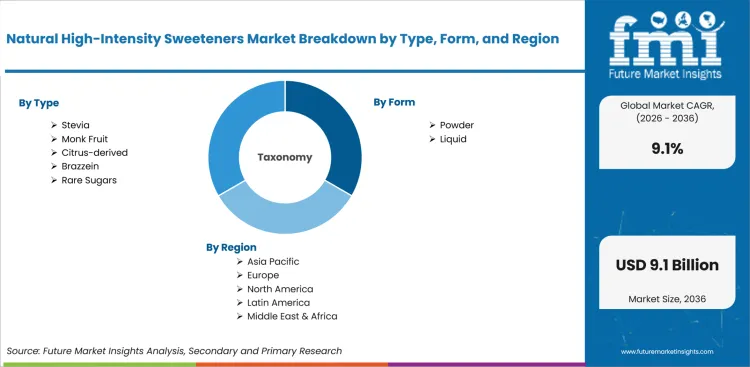
The natural high-intensity sweeteners industry is segmented by type, form, application, and region across the complete study scope.
The segmentation framework separates ingredient source from delivery form and final application so each qualification risk remains visible. Type analysis covers stevia and monk fruit extracts beside citrus-derived sweetener systems and emerging sweet proteins. Form analysis compares powders with liquids through dosing accuracy and storage behavior across routine manufacturing. Application analysis follows beverages and bakery products alongside dairy and confectionery under different heat and acidity conditions. HTBA introduced its refreshed OptiTaste platform in July 2025 for citrus-flavonoid taste modulation during sugar-reduction work. The launch shows how citrus-derived ingredients can correct taste limitations without replacing the primary sweetener. Regional analysis examines approval routes and formulation economics across markets with different labeling rules and technical service access.
Why is stevia central to the type category?
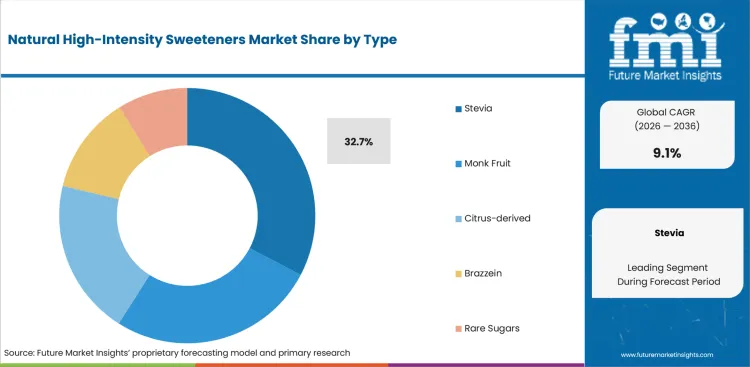
Stevia offers several glycoside profiles and production routes that support different taste targets across reduced-sugar foods. In November 2025, the FDA closed GRAS Notice 1260 without questions for enzyme-treated rebaudioside M from PureCircle by Ingredion. The response documents another United States route for advanced Reb M across eligible food applications. Beverage and dairy formulators must manage bitterness and delayed sweetness as sugar replacement rises within sensitive recipes.
- By type, stevia is forecast to represent 32.7% in 2026 across natural high-intensity sweetener revenue. Established food use and several verified production routes support stevia across major reduced-sugar food applications. Food manufacturers compare glycoside blends against target sweetness curves and finished-product cost during commercial qualification across several product categories.
- Stevia adoption is gaining momentum in beverages and dairy products through staged bench work followed by pilot production. Product developers need stable aftertaste control and complete technical records for the selected ingredient manufacturing method. Broader purchasing follows evidence that one formulation performs across normal storage periods and commercial batch volumes. Comparisons across the natural sweeteners market help technical teams separate source diversity from recipe-specific support.
Why is powder central to the form category?
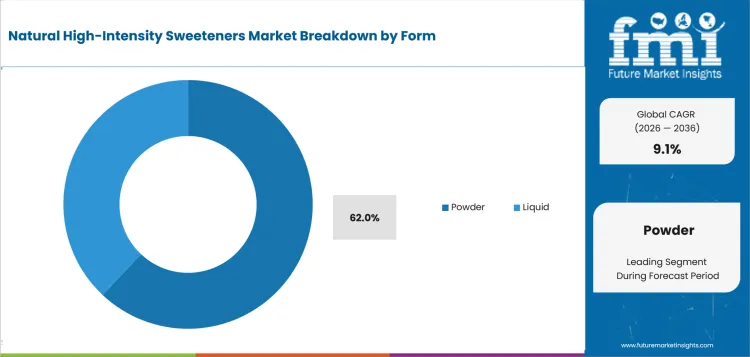
Powdered sweeteners support dry blending and lower freight volume across plants with established ingredient-handling systems. Uneven dispersion can create concentrated sweetness or visible sediment throughout finished beverages and other liquid products. Layn launched SteviUp M2 in July 2025 as an enzyme-derived Reb M2 ingredient with improved solubility. The FDA closed GRAS Notice 1203 without questions in February 2025 for general food use. Both developments place dissolution performance at the center of commercial powder qualification for large manufacturing plants.
- The form category is forecast to be led by powder at 62.0% share in 2026, supported by concentrated dosing and established dry-handling systems. The powder format reduces transport volume and supports standardized batch preparation across comparable manufacturing plants. Its economic advantage declines if operators cannot achieve even dispersion at the intended processing temperature during full production.
- Food manufacturers purchase powder formats for recipes that use preblending and controlled ingredient addition during routine production. Controlled handling practices limit clumping and improve sweetness uniformity across the complete commercial production vessel. Qualification should compare dissolution time with labor and cleaning requirements instead of treating freight savings as the complete benefit. The low-calorie sweeteners market provides useful commercial context for dry-form handling and formulation economics across large food plants.
Why are beverages central to the application category?
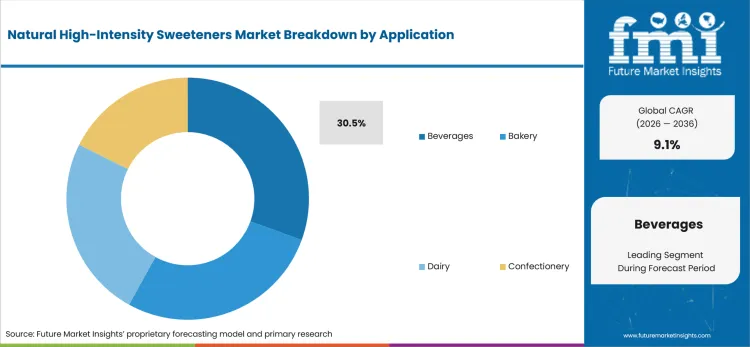
Beverages reveal sweetness onset and lingering notes through direct consumption of the complete flavor profile. In July 2025, Tate & Lyle introduced All-Americas Stevia Reb M through beverage demonstrations at IFT FIRST. The announcement documents regional bioconversion and dedicated application support for commercial reduced-sugar beverage development programs. Commercial trials must confirm clarity and flavor balance across concentrate preparation and the full shelf-life period.
- By application, beverages are estimated to hold 30.5% in 2026 across natural high-intensity sweetener sales. Frequent reformulation across carbonated and functional drinks supports beverage use across major branded product portfolios. Beverage formulators must balance acidity and flavor release so reduced-sugar products retain a familiar sensory profile throughout normal storage.
- Beverage developers are expected to favor natural high-intensity systems for flagship recipes that provide a controlled sensory benchmark. Commercial expansion depends on documented performance during concentrate preparation and filling at normal production scale. Separate testing of sweetness onset and aftertaste helps technical teams adjust the primary sweetener dose without masking process failures. The sweetness enhancers market provides related commercial context for sweetness onset correction across reduced-sugar beverages.
What are the drivers, restraints, and opportunities in the Natural High-Intensity Sweeteners Market?
Sugar thresholds and regulatory controls are increasing formulation work, and advanced production routes widen the available natural ingredient set.
- Driver: Tighter sugar thresholds increase reformulation work across packaged beverages and selected dairy drinks.
- Restraint: Ingredient approvals and intake limits create separate qualification routes across national food systems.
- Opportunity: Bioconversion and fermentation improve access to rare glycosides and emerging sweet proteins.
Government sugar thresholds are increasing reformulation work across packaged drinks with measurable added-sugar levels in major sales channels. In November 2025, the United Kingdom confirmed that the Soft Drinks Industry Levy threshold would fall from 5.0 grams to 4.5 grams per 100 milliliters. The revised framework removes exemptions for milk-based drinks containing added sugar across the covered product categories. Beverage producers need natural sweeteners that lower taxable sugar and preserve familiar taste and texture.
National approval limits slow commercialization by tying each ingredient to permitted doses and production methods. In July 2025, the European Commission listed a daily intake limit of four milligrams of steviol equivalents per kilogram of body weight. The same table records no numerical acceptable daily intake for thaumatin across authorized European applications. Food companies must maintain separate formulation records and label reviews for ingredients that follow different regulatory treatments. The thaumatin applications market provides useful commercial context for sweet-protein use across regulated European food categories.
Bioconversion and fermentation create a commercial route for rare glycosides and sweet proteins that occur at low natural concentrations. In November 2025, China’s National Health Commission recognized new production strains for converted and fermentation-produced steviol glycosides. The decision accepts additional manufacturing routes within food categories that already permit specified steviol glycosides. Commercial use depends on sensory performance and production cost across mainstream packaged food and beverage products. The rare sugar options market provides related commercial context for molecules following distinct national approval pathways.
Which country CAGRs are profiled in the Natural High-Intensity Sweeteners Market?
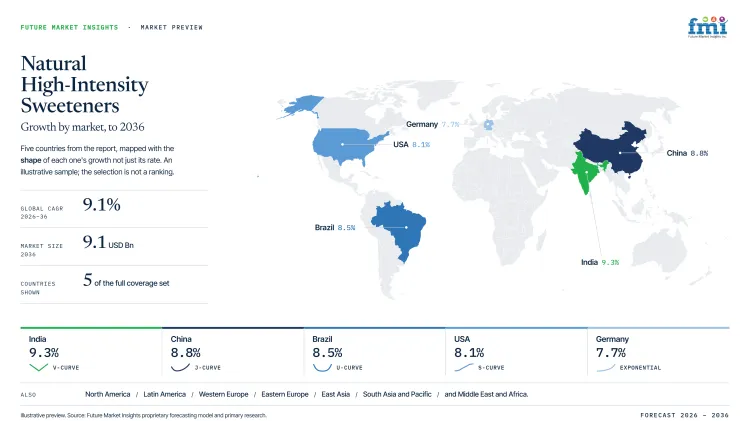
| Country | CAGR |
|---|---|
| USA | 8.1% |
| China | 8.8% |
| Germany | 7.7% |
| Brazil | 8.5% |
| India | 9.3% |
How do country-level CAGRs compare in the Natural High-Intensity Sweeteners Market?
Country forecasts span 1.6 percentage points and indicate different commercialization speeds within a broadly comparable growth range. India and China form a compact upper cluster with local production capacity and extensive packaged-food activity. Brazil and the USA occupy the middle through different approval routes and ingredient supply structures. Germany remains close enough that local approval and formulation support carry more commercial weight than the forecast order.
- India exceeds China by 0.5 percentage points, yet both markets require local formulation work and complete regulatory documentation for scaled launches.
- China remains 0.3 percentage points above Brazil and combines local conversion capacity with detailed food-category controls for commercial formulations.
- Brazil exceeds the USA by 0.4 percentage points, although ingredient authorization creates a different formulation and launch cost for specialty molecules.
- The USA remains 0.4 percentage points above Germany despite mature reformulation activity across both packaged-food systems and national retail channels.
- No adjacent gap exceeds 0.5 percentage points, so account readiness should guide capacity decisions more than small forecast differences across national markets.
Comparable CAGRs can produce different entry conditions through ingredient authorization and local technical service across national food systems. Ingredient manufacturers should sequence capacity against verified customer programs rather than relying on a narrow rate advantage. The full report provides country-level CAGR analysis across North America, Latin America, Europe, East Asia, South Asia, Oceania and the Middle East and Africa.
Country-wise Analysis
- United States food manufacturers use the FDA GRAS notification pathway alongside mandatory ingredient and nutrition labeling for national launches. Natural high-intensity sweetener demand in the United States is forecast to rise at 8.1% CAGR over the forecast period. Documented stevia production routes and established reformulation activity directly support the national commercial outlook for reduced-sugar foods. In February 2025, the FDA closed GRAS Notice 1206 without questions for enzyme-treated rebaudioside M used as a general-purpose sweetener outside stated exclusions. The response adds a documented route for converted Reb M but leaves each manufacturer responsible for lawful use. National distributors and application laboratories support recipe pilots across beverage and dairy manufacturing plants throughout the country. Sensory differences from sucrose remain a material friction during deeper replacement across acidic drinks and dairy products. Food companies need recipe-specific testing and complete label files to extend one formulation across a national portfolio.
- China uses national food-additive standards that set permitted categories and use levels for enzymatically converted steviol glycosides. Domestic extraction and conversion plants provide shorter technical response times across major food manufacturing regions. Adoption of natural high-intensity sweeteners in China is estimated to expand at 8.8% CAGR through 2036. Local conversion capacity and expanded approved uses provide a direct commercial enabler for domestic food producers. The National Health Commission clarified in February 2025 that the approved application expanded permitted uses for enzymatically converted steviol glycosides. Its interpretation explains that the sweetener can improve taste and replace sucrose within authorized applications. Detailed quality and labeling requirements remain a material friction across each production route and food category. Foreign brands need clear Chinese-language dossier ownership to extend one approved formulation into additional categories.
- German beverage manufacturers develop reduced-sugar products under European additive rules and national reformulation targets for packaged drinks. The German natural high-intensity sweeteners sector is projected to record 7.7% CAGR during the assessment period. In July 2025, the Max Rubner-Institut proposed a 15% sugar reduction for cola and cola-mixed beverages through its completed consultation process. The quantified target gives beverage developers a clear benchmark for formulations that preserve familiar taste at lower sugar levels. European authorization provides established use routes for stevia and thaumatin across defined packaged food and beverage applications. Novel sweet proteins and unfamiliar production methods create added review work across national launch programs. Ingredient manufacturers need German-language application data that supports retailer approval for each reformulated product line.
- Brazil requires prior safety assessment for ingredients without an established history of domestic food use. Established stevia and monk fruit channels enable approved formulations across national beverage and dairy portfolios. Brazil’s natural high-intensity sweeteners outlook is anticipated to advance at 8.5% CAGR over the assessment period. Beverage reformulation and established botanical channels support commercial development across major national food production centers. In December 2025, Anvisa prohibited allulose sales; the ingredient lacked authorization as a sweetener or food ingredient. The action shows that domestic legal status can outweigh international interest or favorable sensory results. Import costs and limited technical coverage remain material frictions for specialty molecules across regional plants. Local distributors need inventory plans tied to approved applications to prevent specialty shortages from interrupting reformulation schedules.
- Indian food manufacturers follow FSSAI food-category permissions and manage tight cost targets across mass beverage and dairy products. By 2036, India’s natural high-intensity sweetener market is projected to grow at 9.3% CAGR. Packaged-food capacity and cost-sensitive reformulation activity support the national commercial outlook across established manufacturing networks. Large beverage and dairy networks enable scaled trials through established plants and multi-state distribution systems. Imported sweet proteins face higher landed costs and limited technical coverage outside major manufacturing hubs. FSSAI’s November 2015 amendment established standards for steviol glycosides across specified foods and remains the foundational domestic legal route. Category-specific limits and separate labeling duties create continuing compliance work across every finished commercial recipe. Regional stocking and local trials determine the ability of national brands to repeat one recipe across plants with different process controls.
Who are the notable companies in the Natural High-Intensity Sweeteners Market?
HTBA, Cargill, Tate & Lyle, Ingredion, ADM, Sweegen, Manus, Layn, and dsm-firmenich are the notable companies shaping this market.
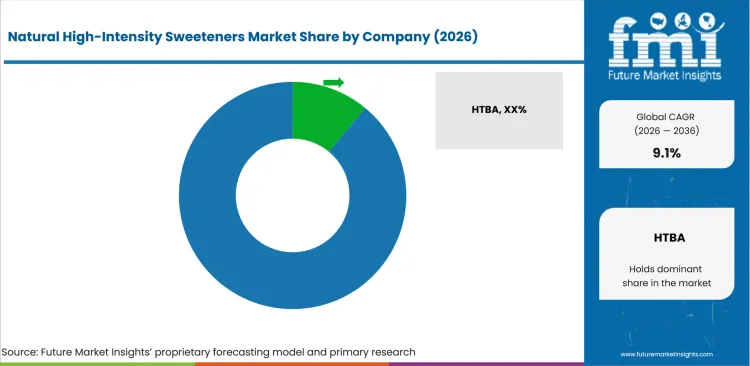
Competition spans botanical extraction and advanced bioconversion alongside precision fermentation and application support across several food categories. HTBA and Layn emphasize plant-derived ingredients; Cargill and dsm-firmenich connect fermentation with application support through Avansya. Tate & Lyle combines sensory expertise with Manus bioconversion capacity across a documented North American supply route. In June 2026, Tate & Lyle announced a recommended cash acquisition by Ingredion through a scheme of arrangement. The proposal did not establish a completed ownership transfer under the ownership status verified at the publication cutoff. The next-generation sweeteners market provides useful context for newer production routes across commercial sugar-reduction programs. Product consistency and scale-up support carry greater commercial weight than corporate size during formulation approval decisions.
- HTBA contributes citrus-derived taste modulation and Ingredion provides extensive stevia technology across several commercial food applications. Manus adds United States bioconversion capacity for rare glycosides used in commercial beverage and food programs. Their competitive position depends on ingredient consistency and application evidence across repeated production runs and launch regions.
- Cargill and ADM combine international distribution with broad sweetening portfolios and dedicated food application laboratories worldwide. Layn adds vertically integrated stevia and monk fruit production alongside documented enzyme-converted Reb M capability. These companies compete through dependable supply and coordinated formulation support across several recipes within the same brand portfolio.
- Tate & Lyle combines sensory expertise with Manus production capacity across established regional Reb M supply programs. Sweegen develops stevia and brazzein systems; dsm-firmenich links fermentation with international taste-modulation expertise through Avansya. Selection depends on repeatable recipe performance and dependable regional supply rather than the breadth of an unrelated ingredient portfolio.
Competitive Benchmarking: Natural High-Intensity Sweeteners Market
| Company | Botanical Sweetener Portfolio | Advanced Production Routes | Application Formulation Support | Geographic Reach |
|---|---|---|---|---|
| HTBA | Medium | Medium | High | Europe and international markets |
| Cargill | Medium | High | High | Global |
| Tate & Lyle | High | High | High | Global |
| Ingredion | High | High | High | Global |
| ADM | High | Medium | High | Global |
| Sweegen | High | High | High | North America and selected international markets |
| Manus | Medium | High | Medium | United States and international partners |
| Layn | High | High | High | Global |
| dsm-firmenich | Medium | High | High | Global |
Key Developments in the Natural High-Intensity Sweeteners Market
- In February 2026, Tate & Lyle and Manus launched Yume under their Sweetener Alliance for commercial sugar-reduction programs. Yume M combines Manus bioconversion at its Augusta facility with Tate & Lyle formulation support for commercial food applications. The launch connects regional Reb M production with sensory and scale-up services across large formulation programs. Food manufacturers gain a documented supply route for reduced-sugar products that require dependable taste and production performance.
- In April 2026, Arzeda received a no-questions response from the FDA for GRAS Notice 1294 covering enzyme-treated rebaudioside M. The notice supports general-purpose food use under current good manufacturing practices across several eligible food categories. The outcome adds a documented United States production route for commercially produced rare steviol glycosides. Commercial use depends on competitive ingredient cost and repeatable sensory performance across normal production batches.
- In June 2026, Shanghai Shenghe Zhizao Biotechnology received a no-questions response from the FDA for GRAS Notice 1307 covering enzyme-treated rebaudioside M. The notice supports general-purpose food use under current good manufacturing practices across several eligible food categories. The regulatory outcome widens the documented commercial producer base for converted Reb M in the United States. Food companies must qualify supply consistency and application performance across intended recipes and routine production conditions.
- In July 2025, Sweegen presented its newly launched Ultratia Brazzein Sweet Protein Systems at IFT FIRST in Chicago. Reduced-sugar demonstrations covered granola and several beverage prototypes across distinct commercial formulation and processing conditions. Brazzein gives food developers a sweetness route separate from steviol glycosides during deeper sugar-reduction programs. The launch expands commercial testing for sweet proteins across heat-treated and acidic applications that require stable sensory performance during routine processing.
Key Players in the Natural High-Intensity Sweeteners Market
Core Technology and Ingredient Developers
- HTBA
- Ingredion
- Manus
Scaled Manufacturing and Supply Groups
- Cargill
- ADM
- Layn
Application and Commercialization Specialists
- Tate & Lyle
- Sweegen
- dsm-firmenich
Natural High-Intensity Sweeteners Market - Report Scope
| Coverage field | Report scope |
|---|---|
| Market breakdown | Type, form, application, and region. |
| Quantitative Units | USD Billion, CAGR in %. |
| Market Definition | Revenue from natural high-intensity sweetener ingredients and directly related formulation systems used to reduce sugar across food and beverage applications. The scope includes stevia, monk fruit, citrus-derived sweeteners, brazzein, rare sugars, powder and liquid forms, and the named application categories. |
| Regions Covered | North America, Latin America, Western Europe, Eastern Europe, East Asia, South Asia and Pacific, and Middle East and Africa. |
| Countries Covered | USA, China, Germany, Brazil, India, plus more than twenty-five additional countries across the regions covered. |
| Key Companies Profiled | HTBA, Cargill, Tate & Lyle, Ingredion, ADM, Sweegen, Manus, Layn, and dsm-firmenich |
| Forecast Period | 2026 to 2036. |
| Approach | Hybrid bottom-up and top-down market sizing supported by primary interviews and authoritative official desk research. |
Natural High-Intensity Sweeteners Market - Research Methodology
| Method | Approach |
|---|---|
| Primary Research | FMI analysts gathered input from manufacturers, service providers, technology developers, distributors, end users, procurement teams, and subject-matter experts. Interviews examined purchasing decisions, product or service evaluation, adoption barriers, approval requirements, pricing considerations, and expectations for technical or commercial support. Respondents were also asked what evidence is required before a trial, pilot, or initial order develops into regular purchasing. |
| Desk Research | Desk research covered government statistics, regulatory publications, trade data, industry associations, technical literature, standards, company filings, product information, and official corporate announcements. Sources were reviewed for relevance, publication date, geographic coverage, and consistency with the defined market scope. Claims relating to performance, applications, approvals, capacity, investment, and commercial activity were retained only when supported by credible public evidence. |
| Market Sizing and Forecasting | The market model combined the baseline value with historical performance, segment structure, pricing and volume indicators, adoption levels, company participation, and country-level demand conditions. Forecast assumptions considered economic activity, investment trends, regulatory developments, technology adoption, purchasing cycles, supply availability, and barriers to wider market use. Segment and regional estimates were reconciled before the final market total was calculated. |
| Data Validation | Estimates were checked against multiple independent indicators, including public data, company activity, trade patterns, industry developments, and findings from primary interviews. Validation also tested whether products, services, applications, and company revenues fell within the defined market boundaries. Adjacent categories, unsupported claims, overlapping revenues, and activities without direct market relevance were excluded to reduce double counting and maintain consistency across segments and countries. |
Natural High-Intensity Sweeteners Market by Segments
Natural High-Intensity Sweeteners Market segmented by Type:
- Stevia
- Monk Fruit
- Citrus-derived
- Brazzein
- Rare Sugars
Natural High-Intensity Sweeteners Market segmented by Form:
- Powder
- Liquid
Natural High-Intensity Sweeteners Market segmented by Application:
- Beverages
- Bakery
- Dairy
- Confectionery
Natural High-Intensity Sweeteners Market by Region:
- North America
- United States
- Canada
- Latin America
- Brazil
- Mexico
- Argentina
- Chile
- Western Europe
- Germany
- France
- United Kingdom
- Italy
- Spain
- Benelux
- Nordics
- Eastern Europe
- Poland
- Czech Republic
- Romania
- Hungary
- East Asia
- China
- Japan
- South Korea
- South Asia and Pacific
- India
- ASEAN
- Australia and New Zealand
- Middle East and Africa
- GCC Countries
- South Africa
- Türkiye
- Israel
Research Sources and Bibliography
- USA Food and Drug Administration. (2025, February 28). GRAS Notice No. 1206: Rebaudioside M produced by enzymatic treatment of rebaudioside A purified from the leaves of Stevia rebaudiana (Bertoni) Bertoni.
- USA Food and Drug Administration. (2025, November 18). GRAS Notice No. 1260: Rebaudioside M produced by enzymatic treatment of steviol glycosides purified from the leaves of Stevia rebaudiana (Bertoni) Bertoni.
- USA Food and Drug Administration. (2025, February 12). GRAS Notice No. 1203: Rebaudioside M2 obtained by enzymatic treatment of steviol glycosides purified from the leaves of Stevia rebaudiana (Bertoni) Bertoni.
- USA Food and Drug Administration. (2026, April 16). GRAS Notice No. 1294: Rebaudioside M produced by enzymatic treatment of steviol glycosides purified from the leaves of Stevia rebaudiana (Bertoni) Bertoni.
- USA Food and Drug Administration. (2026, June 4). GRAS Notice No. 1307: Rebaudioside M produced by enzymatic treatment of steviol glycosides purified from the leaves of Stevia rebaudiana (Bertoni) Bertoni.
- National Health Commission of the People’s Republic of China. (2025, February 10). 解读《关于甜叶菊多酚等20种“三新食品”的公告》(2025年第1号).
- National Health Commission of the People’s Republic of China. (2025, November 27). 解读《关于威尼斯镰刀菌蛋白等14种“三新食品”的公告》(2025年第7号).
- European Commission. (2025, July 23). Acceptable daily intake of sweeteners in the EU.
- HM Revenue & Customs, HM Treasury, & Department of Health and Social Care. (2025, November 25). Strengthening the Soft Drinks Industry Levy.
- Max Rubner-Institut. (2025, July 2). Reduktionsziele für Zucker, Fett und Salz.
- Agência Nacional de Vigilância Sanitária. (2025, December 22). Anvisa proíbe alimento com ingrediente não autorizado.
- Food Safety and Standards Authority of India. (2015, November 20). Food Safety and Standards (Food Products Standards and Food Additives) Amendment Regulation, 2015 relating to standards of Steviol Glycoside in various food products.
- Cargill. (2025, September 26). Cargill’s EverSweet® stevia sweetener named a finalist in the 2025 Global Good Awards Game Changing Innovation of the Year.
- Tate & Lyle. (2025, October 31). One year on: How our stevia Reb M partnership with Manus is benefiting customers.
- Tate & Lyle. (2025, July 7). Tate & Lyle debuts expanded portfolio and mouthfeel leadership at IFT FIRST 2025.
- Tate & Lyle. (2026, February 23). Introducing Yume™: A new standard for sweetness.
- Tate & Lyle. (2026, June 8). RECOMMENDED ACQUISITION of TATE & LYLE PLC by INGREDION INCORPORATED.
- Sweegen. (2025, July 14). IFT 2025.
- HTBA. (2025, July 14). HTBA unveils revitalized flavonoid-powered OptiTaste® Taste Modulation Solutions platform at IFT FIRST 2025.
- Layn Natural Ingredients. (2025, July 14). Layn Natural Ingredients Unveils FDA GRAS Affirmed SteviUp M2, A Breakthrough in Clean, Sugar-Like, Superior Soluble Reb-M.
- Ingredion. (2025, November 14). Solutions for reduced-sugar products: Meeting consumer trends at scale.
- dsm-firmenich. (2026, February 20). Sustainability, innovation, and partnerships - dsm-firmenich Integrated Annual Report 2025.
- ADM. (2026, February 17). Annual Report on Form 10-K for the fiscal year ended December 31, 2025.
This bibliography is provided for reader reference and is not exhaustive. The full report contains the complete reference list and detailed citations.
This Report Answers
- How large is the Natural High-Intensity Sweeteners Market in 2026 and 2036?
- Which regulatory and formulation pressures support natural sugar-reduction programs?
- Why does Stevia account for the largest Type share in 2026?
- Why does Powder account for the largest Form share in 2026?
- Why do Beverages account for the largest Application share in 2026?
- How do country growth rates differ across USA, China, Germany, Brazil, and India?
- Which companies combine botanical extraction with advanced production or application support?
- What limits qualification and commercial scale across national food systems?
- What should food manufacturers test before approving broader purchasing?
Frequently Asked Questions
How big is the Natural High-Intensity Sweeteners Market in 2026?
The natural high-intensity sweeteners market is valued at USD 3.8 billion in 2026 and is forecast to reach USD 9.1 billion by 2036, reflecting growing demand from food and beverage manufacturers lowering added sugar across packaged beverages, dairy products, and confectionery through structured reformulation programs.
What is the CAGR of the Natural High-Intensity Sweeteners Market from 2026 to 2036?
The natural high-intensity sweeteners market is projected to grow at a CAGR of 9.1% between 2026 and 2036, supported by tighter sugar thresholds increasing reformulation work across packaged beverages and selected dairy drinks in major consumer markets.
Which type leads the Natural High-Intensity Sweeteners Market?
Stevia accounts for 32.7% of the natural high-intensity sweeteners market by type in 2026, driven by regulatory familiarity across major markets and several verified glycoside production routes that support different sweetness targets across reduced-sugar food and beverage applications.
Which country segment is growing fastest in the Natural High-Intensity Sweeteners Market?
India is the fastest-growing country segment in the natural high-intensity sweeteners market, expanding at a 9.3% CAGR through 2036, ahead of the market average of 9.1%, shaped by expanding packaged-food manufacturing capacity and cost-sensitive reformulation economics across large-scale beverage and dairy production networks.
Who are the leading companies in the Natural High-Intensity Sweeteners Market?
Leading companies in the natural high-intensity sweeteners market include HTBA, Cargill, Tate & Lyle, Ingredion, ADM, Sweegen, Manus, Layn, and dsm-firmenich, competing across botanical extraction platforms, advanced bioconversion and fermentation routes, and dedicated application formulation support across global food and beverage categories.
Preview the report firsthand - request a free sample
Get SampleGet the brochure for pricing and purchase details.
Get PDFTable of Content
- Key Takeaways
- Market Size and CAGR
- Top Growth Driver
- Fastest Growing Segment
- Leading Region
- Key Companies
- Emerging Opportunities
- Executive Summary
- Global Market Outlook
- Demand-side Trends
- Supply-side Trends
- Technology Roadmap Analysis
- Analysis and Recommendations
- Analyst Perspective (What is happening? Why now? What should investors know?)
- Key Questions Answered
- How large is the market?
- What is the CAGR?
- What are key trends?
- Which region dominates?
- Who are the leaders?
- Market Overview
- Market Coverage / Taxonomy
- Market Definition / Scope / Limitations
- Research Methodology
- Chapter Orientation
- Analytical Lens and Working Hypotheses
- Market Structure, Signals, and Trend Drivers
- Benchmarking and Cross-market Comparability
- Market Sizing, Forecasting, and Opportunity Mapping
- Research Design and Evidence Framework
- Desk Research Programme (Secondary Evidence)
- Expert Input and Fieldwork (Primary Evidence)
- Tooling, Models, and Reference Databases
- Data Engineering and Model Build
- Quality Assurance and Audit Trail
- Market Background
- Market Dynamics (Drivers, Restraints, Opportunity, Trends)
- Scenario Forecast (Optimistic, Likely, Conservative)
- Impact Analysis
- AI Impact
- Sustainability Impact
- Regulatory Impact
- Technology Impact
- Consumer / Buyer Analysis
- Purchase Drivers
- Adoption Barriers
- Buyer Journey
- Opportunity Map Analysis
- Product Life Cycle Analysis
- Supply Chain Analysis
- Investment Feasibility Matrix
- Value Chain Analysis
- PESTLE and Porter's Analysis
- Regulatory Landscape
- Regional Parent Market Outlook
- Production and Consumption Statistics
- Import and Export Statistics
- Global Market Analysis and Forecast, 2021 to 2036
- Historical Market Size Value (USD Billion) Analysis, 2021 to 2025
- Current and Future Market Size Value (USD Billion) Projections, 2026 to 2036
- Y-o-Y Growth Trend Analysis
- Absolute $ Opportunity Analysis
- Global Market Pricing Analysis, 2021 to 2036
- Global Market Analysis and Forecast, By Type, 2021 to 2036
- Introduction / Key Findings
- Historical Market Size Value (USD Billion) Analysis By Type, 2021 to 2025
- Current and Future Market Size Value (USD Billion) Analysis and Forecast By Type, 2026 to 2036
- Stevia
- Monk Fruit
- Citrus-derived
- Brazzein
- Rare Sugars
- Stevia
- Y-o-Y Growth Trend Analysis By Type, 2021 to 2025
- Absolute $ Opportunity Analysis By Type, 2026 to 2036
- Global Market Analysis and Forecast, By Form, 2021 to 2036
- Introduction / Key Findings
- Historical Market Size Value (USD Billion) Analysis By Form, 2021 to 2025
- Current and Future Market Size Value (USD Billion) Analysis and Forecast By Form, 2026 to 2036
- Powder
- Liquid
- Powder
- Y-o-Y Growth Trend Analysis By Form, 2021 to 2025
- Absolute $ Opportunity Analysis By Form, 2026 to 2036
- Global Market Analysis and Forecast, By Application, 2021 to 2036
- Introduction / Key Findings
- Historical Market Size Value (USD Billion) Analysis By Application, 2021 to 2025
- Current and Future Market Size Value (USD Billion) Analysis and Forecast By Application, 2026 to 2036
- Beverages
- Bakery
- Dairy
- Confectionery
- Beverages
- Y-o-Y Growth Trend Analysis By Application, 2021 to 2025
- Absolute $ Opportunity Analysis By Application, 2026 to 2036
- Global Market Analysis and Forecast, By Region, 2021 to 2036
- Introduction
- Historical Market Size Value (USD Billion) Analysis By Region, 2021 to 2025
- Current Market Size Value (USD Billion) Analysis and Forecast By Region, 2026 to 2036
- North America
- Latin America
- Western Europe
- Eastern Europe
- East Asia
- South Asia and Pacific
- Middle East & Africa
- Market Attractiveness Analysis By Region
- North America Market Analysis and Forecast, By Country, 2021 to 2036
- Historical Market Size Value (USD Billion) Trend Analysis By Market Taxonomy, 2021 to 2025
- Market Size Value (USD Billion) Forecast By Market Taxonomy, 2026 to 2036
- By Country
- USA
- Canada
- By Type
- By Form
- By Application
- By Country
- Market Attractiveness Analysis
- By Country
- By Type
- By Form
- By Application
- Key Takeaways
- Latin America Market Analysis and Forecast, By Country
- Historical Market Size Value (USD Billion) Trend Analysis By Market Taxonomy, 2021 to 2025
- Market Size Value (USD Billion) Forecast By Market Taxonomy, 2026 to 2036
- By Country
- Brazil
- Mexico
- Chile
- Rest of Latin America
- By Type
- By Form
- By Application
- By Country
- Market Attractiveness Analysis
- By Country
- By Type
- By Form
- By Application
- Key Takeaways
- Western Europe Market Analysis and Forecast, By Country
- Historical Market Size Value (USD Billion) Trend Analysis By Market Taxonomy, 2021 to 2025
- Market Size Value (USD Billion) Forecast By Market Taxonomy, 2026 to 2036
- By Country
- Germany
- UK
- Italy
- Spain
- France
- Nordic
- BENELUX
- Rest of Western Europe
- By Type
- By Form
- By Application
- By Country
- Market Attractiveness Analysis
- By Country
- By Type
- By Form
- By Application
- Key Takeaways
- Eastern Europe Market Analysis and Forecast, By Country
- Historical Market Size Value (USD Billion) Trend Analysis By Market Taxonomy, 2021 to 2025
- Market Size Value (USD Billion) Forecast By Market Taxonomy, 2026 to 2036
- By Country
- Russia
- Poland
- Hungary
- Balkan & Baltic
- Rest of Eastern Europe
- By Type
- By Form
- By Application
- By Country
- Market Attractiveness Analysis
- By Country
- By Type
- By Form
- By Application
- Key Takeaways
- East Asia Market Analysis and Forecast, By Country
- Historical Market Size Value (USD Billion) Trend Analysis By Market Taxonomy, 2021 to 2025
- Market Size Value (USD Billion) Forecast By Market Taxonomy, 2026 to 2036
- By Country
- China
- Japan
- South Korea
- By Type
- By Form
- By Application
- By Country
- Market Attractiveness Analysis
- By Country
- By Type
- By Form
- By Application
- Key Takeaways
- South Asia and Pacific Market Analysis and Forecast, By Country
- Historical Market Size Value (USD Billion) Trend Analysis By Market Taxonomy, 2021 to 2025
- Market Size Value (USD Billion) Forecast By Market Taxonomy, 2026 to 2036
- By Country
- India
- ASEAN
- Australia & New Zealand
- Rest of South Asia and Pacific
- By Type
- By Form
- By Application
- By Country
- Market Attractiveness Analysis
- By Country
- By Type
- By Form
- By Application
- Key Takeaways
- Middle East & Africa Market Analysis and Forecast, By Country
- Historical Market Size Value (USD Billion) Trend Analysis By Market Taxonomy, 2021 to 2025
- Market Size Value (USD Billion) Forecast By Market Taxonomy, 2026 to 2036
- By Country
- Kingdom of Saudi Arabia
- Other GCC Countries
- Türkiye
- South Africa
- Other African Union
- Rest of Middle East & Africa
- By Type
- By Form
- By Application
- By Country
- Market Attractiveness Analysis
- By Country
- By Type
- By Form
- By Application
- Key Takeaways
- Key Countries Market Analysis
- USA
- Pricing Analysis
- Market Share Analysis, 2025
- By Type
- By Form
- By Application
- Canada
- Pricing Analysis
- Market Share Analysis, 2025
- By Type
- By Form
- By Application
- Mexico
- Pricing Analysis
- Market Share Analysis, 2025
- By Type
- By Form
- By Application
- Brazil
- Pricing Analysis
- Market Share Analysis, 2025
- By Type
- By Form
- By Application
- Chile
- Pricing Analysis
- Market Share Analysis, 2025
- By Type
- By Form
- By Application
- Germany
- Pricing Analysis
- Market Share Analysis, 2025
- By Type
- By Form
- By Application
- UK
- Pricing Analysis
- Market Share Analysis, 2025
- By Type
- By Form
- By Application
- Italy
- Pricing Analysis
- Market Share Analysis, 2025
- By Type
- By Form
- By Application
- Spain
- Pricing Analysis
- Market Share Analysis, 2025
- By Type
- By Form
- By Application
- France
- Pricing Analysis
- Market Share Analysis, 2025
- By Type
- By Form
- By Application
- India
- Pricing Analysis
- Market Share Analysis, 2025
- By Type
- By Form
- By Application
- ASEAN
- Pricing Analysis
- Market Share Analysis, 2025
- By Type
- By Form
- By Application
- Australia & New Zealand
- Pricing Analysis
- Market Share Analysis, 2025
- By Type
- By Form
- By Application
- China
- Pricing Analysis
- Market Share Analysis, 2025
- By Type
- By Form
- By Application
- Japan
- Pricing Analysis
- Market Share Analysis, 2025
- By Type
- By Form
- By Application
- South Korea
- Pricing Analysis
- Market Share Analysis, 2025
- By Type
- By Form
- By Application
- Russia
- Pricing Analysis
- Market Share Analysis, 2025
- By Type
- By Form
- By Application
- Poland
- Pricing Analysis
- Market Share Analysis, 2025
- By Type
- By Form
- By Application
- Hungary
- Pricing Analysis
- Market Share Analysis, 2025
- By Type
- By Form
- By Application
- Kingdom of Saudi Arabia
- Pricing Analysis
- Market Share Analysis, 2025
- By Type
- By Form
- By Application
- Türkiye
- Pricing Analysis
- Market Share Analysis, 2025
- By Type
- By Form
- By Application
- South Africa
- Pricing Analysis
- Market Share Analysis, 2025
- By Type
- By Form
- By Application
- USA
- Market Structure Analysis
- Competition Dashboard
- Competition Benchmarking
- Market Share Analysis of Top Players
- By Regional
- By Type
- By Form
- By Application
- Emerging Startups
- Innovation Benchmarking
- Competition Analysis
- Competition Deep Dive
- HTBA
- Overview
- Product Portfolio
- Profitability by Market Segments
- Sales Footprint
- Strategy Overview
- Marketing Strategy
- Product Strategy
- Channel Strategy
- Cargill
- Tate & Lyle
- Ingredion
- ADM
- Sweegen
- Manus
- Layn
- dsm-firmenich
- HTBA
- Case Studies
- Success Stories
- Recent Developments
- Competition Deep Dive
- Assumptions & Acronyms Used


