

- Market Size (2026)
- USD 151.5 Mn
- Forecast (2036)
- USD 542.2 Mn
- CAGR (2026 to 2036)
- 13.6%
How big is the Saltbush & Native/Halophyte Protein Ingredients Market in 2026?
USD 151.5 million in 2026 and USD 542.2 million by 2036 at a 13.6% CAGR.
Demand for saltbush & native/halophyte protein ingredients is projected to expand at 13.6% CAGR between 2026 and 2036, increasing valuation from USD 151.5 million in 2026 to USD 542.2 million by 2036. Food scientists are actively testing natural plant extracts to prevent spoilage and extend the shelf life of refrigerated foods. In November 2025, Tokysheva and colleagues reported adding 1.5% Salicornia extract to refrigerated beef patties leading to a 42% reduction in secondary lipid oxidation. Such strong preservation performance supports the use of plant-based ingredients in functional foods that require clean-label recipes and longer storage stability.
International food producers and buyers evaluate these salt-tolerant crops based on distinct regional priorities. Buyers in India and United Arab Emirates prioritize saline-crop scalability and local processing support. Formulators in Australia and Spain emphasize native-source identity and documented food performance. Specialized growing methods are also helping improve crop yields and quality. In December 2025, Castanho and colleagues reported for growing Salicornia hydroponically increasing aerial growth by 14% to 50% compared to traditional soil or substrate cultivation. Resulting with such controlled production gains helping to provide a consistent biomass supply for plant-based protein developers serving water-constrained regions.
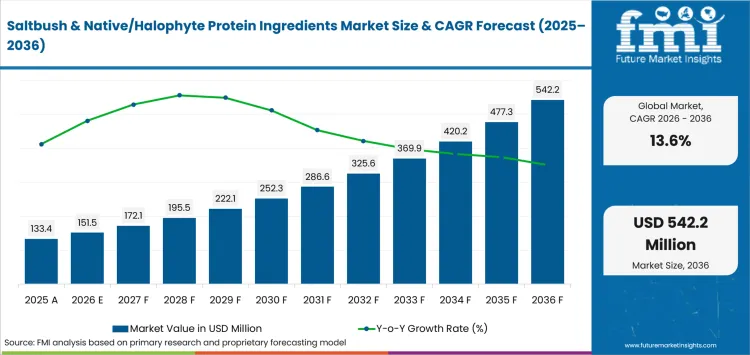
Key Takeaways of Saltbush & Native/Halophyte Protein Ingredients Market
- Demand for saltbush and native halophyte protein ingredients is driven by salt-tolerant crop cultivation supporting ingredient development using saline water and salt-affected agricultural land, with buyer decisions reflecting biomass consistency and documented performance during food or protein processing.
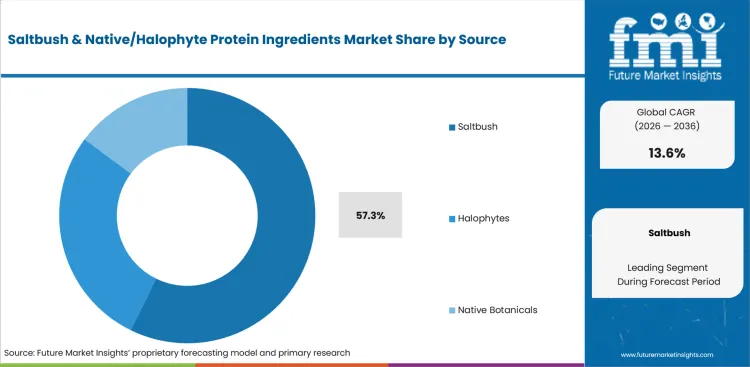
- Saltbush holds the leading source share at 57.3% in 2026, attributable to established Atriplex cultivation knowledge and dependable source assessment, with sodium control receiving initial assessment followed by flavor response and bioactive composition during processing selection.
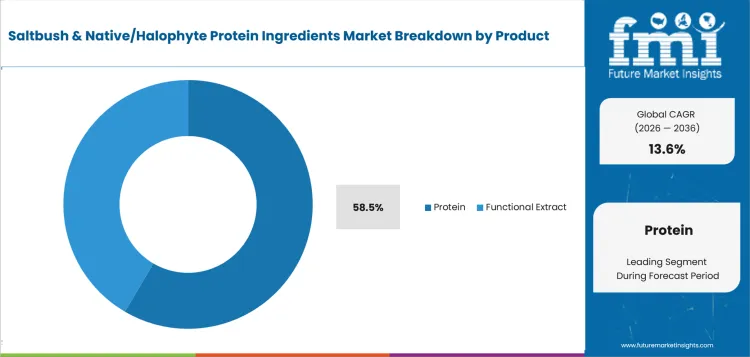
- Protein leads the product category at 58.5% share in 2026, owing to concentrated formats providing measurable nutrition value for specialty foods, with qualification beginning through protein concentration testing followed by solubility review under planned flavor and storage conditions.
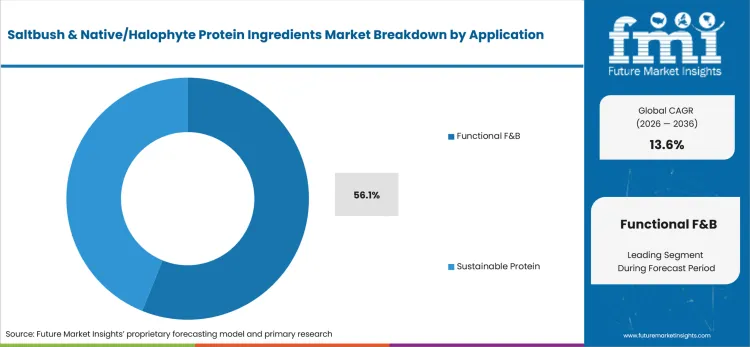
- Functional food and beverage accounts for 56.1% application share in 2026, driven by developers evaluating halophyte powders and extracts for nutrition products requiring defined sensory targets and processing tolerance across finished-product formulations.
- India, the United Arab Emirates, and Australia record CAGRs of 12.3%, 11.9%, and 11.5% respectively through 2036, shaped by commercialized high-biomass Salicornia cultivation technology, native-halophyte cultivation alongside culinary testing, and established saltbush agronomy with producer participation.
- Competition centers on halophyte cultivation and ingredient processing, with Seawater Solutions competing through halophyte protein concentrates and biorefinery development, Salt Crops THNK LLP supporting Salicornia cultivation and nutraceutical programs, and Seashore Cultivation & Habitat LLP addressing cultivation and botanical salt processing.
Analyst Perspective
"The saltbush & native/halophyte protein ingredients market is advancing as food manufacturers explore resilient plant protein sources with differentiated nutritional profiles. Commercial adoption will depend on consistent ingredient quality, validated processing performance, and reliable application outcomes across food and nutraceutical formulations. Companies that strengthen raw material traceability, composition standardization, and technical application support will be better positioned to expand market acceptance."
- Nandini Roy Choudhury, Principal Consultant for Food and Beverages at Future Market Insights
Source: Future Market Insights analysis, 2026.
How is the Saltbush & Native/Halophyte Protein Ingredients Market segmented?
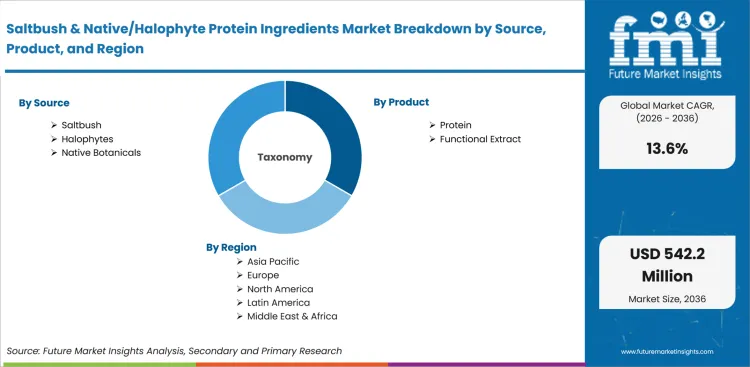
The saltbush & native/halophyte protein ingredients industry is segmented by source, product, application, and region.
The saltbush & native/halophyte protein ingredients market is segmented by source, product, application, and region. Source coverage includes saltbush and halophytes followed by native botanicals. Product coverage distinguishes protein from functional extract formats. Application coverage addresses functional F&B and sustainable protein uses. Regional coverage includes North America and Western Europe together with East Asia. Latin America and Eastern Europe complete analysis with South Asia and Pacific and Middle East and Africa.
Why does saltbush shape source selection?
Atriplex species combine salinity tolerance with nutritional value suited to ingredient development. Sun and colleagues reported saltbush leaf sodium concentrations ranging from 2.38 to 9.36 g per 100 g in February 2025, revealing composition differences influencing washing intensity and formulation limits. Ingredient qualification links species records to controlled washing methods under defined final sodium specifications.
- In 2026, saltbush is projected to represent 57.3% share due to established Atriplex cultivation knowledge supporting dependable source assessment for native-food or protein formulations. Buyer review begins through leaf-composition testing before approval decisions consider harvest timing and extraction performance.
- Halophytes and native botanicals extend source choice depending on Salicornia or locally adapted plants presenting distinct mineral profiles for specialized formulations. Sodium control receives initial assessment, followed by flavor response and bioactive composition during processing selection for each species.
Why does protein shape product selection?
Protein concentrates transform salt-tolerant biomass into defined nutritional inputs for food or feed formulations. Sánchez-Gavilán and colleagues reported sulfur-rich amino acids representing 19.3% to 21.8% of young Salicornia patula shoots in December 2025, highlighting direct comparison of ingredient quality through amino-acid composition. Qualification begins through protein concentration testing, then solubility review establishes suitability under planned flavor or storage conditions.
- Based on product, protein is estimated to secure 58.5% share in 2026 since concentrated formats provide measurable nutrition value for specialty foods or emerging feed formulations. Formulators initially test digestibility together with taste, using mineral balance to direct performance review in beverages or blended products.
- Functional extracts recover antioxidants or selected phytochemicals from halophytic biomass for wellness products requiring controlled composition under defined use limits. Supplier approval starts through marker-compound verification, followed by extraction-record review under stable batch conditions.
Why does functional F&B shape application demand?
Functional F&B use converts saltbush or Salicornia properties into measurable performance within finished foods. Tokysheva and colleagues reported in September 2025 a 1.5-fold increase in alpha-linolenic acid from 3.0% Salicornia perennans powder in cooked sausages, aligning ingredient dose to nutritional improvement. Finished-product evidence connects dosage with sensory quality under defined processing conditions.
- By application, functional F&B is anticipated to account for 56.1% share in 2026 as developers evaluate halophyte powders or extracts for nutrition products requiring defined sensory targets. Product teams compare dosage against taste response, with processing tolerance and label wording determining suitability for functional food ingredients.
- Sustainable protein supports food or feed programs seeking ingredients produced through saline resources or salt-affected land without competing for conventional farmland. Adoption reflects nutrient density under defined digestibility targets, influenced by viable processing economics and dependable supply for alternative protein formulations.
What are the drivers, restraints, and opportunities in the Saltbush & Native/Halophyte Protein Ingredients Market?
Saline agriculture creates a production route for salt-tolerant plants using land and water resources unsuitable for many conventional crops. Commercial viability requires reliable controlled processing and documentation accepted within each destination.
- Driver: Salt-affected land and freshwater pressure encourage cultivation trials involving saltbush and related halophytes. Ingredient demand advances as growers and processors convert agronomic tolerance into dependable biomass specifications.
- Restraint: Variable sodium and mineral profiles increase qualification work. Contaminant results with flavor and composition records affect food or feed approval. Regulatory review and customer testing may delay routine orders if source identity or production records remain incomplete.
- Opportunity: Improved fractionation and formulation methods create routes for proteins or fibers. Antioxidants with mineral-rich extracts support lower-sodium food concepts. Commercial value rises as new formats solve a defined nutrition or formulation problem without weakening taste or processing stability.
Food and Agriculture Organization reported 10.7% of global land as salt-affected in December 2024, expanding interest in crops adapted to saline environments. Halophyte ingredient programs gain a defensible agronomic base as cultivation uses affected land without displacing conventional food crops. Commercial impact emerges through dependable biomass supply for proteins and extracts. Seasonings and specialty food ingredients add further demand routes.
Halophyte ingredients lacking established consumption histories are likely to require detailed identity and production records. European Food Safety Authority described updated novel-food guidance as 2 key documents in September 2024, covering scientific evidence and administrative submission requirements. Composition with exposure evidence supports toxicology review. Nutrition and allergen files complete assessment. Additional dossier work extends development schedules and increases testing costs for unfamiliar extracts or concentrated formats.
Pinto and colleagues recorded bioaccessibility above 95% for phenolics and flavonoids from Salicornia ramosissima by-product in September 2025 during simulated digestion. Such evidence supports functional-extract research using material previously treated as processing residue. Commercial conversion requires standardized recovery and safety review. Marker-compound control with finished-product validation supports wellness claims or routine supply.
What country cagrs are profiled in the Saltbush & Native/Halophyte Protein Ingredients Market?
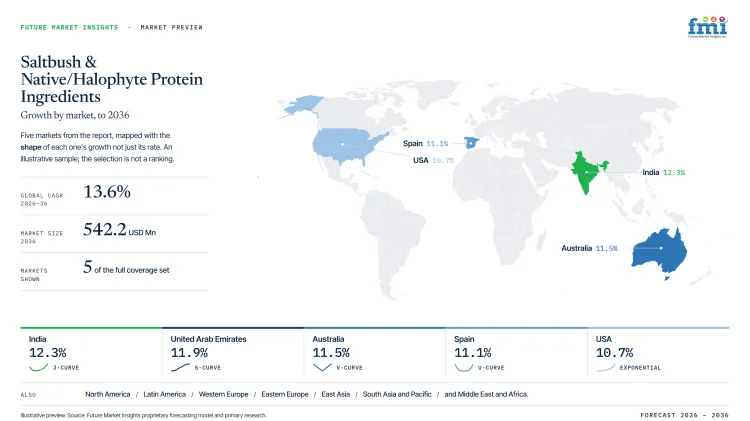
| Country | CAGR |
|---|---|
| India | 12.3% |
| United Arab Emirates | 11.9% |
| Australia | 11.5% |
| Spain | 11.1% |
| USA | 10.7% |
Source: Future Market Insights analysis, 2026.
How do country-level CAGRs compare in the Saltbush & Native/Halophyte Protein Ingredients Market?
Country comparison shows a gradual step-down in growth through the profiled markets. India and the United Arab Emirates occupy the upper rate band. Australia and Spain form a closely grouped middle tier. USA completes the comparison at a moderately lower forecast pace. A 1.6 percentage-point spread separates India from USA, indicating measured divergence without a sharp division in market momentum.
- India leads the comparison and establishes South Asia as the principal development cluster within the profiled group.
- United Arab Emirates follows closely and reflects comparable interest in saline agriculture and halophyte ingredient development.
- Australia and Spain form the next growth band and maintain a limited distance from the upper group.
- USA records the slowest growth within the listed markets despite sustained specialty ingredient development.
- Profiled rates create a steady downward progression instead of a pronounced separation between upper and lower positions.
Markets carrying similar CAGRs may present different entry conditions through cultivation capability, regulatory classification and ingredient-qualification readiness. Full report coverage extends through North America, Latin America, Western Europe, Eastern Europe, East Asia, South Asia and Pacific, and Middle East and Africa.
Country-Level Analysis
- Sector in India is projected to expand at 12.3% CAGR from 2026 to 2036, influenced by coastal saline-agriculture capability and local crop-development experience. Office of the Principal Scientific Adviser reported in May 2026 for Salicornia cultivation yielding approximately 41 t of fresh biomass per hectare, reflecting feedstock planning for botanical salt and ingredient processing. Local cultivation evidence is expected to shorten agronomic learning for nutraceutical and ingredient trials.
- Emirates Nature-WWF reported in October 2024 cultivation work covering 2 edible halophytes, Salicornia and Arthrocaulon. Project sites in Umm Al Quwain support local crop familiarity. Local crop familiarity supports formulation trials. Repeatable composition and scalable processing remain essential for ingredient orders. Demand in the United Arab Emirates is forecast to rise at 11.9% CAGR by 2036, aided by desert agriculture programs linking native halophytes with culinary testing.
- The market in Australia is expected to scale at 11.5% CAGR during the forecast period, backed by native saltbush knowledge promoting source development and grower engagement. CSIRO reported more than 6 million Anameka saltbush shrubs planted by producers in June 2024. Agronomic familiarity is expected to influence provided food-grade processing and composition evidence extend beyond forage use.
- Sales in Spain are anticipated to progress at 11.1% CAGR between 2026 and 2036, helped by mediterranean culinary use and academic work on edible Salicornia. Sánchez Gavilán and colleagues reported analysis of 8 Salicornia patula shoot samples in January 2024, collected in central and southwestern Spain. Domestic composition research strengthens food-development credibility. Commercial proteins and extracts require controlled cultivation and standardized processing.
- Industry in the United States is set to increase at 10.7% CAGR during the assessment period, guided by specialty ingredient demand and formal import controls. United States Department of Agriculture authorized Israeli glasswort imports in April 2026 under 3 entry conditions. Requirements cover commercial consignments with phytosanitary certification and port inspection. Clear access requirements support fresh Salicornia supply evaluation. Processed ingredients face separate food-safety and formulation review.
Who are the notable companies in the Saltbush & Native/Halophyte Protein Ingredients Market?
Seawater Solutions with Salt Crops THNK LLP, and Seashore Cultivation & Habitat LLP are prominent companies profiled for saltbush and native halophyte protein ingredients.
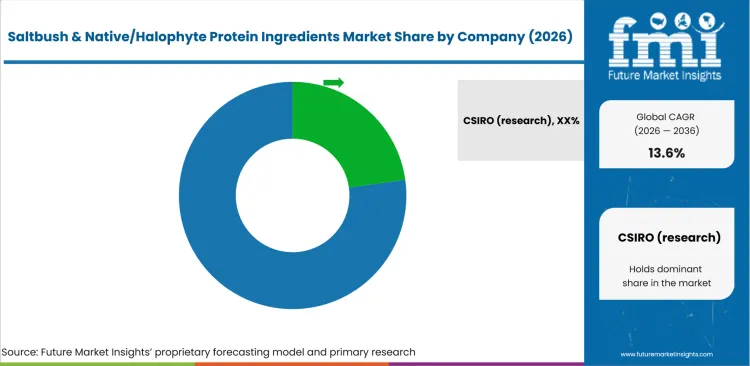
Competition combines saline-crop developers with biomass processors. Protein innovators and application partners complete supplier coverage. Company review is required to examine source ownership and crop-production knowledge. Processing control with ingredient specifications affects customer testing support. Small specialists are expected to secure early projects driven by direct halophyte expertise. Scale requires contracted biomass with repeatable processing and documented quality systems.
- Seawater Solutions receives attention for halophyte-derived protein development and saline-crop biorefinery capability. Commercial evaluation focuses on protein enrichment and bioavailability, while mineral composition and digestibility influence production scale.
- Salt Crops THNK LLP supports Indian market development through Salicornia cultivation and green-salt products. Customer qualification examines harvest consistency alongside food-grade handling, while traceability and conversion routes strengthen nutraceutical and functional product applications.
- Seashore Cultivation & Habitat LLP participates through Salicornia brachiata processing and botanical salt development. Commercial positioning reflects cultivation integration together with support for food manufacturers.
Competitive Benchmarking: Saltbush & Native/Halophyte Protein Ingredients Market
| Company | Portfolio Depth | Ingredient Match | Supply Support | Primary Reach |
|---|---|---|---|---|
| Seawater Solutions | High | High | Medium | United Kingdom and project markets |
| Salt Crops THNK LLP | Medium | High | Medium | India |
| Seashore Cultivation & Habitat LLP | Medium | Medium | Medium | India |
Source: Future Market Insights competitive analysis, 2026.
Key Developments in the Saltbush & Native/Halophyte Protein Ingredients Market
- In January 2026, University of Stirling began first functional validation of a halophyte protein concentrate developed by Seawater Solutions for salmon feeds. Project work covers biochemical characterization and amino-acid and mineral profiles. Antinutritional screening with digestibility and acceptability creates direct evidence for aquafeed qualification.
- In February 2026, RMIT University researchers reported that Old Man Saltbush protein quality nearly matched ideal amino-acid requirements for human nutrition. The study supported saltbush powder as a functional food ingredient and advanced evaluation across noodles and plant-based protein formulations.
- In July 2026, India Science, Technology & Innovation recorded commercialisation of a high-biomass Salicornia cultivation technology with Salt Crops THNK LLP as lead developer. Commercial status strengthens an Indian route from field cultivation into nutraceutical and ingredient applications requiring dependable biomass.
Key Companies in the Saltbush & Native/Halophyte Protein Ingredients Market
Halophyte Protein and Biorefinery Developers
- Seawater Solutions
Salicornia Cultivation and Ingredient Developers
- Salt Crops THNK LLP
- Seashore Cultivation & Habitat LLP
Saltbush & Native/Halophyte Protein Ingredients Market - Report Scope
| Coverage Field | Report Scope |
|---|---|
| Market Breakdown | Saltbush & Native/Halophyte Protein Ingredients Market breakdown by source, product, application, and region. |
| Quantitative Units | USD million in 2026 to USD million by 2036 at CAGR. |
| Market Definition | Revenue from saltbush, Salicornia, native-halophyte proteins, functional extracts, and directly associated ingredient-processing services. Coverage excludes finished foods lacking a separately traded halophyte ingredient and adjacent saline-agriculture products without a direct protein or functional-ingredient role. |
| Regions Covered | North America, Latin America, Western Europe, Eastern Europe, East Asia, South Asia and Pacific, and Middle East and Africa. |
| Countries Covered | Australia, USA, United Arab Emirates, India, Spain, and more than twenty-five additional countries within covered regions. |
| Key Companies Profiled | Seawater Solutions, Salt Crops THNK LLP, and Seashore Cultivation & Habitat LLP. |
| Forecast Period | 2026 to 2036. |
| Approach | Hybrid bottom-up and top-down sizing supported by company activity, cultivation evidence, regulatory material, application research, and country-level commercial conditions. |
Source: Future Market Insights analysis, 2026.
Saltbush & Native/Halophyte Protein Ingredients Market - Research Methodology
| Method | Approach |
|---|---|
| Primary Research | FMI analysts gathered input from manufacturers, service providers, technology developers, distributors, end users, procurement teams, and subject-matter experts. Interviews examined purchasing decisions, product or service evaluation, adoption barriers, approval requirements, pricing considerations, and expectations for technical or commercial support. Respondents were also asked what evidence is required before a trial, pilot, or initial order develops into regular purchasing. |
| Desk Research | Desk research covered government statistics, regulatory publications, trade data, industry associations, technical literature, standards, company filings, product information, and official corporate announcements. Sources were reviewed for relevance, publication date, geographic coverage, and consistency with the defined market scope. Claims relating to performance, applications, approvals, capacity, investment, and commercial activity were retained only when supported by credible public evidence. |
| Market Sizing and Forecasting | The market model combined the baseline value with historical performance, segment structure, pricing and volume indicators, adoption levels, company participation, and country-level demand conditions. Forecast assumptions considered economic activity, investment trends, regulatory developments, technology adoption, purchasing cycles, supply availability, and barriers to wider market use. Segment and regional estimates were reconciled before the final market total was calculated. |
| Data Validation | Estimates were checked against multiple independent indicators, including public data, company activity, trade patterns, industry developments, and findings from primary interviews. Validation also tested whether products, services, applications, and company revenues fell within the defined market boundaries. Adjacent categories, unsupported claims, overlapping revenues, and activities without direct market relevance were excluded to reduce double counting and maintain consistency across segments and countries. |
Source: Future Market Insights analysis, 2026.
Saltbush & Native/Halophyte Protein Ingredients Market by Segments
Saltbush & Native/Halophyte Protein Ingredients Market Segmented by Source
- Saltbush
- Halophytes
- Native Botanicals
Saltbush & Native/Halophyte Protein Ingredients Market Segmented by Product
- Protein
- Functional Extract
Saltbush & Native/Halophyte Protein Ingredients Market Segmented by Application
- Functional F&B
- Sustainable Protein
Saltbush & Native/Halophyte Protein Ingredients Market Segmented by Region
- North America
- United States
- Canada
- Latin America
- Brazil
- Mexico
- Argentina
- Chile
- Western Europe
- Germany
- France
- United Kingdom
- Italy
- Spain
- Benelux
- Nordics
- Eastern Europe
- Poland
- Czech Republic
- Romania
- Hungary
- East Asia
- China
- Japan
- South Korea
- South Asia and Pacific
- India
- ASEAN
- Australia and New Zealand
- Middle East and Africa
- GCC Countries
- South Africa
- Türkiye
- Israel
Research Sources and Bibliography
- Castanho, G., Bahcevandziev, K., Pereira, L., Filipe, O., & Cotas, J. (2025, December 29). Cultivation and preservation of Salicornia ramosissima J. Woods: Effects on biomass quality for food applications. Resources, 15(1), 8.
- Commonwealth Scientific and Industrial Research Organisation. (2024, June 17). Beyond drought: How we’re combatting our dry continent.
- RMIT University. (2026, February 18). Indigenous plant could have handy health benefits.
- Emirates Nature-WWF. (2024, October 24). Promising climate-resilient ingredient from UAE showcased at Umm Al Quwain Halophytes Harvest Festival.
- European Food Safety Authority. (2024, September 30). Navigating novel foods: What EFSA’s updated guidance means for safety assessments.
- Food and Agriculture Organization of the United Nations. (2024, December 11). FAO launches first major global assessment of salt-affected soils in 50 years.
- India Science, Technology & Innovation. (2026, July 3). Salicornia cultivation for high biomass.
- Office of the Principal Scientific Adviser. (2026, May 8). Preparation of low sodium salt of botanic origin - Saloni - with backward integration of cultivation of Salicornia brachiata.
- Pinto, D., Santos, I., Teixeira, F., Sut, S., Vieira, M., Salazar, M., Delerue-Matos, C., Dall’Acqua, S., & Rodrigues, F. (2025, September 15). Unraveling the nutraceutical potential of Salicornia ramosissima by-product: Impact of gastrointestinal digestion and intestinal permeability on in vitro bioactivity. Food Chemistry, 486, 144665.
- Sánchez-Gavilán, I., Sánchez-Mata, M. de C., Rodríguez, N., & de la Fuente, V. (2025, December 30). Amino acids, ferritin, and mineral oxalates in edible Salicornia patula young shoots: Chemical characterization and nutritional implications. Food Chemistry, 497, 146966.
- Sánchez Gavilán, I., Velázquez Ybarzabal, D., de la Fuente, V., Cámara, R. M., Sánchez-Mata, M. C., & Cámara, M. (2024, January 25). Valorization of Salicornia patula Duval-Jouve young shoots in healthy and sustainable diets. Nutrients, 16(3), 358.
- Sun, Y., Netzel, M. E., Sivakumar, D., & Sultanbawa, Y. (2025, February). Climate-smart halophyte: The role of Atriplex in future food security. Trends in Food Science & Technology, 156, 104869.
- Tokysheva, G., Konysbayeva, D., Myrzabayeva, M., Ospankulova, G., Dairova, K., Battalova, N., & Makangali, K. (2025, September 30). Application of Salicornia perennans powder in sausage production: Effects on fatty acid profile, oxidative stability, color, antioxidant properties, and sensory profile. Applied Sciences, 15(19), 10556.
- Tokysheva, G., Konysbayeva, D., Myrzabayeva, M., Ospankulova, G., Dairova, K., & Makangali, K. (2025, November 4). Effects of Salicornia extract on the quality, shelf-life, and functional properties of beef patties during refrigerated storage. Applied Sciences, 15(21), 11751.
- United States Department of Agriculture, Animal and Plant Health Inspection Service. (2026, April 21). APHIS authorizes the importation of fresh leaves and stems of glasswort for consumption from Israel into the United States.
- University of Stirling. (2026, January 5). First validation of halophyte protein concentrate as a novel ingredient for salmon feeds.
This bibliography is provided for reader reference and is not exhaustive. The full report contains the complete reference list and detailed citations.
This Report Answers
- How large is saltbush & native/halophyte protein ingredients demand in 2026 and 2036?
- What source, product, and application segments shape commercial activity?
- Why does protein lead product selection during the forecast period?
- Why does functional F&B lead application demand in ingredient programs?
- Why does saltbush lead source selection within profiled plant groups?
- How do country CAGRs compare for the key countries of the market?
- What companies participate through cultivation and application support?
- What technical and regulatory issues delay routine ingredient qualification?
- How are forecasts checked through bottom-up and top-down analysis?
- What evidence should executives review prior to wider commercial supply?
Frequently Asked Questions
How big is the Saltbush & Native/Halophyte Protein Ingredients Market in 2026?
The saltbush & native/halophyte protein ingredients market is valued at USD 151.5 million in 2026 and is forecast to reach USD 542.2 million by 2036, reflecting growing demand from food developers converting salt-tolerant crop biomass into protein concentrates and functional extracts for nutrition and wellness applications.
What is the CAGR of the Saltbush & Native/Halophyte Protein Ingredients Market from 2026 to 2036?
The saltbush & native/halophyte protein ingredients market is projected to grow at a CAGR of 13.6% between 2026 and 2036, supported by salt-affected land and freshwater pressure encouraging cultivation trials involving saltbush and related halophytes as ingredient demand advances through dependable biomass specifications.
Which source leads the Saltbush & Native/Halophyte Protein Ingredients Market?
Saltbush accounts for 45.0% of the saltbush & native/halophyte protein ingredients market by source in 2026, driven by established Atriplex cultivation knowledge and recognized species identification that supports dependable source assessment for native-food and protein formulation programs.
Which country segment is growing fastest in the Saltbush & Native/Halophyte Protein Ingredients Market?
India is the fastest-growing country segment in the saltbush & native/halophyte protein ingredients market, expanding at a 12.3% CAGR through 2036, ahead of the market average of 13.6%, driven by commercialized high-biomass Salicornia cultivation technology and coastal saline-agriculture capability supporting nutraceutical and ingredient processing programs.
Who are the leading companies in the Saltbush & Native/Halophyte Protein Ingredients Market?
Leading companies in the saltbush & native/halophyte protein ingredients market include Seawater Solutions, Salt Crops THNK LLP, and Seashore Cultivation & Habitat LLP, competing across halophyte protein and biorefinery development, Salicornia cultivation programs, and botanical salt processing for food and nutraceutical applications.
Preview the report firsthand - request a free sample
Get SampleGet the brochure for pricing and purchase details.
Get PDFTable of Content
- Key Takeaways
- Market Size and CAGR
- Top Growth Driver
- Fastest Growing Segment
- Leading Region
- Key Companies
- Emerging Opportunities
- Executive Summary
- Global Market Outlook
- Demand-side Trends
- Supply-side Trends
- Technology Roadmap Analysis
- Analysis and Recommendations
- Analyst Perspective (What is happening? Why now? What should investors know?)
- Key Questions Answered
- How large is the market?
- What is the CAGR?
- What are key trends?
- Which region dominates?
- Who are the leaders?
- Market Overview
- Market Coverage / Taxonomy
- Market Definition / Scope / Limitations
- Research Methodology
- Chapter Orientation
- Analytical Lens and Working Hypotheses
- Market Structure, Signals, and Trend Drivers
- Benchmarking and Cross-market Comparability
- Market Sizing, Forecasting, and Opportunity Mapping
- Research Design and Evidence Framework
- Desk Research Programme (Secondary Evidence)
- Expert Input and Fieldwork (Primary Evidence)
- Tooling, Models, and Reference Databases
- Data Engineering and Model Build
- Quality Assurance and Audit Trail
- Market Background
- Market Dynamics (Drivers, Restraints, Opportunity, Trends)
- Scenario Forecast (Optimistic, Likely, Conservative)
- Impact Analysis
- AI Impact
- Sustainability Impact
- Regulatory Impact
- Technology Impact
- Consumer / Buyer Analysis
- Purchase Drivers
- Adoption Barriers
- Buyer Journey
- Opportunity Map Analysis
- Product Life Cycle Analysis
- Supply Chain Analysis
- Investment Feasibility Matrix
- Value Chain Analysis
- PESTLE and Porter's Analysis
- Regulatory Landscape
- Regional Parent Market Outlook
- Production and Consumption Statistics
- Import and Export Statistics
- Global Market Analysis and Forecast, 2021 to 2036
- Historical Market Size Value (USD Million) Analysis, 2021 to 2025
- Current and Future Market Size Value (USD Million) Projections, 2026 to 2036
- Y-o-Y Growth Trend Analysis
- Absolute $ Opportunity Analysis
- Global Market Pricing Analysis, 2021 to 2036
- Global Market Analysis and Forecast, By Source, 2021 to 2036
- Introduction / Key Findings
- Historical Market Size Value (USD Million) Analysis By Source, 2021 to 2025
- Current and Future Market Size Value (USD Million) Analysis and Forecast By Source, 2026 to 2036
- Saltbush
- Halophytes
- Native Botanicals
- Saltbush
- Y-o-Y Growth Trend Analysis By Source, 2021 to 2025
- Absolute $ Opportunity Analysis By Source, 2026 to 2036
- Global Market Analysis and Forecast, By Product, 2021 to 2036
- Introduction / Key Findings
- Historical Market Size Value (USD Million) Analysis By Product, 2021 to 2025
- Current and Future Market Size Value (USD Million) Analysis and Forecast By Product, 2026 to 2036
- Protein
- Functional Extract
- Protein
- Y-o-Y Growth Trend Analysis By Product, 2021 to 2025
- Absolute $ Opportunity Analysis By Product, 2026 to 2036
- Global Market Analysis and Forecast, By Application, 2021 to 2036
- Introduction / Key Findings
- Historical Market Size Value (USD Million) Analysis By Application, 2021 to 2025
- Current and Future Market Size Value (USD Million) Analysis and Forecast By Application, 2026 to 2036
- Functional F&B
- Sustainable Protein
- Functional F&B
- Y-o-Y Growth Trend Analysis By Application, 2021 to 2025
- Absolute $ Opportunity Analysis By Application, 2026 to 2036
- Global Market Analysis and Forecast, By Region, 2021 to 2036
- Introduction
- Historical Market Size Value (USD Million) Analysis By Region, 2021 to 2025
- Current Market Size Value (USD Million) Analysis and Forecast By Region, 2026 to 2036
- North America
- Latin America
- Western Europe
- Eastern Europe
- East Asia
- South Asia and Pacific
- Middle East & Africa
- Market Attractiveness Analysis By Region
- North America Market Analysis and Forecast, By Country, 2021 to 2036
- Historical Market Size Value (USD Million) Trend Analysis By Market Taxonomy, 2021 to 2025
- Market Size Value (USD Million) Forecast By Market Taxonomy, 2026 to 2036
- By Country
- USA
- Canada
- By Source
- By Product
- By Application
- By Country
- Market Attractiveness Analysis
- By Country
- By Source
- By Product
- By Application
- Key Takeaways
- Latin America Market Analysis and Forecast, By Country
- Historical Market Size Value (USD Million) Trend Analysis By Market Taxonomy, 2021 to 2025
- Market Size Value (USD Million) Forecast By Market Taxonomy, 2026 to 2036
- By Country
- Brazil
- Mexico
- Chile
- Rest of Latin America
- By Source
- By Product
- By Application
- By Country
- Market Attractiveness Analysis
- By Country
- By Source
- By Product
- By Application
- Key Takeaways
- Western Europe Market Analysis and Forecast, By Country
- Historical Market Size Value (USD Million) Trend Analysis By Market Taxonomy, 2021 to 2025
- Market Size Value (USD Million) Forecast By Market Taxonomy, 2026 to 2036
- By Country
- Germany
- UK
- Italy
- Spain
- France
- Nordic
- BENELUX
- Rest of Western Europe
- By Source
- By Product
- By Application
- By Country
- Market Attractiveness Analysis
- By Country
- By Source
- By Product
- By Application
- Key Takeaways
- Eastern Europe Market Analysis and Forecast, By Country
- Historical Market Size Value (USD Million) Trend Analysis By Market Taxonomy, 2021 to 2025
- Market Size Value (USD Million) Forecast By Market Taxonomy, 2026 to 2036
- By Country
- Russia
- Poland
- Hungary
- Balkan & Baltic
- Rest of Eastern Europe
- By Source
- By Product
- By Application
- By Country
- Market Attractiveness Analysis
- By Country
- By Source
- By Product
- By Application
- Key Takeaways
- East Asia Market Analysis and Forecast, By Country
- Historical Market Size Value (USD Million) Trend Analysis By Market Taxonomy, 2021 to 2025
- Market Size Value (USD Million) Forecast By Market Taxonomy, 2026 to 2036
- By Country
- China
- Japan
- South Korea
- By Source
- By Product
- By Application
- By Country
- Market Attractiveness Analysis
- By Country
- By Source
- By Product
- By Application
- Key Takeaways
- South Asia and Pacific Market Analysis and Forecast, By Country
- Historical Market Size Value (USD Million) Trend Analysis By Market Taxonomy, 2021 to 2025
- Market Size Value (USD Million) Forecast By Market Taxonomy, 2026 to 2036
- By Country
- India
- ASEAN
- Australia & New Zealand
- Rest of South Asia and Pacific
- By Source
- By Product
- By Application
- By Country
- Market Attractiveness Analysis
- By Country
- By Source
- By Product
- By Application
- Key Takeaways
- Middle East & Africa Market Analysis and Forecast, By Country
- Historical Market Size Value (USD Million) Trend Analysis By Market Taxonomy, 2021 to 2025
- Market Size Value (USD Million) Forecast By Market Taxonomy, 2026 to 2036
- By Country
- Kingdom of Saudi Arabia
- Other GCC Countries
- Türkiye
- South Africa
- Other African Union
- Rest of Middle East & Africa
- By Source
- By Product
- By Application
- By Country
- Market Attractiveness Analysis
- By Country
- By Source
- By Product
- By Application
- Key Takeaways
- Key Countries Market Analysis
- USA
- Pricing Analysis
- Market Share Analysis, 2025
- By Source
- By Product
- By Application
- Canada
- Pricing Analysis
- Market Share Analysis, 2025
- By Source
- By Product
- By Application
- Mexico
- Pricing Analysis
- Market Share Analysis, 2025
- By Source
- By Product
- By Application
- Brazil
- Pricing Analysis
- Market Share Analysis, 2025
- By Source
- By Product
- By Application
- Chile
- Pricing Analysis
- Market Share Analysis, 2025
- By Source
- By Product
- By Application
- Germany
- Pricing Analysis
- Market Share Analysis, 2025
- By Source
- By Product
- By Application
- UK
- Pricing Analysis
- Market Share Analysis, 2025
- By Source
- By Product
- By Application
- Italy
- Pricing Analysis
- Market Share Analysis, 2025
- By Source
- By Product
- By Application
- Spain
- Pricing Analysis
- Market Share Analysis, 2025
- By Source
- By Product
- By Application
- France
- Pricing Analysis
- Market Share Analysis, 2025
- By Source
- By Product
- By Application
- India
- Pricing Analysis
- Market Share Analysis, 2025
- By Source
- By Product
- By Application
- ASEAN
- Pricing Analysis
- Market Share Analysis, 2025
- By Source
- By Product
- By Application
- Australia & New Zealand
- Pricing Analysis
- Market Share Analysis, 2025
- By Source
- By Product
- By Application
- China
- Pricing Analysis
- Market Share Analysis, 2025
- By Source
- By Product
- By Application
- Japan
- Pricing Analysis
- Market Share Analysis, 2025
- By Source
- By Product
- By Application
- South Korea
- Pricing Analysis
- Market Share Analysis, 2025
- By Source
- By Product
- By Application
- Russia
- Pricing Analysis
- Market Share Analysis, 2025
- By Source
- By Product
- By Application
- Poland
- Pricing Analysis
- Market Share Analysis, 2025
- By Source
- By Product
- By Application
- Hungary
- Pricing Analysis
- Market Share Analysis, 2025
- By Source
- By Product
- By Application
- Kingdom of Saudi Arabia
- Pricing Analysis
- Market Share Analysis, 2025
- By Source
- By Product
- By Application
- Türkiye
- Pricing Analysis
- Market Share Analysis, 2025
- By Source
- By Product
- By Application
- South Africa
- Pricing Analysis
- Market Share Analysis, 2025
- By Source
- By Product
- By Application
- USA
- Market Structure Analysis
- Competition Dashboard
- Competition Benchmarking
- Market Share Analysis of Top Players
- By Regional
- By Source
- By Product
- By Application
- Emerging Startups
- Innovation Benchmarking
- Competition Analysis
- Competition Deep Dive
- CSIRO (research)
- Overview
- Product Portfolio
- Profitability by Market Segments
- Sales Footprint
- Strategy Overview
- Marketing Strategy
- Product Strategy
- Channel Strategy
- Australian native ingredient startups
- Wide Open Agriculture
- ADM
- Roquette
- CSIRO (research)
- Case Studies
- Success Stories
- Recent Developments
- Competition Deep Dive
- Assumptions & Acronyms Used


