


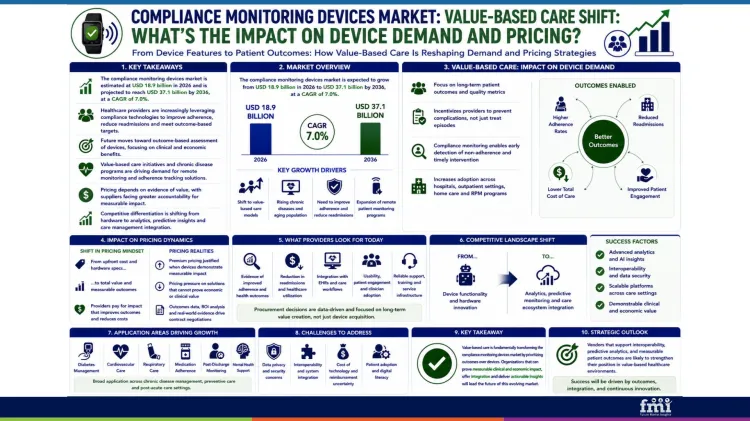
- The compliance monitoring devices market is estimated at USD 18.9 billion in 2026 and is projected to reach USD 37.1 billion by 2036, registering a CAGR of 7.0%. during the forecast period. Increasing shift towards value-based healthcare delivery models globally.
- Healthcare providers are increasingly turning to compliance monitoring technologies to help them improve treatment adherence, reduce readmissions and meet outcome-based performance targets.
- The future is moving towards an assessment of the outcome of the device rather than of the device itself, based on clinical and economic benefit.
- Increasing demand for value based care initiatives as chronic disease management programs require remote monitoring, medication adherence tracking and patient engagement technologies.
- Pricing dynamics are also impacted by the demand for evidence-based justification of technology investments and increased accountability from device suppliers.
- Competitive differentiation is shifting from hardware functionality to analytics, predictive monitoring and integration into broader care management ecosystems.
Introduction
Across the globe, healthcare systems are slowly moving away from the traditional fee-for-service reimbursement model and toward value-based care models that incentivize quality, efficiency and measurable patient outcomes. This is changing the purchasing priorities in the healthcare technology market and creating new demand drivers for compliance monitoring devices.
Health care providers have traditionally focused on diagnosis and treatment of episodes of disease. Value-based care models are holding providers more accountable for long-term patient outcomes, avoidable use of healthcare services and adherence to treatment. The changing responsibilities have increased the strategic value of compliance monitoring technologies.
The market is expected to rise from USD 18.9 billion in 2026 to USD 37.1 billion by 2036 at a CAGR of 7.0%. The market is driven by the demand growth for technologies that drive patient engagement, chronic disease management and measurable clinical outcomes by healthcare organizations. As additional value-based healthcare models are adopted, compliance monitoring devices are being more integrated into care strategies for providers.
Market Context
Patient non-compliance continues to be one of the most challenging problems facing health care systems. Non-adherence to prescribed medication regimens, treatment plans and post-discharge instructions commonly results in preventable complications, disease progression, emergency department visits and hospital readmissions.
The results translated into increased health care utilization under fee-for-service reimbursement models, but did not necessarily translate into direct financial implications for providers. Value-based care models have fundamentally changed this interrelationship.
Quality measures, patient outcomes, performance in the management of chronic disease, and efficiency of health care utilization are increasingly being used to evaluate healthcare organizations. This incentivizes providers to identify noncompliance risks and intervene before costly adverse events occur.
Compliance monitoring devices give us a view into the patient’s world outside of the traditional care environment. These technologies enable continuous monitoring of adherence and early intervention, allowing providers to improve outcomes and cut down on avoidable healthcare costs.
As value-based care is increasingly adopted globally, the need for compliance monitoring solutions is increasingly aligned with the financial and clinical performance objectives of healthcare organizations.
Value-Based Care Is Expanding Device Demand
The shift to value-based care is generating fresh demand for compliance monitoring technologies.
Healthcare providers are increasingly conscious that the success of treatment is not merely about clinical intervention, but also about patient compliance after diagnosis or discharge. Monitoring tools can help bridge this gap, providing continuous oversight and proactive engagement.
Chronic disease management is one of the key growth drivers. For conditions such as diabetes, cardiovascular disease, hypertension and respiratory disorders, sustained patient compliance is essential for optimal outcomes. Compliance monitoring devices allow health care providers to identify adherence problems early and to intervene before complications develop.
Value-based care initiatives promote preventive intervention as well. The trend is to pay providers to keep patients well and avoid costly complications rather than for acute clinical events. Compliance monitoring supports this goal by providing actionable data to enable earlier clinical engagement.
Consequently, compliance monitoring technologies are witnessing increased adoption across hospitals, outpatient facilities, home healthcare programs, and remote patient monitoring initiatives.
Impact on Pricing Dynamics
outcome-based healthcare models is changing the way compliance monitoring devices are priced and evaluated.
In the past, purchasing decisions were based on the initial cost and the hardware specifications. Healthcare organizations are increasingly framing technologies in terms of total value created, not just purchase price.
Procurement teams want evidence that compliance monitoring programs can improve adherence rates, reduce readmission rates, cut healthcare utilization and aid with reimbursement performance. If a device directly contributes to this, then the extra initial cost may be worth it and justify a premium price.
Simultaneously, value-based healthcare is exerting pricing pressure on technologies that cannot show measurable economic value. Healthcare organizations are under increasing financial pressure and have more responsibility for technology investments.
So manufacturers are under pressure to show strong evidence of clinical effectiveness and return on investment. The trend is changing the competition from comparing products to outcome-based value propositions.
As healthcare moves to a more performance-based model, pricing will be more closely aligned with demonstrated contributions to patient outcomes and cost efficiency.
Segment Insights
Compliance monitoring devices are increasingly employed in chronic disease management programs where patient compliance directly impacts clinical outcomes and costs of healthcare.
Healthcare providers are exploring technologies that facilitate long-term patient engagement, medication adherence and compliance with treatment plans. These applications are well-aligned with outcome-based healthcare models care objectives of preventing complications and reducing avoidable healthcare utilization.
The wider acceptance of remote monitoring programs means the need for compliance monitoring technologies is increasing. Real-time monitoring enables care outside traditional healthcare settings and allows providers to monitor patient behaviour and treatment adherence.
As health care systems seek ways to manage chronic disease at scale, compliance monitoring technologies are becoming ever more important in population health strategies.
End-User Insights
Hospitals continue to be among the largest users of compliance monitoring devices, as they are subject to value-based reimbursement models and readmission penalties.
Healthcare organizations are increasingly using monitoring technologies post-discharge to improve patient adherence and decrease the risk of preventable complications. These programs provide outcomes that achieve clinical and fiscal goals while reducing expensive health care utilization.
Outpatient providers are jumping on board too; as chronic disease management is a key focus of value-based healthcare initiatives. Treatment efficacy can be improved and resource utilization optimized through continuous patient engagement and adherence monitoring.
Home health care providers are another big area of growth. Compliance monitoring technologies enable providers to monitor patient adherence remotely, reducing the need for facility-based interventions without compromising clinical oversight.
These trends indicate that more end users are investing in compliance monitoring solutions as value-based care expands.
Procurement and Buyer Behaviour
The advent of value-based health care systems is driving remarkable changes in procurement strategies.
More healthcare organizations are involving clinical leaders, population health managers, financial stakeholders and digital health specialists in technology purchasing decisions. This multidisciplinary approach points to the strategic role played by compliance monitoring technologies in the support of organizational performance.
Buyers are focusing more on measurable outcomes, workflow integration, patient engagement capabilities and long-term economic value. Procurement is increasingly targeting technologies with clear links between monitoring activities and improved outcomes.
The analysis of returns on investments is now of particular significance. Healthcare providers are looking for technologies that can translate to measurable reductions in readmissions, treatment failures and healthcare utilization costs.
As value-based care grows, we'll see a greater emphasis on outcomes in procurement criteria.
Competitive Implications
The rules of competition in the market are being changed by value-based care.
Vendors who are touting their solutions as an improvement on monitoring rather than just monitoring are gaining a competitive advantage. Healthcare providers are looking for technologies that will directly support quality improvement initiatives and also reimbursement performance goals.
Other key differentiators that are emerging include software analytics, predictive adherence monitoring, patient engagement platforms and integration capabilities. Providers are increasingly looking for solutions that deliver actionable insights, rather than just collect compliance data.
Strategic partnerships are also becoming more important. Collaborations among healthcare systems, digital health companies, analytics vendors and care management organizations are expanding solution capabilities and market position.
The ability to demonstrate measurable value across the continuum of care is increasingly the basis for competitive success.
Strategic Implications
As the industry shifts to value-based care, compliance monitoring devices are becoming more than just supportive technologies; they are becoming strategic infrastructure assets.
Providers are being challenged to improve patient outcomes while controlling costs. Compliance monitoring technologies address these challenges head on, with the benefits of improving compliance, reducing complications and enabling proactive care management.
Manufacturers who align their product development with value-based healthcare goals will be in a better position to capture future growth opportunities. Analytics, predictive monitoring and interoperability and patient engagement capabilities are likely to be investments that will become more important.
The extent to which compliance monitoring technologies can deliver measurable outcomes improvements and healthcare efficiency gains will depend substantially on the long-term market outlook.
Bottom Line
Value-based care is changing the way compliance monitoring devices are used to deliver health care. Demand for compliance monitoring technology is picking up pace as providers are being held more accountable for patient outcomes, adherence management and efficiency of healthcare utilization. The deployment of outcome-based healthcare models is continuing and manufacturers that can show tangible clinical and economic value and contribute to broader care management goals will be best positioned to win.

