


- The dyslexia treatments market is projected to grow at a CAGR of 6.3% during the forecast period. The market size is valued at USD 5.2 billion in 2026 and is projected to reach USD 9.6 billion by 2036.
- Greater recognition of learning disabilities, advances in neuroscience research, and higher spending on cognitive health programs are supporting demand for dyslexia treatment solutions.
- Approval timelines play a major role in shaping product development plans, investment priorities, and commercialization efforts within neurodevelopmental disorders.
- The US is still a very attractive market for new therapies due to its large patient population, well-trodden regulatory pathways and strong reimbursement ecosystem.
- Europe remains an important market for developers wishing to enter a number of healthcare markets, although approval processes may need further coordination across countries.
- Regulatory agencies across Asia Pacific have introduced updates to review frameworks aimed at improving access to new healthcare technologies.
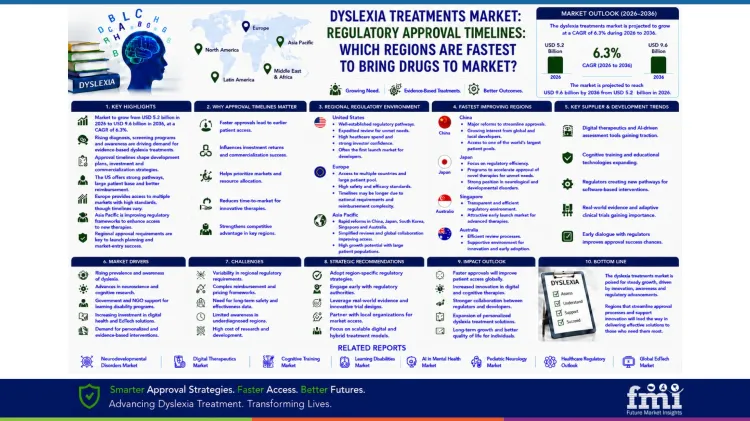
The dyslexia treatments market is growing progressively as healthcare providers, educators, and policymakers are realizing the long-term effects of learning disabilities on academic success, workforce participation, and quality of life. The market is anticipated to grow from USD 5.2 billion in 2026 to USD 9.6 billion by 2036, at a CAGR of 6.3% during the forecast period (2026-2036) owing to rising diagnosis rates, improved screening programs, and rising demand for evidence-based interventions.
As neurodevelopmental disorders have become an increasingly active area for development, regulatory approval timelines have become a more important competitive consideration. The ability to bring a new therapy, digital solution or cognitive intervention to market quickly can have a significant effect on investment returns, patient access and long-term commercial success. So developers are looking more closely at where the most efficient paths from research and development to commercialization are.
The US is still one of the most powerful markets in the international healthcare industry. Many companies focus on regulatory submissions in the USA, which has a high healthcare spend, advanced clinical research infrastructure and high investor appetite for new therapies. The market is particularly appealing for emerging technologies and novel therapeutic approaches, due to a variety of programs implemented by regulatory agencies to expedite the review processes of treatments addressing unmet medical needs.
The combination of regulatory predictability and commercial opportunity in the United States often makes it a launch market for developers of drugs targeting neurodevelopmental disorders. Approval in the USA often bestows credibility with investors, healthcare providers and international partners, and can help build momentum for additional global expansion.
In Europe the value proposition is different. The region has access to a large patient population across multiple countries, and maintains high standards of safety and efficacy. Even with greater convergence of regulatory frameworks developers encounter a complex healthcare environment of national reimbursement systems, local market access requirement and country specific healthcare policies.
Many companies see Europe as a critical component of their commercialization strategy, even if approval timelines in Europe can sometimes be longer than in the United States. The ability to access multiple healthcare markets through a harmonized regulatory process remains a major advantage for organizations seeking to expand internationally.
Asia Pacific is fast emerging as one of the most exciting frontiers for advancements in healthcare. Governments in China, Japan, South Korea, Singapore and Australia are spending heavily on healthcare modernization and regulatory reform. Initiatives to simplify review processes, improve collaboration with global regulatory agencies and promote new ideas have made these markets more enticing to therapy developers.
China in particular has introduced significant reforms to streamline approvals and promote new healthcare products. Such changes are attracting growing interest from multinational companies and local creators seeking faster access to one of the world's biggest patient pools.
Japan remains recognized for its sophisticated healthcare infrastructure and its focus on regulatory efficiency. It has also initiated measures to accelerate the assessment of novel therapies in particular those that meet critical unmet medical needs. Such programs have bolstered the position of Japan as a key market for companies developing therapies for neurological and developmental disorders.
Smaller healthcare markets are becoming more important. Countries such as Singapore and Australia have built reputations for regulatory transparency and efficient review processes. These markets have smaller patient populations than the major global markets but are often seen as attractive early launch markets for advanced healthcare technologies.
The regulatory strategy for developers of therapies for dyslexia goes beyond conventional pharmaceutical products. As digital therapeutics, AI-driven assessment tools, cognitive training platforms and educational technologies gain traction, new regulatory considerations arise. Many jurisdictions are still working out the frameworks around digital health solutions, bringing opportunities and uncertainties for developers.
Regions that create clear and predictable pathways for digital therapeutics can find themselves with a competitive advantage in attracting investment and speeding product launches. This is especially true for interventions for dyslexia where software-based solutions and technology-enabled learning platforms are becoming more and more prominent.
Efficiency in regulation is more than speed of review. Other considerations for developers include the requirements for clinical trials, the complexity of submissions, the transparency of decision-making processes, post-marketing obligations and opportunities for early engagement with regulatory authorities. A region with somewhat longer review timelines might still be appealing if it offers greater predictability and lower overall development risk.
These regulatory dynamics are becoming more important in investment decisions. Before investing large sums of money into new programs, venture capital firms, biotechnology companies, and developers of healthcare technology frequently look at approval pathways. Places perceived as friendly to new ideas generally attract more research money. This creates positive feedback loops that further boost the local creativity ecosystem.
As competition increases in neurodevelopmental disorders companies are deploying more sophisticated global launch strategies. Rather than focusing on a single market, developers are increasingly sequencing regulatory submissions across a number of jurisdictions to maximize commercial opportunities while at the same time contain development costs and the risk of approval.
The future regulatory environment will be more collaborative and technology driven. Increasing the use of real world evidence, digital health data, artificial intelligence and international regulatory collaboration could help to reduce approval timelines and increase patient access to new therapies. These developments may be especially helpful for emerging approaches to treating dyslexia that do not conform to traditional pharmaceutical models.
Bottom Line
As developers seek faster routes to commercialization and patient access, regulatory approval timelines are emerging as a key differentiator in the dyslexia treatments market. Europe remains a key market but more complicated and the USA remains the preferred launch location with its rich creative ecosystem and well-trodden regulatory paths. Regulatory modernization and healthcare investment are quickly helping the Asia Pacific region cement its position. With the advent of digital therapeutics and technology-enabled interventions, the markets for dyslexia treatments will be best placed to attract creativity and foster growth in areas offering efficiency, transparency, and flexibility in regulations.

