


- Canned tuna is well suited to e-commerce because it is shelf-stable, repeat-purchased, easy to store, and commonly bought in multipacks.
- Online grocery supports pantry replenishment by allowing consumers to compare price per can, pack size, flavor variants, and sourcing claims quickly.
- Canned light tuna leads product demand because it fits value-oriented online replenishment and routine household protein use.
- Chunk tuna supports online demand because it is familiar, versatile, and useful across quick meals, meal prep, salads, pasta, and sandwiches.
- E-commerce increases transparency, making brands more exposed to price comparison, reviews, sustainability claims, and private-label alternatives.
- The biggest misconception is that canned tuna is only an offline supermarket product. Online channels increasingly shape replenishment, bulk buying, and product comparison.
Online grocery business for canned tuna is viable due to the nature of the product which suits the pantry replenishment model. Canned tuna is shelf-stable, space efficient, and repeat purchase item. As opposed to fresh fish, there is no need for quick consumption and refrigeration, while it provides meal function and hence is an ideal product for e-commerce.
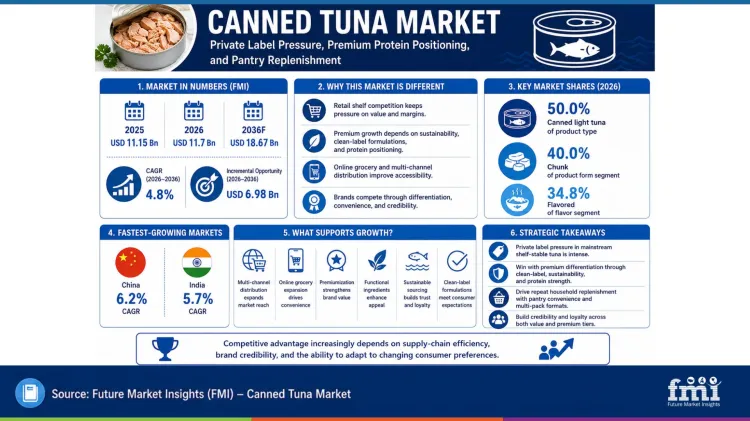
FMI’s Canned Tuna Market preview states that product accessibility is expected to improve through expansion in multi-channel distribution, including online grocery and convenience store formats. FMI also notes that online platforms provide better margins and access to consumer data, while supermarkets and hypermarkets still make up the bulk of volume. This means e-commerce is not replacing retail shelves, but it is changing how consumers compare and replenish tuna.
Canned light tuna is expected to account for 50.0% of product type share in 2026. This is very important in relation to e-commerce due to the versatile nature of light tuna in terms of value multipacks and regular pantry packs. Consumers who purchase tuna online make their comparisons on the unit price, number of cans, net weight, packaging medium, and sodium content.
The Online Grocery Market is relevant because pantry staples behave differently online than impulse products. Consumers may add tuna to recurring baskets, subscribe-and-save orders, family pantry restocks, or bulk purchases. Online grocery also makes it easier to compare private label and branded tuna side by side.
It is estimated that chunk tuna will emerge as the top performing form of product with 40.0% market share by 2026. Chunk tuna possesses great potential in the internet market due to its familiarity and versatility. People understand how to utilize chunk tuna in their meals in the form of sandwiches, salads, wraps, pasta, rice, casserole, etc. The better the use case, the better the reorderability.
The Ready-to-Eat Food Market supports canned tuna’s role as a quick meal component. Online shoppers may buy tuna alongside crackers, pasta, wraps, condiments, salad kits, rice, beans, or meal-prep ingredients. Brands can use online platforms to position tuna within meal bundles, recipe content, and protein pantry solutions.
Even e-commerce benefits flavored tuna. According to FMI, flavored tuna constitutes 34.8% of the flavor segment due to changing consumer preferences and broader retail availability. In e-commerce channels, there is the ability to provide a greater number of flavors than is possible in the physical retail channel. Flavors like lemon pepper, spicy, garlic herb, and Mediterranean, among others, can be experimented online prior to full-scale retail launch.
The Healthy Snacks Market is relevant because single-serve tuna pouches and flavored packs can behave like protein snacks. Online platforms can target fitness consumers, office workers, students, travelers, and meal-prep shoppers with high-protein messaging and convenient formats.
Price transparency in e-commerce also becomes easier. A customer is capable of making comparisons between branded tuna, private label tuna, imported tuna, specialty tuna, tuna in olive oil, tuna in water, and the value packs. This could pose a threat to margins in the core segment. The product might be shelf-stable, but the shelf becomes electronic, and one can filter by price, rating, package size, and claims.
The Seafood Packaging Market is relevant because packaging affects e-commerce performance. Metal cans are durable and familiar, but they add weight. Pouches are lighter and more convenient, but may command a different price point. Multipacks, easy-open lids, retort pouches, and shelf-stable meal kits can all support online buying.
It is much easier to get bad reviews online as opposed to in a brick-and-mortar store. Bad reviews may come because of issues like damaged cans, too much fluid in the can, poor texture or taste, difficult to open, and even uncertain source of manufacture.
Sustainability claims are more common online too. While a store shelf can be limited in terms of space for providing such information, an online product page can detail the fishing process, species, traceability, certification, protein content, and sodium content. It works for brands that have documentation and exposes those without.
The Sustainable Seafood Market supports this point because online consumers can research claims more deeply. A brand that uses sustainability as a premium cue should provide clear proof, not only front-of-pack language.
The CAGR of 6.2% for China and 5.7% for India demonstrate that increasing access is an issue. In high growth countries, e-tail and online grocery platforms can be used to get the product to the cities until distribution is deep enough compared to developed countries.
The fallacy not to embrace is that canned tuna is a supermarket product of bygone eras. While it continues to dominate the supermarket shelf space, the shift to online grocery shopping affects consumer purchase frequency, packaging, and pricing strategy. The successful brands in online grocery would be those that make tuna easy to compare, easy to trust, and easy to reorder.
Bottom line: E-commerce expands canned tuna by turning it into a repeat pantry-replenishment product. The strongest brands will use multipacks, product transparency, convenient formats, and recipe-led positioning to win online grocery and household restock occasions.
FMI Related Links
- Canned Tuna Market: Primary link for market value, online grocery expansion, product type share, form share, and flavored tuna share
- Online Grocery Market: Use when discussing e-commerce, pantry replenishment, and online grocery baskets
- Ready-to-Eat Food Market: Use when discussing tuna as a quick meal component
- Healthy Snacks Market: Use when discussing tuna pouches and protein snacking
- Seafood Packaging Market: Use when discussing cans, pouches, multipacks, and e-commerce packaging

