


- Fish protein isolate is a processing-sensitive ingredient where commercial scale depends on purity, odor control, solubility, color, and batch-to-batch standardization.
- Powder leads form demand because it supports shelf stability, transport efficiency, formulation flexibility, and use across food, beverage, sports nutrition, and nutraceutical systems.
- Food & Beverages leads end-use demand because brands are looking for alternative protein systems that can support clean-label, high-protein, and marine-sourced claims.
- Processing capacity is not only about tonnage. It is about producing food-grade isolate with consistent sensory and functional performance.
- Manufacturers that control raw material quality, extraction, deodorization, drying, and documentation will be better positioned.
- The biggest misconception is that fish protein isolate is simply a higher-protein version of fish meal. In reality, it is a functional ingredient requiring much tighter specifications.
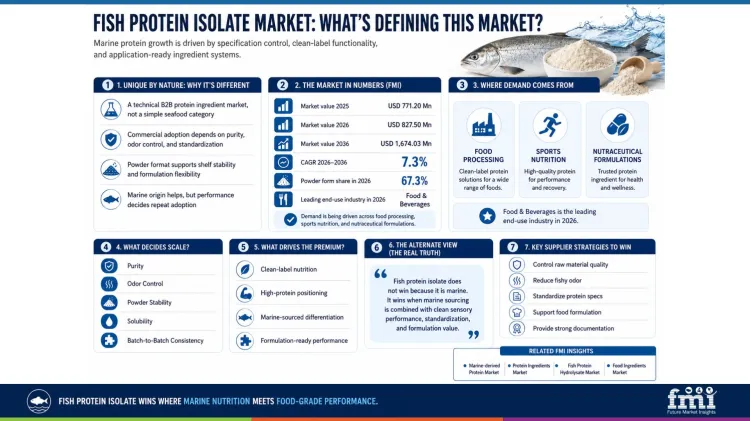
The Fish Protein Isolate Market is a capacity story, but not in the ordinary commodity sense. Commercial advantage does not come only from processing more fish by-products or increasing extraction volume. The real advantage comes from producing standardized, food-grade protein isolate that can meet formulation, nutrition, sensory, and regulatory expectations.
According to FMI, the value of the Fish Protein Isolate Market stood at USD 771.20 Mn in 2025, and it is projected to grow to USD 827.50 Mn in 2026, reaching USD 1,674.03 Mn by 2036 at a CAGR of 7.3%. The growth is attributed to increased demand for protein ingredients from marine sources in food and nutraceutical applications.
Powder is expected to lead form demand with 67.3% share in 2026. This is the clearest signal that processing quality matters. Powdered fish protein isolate must perform reliably in dry blends, protein powders, bars, snacks, beverages, bakery products, soups, sauces, and nutraceutical formulations. Poor powder flow, fishy odor, low solubility, discoloration, or inconsistent protein content can limit commercial adoption.
The Marine-derived Protein Market is relevant because fish protein isolate sits within a broader marine protein shift. Marine-derived proteins are gaining attention as brands look beyond dairy, soy, pea, and collagen. However, marine protein ingredients must overcome sensory and formulation barriers if they are to move into mainstream food and beverage applications.
The first technical requirement is purity. The food and drink producers look for protein isolates that have high levels of protein, limited amount of fat, lower levels of impurities, and guaranteed nutritional profile. In case the isolate has higher amounts of lipids or oxidizable substances, the flavor and shelf-life will be negatively affected.
Deodorization is no less important. Even though a marine protein concentrate might be highly nutritious, if it gives off fishy flavors in beverages, snacks, protein supplements, or nutrition bars, the chances are low for repeated purchases. All the steps mentioned above, including deodorization, enzymes application, filtering, and proper drying affect the sensory characteristics of the product. The winner is not necessarily the manufacturer having the largest plant; it is the one capable of making marine protein palatable in foods.
The Protein Ingredients Market is useful because fish protein isolate competes within the wider protein ingredients landscape. Dairy proteins offer strong functionality, plant proteins offer vegan and sustainability positioning, and collagen offers beauty and joint-health associations. Fish protein isolate must therefore win through a combination of high protein density, digestibility, marine origin, and application performance.
The other very important aspect related to scale is standardization. Food processors cannot have different behaviors for each batch. The food processors need consistent levels of proteins, particle sizes, solubility, moisture content, color, taste, microbial content, and documentation. This becomes even more critical where the fish protein isolate is used in formulated foods, infant nutrition concepts, sports nutrition, clinical nutrition, and nutraceuticals.
The Protein Hydrolysate Market provides a useful adjacent reference because many protein ingredient buyers are familiar with hydrolysates and isolates as technical ingredients. Hydrolysates may offer bioactive peptides and improved digestibility, while isolates may offer higher protein concentration and cleaner formulation positioning. Both require process control, but isolate quality is especially sensitive to sensory performance.
The drying process also plays a very important role. The spray-drying process, the freeze-drying process, and other dehydration processes affect the quality of the powder, the cost, the behavior of the particles, and shelf life. Properly dried powder can help in handling, dosing, and mixing. In contrast, badly dried powder can clump, oxidize, and lose functionality.
The Fish Protein Hydrolysate Market is relevant because it shows how fish-derived protein ingredients are expanding beyond conventional fish meal into value-added nutritional and functional applications. Fish protein isolate benefits from the same broader trend: converting fish processing streams into higher-value ingredients.
In FMI’s market outlook, Food & Beverages dominates in end-use industry demand. This is significant since food is more demanding than feed and industrial uses. For an ingredient to be considered for food, it has to conform to taste, smell, labelling, and quality considerations. There can be some tolerance for marine positioning with sports nutrition products, but not mainstream food applications.
The misconception to avoid is that fish protein isolate is just a by-product valorization story. By-product utilization is important, but it is not enough. A fish processing by-product becomes a high-value isolate only when manufacturers can control purity, sensory quality, safety, and performance.
Bottom line: Fish protein isolate capacity is defined by specification control, not raw material availability alone. Processors that master purity, odor control, powder stability, and batch consistency will be best positioned as marine protein demand expands.
FMI Related Links
- Fish Protein Isolate Market: Primary link for market value, CAGR, powder share, Food & Beverages end-use leadership, and protein ingredient trends
- Marine-derived Protein Market: Use when discussing marine protein positioning, seafood-derived ingredients, and protein diversification
- Protein Ingredients Market: Use when discussing competition with dairy, plant-based, and alternative protein systems
- Protein Hydrolysate Market: Use when discussing protein hydrolysates, enhanced digestibility, and specialized protein ingredient formats
- Fish Protein Hydrolysate Market: Use when discussing value-added fish protein ingredients, bioactive peptides, and marine nutrition applications

