


- Dehydrated onions are gaining in foodservice because they reduce peeling, chopping, storage burden, spoilage, odor management, and prep labor.
- Commercial kitchens use dehydrated onion formats to standardize flavor across soups, sauces, gravies, curries, dressings, fillings, marinades, and ready meals.
- Japan’s growth outlook is strongly linked to ready-to-eat meals and the need for standardized aromatics in labor-constrained foodservice systems.
- Powder, granules, flakes, minced, and chopped formats each serve different commercial kitchen needs, from uniform seasoning to visible onion identity.
- The biggest operational value is consistency: kitchens can reduce variation caused by fresh onion quality, seasonality, and staff preparation skill.
- The biggest misconception is that dehydrated onions are only a low-cost substitute for fresh onions. In foodservice, they are a labor-saving and standardization tool.
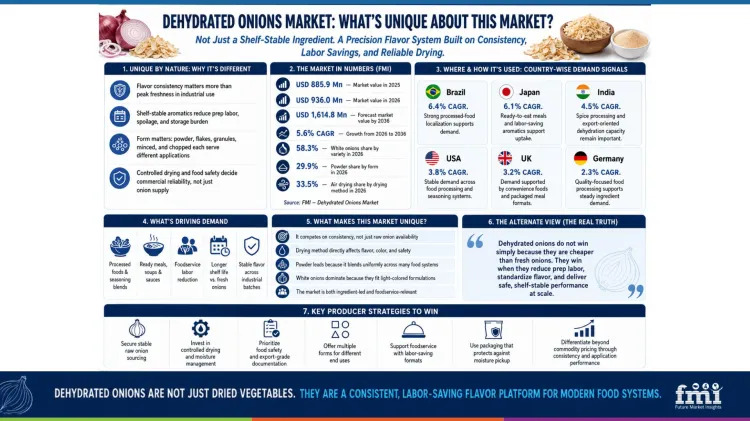
The requirement for dried onions in food services is not only about saving costs. It is about labor and consistency. Whether in restaurants, quick-service restaurants, catering kitchens, commissaries, institutional kitchens, hotels, or ready meal production facilities, there is always the challenge of reducing preparation time without compromising consistency in flavor.
FMI’s Dehydrated Onions Market preview states that fast-casual restaurant expansion is forcing central kitchen operators to adopt dry formats that reduce onsite preparation labor and spoilage. This is highly relevant because onions are one of the most common aromatics in commercial kitchens, but they also create operational friction.
Peeling, chopping, storing, waste management, odor control, and cooking expertise are some of the tasks required to deal with fresh onions. Fresh onions also differ from season to season as well as their size, water content, spiciness, and freshness. For a chain restaurant relying on fresh onions alone, inconsistency of taste might be encountered. Dehydrated onions minimize such problems.
The Foodservice Market is relevant because labor efficiency is a major concern across commercial kitchens. Dehydrated onions help operators reduce back-of-house prep load. This matters especially where labor availability is tight, kitchen footprints are small, or menu complexity is high.
A classic example of this would be Japan. According to the FMI, Japan’s dehydrated onion market will witness a compound annual growth rate of 6.1%, driven by the country’s aging population and demand for pre-cooked meals that require standardized aromatics.
The Ready Meals Market supports this logic because ready meals need stable flavor inputs that survive processing and reheating. Dehydrated onions are useful in sauces, fillings, gravies, curry bases, pasta dishes, soups, rice meals, frozen meals, and meal kits. They help manufacturers reproduce the same flavor profile across batches and production sites.
Form selection is crucial for foodservice operations. Powder form is appropriate for sauces, gravies, spices, batter mixes, marinade, and snack food seasoning. Granules may offer a good hydration level and texture. Chopped and minced onions will be perfect when an identifiable onion presence is required. Onion flakes may be included in soups, stews, toppings, and mixed dishes. Onion rings are suitable to top burgers, salads, rice dishes, and foodservice garnishes.
Powder is recognized as the dominant format in terms of 29.9% market share by FMI in 2026. In foodservice industry, the powder is an advantageous format because it provides the flavor without any preparation work required or any visual impact on texture. But there are cases where visible format is important too.
The white onions will take up a share of 58.3% of variety requirements by 2026. It is useful in commercial kitchens since the onion varieties can be used widely without affecting the visual appeal of the food. White sauces, soups, dips, dressings, snacks, seasoning mixes, etc., may require onion taste without affecting the color.
The Seasonings and Spices Market is relevant because dehydrated onions often sit inside larger seasoning systems. QSRs and restaurants use seasoning blends to standardize flavor across locations. Onion powder and granules are common base notes in burger seasonings, sauce powders, soup mixes, spice rubs, snack coatings, and savory blends.
Central kitchens and commissaries become extremely significant. One single commissary would be able to manufacture sauces, seasonings, fillings, and base mixes for numerous outlets. Dehydrated onions assist commissaries in achieving uniformity and decreasing the need for fresh manufacturing at each individual outlet. This becomes particularly necessary for fast-casual dining chains, institutions, airline catering services, and ready meals.
The Instant Soups Market is another relevant adjacent category because onion powder, flakes, and granules can be used in dry soup mixes and quick-preparation meals. These products require ingredients that hydrate predictably and remain stable during storage.
Recovery also correlates with food service waste management. Onions in their fresh state cause peel waste, trim waste, spoilage of stock, and over-preparation. The dried form prevents such wastage since they are more stable for storage and easy to portion.
The issue here is not the usefulness of dehydrated onions. The issue is the quality of dehydrated onions. Inferior quality dehydrated onions tend to have a strong, flat, old, or burned flavor. Moisture issues can result in the formation of clumps. Lack of control in the area of food safety can result in danger.
The misunderstanding to avoid is assuming that dehydrated onions are merely a cost-saving replacement for fresh onions. This is not always the case. While fresh onions may still be needed for superior taste and freshness in gourmet cooking, there is much to be said for dehydrated onions in certain situations.
Bottom line: Dehydrated onions are gaining in foodservice because they reduce prep labor and improve flavor consistency. The strongest suppliers will help commercial kitchens standardize aromatics without sacrificing food safety, taste, or application performance.
FMI Related Links
- Dehydrated Onions Market: Primary link for form share, variety share, drying method, and market value
- Dehydrated Vegetables Market: Use when discussing onion’s role within dehydrated vegetable demand
- Demand for Dehydrated Onions in EU: Use when discussing EU food processing, B2B demand, and conventional supply
- Food Packaging Market: Use when discussing moisture-barrier packaging and retail formats
- Organic Spices Market: Use when discussing premium and organic spice differentiation

