


- HoReCa matters in malt beverages because cafés, bars, restaurants, hotels, casual dining venues, and social outlets help consumers try premium and moderation-led malt propositions.
- FMI identifies HoReCa as a key channel role for trial, menu integration, and localized activation even though retail remains essential for repeat volume.
- Moderation-led consumption is increasing interest in alcohol-adjacent, low-alcohol, non-alcoholic, and functional malt beverages across social occasions.
- Energy-led and health-oriented malt beverages can benefit from foodservice placement when the occasion is clear: social refreshment, casual dining, premium pairing, or adult alcohol-free alternatives.
- Foodservice success depends on channel-specific assortment design, pack format, outlet storage, serving style, and margin discipline.
- The biggest misconception is that malt beverages are only retail-pack products. HoReCa can be a critical trial engine when brands need to build premium credibility and occasion relevance.
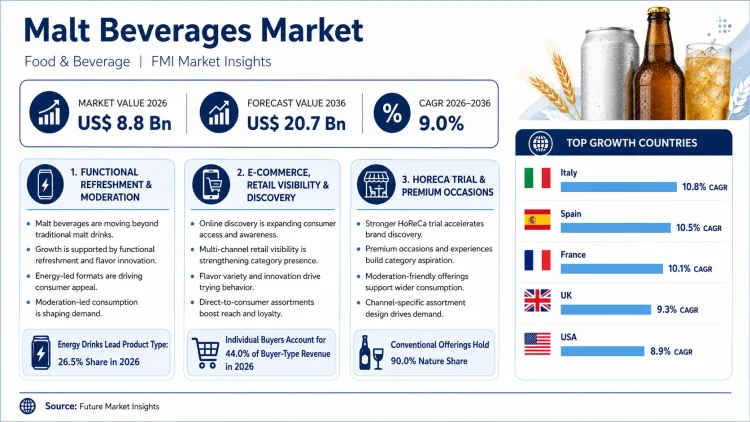
The importance of foodservice recovery in the Malt Beverage Market stems from the fact that malt beverages have become more of an occasion-driven product over time. Although malt beverages are bought through retail channels for consumption on a repetitive basis, people discover better or new products in cafés, bars, hotels, restaurants, casual eateries, events, and social gatherings.
According to FMI, the growth in the market is likely to be aided by increased retail visibility and HoReCa sampling through premium categories. In addition, FMI highlights that moderation-driven consumption is driving more consumer interest towards alternatives related to alcohol beverages. This is an interesting combination since retail drives volume and HoReCa drives social proof.
The Foodservice Market is relevant because beverage trial often happens through menus and social settings. A consumer may not buy a new malt beverage multipack at retail without trying it first. But the same consumer may order it at a bar, café, restaurant, hotel lounge, or casual dining outlet if it is positioned clearly as a refreshing, functional, or alcohol-adjacent option.
The concept of HoReCa is very significant in the context of moderation-based consumption. The consumers, who are in the process of cutting down on their alcohol consumption, need beverages which are not just social but are also mature and taste nice. Such a role can be performed by malt drinks in the absence of regular soft drinks.
The Non-Alcoholic Malt Beverages Market is directly relevant because malt-based alcohol-free and low-alcohol propositions can fit social drinking occasions. These products can appear on menus as adult alternatives for diners who do not want beer, cocktails, or standard soft drinks.
Energy drinks take the lead for demand of malt beverage product type in 2026 with a share of 26.5%. However, this does not mean that all foodservice malt beverages should necessarily be energy-based because it only indicates that function-driven cues are becoming important within the category. Energy-based malt beverages may succeed in cafés, QSRs, gaming venues, events, nightlife-related venues, and convenience foodservice venues.
The Ready-to-Drink Cocktails Market is useful as an adjacent category because it shows how ready-format beverages can build premium value through convenience, packaging, flavor, and social occasions. Malt beverages can learn from the same logic: simplify the serve, make the occasion clear, and protect margin through pack and menu discipline.
HoReCa trials depend upon the pack format as well. Glass bottles can help in making an impressive presentation. Cans can be useful for quick serving at outdoor venues. Fountain or draught packs can serve to increase volume sales. Multipack formats are effective for catering and events. There is need for different pack formats for different foodservice settings.
The Beverage Packaging Market is relevant because packaging helps define the outlet experience. A premium alcohol-adjacent malt drink may need packaging that looks credible on a table or bar counter. A functional malt energy drink may need convenience-led packaging that suits quick-service settings.
Channel assortments are another focus of FMI. Leading companies are leveraging their market positions by controlling their route-to-market activities and by creating separate packs and flavors for different distribution channels. This is important because a brand must not offer the same assortment in all channels if there are issues with cannibalization and pricing.
Italy’s 10.8% CAGR supports the HoReCa and premium occasion story. FMI states that Italy’s growth is supported by premiumization of malt-adjacent offerings and stronger channel segmentation across retail and on-premise. Spain’s 10.5% CAGR is supported by flavored and lifestyle-linked propositions gaining trial in urban markets. France’s 10.1% CAGR is supported by moderation-friendly formats. These country examples show how foodservice and retail can work together.
The Pre-Mixed RTD Alcoholic Drinks Market is relevant because malt beverages may share some occasion logic with RTD alcoholic and alcohol-adjacent products. Convenience, flavor, ready format, and social fit all matter. However, malt beverages can also serve non-alcoholic and functional occasions, making the channel strategy broader.
Successful foodservice marketing demands discipline. Brand marketers need to be careful about listing too many flavors and complicating their menu or making it highly promotional in nature without generating margins. HoReCa needs to be used to establish credibility rather than using the approach of heavy discounting only to generate volume.
The misconception to avoid is that malt beverages are primarily retail products. Retail is essential for scale, but HoReCa can accelerate trial, especially for premium, moderation-led, lifestyle, and alcohol-adjacent propositions.
Bottom line: HoReCa helps malt beverages become more than shelf products. The strongest brands will use foodservice to build trial, premium credibility, and social occasion relevance, then convert that awareness into repeat retail and e-commerce demand.
FMI Related Links
- Malt Beverage Market: Primary link for HoReCa trial, moderation-led consumption, country growth, and channel execution
- Non-Alcoholic Malt Beverages Market: Use when discussing moderation-led consumption, alcohol-free alternatives, and malt-based refreshment
- Ready-to-Drink Cocktails Market: Use when discussing ready-to-drink social beverages, convenience, and premium drinking occasions
- Beverage Packaging Market: Use when discussing cans, bottles, serving formats, packaging innovation, and outlet suitability
- Pre-Mixed RTD Alcoholic Drinks Market: Use when discussing alcohol-adjacent beverages, convenience-driven consumption, and ready-to-drink social formats

