


- Freeze dried fruit capacity is not only about having more fruit. It depends on lyophilization capacity, fruit quality, moisture control, texture retention, and barrier packaging.
- Freeze drying creates a premium technical product because it removes moisture while preserving fruit identity, color, flavor, and crisp texture better than many traditional drying methods.
- Berry-based products lead because they serve both consumer snack packs and ingredient applications such as cereals, bakery toppings, yogurt, and dessert inclusions.
- Fruit pieces lead form demand because visible pieces are easier to use across retail snacking, breakfast, bakery, dairy, and topping applications.
- The biggest operational risk is texture collapse. Freeze dried fruits must be protected from moisture through processing, packaging, storage, and distribution.
- The biggest misconception is that freeze dried fruit scale is just a fruit-sourcing problem. Commercial scale depends on controlled drying, packaging, and format flexibility.
Though they seem easy for consumers, freeze dried fruits require complex processing procedures. In this case, it is necessary to get rid of moisture in a way that the structure, color, taste, and appearance of the fruit will remain intact. It is the reason why freeze dried fruits differ from other dried fruits.
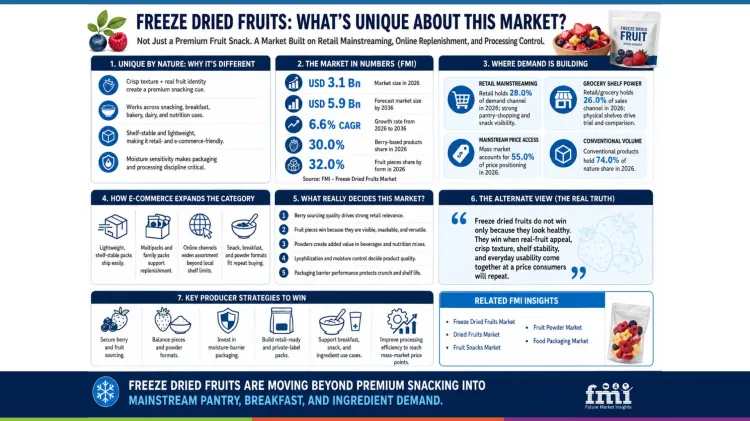
FMI’s Freeze Dried Fruits Market preview shows that the market is estimated at USD 3.1 Bn in 2026 and forecast to reach USD 5.9 Bn by 2036, expanding at 6.6% CAGR. FMI also highlights that fruit pieces remain preferred because they work in snacking and breakfast use, while powders create value in beverages and functional nutrition blends.
The problem of capacity lies in lyophilization. Freezing, vacuum drying, sublimation, secondary drying, and moisture management are part of freeze drying or lyophilization. This method is more time-consuming and costly than other drying processes. Despite this being an effective way to preserve the quality of fruits, it is costly at the same time. Those suppliers who are able to increase productivity and lower costs will be more competitive.
The Dried Fruits Market is useful for comparison because traditional dried fruits and freeze dried fruits have different economics and texture profiles. Traditional dried fruits can be chewy and dense, while freeze dried fruits are lighter and crispier. That crisp texture is part of the value proposition, but it is also more vulnerable to moisture.
The next bottleneck is fruit sourcing. Even freeze drying cannot remedy the problem of poor raw materials. Factors such as color, ripeness, sugar levels, acidity, size, and defects will all influence the end product. Products from berries are projected to have 30.0% market share of fruit type in 2026, making proper fruit sourcing crucial. Berries tend to vary in size, moisture, color strength, and even fragility.
The Frozen Fruits Market is relevant because fruit preparation, freezing, and cold-chain handling are closely connected to freeze drying. Many freeze-drying operations depend on high-quality prepared fruit inputs. If freezing and handling are poor, the final freeze dried pieces may break, darken, or lose visual quality.
The market share for fruit pieces is estimated to be at 32.0% on the basis of the form segment in 2026. This is significant since fruit pieces require maintaining their shape and structure. Although broken pieces can be used in the formulation of powder or inclusion applications, the retail packs have to contain nice pieces of fruit.
The Fruit Powder Market supports the other side of capacity planning. Powders can use fruit that is less suited for whole-piece retail formats, but they still require flavor strength, color consistency, low moisture, and flowability. A supplier with both pieces and powders can improve yield utilization and serve more applications.
Moisture management is the key technological challenge. Free-dried fruits have a very high affinity for water molecules. Should moisture be absorbed by the fruit, it will cease to be crispy and may become sticky or darker in color. The product will not lose its value as fruit; however, the premium quality of its consumption will be compromised. Thus, packaging becomes an element of capacity.
The Food Packaging Market is relevant because barrier performance is essential. Pouches, tubs, sachets, club packs, and ingredient bags must protect against moisture and oxygen. Resealability matters for household use. Bulk packaging matters for B2B ingredients. Poor packaging can erase the value created by careful freeze drying.
Applications also influence capacity needs. Retail snack packs need attractive pieces and strong crunch. Breakfast products need pieces that hold visual appeal in cereals and bowls. Bakery and dairy manufacturers need inclusions that behave predictably during processing. Beverage and nutrition brands may prefer powders for mixing. The Bakery Ingredients Market is useful when discussing inclusion pieces for bakery, dessert, and breakfast applications.
It is forecasted that traditional products will comprise 74.0% of nature share in 2026. This is important because traditional capacity should not be dependent solely on sourcing from either organic or premium fruit suppliers. Systems need to be created that support both traditional volume requirements and organic/premium ranges where necessary.
Mass-market products are expected to account for 55.0% of price positioning in 2026. This puts pressure on processing efficiency. Freeze drying is expensive, so suppliers need yield control, energy efficiency, equipment utilization, and format flexibility to support accessible pricing. A purely premium model may limit category expansion.
The forecasted 7.8% compound annual growth rate for India until 2036 demonstrates the significance of scalable processing. According to FMI, India is recognized as the fastest growing nation because of the adoption of packaged snacks and ingredients used. The fast-growing regions will require a regional or local model of supply which can cope with fruit processing and packaging.
The strongest suppliers will not be those with only one fruit or one format. They will offer fruit pieces, powders, inclusion pieces, snack packs, private-label formats, and B2B ingredient supply. FMI identifies companies such as Paradise Fruits, European Freeze Dry, Mercer Foods, DMH Ingredients, Van Drunen, and Kanegrade as active players across product supply for snacks, ingredients, powders, and pieces.
The misunderstanding to be avoided here is that the freeze dried fruit scale issue is merely a matter of fruit procurement. Fruit procurement is very important; however, the scale issue is an integrated one, encompassing raw material quality, freeze drying capacity, moisture management, packaging, and applications.
Bottom line: Freeze dried fruit capacity is a technical processing advantage. Suppliers that control fruit sourcing, lyophilization, moisture protection, and format flexibility will be better positioned to serve retail, online, and ingredient demand at scale.
FMI Related Links
- Freeze Dried Fruits Market: Primary link for market size, retail share, fruit type share, form share, and price positioning
- Dried Fruits Market: Use when contrasting freeze dried fruits with traditional dried fruit formats
- Fruit Snacks Market: Use when discussing snack aisle competition and retail mainstreaming
- Healthy Snacks Market: Use when discussing better-for-you snacking demand
- Organic Snacks Market: Use when discussing premium organic positioning and claim defense
- Fruit Powder Market: Use when discussing powder formats and ingredient-side demand

