


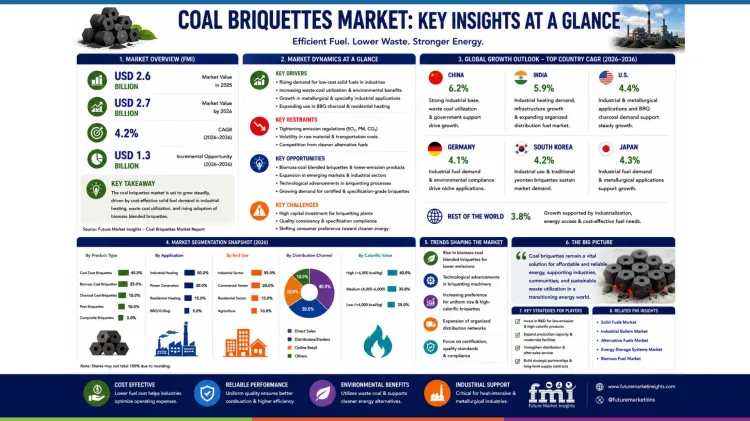
- Industrial heating appears more resilient than power generation in the coal briquettes market because FMI assigns it a 50.0% application share in 2026.
- Manufacturing and processing facilities hold 55.0% of end-use demand, reinforcing the role of briquettes as industrial process fuels.
- Power generation remains relevant where solid fuels are embedded in local energy systems, and coal-fired electricity faces stronger policy, emissions, and replacement pressure in many markets.
- Industrial heating demand is more application-specific and can persist in metals, cement, ceramics, chemicals, and foundry operations where fuel substitution is costly.
- Metallurgical and specialty heating applications may be more defensible than generic steam or electricity production.
- The demand pattern suggests coal briquettes will remain more resilient where they provide process heat, carbon value, or waste-coal utilization rather than bulk electricity generation.
The coal briquette market is not equally exposed to all coal-use trends. A briquette used as process fuel in a foundry has a different demand risk from coal used to generate electricity. A briquette used in cement or ceramics heating has a different substitution pathway from coal consumed in a power plant. This distinction is central to understanding where demand is more resilient.
The FMI segmentation gives a clear signal. Industrial heating is expected to account for 50.0% of coal briquette application demand in 2026. The industrial sector accounts for 55.0% of end-use demand, while the global coal briquettes market is forecast to grow from USD 2.7 billion in 2026 to USD 4.0 billion by 2036 at a 4.2% CAGR.
That structure indicates that coal briquettes are not primarily a power-generation story. They are more strongly tied to industrial heat, metallurgical use, manufacturing, and fuel-cost optimization.
Industrial heating demand is resilient for a practical reason, since many heat users are process-specific. Metals processing, cement, ceramics, chemical manufacturing, foundries, heat treatment, and specialty industrial operations often require high-temperature energy, stable combustion, and established fuel-handling infrastructure. Switching from coal briquettes to gas, electricity, biomass, hydrogen, or waste-derived fuels can require burner changes, furnace modifications, permits, supply contracts, product-quality trials, and new operating procedures.
Power generation faces a different market. Electricity systems can replace coal through gas, renewables, hydro, nuclear, storage, and demand management, depending on the region. The fuel is only one input into a commodity electricity market. When cleaner or cheaper generation is available, coal-fired power can decline even when coal fuel remains physically available.
This is already visible in advanced economies. The IEA Global Energy Review 2025 states that EU coal demand continued its decline in 2024 as countries closed coal power plants, with EU coal power generation down 15% and total coal demand down by over 10%. The European Commission reports that EU coal production and consumption reached their lowest recorded levels in 2024, with consumption falling 13% from 2023.
This does not mean coal briquettes disappear from Europe. FMI still projects the EU coal briquettes market to grow at 4.1% CAGR through 2036, supported by industrial applications, BBQ charcoal, and biomass blending opportunities. The key is that the remaining demand is more selective. Generic coal power is under pressure, while certain industrial, retail, blended, and certified solid-fuel products remain commercially active.
Industrial heating resilience comes from embedded infrastructure. A facility already designed for solid fuel has storage areas, feeding systems, furnaces, ash-handling arrangements, and supplier relationships. If briquettes are cost-competitive and meet emissions limits, the plant may keep buying them. FMI explicitly states that industrial heating applications in metallurgy, chemicals, and cement underpin baseline demand because coal briquettes remain a low-cost solid fuel in some regions.
The strongest industrial use cases tend to share four traits.
High heat demand is the first. Processes such as metal heating, ceramics firing, cement production, and certain chemical operations consume large amounts of thermal energy.
Existing solid-fuel infrastructure is the second. Plants already equipped for coal or coke-based fuel face lower switching urgency if briquettes fit the system.
Cost sensitivity is the third. Fuel cost can be a major operating expense, particularly in commodity manufacturing.
Limited immediate alternatives is the fourth. In regions with weak gas infrastructure, unreliable electricity, or high energy prices, briquettes can remain commercially viable.
Power generation can still use briquettes in smaller, local, or specialty systems, particularly in places where fuel preparation and uniformity matter. Briquettes can provide easier handling than loose fines and may be used where power plants or small-scale systems are designed around solid fuels. The problem is that power generation is more exposed to decarbonization policy, air-quality regulation, and fuel-switching economics.
The IEA Coal 2025 summary notes that coal demand for power generation in 2024 was estimated at 5,946 Mt, with reductions in advanced economies offset by gains in emerging markets. This shows that global coal power is not declining uniformly. It is shifting geographically and structurally. For briquettes specifically, power generation is less prominent in the FMI visible application structure than industrial heating.
The USA offers a useful contrast. FMI identifies the USA as the fastest-growing listed coal briquettes market at 4.4% CAGR, supported by industrial heating, metallurgical applications, and consumer BBQ charcoal briquette consumption. That is not a broad power-generation growth story. It is a diversified demand profile where industrial and consumer applications sustain briquette use even as coal-fired electricity remains under pressure in the wider USA energy system.
Japan shows another pattern. FMI projects 4.3% CAGR, with industrial fuel demand and specialized metallurgical applications sustaining coal briquette consumption. Japan's import-dependent fuel system and high industrial quality standards create demand for specification-controlled briquettes, particularly where metallurgical or process needs are distinct.
South Korea's market includes industrial applications and traditional ondol heating briquettes. FMI notes that yeontan briquettes maintain cultural significance in some residential heating settings while industrial fuel applications support commercial briquette procurement. This mix again points toward end-use specificity rather than broad baseload power growth.
Industrial heating also has a product-upgrade pathway. Briquette suppliers can improve quality through binder systems, moisture control, ash reduction, sulfur control, higher mechanical strength, and uniform shapes. They can also develop biomass-coal blends to reduce net emissions while maintaining handling and combustion benefits. FMI identifies biomass-coal co-firing and lower-emission briquette production as opportunities under tightening environmental regimes.
Power generation has fewer of these briquette-specific levers. A power plant's fuel choice is typically driven by fuel price, plant efficiency, emissions rules, grid dispatch, and system policy. Briquettes may improve handling of fines or support small-scale solid-fuel systems, but they rarely change the broader competitiveness of coal-fired generation against renewables, gas, nuclear, or storage.
A subtle point matters here. Industrial heating demand can be smaller in absolute energy terms than global coal power demand, and more resilient for briquette suppliers because it is closer to the product specific value proposition. A briquette is a shaped, manageable solid fuel. Industrial users value consistency, handling, combustion behavior, and process compatibility. Power generators usually value bulk fuel economics and emissions compliance at scale. That makes briquettes less central to the power-generation decision.
The risk for industrial heating is emissions regulation. FMI states that tightening rules on sulfur dioxide, particulate matter, and carbon dioxide restrict coal combustion and threaten adoption in markets shifting to cleaner fuels. This can directly affect factories, kilns, foundries, and heating applications. Industrial resilience does not mean immunity. It means slower substitution where process constraints and fuel economics remain strong.
The more protected pockets are likely to be specialized industrial and metallurgical applications. FMI identifies metallurgical-grade briquettes for blast furnaces, foundries, and specialty metals processing as a premium market with chemical and physical specifications that create barriers. When a briquette serves as both fuel and carbon input, the substitution decision becomes more complex than replacing a boiler fuel.
The least protected briquette demand is likely to sit in generic thermal use where cleaner fuels are available, affordable, and supported by policy. If an industrial boiler can switch to gas, biomass, electrified heat, or other fuels without major quality risk, coal briquettes become more vulnerable. If a power plant can retire or run less frequently because renewables and storage increase, briquette demand linked to power generation weakens.
Suppliers should therefore separate their customer base into three groups.
Core industrial heat users form the first group, with established solid-fuel systems. These customers value cost, fuel consistency, and supply reliability.
Specialty metallurgical users form the second group, requiring chemical composition, strength, and carbon properties. These customers may support premium pricing.
Transition-exposed power and general heating users form the third group, where policy and alternative fuels can reduce briquette demand over time.
Industrial heating appears more resilient because it is closer to the physical and economic advantages of briquettes, namely uniform solid fuel, waste-coal use, stable handling, and lower-cost process heat. Power generation remains relevant in selected systems, and it is more exposed to energy-transition pressure and large-scale fuel substitution.
The most durable briquette demand is likely to sit where process economics, fuel-handling infrastructure, and product specification matter more than generic coal combustion. For this reason, industrial heating looks stronger than power generation as the core resilient application for coal briquettes.

