

- Market Size (2026)
- USD 1.9 Bn
- Forecast (2036)
- USD 3.5 Bn
- CAGR (2026 to 2036)
- 6.4%
How big is Helmet Shell Plastics Market in 2026?
USD 1.9 billion in 2026 and USD 3.5 billion by 2036 at a 6.4% CAGR.
Demand for helmet shell plastics is projected to expand at 6.4% CAGR between 2026 and 2036, increasing valuation from USD 1.9 billion in 2026 to USD 3.5 billion by 2036. UNECE reported in February 2025 that quality helmets reduce death risk more than sixfold and brain injury risk by up to 74%. This protection requirement sustains material demand across certified motorcycle helmets and other regulated head-protection programs.
Helmet manufacturers compare resin grades through finished-shell weight and impact validation across every intended geometry. Production materials require stable molding windows and documented aging performance prior to a certified design entering commercial production. Resin platforms earn repeat orders through verified process data and regional technical support across additional shell sizes.
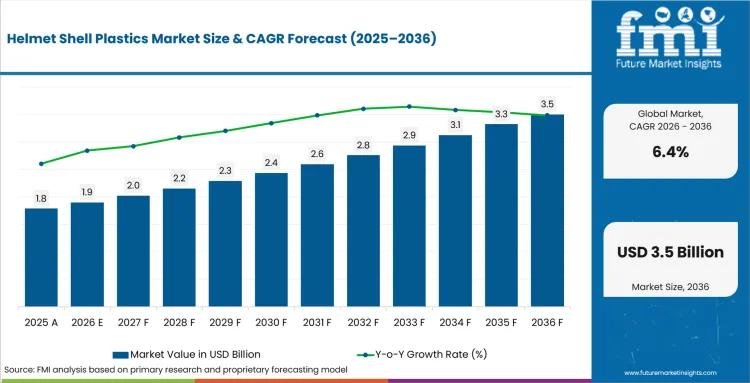
Key Takeaways of Helmet Shell Plastics Market
- Helmet standards tie material approval to finished-shell impact behavior across road and regulated occupational helmet programs.
- Polycarbonate is projected to represent 34.0% by polymer in 2026 due to stable processing and impact performance.
- Motorcycle helmets are estimated to account for 29.0% share in 2026 owing to replacement and certification requirements.
- Injection molding is expected to capture 62.0% share in 2026 due to repeatable geometry across shell sizes.
- Tooling revisions and renewed certification can delay substitutions that change shrinkage or finished-shell impact behavior across established designs.
- SABIC, Covestro and LG Chem supply polycarbonate grades for certified shells as RTP Company and Avient support specialized protective applications.
Analyst Perspective
“Commercial material approval begins with finished-shell results rather than a resin datasheet alone during qualification. A new grade earns volume approval through repeatable impact results across every tool and certified size.”
- Nikhil Kaitwade, Principal Consultant, Future Market Insights
How is the Helmet Shell Plastics Market segmented?
The helmet shell plastics industry is segmented by polymer type, helmet type, manufacturing process, performance requirement, sales channel and region.
The helmet shell plastics market is segmented by polymer type, helmet type, manufacturing process, performance requirement, sales channel and region. Polymer type covers polycarbonate, ABS, PC/ABS blends, nylon/PA, HDPE and fiber-reinforced thermoplastics, and helmet type includes motorcycle, sports, industrial safety, military/tactical and cycling helmets. Manufacturing process includes injection molding, thermoforming, compression molding and hybrid overmolding, and performance requirement covers impact resistance, lightweighting, heat/UV resistance, flame retardance and electrical insulation, and sales channel includes resin supply to molders, compounder supply, direct OEM programs and distributors.
How does polycarbonate influence selection within the polymer type category?
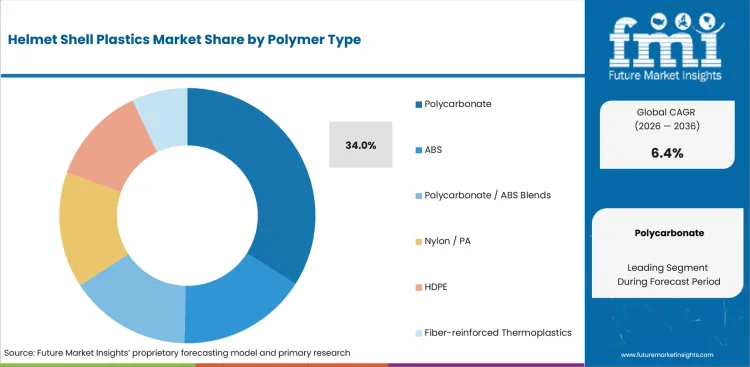
High-impact polycarbonate resins combine flow behavior with support for vents and attachment features across complex shell geometries. Helmet design engineers compare these plastic materials through molding stability and surface aging across demanding outdoor or occupational service conditions.
- Based on polymer type, polycarbonate is projected to account for 34.0% in 2026 due to established molding control across certified shell designs.
- Helmet manufacturers use polycarbonate across multi-size platforms through UV absorbers and validated process windows that limit color change or brittle failure during extended production runs.
What drives motorcycle helmets within the helmet type category?
Certified motorcycle helmets span full-face, open-face and modular designs that require separate impact validation across shell sizes and attachment layouts. Their replacement cycle remains more frequent than many sports protective equipment categories across established road channels.
- Motorcycle helmets are projected to hold 29.0% share in 2026 owing to broad road use and established certification pathways across major sales regions.
- Replacement-focused brands refresh motorcycle models across several approved shell sizes and therefore require dependable resin availability through repeated annual production schedules and coordinated regional launches worldwide.
How does injection molding shape the manufacturing process category?
Injection molding equipment forms repeatable wall thickness with integrated vents and attachment features across high-volume shell programs. Thermoforming machines suit simpler geometries and smaller runs without extending complex multi-cavity tooling commitments across many size variants.
- By manufacturing process, injection molding is forecast to represent 62.0% in 2026 driven by scalable cycle control across qualified production platforms.
- High-volume helmet plants favor injection molding for dimensional repeatability and documented process settings across every approved shell size during long regional production runs and scheduled model renewals across factories.
What makes impact resistance central to the performance requirement category?
Impact resistance determines whether a shell spreads collision energy without cracking around vents or critical retention points. Helmet engineers compare fire-retardant plastics with reinforced grades that can alter melt flow and finished-shell brittleness.
- In 2026, impact resistance is expected to lead the performance requirement category with 39.0% share because every helmet category requires finished-shell collision testing.
- OGK Kabuto announced the F-17R Mips on October 31, 2025, with a carbon shell that combines hyper glass fiber and high-strength organic fiber for lightweight rigidity, with limited-quantity sales beginning December 2025 across specialized racing helmet applications.
What are the drivers, restraints and opportunities in the Helmet Shell Plastics Market?
Helmet standards support validated impact materials, tooling changes slow substitutions and joint trials shorten commercial approval across regional helmet programs.
- Driver: Certification testing connects resin selection with measured impact performance across every approved helmet design.
- Restraint: New grades can change shrinkage across qualified tools and trigger repeated finished-shell impact testing.
- Opportunity: Coordinated material and molding trials can reduce approval work across related regional helmet platforms.
Road and workplace helmet rules make finished-shell evidence central to every commercial material approval decision. Manufacturers prefer resin families with repeatable impact behavior across approved geometries and stable production conditions.
Material changes become costly as tooling and certification establish a stable commercial shell specification for repeat production. Different shrinkage or moisture behavior can alter wall thickness around vents and retention attachment points.
Joint trials align compound data with molding settings and finished-shell testing during one qualification program. Scrap-control methods from recycled plastic packaging support cleaner grade segregation throughout production trials and rework.
Which country CAGRs are profiled in the Helmet Shell Plastics Market?
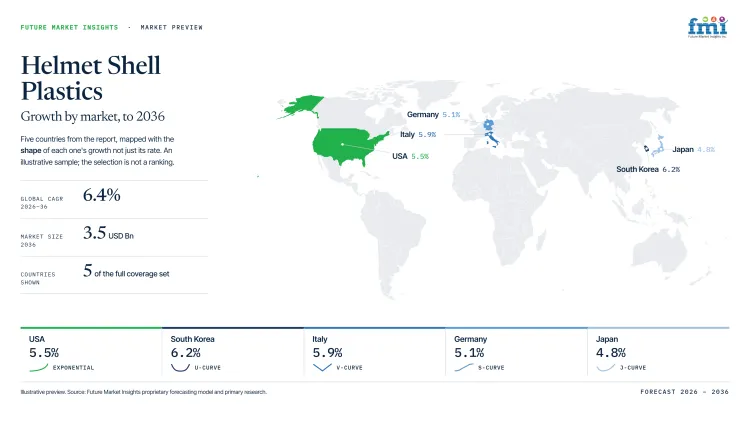
| Country | CAGR |
|---|---|
| United States | 5.5% |
| Germany | 5.1% |
| Japan | 4.8% |
| South Korea | 6.2% |
| Italy | 5.9% |
How do country-level CAGRs compare in the Helmet Shell Plastics Market?
The displayed range spans 1.4 percentage points and forms a compact upper cluster around South Korea and Italy. These forecast rates describe growth pace rather than current market size or established helmet production volume.
- South Korea exceeds Italy as concentrated urban two-wheeler use supports frequent helmet replacement across major cities.
- Italy follows through a mature motorcycle base and domestic helmet manufacturing connected with European distribution routes.
- The United States occupies the middle band through broad replacement channels and established independent testing capacity.
- Germany trails the United States as strict documentation and tooling controls extend approval schedules for unfamiliar materials.
- Japan closes the range through disciplined product marking and conservative qualification across established domestic helmet brands.
Comparable CAGRs can produce different market entry conditions. The full report provides country-level CAGR analysis across North America, Latin America, Europe, East Asia, South Asia and Pacific, and the Middle East and Africa.
Country-wise Analysis
- Access to the USA motorcycle helmet market is governed by FMVSS 218, which requires manufacturers to self-certify every helmet model, while NHTSA reported in May 2025 that 6,335 motorcyclists were killed in 2023, accounting for 15% of all traffic fatalities. Helmet shell plastics sales in the United States are forecast to expand at a 5.5% CAGR through 2036, supported by recurring replacement demand and independent testing capacity. Domestic compounding and import networks support multi-size programs for established brands and repeated certification across product families, although differences in state helmet-use requirements and the presence of non-compliant novelty products complicate consistent material positioning across online channels and regional distributors serving diverse climate conditions.
- Germany's combination of mandatory helmet use and a sizable motorcycle parc provides a stable foundation for helmet demand, with Destatis reporting in March 2026 that 5.1 million motorcycles were officially registered nationwide at the beginning of 2025. Germany's helmet shell plastics market is projected to grow at a 5.1% CAGR during the assessment period, supported by regional polymer distribution networks and established testing expertise. Covestro's domestic technical infrastructure supports material trials for European programs, although stringent documentation requirements and tooling-change controls can prolong approval timelines for new shell grades across multiple sizes and production facilities serving motorcycle and industrial helmet manufacturers through established cross-border distribution channels.
- Replacement-driven purchasing patterns continue to support Japan's helmet market, with JAMA reporting in April 2026 that replacement purchases accounted for 53% of surveyed motorcycle acquisitions in fiscal 2025. Helmet shell plastics demand in Japan is forecast to increase at a 4.8% CAGR over the forecast period, supported by reliable local resin availability and strong engineering capabilities among domestic brands. Mitsubishi Chemical provides manufacturers with access to impact-resistant engineering materials and local technical support, although conservative product-change practices often require separate validation for each shell size, delaying the adoption of unfamiliar compounds across domestic production sites serving road and sports helmet programs through tightly controlled distribution networks and nationwide product launches.
- Growing urban two-wheeler usage continues to generate recurring replacement demand for helmets in South Korea, where the Korea Road Traffic Authority reported in September 2025 that the motorcycle crash fatality rate under fog conditions reached 17.6, eight times the rate recorded on rainy days. The South Korean helmet shell plastics market is expected to register a 6.2% CAGR during the forecast period, supported by intensive road usage and domestic engineering plastics production capacity. LG Chem provides local access to PC/ABS materials and application-development support, although fragmented aftermarket channels and price-sensitive consumers constrain the adoption of higher-cost grades that require documented impact-performance validation across both imported and domestically manufactured helmet programs distributed through urban service networks and regional sales channels.
- Italy's well-established motorcycle culture and domestic helmet manufacturing base continue to underpin material demand, with ACI reporting in January 2026 that used motorcycle ownership transfers reached 644,000 units in 2025, representing a 3.1% year-over-year increase. Demand for helmet shell plastics in Italy is projected to expand at a 5.9% CAGR through 2036, supported by recurring ownership transfers and longstanding manufacturing expertise. Domestic brands have extensive experience in polycarbonate processing for European applications, although seasonal purchasing trends and premium certification requirements can delay volume commitments for smaller shell platforms serving both domestic and export markets through specialized regional distribution networks catering to diverse European safety standards.
Who are the notable companies in the Helmet Shell Plastics Market?
SABIC, Covestro, LG Chem, Mitsubishi Chemical, Lotte Chemical, BASF, RTP Company and Avient are notable helmet shell plastics companies.
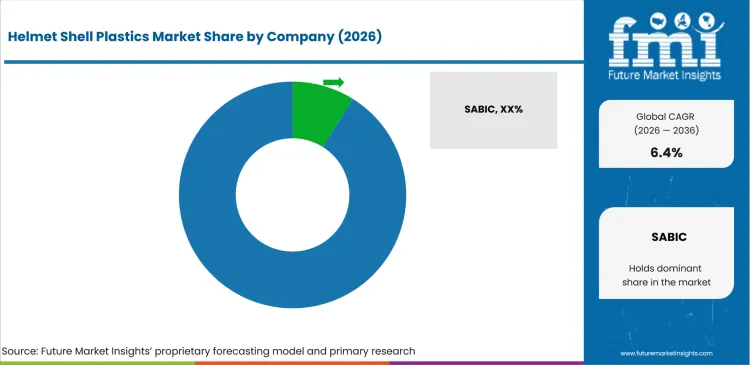
Global resin groups actively compete with specialist compounders across road and occupational helmet programs worldwide. Commercial entry requires verified material performance and application support across approved shell tools and regional production sites.
- SABIC, Covestro and LG Chem provide polycarbonate or PC/ABS platforms for impact-focused shell development programs.
- Engineering plastics from Mitsubishi Chemical, Lotte Chemical and BASF support lightweight or heat-resistant protective components.
- RTP Company provides custom compounds and Avient supplies UHMWPE composite materials for specialized ballistic helmet systems.
Competitive Benchmarking: Helmet Shell Plastics Market
| Company | Helmet Material Evidence | Performance Documentation | Processing Support | Geographic Reach |
|---|---|---|---|---|
| SABIC | High | High | High | Global |
| Covestro | High | High | High | Global |
| LG Chem | Medium | High | Medium | Asia, Europe and Americas |
| Mitsubishi Chemical | Medium | High | Medium | Asia, Europe and Americas |
| Lotte Chemical | Medium | Medium | Medium | Asia and export markets |
| BASF | High | High | High | Global |
| RTP Company | Medium | Medium | High | North America, Europe and Asia |
| Avient | High | High | Medium | Global |
Key Developments in the Helmet Shell Plastics Market
- In August 2025, SHOEI announced the X-Fifteen Carbon with a carbon-fiber shell and scheduled October sales through selected Japanese outlets.
- In June 2025, BMW Motorrad presented the GS Rallye Carbon helmet with a shell made from a carbon and aramid fiber mix.
- In January 2025, Avient unveiled Dyneema HB330 and HB332 hard ballistic materials for helmets and other armor applications with lower system weight.
Helmet Shell Plastics Market - Report Scope
| Coverage field | Report scope |
|---|---|
| Market breakdown | By polymer type, helmet type, manufacturing process, performance requirement, sales channel and region. |
| Quantitative Units | Revenue in USD billion and CAGR in %. |
| Market Definition | The market covers polymer resins and compounds used in outer shells and load-bearing shell components across motorcycle, sports, industrial, military and cycling helmets. |
| Regions Covered | North America, Latin America, Europe, East Asia, South Asia and Pacific, and Middle East and Africa. |
| Countries Covered | United States, Germany, Japan, South Korea, Italy, and 20+ countries included in the full report. |
| Key Companies Profiled | SABIC, Covestro, LG Chem, Mitsubishi Chemical, Lotte Chemical, BASF, RTP Company and Avient. |
| Forecast Period | 2026-2036. |
| Approach | Primary and secondary research with market triangulation. |
Helmet Shell Plastics Market - Research Methodology
| Method | Approach |
|---|---|
| Primary Research | Primary research captures use cases, selection criteria, support needs, and adoption barriers. |
| Desk Research | Desk research reviews official statistics, filings, standards, trade data, and company records. |
| Market Sizing and Forecasting | Market sizing triangulates demand, pricing, supply, adoption, and regional activity. |
| Data Validation | Data validation reconciles segment totals, company activity, regional conditions, and market boundaries. |
Helmet Shell Plastics Market by Segments
Helmet Shell Plastics Market segmented by Polymer Type:
- Polycarbonate
- ABS
- Polycarbonate / ABS Blends
- Nylon / PA
- HDPE
- Fiber-reinforced Thermoplastics
Helmet Shell Plastics Market segmented by Helmet Type:
- Motorcycle Helmets
- Sports Helmets
- Industrial Safety Helmets
- Military / Tactical Helmets
- Cycling Helmets
Helmet Shell Plastics Market segmented by Manufacturing Process:
- Injection Molding
- Thermoforming
- Compression Molding
- Hybrid Overmolding
Helmet Shell Plastics Market segmented by Performance Requirement:
- Impact Resistance
- Lightweighting
- Heat / UV Resistance
- Flame Retardance
- Electrical Insulation
Helmet Shell Plastics Market segmented by Sales Channel:
- Resin Supply to Molders
- Compounder Supply
- Direct OEM Programs
- Distributors
Helmet Shell Plastics Market by Region:
- North America
- United States
- Canada
- Latin America
- Brazil
- Chile
- Mexico
- Rest of Latin America
- Western Europe
- Germany
- United Kingdom
- Italy
- Spain
- France
- Nordics
- Benelux
- Rest of Western Europe
- Eastern Europe
- Russia
- Poland
- Hungary
- Balkan and Baltic States
- Rest of Eastern Europe
- East Asia
- China
- Japan
- South Korea
- South Asia and Pacific
- India
- ASEAN
- Australia and New Zealand
- Rest of South Asia and Pacific
- Middle East and Africa
- Kingdom of Saudi Arabia
- Other GCC Countries
- Türkiye
- South Africa
- Other African Union Countries
- Rest of Middle East and Africa
Research Sources and Bibliography
- United Nations Economic Commission for Europe. (2025, February 18). UNECE and UN Road Safety Envoy call for global use of UN helmet standard to save millions of lives.
- National Highway Traffic Safety Administration. (2025, May 5). Consumer Alert: NHTSA Urges Drivers to Share the Road Amid Rising Motorcyclist Fatality Rate.
- Federal Statistical Office of Germany. (2026, March 23). Bestand an Kraftfahrzeugen und Schienenfahrzeugen für die Jahre 2021 bis 2025.
- Japan Automobile Manufacturers Association. (2026, April 14). 2025年度二輪車市場動向調査について.
- Korea Road Traffic Authority. (2025, September 19). 이륜차 교통사고, 흐리고 안개 낀 날 치사율 높아.
- Automobile Club d’Italia. (2026, January 13). ACI: 2025 positivo per il mercato dell’usato.
- OGK Kabuto Co., Ltd. (2025, October 31). 2025 LIMITED ITEM: F-17R Mips.
- BMW Group. (2025, June 11). BMW Motorrad presents the helmet GS Rallye Carbon with sun visor and the BMW ConnectedRide COM P1 GS.
- SHOEI. (2025, August 25). フルフェイスヘルメットX-Fifteenにカーボンシェルを採用したニューモデル「X-Fifteen Carbon」がラインナップ。2025年10月SHOEI Gallery限定で発売予定。
- Avient Corporation. (2025, January 20). Dyneema® Unveils Groundbreaking Hard Ballistic Product Innovations, Enabling a 45% Weight Reduction in Protective Armor Systems.
This bibliography is provided for reader reference and is not exhaustive. The full report contains the complete reference list and detailed citations
This Report Answers
- How large is the Helmet Shell Plastics Market in 2026 and 2036?
- Which safety requirements sustain demand for certified helmet shell plastics?
- Why does polycarbonate capture the largest polymer type share in 2026?
- How do motorcycle helmets shape recurring resin qualification and replacement demand?
- Why does injection molding remain central to commercial shell production?
- How do country growth rates reflect different approval and replacement conditions?
- Which companies support material selection across certified helmet shell programs?
- What slows material substitution across established tools and approved shell designs?
- How should manufacturers compare polymer grades during commercial volume qualification?
Frequently Asked Questions
How big is the Helmet Shell Plastics Market in 2026?
The helmet shell plastics market is valued at USD 1.9 billion in 2026 and is forecast to reach USD 3.5 billion by 2036. Growth is supported by certified motorcycle and occupational helmet programs that sustain recurring demand for impact-validated resin grades across established molding and qualification pathways.
What is the CAGR of the Helmet Shell Plastics Market from 2026 to 2036?
The helmet shell plastics market grows at a CAGR of 6.4% between 2026 and 2036, supported by certification-driven replacement demand and finished-shell impact testing that keep resin qualification active across motorcycle, sports, and industrial helmet production programs worldwide.
Which polymer type leads the Helmet Shell Plastics Market?
Polycarbonate accounts for 34.0% of the helmet shell plastics market by polymer type in 2026, driven by established molding control and impact performance that let manufacturers reuse validated process windows across multi-size certified shell platforms and production tools.
How much will the Helmet Shell Plastics Market add between 2026 and 2036?
The helmet shell plastics market is set to add USD 1.6 billion between 2026 and 2036, growing from USD 1.9 billion to USD 3.5 billion as certified helmet programs expand resin qualification across a widening base of regulated road and occupational applications.
Who are the leading companies in the Helmet Shell Plastics Market?
Eight companies lead the helmet shell plastics market, including SABIC, Covestro, LG Chem, Mitsubishi Chemical, Lotte Chemical, BASF, RTP Company and Avient, competing through polycarbonate platforms, engineering plastics, and specialized ballistic composite materials across certified helmet production programs worldwide.
Preview the report firsthand - request a free sample
Get SampleGet the brochure for pricing and purchase details.
Get PDFTable of Content
- Key Takeaways
- Market Size and CAGR
- Top Growth Driver
- Fastest Growing Segment
- Leading Region
- Key Companies
- Emerging Opportunities
- Executive Summary
- Global Market Outlook
- Demand-side Trends
- Supply-side Trends
- Technology Roadmap Analysis
- Analysis and Recommendations
- Analyst Perspective (What is happening? Why now? What should investors know?)
- Key Questions Answered
- How large is the market?
- What is the CAGR?
- What are key trends?
- Which region dominates?
- Who are the leaders?
- Market Overview
- Market Coverage / Taxonomy
- Market Definition / Scope / Limitations
- Research Methodology
- Chapter Orientation
- Analytical Lens and Working Hypotheses
- Market Structure, Signals, and Trend Drivers
- Benchmarking and Cross-market Comparability
- Market Sizing, Forecasting, and Opportunity Mapping
- Research Design and Evidence Framework
- Desk Research Programme (Secondary Evidence)
- Expert Input and Fieldwork (Primary Evidence)
- Tooling, Models, and Reference Databases
- Data Engineering and Model Build
- Quality Assurance and Audit Trail
- Market Background
- Market Dynamics (Drivers, Restraints, Opportunity, Trends)
- Scenario Forecast (Optimistic, Likely, Conservative)
- Impact Analysis
- AI Impact
- Sustainability Impact
- Regulatory Impact
- Technology Impact
- Consumer / Buyer Analysis
- Purchase Drivers
- Adoption Barriers
- Buyer Journey
- Opportunity Map Analysis
- Product Life Cycle Analysis
- Supply Chain Analysis
- Investment Feasibility Matrix
- Value Chain Analysis
- PESTLE and Porter's Analysis
- Regulatory Landscape
- Regional Parent Market Outlook
- Production and Consumption Statistics
- Import and Export Statistics
- Global Market Analysis and Forecast, 2021 to 2036
- Historical Market Size Value (USD Billion) Analysis, 2021 to 2025
- Current and Future Market Size Value (USD Billion) Projections, 2026 to 2036
- Y-o-Y Growth Trend Analysis
- Absolute $ Opportunity Analysis
- Global Market Pricing Analysis, 2021 to 2036
- Global Market Analysis and Forecast, By Polymer Type, 2021 to 2036
- Introduction / Key Findings
- Historical Market Size Value (USD Billion) Analysis By Polymer Type, 2021 to 2025
- Current and Future Market Size Value (USD Billion) Analysis and Forecast By Polymer Type, 2026 to 2036
- Polycarbonate
- ABS
- Polycarbonate / ABS Blends
- Nylon / PA
- HDPE
- Fiber-reinforced Thermoplastics
- Polycarbonate
- Y-o-Y Growth Trend Analysis By Polymer Type, 2021 to 2025
- Absolute $ Opportunity Analysis By Polymer Type, 2026 to 2036
- Global Market Analysis and Forecast, By Helmet Type, 2021 to 2036
- Introduction / Key Findings
- Historical Market Size Value (USD Billion) Analysis By Helmet Type, 2021 to 2025
- Current and Future Market Size Value (USD Billion) Analysis and Forecast By Helmet Type, 2026 to 2036
- Motorcycle Helmets
- Sports Helmets
- Industrial Safety Helmets
- Military / Tactical Helmets
- Cycling Helmets
- Motorcycle Helmets
- Y-o-Y Growth Trend Analysis By Helmet Type, 2021 to 2025
- Absolute $ Opportunity Analysis By Helmet Type, 2026 to 2036
- Global Market Analysis and Forecast, By Manufacturing Process, 2021 to 2036
- Introduction / Key Findings
- Historical Market Size Value (USD Billion) Analysis By Manufacturing Process, 2021 to 2025
- Current and Future Market Size Value (USD Billion) Analysis and Forecast By Manufacturing Process, 2026 to 2036
- Injection Molding
- Thermoforming
- Compression Molding
- Hybrid Overmolding
- Injection Molding
- Y-o-Y Growth Trend Analysis By Manufacturing Process, 2021 to 2025
- Absolute $ Opportunity Analysis By Manufacturing Process, 2026 to 2036
- Global Market Analysis and Forecast, By Performance Requirement, 2021 to 2036
- Introduction / Key Findings
- Historical Market Size Value (USD Billion) Analysis By Performance Requirement, 2021 to 2025
- Current and Future Market Size Value (USD Billion) Analysis and Forecast By Performance Requirement, 2026 to 2036
- Impact Resistance
- Lightweighting
- Heat / UV Resistance
- Flame Retardance
- Electrical Insulation
- Impact Resistance
- Y-o-Y Growth Trend Analysis By Performance Requirement, 2021 to 2025
- Absolute $ Opportunity Analysis By Performance Requirement, 2026 to 2036
- Global Market Analysis and Forecast, By Sales Channel, 2021 to 2036
- Introduction / Key Findings
- Historical Market Size Value (USD Billion) Analysis By Sales Channel, 2021 to 2025
- Current and Future Market Size Value (USD Billion) Analysis and Forecast By Sales Channel, 2026 to 2036
- Resin Supply to Molders
- Compounder Supply
- Direct OEM Programs
- Distributors
- Resin Supply to Molders
- Y-o-Y Growth Trend Analysis By Sales Channel, 2021 to 2025
- Absolute $ Opportunity Analysis By Sales Channel, 2026 to 2036
- Global Market Analysis and Forecast, By Region, 2021 to 2036
- Introduction
- Historical Market Size Value (USD Billion) Analysis By Region, 2021 to 2025
- Current Market Size Value (USD Billion) Analysis and Forecast By Region, 2026 to 2036
- North America
- Latin America
- Western Europe
- Eastern Europe
- East Asia
- South Asia and Pacific
- Middle East & Africa
- Market Attractiveness Analysis By Region
- North America Market Analysis and Forecast, By Country, 2021 to 2036
- Historical Market Size Value (USD Billion) Trend Analysis By Market Taxonomy, 2021 to 2025
- Market Size Value (USD Billion) Forecast By Market Taxonomy, 2026 to 2036
- By Country
- USA
- Canada
- By Polymer Type
- By Helmet Type
- By Manufacturing Process
- By Performance Requirement
- By Sales Channel
- By Country
- Market Attractiveness Analysis
- By Country
- By Polymer Type
- By Helmet Type
- By Manufacturing Process
- By Performance Requirement
- By Sales Channel
- Key Takeaways
- Latin America Market Analysis and Forecast, By Country
- Historical Market Size Value (USD Billion) Trend Analysis By Market Taxonomy, 2021 to 2025
- Market Size Value (USD Billion) Forecast By Market Taxonomy, 2026 to 2036
- By Country
- Brazil
- Mexico
- Chile
- Rest of Latin America
- By Polymer Type
- By Helmet Type
- By Manufacturing Process
- By Performance Requirement
- By Sales Channel
- By Country
- Market Attractiveness Analysis
- By Country
- By Polymer Type
- By Helmet Type
- By Manufacturing Process
- By Performance Requirement
- By Sales Channel
- Key Takeaways
- Western Europe Market Analysis and Forecast, By Country
- Historical Market Size Value (USD Billion) Trend Analysis By Market Taxonomy, 2021 to 2025
- Market Size Value (USD Billion) Forecast By Market Taxonomy, 2026 to 2036
- By Country
- Germany
- UK
- Italy
- Spain
- France
- Nordic
- BENELUX
- Rest of Western Europe
- By Polymer Type
- By Helmet Type
- By Manufacturing Process
- By Performance Requirement
- By Sales Channel
- By Country
- Market Attractiveness Analysis
- By Country
- By Polymer Type
- By Helmet Type
- By Manufacturing Process
- By Performance Requirement
- By Sales Channel
- Key Takeaways
- Eastern Europe Market Analysis and Forecast, By Country
- Historical Market Size Value (USD Billion) Trend Analysis By Market Taxonomy, 2021 to 2025
- Market Size Value (USD Billion) Forecast By Market Taxonomy, 2026 to 2036
- By Country
- Russia
- Poland
- Hungary
- Balkan & Baltic
- Rest of Eastern Europe
- By Polymer Type
- By Helmet Type
- By Manufacturing Process
- By Performance Requirement
- By Sales Channel
- By Country
- Market Attractiveness Analysis
- By Country
- By Polymer Type
- By Helmet Type
- By Manufacturing Process
- By Performance Requirement
- By Sales Channel
- Key Takeaways
- East Asia Market Analysis and Forecast, By Country
- Historical Market Size Value (USD Billion) Trend Analysis By Market Taxonomy, 2021 to 2025
- Market Size Value (USD Billion) Forecast By Market Taxonomy, 2026 to 2036
- By Country
- China
- Japan
- South Korea
- By Polymer Type
- By Helmet Type
- By Manufacturing Process
- By Performance Requirement
- By Sales Channel
- By Country
- Market Attractiveness Analysis
- By Country
- By Polymer Type
- By Helmet Type
- By Manufacturing Process
- By Performance Requirement
- By Sales Channel
- Key Takeaways
- South Asia and Pacific Market Analysis and Forecast, By Country
- Historical Market Size Value (USD Billion) Trend Analysis By Market Taxonomy, 2021 to 2025
- Market Size Value (USD Billion) Forecast By Market Taxonomy, 2026 to 2036
- By Country
- India
- ASEAN
- Australia & New Zealand
- Rest of South Asia and Pacific
- By Polymer Type
- By Helmet Type
- By Manufacturing Process
- By Performance Requirement
- By Sales Channel
- By Country
- Market Attractiveness Analysis
- By Country
- By Polymer Type
- By Helmet Type
- By Manufacturing Process
- By Performance Requirement
- By Sales Channel
- Key Takeaways
- Middle East & Africa Market Analysis and Forecast, By Country
- Historical Market Size Value (USD Billion) Trend Analysis By Market Taxonomy, 2021 to 2025
- Market Size Value (USD Billion) Forecast By Market Taxonomy, 2026 to 2036
- By Country
- Kingdom of Saudi Arabia
- Other GCC Countries
- Türkiye
- South Africa
- Other African Union
- Rest of Middle East & Africa
- By Polymer Type
- By Helmet Type
- By Manufacturing Process
- By Performance Requirement
- By Sales Channel
- By Country
- Market Attractiveness Analysis
- By Country
- By Polymer Type
- By Helmet Type
- By Manufacturing Process
- By Performance Requirement
- By Sales Channel
- Key Takeaways
- Key Countries Market Analysis
- USA
- Pricing Analysis
- Market Share Analysis, 2025
- By Polymer Type
- By Helmet Type
- By Manufacturing Process
- By Performance Requirement
- By Sales Channel
- Canada
- Pricing Analysis
- Market Share Analysis, 2025
- By Polymer Type
- By Helmet Type
- By Manufacturing Process
- By Performance Requirement
- By Sales Channel
- Mexico
- Pricing Analysis
- Market Share Analysis, 2025
- By Polymer Type
- By Helmet Type
- By Manufacturing Process
- By Performance Requirement
- By Sales Channel
- Brazil
- Pricing Analysis
- Market Share Analysis, 2025
- By Polymer Type
- By Helmet Type
- By Manufacturing Process
- By Performance Requirement
- By Sales Channel
- Chile
- Pricing Analysis
- Market Share Analysis, 2025
- By Polymer Type
- By Helmet Type
- By Manufacturing Process
- By Performance Requirement
- By Sales Channel
- Germany
- Pricing Analysis
- Market Share Analysis, 2025
- By Polymer Type
- By Helmet Type
- By Manufacturing Process
- By Performance Requirement
- By Sales Channel
- UK
- Pricing Analysis
- Market Share Analysis, 2025
- By Polymer Type
- By Helmet Type
- By Manufacturing Process
- By Performance Requirement
- By Sales Channel
- Italy
- Pricing Analysis
- Market Share Analysis, 2025
- By Polymer Type
- By Helmet Type
- By Manufacturing Process
- By Performance Requirement
- By Sales Channel
- Spain
- Pricing Analysis
- Market Share Analysis, 2025
- By Polymer Type
- By Helmet Type
- By Manufacturing Process
- By Performance Requirement
- By Sales Channel
- France
- Pricing Analysis
- Market Share Analysis, 2025
- By Polymer Type
- By Helmet Type
- By Manufacturing Process
- By Performance Requirement
- By Sales Channel
- India
- Pricing Analysis
- Market Share Analysis, 2025
- By Polymer Type
- By Helmet Type
- By Manufacturing Process
- By Performance Requirement
- By Sales Channel
- ASEAN
- Pricing Analysis
- Market Share Analysis, 2025
- By Polymer Type
- By Helmet Type
- By Manufacturing Process
- By Performance Requirement
- By Sales Channel
- Australia & New Zealand
- Pricing Analysis
- Market Share Analysis, 2025
- By Polymer Type
- By Helmet Type
- By Manufacturing Process
- By Performance Requirement
- By Sales Channel
- China
- Pricing Analysis
- Market Share Analysis, 2025
- By Polymer Type
- By Helmet Type
- By Manufacturing Process
- By Performance Requirement
- By Sales Channel
- Japan
- Pricing Analysis
- Market Share Analysis, 2025
- By Polymer Type
- By Helmet Type
- By Manufacturing Process
- By Performance Requirement
- By Sales Channel
- South Korea
- Pricing Analysis
- Market Share Analysis, 2025
- By Polymer Type
- By Helmet Type
- By Manufacturing Process
- By Performance Requirement
- By Sales Channel
- Russia
- Pricing Analysis
- Market Share Analysis, 2025
- By Polymer Type
- By Helmet Type
- By Manufacturing Process
- By Performance Requirement
- By Sales Channel
- Poland
- Pricing Analysis
- Market Share Analysis, 2025
- By Polymer Type
- By Helmet Type
- By Manufacturing Process
- By Performance Requirement
- By Sales Channel
- Hungary
- Pricing Analysis
- Market Share Analysis, 2025
- By Polymer Type
- By Helmet Type
- By Manufacturing Process
- By Performance Requirement
- By Sales Channel
- Kingdom of Saudi Arabia
- Pricing Analysis
- Market Share Analysis, 2025
- By Polymer Type
- By Helmet Type
- By Manufacturing Process
- By Performance Requirement
- By Sales Channel
- Türkiye
- Pricing Analysis
- Market Share Analysis, 2025
- By Polymer Type
- By Helmet Type
- By Manufacturing Process
- By Performance Requirement
- By Sales Channel
- South Africa
- Pricing Analysis
- Market Share Analysis, 2025
- By Polymer Type
- By Helmet Type
- By Manufacturing Process
- By Performance Requirement
- By Sales Channel
- USA
- Market Structure Analysis
- Competition Dashboard
- Competition Benchmarking
- Market Share Analysis of Top Players
- By Regional
- By Polymer Type
- By Helmet Type
- By Manufacturing Process
- By Performance Requirement
- By Sales Channel
- Emerging Startups
- Innovation Benchmarking
- Competition Analysis
- Competition Deep Dive
- SABIC
- Overview
- Product Portfolio
- Profitability by Market Segments
- Sales Footprint
- Strategy Overview
- Marketing Strategy
- Product Strategy
- Channel Strategy
- Covestro
- Trinseo
- LG Chem
- Mitsubishi Chemical
- Lotte Chemical
- BASF
- RTP Company
- Avient
- Asahi Kasei
- SABIC
- Case Studies
- Success Stories
- Recent Developments
- Competition Deep Dive
- Assumptions & Acronyms Used


