

- Market Size (2026)
- USD 1.7 Bn
- Forecast (2036)
- USD 3.4 Bn
- CAGR (2026 to 2036)
- 7.3%
How big is Foamable Resin Compounds Market in 2026?
USD 1.7 billion in 2026 and USD 3.4 billion by 2036 at a 7.3% CAGR.
Demand for foamable resin compounds is projected to expand at 7.3% CAGR between 2026 and 2036, increasing valuation from USD 1.7 billion in 2026 to USD 3.4 billion by 2036. Automotive programs provide a direct route as controlled foaming lowers component mass through established polymer processing. OICA reported 96.4 million vehicles produced in 2025 through its April 2026 release, sustaining repeated qualification for lightweight polypropylene components.
Commercial conversion depends on matched melt strength and activation temperature across intended automotive plastics processing tools. Packaging teams compare density reduction against protective packaging performance under expected handling conditions and finished-part requirements.
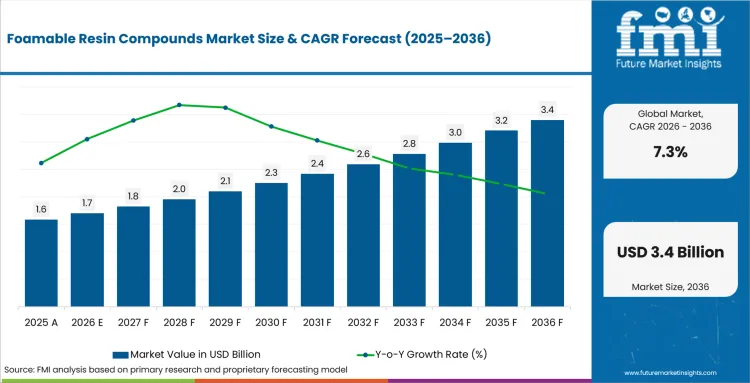
Key Takeaways of Foamable Resin Compounds Market
- Controlled foaming reduces part mass across established polymers without sacrificing molding performance or component stiffness.
- Foamable PP compounds are projected to represent 29.0% in 2026 owing to broad processing compatibility.
- Chemical foaming is estimated to account for 38.0% in 2026 due to adjustable activation ranges.
- Automotive lightweighting is forecast to capture 29.0% in 2026 driven by recurring component weight targets.
- Narrow processing windows restrain adoption as grades require tooling validation for cell structure and appearance.
- Borealis, SABIC, LyondellBasell, Avient, BASF, RTP Company, JSP Corporation and Sekisui Kasei provide materials and process support.
Analyst Perspective
"Foamable compounds earn repeat orders through consistent cell structure rather than the lowest apparent density. Processors should approve each formulation against stiffness, surface finish and cycle stability on the intended tool."
- Nikhil Kaitwade, Principal Consultant, Future Market Insights
How is the Foamable Resin Compounds Market segmented?
The foamable resin compounds industry is segmented by resin type, foaming method, application, density class, sales model and region.
The market is segmented by resin type, foaming method, application, density class, sales model and region. Resin types include PP, PE, PS, PET, TPU or TPE and engineering resin foams, foaming methods cover chemical, physical, microcellular and expandable bead routes, applications include automotive lightweighting, protective packaging, building insulation, footwear or sports goods and consumer products, density classes cover medium, low and high structural foam, and sales models include ready-to-process compounds, masterbatch plus resin supply and custom compounding.
Why do foamable PP compounds lead demand within the resin type category?
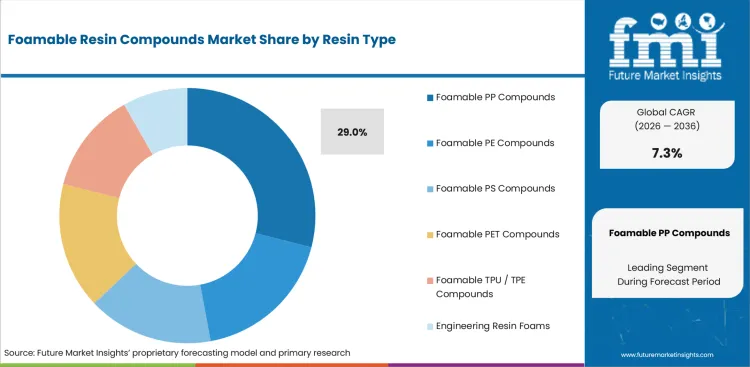
Foamable polypropylene combines low density with melt strength that supports controlled cells across extrusion and molding routes. Formulation teams compare surface quality and stiffness across wall thicknesses during grade transfer between production tools and manufacturing locations.
- The foamable PP compounds segment is projected to hold 29.0% share in 2026 owing to broad process compatibility and polypropylene sourcing routes.
- Production volumes expand once line trials confirm consistent cell structure across intended cycle settings and finished-part requirements. The qualification record helps manufacturers compare foamed polypropylene films with packaging grades that share processing equipment and polymer families.
Why does chemical foaming lead demand within the foaming method category?
Chemical foaming agents release gas inside the polymer melt without dedicated physical-gas delivery equipment during processing. Compounders match decomposition temperature with resin viscosity, residence time and commercial dosing requirements during grade selection.
- By foaming method, chemical foaming is estimated to hold 38.0% share in 2026 owing to adjustable activation ranges across established molding equipment.
- Commercial adoption depends on dosing accuracy and stable surfaces across repeated cycles at commercial line speeds. Plants qualify additive concentration against resin viscosity and cycle settings, then compare low-GWP blowing agents for specific operating and environmental requirements across repeated production campaigns and product families.
How does automotive lightweighting shape the application category?
Automotive programs evaluate foamed compounds through component tests covering surface appearance and mechanical performance requirements. LyondellBasell reported in September 2025 the commissioning of a new laboratory extrusion line and upgraded processing workshop at its Suzhou Technical Center, focused on lightweight plastic body panels and PP compound development for automotive applications.
- The automotive lightweighting segment is likely to capture 29.0% share in 2026 attributable to recurring vehicle mass targets across high-volume molded components.
- Engineering teams extend approved materials across related platforms once crash behavior and geometry remain consistent across tooling locations. Documented component trials support expanded polypropylene foam without treating one successful part as proof for every vehicle platform under review.
What supports medium density demand within the density class category?
Medium-density compounds balance material reduction with stiffness across reusable packaging, molded interiors and semi-structural panels. Developers establish density windows during scale-up and reserve lower-density options for applications requiring tighter cell control.
- The density class is forecast to be led by medium density at 43.0% share in 2026 due to balanced strength and manageable commercial process control.
- Volume commitments follow tool trials that verify even density through thick sections and consistent part dimensions across scheduled commercial production cycles. Formulation teams compare olefinic thermoplastic elastomers across grades whenever molded flexibility or impact recovery affects the final specification.
What are the drivers, restraints and opportunities in the Foamable Resin Compounds Market?
Stable cells support lightweight parts, narrow processing windows raise scrap and simulation reduces repeated qualification work.
- Driver: Automotive and packaging programs require lower part mass without sacrificing stiffness or production reliability.
- Restraint: Resin viscosity and activation temperature can produce uneven density across commercial tools during scale-up.
- Opportunity: Ready-to-process formulations and simulation services reduce plant work during qualification and equipment transfer programs.
Automotive and packaging programs use controlled cells to reduce resin consumption, but repeat orders depend on stable stiffness and surface quality during production. Consistent foam performance also supports compliance with weight reduction and cost-efficiency targets set by end users.
Resin viscosity and activation temperature can destabilize cells during scale-up, raising scrap and forcing additional tool trials ahead of commercial approval. These variations can delay commercialization timelines and increase overall manufacturing costs.
Simulation narrows additive levels ahead of plant trials, and application engineers transfer validated settings across related production tools used for thermal insulation materials. This approach accelerates process qualification while reducing the risk of performance deviations during production ramp-up.
Which country CAGRs are profiled in the Foamable Resin Compounds Market?
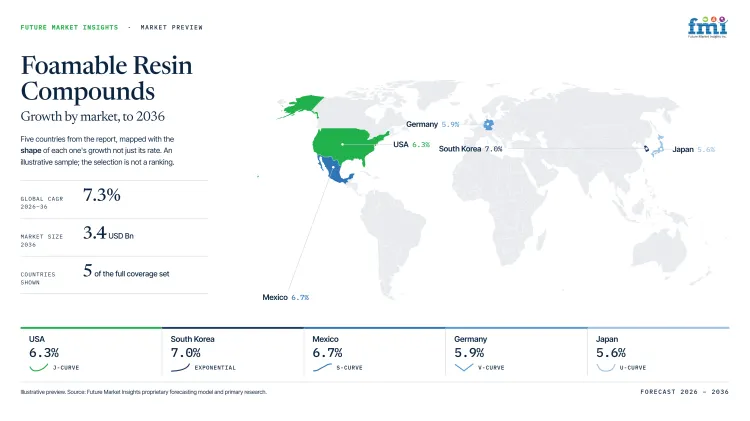
| Country | CAGR |
|---|---|
| United States | 6.3% |
| Germany | 5.9% |
| Japan | 5.6% |
| South Korea | 7.0% |
| Mexico | 6.7% |
How do country-level CAGRs compare in the Foamable Resin Compounds Market?
The 1.4-point range separates an upper pair from a group during the forecast period. These differences describe conversion speed instead of current revenue or installed production capacity within each country.
- South Korea and Mexico form the upper pair as vehicle programs shorten technical feedback cycles.
- Mexico separates from the United States through export-oriented molding clusters and cross-border assembly service routes.
- The United States and Germany retain mature processing networks but follow different automotive qualification paths.
- Germany and Japan require material validation across production sites serving engineering plastics and related components.
- Japan completes the displayed group through plant approvals and conservative formulation transfer across product programs.
Comparable CAGRs produce different entry conditions through available processing capacity and regional technical service networks. Full coverage spans North America, Latin America, Europe, East Asia, South Asia and Pacific, Middle East and Africa.
Country-wise Analysis
- United States compounders can run local trials through regional laboratories and manufacturing sites serving automotive and packaging programs across major industrial corridors. Adoption of foamable resin compounds in the United States is estimated to expand at 6.3% CAGR through 2036, supported by molding capacity and technical service near production centers. BEA reported in June 2026 that new investment in plastics and rubber manufacturing reached USD 19.0 billion during 2025. Manufacturing investment supports equipment upgrades and local technical capacity, but customer-specific approvals raise engineering costs across lower-volume programs and separate production tools across automotive and packaging production lines nationwide.
- Germany links material approvals with component testing through concentrated automotive engineering networks and established polymer laboratories serving major domestic production regions. VDA reported in February 2026 that German plants produced 1.67 million electric passenger cars during 2025 across production sites. Germany’s foamable resin compounds outlook is anticipated to advance at 5.9% CAGR over the assessment period, driven by recurring lightweighting work across vehicle platforms and interior systems. Experienced laboratories support precise formulation transfer across customer programs, yet high energy costs and strict documentation can lengthen commercial trials for compounds requiring narrow temperature control across several tooling locations.
- Japan emphasizes repeatable material performance across vehicle platforms and consumer products that require detailed odor or appearance checks during approval. Japan is estimated to post 5.6% CAGR over the forecast period, supported by mature component networks and disciplined manufacturing practices. The Japan Automobile Manufacturers Association reported in its 2025 industry review that domestic plants produced 8.23 million motor vehicles during 2024. Production scale supports component trials across several plants, but conservative change procedures and separate appearance reviews can slow formulation transfer despite consistent performance during the initial qualification program and subsequent line validation across domestic production programs nationwide.
- South Korea connects major vehicle plants with concentrated component networks that provide rapid access to molding trials and technical feedback across national industrial regions. MOTIE reported in May 2025 that domestic plants produced 385,621 automobiles during April 2025 across the national manufacturing network. The South Korean foamable resin compounds sector is projected to record 7.0% CAGR during the assessment period, supported by compact engineering networks and rapid program feedback. Close coordination among automakers and molders supports faster technical decisions, yet changing export specifications and compressed launch schedules can require repeated commercial validation across several components and production tools.
- Mexico links export-oriented vehicle clusters with regional molding operations and cross-border component programs serving automotive platforms across North America. Proximity to assembly plants supports trial coordination and recurring technical feedback across established industrial corridors. INEGI reported in January 2026 that domestic plants produced 3,953,494 light vehicles during 2025. Foamable resin compound sales in Mexico are forecast to expand at 6.7% CAGR by 2036, supported by established manufacturing corridors and recurring qualification work. Imported specialty grades and limited technical service outside major clusters can extend response times during tooling changes or formulation problems across lower-volume regional production sites.
Who are the notable companies in the Foamable Resin Compounds Market?
Borealis, SABIC, LyondellBasell, Avient, BASF, RTP Company, JSP Corporation and Sekisui Kasei are profiled companies.
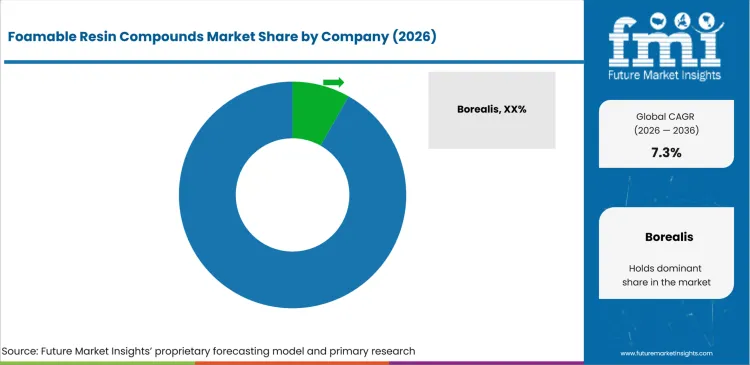
Resin majors, additive formulators and expanded-bead specialists divide a moderately fragmented field across different processing routes. Competition centers on cell control, trial support and application validation across commercial foam plastics end uses.
- Borealis, SABIC and LyondellBasell compete through resin platforms supporting automotive and packaging qualification across regions.
- Avient, BASF and RTP Company differentiate through additive systems and guidance across several polymer families.
- JSP Corporation and Sekisui Kasei focus on expanded materials with specialized molding knowledge across applications.
Competitive Benchmarking: Foamable Resin Compounds Market
| Company | Polymer Compatibility | Processing Support | Application Coverage | Geographic Reach |
|---|---|---|---|---|
| Borealis | Low | Low | High | Global |
| SABIC | High | Medium | High | Global |
| LyondellBasell | Low | Low | Low | Global |
| Avient | Medium | High | Medium | Global |
| BASF | Low | Low | High | Global |
| RTP Company | High | Medium | Medium | Global |
| JSP Corporation | High | Medium | High | Global |
| Sekisui Kasei | High | Medium | High | Global |
Key Developments in the Foamable Resin Compounds Market
- In May 2025, Borealis announced a high-melt-strength polypropylene line intended to triple Daploy supply during 2026.
- In October 2025, Sekisui Kasei published its Integrated Report 2025, outlining the company's expanded foam materials strategy across protective packaging and food-contact applications, including bio-based and recyclable grades within its RETONA product family.
- In April 2025, Avient Corporation presented a broad portfolio of innovative and sustainable materials solutions including its chemical foaming agent and specialty additive systems at Chinaplas 2025 in Shenzhen.
Foamable Resin Compounds Market - Report Scope
| Coverage field | Report scope |
|---|---|
| Market breakdown | By resin type, foaming method, application, density class, sales model and region. |
| Quantitative Units | Revenue USD billion and CAGR in %. |
| Market Definition | Foamable compounds and additive systems converted into cellular plastic parts or intermediates. |
| Regions Covered | North America, Latin America, Western Europe, Eastern Europe, East Asia, South Asia and Pacific, Middle East and Africa. |
| Countries Covered | United States, Germany, Japan, South Korea, Mexico and over twenty-five countries. |
| Key Companies Profiled | Borealis, SABIC, LyondellBasell, Avient, BASF, RTP Company, JSP Corporation and Sekisui Kasei. |
| Forecast Period | 2026 to 2036. |
| Approach | Primary and secondary research with triangulation. |
Foamable Resin Compounds Market - Research Methodology
| Method | Approach |
|---|---|
| Primary Research | FMI analysts gathered input from manufacturers, service providers, technology developers, distributors, end users, procurement teams, and subject-matter experts. Interviews examined purchasing decisions, product or service evaluation, adoption barriers, approval requirements, pricing considerations, and expectations for technical or commercial support. Respondents were also asked what evidence is required before a trial, pilot, or initial order develops into regular purchasing. |
| Desk Research | Desk research covered government statistics, regulatory publications, trade data, industry associations, technical literature, standards, company filings, product information, and official corporate announcements. Sources were reviewed for relevance, publication date, geographic coverage, and consistency with the defined market scope. Claims relating to performance, applications, approvals, capacity, investment, and commercial activity were retained only when supported by credible public evidence. |
| Market Sizing and Forecasting | The market model combined the baseline value with historical performance, segment structure, pricing and volume indicators, adoption levels, company participation, and country-level demand conditions. Forecast assumptions considered economic activity, investment trends, regulatory developments, technology adoption, purchasing cycles, supply availability, and barriers to wider market use. Segment and regional estimates were reconciled before the final market total was calculated. |
| Data Validation | Estimates were checked against multiple independent indicators, including public data, company activity, trade patterns, industry developments, and findings from primary interviews. Validation also tested whether products, services, applications, and company revenues fell within the defined market boundaries. Adjacent categories, unsupported claims, overlapping revenues, and activities without direct market relevance were excluded to reduce double counting and maintain consistency across segments and countries. |
Foamable Resin Compounds Market by Segments
Foamable Resin Compounds Market segmented by Resin Type:
- Foamable PP Compounds
- Foamable PE Compounds
- Foamable PS Compounds
- Foamable PET Compounds
- Foamable TPU / TPE Compounds
- Engineering Resin Foams
Foamable Resin Compounds Market segmented by Foaming Method:
- Chemical Foaming
- Physical Foaming
- Microcellular Foaming
- Expandable Bead / Pellet Foaming
Foamable Resin Compounds Market segmented by Application:
- Automotive Lightweighting
- Protective Packaging
- Building Insulation
- Footwear / Sports Goods
- Consumer Products
Foamable Resin Compounds Market segmented by Density Class:
- Medium Density
- Low Density
- High Structural Foam
Foamable Resin Compounds Market segmented by Sales Model:
- Ready-to-process Compounds
- Masterbatch + Resin Supply
- Custom Compounding
Foamable Resin Compounds Market by Region:
- North America
- United States
- Canada
- Latin America
- Brazil
- Chile
- Mexico
- Rest of Latin America
- Western Europe
- Germany
- United Kingdom
- Italy
- Spain
- France
- Nordics
- Benelux
- Rest of Western Europe
- Eastern Europe
- Russia
- Poland
- Hungary
- Balkan and Baltic States
- Rest of Eastern Europe
- East Asia
- China
- Japan
- South Korea
- South Asia and Pacific
- India
- ASEAN
- Australia and New Zealand
- Rest of South Asia and Pacific
- Middle East and Africa
- Kingdom of Saudi Arabia
- Other GCC Countries
- Türkiye
- South Africa
- Other African Union Countries
- Rest of Middle East and Africa
Research Sources and Bibliography
- International Organization of Motor Vehicle Manufacturers. (2026, April 23). Auto industry growth shifted east in 2025 amid global repositioning.
- Avient Corporation. (2025, April 15). Avient to Present a Broad Array of Innovative and Sustainable Materials Solutions at Chinaplas 2025.
- LyondellBasell Industries. (2025, October 1). LYB helps BMW build a better bumper.
- USA Bureau of Economic Analysis. (2026, June 10). New Foreign Direct Investment in the United States, 2025.
- German Association of the Automotive Industry. (2026, February 3). New record: 40% electric share of passenger car production in 2025.
- Japan Automobile Manufacturers Association, Inc. (2025, October 1). The Motor Industry of Japan 2025.
- Ministry of Trade, Industry and Energy. (2025, May 20). 2025년 4월 자동차산업 동향.
- Instituto Nacional de Estadística y Geografía. (2026, January 9). Registro administrativo de la industria automotriz de vehículos ligeros. Diciembre de 2025.
- Borealis. (2025, May 26). Borealis invests to increase capacity for recyclable, lightweight polymer foam solutions.
- Sekisui Kasei Co., Ltd. (2025, November 17). Providing Containers for Japan’s First Industry-Government-Academia Collaboration Project Expanding the Use of "RETONA FOAM BIO HS Grade" for Food Containers.
- BASF. (2025, November 3). Into the dark: Basotect® Dark EcoBalanced, the world’s first dark melamine resin foam for stylish sound absorption.
- SABIC. (2025, September 18). Foam & Lightweight Solutions Product Brochure 2025.
- RTP Company. (2025). Additive Masterbatches: Delivering Functional Solutions.
- JSP Corporation. (2025). JSP Corporate Report 2025.
- Sekisui Kasei Co., Ltd. (2025, October 29). Integrated Report 2025.
This bibliography is provided for reader reference and is not exhaustive. The full report contains the complete reference list and detailed citations.
This Report Answers
- How large is the global Foamable Resin Compounds market, and what is its growth outlook?
- What factors are supporting demand for foamable resin compounds across industrial and manufacturing applications?
- Which resin type segment holds the largest share of the Foamable Resin Compounds market?
- How do foaming characteristics and performance requirements affect material qualification and adoption?
- Which application segment accounts for the largest share of market demand?
- How do market growth rates and opportunities differ across key countries and regions?
- Which leading companies provide foamable resin compounds and related material solutions?
- What technical, regulatory, and cost-related challenges can delay market adoption?
Frequently Asked Questions
How big is the Foamable Resin Compounds Market in 2026?
The foamable resin compounds market is valued at USD 1.7 billion in 2026 and is forecast to reach USD 3.4 billion by 2036. Growth is supported by automotive lightweighting programs and packaging applications that sustain recurring demand for controlled foaming across established polymer processing routes and production tools.
What is the CAGR of the Foamable Resin Compounds Market from 2026 to 2036?
The foamable resin compounds market grows at a CAGR of 7.3% between 2026 and 2036, supported by automotive and packaging programs adopting controlled foaming once formulations pass tooling validation and qualification requirements across established production lines and processing equipment worldwide.
Which resin type leads the Foamable Resin Compounds Market?
Foamable PP compounds account for 29.0% of the foamable resin compounds market by resin type in 2026, driven by broad processing compatibility across extrusion and molding routes that let formulators reuse established polypropylene sourcing and processing equipment across automotive and packaging production programs.
How much will the Foamable Resin Compounds Market add between 2026 and 2036?
The foamable resin compounds market is set to add USD 1.7 billion between 2026 and 2036, growing from USD 1.7 billion to USD 3.4 billion as automotive and packaging programs expand adoption of controlled foaming across a widening base of qualified production tools and processing lines.
Who are the leading companies in the Foamable Resin Compounds Market?
Eight companies lead the foamable resin compounds market, including Borealis, SABIC, LyondellBasell, Avient, BASF, RTP Company, JSP Corporation and Sekisui Kasei, competing through resin platforms, additive formulation systems, and expanded-bead specialization across automotive, packaging, and consumer application qualification programs worldwide.
Preview the report firsthand - request a free sample
Get SampleGet the brochure for pricing and purchase details.
Get PDFTable of Content
- Key Takeaways
- Market Size and CAGR
- Top Growth Driver
- Fastest Growing Segment
- Leading Region
- Key Companies
- Emerging Opportunities
- Executive Summary
- Global Market Outlook
- Demand-side Trends
- Supply-side Trends
- Technology Roadmap Analysis
- Analysis and Recommendations
- Analyst Perspective (What is happening? Why now? What should investors know?)
- Key Questions Answered
- How large is the market?
- What is the CAGR?
- What are key trends?
- Which region dominates?
- Who are the leaders?
- Market Overview
- Market Coverage / Taxonomy
- Market Definition / Scope / Limitations
- Research Methodology
- Chapter Orientation
- Analytical Lens and Working Hypotheses
- Market Structure, Signals, and Trend Drivers
- Benchmarking and Cross-market Comparability
- Market Sizing, Forecasting, and Opportunity Mapping
- Research Design and Evidence Framework
- Desk Research Programme (Secondary Evidence)
- Expert Input and Fieldwork (Primary Evidence)
- Tooling, Models, and Reference Databases
- Data Engineering and Model Build
- Quality Assurance and Audit Trail
- Market Background
- Market Dynamics (Drivers, Restraints, Opportunity, Trends)
- Scenario Forecast (Optimistic, Likely, Conservative)
- Impact Analysis
- AI Impact
- Sustainability Impact
- Regulatory Impact
- Technology Impact
- Consumer / Buyer Analysis
- Purchase Drivers
- Adoption Barriers
- Buyer Journey
- Opportunity Map Analysis
- Product Life Cycle Analysis
- Supply Chain Analysis
- Investment Feasibility Matrix
- Value Chain Analysis
- PESTLE and Porter's Analysis
- Regulatory Landscape
- Regional Parent Market Outlook
- Production and Consumption Statistics
- Import and Export Statistics
- Global Market Analysis and Forecast, 2021 to 2036
- Historical Market Size Value (USD Billion) Analysis, 2021 to 2025
- Current and Future Market Size Value (USD Billion) Projections, 2026 to 2036
- Y-o-Y Growth Trend Analysis
- Absolute $ Opportunity Analysis
- Global Market Pricing Analysis, 2021 to 2036
- Global Market Analysis and Forecast, By Resin Type, 2021 to 2036
- Introduction / Key Findings
- Historical Market Size Value (USD Billion) Analysis By Resin Type, 2021 to 2025
- Current and Future Market Size Value (USD Billion) Analysis and Forecast By Resin Type, 2026 to 2036
- Foamable PP Compounds
- Foamable PE Compounds
- Foamable PS Compounds
- Foamable PET Compounds
- Foamable TPU / TPE Compounds
- Engineering Resin Foams
- Foamable PP Compounds
- Y-o-Y Growth Trend Analysis By Resin Type, 2021 to 2025
- Absolute $ Opportunity Analysis By Resin Type, 2026 to 2036
- Global Market Analysis and Forecast, By Foaming Method, 2021 to 2036
- Introduction / Key Findings
- Historical Market Size Value (USD Billion) Analysis By Foaming Method, 2021 to 2025
- Current and Future Market Size Value (USD Billion) Analysis and Forecast By Foaming Method, 2026 to 2036
- Chemical Foaming
- Physical Foaming
- Microcellular Foaming
- Expandable Bead / Pellet Foaming
- Chemical Foaming
- Y-o-Y Growth Trend Analysis By Foaming Method, 2021 to 2025
- Absolute $ Opportunity Analysis By Foaming Method, 2026 to 2036
- Global Market Analysis and Forecast, By Application, 2021 to 2036
- Introduction / Key Findings
- Historical Market Size Value (USD Billion) Analysis By Application, 2021 to 2025
- Current and Future Market Size Value (USD Billion) Analysis and Forecast By Application, 2026 to 2036
- Automotive Lightweighting
- Protective Packaging
- Building Insulation
- Footwear / Sports Goods
- Consumer Products
- Automotive Lightweighting
- Y-o-Y Growth Trend Analysis By Application, 2021 to 2025
- Absolute $ Opportunity Analysis By Application, 2026 to 2036
- Global Market Analysis and Forecast, By Density Class, 2021 to 2036
- Introduction / Key Findings
- Historical Market Size Value (USD Billion) Analysis By Density Class, 2021 to 2025
- Current and Future Market Size Value (USD Billion) Analysis and Forecast By Density Class, 2026 to 2036
- Medium Density
- Low Density
- High Structural Foam
- Medium Density
- Y-o-Y Growth Trend Analysis By Density Class, 2021 to 2025
- Absolute $ Opportunity Analysis By Density Class, 2026 to 2036
- Global Market Analysis and Forecast, By Sales Model, 2021 to 2036
- Introduction / Key Findings
- Historical Market Size Value (USD Billion) Analysis By Sales Model, 2021 to 2025
- Current and Future Market Size Value (USD Billion) Analysis and Forecast By Sales Model, 2026 to 2036
- Ready-to-process Compounds
- Masterbatch + Resin Supply
- Custom Compounding
- Ready-to-process Compounds
- Y-o-Y Growth Trend Analysis By Sales Model, 2021 to 2025
- Absolute $ Opportunity Analysis By Sales Model, 2026 to 2036
- Global Market Analysis and Forecast, By Region, 2021 to 2036
- Introduction
- Historical Market Size Value (USD Billion) Analysis By Region, 2021 to 2025
- Current Market Size Value (USD Billion) Analysis and Forecast By Region, 2026 to 2036
- North America
- Latin America
- Western Europe
- Eastern Europe
- East Asia
- South Asia and Pacific
- Middle East & Africa
- Market Attractiveness Analysis By Region
- North America Market Analysis and Forecast, By Country, 2021 to 2036
- Historical Market Size Value (USD Billion) Trend Analysis By Market Taxonomy, 2021 to 2025
- Market Size Value (USD Billion) Forecast By Market Taxonomy, 2026 to 2036
- By Country
- USA
- Canada
- By Resin Type
- By Foaming Method
- By Application
- By Density Class
- By Sales Model
- By Country
- Market Attractiveness Analysis
- By Country
- By Resin Type
- By Foaming Method
- By Application
- By Density Class
- By Sales Model
- Key Takeaways
- Latin America Market Analysis and Forecast, By Country
- Historical Market Size Value (USD Billion) Trend Analysis By Market Taxonomy, 2021 to 2025
- Market Size Value (USD Billion) Forecast By Market Taxonomy, 2026 to 2036
- By Country
- Brazil
- Mexico
- Chile
- Rest of Latin America
- By Resin Type
- By Foaming Method
- By Application
- By Density Class
- By Sales Model
- By Country
- Market Attractiveness Analysis
- By Country
- By Resin Type
- By Foaming Method
- By Application
- By Density Class
- By Sales Model
- Key Takeaways
- Western Europe Market Analysis and Forecast, By Country
- Historical Market Size Value (USD Billion) Trend Analysis By Market Taxonomy, 2021 to 2025
- Market Size Value (USD Billion) Forecast By Market Taxonomy, 2026 to 2036
- By Country
- Germany
- UK
- Italy
- Spain
- France
- Nordic
- BENELUX
- Rest of Western Europe
- By Resin Type
- By Foaming Method
- By Application
- By Density Class
- By Sales Model
- By Country
- Market Attractiveness Analysis
- By Country
- By Resin Type
- By Foaming Method
- By Application
- By Density Class
- By Sales Model
- Key Takeaways
- Eastern Europe Market Analysis and Forecast, By Country
- Historical Market Size Value (USD Billion) Trend Analysis By Market Taxonomy, 2021 to 2025
- Market Size Value (USD Billion) Forecast By Market Taxonomy, 2026 to 2036
- By Country
- Russia
- Poland
- Hungary
- Balkan & Baltic
- Rest of Eastern Europe
- By Resin Type
- By Foaming Method
- By Application
- By Density Class
- By Sales Model
- By Country
- Market Attractiveness Analysis
- By Country
- By Resin Type
- By Foaming Method
- By Application
- By Density Class
- By Sales Model
- Key Takeaways
- East Asia Market Analysis and Forecast, By Country
- Historical Market Size Value (USD Billion) Trend Analysis By Market Taxonomy, 2021 to 2025
- Market Size Value (USD Billion) Forecast By Market Taxonomy, 2026 to 2036
- By Country
- China
- Japan
- South Korea
- By Resin Type
- By Foaming Method
- By Application
- By Density Class
- By Sales Model
- By Country
- Market Attractiveness Analysis
- By Country
- By Resin Type
- By Foaming Method
- By Application
- By Density Class
- By Sales Model
- Key Takeaways
- South Asia and Pacific Market Analysis and Forecast, By Country
- Historical Market Size Value (USD Billion) Trend Analysis By Market Taxonomy, 2021 to 2025
- Market Size Value (USD Billion) Forecast By Market Taxonomy, 2026 to 2036
- By Country
- India
- ASEAN
- Australia & New Zealand
- Rest of South Asia and Pacific
- By Resin Type
- By Foaming Method
- By Application
- By Density Class
- By Sales Model
- By Country
- Market Attractiveness Analysis
- By Country
- By Resin Type
- By Foaming Method
- By Application
- By Density Class
- By Sales Model
- Key Takeaways
- Middle East & Africa Market Analysis and Forecast, By Country
- Historical Market Size Value (USD Billion) Trend Analysis By Market Taxonomy, 2021 to 2025
- Market Size Value (USD Billion) Forecast By Market Taxonomy, 2026 to 2036
- By Country
- Kingdom of Saudi Arabia
- Other GCC Countries
- Türkiye
- South Africa
- Other African Union
- Rest of Middle East & Africa
- By Resin Type
- By Foaming Method
- By Application
- By Density Class
- By Sales Model
- By Country
- Market Attractiveness Analysis
- By Country
- By Resin Type
- By Foaming Method
- By Application
- By Density Class
- By Sales Model
- Key Takeaways
- Key Countries Market Analysis
- USA
- Pricing Analysis
- Market Share Analysis, 2025
- By Resin Type
- By Foaming Method
- By Application
- By Density Class
- By Sales Model
- Canada
- Pricing Analysis
- Market Share Analysis, 2025
- By Resin Type
- By Foaming Method
- By Application
- By Density Class
- By Sales Model
- Mexico
- Pricing Analysis
- Market Share Analysis, 2025
- By Resin Type
- By Foaming Method
- By Application
- By Density Class
- By Sales Model
- Brazil
- Pricing Analysis
- Market Share Analysis, 2025
- By Resin Type
- By Foaming Method
- By Application
- By Density Class
- By Sales Model
- Chile
- Pricing Analysis
- Market Share Analysis, 2025
- By Resin Type
- By Foaming Method
- By Application
- By Density Class
- By Sales Model
- Germany
- Pricing Analysis
- Market Share Analysis, 2025
- By Resin Type
- By Foaming Method
- By Application
- By Density Class
- By Sales Model
- UK
- Pricing Analysis
- Market Share Analysis, 2025
- By Resin Type
- By Foaming Method
- By Application
- By Density Class
- By Sales Model
- Italy
- Pricing Analysis
- Market Share Analysis, 2025
- By Resin Type
- By Foaming Method
- By Application
- By Density Class
- By Sales Model
- Spain
- Pricing Analysis
- Market Share Analysis, 2025
- By Resin Type
- By Foaming Method
- By Application
- By Density Class
- By Sales Model
- France
- Pricing Analysis
- Market Share Analysis, 2025
- By Resin Type
- By Foaming Method
- By Application
- By Density Class
- By Sales Model
- India
- Pricing Analysis
- Market Share Analysis, 2025
- By Resin Type
- By Foaming Method
- By Application
- By Density Class
- By Sales Model
- ASEAN
- Pricing Analysis
- Market Share Analysis, 2025
- By Resin Type
- By Foaming Method
- By Application
- By Density Class
- By Sales Model
- Australia & New Zealand
- Pricing Analysis
- Market Share Analysis, 2025
- By Resin Type
- By Foaming Method
- By Application
- By Density Class
- By Sales Model
- China
- Pricing Analysis
- Market Share Analysis, 2025
- By Resin Type
- By Foaming Method
- By Application
- By Density Class
- By Sales Model
- Japan
- Pricing Analysis
- Market Share Analysis, 2025
- By Resin Type
- By Foaming Method
- By Application
- By Density Class
- By Sales Model
- South Korea
- Pricing Analysis
- Market Share Analysis, 2025
- By Resin Type
- By Foaming Method
- By Application
- By Density Class
- By Sales Model
- Russia
- Pricing Analysis
- Market Share Analysis, 2025
- By Resin Type
- By Foaming Method
- By Application
- By Density Class
- By Sales Model
- Poland
- Pricing Analysis
- Market Share Analysis, 2025
- By Resin Type
- By Foaming Method
- By Application
- By Density Class
- By Sales Model
- Hungary
- Pricing Analysis
- Market Share Analysis, 2025
- By Resin Type
- By Foaming Method
- By Application
- By Density Class
- By Sales Model
- Kingdom of Saudi Arabia
- Pricing Analysis
- Market Share Analysis, 2025
- By Resin Type
- By Foaming Method
- By Application
- By Density Class
- By Sales Model
- Türkiye
- Pricing Analysis
- Market Share Analysis, 2025
- By Resin Type
- By Foaming Method
- By Application
- By Density Class
- By Sales Model
- South Africa
- Pricing Analysis
- Market Share Analysis, 2025
- By Resin Type
- By Foaming Method
- By Application
- By Density Class
- By Sales Model
- USA
- Market Structure Analysis
- Competition Dashboard
- Competition Benchmarking
- Market Share Analysis of Top Players
- By Regional
- By Resin Type
- By Foaming Method
- By Application
- By Density Class
- By Sales Model
- Emerging Startups
- Innovation Benchmarking
- Competition Analysis
- Competition Deep Dive
- Borealis
- Overview
- Product Portfolio
- Profitability by Market Segments
- Sales Footprint
- Strategy Overview
- Marketing Strategy
- Product Strategy
- Channel Strategy
- SABIC
- LyondellBasell
- INEOS Styrolution
- Avient
- Mitsubishi Chemical
- BASF
- RTP Company
- JSP Corporation
- Sekisui Plastics
- Borealis
- Case Studies
- Success Stories
- Recent Developments
- Competition Deep Dive
- Assumptions & Acronyms Used


