

- Market Size (2026)
- USD 771.1 Mn
- Forecast (2036)
- USD 1664.7 Mn
- CAGR (2026 to 2036)
- 8.0%
Low GWP Foam Blowing Agents Market Size, Market Forecast and Outlook By FMI
USD 771.1 million in 2026 and USD 1,664.7 million by 2036 at an 8.0% CAGR.
The low GWP foam blowing agents industry value is forecast to grow from USD 714.0 million in 2025 to USD 1,664.7 million by 2036. Demand is led by HFO, HCFO, hydrocarbon, water-blown, and methyl formate systems used in insulation, appliances, packaging, and molded industrial foam.
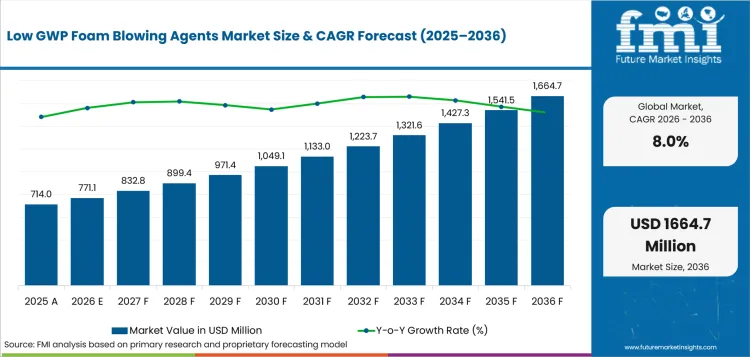
Low GWP Foam Blowing Agents Market Overview: Size and Forecast
- 2025 Market Size: USD 714.0 million
- 2026 Market Size: USD 771.1 million
- 2036 Market Size: USD 1,664.7 million
- Forecast CAGR: 8.0% from 2026 to 2036
- Leading Chemistry Type: Low VOC
- Low VOC Share in 2026: 38.0%
- Leading Function: Process Aid
- Process Aid Share in 2026: 48.0%
- Fastest-growing Country: China
- China CAGR: 9.1% by 2036
Summary of the Low GWP Foam Blowing Agents Market
- Demand and Growth Drivers
- Foam producers are qualifying HFO and HCFO systems because HFC use is narrowing in regulated foam categories.
- Construction insulation demand is expected to support rigid foam boards and closed-cell spray foam where energy performance matters.
- Appliance foam makers are expected to favor agents that protect wall thickness and long-term thermal resistance.
- Product and Segment View
- Low VOC chemistry is estimated to represent 38.0% share in 2026 through HFO and HCFO use in rigid foam systems.
- Process aid function is projected to hold 48.0% share in 2026 because blowing agents form foam cells and control density.
- Construction is expected to hold 42.0% application share in 2026 as insulation boards and spray foam shift toward compliant systems.
- Geography and Competitive Outlook
- China is projected to record 9.1% CAGR through 2036 as appliance foam and insulation output support local conversion.
- India is expected to expand at 8.9% CAGR through 2036 after HCFC-141b phase-out created a conversion base.
- Honeywell, Chemours, and Arkema compete through fluorochemical scale and foam-application support.
- Foam Supplies, AGC, Central Glass, and Harp International compete through methyl formate, HFO, and regional supply routes.
- Analyst Opinion
- Nikhil Kaitwade, Principal Consultant at FMI says, “This market is less a simple material switch and more a qualification cycle inside foam factories. Buyers are asking whether the formulation keeps k-factor performance, foam density, fire behavior, line speed, and shelf stability inside existing production limits. Supplier advantage is expected to come from field support for spray foam contractors, boardstock producers, and appliance foam lines.”
Regulation is the main pressure point for foam producers. The USA EPA says certain technologies cannot use high-GWP HFCs or HFC blends from January 1, 2025. The European Commission says HFCs sold on the EU market should be phased out by 2050 under the 2024 F-gas rules. Arkema’s August 2025 Forane 1233zd investment gives buyers a supplier-side signal because the company is converting a legacy HFC line into HFO 1233zd capacity. This matters because foam producers are selecting agents that meet regulatory cutoffs and fit existing polyurethane processing equipment.
Which factors support expansion in the low GWP foam blowing agents market?
Regulatory deadlines and insulation performance requirements support market value across foam production channels.
- Market value is rising as USA foam products using HFCs with GWP above 150 face manufacture and import limits from January 2025.
- The shift from HFC-245fa and HFC-365mfc creates demand for HFO-1233zd, HFO-1336mzz, and HFO-1234ze as buyers rewrite foam formulations around lower-GWP rules.
- Construction foam creates the largest value pool because closed-cell spray foam and PIR boards need insulation performance that supports energy-code and building-envelope targets.
- Appliance producers are expected to pay for low-GWP agents when refrigerator wall thickness and energy ratings limit design freedom.
- Entry barriers rise when suppliers need toxicology files, SNAP acceptance, regional registrations, and foam-system testing.
Why is the low GWP foam blowing agents market growing?
HFC restrictions are changing buying criteria from lowest cost to compliant foam performance.
Adjacent procurement analysis is linked to blowing agents market, polyurethane foam market, spray foam insulation market, polyisocyanurate insulation market, thermal insulation material market, cold chain packaging market, appliance insulation market, construction chemicals market, fluorochemicals market, and low VOC adhesives market where insulation, foams, and fluorochemical inputs overlap.
The main growth driver is compliance inside foam production lines. EPA’s Technology Transitions Program restricts higher-GWP HFCs in several foam subsectors from January 2025. This makes blowing agent selection a regulatory decision as well as a formulation decision.
A second growth driver is building energy pressure. UNEP and GlobalABC reported in March 2025 that buildings consumed 32% of global energy and contributed 34% of global CO₂ emissions. Foam blowing agents influence the cell gas inside rigid foam, which affects thermal performance over time.
How is the low GWP foam blowing agents market segmented?
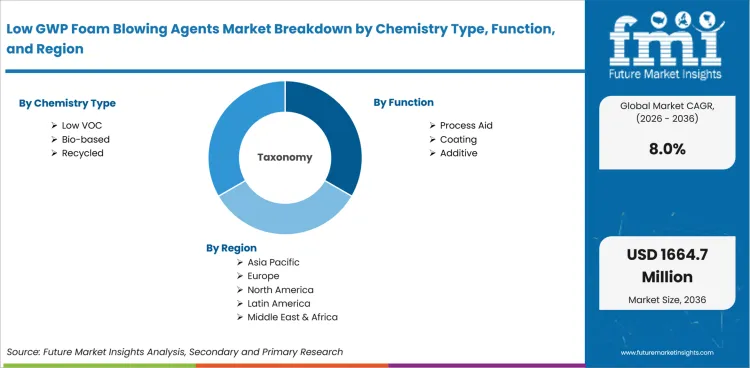
The low GWP foam blowing agents industry is segmented by chemistry type, function, application, end-use industry, and region.
- Low VOC chemistry is expected to lead Chemistry Type with an estimated 38.0% share in 2026 as HFO and HCFO agents meet low-emission procurement rules.
- Process aid is expected to lead Function with a projected 48.0% share in 2026 because blowing agents control foam expansion and cell formation.
- Construction applications are anticipated to reach 42.0% share in 2026 as spray foam and insulation boards shift away from high-GWP HFCs.
- Packaging buyers are projected to account for 31.5% end-use share in 2026 as protective foam and cold-chain packs need lower-impact materials.
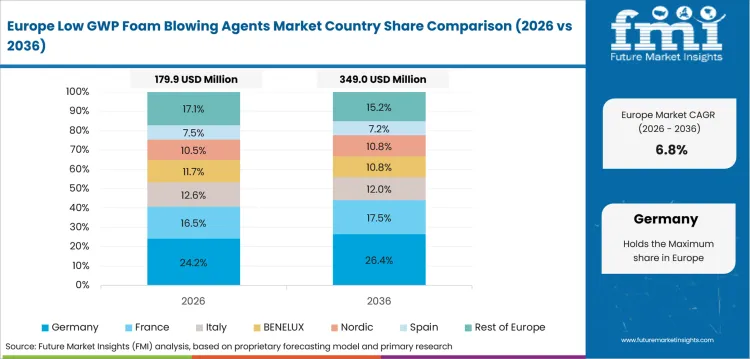
- Europe is estimated to hold 31.0% of regional demand in 2026 due to F-gas rules and insulation renovation programs.
Segmentation reflects how buyers specify foam performance. Chemistry choice starts with regulation but is tested through density, thermal value, flammability, and processing speed.
Why does Low VOC chemistry lead the market?
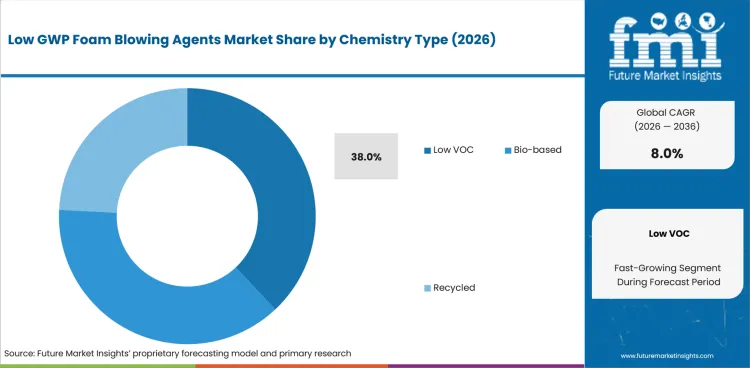
- Low VOC chemistry is projected to account for 38.0% share in 2026 as HFO agents offer low climate impact with closed-cell insulation performance.
- Buyer qualification often centers on aged k-factor testing. This makes thermal validation more important than the initial GWP claim.
Which function leads the low GWP foam blowing agents market?
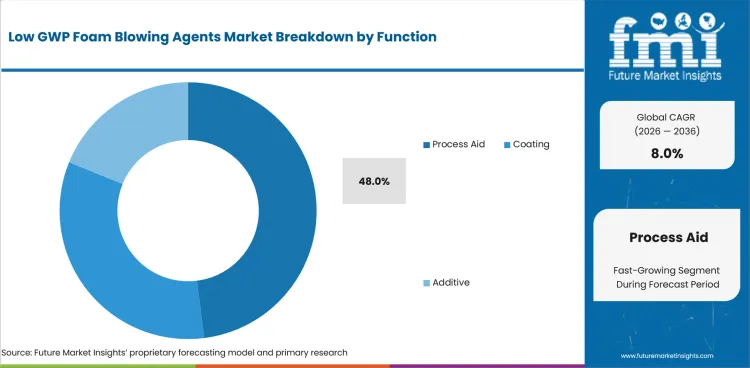
- Process aid is estimated to account for 48.0% share in 2026 as blowing agents form foam cells and influence density during production.
- Line operators often compare vapor pressure and solubility before price because those traits affect foam rise profile and machine settings.
Which application leads the low GWP foam blowing agents market?
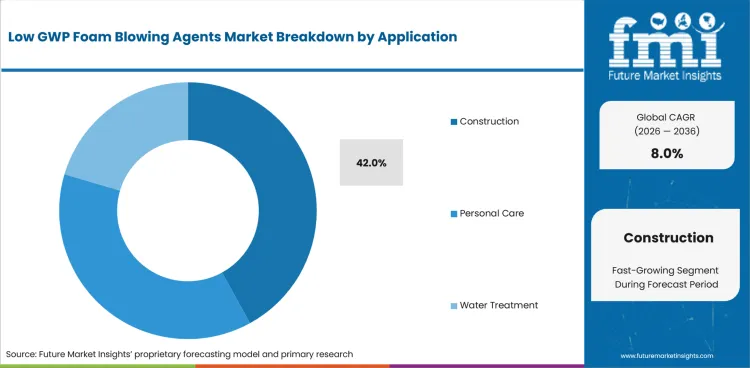
- Construction is anticipated to hold 42.0% share in 2026 as spray foam, PIR boards, and rigid insulation need lower-GWP cell gases.
- Roofing and wall systems often favor non-flammable liquid agents in boardstock lines. Site-applied spray foam needs added contractor training.
Which end-use industry leads the low GWP foam blowing agents market?
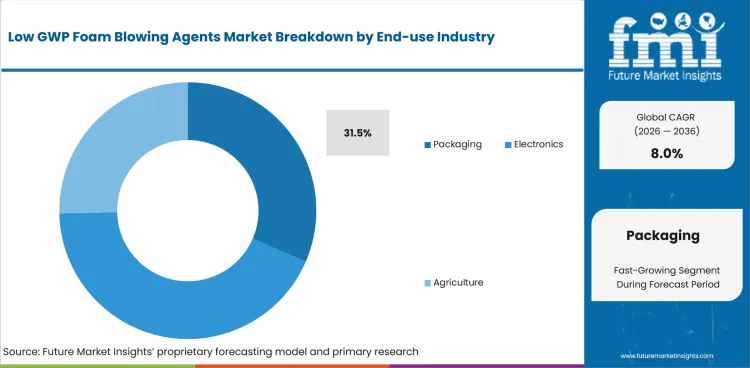
- Packaging is expected to represent 31.5% share in 2026 as foam packaging protects electronics and cold-chain products with lower material weight.
- Cold-chain packaging buyers often choose agents through finished foam validation because shock absorption and thermal hold time matter more than chemical label claims.
Which region leads the low GWP foam blowing agents market?
- Europe is projected to account for 31.0% share in 2026 as revised F-gas rules accelerate the shift away from fluorinated high-GWP options.
- The region is unusual because foam disposal rules and HFC quota pressure influence both new foam production and end-of-life handling.
What are the drivers, restraints, and opportunities in the low GWP foam blowing agents market?
Foam GWP thresholds support growth while HFO cost and plant-safety changes slow adoption in price-sensitive applications.
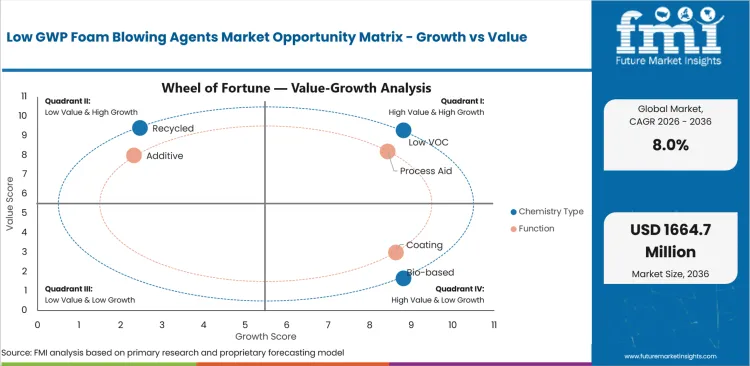
- Foam GWP thresholds are turning regulation into a direct specification line in supplier contracts, forcing material choices to align with compliance timelines.
- Appliance insulation creates demand for agents with low thermal conductivity and stable closed cells because energy performance depends on foam consistency.
- Construction foam buyers are moving toward proven HFO and HCFO systems as energy codes reward insulation value and contractors seek predictable field performance.
- HFO products often carry a cost premium that limits use in price-sensitive foam packaging, especially where buyers cannot recover the cost through compliance value.
- Water-blown and methyl formate routes create lower-cost options for foam makers that can manage processing changes, safety controls, and performance tradeoffs.
Low GWP Foam Blowing Agents Market Demand Outlook
Demand outlook is moving toward documented foam performance rather than a simple molecule change. Producers must show that the finished foam keeps thermal resistance, density control, and fire behavior after reformulation.
Arkema’s August 2025 Forane FBA 1233zd unit in Kentucky shows how localized fluorochemical capacity can support North American foam customers. The company stated that the unit lifts output to 15 kilotons per year.
Voice of Customer and Decision-driver Analysis
Foam producers compare blowing agents through k-factor aging, density, dimensional stability, equipment setting changes, and safety handling. Compliance opens the purchasing conversation but processing reliability decides the approved supplier.
Which countries are growing fastest in the low GWP foam blowing agents market?
China 9.1% CAGR, India 8.9% CAGR, South Korea 8.4% CAGR, United States 8.0% CAGR, Germany 7.8% CAGR, France 7.5% CAGR, United Kingdom 7.4% CAGR, and Japan 7.1% CAGR through 2036.
.webp "Top Country Growth Comparison Low Gwp Foam Blowing Agents Market Cagr (2026 2036)")
| Country | CAGR |
| China | 9.1% |
| India | 8.9% |
| South Korea | 8.4% |
| United States | 8.0% |
| Germany | 7.8% |
| France | 7.5% |
| United Kingdom | 7.4% |
| Japan | 7.1% |
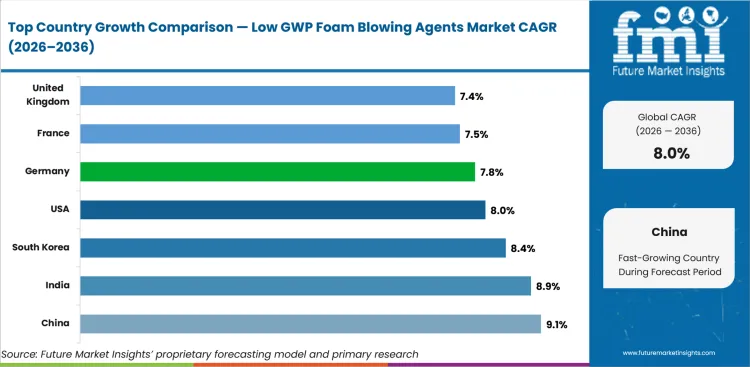
Source: Future Market Insights, 2026.
How do country-level CAGRs compare in the low GWP foam blowing agents market?
- China is projected to record 9.1% CAGR by 2036 as appliance foam and green-building conversion support the fastest outlook.
- India is expected to expand at 8.9% CAGR through 2036 as cold-chain insulation and foam-sector conversion widen demand.
- South Korea is estimated to post 8.4% CAGR through 2036 as export-facing appliances and panels adopt compliant systems.
- The United States is forecast to rise at 8.0% CAGR through 2036 due to federal HFC restrictions and spray foam conversion.
- Germany is projected to grow at 7.8% CAGR through 2036 as EU F-gas rules and renovation demand support low-GWP products.
- France is expected to rise at 7.5% CAGR through 2036 as renovation aid supports insulation-product qualification.
- The United Kingdom is estimated to expand at 7.4% CAGR through 2036 as retrofit scrutiny and F-gas controls shape adoption.
- Japan is forecast to grow at 7.1% CAGR through 2036 as appliance insulation and compact design needs sustain demand.
How fast is the low GWP foam blowing agents market growing in China?
A 9.1% CAGR through 2036 reflects appliance insulation and urban retrofit programs across domestic foam production and imported formulation support.
Country Market Snapshot Table
| Parameter | Value |
|---|---|
| Market Size in 2025 (Value) | USD 121.4 million |
| Market Size in 2026 (Value) | USD 132.5 million |
| Market Forecast in 2036 (Value) | USD 316.6 million |
| CAGR (2026 to 2036) | 9.1% |
| Years Considered | 2021 to 2036 |
| Base Year | 2025 |
| Forecast Period | 2026 to 2036 |
| Units Considered | Value (USD million) |
| Leading Sub-Region | East China and Yangtze River Delta |
China Low GWP Foam Blowing Agents Market Outlook
China is forecast to lead country growth at 9.1% CAGR through 2036 due to appliance scale and factory conversion into lower-GWP foam systems.
Key Growth Drivers
- China appliance foam demand is supported by 2025 household appliances and audio-video retail sales rising 11.0% according to the national statistical communique.
- China factory conversion is supported by industrial enterprises above designated size increasing value added by 5.9% in 2025 according to the National Bureau of Statistics.
- Cold-chain and export packaging suppliers are expected to use lower-GWP foam systems where international buyers require documented climate impact.
- Urban retrofit and district-level renovation programs are expected to support rigid insulation even as new property development remains weak.
Key Restraints
- China construction foam demand is constrained because real estate development investment fell 17.2% in 2025 according to the National Bureau of Statistics.
- Price competition can push packaging and molded foam converters toward hydrocarbons and water-blown systems rather than premium HFO routes.
- Regional qualification gaps may persist where smaller foam plants lack the equipment upgrades needed for safer hydrocarbon handling.
What makes China unique
China is unique because appliance manufacturing scale can pull lower-GWP systems through local system houses quickly.
Key Companies
- Wanhua Chemical Group
- Sinochem Lantian
- Jiangsu Meilan Chemical
- Zhejiang Juhua Co., Ltd.
- Shandong Dongyue Chemical
- Hubei Xiangyun Group
- Beijing Huadu Polyurethane
Sales & Marketing Channels
- Appliance OEM procurement
- System house networks
- Cold-chain panel makers
- Construction insulation distributors
- Export packaging converters
- Regional chemical traders
Country Segment Breakdown Table
| Segment | Sub-Segments |
|---|---|
| By Chemistry Type | Bio-based · Recycled · Low VOC · Halogen-free · Waterborne |
| By Function | Solvent · Additive · Binder · Coating · Process Aid |
| By Application | Textiles · Batteries · Construction · Personal Care · Water Treatment |
| By End-use Industry | Automotive · Electronics · Packaging · Agriculture · Industrial Manufacturing |
| By Region | North America · Europe · East Asia · South Asia · Latin America · Rest of World |
| Key Sub-Regions Covered, Manufacturing and automation corridors | Yangtze River Delta · Pearl River Delta · Bohai Rim · Chengdu-Chongqing · Central China · Northeast industrial corridors |
Frequently Asked Questions
How fast is China low GWP foam blowing agents market growing?
Sales in China are expected to scale at 9.1% CAGR from 2026 to 2036.
Who leads China low GWP foam blowing agents market?
Wanhua Chemical Group, Sinochem Lantian, and Jiangsu Meilan Chemical compete through local supply, formulation support, and foam-system validation.
What is driving adoption in China low GWP foam blowing agents market?
Adoption is driven by appliance insulation and urban retrofit programs and stricter documentation requirements for insulation foam performance.
How fast is the low GWP foam blowing agents market growing in India?
A 8.9% CAGR through 2036 reflects cold-chain insulation and foam-sector conversion across domestic foam production and imported formulation support.
Country Market Snapshot Table
| Parameter | Value |
|---|---|
| Market Size in 2025 (Value) | USD 55.5 million |
| Market Size in 2026 (Value) | USD 60.4 million |
| Market Forecast in 2036 (Value) | USD 141.7 million |
| CAGR (2026 to 2036) | 8.9% |
| Years Considered | 2021 to 2036 |
| Base Year | 2025 |
| Forecast Period | 2026 to 2036 |
| Units Considered | Value (USD million) |
| Leading Sub-Region | West and South India |
India Low GWP Foam Blowing Agents Market Outlook
India is expected to advance at 8.9% CAGR through 2036 as cold-chain buildout and foam-sector conversion support low-GWP blowing agent use.
Key Growth Drivers
- India foam conversion has a stronger base after the Multilateral Fund reported 160 supported enterprise conversions away from HCFC-141b in December 2025.
- India cold-chain demand is supported by 395 approved integrated cold-chain projects according to PIB’s October 2025 update.
- India cold storage insulation demand is supported by 8,815 cold storages according to PIB’s September 2025 release.
- Factory output is expected to help system-house sales because March 2026 IIP rose 4.1% year over year according to PIB.
Key Restraints
- India conversion cost remains a restraint because the Multilateral Fund reported 44 eligible enterprises transitioned without financial support.
- Smaller foam converters may prefer cyclopentane or water-blown routes when HFO pricing exceeds project budgets.
- Cold-chain project delays can affect panel demand because grants and operational approvals move through state and central schemes.
What makes India unique
India is unique because cold-chain expansion and prior HCFC-141b phase-out create a large conversion base for lower-GWP agents.
Key Companies
- Manali Petrochemicals Ltd.
- Sheela Foam Ltd.
- Supreme Petrochem Ltd.
- BASF India Ltd.
- Huntsman India
- Dow Chemical International Pvt. Ltd.
- Kimpur India
Sales & Marketing Channels
- PU system houses
- Cold-chain panel makers
- Appliance OEM procurement
- Chemical distributors
- Industrial insulation contractors
- Food logistics integrators
Country Segment Breakdown Table
| Segment | Sub-Segments |
|---|---|
| By Chemistry Type | Bio-based · Recycled · Low VOC · Halogen-free · Waterborne |
| By Function | Solvent · Additive · Binder · Coating · Process Aid |
| By Application | Textiles · Batteries · Construction · Personal Care · Water Treatment |
| By End-use Industry | Automotive · Electronics · Packaging · Agriculture · Industrial Manufacturing |
| By Region | North America · Europe · East Asia · South Asia · Latin America · Rest of World |
| Key Sub-Regions Covered, Manufacturing and automation corridors | Maharashtra · Gujarat · Tamil Nadu · Karnataka · Telangana · Delhi NCR |
Frequently Asked Questions
How fast is India low GWP foam blowing agents market growing?
Sales in India are expected to scale at 8.9% CAGR from 2026 to 2036.
Who leads India low GWP foam blowing agents market?
Manali Petrochemicals Ltd., Sheela Foam Ltd., and Supreme Petrochem Ltd. compete through local supply, formulation support, and foam-system validation.
What is driving adoption in India low GWP foam blowing agents market?
Adoption is driven by cold-chain insulation and foam-sector conversion and stricter documentation requirements for insulation foam performance.
How fast is the low GWP foam blowing agents market growing in South Korea?
A 8.4% CAGR through 2036 reflects appliance exporters and insulated construction systems across domestic foam production and imported formulation support.
Country Market Snapshot Table
| Parameter | Value |
|---|---|
| Market Size in 2025 (Value) | USD 34.9 million |
| Market Size in 2026 (Value) | USD 37.8 million |
| Market Forecast in 2036 (Value) | USD 84.7 million |
| CAGR (2026 to 2036) | 8.4% |
| Years Considered | 2021 to 2036 |
| Base Year | 2025 |
| Forecast Period | 2026 to 2036 |
| Units Considered | Value (USD million) |
| Leading Sub-Region | Seoul Capital Area |
South Korea Low GWP Foam Blowing Agents Market Outlook
South Korea is estimated to grow at 8.4% CAGR through 2036 as appliance exporters and construction systems qualify lower-GWP foam chemistry.
Key Growth Drivers
- South Korea construction foam demand is supported by 2024 construction value of 364 trillion won according to the Ministry of Data and Statistics.
- South Korea industrial foam demand is supported by April 2025 manufacturing production increasing 5.2% year over year according to the Ministry of Data and Statistics.
- Appliance exporters are expected to favor HFO and hydrocarbon systems when customers in the United States and Europe require low-GWP insulation.
- Cold-chain and cleanroom panel makers are expected to specify lower-GWP agents where insulation performance and plant fire safety are audited together.
Key Restraints
- South Korea building-foam demand is restrained because April 2025 construction completed at constant prices fell 20.5% year over year according to the Ministry of Data and Statistics.
- Smaller foam users can struggle with validation cost when customers request full thermal aging and flammability documentation.
- Premium imported HFO supply can expose Korean system houses to currency and logistics risk during qualification cycles.
What makes South Korea unique
South Korea is unique because export-facing appliance and panel makers must align with foreign HFC restrictions.
Key Companies
- Huntsman Korea
- BASF Korea
- LG Chem
- SK geo centric
- Kumho Mitsui Chemicals
- KCC Corporation
- Hanwha Solutions
Sales & Marketing Channels
- Appliance OEM procurement
- Industrial panel makers
- System house distributors
- Construction material wholesalers
- Cold-chain equipment suppliers
- Export-oriented foam converters
Country Segment Breakdown Table
| Segment | Sub-Segments |
|---|---|
| By Chemistry Type | Bio-based · Recycled · Low VOC · Halogen-free · Waterborne |
| By Function | Solvent · Additive · Binder · Coating · Process Aid |
| By Application | Textiles · Batteries · Construction · Personal Care · Water Treatment |
| By End-use Industry | Automotive · Electronics · Packaging · Agriculture · Industrial Manufacturing |
| By Region | North America · Europe · East Asia · South Asia · Latin America · Rest of World |
| Key Sub-Regions Covered, Manufacturing and automation corridors | Seoul Capital Area · Incheon · Gyeonggi · Ulsan · Busan · Chungcheong industrial belt |
Frequently Asked Questions
How fast is South Korea low GWP foam blowing agents market growing?
Sales in South Korea are expected to scale at 8.4% CAGR from 2026 to 2036.
Who leads South Korea low GWP foam blowing agents market?
Huntsman Korea, BASF Korea, and LG Chem compete through local supply, formulation support, and foam-system validation.
What is driving adoption in South Korea low GWP foam blowing agents market?
Adoption is driven by appliance exporters and insulated construction systems and stricter documentation requirements for insulation foam performance.
How fast is the low GWP foam blowing agents market growing in United States?
A 8.0% CAGR through 2036 reflects federal HFC restrictions and spray foam compliance across domestic foam production and imported formulation support.
Country Market Snapshot Table
| Parameter | Value |
|---|---|
| Market Size in 2025 (Value) | USD 165.4 million |
| Market Size in 2026 (Value) | USD 178.6 million |
| Market Forecast in 2036 (Value) | USD 385.6 million |
| CAGR (2026 to 2036) | 8.0% |
| Years Considered | 2021 to 2036 |
| Base Year | 2025 |
| Forecast Period | 2026 to 2036 |
| Units Considered | Value (USD million) |
| Leading Sub-Region | South and Midwest |
United States Low GWP Foam Blowing Agents Market Outlook
The United States market is projected to grow at 8.0% CAGR through 2036 due to federal HFC restrictions and stable demand from spray foam and appliance insulation.
Key Growth Drivers
- USA foam producers are expected to accelerate HFO qualification because EPA applies a 150 GWP limit to several foam subsectors from January 2025.
- USA construction insulation demand is supported by May 2026 housing starts of 1,177,000 units at a seasonally adjusted annual rate according to the Census Bureau.
- Appliance foam buyers are expected to retain HFO systems where thinner refrigerator walls must protect energy performance and cabinet capacity.
- State energy-code tracking is expected to sustain demand for verified insulation materials because DOE maintains a dedicated portal for residential and commercial code adoption.
Key Restraints
- USA demand is exposed to housing-cycle weakness because May 2026 housing starts were 8.7% below the May 2025 rate according to the Census Bureau.
- Spray foam contractors face a training burden when HFO systems change reactivity and equipment settings compared with older HFC formulations.
- Premium HFO pricing is expected to keep some packaging foam converters on hydrocarbon or water-blown systems until customers pay for compliance documentation.
What makes United States unique
The United States is unique because federal HFC rules create a national compliance cutover for foam makers.
Key Companies
- Honeywell International Inc.
- The Chemours Company
- Arkema Inc.
- Carlisle Spray Foam Insulation
- Gaco
- Lapolla Industries
- Johns Manville
Sales & Marketing Channels
- Spray foam system houses
- Appliance OEM procurement
- Insulation board producers
- Chemical distributors
- Contractor training networks
- Building product retailers
Country Segment Breakdown Table
| Segment | Sub-Segments |
|---|---|
| By Chemistry Type | Bio-based · Recycled · Low VOC · Halogen-free · Waterborne |
| By Function | Solvent · Additive · Binder · Coating · Process Aid |
| By Application | Textiles · Batteries · Construction · Personal Care · Water Treatment |
| By End-use Industry | Automotive · Electronics · Packaging · Agriculture · Industrial Manufacturing |
| By Region | North America · Europe · East Asia · South Asia · Latin America · Rest of World |
| Key Sub-Regions Covered, Manufacturing and automation corridors | South · Midwest · Gulf Coast · Great Lakes · California · Pacific Northwest |
Frequently Asked Questions
How fast is United States low GWP foam blowing agents market growing?
Sales in United States are expected to scale at 8.0% CAGR from 2026 to 2036.
Who leads United States low GWP foam blowing agents market?
Honeywell International Inc., The Chemours Company, and Arkema Inc. compete through local supply, formulation support, and foam-system validation.
What is driving adoption in United States low GWP foam blowing agents market?
Adoption is driven by federal HFC restrictions and spray foam compliance and stricter documentation requirements for insulation foam performance.
How fast is the low GWP foam blowing agents market growing in Germany?
A 7.8% CAGR through 2036 reflects EU F-gas rules and insulation renovation across domestic foam production and imported formulation support.
Country Market Snapshot Table
| Parameter | Value |
|---|---|
| Market Size in 2025 (Value) | USD 93.9 million |
| Market Size in 2026 (Value) | USD 101.2 million |
| Market Forecast in 2036 (Value) | USD 214.5 million |
| CAGR (2026 to 2036) | 7.8% |
| Years Considered | 2021 to 2036 |
| Base Year | 2025 |
| Forecast Period | 2026 to 2036 |
| Units Considered | Value (USD million) |
| Leading Sub-Region | North Rhine-Westphalia and Bavaria |
Germany Low GWP Foam Blowing Agents Market Outlook
Germany is forecast to record 7.8% CAGR through 2036 as EU F-gas phase-out rules and renovation demand support low-GWP rigid foam systems.
Key Growth Drivers
- Germany foam users are expected to move faster because Regulation 2024/573 has applied since 11 March 2024 according to Umweltbundesamt.
- German construction demand is supported by 238,063 dwellings permitted in 2025 according to Destatis.
- Appliance and cold-storage insulation buyers are expected to favor low-GWP HFOs where energy labels make thermal drift a procurement concern.
- Polyiso and PIR board producers are expected to retain HFO blends where non-flammable processing supports high-volume lamination lines.
Key Restraints
- Germany faces project timing risk because residential property prices rose 3.2% on an annual average basis in 2025 according to Destatis.
- Construction weakness can slow foam conversion when developers delay new building and renovation projects in cities with high financing costs.
- German buyers may resist premium HFO use in low-margin panels when mineral wool and hydrocarbon systems remain available alternatives.
What makes Germany unique
Germany is unique because EU rules combine with demanding building standards and a large technical insulation supply base.
Key Companies
- Covestro AG
- BASF SE
- Kingspan Insulation GmbH
- Synthesia Technology Deutschland
- Recticel Insulation Germany
- RAMPF Group
- BACHL Dämmstoff GmbH
Sales & Marketing Channels
- Polyurethane system houses
- PIR board manufacturers
- Construction material wholesalers
- Appliance OEM channels
- Energy retrofit contractors
- Architect specification networks
Country Segment Breakdown Table
| Segment | Sub-Segments |
|---|---|
| By Chemistry Type | Bio-based · Recycled · Low VOC · Halogen-free · Waterborne |
| By Function | Solvent · Additive · Binder · Coating · Process Aid |
| By Application | Textiles · Batteries · Construction · Personal Care · Water Treatment |
| By End-use Industry | Automotive · Electronics · Packaging · Agriculture · Industrial Manufacturing |
| By Region | North America · Europe · East Asia · South Asia · Latin America · Rest of World |
| Key Sub-Regions Covered, Manufacturing and automation corridors | North Rhine-Westphalia · Bavaria · Baden-Württemberg · Hesse · Lower Saxony · Berlin-Brandenburg |
Frequently Asked Questions
How fast is Germany low GWP foam blowing agents market growing?
Sales in Germany are expected to scale at 7.8% CAGR from 2026 to 2036.
Who leads Germany low GWP foam blowing agents market?
Covestro AG, BASF SE, and Kingspan Insulation GmbH compete through local supply, formulation support, and foam-system validation.
What is driving adoption in Germany low GWP foam blowing agents market?
Adoption is driven by EU F-gas rules and insulation renovation and stricter documentation requirements for insulation foam performance.
How fast is the low GWP foam blowing agents market growing in France?
A 7.5% CAGR through 2036 reflects energy renovation support and panel insulation across domestic foam production and imported formulation support.
Country Market Snapshot Table
| Parameter | Value |
|---|---|
| Market Size in 2025 (Value) | USD 67.3 million |
| Market Size in 2026 (Value) | USD 72.4 million |
| Market Forecast in 2036 (Value) | USD 149.2 million |
| CAGR (2026 to 2036) | 7.5% |
| Years Considered | 2021 to 2036 |
| Base Year | 2025 |
| Forecast Period | 2026 to 2036 |
| Units Considered | Value (USD million) |
| Leading Sub-Region | Île-de-France and Auvergne-Rhône-Alpes |
France Low GWP Foam Blowing Agents Market Outlook
France is expected to post 7.5% CAGR through 2036 as renovation aid and EU F-gas rules support low-GWP insulation foam demand.
Key Growth Drivers
- France retrofit demand is supported because MaPrimeRénov condominium aid covers 30% of net works under defined renovation conditions.
- France construction planning remains active because 384,539 dwellings were authorized from May 2025 to April 2026 according to SDES.
- Foam board suppliers are expected to benefit where co-owned buildings plan envelope renovation and need documented thermal performance.
- Appliance insulation demand is expected to keep HFO agents relevant where refrigerator and freezer makers balance cabinet capacity with energy labels.
Key Restraints
- France renovation timing remains exposed to cost swings because INSEE reported the construction cost index at 2,058 in Q4 2025.
- Retrofit conversions can face stop-start demand when public aid rules shift because household eligibility differs between renovation pathways.
- Smaller installers may avoid spray foam when documentation and quality assurance requirements raise project management costs.
What makes France unique
France is unique because renovation subsidy rules can quickly redirect insulation product demand toward approved envelope measures.
Key Companies
- Arkema France
- Saint-Gobain Isover
- Soprema Group
- Recticel Insulation France
- Synthesia Technology France
- Huntsman France
- Actis Insulation
Sales & Marketing Channels
- Renovation subsidy networks
- Insulation board distributors
- Specialist installers
- Appliance OEM procurement
- Building material merchants
- Energy-audit specifiers
Country Segment Breakdown Table
| Segment | Sub-Segments |
|---|---|
| By Chemistry Type | Bio-based · Recycled · Low VOC · Halogen-free · Waterborne |
| By Function | Solvent · Additive · Binder · Coating · Process Aid |
| By Application | Textiles · Batteries · Construction · Personal Care · Water Treatment |
| By End-use Industry | Automotive · Electronics · Packaging · Agriculture · Industrial Manufacturing |
| By Region | North America · Europe · East Asia · South Asia · Latin America · Rest of World |
| Key Sub-Regions Covered, Manufacturing and automation corridors | Île-de-France · Auvergne-Rhône-Alpes · Hauts-de-France · Grand Est · Nouvelle-Aquitaine · Occitanie |
Frequently Asked Questions
How fast is France low GWP foam blowing agents market growing?
Sales in France are expected to scale at 7.5% CAGR from 2026 to 2036.
Who leads France low GWP foam blowing agents market?
Arkema France, Saint-Gobain Isover, and Soprema Group compete through local supply, formulation support, and foam-system validation.
What is driving adoption in France low GWP foam blowing agents market?
Adoption is driven by energy renovation support and panel insulation and stricter documentation requirements for insulation foam performance.
How fast is the low GWP foam blowing agents market growing in United Kingdom?
A 7.4% CAGR through 2036 reflects F-gas rules and residential retrofit checks across domestic foam production and imported formulation support.
Country Market Snapshot Table
| Parameter | Value |
|---|---|
| Market Size in 2025 (Value) | USD 64.3 million |
| Market Size in 2026 (Value) | USD 69.1 million |
| Market Forecast in 2036 (Value) | USD 141.1 million |
| CAGR (2026 to 2036) | 7.4% |
| Years Considered | 2021 to 2036 |
| Base Year | 2025 |
| Forecast Period | 2026 to 2036 |
| Units Considered | Value (USD million) |
| Leading Sub-Region | England construction corridors |
United Kingdom Low GWP Foam Blowing Agents Market Outlook
The United Kingdom market is estimated to expand at 7.4% CAGR through 2036 as F-gas controls and housing retrofit scrutiny shape approved foam choices.
Key Growth Drivers
- UK insulation retrofits are expected to require tighter product evidence because the English Housing Survey found spray foam in 231,000 dwellings in 2024 to 2025.
- UK foam suppliers are expected to benefit from building energy rules because Approved Document L 2026 guides insulation that is reasonably continuous and limits thermal bridging.
- F-gas compliance is expected to support lower-GWP products because September 2024 UK guidance states the rules apply to HFC used in foam insulation.
- Rigid foam board suppliers are expected to see demand from roof and wall upgrades where buyers prefer factory-made insulation with documented thermal values.
Key Restraints
- UK spray foam installers face tighter lender scrutiny because the House of Commons Library linked poor installation to roof condensation and mortgage difficulty in January 2026.
- UK retrofit buyers may delay foam upgrades where mineral wool remains the default material across just under 18 million insulated lofts.
- Project-level documentation costs can restrain smaller contractors when lenders and surveyors ask for installation records and product certificates.
What makes United Kingdom unique
The United Kingdom is unique because mortgage risk makes installation quality a market access issue for spray foam.
Key Companies
- Synthesia Technology UK
- Kingspan Group plc
- Carlisle Construction Materials UK
- BASF plc
- Huntsman Building Solutions UK
- Eco Spray Foam Systems
- Chemique Adhesives
Sales & Marketing Channels
- Specialist insulation installers
- Building merchants
- Surveyor-led retrofit networks
- Insulation board distributors
- Appliance repair supply routes
- Architect specification channels
Country Segment Breakdown Table
| Segment | Sub-Segments |
|---|---|
| By Chemistry Type | Bio-based · Recycled · Low VOC · Halogen-free · Waterborne |
| By Function | Solvent · Additive · Binder · Coating · Process Aid |
| By Application | Textiles · Batteries · Construction · Personal Care · Water Treatment |
| By End-use Industry | Automotive · Electronics · Packaging · Agriculture · Industrial Manufacturing |
| By Region | North America · Europe · East Asia · South Asia · Latin America · Rest of World |
| Key Sub-Regions Covered, Manufacturing and automation corridors | London · South East England · Midlands · North West England · Scotland · Wales |
Frequently Asked Questions
How fast is United Kingdom low GWP foam blowing agents market growing?
Sales in United Kingdom are expected to scale at 7.4% CAGR from 2026 to 2036.
Who leads United Kingdom low GWP foam blowing agents market?
Synthesia Technology UK, Kingspan Group plc, and Carlisle Construction Materials UK compete through local supply, formulation support, and foam-system validation.
What is driving adoption in United Kingdom low GWP foam blowing agents market?
Adoption is driven by F-gas rules and residential retrofit checks and stricter documentation requirements for insulation foam performance.
How fast is the low GWP foam blowing agents market growing in Japan?
A 7.1% CAGR through 2036 reflects appliance insulation and compact building design across domestic foam production and imported formulation support.
Country Market Snapshot Table
| Parameter | Value |
|---|---|
| Market Size in 2025 (Value) | USD 54.2 million |
| Market Size in 2026 (Value) | USD 58.0 million |
| Market Forecast in 2036 (Value) | USD 115.2 million |
| CAGR (2026 to 2036) | 7.1% |
| Years Considered | 2021 to 2036 |
| Base Year | 2025 |
| Forecast Period | 2026 to 2036 |
| Units Considered | Value (USD million) |
| Leading Sub-Region | Kanto and Kansai |
Japan Low GWP Foam Blowing Agents Market Outlook
Japan is projected to expand at 7.1% CAGR through 2036 as appliance insulation and compact building design support lower-GWP foam systems.
Key Growth Drivers
- Japan appliance insulation demand is supported by 10,187 thousand air conditioners demanded in 2024 according to JRAIA’s June 2025 estimate.
- Japan industrial foam demand is supported by METI’s April 2026 production index of 102.5 on a 2020 average base.
- Compact housing and appliance designs are expected to favor agents that hold insulation value without increasing panel thickness.
- Japanese system houses are expected to prefer lower-flammability HFO options where plant safety and precise formulation control matter.
Key Restraints
- Japan construction-linked foam demand is restrained because housing starts decreased to 62,569 units in April 2026 according to MLIT-linked statistics.
- Premium HFO conversion can be slow where domestic appliance makers have already optimized cyclopentane and water-blown production routes.
- Smaller molded foam users may delay qualification because Japanese buyers often require long validation cycles before material changes.
What makes Japan unique
Japan is unique because dense appliance design makes thermal conductivity and formulation stability unusually important.
Key Companies
- AGC Inc.
- Central Glass Co., Ltd.
- Tosoh Corporation
- Sekisui Chemical Co., Ltd.
- Asahi Kasei Construction Materials
- Nichias Corporation
- Kaneka Corporation
Sales & Marketing Channels
- Appliance OEM channels
- Foam system houses
- Construction insulation distributors
- Cold-chain equipment makers
- Specialty chemical traders
- Prefabricated housing suppliers
Country Segment Breakdown Table
| Segment | Sub-Segments |
|---|---|
| By Chemistry Type | Bio-based · Recycled · Low VOC · Halogen-free · Waterborne |
| By Function | Solvent · Additive · Binder · Coating · Process Aid |
| By Application | Textiles · Batteries · Construction · Personal Care · Water Treatment |
| By End-use Industry | Automotive · Electronics · Packaging · Agriculture · Industrial Manufacturing |
| By Region | North America · Europe · East Asia · South Asia · Latin America · Rest of World |
| Key Sub-Regions Covered, Manufacturing and automation corridors | Kanto · Kansai · Chubu · Kyushu · Tohoku · Hokkaido |
Frequently Asked Questions
How fast is Japan low GWP foam blowing agents market growing?
Sales in Japan are expected to scale at 7.1% CAGR from 2026 to 2036.
Who leads Japan low GWP foam blowing agents market?
AGC Inc., Central Glass Co., Ltd., and Tosoh Corporation compete through local supply, formulation support, and foam-system validation.
What is driving adoption in Japan low GWP foam blowing agents market?
Adoption is driven by appliance insulation and compact building design and stricter documentation requirements for insulation foam performance.
How competitive is the low GWP foam blowing agents market?
Honeywell, Chemours, and Arkema compete through named HFO platforms used in spray foam, appliance foam, and rigid insulation panels.
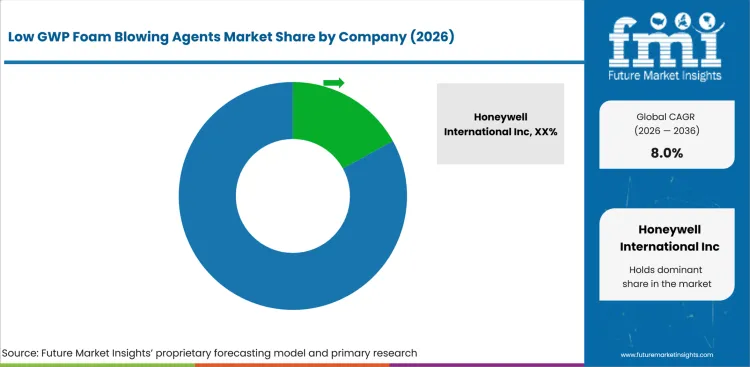
The low‑GWP foam blowing agents market is moderately to highly competitive, shaped by both technology differentiation and application‑specific cost pressures. Global fluorochemical leaders such as Honeywell, Chemours, and Arkema compete primarily through branded HFO platforms that are qualified across spray foam, appliance foam, and rigid insulation panel applications, where regulatory compliance, thermal performance, and OEM approvals matter most.
Competition is intensified by hydrocarbon, methyl formate, and water‑blown systems, which remain attractive in cost‑sensitive and less regulation‑driven foam segments. Regional system houses and specialty suppliers further strengthen competitive intensity by defending share through localized formulation expertise, lower‑cost physical blowing agents, and hands‑on plant‑level troubleshooting, often delaying or preventing customer transitions to new blowing agent chemistries.
How do top low GWP foam blowing agents companies compare?
Honeywell, Chemours, and Arkema score strongest on HFO platforms while AGC, Central Glass, and Foam Supplies compete through regional chemistry routes and alternative blowing agent systems.
| Company | Low-GWP Platform | Foam Application Focus | Regulatory Coverage | Footprint |
| Honeywell | Solstice LBA HFO-1233zd(E) | Spray foam, appliance, panels | High | Global |
| Chemours | Opteon 1100 and related HFO agents | Polyurethane and polyiso foam | High | Global |
| Arkema | Forane FBA 1233zd | Roofing, appliance, buildings | High | North America and Europe |
| AGC | HFO and fluorochemical routes | Rigid urethane foam | Medium | Japan and Asia |
| Central Glass | HFO-1233zd(E) product routes | Buildings and cold applications | Medium | Japan and export markets |
| Foam Supplies | Ecomate methyl formate systems | Packaging and molded foam | Medium | North America |
Who are the key players in the low GWP foam blowing agents market?
Honeywell, Chemours, Arkema, AGC, and Central Glass are listed with Foam Supplies and Harp International among other suppliers.
Key global companies in the low GWP foam blowing agents market include:
- Honeywell International Inc.
- The Chemours Company
- Arkema
- AGC Inc.
- Central Glass Co., Ltd.
- Foam Supplies Inc.
- Harp International Ltd.
- Wanhua Chemical Group
- Sinochem Lantian
- Tosoh Corporation
Key Developments in Low GWP Foam Blowing Agents Market
- In August 2025, Arkema completed the Forane FBA 1233zd production unit at Calvert City, Kentucky and increased North American output to 15 kilotons per year.
- In December 2025, the Multilateral Fund reported that India’s foam-sector phase-out supported 160 enterprise conversions away from HCFC-141b.
- In June 2025, JRAIA estimated global air conditioner demand at 131,638 thousand units in 2024, supporting appliance insulation planning for low-GWP foam systems.
Key Players in the Low GWP Foam Blowing Agents Market
Global Fluorochemical Groups
- Honeywell International Inc.
- The Chemours Company
- Arkema
- AGC Inc.
- Central Glass Co., Ltd.
Alternative and Specialty Blowing Agent Suppliers
- Foam Supplies Inc.
- Harp International Ltd.
- Solvay
- Linde
- Ecomate system partners
Regional System House and Foam Chemistry Suppliers
- Wanhua Chemical Group
- Sinochem Lantian
- Tosoh Corporation
- BASF regional system houses
- Huntsman regional system houses
Low GWP Foam Blowing Agents Market - Report Scope
| Parameter | Details |
|---|---|
| Forecast period | 2026 to 2036 |
| Historical period | 2021 to 2025 |
| Quantitative unit | Revenue in USD million |
| By chemistry type | Bio-based, recycled, low VOC, halogen-free, waterborne |
| By function | Solvent, additive, binder, coating, process aid |
| By application | Textiles, batteries, construction, personal care, water treatment |
| By end-use industry | Automotive, electronics, packaging, agriculture, industrial manufacturing |
| Regions covered | North America, Latin America, Europe, East Asia, South Asia and Pacific, Middle East and Africa |
| Countries covered | China, India, South Korea, United States, Germany, France, United Kingdom, Japan |
| Key companies profiled | Honeywell, Chemours, Arkema, AGC, Central Glass, Foam Supplies, Harp International, Wanhua Chemical Group |
| Approach | Bottom-up foam application approach using blowing agent revenue, chemistry conversion rates, regulatory milestones, country-level foam demand, and supplier capacity |
Source: Future Market Insights, 2026.
Low GWP Foam Blowing Agents Market - Scope & Definition
| Attribute | Detail |
| Market Definition | Chemicals used to create cellular structures in polymer foams while reducing climate impact versus legacy HFC or HCFC blowing agents |
| Functions Covered | Foam expansion, cell formation, density control, insulation performance support, process-aid functionality |
| Applications Covered | Textiles, batteries, construction, personal care, water treatment, spray foam, insulation panels, appliance foam, packaging foam |
| End-Use Industries | Automotive, electronics, packaging, agriculture, industrial manufacturing, construction materials, appliances, cold-chain packaging |
| Grades Covered | Bio-based, recycled, low VOC, halogen-free, waterborne and other commercially supplied low-GWP foam blowing agent systems |
| Inclusions | Commercially traded low-GWP blowing agents used by foam system houses, insulation board producers, appliance makers, packaging converters, and industrial foam users |
| Exclusions | General refrigerants, aerosol propellants, fire suppression agents, finished foam products, foam surfactants, flame retardants, and high-GWP blowing agents outside foam applications |
Low GWP Foam Blowing Agents Market - Research Methodology
| Method | Description |
| Primary Research | FMI analyst interviews with foam system houses, insulation board makers, appliance insulation users, chemical distributors, regional formulators, and contractor-facing suppliers |
| Desk Research | Review of regulatory data from EPA, EU F-gas materials, Montreal Protocol documentation, company product pages, official releases, and public foam-sector policy documents |
| Market Sizing & Forecasting | Bottom-up foam application approach using 2025 value anchors, chemistry conversion rates, regional regulation, construction demand, appliance demand, and supplier availability |
| Data Validation | Cross-verification using official HFC phase-down schedules, parent foam demand, insulation material use, supplier portfolios, and company capacity disclosures |
Low GWP Foam Blowing Agents Market Breakdown by Chemistry Type, Function, Application, End-use Industry, and Region
Low GWP Foam Blowing Agents Market Segmented by Chemistry Type
- Bio-based
- Recycled
- Low VOC
- Halogen-free
- Waterborne
Low GWP Foam Blowing Agents Market Segmented by Function
- Solvent
- Additive
- Binder
- Coating
- Process Aid
Low GWP Foam Blowing Agents Market Segmented by Application
- Textiles
- Batteries
- Construction
- Personal Care
- Water Treatment
Low GWP Foam Blowing Agents Market Segmented by End-use Industry
- Automotive
- Electronics
- Packaging
- Agriculture
- Industrial Manufacturing
Low GWP Foam Blowing Agents Market by Region
- North America
- Latin America
- Europe
- East Asia
- South Asia and Pacific
- Middle East and Africa
Research Sources and Bibliography
- Arkema. (2025, August 28). Arkema strengthens its fluorospecialties business with its new Forane 1233zd production unit in the United States.
- Center for the Polyurethanes Industry. (2025). State phase-down of HFCs in the spray foam industry.
- Department for Levelling Up, Housing and Communities. (2026, March). Approved Document L, Volume 1: Conservation of fuel and power.
- Destatis. (2026). Building permits for building construction in Germany.
- Destatis. (2026, March 25). Construction prices and real property prices.
- European Commission. (2024, February 20). Regulation (EU) 2024/573 on fluorinated greenhouse gases.
- European Commission. (2026). Fluorinated greenhouse gases: EU rules.
- Government of the United Kingdom. (2024, September). Fluorinated greenhouse gases guidance.
- Government of the United Kingdom. (2026, January 5). Spray foam insulation and mortgages.
- Government of the United Kingdom. (2026, May 14). English Housing Survey 2024 to 2025: Home insulation fact sheet.
- Honeywell. (2024). Solstice LBA conversion manual.
- Honeywell. (2026). Solstice Liquid Blowing Agent.
- Institut national de la statistique et des études économiques. (2026, March 24). In Q4 2025, the Cost-of-Construction Index stood at 2,058.
- Japan Ministry of Economy, Trade and Industry. (2026, June 12). Indices of industrial production: Revised report for April 2026.
- Japan Refrigeration and Air Conditioning Industry Association. (2025, June). Estimates of world air conditioner demand.
- Ministry of Data and Statistics, Republic of Korea. (2025, May 30). Monthly industrial statistics, April 2025.
- Ministry of Data and Statistics, Republic of Korea. (2025, August 22). Preliminary results of the 2024 Construction Survey.
- Ministry of Statistics and Programme Implementation. (2026, April 28). Quick estimate of Index of Industrial Production and use-based index for March 2026.
- Multilateral Fund for the Implementation of the Montreal Protocol. (2025, December 2). Bestopuf’s experience in India’s foam sector phase-out.
- National Bureau of Statistics of China. (2026, January 19). National economy pushed forward with innovation-led development in 2025.
- National Bureau of Statistics of China. (2026, January 20). Investment in real estate development for 2025.
- National Bureau of Statistics of China. (2026, February 28). Statistical communique of the People’s Republic of China on the 2025 national economic and social development.
- Press Information Bureau, Government of India. (2025, September 28). Building resilient infrastructure for storage of food grains.
- Press Information Bureau, Government of India. (2025, October 29). Integrated cold chain and value addition infrastructure.
- Service-Public.fr. (2024, March 18). MaPrimeRénov’ Condominium: Aid increases.
- Service-Public.fr. (2024, May 6). MaPrimeRénov’ evolves: New provisions for 2024.
- Service des données et études statistiques. (2026, June 1). Construction de logements: Résultats à fin avril 2026.
- United Nations Environment Programme. (2025, March 17). Global Status Report for Buildings and Construction 2024/2025.
- USA Census Bureau. (2026, June 16). New residential construction: May 2026.
- USA Department of Energy. (2026). Building Energy Codes Program state portal.
- USA Environmental Protection Agency. (2026). Technology Transitions HFC restrictions by sector.
This bibliography is provided for reader reference and is not exhaustive. The full report contains the complete reference list and detailed citations.
This Report Answers
- Market size estimates for 2026 and forecasts through 2036 for the low GWP foam blowing agents market.
- Insights across more than 30 regional and country-level markets.
- Analysis of demand drivers, foam reformulation patterns, regulatory milestones, and purchasing behavior.
- Evaluation of key chemistry types and functions, including low VOC chemistry and process-aid use.
- Assessment of regulatory frameworks, HFC restrictions, F-gas rules, and foam qualification requirements.
- Identification of growth opportunities across HFO, HCFO, hydrocarbon, water-blown, and methyl formate systems.
- Evaluation of supply chain dynamics, product qualification trends, and country-level conversion barriers.
- Country-level growth analysis covering China, India, South Korea, United States, Germany, France, United Kingdom, and Japan.
- Assessment of the competitive landscape, including leading fluorochemical suppliers and alternative blowing agent providers.
- Analysis of buyer preferences, insulation performance needs, and qualification-cycle requirements.
- Regional outlooks across North America, Europe, East Asia, South Asia, and Latin America.
- Delivery of market data, forecasts, and supporting analysis in PDF and Excel formats.
Frequently Asked Questions
What is the growth prospect for low GWP foam blowing agents?
Demand for low GWP foam blowing agents is expected to rise as foam producers qualify lower-GWP systems across insulation, appliance, packaging, and industrial foam applications.
Which companies are expected to shape the low GWP foam blowing agents market?
Honeywell, Chemours, Arkema, AGC, Central Glass, Foam Supplies, and Harp International are expected to shape competition through low-GWP platforms and foam-system support.
Why are chemical suppliers investing in low GWP foam blowing agents?
Chemical suppliers are investing in low GWP foam blowing agents to meet HFC restrictions and support foam producers that need compliant insulation performance.
Why are regulatory approvals important in the low GWP foam blowing agents market?
Regulatory approvals help foam producers confirm whether a blowing agent can be used in target applications without creating import or sales risk.
Which chemistry formats are gaining attention in low GWP foam blowing agents?
HFO, HCFO, hydrocarbon, water-blown, and methyl formate routes are gaining attention because each addresses a different cost, safety, and performance need.
How do regulations influence low GWP foam blowing agent launches?
Regulations influence launches by setting GWP limits and forcing suppliers to prove that lower-impact agents can meet foam performance requirements.
Why is insulation performance important for low GWP foam blowing agents?
Insulation performance is important because buyers need lower-GWP foam without losing k-factor, density control, fire behavior, or long-term thermal resistance.
How do country-level rules affect low GWP foam blowing agents?
Country-level rules affect adoption by changing the pace of HFC phase-down, foam product approvals, plant conversion timing, and contractor documentation requirements.
What role do system houses play in low GWP foam blowing agents?
System houses support adoption by adjusting formulations, testing foam performance, and helping contractors or OEMs manage processing changes.
Preview the report firsthand - request a free sample
Get SampleGet the brochure for pricing and purchase details.
Get PDFTable of Content
- Key Takeaways
- Market Size and CAGR
- Top Growth Driver
- Fastest Growing Segment
- Leading Region
- Key Companies
- Emerging Opportunities
- Executive Summary
- Global Market Outlook
- Demand-side Trends
- Supply-side Trends
- Technology Roadmap Analysis
- Analysis and Recommendations
- Analyst Perspective (What is happening? Why now? What should investors know?)
- Key Questions Answered
- How large is the market?
- What is the CAGR?
- What are key trends?
- Which region dominates?
- Who are the leaders?
- Market Overview
- Market Coverage / Taxonomy
- Market Definition / Scope / Limitations
- Research Methodology
- Chapter Orientation
- Analytical Lens and Working Hypotheses
- Market Structure, Signals, and Trend Drivers
- Benchmarking and Cross-market Comparability
- Market Sizing, Forecasting, and Opportunity Mapping
- Research Design and Evidence Framework
- Desk Research Programme (Secondary Evidence)
- Expert Input and Fieldwork (Primary Evidence)
- Tooling, Models, and Reference Databases
- Data Engineering and Model Build
- Quality Assurance and Audit Trail
- Market Background
- Market Dynamics (Drivers, Restraints, Opportunity, Trends)
- Scenario Forecast (Optimistic, Likely, Conservative)
- Impact Analysis
- AI Impact
- Sustainability Impact
- Regulatory Impact
- Technology Impact
- Consumer / Buyer Analysis
- Purchase Drivers
- Adoption Barriers
- Buyer Journey
- Opportunity Map Analysis
- Product Life Cycle Analysis
- Supply Chain Analysis
- Investment Feasibility Matrix
- Value Chain Analysis
- PESTLE and Porter's Analysis
- Regulatory Landscape
- Regional Parent Market Outlook
- Production and Consumption Statistics
- Import and Export Statistics
- Global Market Analysis and Forecast, 2021 to 2036
- Historical Market Size Value (USD Million) & Volume (Unit) Analysis, 2021 to 2025
- Current and Future Market Size Value (USD Million) & Volume (Unit) Projections, 2026 to 2036
- Y-o-Y Growth Trend Analysis
- Absolute $ Opportunity Analysis
- Global Market Pricing Analysis, 2021 to 2036
- Global Market Analysis and Forecast, By Chemistry Type, 2021 to 2036
- Introduction / Key Findings
- Historical Market Size Value (USD Million) & Volume (Unit) Analysis By Chemistry Type, 2021 to 2025
- Current and Future Market Size Value (USD Million) & Volume (Unit) Analysis and Forecast By Chemistry Type, 2026 to 2036
- Low VOC
- Bio-based
- Recycled
- Halogen-free
- Waterborne
- Low VOC
- Y-o-Y Growth Trend Analysis By Chemistry Type, 2021 to 2025
- Absolute $ Opportunity Analysis By Chemistry Type, 2026 to 2036
- Global Market Analysis and Forecast, By Function, 2021 to 2036
- Introduction / Key Findings
- Historical Market Size Value (USD Million) & Volume (Unit) Analysis By Function, 2021 to 2025
- Current and Future Market Size Value (USD Million) & Volume (Unit) Analysis and Forecast By Function, 2026 to 2036
- Process Aid
- Solvent
- Additive
- Binder
- Coating
- Process Aid
- Y-o-Y Growth Trend Analysis By Function, 2021 to 2025
- Absolute $ Opportunity Analysis By Function, 2026 to 2036
- Global Market Analysis and Forecast, By Application, 2021 to 2036
- Introduction / Key Findings
- Historical Market Size Value (USD Million) & Volume (Unit) Analysis By Application, 2021 to 2025
- Current and Future Market Size Value (USD Million) & Volume (Unit) Analysis and Forecast By Application, 2026 to 2036
- Construction
- Textiles
- Batteries
- Personal Care
- Water Treatment
- Construction
- Y-o-Y Growth Trend Analysis By Application, 2021 to 2025
- Absolute $ Opportunity Analysis By Application, 2026 to 2036
- Global Market Analysis and Forecast, By End-use Industry, 2021 to 2036
- Introduction / Key Findings
- Historical Market Size Value (USD Million) & Volume (Unit) Analysis By End-use Industry, 2021 to 2025
- Current and Future Market Size Value (USD Million) & Volume (Unit) Analysis and Forecast By End-use Industry, 2026 to 2036
- Packaging
- Automotive
- Electronics
- Agriculture
- Industrial Manufacturing
- Packaging
- Y-o-Y Growth Trend Analysis By End-use Industry, 2021 to 2025
- Absolute $ Opportunity Analysis By End-use Industry, 2026 to 2036
- Global Market Analysis and Forecast, By Region, 2021 to 2036
- Introduction
- Historical Market Size Value (USD Million) & Volume (Unit) Analysis By Region, 2021 to 2025
- Current Market Size Value (USD Million) & Volume (Unit) Analysis and Forecast By Region, 2026 to 2036
- North America
- Latin America
- Western Europe
- Eastern Europe
- East Asia
- South Asia and Pacific
- Middle East & Africa
- Market Attractiveness Analysis By Region
- North America Market Analysis and Forecast, By Country, 2021 to 2036
- Historical Market Size Value (USD Million) & Volume (Unit) Trend Analysis By Market Taxonomy, 2021 to 2025
- Market Size Value (USD Million) & Volume (Unit) Forecast By Market Taxonomy, 2026 to 2036
- By Country
- USA
- Canada
- Mexico
- By Chemistry Type
- By Function
- By Application
- By End-use Industry
- By Country
- Market Attractiveness Analysis
- By Country
- By Chemistry Type
- By Function
- By Application
- By End-use Industry
- Key Takeaways
- Latin America Market Analysis and Forecast, By Country
- Historical Market Size Value (USD Million) & Volume (Unit) Trend Analysis By Market Taxonomy, 2021 to 2025
- Market Size Value (USD Million) & Volume (Unit) Forecast By Market Taxonomy, 2026 to 2036
- By Country
- Brazil
- Chile
- Rest of Latin America
- By Chemistry Type
- By Function
- By Application
- By End-use Industry
- By Country
- Market Attractiveness Analysis
- By Country
- By Chemistry Type
- By Function
- By Application
- By End-use Industry
- Key Takeaways
- Western Europe Market Analysis and Forecast, By Country
- Historical Market Size Value (USD Million) & Volume (Unit) Trend Analysis By Market Taxonomy, 2021 to 2025
- Market Size Value (USD Million) & Volume (Unit) Forecast By Market Taxonomy, 2026 to 2036
- By Country
- Germany
- UK
- Italy
- Spain
- France
- Nordic
- BENELUX
- Rest of Western Europe
- By Chemistry Type
- By Function
- By Application
- By End-use Industry
- By Country
- Market Attractiveness Analysis
- By Country
- By Chemistry Type
- By Function
- By Application
- By End-use Industry
- Key Takeaways
- Eastern Europe Market Analysis and Forecast, By Country
- Historical Market Size Value (USD Million) & Volume (Unit) Trend Analysis By Market Taxonomy, 2021 to 2025
- Market Size Value (USD Million) & Volume (Unit) Forecast By Market Taxonomy, 2026 to 2036
- By Country
- Russia
- Poland
- Hungary
- Balkan & Baltic
- Rest of Eastern Europe
- By Chemistry Type
- By Function
- By Application
- By End-use Industry
- By Country
- Market Attractiveness Analysis
- By Country
- By Chemistry Type
- By Function
- By Application
- By End-use Industry
- Key Takeaways
- East Asia Market Analysis and Forecast, By Country
- Historical Market Size Value (USD Million) & Volume (Unit) Trend Analysis By Market Taxonomy, 2021 to 2025
- Market Size Value (USD Million) & Volume (Unit) Forecast By Market Taxonomy, 2026 to 2036
- By Country
- China
- Japan
- South Korea
- By Chemistry Type
- By Function
- By Application
- By End-use Industry
- By Country
- Market Attractiveness Analysis
- By Country
- By Chemistry Type
- By Function
- By Application
- By End-use Industry
- Key Takeaways
- South Asia and Pacific Market Analysis and Forecast, By Country
- Historical Market Size Value (USD Million) & Volume (Unit) Trend Analysis By Market Taxonomy, 2021 to 2025
- Market Size Value (USD Million) & Volume (Unit) Forecast By Market Taxonomy, 2026 to 2036
- By Country
- India
- ASEAN
- Australia & New Zealand
- Rest of South Asia and Pacific
- By Chemistry Type
- By Function
- By Application
- By End-use Industry
- By Country
- Market Attractiveness Analysis
- By Country
- By Chemistry Type
- By Function
- By Application
- By End-use Industry
- Key Takeaways
- Middle East & Africa Market Analysis and Forecast, By Country
- Historical Market Size Value (USD Million) & Volume (Unit) Trend Analysis By Market Taxonomy, 2021 to 2025
- Market Size Value (USD Million) & Volume (Unit) Forecast By Market Taxonomy, 2026 to 2036
- By Country
- Kingdom of Saudi Arabia
- Other GCC Countries
- Türkiye
- South Africa
- Other African Union
- Rest of Middle East & Africa
- By Chemistry Type
- By Function
- By Application
- By End-use Industry
- By Country
- Market Attractiveness Analysis
- By Country
- By Chemistry Type
- By Function
- By Application
- By End-use Industry
- Key Takeaways
- Key Countries Market Analysis
- USA
- Pricing Analysis
- Market Share Analysis, 2025
- By Chemistry Type
- By Function
- By Application
- By End-use Industry
- Canada
- Pricing Analysis
- Market Share Analysis, 2025
- By Chemistry Type
- By Function
- By Application
- By End-use Industry
- Mexico
- Pricing Analysis
- Market Share Analysis, 2025
- By Chemistry Type
- By Function
- By Application
- By End-use Industry
- Brazil
- Pricing Analysis
- Market Share Analysis, 2025
- By Chemistry Type
- By Function
- By Application
- By End-use Industry
- Chile
- Pricing Analysis
- Market Share Analysis, 2025
- By Chemistry Type
- By Function
- By Application
- By End-use Industry
- Germany
- Pricing Analysis
- Market Share Analysis, 2025
- By Chemistry Type
- By Function
- By Application
- By End-use Industry
- UK
- Pricing Analysis
- Market Share Analysis, 2025
- By Chemistry Type
- By Function
- By Application
- By End-use Industry
- Italy
- Pricing Analysis
- Market Share Analysis, 2025
- By Chemistry Type
- By Function
- By Application
- By End-use Industry
- Spain
- Pricing Analysis
- Market Share Analysis, 2025
- By Chemistry Type
- By Function
- By Application
- By End-use Industry
- France
- Pricing Analysis
- Market Share Analysis, 2025
- By Chemistry Type
- By Function
- By Application
- By End-use Industry
- India
- Pricing Analysis
- Market Share Analysis, 2025
- By Chemistry Type
- By Function
- By Application
- By End-use Industry
- ASEAN
- Pricing Analysis
- Market Share Analysis, 2025
- By Chemistry Type
- By Function
- By Application
- By End-use Industry
- Australia & New Zealand
- Pricing Analysis
- Market Share Analysis, 2025
- By Chemistry Type
- By Function
- By Application
- By End-use Industry
- China
- Pricing Analysis
- Market Share Analysis, 2025
- By Chemistry Type
- By Function
- By Application
- By End-use Industry
- Japan
- Pricing Analysis
- Market Share Analysis, 2025
- By Chemistry Type
- By Function
- By Application
- By End-use Industry
- South Korea
- Pricing Analysis
- Market Share Analysis, 2025
- By Chemistry Type
- By Function
- By Application
- By End-use Industry
- Russia
- Pricing Analysis
- Market Share Analysis, 2025
- By Chemistry Type
- By Function
- By Application
- By End-use Industry
- Poland
- Pricing Analysis
- Market Share Analysis, 2025
- By Chemistry Type
- By Function
- By Application
- By End-use Industry
- Hungary
- Pricing Analysis
- Market Share Analysis, 2025
- By Chemistry Type
- By Function
- By Application
- By End-use Industry
- Kingdom of Saudi Arabia
- Pricing Analysis
- Market Share Analysis, 2025
- By Chemistry Type
- By Function
- By Application
- By End-use Industry
- Türkiye
- Pricing Analysis
- Market Share Analysis, 2025
- By Chemistry Type
- By Function
- By Application
- By End-use Industry
- South Africa
- Pricing Analysis
- Market Share Analysis, 2025
- By Chemistry Type
- By Function
- By Application
- By End-use Industry
- USA
- Market Structure Analysis
- Competition Dashboard
- Competition Benchmarking
- Market Share Analysis of Top Players
- By Regional
- By Chemistry Type
- By Function
- By Application
- By End-use Industry
- Emerging Startups
- Innovation Benchmarking
- Competition Analysis
- Competition Deep Dive
- Honeywell International Inc.
- Overview
- Product Portfolio
- Profitability by Market Segments (Product/Region/Sales Channel)
- Sales Footprint
- Strategy Overview
- Marketing Strategy
- Product Strategy
- Channel Strategy
- The Chemours Company
- Arkema
- AGC Inc.
- Central Glass Co., Ltd.
- Foam Supplies Inc.
- Harp International Ltd.
- Wanhua Chemical Group
- Sinochem Lantian
- Tosoh Corporation
- Honeywell International Inc.
- Case Studies
- Success Stories
- Recent Developments
- Competition Deep Dive
- Assumptions & Acronyms Used


