


- Coal briquettes can remain competitive in selected markets, and their position is increasingly tied to cost, emissions control, biomass blending, fuel certification, and process-specific industrial demand.
- FMI forecasts the coal briquettes market to grow at 4.2% CAGR, reaching USD 4.0 billion by 2036 despite long-term pressure on coal combustion.
- Emission rules on sulfur dioxide, particulate matter, and carbon dioxide are the clearest restraint on coal briquette adoption.
- Biomass-coal blended briquettes, metallurgical-grade briquettes, and certified low-emission solid fuels offer more defensible paths than generic coal briquettes.
- EU coal demand fell to record-low levels in 2024, highlighting the structural pressure on coal-based fuels in advanced energy-transition markets.
- The competitive future of coal briquettes is likely to be selective, with demand strongest where low-cost heat, waste utilization, and limited fuel alternatives still matter.
Coal briquettes sit at the intersection of two opposing forces. On one side is the need for affordable solid fuel. Many industrial and residential users still need low-cost heat, particularly where natural gas infrastructure is limited, electricity is expensive, or existing equipment is designed for solid fuels. On the other side is rising pressure to reduce sulfur dioxide, particulate matter, and carbon dioxide emissions from coal combustion.
The market is not collapsing under that pressure, and it is being reshaped by it.
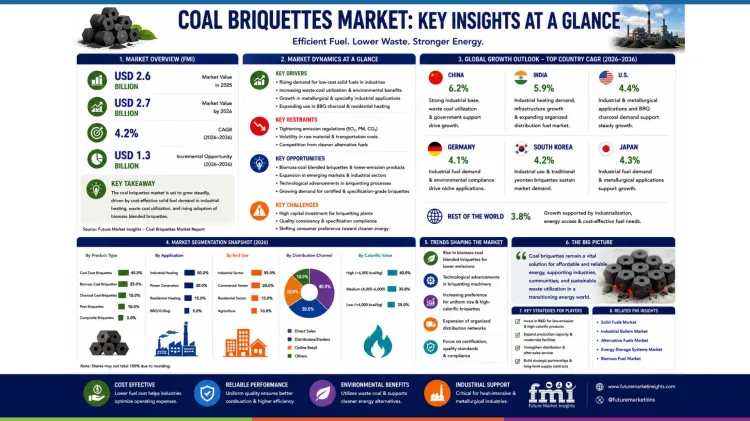
FMI projects the coal briquettes market to expand from USD 2.7 billion in 2026 to USD 4.0 billion by 2036 at a 4.2% CAGR. Coal dust briquettes hold 45.0% product share, industrial heating accounts for 50.0% of application demand, and industrial end users account for 55.0%. These shares show that briquettes remain tied to cost-sensitive industrial fuel procurement and waste-coal utilization rather than a broad clean-energy growth story.
The competitive case begins with cost. FMI states that demand is supported by the cost competitiveness of coal briquettes as solid fuel in industrial applications. Manufacturing facilities with established solid-fuel handling systems continue buying briquettes when the cost of changing fuels outweighs the expected economic benefit of switching. This is the core reason coal briquettes remain relevant. Infrastructure lock-in and delivered heat cost matter.
Coal dust briquettes add another cost advantage through waste utilization. Coal fines and dust are often generated during mining and processing. Briquetting converts those lower-value materials into saleable fuel with more uniform sizing and handling. This can reduce waste and create fuel value from material that would otherwise be difficult to use.
That message is commercially important, and it should not be overstated. Waste utilization does not make coal briquettes climate-neutral. They are still carbon-based fuels. Their competitiveness in energy-transition markets depends on whether they can meet emissions requirements, remain cheaper than alternatives, and serve applications where fuel switching is difficult.
Emission pressure is the central constraint. FMI notes that tightening environmental regulations on coal combustion emissions, including sulfur dioxide, particulate matter, and carbon dioxide, limit adoption. It also states that briquettes are losing share in areas with strict air-quality standards as industrial activity shifts toward cleaner fuels.
This is visible in Europe. The European Commission states that EU coal production and consumption fell to their lowest recorded levels in 2024, reaching 242 million tonnes and 306 million tonnes respectively, with consumption down 13% and production down 12% from 2023. The IEA Global Energy Review 2025 reports that EU coal power generation fell 15% in 2024 and total coal demand declined by more than 10%.
These figures show that in strict energy-transition markets, generic coal fuel is under structural pressure. A coal briquette supplier cannot rely only on low price in such environments. The product must fit narrower use cases such as certified smokeless fuels, blended products, industrial applications without immediate alternatives, specialty metallurgical inputs, or consumer barbecue markets where policy permits.
The UK is a useful example of how regulation can reshape rather than entirely eliminate solid-fuel demand. GOV.UK states that in smoke control areas, only authorised fuels or exempt appliances can be used. The Defra official authorised-fuel list includes manufactured solid fuels certified under the Clean Air Act and domestic solid fuel standards. FMI notes that smokeless fuel briquettes serve UK residential heating markets where Clean Air Act regulations require low-emission solid fuels.
This creates a compliance-filtered market. Suppliers that can produce approved low-smoke or smokeless briquettes may retain access. Suppliers selling high-smoke products face restriction. The market does not disappear, and it becomes more regulated and specification-driven.
Biomass-coal blending is one route to preserve competitiveness. FMI identifies biomass-coal blended briquettes as an opportunity because they can reduce net carbon emissions by using agricultural and forestry residues as co-feedstocks while retaining the handling benefits of briquetted solid fuel. The report also mentions 2025 developments involving biomass white coal briquette product expansion and a biomass-coal blended briquette production line for a European industrial customer seeking lower-emission solid fuel alternatives.
The value of biomass blending depends on actual composition, emissions profile, energy value, ash behavior, supply consistency, and certification. A blended briquette may still face restrictions if it produces excessive smoke, sulfur, particulates, or carbon intensity. Buyers will increasingly ask for test data, combustion performance, and regulatory acceptability rather than accepting a green label.
Metallurgical applications provide another defensible route. Coal briquettes used in blast furnaces, foundries, and specialty metals processing may provide carbon and process functionality rather than only heat. FMI identifies metallurgical-grade briquettes as a premium niche with specific chemical and physical product specifications. In these uses, briquettes compete less directly with household heating fuels and more with coke breeze, anthracite, metallurgical coal products, and carbon additives.
The industrial heating market is more nuanced. A factory using briquettes in a region with limited natural gas access and high electricity prices may continue buying if emissions can be managed. A plant in a strict air-quality zone with access to cleaner fuels may phase down briquette use. The same product can be competitive in one market and structurally disadvantaged in another.
The USA demonstrates diversified demand. FMI projects 4.4% CAGR, supported by industrial heating, metallurgical applications, consumer BBQ charcoal briquettes, and waste-coal utilization. This suggests that coal briquettes in the USA are not dependent on utility coal power alone. Consumer barbecue and specialty industrial demand can sustain a separate commercial base.
Japan and South Korea show similar selectivity. FMI projects Japan at 4.3%, driven by industrial fuel demand and specialized metallurgical applications. South Korea is projected at 4.2%, supported by industrial applications and traditional yeontan heating demand in some residential settings. These countries do not represent unrestricted coal growth. They represent targeted briquette demand within specific cultural, industrial, and procurement contexts.
In emerging markets, coal briquettes may remain competitive for a different reason, namely infrastructure limitations. FMI notes that developing economies in Asia and Africa sustain residential briquette consumption for heating and cooking where natural gas infrastructure is limited. For such users, the fuel choice may be driven by affordability, availability, and compatibility with existing stoves or heating systems. Energy transition pressure still exists, and practical substitution can be slower when cleaner alternatives are unavailable or unaffordable.
The long-term risk is that coal briquettes can be squeezed from both sides. In advanced markets, regulation and decarbonization reduce coal fuel use. In emerging markets, policy support for cleaner cooking, LPG, electricity, biomass pellets, and solar may gradually reduce household coal use. Industrial buyers may electrify heat, adopt gas, switch to biomass, or use alternative fuels when economics and equipment allow.
The counterweight is cost and specialization. Briquettes can remain competitive where they provide low-cost industrial heat, convert waste coal into usable fuel, meet approved smokeless standards, serve barbecue or consumer charcoal demand, or deliver metallurgical performance. The broad market may not be high-growth, but selected applications can remain commercially durable.
Suppliers should adapt the product strategy rather than defend coal briquettes as a generic low-cost fuel. Four pathways look more practical.
Certified low-emission fuels are one path, with products designed for smoke-control or air-quality-regulated markets.
Biomass-coal blends are a second path, using formulations that reduce coal intensity while preserving handling and solid-fuel compatibility.
Industrial specification briquettes are a third path, tailored for metals, cement, ceramics, chemicals, and heat-treatment applications.
Metallurgical-grade briquettes are a fourth path, where carbon content, strength, ash, sulfur, and reactivity are controlled.
The commercial language also needs to shift. A buyer in an energy-transition market may not respond to cheap coal fuel alone. It may respond to waste recovery, lower smoke, certified performance, reduced dust, uniform combustion, biomass content, and process-specific cost advantage. Even then, claims need to be supported by test data and regulatory approvals.
Coal briquettes can remain competitive, but not in the same way everywhere. In strict policy markets, the future is narrower and more specification-driven. In developing markets, affordability and infrastructure gaps can sustain demand longer. In industrial markets, process heat and metallurgical uses are more resilient than generic fuel use.
The market's 4.2% CAGR suggests a steady, selective future rather than rapid expansion. The products most likely to survive are those that move beyond undifferentiated coal combustion and align with waste utilization, certified lower-emission performance, biomass blending, and specialized industrial value.

