


By Sabyasachi Ghosh
Clinical seating is no longer a commodity purchase. Hospitals and outpatient centers now expect chairs to support infection control, staff safety, patient comfort, and faster room turnover at the same time.
That shift matters because more care is moving into seated treatment environments. The result is a market where product specification is getting more technical and replacement cycles are being shaped by workflow, not just furniture budgets.
Why procurement standards are rising
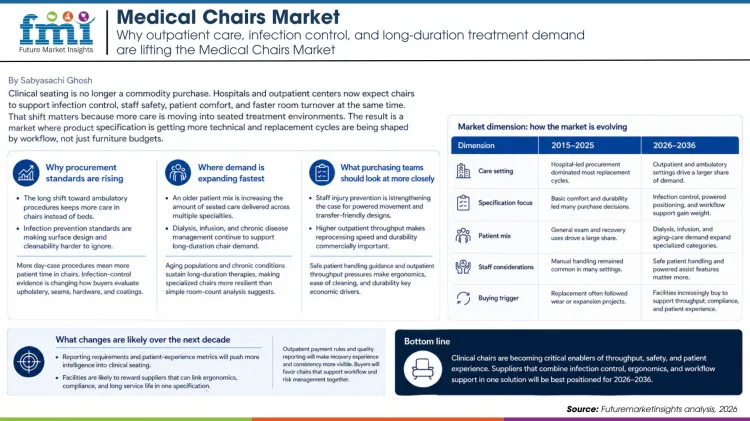
- The long shift toward ambulatory procedures keeps more care in chairs instead of beds.
- Infection prevention standards are making surface design and cleanability harder to ignore.
OECD ambulatory surgery data show that day-case treatment is firmly established in many health systems, especially for routine procedures such as cataracts. That means more patient time is spent in exam, treatment, and recovery chairs, which lifts both baseline demand and the importance of ergonomic design.
At the same time, infection-control evidence keeps pressure on clinical furniture specifications. CDC prevalence work and WHO reporting on infection prevention both reinforce the need for surfaces that are easy to disinfect and less likely to trap contamination. That changes how buyers compare upholstery, seams, hardware, and coatings.
Where demand is expanding fastest
- An older patient mix is increasing the amount of seated care delivered across multiple specialties.
- Dialysis, infusion, and chronic disease management continue to support long-duration chair demand.
Population aging extends the runway for chairs used in primary care, specialty visits, and recurring therapies. More older patients means more time spent in settings where the chair is part of the clinical experience rather than a background fixture.
Chronic conditions reinforce that trend. Diabetes and kidney disease continue to sustain dialysis and infusion activity, and those treatment settings require seating that can handle long dwell times, repositioning needs, and staff handling requirements. This makes specialized chair categories more resilient than a simple room-count analysis would suggest.
| Market dimension | 2015-2025 | 2026-2036 |
|---|---|---|
| Care setting | Hospital-led procurement dominated most replacement cycles. | Outpatient and ambulatory settings drive a larger share of demand. |
| Specification focus | Basic comfort and durability led many purchase decisions. | Infection control, powered positioning, and workflow support gain weight. |
| Patient mix | General exam and recovery uses drove a large share. | Dialysis, infusion, and aging-care demand expand specialized categories. |
| Staff considerations | Manual handling remained common in many settings. | Safe patient handling and powered assist features matter more. |
| Buying trigger | Replacement often followed wear or expansion projects. | Facilities increasingly buy to support throughput, compliance, and patient experience. |
What purchasing teams should look at more closely
- Staff injury prevention is strengthening the case for powered movement and transfer-friendly designs.
- Higher outpatient throughput makes reprocessing speed and durability commercially important.
OSHA and NIOSH safe patient handling guidance keeps attention on devices that reduce manual strain on staff. In chair procurement, that favors powered lift, tilt, height adjustment, and lateral support features that help facilities lower ergonomic risk without slowing patient flow.
Outpatient surgery growth adds another layer. As centers process more same-day cases, chairs must clean quickly, hold up under repeated use, and support consistent positioning across procedures. Buyers who still evaluate them like basic seating will miss the operational cost side of the decision.
What changes are likely over the next decade
- Reporting requirements and patient-experience metrics will push more intelligence into clinical seating.
- Facilities are likely to reward suppliers that can link ergonomics, compliance, and long service life in one specification.
Outpatient payment rules and quality reporting are slowly making recovery experience, documentation, and care consistency more visible. That should favor chairs that support memory settings, integrated scales, or accessory interfaces in higher-acuity use cases.
The market will still grow through construction and replacement, but the more interesting shift is qualitative. Buyers increasingly want equipment that supports workflow and risk management together. For detailed segment sizing and the 2026-2036 outlook, see the Future Market Insights report: Medical Chairs Market (2026 - 2036) - https://www.futuremarketinsights.com/reports/medical-chairs-market
Bibliography
- OECD, Health at a Glance 2023: Ambulatory surgery chapter. Https://www.oecd.org/en/publications/health-at-a-glance-2023_7a7afb35-en/full-report/ambulatory-surgery_f0b2228d
- OECD, Health at a Glance 2025: Ambulatory surgery indicators. Https://www.oecd.org/content/dam/oecd/en/publications/reports/2025/11/health-at-a-glance-2025_a894f72e/8f9e3f98-en.pdf
- CDC, 2018 HAI Progress Report and prevalence statement. Https://archive.cdc.gov/www_cdc_gov/hai/data/archive/2018-HAI-progress-report.html
- WHO, Global report on infection prevention and control 2024. Https://www.who.int/publications/i/item/9789240103986
- UN DESA, World Population Prospects 2022 Summary of Results. Https://www.un.org/development/desa/pd/sites/www.un.org.development.desa.pd/files/wpp2022_summary_of_results.pdf
- WHO, Diabetes materials referencing 422 million and mortality. Https://www.who.int/publications/i/item/SEA-NCD-114 and https://www.who.int/southeastasia/news/detail/14-11-2023-world-diabetes-day--access-to-diabetes-care
- USRDS 2023 Interactive Annual Data Report overview. Https://www.niddk.nih.gov/about-niddk/strategic-plans-reports/usrds/news/2023/usrds-releases-2023-interactive-annual-data-report
- CMS, CY 2024 OPPS/ASC Payment System Final Rule Fact Sheet. Https://www.cms.gov/newsroom/fact-sheets/cy-2024-medicare-hospital-outpatient-prospective-payment-system-and-ambulatory-surgical-center-0
- CMS, CY 2025 OPPS/ASC Payment System Final Rule Fact Sheet. Https://www.cms.gov/newsroom/fact-sheets/cy-2025-medicare-hospital-outpatient-prospective-payment-system-ambulatory-surgical-center-payment
- OSHA, Safe Patient Handling overview. Https://www.osha.gov/healthcare/safe-patient-handling
- OSHA, SPH program effectiveness brief. Https://www.osha.gov/sites/default/files/3.5_SPH_effectiveness_508.pdf
- ASCA and CMS-derived ASC counts via Becker's. Https://www.beckersasc.com/leadership/the-number-of-ascs-in-all-50-states-2025/
- Alcon 2024 Annual Report data on cataract volumes. Https://www.sec.gov/Archives/edgar/data/1111485/000095017024048392/2024_ars_12312023.pdf

