


- Pet milk replacers are not bought like routine pet food; they are purchased during high-risk neonatal feeding situations where survival, digestion, and growth consistency matter more than shelf price.
- FMI’s Pet Milk Replacers Market identifies cat milk replacers as the leading pet-type segment and dog puppy milk replacers as another major demand pool, showing that early-life nutrition is the core market logic.
- The real economic benchmark is cost-in-use: mixing accuracy, digestibility, tolerance, waste reduction, feeding compliance, and the risk of poor outcomes.
- Premium value is strongest where products combine dairy-based nutrition, digestibility support, clear preparation instructions, probiotic or immune-support positioning, and veterinary or breeder trust.
- Ingredient volatility in dairy proteins, fats, vitamins, minerals, and functional additives can change margins, but buyers are less likely to trade down when neonatal risk is high.
- The misconception to avoid is that pet milk replacer demand is driven by general pet food premiumization alone. It is a protocol-led emergency and neonatal care category.
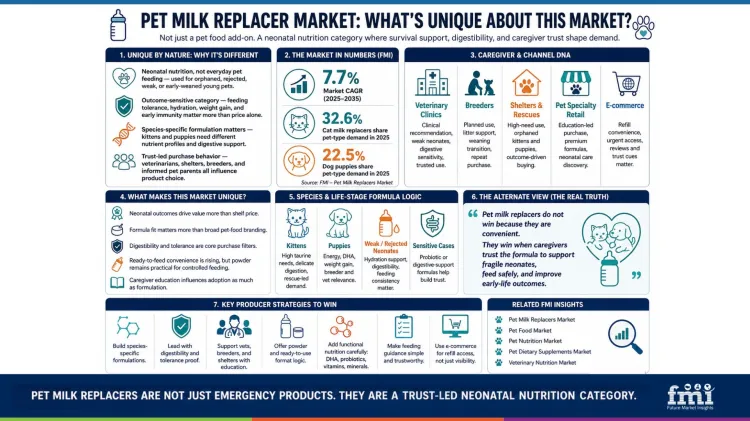
Pet milk replacers sit in a very different buying context from mainstream pet food. A dog owner buying kibble or treats may compare flavor, brand, price, and convenience. A breeder, shelter worker, rescuer, veterinarian, or pet parent buying milk replacer is often responding to a vulnerable newborn animal that cannot nurse properly, has lost maternal access, or requires supplemental feeding. That changes the economics of the category.
In the Pet Milk Replacers Market, FMI identifies cat milk replacers as the leading pet-type segment, with dog puppy milk replacers also representing a major demand pool. This segmentation matters because the category is anchored in neonatal care rather than ordinary feeding. Buyers are not only purchasing calories. They are buying confidence that the product will support early growth, digestion, hydration, and survivability during a high-risk window.
This is why the best economic lens is not price per can, price per pouch, or price per gram. The better measure is risk-adjusted cost-in-use. A lower-priced replacer can become expensive if it mixes poorly, creates digestive upset, leads to waste, confuses caregivers, or fails to support consistent weight gain. In neonatal feeding, small formulation or preparation errors can quickly become larger outcome risks. The value of a milk replacer therefore depends on how reliably it works under real caregiver conditions.
The Pet Food Market is a useful adjacent reference because it shows the broader premiumization and humanization of companion animal nutrition. However, pet milk replacers do not behave like normal pet food. The purchase is narrower, more urgent, and more technical. A pet owner may trade down on adult pet food if budgets tighten. A breeder or rescue caregiver is less likely to trade down during newborn feeding if the product is already trusted and the risk of poor tolerance is high.
Ingredient economics still matter. Milk replacers often depend on dairy-derived proteins, fats, lactose or carbohydrate systems, vitamins, minerals, amino acids, digestive support ingredients, and sometimes probiotics or immune-support positioning. Volatility in dairy ingredient prices, packaging costs, and logistics can affect supplier margins. Yet the finished product’s value is protected when the brand has proven reliability. In other words, the category has cost pressure, but it also has a high trust barrier that limits purely price-led switching.
The Functional Milk Replacers Market helps explain the wider logic. Milk replacers are increasingly evaluated not only as substitutes for maternal milk, but as functional nutrition systems that can support gut health, immunity, and early development. The same logic applies to pets, although the buying base is smaller and more emotional. A product that supports digestion, stool quality, feeding acceptance, and visible neonatal progress can defend a premium because it reduces caregiver uncertainty.
This premium is not automatic. It must be connected to usable proof. Caregivers need clear mixing ratios, feeding tables, storage instructions, and species-specific guidance. Veterinary clinics and shelters need reliable preparation instructions that can be followed across shifts. Breeders need consistency across litters. Retailers need pack formats that reduce misuse and improve repeat purchase. A technically strong formula can still underperform commercially if the user experience is confusing.
Powder formats often have practical advantages because they support longer shelf life, lower shipping weight, and flexible preparation volumes. But powder also creates execution risk. If the ratio is misunderstood, the water temperature is wrong, or the mixture is not fully dissolved, the finished feeding solution may not perform as intended. This makes instruction design part of the economics. A brand that reduces preparation error can create more value than one that simply offers a lower ingredient cost.
Liquid ready-to-feed formats have a different economic story. They may reduce mixing error and suit urgent use, shelters, veterinary settings, or inexperienced caregivers. However, they can be heavier to ship, more expensive per feeding, and less flexible once opened. The choice between powder and liquid is therefore not only about consumer preference. It is about balancing cost, safety, dosing accuracy, storage, and the caregiver’s skill level.
The Veterinary Therapeutic Diet Market provides another useful reference because it shows how animal nutrition categories can gain value when professional recommendation and health-related use cases are involved. Pet milk replacers are not therapeutic diets, but they share a similar trust pathway: users rely on professional guidance when the animal’s condition is sensitive. Brands that are accepted by veterinarians, shelters, breeders, and rescue networks are better positioned than brands that depend only on retail shelf visibility.
The strongest premium opportunities sit in kitten milk replacers, puppy milk replacers, digestive-support formulas, immune-support formulas, breeder packs, shelter-ready bulk packs, and products with clear veterinary-style feeding protocols. The weaker opportunities are generic products that rely only on broad pet nutrition claims without addressing preparation, tolerance, and neonatal outcomes. In this market, vague premium language has limited value unless it is tied to practical feeding confidence.
Manufacturers should therefore evaluate product economics at three levels. First, ingredient economics: dairy protein source, fat quality, vitamin-mineral inclusion, probiotics, and supply stability. Second, usage economics: mixing accuracy, dosage flexibility, pack size, waste, and storage. Third, outcome economics: digestibility, growth support, stool quality, acceptance, and caregiver confidence. The strongest products perform across all three levels.
Retailer education also changes the economics. Pet specialty stores and online product pages need to explain why milk replacers are species-specific, why preparation ratios matter, and when veterinary advice is needed. Stronger brands reduce purchase friction by making the category easier to understand at the point of need. This is particularly important because many buyers enter the category suddenly and may not have time to compare technical details.
Suppliers that can support training materials, breeder guidance, shelter-use instructions, and customer service are therefore better positioned than suppliers that rely only on nutritional composition. In this market, the service layer becomes part of the product value. The economic premium is earned when the brand helps prevent avoidable mistakes during a sensitive feeding window.
The misconception to avoid is that pet milk replacers are simply a small extension of the pet food aisle. They are not. They are a neonatal nutrition category where trust, instruction clarity, and outcome risk shape pricing power. A product can look expensive by shelf price but economical if it reduces feeding failure, waste, and uncertainty.
Bottom line: pet milk replacers win when they reduce neonatal feeding risk. Price matters, but the category’s real economics are built around digestibility, preparation reliability, species fit, and the confidence of breeders, shelters, veterinarians, and pet parents.

