


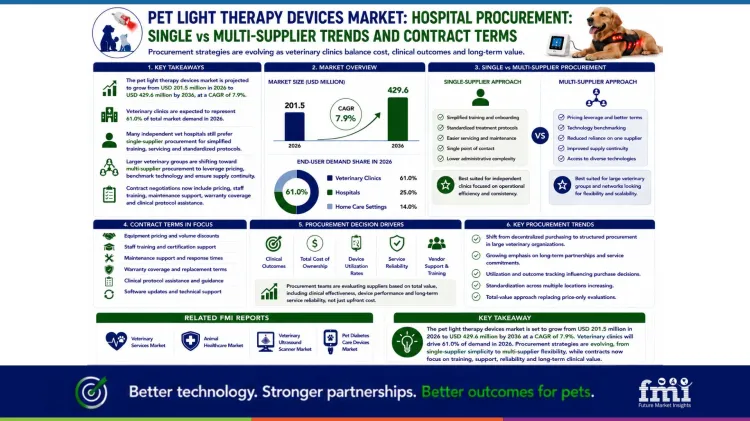
- The pet light therapy devices market is projected to expand from USD 201.5 million in 2026 to USD 429.6 million by 2036, exhibiting a CAGR of 7.9%, driven by the rising investments of veterinary clinics in non-invasive pain management and rehabilitation technologies.
- Veterinary clinics are projected to represent 61.0% of total market demand in 2026, with procurement strategies within clinic networks being a key factor for supplier success.
- Many independent vet hospitals still prefer single-supplier procurement for simplified training, servicing and standardized treatment protocols.
- Larger veterinary groups are moving toward multi-supplier procurement models that focus on pricing leverage, technology benchmarking and supply continuity.
- More and more, contract negotiations are focused on equipment pricing, staff training, device maintenance support, warranty coverage and clinical protocol assistance.
- Procurement teams are looking at pet light therapy systems through a total-value lens, considering clinical outcomes, device utilization rates and long-term service reliability.
The pet light therapy devices market is witnessing accelerated commercialization on account of the rising adoption of photobiomodulation technologies by veterinary providers for managing pain, rehabilitation, wound healing and post-surgical recovery. The market valuation is expected to rise from USD 201.5 million in 2026 to USD 429.6 million by 2036 providing lucrative opportunities for manufacturers and suppliers of devices in the field of companion animal healthcare.
As adoption increases, so does the importance of procurement strategies.
The purchasing decisions for traditional veterinary equipment categories tend to be highly decentralized, but pet light therapy devices typically entail staff training, treatment protocol development, and ongoing utilization support. Procurement decisions are thus not limited to the purchase of hardware, but increasingly concern long-term vendor relationships.
Most small and mid-sized veterinary practices are still operating under a single-supplier procurement model.
Many clinics prefer to deal with one main supplier as it makes it easier to train technicians, maintain devices, manage consumables, and standardize clinical workflow. A single-vendor environment also reduces administrative complexity and allows veterinary teams to become comfortable with a consistent treatment platform.
For independent practices, the ease of procurement often outweighs any potential savings that could be achieved by purchasing equipment from multiple vendors.
This phenomenon holds particular importance as veterinary clinics are expected to contribute 61.0% to the market demand in 2026. When new technologies like light therapy systems enter the picture, many of these facilities focus on operational efficiency and predictable support.
But procurement behavior shifts dramatically in larger veterinary organizations.
Multi-supplier procurement strategies are increasingly being adopted by corporate veterinary groups, specialty hospital networks, and multi-location operators. These organizations typically do competitive evaluations of suppliers to benchmark clinical performance, service capabilities, financing options and total cost of ownership.
Multi-supplier procurement provides leverage in negotiations.
When a lot of vendors are competing for a place across a network, buyers have more flexibility on price, warranty terms, training support and service commitments. Veterinary groups also can reduce reliance on one supplier and still gain access to new technologies entering the marketplace.
The growing diversity of light therapy systems available allows for multi-supplier approaches.
Laser-based devices are expected to represent 58.0% of the market demand in 2026; various LED and near-infrared technologies are still growing in clinical applications. Different suppliers are specialists in different treatment platforms, so buyers are encouraged to look at several options before making fleet-wide commitments.
Contracting structures are also in transition.
Traditional veterinary equipment contracts have been primarily price of equipment and length of warranty period. Clinical education programs, certification support, software updates, maintenance response times, replacement unit availability and treatment protocol guidance are all becoming part of procurement discussions more and more today.
These considerations are particularly important because utilization rates ultimately determine return on investment.
A device that receives limited clinical use generates little economic value regardless of acquisition cost. Consequently, veterinary providers increasingly seek suppliers capable of supporting long-term adoption and workflow integration.
Service-level agreements are becoming more prominent as well.
The veterinary hospitals that do a lot of rehabilitation and pain management want equipment they can count on to keep working. Thus, supplier evaluations are increasingly focusing on contract clauses concerning repair turnaround times, the availability of technical support and preventive maintenance schedules.
Trends in veterinary healthcare consolidation are also shaping the procurement landscape.
Increasingly larger veterinary organizations are expanding through acquisitions and by building networks, and the purchasing authority is moving away from individual clinicians and into centralized procurement teams. Such teams tend to use structured evaluation criteria and focus on measurable value metrics in supplier selection.
Those manufacturers who can show clinical efficacy, strong support infrastructure and scalable service capabilities are likely to be the biggest winners in this transition.
The mistake to avoid is assuming that procurement decisions are mainly driven by price.
In fact, veterinary organizations are increasingly focusing on evaluating suppliers for their ability to support them in adopting treatments, keeping equipment performing and contributing to operational efficiency over the life of the contract.
Bottom Line
Procurement strategies in pet light therapy devices market are getting sophisticated with the rate of adoption. Independent clinics still love the simplicity of single-supplier models, but larger veterinary organizations are increasingly looking to multi-supplier models to gain negotiating leverage and access to a wider range of technologies. With the market projected to grow to USD 429.6 million by 2036, supplier support capabilities and contract value propositions are expected to be increasingly important competitive differentiators.

