


- Private label is not the first obvious angle for chitin, but it matters because retailer brands increasingly shape clean-label, preservation, packaging, and sustainability requirements.
- Chitin-enabled preservation can become a hidden enabler of private-label quality, especially in fresh produce, seafood, meat, ready meals, and packaged foods.
- If chitosan-based coatings and preservation systems become scalable, retailers can use them to make private-label products look fresher, cleaner, and more sustainable.
- Premium food brands are exposed if their clean-label preservation claims become easy for retailers to copy.
- Supplier differentiation will matter because private-label adoption requires cost efficiency, regulatory support, food-grade reliability, and application proof.
- The biggest misconception is that private label matters only in finished consumer products. In chitin, private label can influence upstream ingredient demand through retailer specifications.
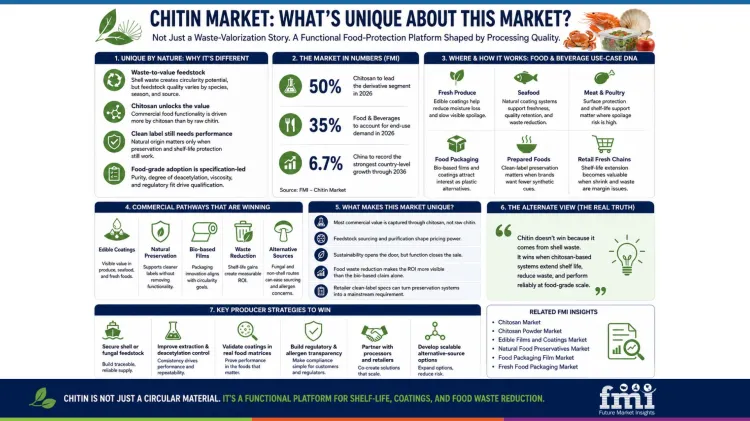
While the issue of private labeling in chitin may be indirect, it remains significant nevertheless. First of all, chitin is certainly not a product line sold in supermarkets and thus, there will be no need to refer to its purchase in terms of “chitin.” However, chitin and chitosan have an impact on the competitive ability of certain food products.
The Chitin Market is relevant to private-label strategy because Food & Beverages accounts for 35% of end-use demand in 2026. This means chitin-based systems are connected to the types of food categories where retailers and private-label brands compete directly: fresh produce, seafood, meat, ready meals, packaged foods, and clean-label formats.
Food retailers have become highly influential players in food innovations. Retailers determine the range of their own products, the needs from suppliers, packaging practices, shelf life expectations, and even clean label expectations. Should there be a need by a retailer for longer lasting fresh produce or seafood packaging that does not easily spoil, chitosan-based solutions may come into play.
Chitosan’s 50% derivative share matters because chitosan is more application-ready than raw chitin. The Chitosan Market supports this discussion because chitosan-based preservation and coating systems can help deliver functional outcomes that retailers value: freshness protection, microbial control, reduced spoilage, and shelf-life support.
The problem starts for private label when the claim is scaled. Specialty foods brands can initiate by introducing products with natural coatings, bio-degradable packaging, or clean preservation methods as a means of distinguishing their products from others. However, once the technology for such processes spreads among other food companies and retailers, the private label companies will be able to do the same at reduced costs.
The Edible Films and Coatings Market is useful for this logic because coating technologies can move from niche innovation into mainstream fresh-food protection. If a coating can reduce moisture loss, slow visible spoilage, or support freshness in fresh produce and seafood, retailers have a clear incentive to test it in private-label supply chains.
Retailers also have a strong incentive to reduce food waste. Food waste affects margins, sustainability reporting, store operations, and consumer trust. This is why the Fresh Food Packaging Market is relevant when discussing retailer-led adoption in produce, meat, seafood, and chilled food formats. Shelf-life extension can have direct commercial value.
Private-label adoption can also affect ready meals and packaged foods. The Ready Meals Packaging Market is a useful link when discussing chilled, frozen, and packaged meal formats where clean-label preservation, packaging performance, and shelf stability matter. Retailers may use functional packaging and preservation systems to improve quality while defending accessible price points.
The clean-label preservation angle should also be linked to the Natural Food Preservatives Market, because retailer brands may use natural preservative systems to compete with premium brands while keeping prices more accessible. If consumers respond to cleaner labels but remain price-sensitive, private label can become a powerful adoption channel.
The premium foods brands will be most vulnerable when they have a weak differentiation strategy. This is because, in case the differentiation of the brand hinges on “natural preservation,” “biological coatings,” or “fewer synthetic ingredients,” then the private label food brands will simply replicate that marketing message as soon as it becomes scalable by the supplier.
The use of private-label chitin will not just happen; proof will be needed on behalf of retailers and contract manufacturers. Chitin technologies must comply with food contact/food use criteria, have no sensory impact, work within manufacturing equipment, and work under any conditions of distribution and they need to be economic, too. Retailers will not embrace a technology that protects shelf life but cuts margins.
This creates an important supplier opportunity. Chitin and chitosan producers that can offer validated application systems may benefit from retailer-led demand. The strongest suppliers will not simply sell raw material. They will help processors apply coatings, test shelf life, manage regulatory documentation, and adapt systems for different food matrices.
There is also the issue of positioning. The use of chitosan from crustaceans may have excellent technical merits, but some retailers might want to use fungi or any other source of chitosan for their positioning as vegans, allergen-sensitive, and environmentally friendly products. They could position themselves differently according to their location and type of product, as well.
The implications for the chitin market are hence altered as a result. It is not just the biomaterial market that can be considered an upstream market anymore. The market for chitin may enter into competition on the basis of freshness, reduction of waste, clean labeling, and sustainability of packaging. With the introduction of private labels in functional foods, upstream ingredients like chitin can be used as hidden weapons in competition.
The common myth that must be debunked is the belief that private labeling is irrelevant because chitin is a B2B product. In truth, retailer demands could actually influence the preservation and packaging technologies used by food manufacturers.
Bottom line: Private label could accelerate chitin adoption if retailers use chitosan-based preservation, coatings, or packaging to improve freshness, reduce waste, and mainstream clean-label claims. Premium brands will need stronger differentiation once natural preservation becomes easier to copy.

