


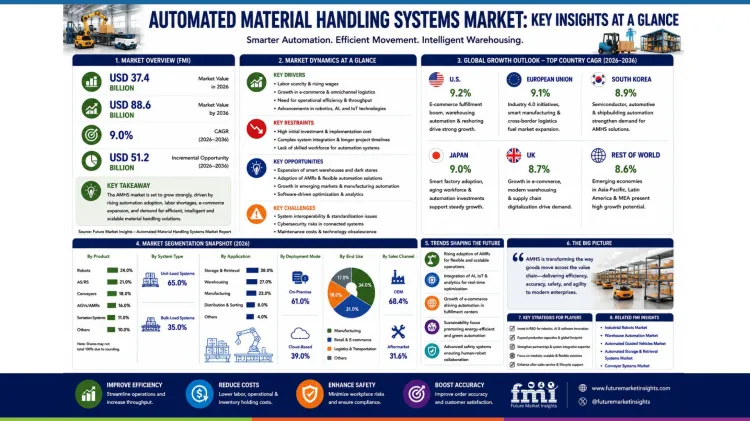
- The USA shows the highest FMI growth forecast among the listed AMHS markets, at 9.2% CAGR through 2036, narrowly ahead of the EU at 9.1%.
- China remains the largest industrial robotics deployment market by scale, with 295,000 industrial robot installations in 2024 and more than 2 million operational factory robots.
- The EU combines factory automation, automotive logistics modernization, cross-border e-commerce, and harmonized machinery standards.
- USA demand is being shaped by e-commerce fulfilment, warehouse labour constraints, CHIPS Act-linked semiconductor facilities, and reshoring-related manufacturing expansion.
- China's advantage is production and deployment scale, while USA and EU demand is more visibly linked to high-value warehouse automation, advanced manufacturing, compliance, and multi-site logistics.
- The regional conclusion depends on the metric. China leads in automation scale, while FMI places the USA marginally ahead of the EU in forecast AMHS growth.
China, the European Union, and the United States are all investing heavily in automated material handling. The comparison becomes misleading when it is reduced to one question about who is investing fastest. The answer changes depending on whether the measure is robot deployment, warehouse automation growth, semiconductor expansion, e-commerce throughput, manufacturing modernization, or forecast market CAGR.
China is the scale leader in industrial automation. The United States is the fastest-growing country in the FMI automated material handling systems forecast. The European Union is close behind and benefits from one of the strongest manufacturing and cross-border logistics ecosystems in the world.
This is not a three-way race with one universal winner. It is a division of strengths.
FMI forecasts the global automated material handling systems market to grow from USD 37.4 billion in 2026 to USD 88.6 billion by 2036 at a 9.0% CAGR. It places the USA at 9.2% CAGR through 2036 and the EU at 9.1%. Japan follows at 9.0%, South Korea at 8.9%, and the UK at 8.7%. China is included in the East Asia regional scope, and the visible country comparison on the report page does not publish a China-specific AMHS CAGR. That distinction is important. China should not be assigned an FMI country growth rate that the report page does not provide.
The available evidence still makes China central to the automation discussion.
The International Federation of Robotics reports that China installed 295,000 industrial robots in 2024, equal to 54% of global deployments. China operational robot stock exceeded 2 million units that year. The country also accounted for 43.5% of the global operational industrial robot stock in 2024. These figures are not AMHS-only data, and they indicate the depth of China broader manufacturing automation base.
China strength begins with industrial density. Automotive, electronics, batteries, machinery, e-commerce, consumer goods, port logistics, and high-volume manufacturing all create a large addressable base for conveyors, sortation systems, automated storage, AGVs, AMRs, industrial robots, and warehouse software. The scale of Chinese e-commerce alone creates a strong need for fulfilment automation, while its large electronics and EV supply chains create demand for factory logistics.
FMI identifies East Asia as a core demand centre, driven by Chinese e-commerce logistics scale, Japanese smart factory investment, and South Korean semiconductor manufacturing. The Chinese market is therefore not only a robotics market. It is also a logistics and material-flow market with large warehouse, factory, and distribution infrastructure.
The challenge for international suppliers in China is competition. IFR reports that Chinese robot manufacturers held 57% of their domestic market in 2024, compared with approximately 28% over the previous decade. This suggests that local suppliers are gaining not only on volume but also on market access, price, service, and product familiarity. Global AMHS companies can still compete in advanced systems, software, high-density storage, cleanroom logistics, and multinational customer projects. Their position is harder in mid-tier standardized applications where domestic manufacturers can offer lower cost and faster local support.
The United States has a different investment profile. FMI places it at the highest visible AMHS growth rate, 9.2% CAGR through 2036. The report attributes that growth to e-commerce fulfilment expansion, warehouse automation investment by major retailers and 3PL operators, CHIPS Act semiconductor facility construction, reshoring-related manufacturing expansion, labour cost pressure, and workforce shortages.
This combination makes the USA attractive for high-value system integration. Large fulfilment centres increasingly need automated storage, robotic picking, high-speed sortation, and warehouse execution software to support same-day and next-day delivery expectations. These projects can be expensive, and the business case is strengthened by higher labour costs, turnover, and pressure to maintain service levels.
Semiconductor investment adds a specialized source of demand. Semiconductor fabs require highly controlled material movement. Wafer carriers, cleanroom transport, chemical logistics, inter-bay systems, and contamination-controlled handling are difficult to manage manually at scale. FMI specifically identifies CHIPS Act facility construction as a growth trigger for specialized cleanroom material handling in the USA
Reshoring creates a second USA demand layer. Manufacturing facilities that bring production closer to domestic markets need material-flow systems for receiving, storage, parts sequencing, assembly support, finished-goods movement, and internal logistics. Automotive, EV battery production, electronics, food and beverage, and industrial machinery all contribute to this demand.
The EU has a different mix again. FMI projects 9.1% CAGR through 2036, only 0.1 percentage points below the USA The report links EU growth to German automotive manufacturing automation, Industrie 4.0 smart factory programs, cross-border e-commerce logistics expansion, and harmonized DIN and EU CE equipment standards.
The EU strength is not only its manufacturing base. It is the combination of many connected markets. A warehouse or distribution network can serve multiple countries, which makes cross-border logistics automation valuable. E-commerce operators need sortation, storage, order fulfilment, and inventory visibility across national boundaries. Manufacturers need systems that comply with shared standards while supporting local operating conditions.
The European Commission states that machinery placed on the EU market before 20 January 2027 must comply with the current Machinery Directive, while the Machinery Regulation 2023/1230 establishes the future framework. This regulatory environment can slow some deployments because safety, conformity, documentation, and system integration require attention. It can also favour established integrators that can deliver compliant equipment across several EU countries.
Germany remains particularly important within the EU because of automotive, industrial equipment, chemicals, food processing, and advanced manufacturing. German smart factory initiatives and a large installed base of industrial systems create opportunities for upgrades, AGVs, AMRs, ASRS, conveyor modernization, and software integration. The region is also relevant for suppliers focused on energy-efficient equipment, safety-certified robotics, and cross-border service support.
Labour conditions matter across all three regions, in different ways. FMI identifies labour scarcity as a central AMHS growth driver, particularly in the USA, Japan, and Western Europe. China also faces demographic shifts and rising labour costs, and its automation case is more closely tied to manufacturing scale, domestic technology capability, and high-volume digital commerce.
The International Federation of Robotics provides another useful comparison. Asia represented 74% of new industrial robot deployments in 2024, Europe represented 16%, and the Americas represented 9%. China deployment scale is therefore far ahead. The USA remains the largest American industrial robot market, with 34,164 installations in 2024. The EU 27 accounted for 67,819 industrial robot installations in 2024. These figures should not be treated as a direct AMHS market-size ranking because industrial robots include applications beyond material handling. They do provide a directional view of automation intensity.
The faster-investment question is best answered through a matrix rather than a single ranking.
China leads on absolute factory automation scale, domestic robotics manufacturing, and e-commerce logistics volume. Its market is especially relevant for suppliers able to compete in cost-sensitive, high-volume, and locally supported automation programs.
The USA appears strongest in projected AMHS growth, warehouse labour economics, large fulfilment projects, reshoring, and semiconductor-related cleanroom logistics. It is likely to remain attractive for integrated warehouse automation, robotics, software, and high-value system projects.
The EU offers nearly equal forecast growth, a large manufacturing base, cross-border logistics demand, and a compliance framework that can favour sophisticated equipment suppliers. It is likely to be especially attractive for companies with strong safety, software, service, and multi-country delivery capabilities.
For AMHS providers, this suggests different go-to-market models. China may require local partnerships, local engineering, competitive cost, and faster application adaptation. The USA may reward end-to-end project delivery, strong service networks, and sector specialization in e-commerce, 3PL, automotive, and semiconductors. The EU may reward modularity, CE compliance, integration with legacy systems, and regional support.
The regional pattern is not static. China automation scale can create both export opportunities and competitive pressure. USA warehouse and chip-fab investment may create a larger share of high-value projects. EU standardization can simplify regional scaling for vendors already capable of meeting regulatory requirements.
The clearest observation is that China is investing at the largest industrial automation scale, while the USA and EU are showing closely matched growth prospects for automated material handling systems. Suppliers should not ask which region is best in isolation. They should assess whether their portfolio is designed for China scale, the USA project environment, or the EU integrated and compliance-led procurement structure.

