


By Nikhil Kaitwade
Rotary scroll compressors are gaining attention where compressed air quality, acoustic performance, and operating efficiency matter more than brute industrial scale. That puts them in a favorable position across healthcare, laboratories, food production, and other contamination-sensitive environments.
The buying decision is becoming more technical as well. Engineers are now weighing purity standards, part-load efficiency, monitoring capability, and code compliance together rather than treating the compressor as a simple utility asset.
Why the market is benefiting from tougher scrutiny
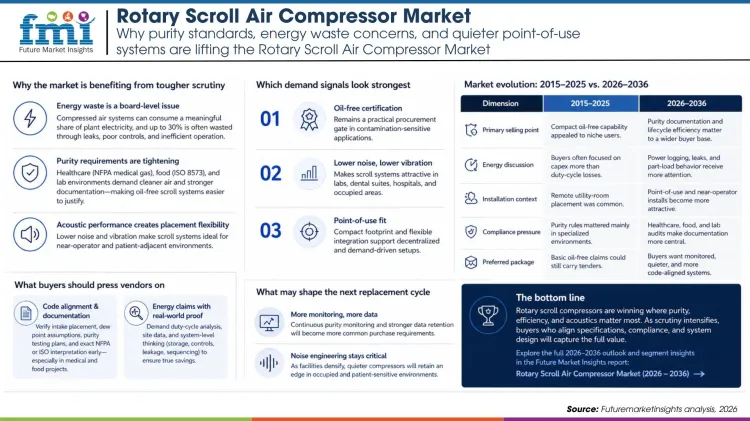
- Compressed air waste remains large enough that energy efficiency has become a board-level industrial maintenance issue.
- Healthcare and food applications keep pushing buyers toward cleaner air architectures and better documentation.
DOE guidance on compressed air makes the commercial case clear: these systems can consume a meaningful share of plant electricity, and poorly managed systems waste an enormous amount of that input. That makes buyers more receptive to compressor types that can perform well in the duty cycles they actually run, not just on a nameplate.
Purity requirements reinforce the shift. Hospitals must align with NFPA medical gas expectations, while food facilities increasingly document compressed air quality under standards such as ISO 8573 and food-safety audit programs. In those settings, oil-free scroll systems are easier to justify because contamination risk carries outsized consequences.
Which demand signals look strongest
- Oil-free certification remains a practical procurement gate in contamination-sensitive applications.
- Lower noise and vibration make scroll systems especially attractive near operators and patients.
Compressed air purity is not an abstract specification in this market. Where air can affect product, packaging, or patient safety, buyers increasingly want Class 0 or similarly stringent oil-free assurance. Scroll packages benefit because they fit naturally into that conversation.
Acoustic performance is the second major advantage. Lower pulsation and quieter operation make scroll machines easier to place near laboratories, dental suites, and other occupied areas where larger or noisier compressor architectures create additional enclosure and installation burdens.
| Market dimension | 2015-2025 | 2026-2036 |
|---|---|---|
| Primary selling point | Compact oil-free capability appealed to niche users. | Purity documentation and lifecycle efficiency matter to a wider buyer base. |
| Energy discussion | Buyers often focused on capex more than duty-cycle losses. | Power logging, leaks, and part-load behavior receive more attention. |
| Installation context | Remote utility-room placement was common. | Point-of-use and near-operator installs become more attractive. |
| Compliance pressure | Purity rules mattered mainly in specialized environments. | Healthcare, food, and lab audits make documentation more central. |
| Preferred package | Basic oil-free claims could still carry tenders. | Buyers want monitored, quieter, and more code-aligned systems. |
What buyers should press vendors on
- Code alignment and audit documentation should be checked early, especially in medical and food projects.
- Energy claims only matter if they are supported by realistic duty-cycle analysis and site data.
Medical gas and food-grade projects demand a more disciplined specification process. Buyers should verify intake placement, dew point assumptions, purity testing plans, and the exact NFPA or ISO interpretation being used before they treat a package as compliant.
Energy savings require the same skepticism. A scroll compressor may be the right answer for a point-of-use or variable-duty application, but only if storage, controls, leakage management, and sequencing are addressed. Otherwise the buyer may pay for an efficient machine inside an inefficient system.
What may shape the next replacement cycle
- Continuous purity monitoring and better data retention are likely to become more common purchase requirements.
- Noise engineering will keep giving scroll systems an advantage in occupied environments.
Guidance on compressed-air purity is becoming easier to operationalize, and sensors for contamination detection are becoming more plausible to bundle into commercial systems. That should reward vendors who can offer both machine performance and a stronger documentation layer.
The acoustic edge is also likely to stay important. As facilities densify and place utilities closer to operators, quieter compressors solve real installation problems. For the 2026-2036 forecast and segment detail, see the Future Market Insights report: Rotary Scroll Air Compressor Market (2026 - 2036) - https://www.futuremarketinsights.com/reports/rotary-scroll-air-compressor-market
Bibliography
- US Department of Energy, Energy Tips - Compressed Air: https://www1.eere.energy.gov/manufacturing/tech_assistance/pdfs/compressed_air1.pdf
- Consulting-Specifying Engineer, Interpreting NFPA 99 medical gas changes: https://www.csemag.com/articles/how-to-interpret-nfpa-99-medical-gas-electrical-changes/
- BCAS, Food & Beverage Grade Compressed Air Best Practice Guideline: https://www.bcas.org.uk/article/food-beverage-grade-compressed-best-practice-44.aspx
- Atlas Copco, ISO 8573-1 Class 0 overview: https://www.atlascopco.com/en-ae/compressors/customerbenefit/class-0-iso-8573-1
- Compressed Air Best Practices, ISO 8573.1 and ISO 12500 guide: https://www.airbestpractices.com/system-assessments/air-treatmentn2/air-quality-standards-iso-85731-iso12500
- Trace Analytics, Food-grade air testing and standards mapping: https://www.airchecklab.com/services/manufacturing-iso-8573-1/food-grade-air-testing/
- ScienceDirect, Noise analysis of dry scroll vacuum pump: https://www.sciencedirect.com/science/article/pii/S0042207X24002331
- MDPI, Noise reduction in electric scroll compressors: https://www.mdpi.com/2032-6653/16/3/126
- CAGI, Compressed Air Purity Guide: https://www.cagi.org/assets/documents/pdfs/publications/cagi-compressed-air-purity-guide.pdf%3Fupdated%3D1755803863
- arXiv, Photo-acoustic sensor for oil contamination in compressed air: https://arxiv.org/abs/1612.04806

