

- Market Size (2026)
- USD 107.8 Mn
- Forecast (2036)
- USD 328.9 Mn
- CAGR (2026 to 2036)
- 11.8%
How big is Capstan Cable Drives Market in 2026?
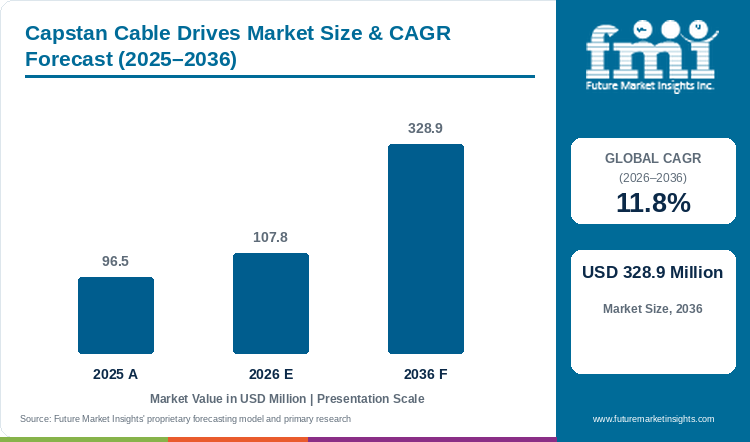
The capstan cable drives market demonstrated steady progress from USD 96.5 million in 2025 to USD 107.8 million in 2026, building toward a targeted valuation of USD 328.9 million by 2036 at a CAGR of 11.8%.
Rising hospital adoption of minimally invasive robotic surgery is driving recurring orders for miniature tendon drives as surgical departments perform more soft-tissue procedures each week, evidenced by an April 2026 United States Securities and Exchange Commission (SEC) Form 8-K filing from Intuitive Surgical showing annual procedure volume above 3.1 million across 11,395 installed da Vinci systems [1]. Because surgical wrists route cables around tight pulleys under steam sterilization, Tungsten Micro Wire Rope is projected to secure 62.4% of cable tendon material demand in 2026 as instrument builders pack four to six capstan spools into each disposable cartridge. Rising tendon count per robotic wrist multiplies micro-cable consumption faster than hospital system installations alone. Future Market Insights estimates that the global capstan cable drives market grew from USD 96.5 million in 2025 to USD 107.8 million in 2026 and will reach USD 328.9 million by 2036 at an 11.8% CAGR, adding USD 221.1 million in component value over the decade. Component expansion at an 11.8% CAGR runs below the 17.3% CAGR projected for downstream surgical robot procedures because each stainless helical drum endures 10 to 18 hospital sterilization cycles before cartridge retirement. Even while multi-port laparoscopy platforms generate steady replacement volume, wire strand wear during repeated autoclaving and manual cable tensioning hurdles still restrain rapid qualification on single-port microsurgical wrists.
Key Market Trends & Insights
- By cable tendon material: Tungsten Micro Wire Rope is projected to capture 62.4% in 2026 because 7x19 and 7x49 tungsten micro-strands resist bending fatigue across sub-5-millimeter surgical wrist pulleys.
- By drum grooving design: Helical Differential Capstan Drum units are estimated to command 66.8% in 2026 as micro-grooved differential drums prevent overlapping cable wind and multiply torque inside compact instrument housings.
- By end-use precision system: Surgical Robotics Systems are expected to concentrate 51.6% in 2026 because every multi-use wristed laparoscopic instrument cartridge contains four to six precision capstan drive spools.
- By preload tensioning mechanism: Spring-Seated Self-Tensioning assemblies are forecast to generate 58.2% in 2026 owing to automatic take-up of thermal expansion and initial wire constructional stretch.
- By sales channel: Captive & Tier-1 OEM supply is anticipated to account for 68.5% in 2026 through FDA-validated instrument cartridge manufacturing and cleanroom cable-termination contracts.
Regional Highlights
- Top national expansion: South Korea is projected to lead country-level growth at a 13.3% CAGR through 2036 under rapid domestic surgical robot commercialization, humanoid dexterous hand R&D, and semiconductor wafer scanner gantry builds.
- Broader country progression: Taiwan is expected to expand at 13.1% CAGR ahead of China at 12.8%, Switzerland at 12.5%, the USA at 11.5%, Japan at 11.0%, Germany at 10.8%, and the UK at 10.5%.
Market Size & Forecast
Table 1: Market Size and Forecast for the Capstan Cable Drives Market (USD million and CAGR percentage), 2025 to 2036
| Metric | Value |
|---|---|
| 2025 Market Size | USD 96.5 million |
| Estimated Market Size in 2026 | USD 107.8 million |
| Projected Market Size by 2036 | USD 328.9 million |
| CAGR, 2026 to 2036 | 11.8% |
| Added Revenue, 2026 to 2036 | USD 221.1 million |
Hospital operating rooms and robotic surgery manufacturers face growing pressure to fit more wrist articulation into narrower 8-millimeter incisions without adding weight to the instrument tip. Miniature gear trains add distal weight and friction that dull a surgeon's sense of tissue resistance. In January 2026, Intuitive Surgical reported that cumulative clinical adoption passed 20 million da Vinci patients globally, with more than 3.1 million da Vinci procedures and 140,000 Ion biopsy procedures performed in 2025 [2]. Beyond surgical instruments, robotics engineers are building micro-grooved capstan spools into tactile robotic dexterous hands so heavy drive motors stay inside the forearm instead of the fingers.
Robotic Procedure and Capstan-Spool Volume Sizing
Table 2: Robotic Procedure and Capstan-Spool Volume Sizing for the Capstan Cable Drives Market (USD million and operational ranges), 2025 to 2036
| Metric | 2025 | 2026 | 2036 |
|---|---|---|---|
| Market size (USD million) | 96.5 | 107.8 | 328.9 |
| Active surgical & haptic robot base (thousand) | 18.5 to 21.0 | 21.2 to 24.0 | 64.0 to 72.5 |
| Precision capstan drive axes shipped (million) | 1.85 to 2.15 | 2.10 to 2.42 | 6.45 to 7.35 |
| Average capstan drive value per axis (USD) | 45.0 to 52.0 | 44.5 to 51.5 | 44.8 to 51.0 |
Operational note: Capstan axis volumes reflect four to six micro-grooved capstan drums per disposable or 10-to-18-use surgical wrist cartridge plus three to six permanent capstan stages per haptic master console and dexterous hand.
Medical and cleanroom capstan drives differ sharply from industrial wire rope slings because surgical capstans wrap hair-thin 0.15-to-0.60-millimeter tungsten or polymer tendons across helical drum grooves with zero play. Instrument builders apply medical-grade wire rope lubricants and dry fluoropolymer coatings to stop stick-slip jerking when cables bend around tiny wrist pulleys.
Installed System & Instrument Cartridge Spend Sizing
Table 3: Installed System and Instrument Spend Indicators for the Capstan Cable Drives Market (USD), 2025 to 2036
| Metric | 2025 | 2026 | 2036 |
|---|---|---|---|
| Global robotic surgical & haptic systems (thousand) | 19.8 | 22.6 | 68.2 |
| Capstan drive spend per 1,000 systems (USD thousand) | 4,873.7 | 4,769.9 | 4,822.6 |
| Annual capstan spend per surgical robot (USD) | 4,600 to 5,250 | 4,550 to 5,180 | 4,620 to 5,200 |
| Captive & Tier-1 OEM cartridge share (%) | 67.0% to 69.5% | 67.5% to 70.0% | 70.0% to 73.0% |
Table 4: System & End-Use Spending Indicators for the Capstan Cable Drives Market (USD and percentages), 2026
| Metric | Value | Institutional Reference Basis |
|---|---|---|
| Market size, 2026 | USD 107.8 million | 2026 global valuation baseline |
| Active robotic & haptic systems | 22.6 thousand | Global surgical, haptic, and scanner base |
| Market spend per active system | USD 4,769.9 | Annualized capstan drum & cable outlay |
| Surgical Robotics Systems revenue, 2026 | USD 55.6 million | 51.6% end-use precision system share |
Preventing cable slip during rapid direction reversals requires tightly swaged end fittings and mirror-finished helical drum grooves. Medical wire drawers adapt cold-drawing methods from compacted strand wire ropes and commercial wire and cable assemblies to supply 7x49 tungsten micro-ropes that resist stretching over thousands of wrist flex cycles.
Analyst Perspective
"Surgical robotics and force-reflective haptics rely on capstan cable drives because no miniature gear train matches the transparency, zero backlash, and distal weight savings of a pre-tensioned tungsten micro-cable wrapped around a helical differential drum. Suppliers that solve strand fretting across 8-millimeter wrist pulleys and automate spring-seated pretensioning are capturing high-margin recurring instrument volume."
- Nikhil Kaitwade, Principal Consultant, Future Market Insights.
How is the capstan cable drives market segmented?
The capstan cable drives market is segmented by cable tendon material, drum grooving design, end-use precision system, preload tensioning mechanism, and sales channel. In 2026, Tungsten Micro Wire Rope is projected at 62.4%, Helical Differential Capstan Drum at 66.8%, Surgical Robotics Systems at 51.6%, Spring-Seated Self-Tensioning at 58.2%, and Captive & Tier-1 OEM at 68.5%.
By cable tendon material: Tungsten Micro Wire Rope, UHMWPE Braided Tendons, Vectran Low-Creep Tendons, and 316L Stainless Micro-Rope.
By drum grooving design: Helical Differential Capstan Drum, Spring-Preloaded Split-Drum Capstan, and Dual-Flange Spiral Drum.
By end-use precision system: Surgical Robotics Systems, Force-Reflective Haptic Exoskeletons, and Dexterous Robot Hands.
By preload tensioning mechanism: Spring-Seated Self-Tensioning, Threaded Barrel Turnbuckle, Compliant Flexure Tensioner, and Ratchet Spool Tensioner.
By sales channel: Captive & Tier-1 OEM, Precision Motion Integrators, Medical Cartridge Rebuilders, Research Robotics Distributors, and Cleanroom Assembly Contractors.
Why does Tungsten Micro Wire Rope lead the cable tendon material category?
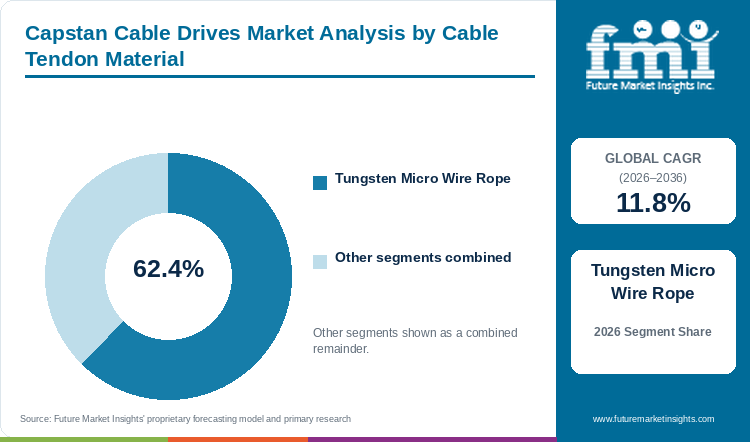
Tungsten Micro Wire Rope assemblies are projected to capture 62.4% of cable tendon material demand in 2026, supported by elastic modulus and tight D/d pulley bending endurance.
Table 5: Cable Tendon Material Share for the Capstan Cable Drives Market (percentage share), 2026
| Cable Tendon Material | Share (2026) |
|---|---|
| Tungsten Micro Wire Rope | 62.4% |
| Other Segments Combined | 37.6%* |
| Total | 100.0% |
*Note: UHMWPE Braided Tendons (16.4%), Vectran Low-Creep Tendons (11.2%), and 316L Stainless Micro-Rope (10.0%) sum to 100.0% of 2026 cable tendon material volume.
Table 6: Cable Tendon Material Leadership and Market Growth for the Capstan Cable Drives Market (segment and CAGR percentage), 2026 to 2036
| Metric | Value |
|---|---|
| Global CAGR (2026 to 2036) | 11.8% |
| Leading Segment | Tungsten Micro Wire Rope |
Surgical instrument designers favor drawn tungsten micro-wire ropes because the metal resists stretching when bent around tiny 4-millimeter wrist pulleys and survives repeated 134-degree-Celsius steam autoclaving. While braided UHMWPE and Vectran synthetic tendons cut weight in wearable robotic exoskeletons, tungsten wire ropes deliver the stiffness required to keep surgical needle drivers from flexing when suturing tough tissue.
- Tungsten Micro Wire Rope is projected to secure 62.4% of cable tendon material demand in 2026 by routing cleanly around sub-5-millimeter pulleys without thermal creep during hospital sterilization.
- Bench testing published in The International Journal of Medical Robotics and Computer Assisted Surgery in July 2026 showed that a 5-millimeter laparoscopic wrist driven by a 0.5-millimeter metallic tendon delivers 13.2 N of grasping force across 75 degrees of articulation [3], reinforcing OEM reliance on metallic micro-wire ropes.
Why does Helical Differential Capstan Drum define the largest drum grooving design segment?
Helical Differential Capstan Drum designs are estimated to secure 66.8% of the drum grooving design category in 2026, driven by zero-overlap cable tracking and compact force amplification.
Keeping miniature cables from rubbing against adjacent turns during high-speed spooling requires precision-machined helical grooves on stepped capstan drums. Unlike flat or dual-flange spools where cables can climb over one another, helical differential drums allow builders of medical rehabilitation exoskeletons and surgical wrists to multiply output torque smoothly without bulky gearboxes.
- Helical Differential Capstan Drum units are estimated to command 66.8% of the drum grooving design segment in 2026 as instrument engineers prevent cable-on-cable wear during multi-turn winding.
- Tendon friction modeling published in IEEE Robotics and Automation Letters in April 2026 reduced distal tip position error on a 402-millimeter surgical manipulator from 36.11 millimeters down to 9.42 millimeters [4] and confirmed the accuracy gains of grooved capstan tracking.
What keeps Surgical Robotics Systems ahead by end-use precision system?
Surgical Robotics Systems are expected to command 51.6% of end-use precision system volume in 2026, driven by recurring multi-axis wristed instrument consumption across global hospitals.
Multi-port laparoscopic and endovascular surgical robotics systems generate the largest recurring order volume in the market because hospital safety rules cap reusable wristed instruments at 10 to 18 surgical procedures. Unlike desktop haptic consoles or laboratory robot hands that run for years on one cable set, every surgical robot consumes hundreds of fresh capstan-driven instrument cartridges over its operating life.
- Surgical Robotics Systems are expected to hold 51.6% of end-use precision system demand in 2026 because programmed 10-to-18-use instrument life limits create steady cartridge replacement orders.
- Control testing on a cable-driven da Vinci Research Kit needle driver published in IEEE Robotics and Automation Letters in June 2026 corrected 10 degrees of cable slack error to complete 17 to 19 out of 20 autonomous suture grasps [5], showing why surgical OEMs pair software compensation with fresh capstan cartridges.
Why does Spring-Seated Self-Tensioning lead the preload tensioning mechanism category?
Spring-Seated Self-Tensioning mechanisms are forecast to generate 58.2% of preload tensioning mechanism demand in 2026, owing to automatic take-up of cable elongation.
Maintaining constant cable tension across thousands of wrist bends and hot steam sterilization cycles requires a self-adjusting preload mechanism inside the instrument housing. Unlike manual turnbuckles or ratchet spools that require technician re-tuning, internal compression and torsion springs automatically take up wire stretch so cables never jump off their pulleys during surgery.
- Spring-Seated Self-Tensioning assemblies are forecast to account for 58.2% of preload tensioning mechanism demand in 2026 as robotics OEMs eliminate manual turnbuckle adjustments on sealed cartridges.
- Robotic hand durability testing published in Science Advances in April 2025 showed that spring-coupled tendon drives achieve a 220-millisecond finger closing response while keeping grip force loss to 6.44% over 1,000 cycles [6].
What gives Captive & Tier-1 OEM the leading position in sales channel?
Captive & Tier-1 OEM channels are anticipated to account for 68.5% of sales channel demand in 2026, reinforced by proprietary surgical cartridge production and cleanroom cable swaging.
Surgical robotics manufacturers either wind capstan cartridges inside their own cleanrooms or contract directly with FDA-registered Tier-1 medical wire-rope specialists, leaving independent distributors and rebuilders to serve academic labs and industrial gantries. Strict medical device master records lock qualified tungsten wire drawers and capstan drum machinists into multi-year OEM supply agreements.
- Captive & Tier-1 OEM channels are anticipated to capture 68.5% of sales channel demand in 2026 because surgical wrist capstans ship as pre-tensioned, lot-traceable cleanroom sub-assemblies.
- A September 2025 study in Micromachines validated a 10-millimeter cable-driven surgical forceps using 0.2-millimeter cables and miniature cable wheels that delivered 5.13 N lifting force and 0.75 N jaw clamping force [7].
What are the drivers, restraints, and opportunities in the capstan cable drives market?
In the capstan cable drives market, rising robotic surgery procedure volumes and humanoid dexterous hand commercialization are projected to accelerate micro-capstan adoption whereas synthetic tendon creep and autoclave fatigue restrain reusable cycle life and sensorized force-feedback capstans create closed-loop microsurgery opportunities.
- Driver: Expanding multi-quadrant and single-port robotic surgery procedures with 18-to-22-DoF humanoid dexterous hands multiply micro-grooved capstan drum and tungsten cable consumption.
- Restraint: Logarithmic polymer creep in UHMWPE tendons and wire-strand fretting across sub-5-millimeter pulleys degrade kinematic accuracy and cap reusable surgical instrument lifespans.
- Opportunity: Embedding compliant strain-sensing brackets and posture-perceptive soft sensors directly into capstan actuator housings supports live haptic force feedback without distal tip load cells.
Growth Analysis and Future Potential: Qualitative Demand Catalysts
Humanoid robot builders and medical rehabilitation robotics companies are adopting forearm-mounted capstan winding spools so multi-jointed fingers can grasp objects without placing heavy motors inside the hand. Packing 15 to 22 degrees of freedom into a human-sized hand requires compact capstan drums that pull thin tendons smoothly through curved wrist channels. Future Market Insights notes that this emerging humanoid hand demand is creating a second high-volume growth engine next to hospital surgical cartridges. In February 2026, a humanoid hand study published in Microsystems & Nanoengineering validated an 18-degree-of-freedom five-finger hand driven by nine arm-mounted servos and capstan winding wheels with ±2.13-degree pitch accuracy [8]. Robotics OEMs therefore sign multi-year supply agreements with precision wire-rope and capstan machinists to secure production capacity.
Risk Assessment of the Capstan Cable Drives Market: Operational and Formulation Friction
Gradual cable stretching, strand-on-strand rubbing, and friction losses across multi-pulley routing paths remain the toughest barriers limiting tendon drive lifespan. When synthetic polymer ropes stay under continuous preload, molecular creep slowly lengthens the cable and introduces positioning lag at the instrument tip. In February 2025, a synthetic fiber rope study in PLOS One showed that cyclic pre-stretching is needed to cut logarithmic creep rates in 1600D Dyneema HMPE ropes from 0.180–0.205 down to 0.085–0.105 [9]. In hospital surgical instruments, repeated 134-degree-Celsius steam autoclave cycles also strip protective lubricants and fray tungsten micro-wires if pulley grooves are too tight. Hospital purchasing committees push back against high per-procedure disposable instrument costs, pressuring suppliers to extend wire fatigue life.
Commercial Opportunity Analysis: Formulation Differentiation and Value-Add Formats
Surgical robotics procurement teams reward component suppliers that build force-sensing brackets directly into the capstan drive housing so surgeons can feel tissue tension. Placing delicate electronic load cells at the tip of an 8-millimeter laparoscopic instrument is expensive and vulnerable to steam sterilization damage. Manufacturers capturing higher margins instead measure cable tension right at the proximal capstan spool outside the patient's body. In August 2026, a continuum surgical robot study on arXiv demonstrated a compact capstan-driven surgical robot using a compliant motor-mounting bracket to measure instant cable tension and tip contact force without distal sensors [10]. Supplying pre-calibrated capstan drums with integrated tension-sensing flexures allows Tier-1 vendors to lift average selling prices by 25% to 40% on next-generation surgical platforms.
Capstan Cable Drives Market by Country (2026 to 2036)
As per FMI, South Korea is projected to lead capstan cable drives expansion across precision robotics and medical manufacturing markets at a 13.3% CAGR through 2036, whereas the UK is forecast to progress at a 10.5% CAGR. Commercial performance across surgical and semiconductor equipment hubs in East Asia as well as medtech clusters in North America and Europe depends on robotic procedure growth and cleanroom micro-cable assembly capacity.
Table 7: Country CAGR and Primary Growth Levers for the Capstan Cable Drives Market (CAGR percentage and operational drivers), 2026 to 2036
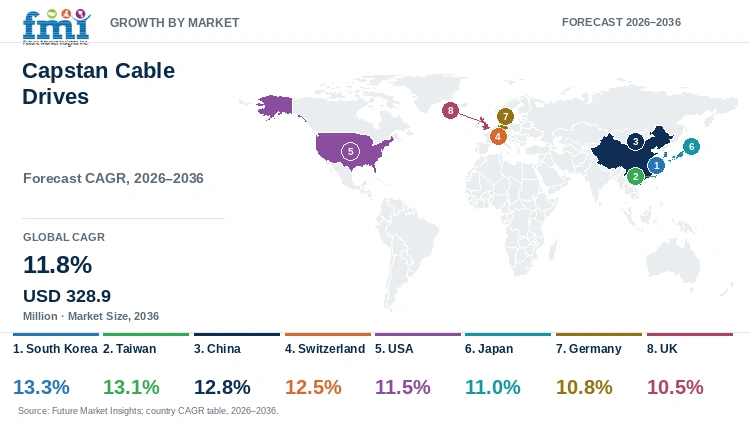
| Country | CAGR (2026 to 2036) | Primary Growth Lever |
|---|---|---|
| South Korea | 13.3% | Domestic laparoscopic surgical robots, humanoid hands, and wafer scanner gantries |
| Taiwan | 13.1% | Semiconductor wafer scanner cable gantries and precision medical contract manufacturing |
| China | 12.8% | NMPA-cleared endoscopic surgical robots and anthropomorphic dexterous hand production |
| Switzerland | 12.5% | Force-reflective desktop haptic interfaces and microsurgical watchmaking-grade capstans |
| USA | 11.5% | Captive da Vinci 5 surgical instrument manufacturing and medical wire-rope drawing |
| Japan | 11.0% | 316L and tungsten micro-stranded wire rope metallurgy and surgical robot adoption |
| Germany | 10.8% | High-precision cable termination systems, optical gantries, and rehabilitation robotics |
| UK | 10.5% | Anthropomorphic Shadow dexterous robot hands and nuclear tendon-driven manipulators |
Source: Future Market Insights analysis
South Korea Capstan Cable Drives Market Outlook (2026 to 2036)
Unlike Western markets focused primarily on hospital surgical disposables, South Korea combines domestic laparoscopic surgical robot commercialization with aggressive investments in humanoid dexterous hands and semiconductor wafer gantries. A September 2025 tendon actuation study in Biomimetics benchmarked 0.5-millimeter and 1.0-millimeter UHMWPE, aramid, and nylon tendons inside a 335-gram five-finger robotic hand delivering 7.4 N fingertip force [11]. Demand for capstan cable drives in South Korea is projected to expand at a leading 13.3% CAGR through 2036 as surgical and electronics equipment OEMs in Seoul and Daejeon scale production. Because domestic builders still import ultra-fine tungsten wire strands from Japan and the USA, local integrators focus on high-precision helical drum machining and spring-preloaded cartridge assembly.
Key takeaway: In South Korea, domestic surgical robot commercialization and semiconductor gantry manufacturing are projected to drive a 13.3% CAGR through 2036.
Taiwan Capstan Cable Drives Market Outlook (2026 to 2036)
Sales of capstan cable drives in Taiwan are expected to climb at a 13.1% CAGR from 2026 to 2036, driven by cleanroom semiconductor inspection stages and contract medical machining in Hsinchu and Taichung. Whereas buyers in Europe focus on desktop haptics, manufacturers in Taiwan integrate zero-backlash cable capstans into optical wafer-scanner carriages and wearable rehabilitation devices that require smooth, particle-free motion. In August 2026, a wearable exoskeleton study in Frontiers in Robotics and AI validated a 0.99-kilogram tendon-driven actuator delivering 103.7 N cable pull force and 10.37 N·m elbow torque [12]. Tight cleanroom outgassing rules in semiconductor fabs restrict standard cable greases, prompting suppliers in Taiwan to pair dry-coated stainless micro-ropes with anodized aluminum capstan drums.
Key takeaway: In Taiwan, cleanroom wafer-inspection cable stages and rehabilitation exoskeleton production are forecast to sustain a 13.1% CAGR.
China Capstan Cable Drives Market Outlook (2026 to 2036)
In contrast to mature single-vendor surgical markets, China is rapidly scaling dozens of domestic NMPA-cleared laparoscopic, orthopedic, and percutaneous puncture robot platforms as well as humanoid hand factories in Shenzhen, Shanghai, and Suzhou. An October 2025 clinical robotics study in The International Journal of Medical Robotics and Computer Assisted Surgery demonstrated a parallel cable-driven prostate puncture robot achieving 0.35-millimeter to 0.40-millimeter needle placement accuracy under MRI guidance [13]. Because provincial hospital equipment tenders favor domestic robotic systems, capstan cable drives demand in China is forecast to advance at a 12.8% CAGR through 2036. Volume-based hospital procurement caps on disposable surgical instruments still squeeze component budgets, pushing OEMs in China to source reusable 15-life tungsten cable cartridges.
Key takeaway: In China, domestic surgical robot tenders and humanoid dexterous hand scaling are estimated to generate a 12.8% CAGR through 2036.
Switzerland Capstan Cable Drives Market Outlook (2026 to 2036)
What distinguishes Switzerland from high-volume Asian assembly hubs is its watchmaking-grade micro-machining cluster in Lausanne, Geneva, and Zurich that supplies ultra-low-friction capstans for force-reflective haptic consoles and ophthalmic microsurgery robots. In March 2025, a continuum robot friction study in Micromachines cut tendon path prediction error to 0.3% across 0.5 to 40 N cable tensions [14]. Demand in Switzerland is anticipated to rise at a 12.5% CAGR over the ten-year period to 2036 as surgical tele-operation and micro-robotics builders expand export shipments. High precision-machining wages in Switzerland make commodity cable assemblies uncompetitive, so domestic firms such as Force Dimension specialize in high-margin 6- and 7-degree-of-freedom differential capstan mechanisms.
Key takeaway: In Switzerland, force-reflective haptic master consoles and ophthalmic microsurgery drives are projected to deliver a 12.5% CAGR.
USA Capstan Cable Drives Market Outlook (2026 to 2036)
Unlike import-dependent hospital markets, the USA anchors both the world's largest installed base of surgical robots and the leading domestic producers of medical tungsten micro-wire ropes and swaged capstan assemblies. In March 2026, a preclinical micro-device wire study in Scientific Reports demonstrated laser-welding of 25-micrometer coiled platinum-iridium microwires at 75 to 100 W that held strain force to 10.5 mN at 11% elongation [15]. Commercial capstan cable drive demand in the USA is estimated to grow at an 11.5% CAGR through 2036 as Intuitive Surgical scales da Vinci 5 force-sensing instrument production and ambulatory surgery centers add robotic suites. Because hospital value-analysis committees scrutinize per-case instrument fees, Tier-1 suppliers such as Carl Stahl Sava Industries and Fort Wayne Metals invest in automated wire drawing and swaging to hold unit costs down.
Key takeaway: In the USA, da Vinci 5 force-sensing instrument rollouts and domestic tungsten micro-cable drawing are expected to sustain an 11.5% CAGR.
Japan Capstan Cable Drives Market Outlook (2026 to 2036)
Japan occupies a critical upstream position in the global supply chain through its specialty stainless and tungsten micro-wire metallurgy and growing domestic hospital reimbursement for robotic surgery. An April 2025 review in Advanced Materials compared tendon-driven surgical actuators delivering 1 to 10 N force output and 0.1 to 2.0 second response times against softer bioelectronic actuators [16]. Demand in Japan is projected to expand at an 11.0% CAGR between 2026 and 2036 as domestic surgical robot builders and industrial automation firms procure ultra-fine 7x49 wire ropes. Strict hospital sterilization standards and aging surgical nursing staff favor pre-tensioned, maintenance-free capstan cartridges supplied by wire specialists in Japan such as Nippon Seisen.
Key takeaway: In Japan, specialty medical wire-rope metallurgy and expanding inpatient robotic surgery coverage are forecast to maintain an 11.0% CAGR.
Germany Capstan Cable Drives Market Outlook (2026 to 2036)
Germany combines Tuttlingen surgical instrument craftsmanship with Munich and Stuttgart robotics engineering, creating diversified demand across medical rehabilitation exoskeletons, endoscopic instruments, and optical wafer inspection stages. In June 2026, a clinical trial published in Nature Machine Intelligence showed that a tendon-driven soft hand exoskeleton achieved over 95% grasp reliability across more than 125 trials and a 17-point arm function gain in stroke patients [17]. Market valuation in Germany is forecast to progress at a 10.8% CAGR through 2036 as neurological clinics and precision equipment builders adopt compact cable drives. Stringent European Union Medical Device Regulation (MDR) audit requirements lengthen qualification timelines for new cable vendors, rewarding incumbent ISO 13485 certified suppliers.
Key takeaway: In Germany, clinical neurorehabilitation hand exoskeletons and precision optical gantries are projected to support a 10.8% CAGR.
UK Capstan Cable Drives Market Outlook (2026 to 2036)
Whereas continental European demand centers on surgical instrument manufacturing, the UK has carved out a specialized leadership position in 20-degree-of-freedom anthropomorphic dexterous robot hands and tendon-driven manipulators for nuclear decommissioning. In April 2026, a robotics study in Frontiers in Robotics and AI validated a tendon-driven serial manipulator that routes four pre-tensioned cables from base motors across passive pulleys to inspect radioactive water ponds [18]. Sales in the UK are projected to rise at a 10.5% CAGR from 2026 to 2036 as AI robotics labs and nuclear facilities order remote tendon-driven arms. Because National Health Service capital budgets still limit rapid hospital robot replacements, UK producers such as Shadow Robot Company rely heavily on export sales to AI research centers in North America and Asia.
Key takeaway: In the UK, anthropomorphic dexterous robot hand exports and remote nuclear inspection manipulators are anticipated to drive a 10.5% CAGR.
Full report country CAGRs cover: North America; Latin America; Western Europe; Eastern Europe; East Asia; South Asia and Pacific; and Middle East and Africa.
Who are the notable companies in the capstan cable drives market?
Intuitive Surgical, Inc. (Captive & Tier-1 Tungsten Cable Capstans), Carl Stahl Sava Industries, Inc., Fort Wayne Metals Research Products Corp., Nippon Seisen Co., Ltd., Force Dimension Sarl, 3D Systems Corporation (Sensable Phantom Haptics), Shadow Robot Company, and Bergen Cable Technology, Inc. are the notable companies in the capstan cable drives market.
FMI analysis indicates that the competitive arena divides between captive surgical robotics manufacturers, specialized medical micro-cable drawers, and haptic or dexterous-hand OEMs. Captive surgical robotics leaders wind millions of tungsten cable capstan spools for disposable wrist cartridges. Medical wire-rope specialists in the USA and Japan supply ultra-fine 7x49 strands and swaged terminations, while European robotics firms engineer zero-backlash differential capstans for haptic consoles and anthropomorphic hands.
- Captive Surgical Robotics Platforms: Intuitive Surgical, Inc. engineers and consumes millions of precision helical capstan drums and tungsten micro-cable assemblies annually across its EndoWrist and da Vinci 5 force-sensing instrument lines.
- Medical Micro-Cable & Capstan Specialists: Carl Stahl Sava Industries, Inc., Fort Wayne Metals Research Products Corp., Nippon Seisen Co., Ltd., and Bergen Cable Technology, Inc. draw 7x19 and 7x49 tungsten and 316L micro-ropes and swage custom capstan drum terminations.
- Haptic Console & Dexterous Hand OEMs: Force Dimension Sarl, 3D Systems Corporation (Sensable Phantom Haptics), and Shadow Robot Company build zero-backlash capstan-driven haptic master interfaces and 20-DoF tendon-driven anthropomorphic hands.
Competitive Benchmarking: Capstan Cable Drives Market
Table 8: Competitive Benchmarking for the Capstan Cable Drives Market (qualitative capability ratings), 2026
| Company | Micro-Cable Metallurgy Depth | Helical Capstan Drum Precision | Surgical & FDA Cleanroom Scale | Geographic Reach |
|---|---|---|---|---|
| Intuitive Surgical, Inc. (Captive/Tier-1) | High | High | High | High |
| Carl Stahl Sava Industries, Inc. | High | High | High | High |
| Fort Wayne Metals Research Products | High | Medium | High | High |
| Nippon Seisen Co., Ltd. | High | Medium | High | High |
| Force Dimension Sarl | Medium | High | Medium | High |
| 3D Systems Corp. (Sensable Phantom) | Medium | High | Medium | High |
| Shadow Robot Company | Medium | High | Medium | Medium |
| Bergen Cable Technology, Inc. | High | High | Medium | Medium |
Scoring basis: Capability tiers evaluate sub-0.5-millimeter tungsten and 316L wire-rope fatigue life, helical differential capstan drum machining tolerances, ISO 13485 cleanroom termination capacity, and global OEM supply footprint.
Key Developments in the Capstan Cable Drives Market
- Intuitive Surgical, Inc. reported Q2 2026 revenue of USD 2,892.3 million in July 2026, with instruments and accessories revenue reaching USD 1,734.9 million as the installed base expanded to 11,710 da Vinci systems including 246 Q2 da Vinci 5 placements [19].
- Intuitive Surgical, Inc. posted full-year 2025 revenue of USD 10,064.7 million in January 2026, driven by USD 6,018.9 million in instruments and accessories revenue across 11,106 installed da Vinci surgical systems [20].
- A laparoscopic actuation study in Scientific Reports in April 2025 highlighted that conventional robotic disposable instruments add USD 3,000 to USD 17,000 per procedure, spurring hospital demand for extended-life 0.8 N spring-preloaded tendon mechanisms [21].
Key Players in the Capstan Cable Drives Market
Captive Surgical Robotics & Haptic System Leaders
- Intuitive Surgical, Inc. (Captive & Tier-1 Tungsten Cable Capstans)
- Force Dimension Sarl
- 3D Systems Corporation (Sensable Phantom Haptics)
Medical Micro-Stranded Wire Rope Specialists
- Carl Stahl Sava Industries, Inc.
- Fort Wayne Metals Research Products Corp.
- Nippon Seisen Co., Ltd.
Dexterous Hand & Precision Cable Assemblies
- Shadow Robot Company
- Bergen Cable Technology, Inc.
Capstan Cable Drives Market - Report Scope
Table 9: Report Scope for the Capstan Cable Drives Market (coverage fields and definitions), 2026 to 2036
| Coverage field | Report scope |
|---|---|
| Market breakdown | Cable Tendon Material; Drum Grooving Design; End-Use Precision System; Preload Tensioning Mechanism; Sales Channel |
| Quantitative Units | USD Million |
| Market Definition | Includes commercial and captive component-level valuation of precision capstan drums, helical differential cable spools, spring-preloaded split-drum capstans, and terminated tungsten, 316L, UHMWPE, and Vectran micro-tendon assemblies. Category Scope Note: Excludes heavy maritime mooring winches, elevator traction sheaves, and full surgical robot capital equipment value. |
| Regions Covered | North America; Latin America; Western Europe; Eastern Europe; East Asia; South Asia and Pacific; Middle East and Africa |
| Countries Covered | South Korea, Taiwan, China, Switzerland, USA, Japan, Germany, UK, and additional countries in the full report |
| Key Companies Covered | Intuitive Surgical, Inc. (Captive & Tier-1 Tungsten Cable Capstans), Carl Stahl Sava Industries, Inc., Fort Wayne Metals Research Products Corp., Nippon Seisen Co., Ltd., Force Dimension Sarl, 3D Systems Corporation (Sensable Phantom Haptics), Shadow Robot Company, Bergen Cable Technology, Inc. |
| Forecast Period | 2026 to 2036 |
| Approach | Primary and secondary research combining bottom-up surgical instrument cartridge and haptic axis counts with top-down robotic subsystem bill-of-materials reconciliation. |
Capstan Cable Drives Market - Research Methodology
Table 10: Research Methodology for the Capstan Cable Drives Market (research methods and approach), 2026 edition
| Method | Approach |
|---|---|
| Primary Research | Structured interviews with surgical robotics mechanical architects, medical wire-rope drawing engineers, haptic console designers, and cleanroom cable-swaging Tier-1 suppliers. |
| Secondary Research | Analysis of Intuitive Surgical SEC Form 8-K filings, IEEE Robotics and Automation Letters continuum friction studies, Science Advances and Nature Machine Intelligence dexterous hand trials, and PubMed surgical robotics literature. |
| Market Sizing and Forecasting | Bottom-up active surgical robot procedure volumes, disposable instrument cartridge consumption (4 to 6 capstan axes per cartridge), and haptic/dexterous hand shipments reconciled from 2026 to 2036. |
| Country Forecasting Model | Country projections weight installed surgical robot bases, domestic laparoscopic robot clearances, semiconductor wafer scanner gantry builds, and specialty wire-drawing capacity across eight nations. |
| Operational Benchmark Traceability | System counts and per-axis capstan values in Tables 2, 3, and 4 trace to SEC Form 8-K da Vinci procedure disclosures and peer-reviewed tendon-pulley kinematic benchmarks. |
| Data Triangulation and Validation | Component valuations are strictly isolated to the capstan drum, preload mechanism, and terminated micro-cable assembly without double counting full USD 1.5–2.5 million surgical robot consoles. |
Capstan Cable Drives Market by Segments
Capstan Cable Drives Market segmented by Cable Tendon Material:
- Tungsten Micro Wire Rope
- UHMWPE Braided Tendons
- Vectran Low-Creep Tendons
- 316L Stainless Micro-Rope
Capstan Cable Drives Market segmented by Drum Grooving Design:
- Helical Differential Capstan Drum
- Spring-Preloaded Split-Drum Capstan
- Dual-Flange Spiral Drum
Capstan Cable Drives Market segmented by End-Use Precision System:
- Surgical Robotics Systems
- Force-Reflective Haptic Exoskeletons
- Dexterous Robot Hands
Capstan Cable Drives Market segmented by Preload Tensioning Mechanism:
- Spring-Seated Self-Tensioning
- Threaded Barrel Turnbuckle
- Compliant Flexure Tensioner
- Ratchet Spool Tensioner
Capstan Cable Drives Market segmented by Sales Channel:
- Captive & Tier-1 OEM
- Precision Motion Integrators
- Medical Cartridge Rebuilders
- Research Robotics Distributors
- Cleanroom Assembly Contractors
Capstan Cable Drives Market by Region
- North America
- United States
- Canada
- Latin America
- Brazil
- Mexico
- Argentina
- Chile
- Western Europe
- Germany
- France
- United Kingdom
- Italy
- Spain
- Benelux
- Nordics
- Eastern Europe
- Poland
- Czech Republic
- Romania
- Hungary
- East Asia
- China
- Japan
- South Korea
- South Asia and Pacific
- India
- ASEAN
- Australia and New Zealand
- Middle East and Africa
- GCC Countries
- South Africa
- Türkiye
- Israel
Research Sources and Bibliography
- [1] Intuitive Surgical, Inc. (2026, April 21). Intuitive Announces First Quarter Earnings (Form 8-K Exhibit 99.1). U.S. Securities and Exchange Commission (SEC).
- [2] Intuitive Surgical, Inc. (2026, January 23). 20 Million Patients Benefit from da Vinci Surgery Globally. Intuitive Surgical Investor Relations.
- [3] Kumar, P., & Ravi, B. (2026, July 10). A Hybrid Compliant–Tendon Laparoscopic Instrument for Distal Articulation and Grasping: Design and Experimental Validation. The International Journal of Medical Robotics and Computer Assisted Surgery, 22(4), e70206 (PubMed PMID 42430570).
- [4] Shen, J., Browne, B., Ha, J., & Chen, Y. (2026, April 27). Friction Modeling of Tendon-driven Continuum Robots through Linear Complementarity Problem. IEEE Robotics and Automation Letters, 11(6), 7468–7475 (PubMed PMID 42147458).
- [5] Joglekar, N., Liu, F., Richter, F., & Yip, M. C. (2026, June 1). Stable Tracking-in-the-Loop Control of Cable-Driven RCM Surgical Manipulators under Erroneous Kinematic Chains. IEEE Robotics and Automation Letters, 11(7), 8608–8615 (PubMed PMID 42396094).
- [6] Zhang, N., Zhou, P., Yang, X., Shen, F., Ren, J., Hou, T., Dong, L., Bian, R., Wang, D., Gu, G., & Zhu, X. (2025, April 23). Biomimetic rigid-soft finger design for highly dexterous and adaptive robotic hands. Science Advances, 11(17), eadu2018 (PubMed PMID 40267195).
- [7] Li, J., Li, Y., Sun, Z., & Sun, Z. (2025, September 29). Design and Analysis of a Magnetic Anchored and Cable-Driven Surgical Forceps for Minimally Invasive Surgery. Micromachines, 16(10), 1109 (PubMed PMID 41156356).
- [8] Zhong, L., Tian, X., Wang, J., Song, X., Li, J., & Peng, Y. (2026, February 12). Soft sensor for omnidirectional posture perception in humanoid dexterous hands. Microsystems & Nanoengineering, 12, 60 (PubMed PMID 41680124).
- [9] Zeng, J., Zhang, H., Jin, B., Dong, H., Chou, C., & Li, H. (2025, February 6). Mechanical behavior of synthetic fiber ropes for mooring floating offshore wind turbines. PLOS One, 20(2), e0318190 (PubMed PMID 39913365).
- [10] Zhang, G., Qiu, Y., Yan, J., Zeng, W., Lu, W., & Cheng, S. S. (2026, August 13). Capstan-driven Continuum Surgical Robot: Design, Modeling, and Perception. arXiv Preprint, arXiv:2608.13396.
- [11] Zheng, Z., Zhan, J., Li, Z., Wang, Y., Xu, C., & Wang, X. (2025, September 15). Data-Driven Twisted String Actuation for Lightweight and Compliant Anthropomorphic Dexterous Hands. Biomimetics, 10(9), 621 (PubMed PMID 41002855).
- [12] Sun, T., & Stefanovic, F. (2026, August 12). A compact external-rail linear actuation mechanism with a high stroke-to-length ratio for wearable exoskeleton applications. Frontiers in Robotics and AI, 13, 1843206 (PubMed PMID 42656246).
- [13] Zou, Y., Lan, T., Zhang, Y., Lai, X., Zhou, Z., & Li, C. (2025, October 1). Parallel Cable-Driven Prostate Puncture Robot: Design and Performance Evaluation. The International Journal of Medical Robotics and Computer Assisted Surgery, 21(5), e70102 (PubMed PMID 40914976).
- [14] Wang, H., Du, J., & Mao, Y. (2025, March 19). Cosserat Rod-Based Tendon Friction Modeling, Simulation, and Experiments for Tendon-Driven Continuum Robots. Micromachines, 16(3), 346 (PubMed PMID 40141957).
- [15] Mirkiani, S., O'Sullivan, C. L., Arefadib, A., Tyreman, N., Sari, K., Wilson, D., Tawakol, O., Troyk, P. R., Fox, R., & Mushahwar, V. K. (2026, March 24). A fully implantable intraspinal microstimulation device for early preclinical evaluation of feasibility, stability, and functionality. Scientific Reports, 16, 14865 (PubMed PMID 41876656).
- [16] Dong, C., & Malliaras, G. G. (2025, April 15). Recent Advances in Stimuli‐Responsive Materials and Soft Robotic Actuators for Bioelectronic Medicine. Advanced Materials, 37(27), 2417325 (PubMed PMID 40231654).
- [17] Nassour, J., Berberich, N., Utpadel-Fischler, D., Wächter, T., & Cheng, G. (2026, June 23). A dexterous soft hand exoskeleton restores intentional grasping in individuals with severe hand impairment. Nature Machine Intelligence, 8(7), 1100–1114 (PubMed PMID 42499995).
- [18] Khalifa, A., Groves, K., & Carrasco, J. (2026, April 24). Development of a tendon-driven serial manipulator for an aquatic autonomous surface vehicle. Frontiers in Robotics and AI, 13, 1801347 (PubMed PMID 42110681).
- [19] Intuitive Surgical, Inc. (2026, July 16). Intuitive Announces Second Quarter Earnings (Form 8-K Exhibit 99.1). U.S. Securities and Exchange Commission (SEC).
- [20] Intuitive Surgical, Inc. (2026, January 22). Intuitive Announces Fourth Quarter Earnings. Intuitive Surgical Investor Relations.
- [21] Pietsch, M., Henkel, K., Körbitz, R., Hüttner, R., Uhlig, K., Bruk, S., Fischer, M., Hampe, J., Richter, A., & Brinkmann, F. (2025, April 2). A deflectable video camera system for laparoscopic surgery based on shape memory alloy actuators. Scientific Reports, 15, 11354 (PubMed PMID 40175467).
- [22] Day, S., Elder, S., Brookshire, C., & Jaffe, M. H. (2025, July 16). Ex vivo evaluation of polyethylene cable compared to stainless steel cerclage wire in a canine fracture model. Frontiers in Veterinary Science, 12, 1613295 (PubMed PMID 40740303).
- [23] Li, H., Ye, C., Jia, R., Yu, S., & Tao, G. (2026, March 2). A Dexterous Hand for Omnidirectional In-Hand Manipulation: Design, Analysis and Experimental Validation. Biomimetics, 11(3), 167 (PubMed PMID 41892090).
This bibliography is provided for reader reference and is not exhaustive. The full report contains the complete citation list.
This Report Answers
- How large is the capstan cable drives market in 2026 and what is forecast for 2036?
- Which surgical robotics and haptic precision pressures support demand for capstan cable drives?
- Why does Tungsten Micro Wire Rope lead the cable tendon material category?
- Why does Helical Differential Capstan Drum lead the drum grooving design category globally?
- How do growth rates differ across South Korea, Taiwan, China, and the USA?
- Which leading companies supply tungsten micro-cables and precision capstan drums today?
- What limits adoption or supplier switching in the capstan cable drives market?
- What should buyers evaluate before qualifying a capstan cable drive?
Frequently Asked Questions
How big is the capstan cable drives market in 2026, and what is forecast for 2036?
According to FMI, global capstan cable drives valuation is estimated to reach USD 107.8 million in 2026 from USD 96.5 million in 2025 and is projected to climb to USD 328.9 million by 2036.
What is the CAGR for the capstan cable drives market from 2026 to 2036?
Future Market Insights projects an 11.8% compound annual growth rate between 2026 and 2036, generating USD 221.1 million in incremental component demand over the 10-year period.
Which cable tendon material segment leads the capstan cable drives market?
Tungsten Micro Wire Rope assemblies are projected to capture 62.4% of cable tendon material demand in 2026 because 7x19 and 7x49 tungsten micro-strands withstand tight bend radii and steam autoclaving.
Which drum grooving design segment leads the capstan cable drives market?
Helical Differential Capstan Drum designs are estimated to secure 66.8% of the drum grooving design category in 2026 as precision helical micro-grooves prevent cable overlap and backlash.
Which country has a notable growth outlook during the assessment period?
South Korea is projected to lead national growth at a 13.3% CAGR through 2036, driven by domestic laparoscopic surgical robot systems, humanoid dexterous hands, and wafer scanner gantries.
Who are the key players in the market?
Intuitive Surgical, Inc. (Captive & Tier-1 Tungsten Cable Capstans), Carl Stahl Sava Industries, Inc., Fort Wayne Metals Research Products Corp., Nippon Seisen Co., Ltd., Force Dimension Sarl, 3D Systems Corporation (Sensable Phantom Haptics), Shadow Robot Company, and Bergen Cable Technology, Inc. are key players.
Preview the report firsthand - request a free sample
Get SampleGet the brochure for pricing and purchase details.
Get PDFTable of Content
- Key Takeaways
- Market Size and CAGR
- Top Growth Driver
- Fastest Growing Segment
- Leading Region
- Key Companies
- Emerging Opportunities
- Executive Summary
- Global Market Outlook
- Demand-side Trends
- Supply-side Trends
- Technology Roadmap Analysis
- Analysis and Recommendations
- Analyst Perspective (What is happening? Why now? What should investors know?)
- Key Questions Answered
- How large is the market?
- What is the CAGR?
- What are key trends?
- Which region dominates?
- Who are the leaders?
- Market Overview
- Market Coverage / Taxonomy
- Market Definition / Scope / Limitations
- Research Methodology
- Chapter Orientation
- Analytical Lens and Working Hypotheses
- Market Structure, Signals, and Trend Drivers
- Benchmarking and Cross-market Comparability
- Market Sizing, Forecasting, and Opportunity Mapping
- Research Design and Evidence Framework
- Desk Research Programme (Secondary Evidence)
- Expert Input and Fieldwork (Primary Evidence)
- Tooling, Models, and Reference Databases
- Data Engineering and Model Build
- Quality Assurance and Audit Trail
- Market Background
- Market Dynamics (Drivers, Restraints, Opportunity, Trends)
- Scenario Forecast (Optimistic, Likely, Conservative)
- Impact Analysis
- AI Impact
- Sustainability Impact
- Regulatory Impact
- Technology Impact
- Consumer / Buyer Analysis
- Purchase Drivers
- Adoption Barriers
- Buyer Journey
- Opportunity Map Analysis
- Product Life Cycle Analysis
- Supply Chain Analysis
- Investment Feasibility Matrix
- Value Chain Analysis
- PESTLE and Porter's Analysis
- Regulatory Landscape
- Regional Parent Market Outlook
- Production and Consumption Statistics
- Import and Export Statistics
- Global Market Analysis and Forecast, 2021 to 2036
- Historical Market Size Value (USD Million) Analysis, 2021 to 2025
- Current and Future Market Size Value (USD Million) Projections, 2026 to 2036
- Y-o-Y Growth Trend Analysis
- Absolute $ Opportunity Analysis
- Global Market Pricing Analysis, 2021 to 2036
- Global Market Analysis and Forecast, By Cable Tendon Material, 2021 to 2036
- Introduction / Key Findings
- Historical Market Size Value (USD Million) Analysis By Cable Tendon Material, 2021 to 2025
- Current and Future Market Size Value (USD Million) Analysis and Forecast By Cable Tendon Material, 2026 to 2036
- Tungsten Micro Wire Rope
- UHMWPE Braided Tendons
- Vectran Low-Creep Tendons
- 316L Stainless Micro-Rope
- Y-o-Y Growth Trend Analysis By Cable Tendon Material, 2021 to 2025
- Absolute $ Opportunity Analysis By Cable Tendon Material, 2026 to 2036
- Global Market Analysis and Forecast, By Drum Grooving Design, 2021 to 2036
- Introduction / Key Findings
- Historical Market Size Value (USD Million) Analysis By Drum Grooving Design, 2021 to 2025
- Current and Future Market Size Value (USD Million) Analysis and Forecast By Drum Grooving Design, 2026 to 2036
- Helical Differential Capstan Drum
- Spring-Preloaded Split-Drum Capstan
- Dual-Flange Spiral Drum
- Y-o-Y Growth Trend Analysis By Drum Grooving Design, 2021 to 2025
- Absolute $ Opportunity Analysis By Drum Grooving Design, 2026 to 2036
- Global Market Analysis and Forecast, By End-Use Precision System, 2021 to 2036
- Introduction / Key Findings
- Historical Market Size Value (USD Million) Analysis By End-Use Precision System, 2021 to 2025
- Current and Future Market Size Value (USD Million) Analysis and Forecast By End-Use Precision System, 2026 to 2036
- Surgical Robotics Systems
- Force-Reflective Haptic Exoskeletons
- Dexterous Robot Hands
- Y-o-Y Growth Trend Analysis By End-Use Precision System, 2021 to 2025
- Absolute $ Opportunity Analysis By End-Use Precision System, 2026 to 2036
- Global Market Analysis and Forecast, By Preload Tensioning Mechanism, 2021 to 2036
- Introduction / Key Findings
- Historical Market Size Value (USD Million) Analysis By Preload Tensioning Mechanism, 2021 to 2025
- Current and Future Market Size Value (USD Million) Analysis and Forecast By Preload Tensioning Mechanism, 2026 to 2036
- Spring-Seated Self-Tensioning
- Threaded Barrel Turnbuckle
- Compliant Flexure Tensioner
- Ratchet Spool Tensioner
- Y-o-Y Growth Trend Analysis By Preload Tensioning Mechanism, 2021 to 2025
- Absolute $ Opportunity Analysis By Preload Tensioning Mechanism, 2026 to 2036
- Global Market Analysis and Forecast, By Sales Channel, 2021 to 2036
- Introduction / Key Findings
- Historical Market Size Value (USD Million) Analysis By Sales Channel, 2021 to 2025
- Current and Future Market Size Value (USD Million) Analysis and Forecast By Sales Channel, 2026 to 2036
- Captive & Tier-1 OEM
- Precision Motion Integrators
- Medical Cartridge Rebuilders
- Research Robotics Distributors
- Cleanroom Assembly Contractors
- Y-o-Y Growth Trend Analysis By Sales Channel, 2021 to 2025
- Absolute $ Opportunity Analysis By Sales Channel, 2026 to 2036
- Global Market Analysis and Forecast, By Region, 2021 to 2036
- Introduction
- Historical Market Size Value (USD Million) Analysis By Region, 2021 to 2025
- Current Market Size Value (USD Million) Analysis and Forecast By Region, 2026 to 2036
- North America
- Latin America
- Western Europe
- Eastern Europe
- East Asia
- South Asia and Pacific
- Middle East and Africa
- Market Attractiveness Analysis By Region
- North America Market Analysis and Forecast, By Country, 2021 to 2036
- Historical Market Size Value (USD Million) Trend Analysis By Market Taxonomy, 2021 to 2025
- Market Size Value (USD Million) Forecast By Market Taxonomy, 2026 to 2036
- By Country
- United States
- Canada
- By Cable Tendon Material
- By Drum Grooving Design
- By End-Use Precision System
- By Preload Tensioning Mechanism
- By Sales Channel
- By Country
- Market Attractiveness Analysis
- By Country
- By Cable Tendon Material
- By Drum Grooving Design
- By End-Use Precision System
- By Preload Tensioning Mechanism
- By Sales Channel
- Key Takeaways
- Latin America Market Analysis and Forecast, By Country
- Historical Market Size Value (USD Million) Trend Analysis By Market Taxonomy, 2021 to 2025
- Market Size Value (USD Million) Forecast By Market Taxonomy, 2026 to 2036
- By Country
- Brazil
- Mexico
- Argentina
- Chile
- By Cable Tendon Material
- By Drum Grooving Design
- By End-Use Precision System
- By Preload Tensioning Mechanism
- By Sales Channel
- By Country
- Market Attractiveness Analysis
- By Country
- By Cable Tendon Material
- By Drum Grooving Design
- By End-Use Precision System
- By Preload Tensioning Mechanism
- By Sales Channel
- Key Takeaways
- Western Europe Market Analysis and Forecast, By Country
- Historical Market Size Value (USD Million) Trend Analysis By Market Taxonomy, 2021 to 2025
- Market Size Value (USD Million) Forecast By Market Taxonomy, 2026 to 2036
- By Country
- Germany
- France
- United Kingdom
- Italy
- Spain
- Benelux
- Nordics
- By Cable Tendon Material
- By Drum Grooving Design
- By End-Use Precision System
- By Preload Tensioning Mechanism
- By Sales Channel
- By Country
- Market Attractiveness Analysis
- By Country
- By Cable Tendon Material
- By Drum Grooving Design
- By End-Use Precision System
- By Preload Tensioning Mechanism
- By Sales Channel
- Key Takeaways
- Eastern Europe Market Analysis and Forecast, By Country
- Historical Market Size Value (USD Million) Trend Analysis By Market Taxonomy, 2021 to 2025
- Market Size Value (USD Million) Forecast By Market Taxonomy, 2026 to 2036
- By Country
- Poland
- Czech Republic
- Romania
- Hungary
- By Cable Tendon Material
- By Drum Grooving Design
- By End-Use Precision System
- By Preload Tensioning Mechanism
- By Sales Channel
- By Country
- Market Attractiveness Analysis
- By Country
- By Cable Tendon Material
- By Drum Grooving Design
- By End-Use Precision System
- By Preload Tensioning Mechanism
- By Sales Channel
- Key Takeaways
- East Asia Market Analysis and Forecast, By Country
- Historical Market Size Value (USD Million) Trend Analysis By Market Taxonomy, 2021 to 2025
- Market Size Value (USD Million) Forecast By Market Taxonomy, 2026 to 2036
- By Country
- China
- Japan
- South Korea
- By Cable Tendon Material
- By Drum Grooving Design
- By End-Use Precision System
- By Preload Tensioning Mechanism
- By Sales Channel
- By Country
- Market Attractiveness Analysis
- By Country
- By Cable Tendon Material
- By Drum Grooving Design
- By End-Use Precision System
- By Preload Tensioning Mechanism
- By Sales Channel
- Key Takeaways
- South Asia and Pacific Market Analysis and Forecast, By Country
- Historical Market Size Value (USD Million) Trend Analysis By Market Taxonomy, 2021 to 2025
- Market Size Value (USD Million) Forecast By Market Taxonomy, 2026 to 2036
- By Country
- India
- ASEAN
- Australia and New Zealand
- By Cable Tendon Material
- By Drum Grooving Design
- By End-Use Precision System
- By Preload Tensioning Mechanism
- By Sales Channel
- By Country
- Market Attractiveness Analysis
- By Country
- By Cable Tendon Material
- By Drum Grooving Design
- By End-Use Precision System
- By Preload Tensioning Mechanism
- By Sales Channel
- Key Takeaways
- Middle East and Africa Market Analysis and Forecast, By Country
- Historical Market Size Value (USD Million) Trend Analysis By Market Taxonomy, 2021 to 2025
- Market Size Value (USD Million) Forecast By Market Taxonomy, 2026 to 2036
- By Country
- GCC Countries
- South Africa
- Türkiye
- Israel
- By Cable Tendon Material
- By Drum Grooving Design
- By End-Use Precision System
- By Preload Tensioning Mechanism
- By Sales Channel
- By Country
- Market Attractiveness Analysis
- By Country
- By Cable Tendon Material
- By Drum Grooving Design
- By End-Use Precision System
- By Preload Tensioning Mechanism
- By Sales Channel
- Key Takeaways
- Key Countries Market Analysis
- United States
- Pricing Analysis
- Market Share Analysis, 2025
- By Cable Tendon Material
- By Drum Grooving Design
- By End-Use Precision System
- By Preload Tensioning Mechanism
- By Sales Channel
- Canada
- Pricing Analysis
- Market Share Analysis, 2025
- By Cable Tendon Material
- By Drum Grooving Design
- By End-Use Precision System
- By Preload Tensioning Mechanism
- By Sales Channel
- Mexico
- Pricing Analysis
- Market Share Analysis, 2025
- By Cable Tendon Material
- By Drum Grooving Design
- By End-Use Precision System
- By Preload Tensioning Mechanism
- By Sales Channel
- Brazil
- Pricing Analysis
- Market Share Analysis, 2025
- By Cable Tendon Material
- By Drum Grooving Design
- By End-Use Precision System
- By Preload Tensioning Mechanism
- By Sales Channel
- Chile
- Pricing Analysis
- Market Share Analysis, 2025
- By Cable Tendon Material
- By Drum Grooving Design
- By End-Use Precision System
- By Preload Tensioning Mechanism
- By Sales Channel
- Germany
- Pricing Analysis
- Market Share Analysis, 2025
- By Cable Tendon Material
- By Drum Grooving Design
- By End-Use Precision System
- By Preload Tensioning Mechanism
- By Sales Channel
- United Kingdom
- Pricing Analysis
- Market Share Analysis, 2025
- By Cable Tendon Material
- By Drum Grooving Design
- By End-Use Precision System
- By Preload Tensioning Mechanism
- By Sales Channel
- Italy
- Pricing Analysis
- Market Share Analysis, 2025
- By Cable Tendon Material
- By Drum Grooving Design
- By End-Use Precision System
- By Preload Tensioning Mechanism
- By Sales Channel
- Spain
- Pricing Analysis
- Market Share Analysis, 2025
- By Cable Tendon Material
- By Drum Grooving Design
- By End-Use Precision System
- By Preload Tensioning Mechanism
- By Sales Channel
- France
- Pricing Analysis
- Market Share Analysis, 2025
- By Cable Tendon Material
- By Drum Grooving Design
- By End-Use Precision System
- By Preload Tensioning Mechanism
- By Sales Channel
- India
- Pricing Analysis
- Market Share Analysis, 2025
- By Cable Tendon Material
- By Drum Grooving Design
- By End-Use Precision System
- By Preload Tensioning Mechanism
- By Sales Channel
- ASEAN
- Pricing Analysis
- Market Share Analysis, 2025
- By Cable Tendon Material
- By Drum Grooving Design
- By End-Use Precision System
- By Preload Tensioning Mechanism
- By Sales Channel
- Australia and New Zealand
- Pricing Analysis
- Market Share Analysis, 2025
- By Cable Tendon Material
- By Drum Grooving Design
- By End-Use Precision System
- By Preload Tensioning Mechanism
- By Sales Channel
- China
- Pricing Analysis
- Market Share Analysis, 2025
- By Cable Tendon Material
- By Drum Grooving Design
- By End-Use Precision System
- By Preload Tensioning Mechanism
- By Sales Channel
- Japan
- Pricing Analysis
- Market Share Analysis, 2025
- By Cable Tendon Material
- By Drum Grooving Design
- By End-Use Precision System
- By Preload Tensioning Mechanism
- By Sales Channel
- South Korea
- Pricing Analysis
- Market Share Analysis, 2025
- By Cable Tendon Material
- By Drum Grooving Design
- By End-Use Precision System
- By Preload Tensioning Mechanism
- By Sales Channel
- Poland
- Pricing Analysis
- Market Share Analysis, 2025
- By Cable Tendon Material
- By Drum Grooving Design
- By End-Use Precision System
- By Preload Tensioning Mechanism
- By Sales Channel
- Hungary
- Pricing Analysis
- Market Share Analysis, 2025
- By Cable Tendon Material
- By Drum Grooving Design
- By End-Use Precision System
- By Preload Tensioning Mechanism
- By Sales Channel
- Türkiye
- Pricing Analysis
- Market Share Analysis, 2025
- By Cable Tendon Material
- By Drum Grooving Design
- By End-Use Precision System
- By Preload Tensioning Mechanism
- By Sales Channel
- South Africa
- Pricing Analysis
- Market Share Analysis, 2025
- By Cable Tendon Material
- By Drum Grooving Design
- By End-Use Precision System
- By Preload Tensioning Mechanism
- By Sales Channel
- Taiwan
- Pricing Analysis
- Market Share Analysis, 2025
- By Cable Tendon Material
- By Drum Grooving Design
- By End-Use Precision System
- By Preload Tensioning Mechanism
- By Sales Channel
- Switzerland
- Pricing Analysis
- Market Share Analysis, 2025
- By Cable Tendon Material
- By Drum Grooving Design
- By End-Use Precision System
- By Preload Tensioning Mechanism
- By Sales Channel
- United States
- Market Structure Analysis
- Competition Dashboard
- Competition Benchmarking
- Market Share Analysis of Top Players
- By Regional
- By Cable Tendon Material
- By Drum Grooving Design
- By End-Use Precision System
- By Preload Tensioning Mechanism
- By Sales Channel
- Emerging Startups
- Innovation Benchmarking
- Competition Analysis
- Competition Deep Dive
- Intuitive Surgical, Inc. (Captive/Tier-1)
- Overview
- Product Portfolio
- Profitability by Market Segments
- Sales Footprint
- Strategy Overview
- Marketing Strategy
- Product Strategy
- Channel Strategy
- Carl Stahl Sava Industries, Inc.
- Fort Wayne Metals Research Products
- Nippon Seisen Co., Ltd.
- Force Dimension Sarl
- 3D Systems Corp. (Sensable Phantom)
- Shadow Robot Company
- Bergen Cable Technology, Inc.
- Intuitive Surgical, Inc. (Captive & Tier-1 Tungsten Cable Capstans)
- 3D Systems Corporation (Sensable Phantom Haptics)
- Fort Wayne Metals Research Products Corp.
- Intuitive Surgical, Inc. (Captive/Tier-1)
- Case Studies
- Success Stories
- Recent Developments
- Competition Deep Dive
- Assumptions & Acronyms Used


