

- Market Size (2026)
- USD 195.0 Mn
- Forecast (2036)
- USD 1367.1 Mn
- CAGR (2026 to 2036)
- 21.5%
How big is Endovascular Surgical Robotics Market in 2026?
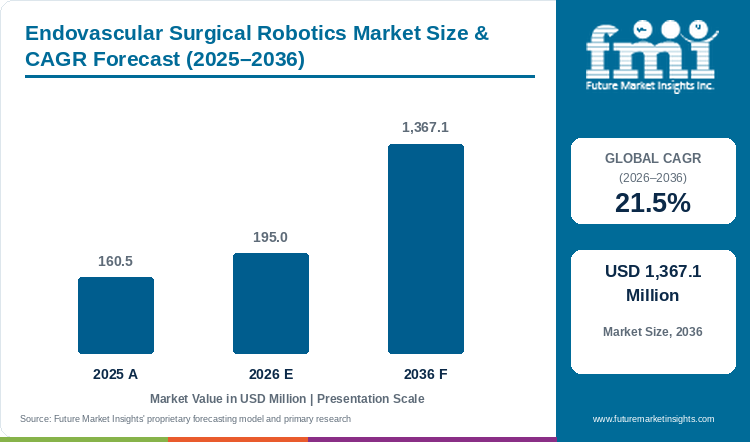
Demand for endovascular surgical robotics is projected to expand at 21.5% CAGR between 2026 and 2036. Industry value grows from USD 160.5 million in 2025 to USD 195.0 million in 2026 and is projected to reach USD 1,367.1 million by 2036.
Endovascular surgical robotics market was valued at USD 160.5 million in 2025 and is projected to increase from USD 195.0 million in 2026 to USD 1,367.1 million by 2036, at 21.5% CAGR. According to FMI, robotic systems accounted for 63.6% of product type revenue in 2026, as bedside units and consoles creates the main procedure capacity. The FDA cleared LIBERTY under K243789 in September 2025 for peripheral endovascular procedures.[1] Stereotaxis reported more than 150,000 patients treated with its robotic technology by August 2026, while robotic catheter revenue crossed USD 1.0 million and increased 270% sequentially.[2] Microbot Medical also recorded more than 100% quarterly revenue and customer growth, use across four embolization procedure groups and expansion from four to eight sales territories.[3] While cumulative procedure counts demonstrate clinical feasibility, annual market value is driven by capital system placements, disposables, and service contracts across surgical robot procedures.
Key Market Trends & Insights
- By product type, robotic systems led with 63.6% of revenue in 2026, as bedside units and control consoles establish the installed procedure capacity.
- By application, coronary interventions accounted for 47.3% in 2026, owing to defined guidewire, balloon and stent procedures in existing catheterization laboratories.
- By technology, electromechanical drive systems represented 61.0% in 2026, supported by controlled movement of familiar catheter and guidewire formats.
- By end user, hospitals held 68.6% in 2026 because catheterization laboratories, imaging systems, trained specialists and emergency support are required together.
Regional Highlights
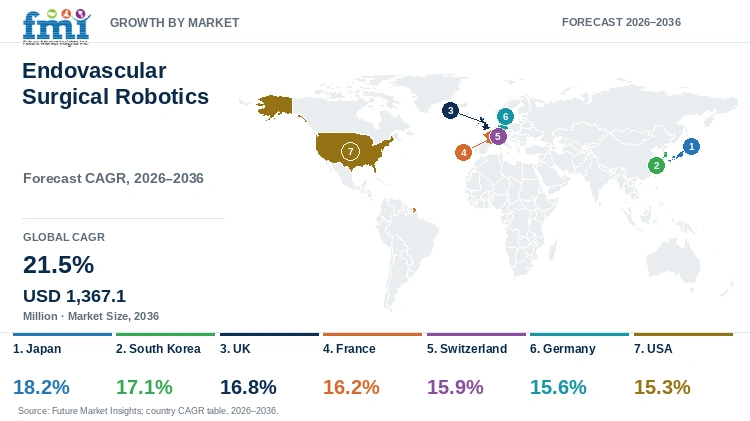
- Fastest-growing profiled country: Japan (18.2% CAGR, 2026 to 2036).
- By country: South Korea (17.1%) and the UK (16.8%) follow, while the USA records the lowest profiled CAGR at 15.3%.
Market Size & Forecast
Table 1: Market Size and Forecast for the Endovascular Surgical Robotics Market (USD million and percentage), 2025 to 2036
| Metric | Value |
|---|---|
| 2025 Market Size | USD 160.5 million |
| Estimated Market Size in 2026 | USD 195.0 million |
| Projected Market Size by 2036 | USD 1,367.1 million |
| CAGR, 2026 to 2036 | 21.5% |
| Added Revenue, 2026 to 2036 | USD 1,172.1 million |
An FMI analyst notes that endovascular robotics demand depends on eligible procedures and prepared hospital teams, and not on vascular patient numbers alone. ARPA-H reported in August 2026 that only about 12% of Americans requiring thrombectomy receives it, while half of the population lives more than one hour from an advanced care center, with every 10-minute treatment delay linked with 39 additional disability days and about USD 10,000 in healthcare costs.[5] The American Heart Association 2026 acute stroke management guidelines emphasize that mechanical thrombectomy remains time-critical for achieving functional independence in large vessel occlusion cases.[25] These figures gives remote stroke robotics a clear access opportunity. However, imaging, bedside staff and emergency conversion will remain required before remote control can become regular hospital treatment.
Procedure Access and Commercial Readiness
Remote robotic treatment can expand where a specialist is connected with a hospital already having imaging, trained staff and emergency support. Regulatory clearance gives hospitals a product which can be purchased, whereas eligible procedures and recurring instruments decides whether the system moves into daily use. Wider access will therefore depend on complete treatment pathways, specialized catheter laboratories, and integrated interventional cardiology devices.
Table 2: Procedure Access and Commercial Readiness Indicators for the Endovascular Surgical Robotics Market (patients, percentages, time, facilities, territories, and USD), mixed reporting years from 2025 to 2026
| Indicator | Data Point | Why It Matters | Source |
|---|---|---|---|
| Authorized peripheral platform | FDA decision on K243789, September 2025 | Provides an authorized U.S. route for single-use peripheral robotic navigation. | [1] |
| Documented robotic use | More than 150,000 patients treated with Stereotaxis technology by August 2026 | Shows a current clinical base for magnetic robotic navigation. | [2] |
| Procedure-linked sales | Robotic catheter revenue above USD 1.0 million; 270% sequential growth | Connects installed systems with repeat catheter demand. | [2] |
| Commercial expansion | More than 100% quarterly revenue and customer growth; eight sales territories | Shows movement from limited release towards wider hospital access. | [3] |
| Stroke treatment gap | About 12% of Americans needing thrombectomy receive it | Defines the access gap considered by remote-stroke programs. | [5] |
| Distance and delay burden | Half of Americans exceed one hour from advanced care; 10 minutes adds 39 disability days and about USD 10,000 | Explains why specialist control from another location is being developed. | [5] |
Analyst Perspective
“Hospitals will expand robotic use where eligible catheter procedures are frequent enough to support regular system operation. Remote stroke robotics can widen treatment access, but prepared imaging and emergency teams will still decide adoption.”
- Anurag Sharma, Principal Consultant, Future Market Insights.
How is the endovascular surgical robotics market segmented?
Endovascular surgical robotics market is segmented by four primary commercial axes and region: product type, application, technology, end user, and region. In 2026, robotic systems are projected at 63.6%, coronary interventions at 47.3%, electromechanical drive systems at 61.0%, and hospitals at 68.6%.
Endovascular surgical robotics market is segmented by product type, application, technology, end user, and region.
By product type: robotic systems, disposable cassettes and consumables, and software and navigation services.
By application: coronary interventions, neurovascular interventions, peripheral vascular interventions, and electrophysiology and structural heart.
By technology: electromechanical drive systems, magnetic navigation systems, and telerobotic and AI-assisted platforms.
By end user: hospitals, ambulatory surgical centers, and academic and research institutes.
By region: North America, Latin America, Western Europe, Eastern Europe, East Asia, South Asia and Pacific, and Middle East and Africa.
Why do Robotic Systems anchor purchasing by Product Type?
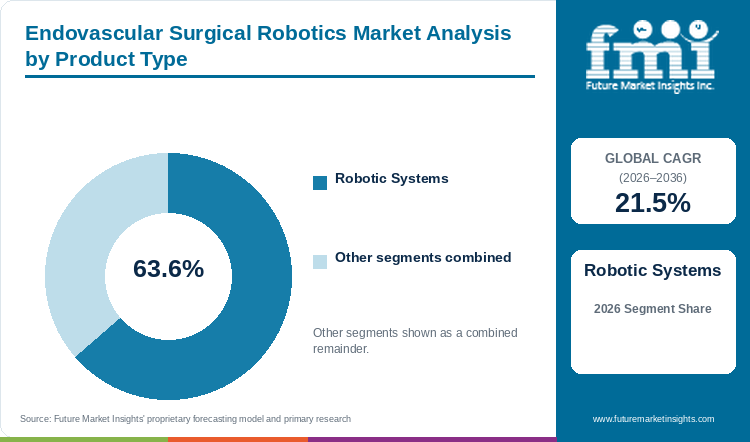
Robotic systems are expected to account for 63.6% of product type revenue in 2026, supported by bedside unit and console capacity.
Table 3: Product Type Share for the Endovascular Surgical Robotics Market (percentage share), 2026
| Product Type | Share (2026) |
|---|---|
| Robotic Systems | 63.6% |
| Other Segments Combined | 36.4%* |
| Total | 100.0% |
*Calculated as the balance remaining after deducting the leading segment's reported share from 100.0%.
Table 4: Product Type Leadership and Market Growth for the Endovascular Surgical Robotics Market (segment and CAGR percentage), 2026 to 2036
| Metric | Value |
|---|---|
| Global CAGR (2026 to 2036) | 21.5% |
| Leading Segment | Robotic Systems |
Robotic systems include bedside units and control consoles used for moving endovascular devices away from the patient table. These systems establish the robotic procedure capacity, creating a foundation for next-generation AI-based surgical robots in clinical practice. Installation of robotic units creates demand for compatible instruments, operator training and maintenance. The robotic systems segment is expected to support endovascular surgical robotics market growth over the forecast period.
- Robotic systems are projected to hold 63.6% of product type revenue in 2026. The segment benefits from requirement for bedside robotic units and remote control consoles.
- In November 2025, Stereotaxis received FDA 510(k) clearance for its redesigned GenesisX robotic magnetic navigation system, expanding bedside procedural capacity for catheterization laboratories.[26]
What sustains Coronary Interventions within Application?
Coronary interventions are estimated to represent 47.3% of the application category in 2026, reflecting standardized guidewire and balloon sequences.
Coronary interventions use guidewires, balloon catheters and stents for treating blocked coronary arteries. Existing catheterization laboratories and a defined device sequence are supporting robotic use in selected coronary cases. Clinicians frequently integrate precision robotic movement with drug-eluting coronary stents during complex bifurcation cases. In the FMI report, coronary interventions account for 47.3% of application revenue in 2026, which is anticipated to support this segment during the assessment period.
- Coronary interventions are projected to hold 47.3% of application revenue in 2026, supported by defined catheterization workflows.
- In April 2026, Stereotaxis announced first U.S. procedures with the MAGiC magnetic interventional ablation catheter.[6] Increasing clinical use of robotic catheter products is expanding procedure experience at cardiac centers.
How do Electromechanical Drive Systems lead the Technology mix?
Electromechanical drive systems are set to lead technology with 61.0% share in 2026, driven by compatibility with standard catheter formats.
Electromechanical drive systems converts operator commands into forward, backward and rotational movement of guidewires and catheters. The technology works with familiar device formats, including specialty micro guide catheters, and does not require magnetic instruments throughout each procedure. This allows hospitals to examine robotic movement within existing catheterization practices. As noted by FMI, electromechanical drive systems hold 61.0% of technology revenue in 2026, owing to requirement for controlled catheter handling.
- Electromechanical drive systems hold 61.0% in 2026, with cassette-based and actuator-based control addressing movement through existing catheter workflows.
- In May 2026, Sentante received CE Mark approval for its device-agnostic endovascular robotic platform.[7] The approval allows the company to begin commercial introduction for vascular procedures in Europe.
Why are hospitals central to end-user demand for robotic systems?
Hospitals are expected to command 68.6% of end-user revenue in 2026, owing to specialist catheterization infrastructure and emergency rescue capabilities.
Hospitals provides catheterization laboratories, imaging systems, trained specialists and emergency support required for robotic endovascular procedures. Beyond cardiac suites, facilities are expanding robotic trials into interventional radiology suites for peripheral and oncology treatments. FMI research indicates hospitals account for 68.6% of end-user revenue in 2026, owing to presence of specialist infrastructure and trained teams.
- Hospitals account for 68.6% in 2026, where the ability to coordinate procedural infrastructure and rescue capability supports platform purchasing.
- In May 2026, Robocath completed enrollment of 20 patients at Centre Cardiologique du Nord for its next-generation robotic platform.[8] Specialist hospitals provides the clinical teams and imaging systems required for robotic evaluation.
What are the drivers, restraints, and opportunities in the endovascular surgical robotics market?
In the endovascular surgical robotics market, occupational radiation protection supports demand while incomplete workflow compatibility restrains adoption and validated remote stroke pathways offer an expansion opportunity.
- Driver: Remote catheter movement can reduce radiation exposure for the principal operator during repeated fluoroscopy-guided procedures.
- Restraint: Limited compatibility with imaging and treatment devices can increase manual handling and restrict the number of robotic procedures.
- Opportunity: Remote stroke robotics can extend specialist control to prepared hospitals where immediate interventional expertise is not available.
Occupational Radiation Protection Supports Adoption
Repeated fluoroscopy exposes catheterization teams to occupational radiation, creating a measurable reason to consider remote operation. While standard manual procedures require operators to manipulate coronary guidewires under direct X-ray guidance, robotic consoles allow remote manipulation from a radiation-shielded cockpit. A 2025 clinical review published in the Journal of Clinical Medicine reported that endovascular robotics reduces operator radiation exposure by 85% to 95% compared with manual techniques.[9] The demand effect is strongest when hospitals can use the protected position through a repeatable group of eligible procedures. Radiation reduction supports evaluation, while procedure volume determines whether the benefit can justify equipment, training, and support costs.
Workflow and Device Compatibility Limit Whole-Procedure Use
Endovascular robotic systems can control guidewire and catheter movement, whereas unsupported devices may still require manual operation. In September 2026, the FDA issued draft guidance covering performance testing, clinical data and labeling for robotically assisted surgical devices.[10] Complete procedural automation requires broader compatibility across specialized peripheral vascular devices and therapeutic delivery platforms. Additional testing and clear device limitations can increase product approval and hospital evaluation time. High compatibility requirement may hamper wider market growth.
Remote Stroke Networks Expand Specialist Coverage
Remote endovascular treatment can connect a specialist with a prepared hospital when distance limits immediate access. In August 2025, Nanoflex Robotics completed a remote animal thrombectomy study between Arizona and Bern.[11] The study supports long-distance magnetic navigation, while imaging and local emergency support remains required at the treatment site. Expanding remote telestroke programs alongside advanced neurovascular devices allows remote specialists to navigate tortuous cerebral anatomy from centralized hubs, creating new opportunities during the forecast period.
Which country CAGRs are profiled in the endovascular surgical robotics market?
Table 5: Country CAGR Comparison for the Endovascular Surgical Robotics Market (CAGR percentage), 2026 to 2036
| Country | CAGR |
|---|---|
| Japan | 18.2% |
| South Korea | 17.1% |
| UK | 16.8% |
| France | 16.2% |
| Switzerland | 15.9% |
| Germany | 15.6% |
| USA | 15.3% |
How do country-level CAGRs compare in the endovascular surgical robotics market?
As per the analysis from FMI, growth conditions vary between the profiled countries as catheterization infrastructure, regulatory clearances, and specialist stroke network readiness differ across healthcare systems. Japan and South Korea lead projected expansion above 17.0 per cent, while European markets and the United States reflect established procedural volume.
- Japan emphasizes dedicated catheterization facilities and structured clinical evaluation for robotic percutaneous coronary procedures.
- South Korean cardiac centers expand electrophysiology laboratories and advanced catheter systems alongside international medical device collaborations.
- The UK combines national mechanical thrombectomy expansion with centralized stroke center infrastructure to broaden specialist intervention access.
- French cardiology and neurovascular intensive care units provide organized clinical environments for complex interventional trials.
- Switzerland supports biomedical research partnerships, authorization cooperation, and structured clinical evaluation across university hospital centers.
- German university centers advance neurovascular simulation research and operator training to establish procedural competency before patient deployment.
- United States hospitals balance commercial single-use platform adoption with rigorous institutional review and multi-specialty catheterization demand.
Full report country CAGRs cover: North America; Latin America; Western Europe; Eastern Europe; East Asia; South Asia and Pacific; Middle East and Africa.
Country-wise Analysis
- Japan endovascular surgical robotics market is projected to grow at 18.2% CAGR through 2036. In December 2025, the Ministry of Health published 2024 NDB open data covering medical procedures and hospital activity.[12] The data allows hospitals to review catheter-treatment volumes before installing robotic systems. Japan also has established facility and operator requirements for robotic PCI. FMI data suggests that procedure review along with demand for compatible imaging and catheter devices will support market expansion.
- South Korea endovascular surgical robotics market is anticipated to advance at 17.1% CAGR during the assessment period. In December 2025, the Korea Health Industry Development Institute published a review of pulsed field ablation and catheter-based arrhythmia treatment.[13] The review noted wider use of advanced catheter systems and participation of global medical-device companies. Presence of electrophysiology laboratories and trained specialists can support robotic navigation evaluation. These factors are anticipated to propel the South Korea market growth.
- Demand for endovascular surgical robotics in the UK is forecast to rise at 16.8% CAGR through 2036. In May 2026, NHS England reported that mechanical thrombectomy opens the blocked artery in about 70% of cases, and recorded a 45% average chance of regaining independence after treatment compared with 26% without it.[4] Expansion of thrombectomy services provides prepared hospitals for future robotic treatment. Availability of specialist stroke teams is expected to support the UK market growth.
- France endovascular surgical robotics market is anticipated to grow at 16.2% CAGR between 2026 and 2036. In January 2026, the French health ministry published the 2025 medical-unit classification covering adult cardiology and neurovascular intensive-care units.[14] The classification identifies hospitals where complex cardiac and stroke procedures are organized. Specialist centers can support robotic studies, operator training and manual conversion. These conditions are expected to support the France market revenue growth.
- Adoption of endovascular robotics in Switzerland is estimated to expand at 15.9% CAGR through 2036. In November 2025, the Federal Office of Public Health completed its 2013 to 2025 biomedicine master-plan report.[15] Clinical research, authorization cooperation and secure health-data programs will continue after completion of the plan. These conditions can support studies for magnetic and remote navigation systems. Hospital collaboration is expected to create growth opportunities in Switzerland.
- Germany endovascular surgical robotics market is projected to record 15.6% CAGR during the assessment period. In March 2025, University Hospital Bonn published a neurovascular phantom study comparing operators with different experience on CorPath GRX.[16] The study provides local information for designing robotic training before patient use. German hospitals also requires documented compatibility with imaging and catheter devices. Expansion of simulation and specialist training is likely to fuel the Germany market growth.
- Revenue from endovascular surgical robotics sales in the USA is projected to rise at 15.3% CAGR over the assessment period. In June 2026, Microbot Medical entered into an agreement to expand access to the LIBERTY system across more than 2,000 U.S. government healthcare facilities.[17] The single-use platform addresses prostate, uterine, genicular, and peripheral vascular embolization procedures. Broader institutional access across federal hospitals and clinical evaluations is expected to support sustained adoption in the United States.
Who are the notable companies in the endovascular surgical robotics market?
Stereotaxis, Inc., Siemens Healthineers AG, Robocath SAS, Microbot Medical Inc., XCath Inc., Nanoflex Robotics AG, Sentante UAB, Remedy Robotics, Inc., Medtronic plc are the notable companies profiled in this market.
Endovascular surgical robotics market includes magnetic navigation companies, mechanical catheter-control suppliers and remote neurovascular developers. Stereotaxis and Robocath are under common ownership, whereas both companies continue with different robotic technologies. In electrophysiology, dedicated robotic steering coordinates with specialized magnetic ablation catheter systems to treat complex arrhythmias. Microbot Medical and Sentante are focusing on peripheral and vascular procedures. XCath, Nanoflex Robotics, Remedy Robotics and Siemens Healthineers are developing remote or autonomous stroke systems. Some of the prominent players are expanding approvals, clinical studies and commercial supply in order to increase hospital use.
- Procedure-specific commercial robotic platforms: Stereotaxis, Inc., Robocath SAS, Microbot Medical Inc., and Sentante UAB.
- Remote neurovascular development platforms: Siemens Healthineers AG, XCath Inc., Nanoflex Robotics AG, and Remedy Robotics, Inc.
- Adjacent medical robotics providers: Medtronic plc.
Competitive Benchmarking: Endovascular Surgical Robotics Market
Table 6: Competitive Benchmarking for the Endovascular Surgical Robotics Market (qualitative capability ratings), 2026
| Company | Clinical Translation | Conventional Device Compatibility | Long-Distance Teleoperation | Geographic Reach |
|---|---|---|---|---|
| Stereotaxis, Inc. | High | Low | Low | Medium |
| Siemens Healthineers AG | Low | Low | Low | Medium |
| Robocath SAS | High | High | Low | Medium |
| Microbot Medical Inc. | High | High | Low | Medium |
| XCath Inc. | Medium | Low | High | Medium |
| Nanoflex Robotics AG | Low | Medium | Medium | Medium |
| Sentante UAB | High | High | Medium | Medium |
| Remedy Robotics, Inc. | Medium | Low | High | Medium |
| Medtronic plc | Low | Low | Low | Medium |
High indicates wider authorized or clinical activity, Medium indicates limited human or preclinical activity, and Low indicates early development or limited direct evidence. These ratings do not indicate product quality, company rank or numerical market share.
Key Developments in the Endovascular Surgical Robotics Market
- In July 2026, Stereotaxis, Inc. completed the acquisition of Robocath.[18] The acquisition added mechanical coronary robotics to the magnetic navigation product portfolio of Stereotaxis.
- In March 2026, XCath Inc. announced a remote thrombectomy in a stroke patient during a clinical investigation in Panama.[19] The operator and patient were located more than 200 kilometers apart, whereas the Iris platform remained investigational.
- In June 2026, Microbot Medical Inc. entered into a strategic manufacturing agreement with Sanmina to expand commercial production capacity for the LIBERTY system.[24]
Key Players in the Endovascular Surgical Robotics Market
Procedure-specific commercial robotic platforms
- Stereotaxis, Inc.
- Robocath SAS
- Microbot Medical Inc.
- Sentante UAB
Remote neurovascular development platforms
- Siemens Healthineers AG
- XCath Inc.
- Nanoflex Robotics AG
- Remedy Robotics, Inc.
Adjacent surgical robotics platforms
- Medtronic plc
Endovascular Surgical Robotics Market - Report Scope
Table 7: Report Scope for the Endovascular Surgical Robotics Market (coverage fields and definitions), 2026 to 2036
| Coverage field | Report scope |
|---|---|
| Market breakdown | Product Type; Application; Technology; End User |
| Quantitative Units | USD Million |
| Market Definition | Revenue covers endovascular robotic systems, dedicated robot-compatible instruments and consumables, and attributable navigation software or service and maintenance contracts used within the stated applications; bundled elements are allocated once and aftermarket revenue is counted only when directly attributable. Hospital procedure fees, unrelated imaging equipment, general-purpose manual devices, therapeutic implants and soft-tissue surgical robots are excluded, as are research grants and revenue outside the stated segmentation. |
| Regions Covered | North America; Latin America; Western Europe; Eastern Europe; East Asia; South Asia and Pacific; Middle East and Africa |
| Countries Covered | Japan; South Korea; UK; France; Switzerland; Germany; USA |
| Key Companies Profiled | Stereotaxis, Inc.; Siemens Healthineers AG; Robocath SAS; Microbot Medical Inc.; XCath Inc.; Nanoflex Robotics AG; Sentante UAB; Remedy Robotics, Inc.; Medtronic plc |
| Forecast Period | 2026 to 2036 |
| Approach | Primary and secondary research with market triangulation. |
Endovascular Surgical Robotics Market - Research Methodology
Table 8: Research Methodology for the Endovascular Surgical Robotics Market (research methods and approach), 2026 edition
| Method | Approach |
|---|---|
| Primary Research | Primary research includes interviews with manufacturers, technology developers, distributors, hospitals, procurement teams and industry experts. Interviews covers purchasing decision, product evaluation, pricing, adoption barriers, approval requirement and technical support. |
| Desk Research | Desk research covers government publications, regulatory records, company filings, official announcements, clinical literature, standards and current product information. |
| Market Sizing and Forecasting | Market sizing combines the base value, segment share, product pricing, system installation, procedure-linked demand, company participation and country demand condition. Forecasts considers regulation, technology adoption, purchasing cycle and supply availability. |
| Data Validation | Market estimates are checked with public data, official company activity, regulatory records and primary research findings. Overlapping revenue, unrelated devices, research grants and activities outside the market definition are excluded. |
Endovascular Surgical Robotics Market by Segments
Endovascular Surgical Robotics Market segmented by Product Type:
- Robotic Systems
- Bedside Robotic Units
- Remote Control Consoles
- Disposable Cassettes and Consumables
- Single-Use Drive Cassettes
- Robot-Compatible Guidewires and Catheters
- Software and Navigation Services
- Imaging Fusion and Navigation Software
- Service and Maintenance Contracts
Endovascular Surgical Robotics Market segmented by Application:
- Coronary Interventions
- Percutaneous Coronary Intervention
- Complex Lesion and CTO Procedures
- Neurovascular Interventions
- Mechanical Thrombectomy
- Aneurysm Coiling and Stenting
- Peripheral Vascular Interventions
- Lower-Limb Angioplasty
- Venous and Dialysis Access Procedures
- Electrophysiology and Structural Heart
- Robotic Catheter Ablation
- Structural Heart Navigation
Endovascular Surgical Robotics Market segmented by Technology:
- Electromechanical Drive Systems
- Cassette-Based Catheter Drives
- Linear Actuator Manipulators
- Magnetic Navigation Systems
- Robotic Magnetic Catheter Steering
- Magnetically Guided Guidewires
- Telerobotic and AI-Assisted Platforms
- Remote Long-Distance Procedures
- AI-Guided Navigation Assistance
Endovascular Surgical Robotics Market segmented by End User:
- Hospitals
- Tertiary Cardiac Centers
- Comprehensive Stroke Centers
- Ambulatory Surgical Centers
- Office-Based Labs
- Outpatient Cath Labs
- Academic and Research Institutes
- University Teaching Hospitals
- Simulation and Training Centers
Endovascular Surgical Robotics Market by Region:
- North America
- United States
- Canada
- Latin America
- Brazil
- Mexico
- Argentina
- Chile
- Western Europe
- Germany
- France
- United Kingdom
- Italy
- Spain
- Benelux
- Nordics
- Eastern Europe
- Poland
- Czech Republic
- Romania
- Hungary
- East Asia
- China
- Japan
- South Korea
- South Asia and Pacific
- India
- ASEAN
- Australia and New Zealand
- Middle East and Africa
- GCC Countries
- South Africa
- Türkiye
- Israel
Research Sources and Bibliography
- [1] U.S. Food and Drug Administration (2025, September 4). LIBERTY Endovascular Robotic System: 510(k) K243789 clearance and summary.
- [2] Stereotaxis, Inc. (2026, August 11). Form 10-Q for the quarterly period ended June 30, 2026. U.S. Securities and Exchange Commission.
- [3] Microbot Medical Inc. (2026, August 11). Microbot Medical® Files 10-Q, Reports Significant Revenue and Customer Growth During the 2026 Second Quarter.
- [4] NHS England (2026, May 14). Mechanical thrombectomy for acute ischaemic stroke: Annual activity and clinical outcomes report.
- [5] Advanced Research Projects Agency for Health (2026, August 6). ARPA-H funded teams to transform life-saving stroke interventions with autonomous robotic surgeries.
- [6] Stereotaxis, Inc. (2026, April 28). Stereotaxis Announces First U.S. Procedures with MAGiC Magnetic Interventional Ablation Catheter.
- [7] Sentante (2026, May 20). Sentante Receives CE Mark Approval unlocking commercialisation of its Endovascular Robotic platform.
- [8] Robocath (2026, May 11). Robocath completes enrollment in First-In-Human (FIH) study of next-gen robotic platform in interventional cardiology.
- [9] Alsabbagh, Y., et al. (2025, October 17). Robotic-Assisted Vascular Surgery: Current Landscape, Challenges, and Future Directions. Journal of Clinical Medicine, 14(20), 7353.
- [10] U.S. Food and Drug Administration. (2026, September 24). Robotically-assisted surgical devices: Premarket submissions.
- [11] Nanoflex Robotics AG (2025, August 14). Nanoflex Robotics Conducts First Transatlantic Remote Animal Thrombectomy Study.
- [12] Ministry of Health, Labour and Welfare of Japan. (2025, December). 10th NDB Open Data Japan: National database of health insurance claims and specific health checkups of Japan.
- [13] Korea Health Industry Development Institute. (2025, December). Global medical device trend report: Pulsed field ablation and catheter arrhythmia interventions.
- [14] Ministère de la Santé. (2026, January). Nomenclature des unités médicales 2025.
- [15] Swiss Federal Office of Public Health. (2025, November 5). Biomedicine master plan: Boosting biomedical research and technology.
- [16] Dell, T., et al. (2025, March 3). Impact of robotic assistance on the learning curve in endovascular interventions: exploring the role of operator experience with the CorPath GRX system.
- [17] Microbot Medical Inc. (2026, June 16). Microbot Medical enters into an agreement to expand access for America’s veteran and military patient populations.
- [18] Stereotaxis, Inc. (2026, July 9). Stereotaxis Completes Acquisition of Robocath.
- [19] XCath (2026, March 19). XCath Makes Medical History With the World’s First Remote Robotic Intervention in a Stroke Patient.
- [20] Sentante (2026, August 20). Sentante takes physical AI to market, beginning commercial rollout in vascular surgery and interventional radiology.
- [21] Stereotaxis, Inc. (2026, January 6). Stereotaxis Receives FDA Approval for MAGiC Ablation Catheter.
- [22] Nanoflex Robotics AG (2026, June 24). Nanoflex Robotics Awarded €12.5 Million from the EIC Accelerator.
- [23] Remedy Robotics (2025, October). Remedy Announces Partnership with SVIN Mission Thrombectomy.
- [24] Microbot Medical Inc. (2026, June 30). Microbot Medical® Increases Manufacturing Capacity as Demand for the LIBERTY® System Rises; Enters into Strategic Agreement with Sanmina, a Global Manufacturing Leader.
- [25] American Heart Association. (2026, January 26). 2026 Guideline for the Early Management of Patients With Acute Ischemic Stroke. Stroke, 57(3), e1-e100.
- [26] U.S. Food and Drug Administration. (2025, November 12). GenesisX Robotic Magnetic Navigation System: 510(k) K251842 clearance and summary.
This bibliography is provided for reader reference. The full report contains the complete reference list and detailed citations.
This Report Answers
- How big is the endovascular surgical robotics market in 2026 and 2036?
- Which clinical and workplace pressures support spending on endovascular surgical robotics?
- Why do Robotic Systems lead the Product Type category?
- Why do Coronary Interventions lead the Application category?
- How do growth rates differ across the profiled countries?
- Which profiled companies supply commercial platforms and which remain in development?
- What limits robotic adoption or switching between device ecosystems?
- What should hospitals evaluate before committing to an endovascular robotic platform?
Frequently Asked Questions
How large is the Endovascular Surgical Robotics Market expected to be in 2026?
Future Market Insights estimates that the endovascular surgical robotics market will reach USD 195.0 million in 2026. The market is projected to expand further and reach USD 1,367.1 million by 2036.
What CAGR is forecast for the Endovascular Surgical Robotics Market through 2036?
As per FMI, the endovascular surgical robotics market is projected to grow at a 21.5% CAGR from 2026 to 2036. Growth is supported by radiation protection, controlled catheter movement, and remote stroke treatment development.
Which product type holds a notable endovascular surgical robotics demand share in 2026?
Robotic systems are projected to hold 63.6% of product type revenue in 2026. The segment benefits from bedside robotic units and remote control consoles that establish procedural capacity.
Which application segment holds a notable endovascular surgical robotics share in 2026?
Coronary interventions will hold 47.3% of application demand in 2026. Demand is supported by defined guidewire, balloon, and stenting sequences in existing cardiac catheterization suites.
Which country has a notable endovascular surgical robotics expansion outlook during the forecast period?
Japan is projected to expand at an 18.2% CAGR during the 2026 to 2036 assessment period. Growth is supported by established catheterization activity and structured clinical evaluation for robotic PCI.
Which companies are active in the Endovascular Surgical Robotics Market during 2026?
Notable companies include Stereotaxis, Inc., Siemens Healthineers AG, Robocath SAS, Microbot Medical Inc., XCath Inc., Nanoflex Robotics AG, Sentante UAB, Remedy Robotics, Inc., and Medtronic plc. These companies are focusing on regulatory clearances, clinical investigations, and expanding procedural indications.
Preview the report firsthand - request a free sample
Get SampleGet the brochure for pricing and purchase details.
Get PDFTable of Content
- Key Takeaways
- Market Size and CAGR
- Top Growth Driver
- Fastest Growing Segment
- Leading Region
- Key Companies
- Emerging Opportunities
- Executive Summary
- Global Market Outlook
- Demand-side Trends
- Supply-side Trends
- Technology Roadmap Analysis
- Analysis and Recommendations
- Analyst Perspective (What is happening? Why now? What should investors know?)
- Key Questions Answered
- How large is the market?
- What is the CAGR?
- What are key trends?
- Which region dominates?
- Who are the leaders?
- Market Overview
- Market Coverage / Taxonomy
- Market Definition / Scope / Limitations
- Research Methodology
- Chapter Orientation
- Analytical Lens and Working Hypotheses
- Market Structure, Signals, and Trend Drivers
- Benchmarking and Cross-market Comparability
- Market Sizing, Forecasting, and Opportunity Mapping
- Research Design and Evidence Framework
- Desk Research Programme (Secondary Evidence)
- Expert Input and Fieldwork (Primary Evidence)
- Tooling, Models, and Reference Databases
- Data Engineering and Model Build
- Quality Assurance and Audit Trail
- Market Background
- Market Dynamics (Drivers, Restraints, Opportunity, Trends)
- Scenario Forecast (Optimistic, Likely, Conservative)
- Impact Analysis
- AI Impact
- Sustainability Impact
- Regulatory Impact
- Technology Impact
- Consumer / Buyer Analysis
- Purchase Drivers
- Adoption Barriers
- Buyer Journey
- Opportunity Map Analysis
- Product Life Cycle Analysis
- Supply Chain Analysis
- Investment Feasibility Matrix
- Value Chain Analysis
- PESTLE and Porter's Analysis
- Regulatory Landscape
- Regional Parent Market Outlook
- Production and Consumption Statistics
- Import and Export Statistics
- Global Market Analysis and Forecast, 2021 to 2036
- Historical Market Size Value (USD Million) Analysis, 2021 to 2025
- Current and Future Market Size Value (USD Million) Projections, 2026 to 2036
- Y-o-Y Growth Trend Analysis
- Absolute $ Opportunity Analysis
- Global Market Pricing Analysis, 2021 to 2036
- Global Market Analysis and Forecast, By Product Type, 2021 to 2036
- Introduction / Key Findings
- Historical Market Size Value (USD Million) Analysis By Product Type, 2021 to 2025
- Current and Future Market Size Value (USD Million) Analysis and Forecast By Product Type, 2026 to 2036
- Robotic Systems
- Bedside Robotic Units
- Remote Control Consoles
- Disposable Cassettes and Consumables
- Single-Use Drive Cassettes
- Robot-Compatible Guidewires and Catheters
- Software and Navigation Services
- Imaging Fusion and Navigation Software
- Service and Maintenance Contracts
- Robotic Systems
- Y-o-Y Growth Trend Analysis By Product Type, 2021 to 2025
- Absolute $ Opportunity Analysis By Product Type, 2026 to 2036
- Global Market Analysis and Forecast, By Application, 2021 to 2036
- Introduction / Key Findings
- Historical Market Size Value (USD Million) Analysis By Application, 2021 to 2025
- Current and Future Market Size Value (USD Million) Analysis and Forecast By Application, 2026 to 2036
- Coronary Interventions
- Percutaneous Coronary Intervention
- Complex Lesion and CTO Procedures
- Neurovascular Interventions
- Mechanical Thrombectomy
- Aneurysm Coiling and Stenting
- Peripheral Vascular Interventions
- Lower-Limb Angioplasty
- Venous and Dialysis Access Procedures
- Electrophysiology and Structural Heart
- Robotic Catheter Ablation
- Structural Heart Navigation
- Coronary Interventions
- Y-o-Y Growth Trend Analysis By Application, 2021 to 2025
- Absolute $ Opportunity Analysis By Application, 2026 to 2036
- Global Market Analysis and Forecast, By Technology, 2021 to 2036
- Introduction / Key Findings
- Historical Market Size Value (USD Million) Analysis By Technology, 2021 to 2025
- Current and Future Market Size Value (USD Million) Analysis and Forecast By Technology, 2026 to 2036
- Electromechanical Drive Systems
- Cassette-Based Catheter Drives
- Linear Actuator Manipulators
- Magnetic Navigation Systems
- Robotic Magnetic Catheter Steering
- Magnetically Guided Guidewires
- Telerobotic and AI-Assisted Platforms
- Remote Long-Distance Procedures
- AI-Guided Navigation Assistance
- Electromechanical Drive Systems
- Y-o-Y Growth Trend Analysis By Technology, 2021 to 2025
- Absolute $ Opportunity Analysis By Technology, 2026 to 2036
- Global Market Analysis and Forecast, By End User, 2021 to 2036
- Introduction / Key Findings
- Historical Market Size Value (USD Million) Analysis By End User, 2021 to 2025
- Current and Future Market Size Value (USD Million) Analysis and Forecast By End User, 2026 to 2036
- Hospitals
- Tertiary Cardiac Centers
- Comprehensive Stroke Centers
- Ambulatory Surgical Centers
- Office-Based Labs
- Outpatient Cath Labs
- Academic and Research Institutes
- University Teaching Hospitals
- Simulation and Training Centers
- Hospitals
- Y-o-Y Growth Trend Analysis By End User, 2021 to 2025
- Absolute $ Opportunity Analysis By End User, 2026 to 2036
- Global Market Analysis and Forecast, By Region, 2021 to 2036
- Introduction
- Historical Market Size Value (USD Million) Analysis By Region, 2021 to 2025
- Current Market Size Value (USD Million) Analysis and Forecast By Region, 2026 to 2036
- North America
- Latin America
- Western Europe
- Eastern Europe
- East Asia
- South Asia and Pacific
- Middle East and Africa
- Market Attractiveness Analysis By Region
- North America Market Analysis and Forecast, By Country, 2021 to 2036
- Historical Market Size Value (USD Million) Trend Analysis By Market Taxonomy, 2021 to 2025
- Market Size Value (USD Million) Forecast By Market Taxonomy, 2026 to 2036
- By Country
- United States
- Canada
- By Product Type
- By Application
- By Technology
- By End User
- By Country
- Market Attractiveness Analysis
- By Country
- By Product Type
- By Application
- By Technology
- By End User
- Key Takeaways
- Latin America Market Analysis and Forecast, By Country
- Historical Market Size Value (USD Million) Trend Analysis By Market Taxonomy, 2021 to 2025
- Market Size Value (USD Million) Forecast By Market Taxonomy, 2026 to 2036
- By Country
- Brazil
- Mexico
- Argentina
- Chile
- By Product Type
- By Application
- By Technology
- By End User
- By Country
- Market Attractiveness Analysis
- By Country
- By Product Type
- By Application
- By Technology
- By End User
- Key Takeaways
- Western Europe Market Analysis and Forecast, By Country
- Historical Market Size Value (USD Million) Trend Analysis By Market Taxonomy, 2021 to 2025
- Market Size Value (USD Million) Forecast By Market Taxonomy, 2026 to 2036
- By Country
- Germany
- France
- United Kingdom
- Italy
- Spain
- Benelux
- Nordics
- By Product Type
- By Application
- By Technology
- By End User
- By Country
- Market Attractiveness Analysis
- By Country
- By Product Type
- By Application
- By Technology
- By End User
- Key Takeaways
- Eastern Europe Market Analysis and Forecast, By Country
- Historical Market Size Value (USD Million) Trend Analysis By Market Taxonomy, 2021 to 2025
- Market Size Value (USD Million) Forecast By Market Taxonomy, 2026 to 2036
- By Country
- Poland
- Czech Republic
- Romania
- Hungary
- By Product Type
- By Application
- By Technology
- By End User
- By Country
- Market Attractiveness Analysis
- By Country
- By Product Type
- By Application
- By Technology
- By End User
- Key Takeaways
- East Asia Market Analysis and Forecast, By Country
- Historical Market Size Value (USD Million) Trend Analysis By Market Taxonomy, 2021 to 2025
- Market Size Value (USD Million) Forecast By Market Taxonomy, 2026 to 2036
- By Country
- China
- Japan
- South Korea
- By Product Type
- By Application
- By Technology
- By End User
- By Country
- Market Attractiveness Analysis
- By Country
- By Product Type
- By Application
- By Technology
- By End User
- Key Takeaways
- South Asia and Pacific Market Analysis and Forecast, By Country
- Historical Market Size Value (USD Million) Trend Analysis By Market Taxonomy, 2021 to 2025
- Market Size Value (USD Million) Forecast By Market Taxonomy, 2026 to 2036
- By Country
- India
- ASEAN
- Australia and New Zealand
- By Product Type
- By Application
- By Technology
- By End User
- By Country
- Market Attractiveness Analysis
- By Country
- By Product Type
- By Application
- By Technology
- By End User
- Key Takeaways
- Middle East and Africa Market Analysis and Forecast, By Country
- Historical Market Size Value (USD Million) Trend Analysis By Market Taxonomy, 2021 to 2025
- Market Size Value (USD Million) Forecast By Market Taxonomy, 2026 to 2036
- By Country
- GCC Countries
- South Africa
- Türkiye
- Israel
- By Product Type
- By Application
- By Technology
- By End User
- By Country
- Market Attractiveness Analysis
- By Country
- By Product Type
- By Application
- By Technology
- By End User
- Key Takeaways
- Key Countries Market Analysis
- United States
- Pricing Analysis
- Market Share Analysis, 2025
- By Product Type
- By Application
- By Technology
- By End User
- Canada
- Pricing Analysis
- Market Share Analysis, 2025
- By Product Type
- By Application
- By Technology
- By End User
- Mexico
- Pricing Analysis
- Market Share Analysis, 2025
- By Product Type
- By Application
- By Technology
- By End User
- Brazil
- Pricing Analysis
- Market Share Analysis, 2025
- By Product Type
- By Application
- By Technology
- By End User
- Chile
- Pricing Analysis
- Market Share Analysis, 2025
- By Product Type
- By Application
- By Technology
- By End User
- Germany
- Pricing Analysis
- Market Share Analysis, 2025
- By Product Type
- By Application
- By Technology
- By End User
- United Kingdom
- Pricing Analysis
- Market Share Analysis, 2025
- By Product Type
- By Application
- By Technology
- By End User
- Italy
- Pricing Analysis
- Market Share Analysis, 2025
- By Product Type
- By Application
- By Technology
- By End User
- Spain
- Pricing Analysis
- Market Share Analysis, 2025
- By Product Type
- By Application
- By Technology
- By End User
- France
- Pricing Analysis
- Market Share Analysis, 2025
- By Product Type
- By Application
- By Technology
- By End User
- India
- Pricing Analysis
- Market Share Analysis, 2025
- By Product Type
- By Application
- By Technology
- By End User
- ASEAN
- Pricing Analysis
- Market Share Analysis, 2025
- By Product Type
- By Application
- By Technology
- By End User
- Australia and New Zealand
- Pricing Analysis
- Market Share Analysis, 2025
- By Product Type
- By Application
- By Technology
- By End User
- China
- Pricing Analysis
- Market Share Analysis, 2025
- By Product Type
- By Application
- By Technology
- By End User
- Japan
- Pricing Analysis
- Market Share Analysis, 2025
- By Product Type
- By Application
- By Technology
- By End User
- South Korea
- Pricing Analysis
- Market Share Analysis, 2025
- By Product Type
- By Application
- By Technology
- By End User
- Poland
- Pricing Analysis
- Market Share Analysis, 2025
- By Product Type
- By Application
- By Technology
- By End User
- Hungary
- Pricing Analysis
- Market Share Analysis, 2025
- By Product Type
- By Application
- By Technology
- By End User
- Türkiye
- Pricing Analysis
- Market Share Analysis, 2025
- By Product Type
- By Application
- By Technology
- By End User
- South Africa
- Pricing Analysis
- Market Share Analysis, 2025
- By Product Type
- By Application
- By Technology
- By End User
- Switzerland
- Pricing Analysis
- Market Share Analysis, 2025
- By Product Type
- By Application
- By Technology
- By End User
- United States
- Market Structure Analysis
- Competition Dashboard
- Competition Benchmarking
- Market Share Analysis of Top Players
- By Regional
- By Product Type
- By Application
- By Technology
- By End User
- Emerging Startups
- Innovation Benchmarking
- Competition Analysis
- Competition Deep Dive
- Stereotaxis, Inc.
- Overview
- Product Portfolio
- Profitability by Market Segments
- Sales Footprint
- Strategy Overview
- Marketing Strategy
- Product Strategy
- Channel Strategy
- Siemens Healthineers AG
- Robocath SAS
- Microbot Medical Inc.
- XCath Inc.
- Nanoflex Robotics AG
- Sentante UAB
- Remedy Robotics, Inc.
- Medtronic plc
- Stereotaxis, Inc.
- Case Studies
- Success Stories
- Recent Developments
- Competition Deep Dive
- Assumptions & Acronyms Used


